Adaptive CCA Broadcast Encryption
with Constant-Size Secret Keys and Ciphertexts
∗
Duong-Hieu Phan
1,2,3David Pointcheval
2,3Siamak F. Shahandashti
1,2Mario Strefler
2,3 1LAGA, University of Paris 8
2ENS / CNRS
3INRIA
{
phan, pointche, fshahand, strefler
}
@di.ens.fr
Abstract
We consider designing broadcast encryption schemes with constant-size secret keys and ciphertexts, achieving chosen-ciphertext security. We first argue that known CPA-to-CCA transforms currently do not yield such schemes. We then propose a scheme, modifying a previous selective CPA secure proposal by Boneh, Gentry, and Waters. Our proposed scheme has constant-size secret keys and ciphertexts and we prove that it is selective chosen-ciphertext secure based on standard assumptions. Our scheme has ciphertexts that are shorter than those of the previous CCA secure proposals. Then we propose a second scheme that provides the functionality of both broadcast encryption and revocation schemes simultaneously using the same set of parameters. Finally we show that it is possible to prove our first scheme adaptive chosen-ciphertext secure under reasonable extensions of the bilinear Diffie-Hellman exponent and the knowledge of exponent assumptions. We prove both of these extended assumptions in the generic group model. Hence, our scheme becomes the first to achieve constant-size secret keys and ciphertexts (both asymptotically optimal) and adaptive chosen-ciphertext security at the same time.
1
Introduction
A broadcast encryption is a cryptographic scheme that enables encryption of broadcast content such that only a set of target users, selected at the time of encryption, can decrypt the content. Apparent applications include group communication, pay TV, content protection, file system access control, and geolocation.
A crucial aspect of any cryptographic scheme, which arguably decides its fate of being used in prac-tice, is its efficiency. Since one of the most prominent applications of broadcast encryption is real-time broadcasting, ciphertext size is at the heart of efficiency measures for such schemes, and constructions with constant-size ciphertexts are desirable. Indeed, if one allows the ciphertext size to grow linearly with the number of target users, construction of secure broadcast encryption becomes trivial. Other important measures of efficiency for broadcast encryption include the secret and public key sizes and the encryption and decryption times.
A broadcast encryption scheme can be static or dynamic, depending on if the system users need to be fixed once and for all at the setup stage or if it supports new users joining the system at an arbitrary time, incurring only incremental parameter changes. Evidently, dynamic schemes are more flexible and hence more desirable in practical applications.
An important security paradigm for broadcast encryption schemes is that ofadaptive security. This paradigm captures the fact that an adversary might choose to compromise keys in the system adaptively, based on its acquired knowledge of the system parameters and previously compromised keys and cipher-texts. Such a definition is widely accepted as the proper notion of security for broadcast encryption schemes and there are schemes proposed in the literature that provably achieve security against adaptive adversaries.
On the other hand, security against chosen ciphertext attacks (CCA) is a fundamental notion of security for any encryption scheme, broadcast encryption included. Although there have been a number of proposed broadcast encryption schemes that are secure against chosen plaintext attacks (CPA), the CPA-to-CCA transformations in the literature do not seem to yield CCA secure broadcast encryption schemes with constant-size ciphertexts.
Adaptive and CCA security, and constant-size ciphertexts, have all three been separately achieved for broadcast encryption. However, there has not been any proposal that achieves all three simultaneously. In this paper, we propose a broadcast encryption with constant-size ciphertexts and prove it adaptive CCA secure under assumptions that are reasonable generalizations of previous assumptions in the literature.
The literature on broadcast encryption mainly considers two categories of such schemes and each work usually provides solutions that are efficient only for one of the two cases, depending on whether the content is broadcast to a very small or a very large proportion of registered users. The party who encrypts the content, hence either determines their intended set of target users or that of revoked users, respectively, as an input to the encryption algorithm. Consequently, the latter category of schemes are sometimes called
revocationschemes.
Consider the pay-TV application in which the content of the broadcast consists of several TV channels. Normally, there are a number of basic channels that are usually bundled together and provided to most of the customers in different packages, and also there are a number of more specialized channels (e.g., pay-per-view) that are of the interest of a small proportion of customers. Hence we face a scenario in which both of the above categories of schemes are simultaneously needed to broadcast the content. Nevertheless, there has been no proposal in the literature that provides both functionalities efficiently, and hence the existing efficient solution to the above scenario is to set up two parallel schemes, each covering part of the broadcast content. In this paper, we propose a scheme that can handle both cases efficiently, providing a solution to the above scenario that does not require maintaining two parallel sets of system parameters.
1.1
Related Work
Broadcast encryption was first formalized by Fiat and Naor [FN94]. Their scheme is a private key scheme and proved secure against an upper bounded number of colluders. Fully collusion secure (private-key) broadcast encryption was first proposed in [NNL01], which introduced the subset cover framework that became the basis for many subsequent proposals, including [DF03] which proposed the first public key broadcast encryption.
Boneh, Gentry, and Waters [BGW05] were first to propose a fully collusion-resistant public key broad-cast encryption in which the ciphertext size is constant. In all the previous schemes, the size of the ciphertext is linear in the size of the target set. In this paper we limit our attention to such schemes. They proposed two schemes, respectively CPA and CCA secure, both in the selective model of security. Dynamic broadcast encryption was proposed in [DPP07] where they designed CPA secure schemes that were only partially adaptive secure. Strictly speaking, their scheme is arevocation scheme, in which the set of revoked users is selected at the time of encryption, and in turn, any user outside of the revoked set is able to decrypt. [Del07] proposed identity-based broadcast encryption and gave a selective CPA secure scheme.
Adaptive security was proposed by [GW09] where they gave several schemes achieving adaptive CPA security, including two broadcast encryption schemes and two identity-based broadcast encryption (IBBE) schemes, one of each achieving constant-size ciphertexts in the random oracle model. The schemes pro-posed in [Wat09] and [LSW10], respectively a broadcast encryption and a revocation scheme, are the only schemes secure under static assumptions (as opposed to the so called q-based ones). The latter work also proposes an identity-based revocation scheme which is proved selective CPA secure. Recently, the first adaptive CCA secure schemes were proposed by [PPS11a], although their schemes do not have constant-size ciphertexts.
1.2
Our Contributions
elements), constant-size secret keys (only one group element), and a public key which grows linearly with the number of users in the system. We construct our scheme by modifying a selective CPA secure scheme (dubbed BGW1from now on) by Boneh, Gentry, and Waters [BGW05]. Our modification is minimal in the sense that our scheme has exactly the same ciphertext and secret key sizes as that of BGW1, and is proved secure under the same assumption, plus the comparatively weak UOWHF assumption. The minor difference is that our scheme has one extra element in the linearly-growing public key. The only other CCA secure scheme with constant-size ciphertexts is a modified version of BGW1 by the same authors
(dubbedBGW2from now on), which has ciphertexts that are double the size of our scheme (i.e., four group
elements vs. our two). BGW2 is proved selective CCA secure under BDHE, plus the assumption that a
signature scheme used in the construction is strongly unforgeable, which is an assumption of comparable strength as UOWHF.
We also propose aninclusive-exclusivebroadcast encryption scheme which can act as both a broadcast encryption and a revocation scheme at the same time, as it allows the flexibility to specify either the target set or the revoked set at the time of encryption. The ciphertext and the secret key are still only two and one group elements, respectively, but we need to add one group element per user to the already linearly-growing public key which results in a public key which is 1.5 times that ofBGW1.
Next, we show that it is possible to prove OurBEadaptive CCA secure under generalized versions of existing assumptions. Particularly, we propose generalized versions of the BDHE and the knowledge-of-exponent (KEA) assumptions, and prove that both hold in the generic group model. We argue that both of these are intuitive and reasonable generalizations of accepted assumptions, and in turn, enable achieving the highest level of security with highly-efficient parameters. Namely, OurBEis provably adaptive CCA secure with constant-size ciphertexts and secret keys, and it is the first scheme to achieve such properties.
2
Preliminaries
In this section we review the notation we use, the BDHE and GBDHE assumptions, and the notions of security for dynamic broadcast encryption and universal one-way hash function.
Notation We use the following typefaces: Roman X for constants, italic X for variables, sans serif X
for algorithms, and calligraphicX for oracles. LetGandGTbe groups of order p, ande:G×G7→GT
be a bilinear map. Letg be a generator ofGandgT=e(g, g).
2.1
Dynamic Broadcast Encapsulation
Broadcast encryption is conventionally formalized asbroadcast encapsulationin which, instead of a cipher-text, a session key is produced, which is required to be indistinguishable from random. Such a scheme can provide public encryption functionality in combination with a symmetric encryption through the hybrid encryption (a.k.a. KEM-DEM) paradigm [CS03]. We hence use the terms encryption and encapsulation interchangeably.
Following [DPP07], we define (public-key) dynamic broadcast encapsulation as a tuple of four algo-rithmsBE= (Setup,Join,Encaps,Decaps) where:
• Setup(1k) outputs (MSK,EK) containing the master secret key and the (initial) encryption key;
• Join(MSK, i) outputs the key pair (ski, pki) for user i, and appendspki toEK;
• Encaps(EK, S) for a set of users S outputs (H, K) containing a ciphertext (a.k.a. header) and a session key; and
• Decaps(EK, ski, S, H) outputsK ifi∈S and⊥otherwise.
Adaptive CCA security forBEis defined via the following experiments forb∈ {0,1}between the challenger
Cand the adversaryA:
1. Setup: Cruns Setup(1k) and gives EKto A;
• join oracle queryJoin(i): CrunsJoin(MSK, i) and givespki toA;
• corruption oracle queryCor(i): Cgivesski toA;
• decapsulation oracle queryDec(i, S, H): CrunsDecaps(EK, ski, S, H) and givesK toA;
3. Challenge: Aoutputs a setS∗ on which it wants to be challenged;Cruns Encaps(EK, S∗) and gets
(H∗, K∗), then setsK=K∗ ifb= 0 or picks a random Kifb= 1, and finally gives (H∗, K) toA;
4. Query: Aissues further oracle queries as the previous query phase;
5. Guess: Aoutputs a guess b0. The experiment outputs 1 if b0 =b and there is noi∗ ∈S∗ for which there has been aCor(i∗) orDec(i∗, S∗, H∗) query. The experiment outputs 0 otherwise.
For any adversaryA, we define itsadvantage againstBEin an adaptive CCA attack to be the difference between the probability that the above experiment for b = 0 outputs 1 and the probability that the experiment forb= 1 outputs 1. The scheme is said to be adaptive CCA secure if for any adversaryAits advantage againstBEin an adaptive CCA attack is negligible ink.
Selective security is defined via similar games with the difference thatAcommits to the setS∗before the setup phase. For CPA security, A does not get to query the decryption oracle. We sometimes use SCPA, SCCA, ACPA, and ACCA as shorthands referring to selective CPA, selective CCA, adaptive CPA, and adaptive CCA security.
Note that the above definition (which is based on that of [PPS11b]1) is stronger than that of [BGW05]
since they require that the adversary does not make any decryption oracle query withi∈S∗ for which
H=H∗, but we relax the constraint and only require no query withi∈S∗ for which (S, H) = (S∗, H∗).
2.2
The BDHE and GBDHE Assumptions
Let us define the sets of polynomials P = (p1, . . . , ps) and Q = (q1, . . . , qt), with p1 = q1 = 1, and
a polynomial f, where ∀i, k : pi, qk, f ∈ Fp[X1, . . . , Xn]. Let gP = (gp1, . . . , gps). We say that f is
independent of (P, Q) if it cannot be written asf =Ps
i,j=1ai,jpipj+P t
k=1bkqk for constantsai,j andbk.
The generalized decision bilinear Diffie-Hellman exponent (GBDHE) problem [BBG05] is defined as follows: given the inputgP(x1,...,xn)andgQ(x1,...,xn)
T for random choices ofx1, . . . , xn ∈Fp, decide between
gf(x1,...,xn)
T and a random T ∈ GT. The GBDHE assumption says that it is hard to solve the GBDHE
problem iff is independent of (P, Q).
The decision bilinear Diffie-Hellman exponent assumption (parameterized by n and denoted by n -BDHE), which is an instance of the GBDHE assumption, says that given the inputg, h,{gαk}
k∈{1,...,2n}\{n+1}
for randomh∈Gandα∈Zp, it is hard to decide betweene(g, h)α
n+1
and a random T ∈GT.
2.3
Universal One-Way Hash Function
Consider a keyed hash functionH. H is called a universal one-way hash function (UOWHF) if there is no efficient adversary winning the following security game. First, the adversary chooses a message and outputs it. Then, the challenger chooses a random key forHand gives it to the adversary. Finally, the adversary outputs a second message and terminates. The adversary wins if the two messages are different, but their hashes under the chosen key are the same. This notion was first proposed in [NY89], and is shown to be strictly weaker than collision resistance [Sim98, RS04]. In fact, one-way functions are shown to be sufficient for UOWHF [Rom90], whereas collision resistant hash functions are only known to be constructed assuming claw-free permutations [Dam88] or lattice-based assumptions [GGH96].
3
CCA from Generic Transforms?
In this section we consider the two types of standard model CPA-to-CCA transforms, namely NY-like and CHK-like, and argue that applying these transforms to the proposed broadcast encryption schemes in the literature does not give us CCA security and constant-size ciphertexts.
NY-like Transforms The Naor-Yung paradigm [NY90, Sah99, DDN00, Lin03] provides a construction for CCA secure encryption from CPA secure encryption and non-interactive zero-knowledge proofs. To apply any NY-like transform to a broadcast encryption, one needs to make a NIZK proof of a statement containing the session keyK. Such proofs tend to be long and inefficient. Furthermore, all the proposed schemes that have a constant-size ciphertext are pairing-based, and in all these schemes the session key is a member of the target set GT, but NIZK proofs of statements containing members of GT are not
known. In particular, Groth-Sahai constructions [GS08] only provide witness indistinguishable proofs for such statements, whereas zero knowledge, and in particular the ability to simulate proofs without knowing a witness, seems to be essential to the security proofs of NY-like constructions.
CHK-like Transforms The Canetti-Halevi-Katz paradigm [CHK04, BK05, Kil06] provides a construc-tion for CCA secure encrypconstruc-tion from CPA secureidentity-based encryption and an extra authenticating primitive such as signature or message authentication code (MAC). Essential to the paradigm is that any encryption to an identity can be decrypted by the secret key generated for the same identity. However, in the broadcast encryption case, encryptions are made to a set and decryptions are possible by the secret key of any member of that set. Hence, such transforms are not readily applicable to identity-based broadcast encryptions.
4
An Efficient Selective CCA Broadcast Encryption
LetHκ:G7→Zp be a hash family indexed byκ. We define a broadcast encryption schemeOurBEin the
following. We describe the system for (at most)n−1 users to be notationally consistent with the original scheme of [BGW05], on which the system is based. The system fornusers can be defined accordingly.
• Setup(1k, n−1) picks a random generator g∈
G, two random quantitiesα, γ ∈Zp, and a random
indexκfor hash functionH, computesv=gγ, and outputs MSK= (α, γ) andEK= (g, v, κ).
• Join(MSK, i) computesgk=g(α
k)
fork=i, i+ 1, n+ 1−i, andn+ 1 +i, anddi=g γ
i, and outputs
ski = di and pki = (gi, gi+1, gn+1−i, gn+1+i). The secret key ski is given to the user, and EK is
updated by appendingpki.
• Encaps(EK, S) picks a random t ∈ Zp and sets K =e(gn+1, g)t, which can be computed as K =
e(gn+1−i, gi)t for anyi, computesH as follows, and outputs (H, K).
H =hgt,(v·gHκ(gt)
1 ·
Y
j∈S
gn+1−j)ti.
• Decaps(EK, ski, S, H) parses the header asH = (C0, C1), checks if the following equation holds:
e(C1, g) =e(v·g
Hκ(C0)
1 ·
Y
j∈S
gn+1−j, C0), (1)
and if it does, then calculates the session key as follows:
K= e(C1, gi)
e(di·g
Hκ(C0)
1+i ·
Y
j∈S\{i}
gn+1−j+i, C0)
.
In the following we bring a theorem which states that if the hash functionHis a universal one-way hash function, then the proposed scheme satisfies selective CCA security under the same assumption as that of the original scheme, namely n-BDHE. Intuitively, the main modification we make in (the encryption algorithm of) the original scheme is the introduction ofgHκ(gt)
1 . If this element is not present, as it is in
the original scheme, given a headerH= (C0, C1) corresponding to a key K, one can compute the header
(Cr
0, C1r) that corresponds to the keyKr, and hence the scheme is malleable. We show that a UOWHF
Table 1: Comparison of CCA secure schemes with constant-size ciphertexts Scheme |ski|/|EK| |H| Security Assumption
[BGW05] 1 / 2n+1 4 SCCA n-BDHE, SUF
OurBE 1 / 2n+2 2 SCCA n-BDHE, UOWHF
| · |: size in number of elements n: number of users plus one.
Theorem 1 The above scheme is selective CCA secure if then-BDHE decision problem is hard andHis a universal one-way hash function.
On Dynamicity Note that the bound on the number of users in OurBEdoes not prevent the system from being able to handle more thann−1 users. That is, as long as the system “jumps over” the users numbernandn+ 1 (i.e., after user numbern−1, the next user is numberedn+ 2), the system can handle polynomially many users more than n−1 and remains secure. The security of the scheme with more thann−1 users can be proved based on the following assumption: given the inputh, and{gk =gα
k
}for
k∈ {n+ 1−m, . . . , n+ 1 +m} \ {n+ 1}for random g, h∈Gand α∈Zp, it is hard to decide between
e(gn+1, h) and a randomT ∈GT. It is not hard to see that this assumption is equivalent to the following
assumption: given the inputg,h, and{gk =gα
k
}fork∈ {1, . . . ,2m}\{m}for randomh∈Gandα∈Zp,
it is hard to decide betweene(gm, h) and a random T ∈GT. Herem≥n+ 2 is the last user number to
join. This assumption is comparable to them-BDHE assumption. In fact, like the BDHE assumption, it is an instance of the GBDHE assumption. In view of this observation,OurBEis adynamic broadcast encryption in the sense that: (1) the system setup and the ciphertext size are independent of the upper bound on the number of users; (2) a new user can join anytime without incurring modification of other user secret keys; and (3) the encryption key is incrementally updated by an operation of O(1) complexity.
Comparison The only broadcast encryption scheme in the literature that provides CCA security with constant-size ciphertexts isBGW2. It has similar secret and public key sizes as our scheme. However, there are differences in terms of security assumptions and ciphertext size. BGW2uses a signature or a message authentication code (MAC) and is proved secure under n-BDHE plus the strong unforgeability (SUF) of the signature or the MAC, whereas OurBE needs n-BDHE plus a universal one-way hash function (UOWHF). In theory, SUF and UOWHF are equivalent (both are equivalent to one-wayness), but in practice, hash functions are generally much more efficient than signatures. In terms of ciphertext size,
BGW2has a ciphertext whose size is (about) double that ofBGW1’s ciphertext: aBGW2ciphertext consists
of aBGW1 ciphertext of twoGelements, plus an element inZp and a signature (or a MAC tag). OurBE
has the same ciphertext size as that ofBGW1, i.e., only twoGelements. We summarize this comparison in Table 1. For simplification, we show the total number of elements without the details of the groups to which each element belongs. Note that althoughpki in OurBEincludes four group elements, since there
are some repeating values the finalEKincludes the three initial values plus only 2n−1 extra values ofgi.
5
Inclusive-Exclusive Broadcast Encryption
In this section we show thatOurBE can be slightly modified to provide both the broadcast encryption and the revocation functionality simultaneously; that is, we propose a scheme in which the encrypter may choose to determine either a target setS or a revoked setR of users at the time of encryption, without the need to set up two parallel systems. The decryption naturally goes ahead only if the user is either in
S or not in R. In the following we (ab)use the notation “S/R” to indicate “either S or R” as input to the encapsulation and decapsulation algorithms. In practice this can be implemented using the first bit of the input to indicate the inclusive or exclusive mode of operation.
• Setup(1k, n−1) picks random g ∈ G, α, γ ∈ Zp, and κ for H, computes v = gγ, sets π0 =
gα(αn−1)/(α−1)
• Join(MSK, i) computes gi, gi+1, gn+1−i, gn+1+i, and di = giγ, sets πi = πα
i
0 /gn+1, and outputs
ski =di andpki = (gi, gi+1, gn+1−i, gn+1+i, πi). Now, ski is given to the user, andEKis updated
by appendingpki.
• Encaps(EK, S/R) picks a random t ∈ Zp and sets K = e(gn+1, g)t, computes H as either of the
following accordingly, and outputs (H, K).
H =hgt,(v·gHκ(gt)
1 ·
Y
j∈S
gn+1−j)tiorhgt,(v·gHκ(g
t)
1 ·π0/
Y
j∈R
gn+1−j)ti
• Decaps(EK, ski, S/R, H) parsesH= (C0, C1), checks if the either of the following equation
accord-ingly holds:
e(C1, g) =e(v·g
Hκ(C0)
1 ·
Y
j∈S
gn+1−j, C0) ore(v·g
Hκ(C0)
1 ·π0/
Y
j∈R
gn+1−j, C0),
and if it does, then calculates the session key accordingly as follows:
K= e(C1, gi)
e(di·g
Hκ(C0)
1+i ·
Y
j∈S\{i}
gn+1−j+i, C0)
, or
K= e(C1, gi)
e(di·g
Hκ(C0)
1+i ·πi/
Y
j∈R
gn+1−j+i, C0)
.
Correctness LetN={1, . . . , n−1}. We have
π0=
Y
j∈N
gn+1−j and πi=
Y
j∈N\{i}
gn+1−j+i.
Hence in the exclusive mode, for anyi /∈Rwe have:
π0/
Y
j∈R
gn+1−j=
Y
j∈N\R
gn+1−j and πi/
Y
j∈R
gn+1−j+i=
Y
j∈(N\R)\{i}
gn+1−j+i.
Hence, ifi /∈R, the session key the user icalculates in the exclusive mode is effectively the same as the session key it would have calculated if it were decrypting a ciphertext encrypted to S = N \R in the inclusive mode, and therefore the scheme is correct.
Note that the parameters are set in a way that the scheme properly excludes users that join after the time of encryption from inclusive-mode ciphertexts, and includes such users in the exclusive-mode ciphertexts.
Efficiency The scheme enjoys similar desirable efficiency measures as the inclusive-only scheme; that is, the ciphertext and the user secret key sizes are both constant and the public key size is linear in the number of users.
Security A similar security definition to that of broadcast encryption can be defined for such schemes, with the difference that the adversary is now allowed to ask decryption oracle queries for both modes. Naturally exclusive-mode decryption oracle queriesDec(i∗, N\S∗, H∗) fori∗∈S∗ are also not allowed.
6
Achieving Adaptive CCA Security
Since we have a very efficient scheme with asymptotically optimal size secret keys and ciphertexts which is already proved selective CCA secure based on standard assumptions, in this section we try to see how further we can achieve in terms of security by considering reasonable generalizations of some standard assumptions, while retaining the same optimally efficient secret key and ciphertext sizes. We first propose reasonable generalizations of the GBDHE and prove that they hold in the generic group model; then we prove thatOurBEcan be proved ACCA secure under these assumptions; and finally we compare our scheme to existing adaptive or CCA secure broadcast encryptions.
6.1
The OBDHE Assumption
We consider extending the GBDHE problem assuming that an extra resource is also given: the Diffie-Hellman computation oracleODH
g,e, that takes two inputsu, v∈Gand outputsw∈Gsuch thate(u, v) =
e(g, w). Formally, we define:
The OBDHE Problem: Given the inputgP(x1,...,xn)andgQ(x1,...,xn)
T for random choices ofx1, . . . , xn∈
Fp, and access to theODHg,e oracle, decide betweeng
f(x1,...,xn)
T and a randomT ∈GT.
Note that the GBDHE assumption implies that the only elements (dependent onx1, . . . , xn and) inG
that can be computed are those in the form gPaipi. Also note that if we assume u=gσu and v =gσv,
we will havew = ODH
g,e(u, v) = gσuσv. Hence, by providing access to ODHg,e, basically a number of “free
multiplications” in the exponent are given. Let us definep0=σuσv. If we considerq0queries toODHg,e, and
the output to thei-th query represented aswi=gp 0
i, we can defineP0 = (p0
1, . . . , p0q0). Our extension of the
GBDHE assumption says that it is still hard to solve the GBDHE problem if these “free multiplications” in the exponent do not help breaking the independence property. Formally, lettingkdenote concatenation, we define:
Assumption 1 (OBDHE) It is hard to solve the decision(P, Q, f)-OBDHE problem iff is independent of(P kP0, Q).
In Appendix B we prove that the assumption holds in the generic group model [Sho97, BBG05]. We prove an upper bound on the success of any generic algorithm trying to solve the OBDHE problem which is negligible ifp, the order ofFp is super-polynomial. In fact, our proof is very similar to that of [BBG05],
suggesting that our assumption is a natural and closely-related extension of GBDHE.
It is also worth to note that OBDHE is falsifiable by simply solving the corresponding (P kP0, Q, f )-GBDHE problem efficiently.
6.2
The GKEA Assumption
We propose the generalized knowledge of exponent assumption (GKEA) as follows and prove that it holds in the generic group model.
In the following we usepto denote a polynomial (suppressing the random variables) andp(x1, . . . , xn)
to denote the evaluation ofpon the input (x1, . . . , xn). Let P = (p1, . . . , ps)∈Fp[X1, . . . , Xn]s. Let the
linear span of P, denoted by Span(P), be defined as the vector space containing all the polynomials in the formPs
k=1akpk.
Assumption 2 (GKEA) Let P = (p1, . . . , ps)∈Fp[X1, . . . , Xn]s, where p1= 1. Let Abe an algorithm
that givengP(x1,...,xn) for a random(x
1, . . . , xn), outputs
( (ak)sk=1, h, h
q(x1,...,xn) ), such that q(x
1, . . . , xn) = s
X
k=1
akpk(x1, . . . , xn).
Consider the subspace ofSpan(P)defined asVq={r|r, rq∈Span(P)}and let{ri}ti=1 be a basis forVq.
Then, there exists an extractorEthat given the same input as Aoutputs
(bi)ti=1, such that dlogg(h) = t
X
i=1
This assumption basically says that the only way an adversary can produce pairs of the form (h, hq) is to pick given pairs of the form (hi, hqi) and output (
Q
hbi
i ,
Q
(hqi)bi) for some known values ofb
i.
ForP = (1, X) and q(X) =X, this becomes the original KEA of [Dam92], which basically says that given (g, gx) the only way an adversary can produce pairs of the form (h, hx) is to output (gb,(gx)b) for some known value ofb. This assumption is referred to KEA1 in [HT98, BP04] and as Diffie-Hellman Knowledge (DHK) in [Den06]. A similar problem is formalized as strong Diffie-Hellman (SDH) in [ABR01]. ForP = (1, X, Y, Y X) andq(X, Y) =X, this becomes the KEA3 assumption of [BP04], which basically says that given (g, gx, f, fx) the only way an adversary can produce pairs of the form (h, hx) is to output
(gbfc,(gx)b(fx)c) for some known values of b and c. This assumption is referred to as Extended KEA
(XKEA) in [AF07] and as Extended Diffie-Hellman Knowledge (EDHK) in [DP08].
The above two instances of the assumption have already been proved to hold in the generic group model [Den06, AF07, DP08]. In the following we propose a theorem stating the generic assumption and prove it in Appendix C.
Theorem 2 The GKEA Assumption holds in the generic group model.
6.3
Adaptive CCA Security
In this section we prove OurBE adaptive CCA secure under our generalized versions of the BDHE and knowledge of exponent assumptions. To prove adaptive CCA security, we basically show that a decryption query by the adversary that contains a valid ciphertext does not increase the (cryptographic) ‘knowledge’ of the adversary. Also note that since ciphertext validity is publicly verifiable, a decryption query that contains an invalid ciphertext does not increase the adversary’s knowledge either. Hence we basically show that a CCA attack against the system is equivalent to a CPA attack, under the GKEA assumption and the hash function being a UOWHF. Furthermore, the access toODH
g,e enables answering adaptive corruption
queries.
Formally, we prove adaptive CCA security assuming that the OBDHE and the GKEA assumptions hold andHis a UOWHF. Intuitively, selective CPA security stems from the BDHE assumption underlying the OBDHE assumption along with the hash function being a UOWHF; the Diffie-Hellman oracle enables adaptive security; and the CCA security is achieved from the GKEA assumption along with the hash function being a UOWHF. The following theorem is proved in Appendix D.
Theorem 3 OurBEis adaptive CCA secure if the OBDHE and the GKEA assumptions hold andHis a universal one-way hash function.
We note that we prove CCA security based on the GKEA assumption, an assumption which is much weaker than the generic model itself (and instances of it are shown to be falsifiable [BP04]), and in fact, proving the equivalence of CPA and CCA security is trivial if the generic group model is used directly, since on a decryption query with a first elementgt, we may assume thatt is known.
6.4
Comparison
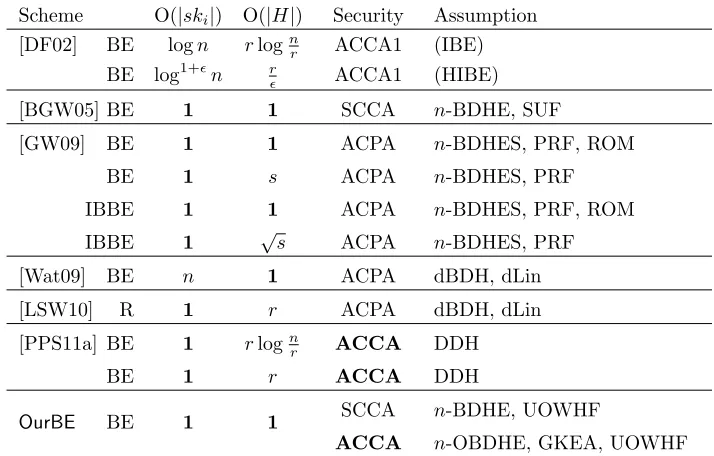
Table 2: Comparison of adaptive or CCA secure broadcast encryption schemes Scheme O(|ski|) O(|H|) Security Assumption
[DF02] BE logn rlognr ACCA1 (IBE) BE log1+n r
ACCA1 (HIBE)
[BGW05] BE 1 1 SCCA n-BDHE, SUF
[GW09] BE 1 1 ACPA n-BDHES, PRF, ROM BE 1 s ACPA n-BDHES, PRF IBBE 1 1 ACPA n-BDHES, PRF, ROM IBBE 1 √s ACPA n-BDHES, PRF [Wat09] BE n 1 ACPA dBDH, dLin [LSW10] R 1 r ACPA dBDH, dLin [PPS11a] BE 1 rlognr ACCA DDH
BE 1 r ACCA DDH
OurBE BE 1 1 SCCA
ACCA
n-BDHE, UOWHF
n-OBDHE, GKEA, UOWHF O(| · |): order of size, n, s, r: number of total, targeted, revoked users.
7
Concluding Remarks
We proposed a very efficient broadcast encryption scheme. The sizes of the secret keys and ciphertexts in the scheme are asymptotically optimal, i.e., constant. We showed that the scheme can be proved selective CCA secure assuming BDHE and a universal one-way hash function. Furthermore, we showed that proving adaptive CCA security is possible if we consider extended versions of the GBDHE and knowledge of exponent assumptions. Considering only the standard assumptions, our scheme provides shorter ciphertexts than the only other known CCA secure scheme. Considering the extended assumptions, our scheme is the first scheme to achieve constant size secret keys and ciphertexts and adaptive CCA security at the same time. The problem of designing schemes that achieve such properties under standard assumptions remains open.
Acknowledgments
This work was supported by the French ANR-09-VERS-016 BEST Project. The authors would like to thank the anonymous reviewers of the ACISP 2012 conference.
References
[ABR01] Michel Abdalla, Mihir Bellare, and Phillip Rogaway. The oracle Diffie-Hellman assumptions and an analysis of DHIES. In David Naccache, editor,Topics in Cryptology – CT-RSA 2001, volume 2020 ofLecture Notes in Computer Science, pages 143–158. Springer, April 2001.
[AF07] Masayuki Abe and Serge Fehr. Perfect NIZK with adaptive soundness. In Salil P. Vadhan, editor, TCC 2007: 4th Theory of Cryptography Conference, volume 4392 ofLecture Notes in Computer Science, pages 118–136. Springer, February 2007.
[Ber70] Elwyn R. Berlekamp. Factoring polynomials over large finite fields. Mathematics of Computa-tion, 24(111):pp. 713–735, 1970.
[BGW05] Dan Boneh, Craig Gentry, and Brent Waters. Collusion resistant broadcast encryption with short ciphertexts and private keys. In Victor Shoup, editor, Advances in Cryptology – CRYPTO 2005, volume 3621 ofLecture Notes in Computer Science, pages 258–275. Springer, August 2005.
[BK05] Dan Boneh and Jonathan Katz. Improved efficiency for CCA-secure cryptosystems built using identity-based encryption. In Alfred Menezes, editor, Topics in Cryptology – CT-RSA 2005, volume 3376 ofLecture Notes in Computer Science, pages 87–103. Springer, February 2005.
[BMW05] Xavier Boyen, Qixiang Mei, and Brent Waters. Direct chosen ciphertext security from identity-based techniques. In Vijayalakshmi Atluri, Catherine Meadows, and Ari Juels, editors,ACM CCS 05: 12th Conference on Computer and Communications Security, pages 320–329. ACM Press, November 2005.
[BP04] Mihir Bellare and Adriana Palacio. The knowledge-of-exponent assumptions and 3-round zero-knowledge protocols. In Matthew Franklin, editor, Advances in Cryptology – CRYPTO 2004, volume 3152 ofLecture Notes in Computer Science, pages 273–289. Springer, August 2004.
[BR93] Mihir Bellare and Phillip Rogaway. Random oracles are practical: A paradigm for designing efficient protocols. In V. Ashby, editor, ACM CCS 93: 1st Conference on Computer and Communications Security, pages 62–73. ACM Press, November 1993.
[CHK04] Ran Canetti, Shai Halevi, and Jonathan Katz. Chosen-ciphertext security from identity-based encryption. In Christian Cachin and Jan Camenisch, editors, Advances in Cryptology – EU-ROCRYPT 2004, volume 3027 ofLecture Notes in Computer Science, pages 207–222. Springer, May 2004.
[CS03] Ronald Cramer and Victor Shoup. Design and analysis of practical public-key encryption schemes secure against adaptive chosen ciphertext attack. SIAM Journal on Computing, 33(1):167–226, 2003.
[Dam88] Ivan Damg˚ard. Collision free hash functions and public key signature schemes. In David Chaum and Wyn L. Price, editors,Advances in Cryptology – EUROCRYPT’87, volume 304 ofLecture Notes in Computer Science, pages 203–216. Springer, April 1988.
[Dam92] Ivan Damg˚ard. Towards practical public key systems secure against chosen ciphertext attacks. In Joan Feigenbaum, editor, Advances in Cryptology – CRYPTO’91, volume 576 of Lecture Notes in Computer Science, pages 445–456. Springer, August 1992.
[DDN00] Danny Dolev, Cynthia Dwork, and Moni Naor. Nonmalleable cryptography. SIAM Journal on Computing, 30(2):391–437, 2000.
[Del07] C´ecile Delerabl´ee. Identity-based broadcast encryption with constant size ciphertexts and pri-vate keys. In Kaoru Kurosawa, editor, Advances in Cryptology – ASIACRYPT 2007, volume 4833 ofLecture Notes in Computer Science, pages 200–215. Springer, December 2007.
[Den06] Alexander W. Dent. The hardness of the dhk problem in the generic group model. Cryptology ePrint Archive, Report 2006/156, 2006. http://eprint.iacr.org/2006/156.
[DF02] Yevgeniy Dodis and Nelly Fazio. Public-key broadcast encryption for stateless receivers. In
ACM Digital Rights Management—DRM ’02, pages 61–80, Heidelberg, 2002. Springer. LNCS 2696.
[DP08] Yvo Desmedt and Duong Hieu Phan. A CCA secure hybrid Damg˚ard’s ElGamal encryption. In Joonsang Baek, Feng Bao, Kefei Chen, and Xuejia Lai, editors,ProvSec 2008: 2nd International Conference on Provable Security, volume 5324 ofLecture Notes in Computer Science, pages 68– 82. Springer, October / November 2008.
[DPP07] C´ecile Delerabl´ee, Pascal Paillier, and David Pointcheval. Fully collusion secure dynamic broad-cast encryption with constant-size ciphertexts or decryption keys. In Tsuyoshi Takagi, Tatsuaki Okamoto, Eiji Okamoto, and Takeshi Okamoto, editors,PAIRING 2007: 1st International Con-ference on Pairing-based Cryptography, volume 4575 of Lecture Notes in Computer Science, pages 39–59. Springer, July 2007.
[FN94] Amos Fiat and Moni Naor. Broadcast encryption. In Douglas R. Stinson, editor,Advances in Cryptology – CRYPTO’93, volume 773 ofLecture Notes in Computer Science, pages 480–491. Springer, August 1994.
[GGH96] Oded Goldreich, Shafi Goldwasser, and Shai Halevi. Collision-free hashing from lattice problems. Cryptology ePrint Archive, Report 1996/009, 1996.
http://eprint.iacr.org/1996/009.
[GS08] Jens Groth and Amit Sahai. Efficient non-interactive proof systems for bilinear groups. In Nigel P. Smart, editor,Advances in Cryptology – EUROCRYPT 2008, volume 4965 ofLecture Notes in Computer Science, pages 415–432. Springer, April 2008.
[GW09] Craig Gentry and Brent Waters. Adaptive security in broadcast encryption systems (with short ciphertexts). In Antoine Joux, editor,Advances in Cryptology – EUROCRYPT 2009, volume 5479 ofLecture Notes in Computer Science, pages 171–188. Springer, April 2009.
[HT98] Satoshi Hada and Toshiaki Tanaka. On the existence of 3-round zero-knowledge protocols. In Hugo Krawczyk, editor,Advances in Cryptology – CRYPTO’98, volume 1462 ofLecture Notes in Computer Science, pages 408–423. Springer, August 1998.
[Kil06] Eike Kiltz. Chosen-ciphertext security from tag-based encryption. In Shai Halevi and Tal Rabin, editors, TCC 2006: 3rd Theory of Cryptography Conference, volume 3876 of Lecture Notes in Computer Science, pages 581–600. Springer, March 2006.
[Lin03] Yehuda Lindell. A simpler construction of cca2-secure public-key encryption under general assumptions. In Eli Biham, editor, Advances in Cryptology – EUROCRYPT 2003, volume 2656 ofLecture Notes in Computer Science, pages 241–254. Springer, May 2003.
[LSW10] Allison B. Lewko, Amit Sahai, and Brent Waters. Revocation systems with very small private keys. In 2010 IEEE Symposium on Security and Privacy, pages 273–285. IEEE Computer Society Press, May 2010.
[Nie02] Jesper Buus Nielsen. Separating random oracle proofs from complexity theoretic proofs: The non-committing encryption case. In Moti Yung, editor, Advances in Cryptology – CRYPTO 2002, volume 2442 ofLecture Notes in Computer Science, pages 111–126. Springer, August 2002.
[NNL01] Dalit Naor, Moni Naor, and Jeffery Lotspiech. Revocation and tracing schemes for stateless receivers. In Joe Kilian, editor, Advances in Cryptology – CRYPTO 2001, volume 2139 of
Lecture Notes in Computer Science, pages 41–62. Springer, August 2001.
[NY89] Moni Naor and Moti Yung. Universal one-way hash functions and their cryptographic appli-cations. In21st Annual ACM Symposium on Theory of Computing, pages 33–43. ACM Press, May 1989.
[PPS11a] Duong Hieu Phan, David Pointcheval, and Mario Strefler. Adaptively secure broad-cast encryption with forward secrecy. Cryptology ePrint Archive, Report 2011/463, 2011.
http://eprint.iacr.org/2011/463.
[PPS11b] Duong Hieu Phan, David Pointcheval, and Mario Strefler. Security notions for broadcast encryption. In Javier Lopez and Gene Tsudik, editors, ACNS 011, volume 6715 of Lecture
Notes in Computer Science, pages 377–394, 2011.
[PPSS12] Duong Hieu Phan, David Pointcheval, Siamak F. Shahandashti, and Mario Strefler. Adaptive cca broadcast encryption with constant-size secret keys and ciphertexts. In Willy Susilo, Yi Mu, and Jennifer Seberry, editors,ACISP, volume 7372 ofLecture Notes in Computer Science, pages 308–321. Springer, 2012.
[Rom90] John Rompel. One-way functions are necessary and sufficient for secure signatures. In 22nd Annual ACM Symposium on Theory of Computing, pages 387–394. ACM Press, May 1990.
[RS04] Phillip Rogaway and Thomas Shrimpton. Cryptographic hash-function basics: Definitions, implications, and separations for preimage resistance, second-preimage resistance, and collision resistance. In Bimal K. Roy and Willi Meier, editors, Fast Software Encryption – FSE 2004, volume 3017 ofLecture Notes in Computer Science, pages 371–388. Springer, February 2004.
[Sah99] Amit Sahai. Non-malleable non-interactive zero knowledge and adaptive chosen-ciphertext security. In 40th Annual Symposium on Foundations of Computer Science, pages 543–553. IEEE Computer Society Press, October 1999.
[Sho90] Victor Shoup. On the deterministic complexity of factoring polynomials over finite fields.
Information Processing Letters, 33(5):261 – 267, 1990.
[Sho97] Victor Shoup. Lower bounds for discrete logarithms and related problems. In Walter Fumy, editor,Advances in Cryptology – EUROCRYPT’97, volume 1233 ofLecture Notes in Computer Science, pages 256–266. Springer, May 1997.
[Sim98] Daniel R. Simon. Finding collisions on a one-way street: Can secure hash functions be based on general assumptions? In Kaisa Nyberg, editor,Advances in Cryptology – EUROCRYPT’98, volume 1403 ofLecture Notes in Computer Science, pages 334–345. Springer, May / June 1998.
[Wat09] Brent Waters. Dual system encryption: Realizing fully secure IBE and HIBE under simple assumptions. In Shai Halevi, editor,Advances in Cryptology – CRYPTO 2009, volume 5677 of
Lecture Notes in Computer Science, pages 619–636. Springer, August 2009.
A
Proof of Theorem 1
Proof. Suppose there exist a selective CCA adversary Athat is able to distinguish the above scheme’s keys from random elements. We construct an algorithmB that either outputs a collision for a given key
κor solves then-BDHE decision problem.
Let B be given an n-BDHE challenge (g, h,{gi}i∈{1,...,2n}\{n+1}, T) and has to decide whether T =
e(gn+1, h) or it is random. B runs A and receives a set S∗ of honest users on which it wishes to be
challenged. As a UOWHF adversary, B also gives out has the first message on which it wishes to be challenged and receives a keyκfor the hash function. Bchooses a randomβ ∈Zp, calculatesvas follows,
and givesEK= (g, v, κ) toA.
v=gβ·g−Hκ(h)
1 ·
Y
j∈S∗
g−1n+1−j. (2)
On any join query for userimade byA, Bgivespki = (gi, gn+1−i, gn+1+i) toA.
On any private key query for user i made by A (note that i /∈ S∗), B calculates the private key as follows and gives it toA.
di=giβ·g −Hκ(h)
1+i ·
Y
j∈S∗
Note thatdi is properly simulated since we havedi=vα
i
.
On a decryption query (i, S,(C0, C1)) byA(note thatS⊂S∗andi∈S),Bfirst checks the validity of
the ciphertext using Equation 1. If the ciphertext is valid then it checks whetherHκ(h) =Hκ(C0) which
in case of validity provides a collision for the hash functionHκ and henceBcan output C0 as the second
message and break the UOWHF property.
If Equation 1 holds andHκ(h)6=Hκ(C0), then letδ=Hκ(C0)−Hκ(h). Bcalculates the key as follows:
K= e(C1, g·g
1/δ
n )
e(gβ·gβ/δ n ·g1δ·
Y
j∈S∗\S
(gn+1−j·g2n+1−j1/δ )−1, C0)
.
Now since Equation 1 holds, the ciphertext is in the form
(gt,(v·gHκ(gt)
1 ·
Y
j∈S
gn+1−j)t)
for some (unknown)t. Hence, the above calculatedK will be as follows:
K=
e((v·gHκ(gt)
1 ·
Y
j∈S
gn+1−j)t, g·g1/δn )
e(gβ·gβ/δ n ·g1δ·
Y
j∈S∗\S
(gn+1−j·g2n+1−j1/δ )−1, g t)
=
e(gβ·g1δ· Y
j∈S∗\S
gn+1−j−1 , g·g1/δn )
e(gβ·gβ/δ n ·gδ1·
Y
j∈S∗\S
(gn+1−j·g2n+1−j1/δ )−1, g)
!t
(substitutingv from Equation 2)
=
e(gβ·gδ1·
Y
j∈S∗\S
gn+1−j−1 , g1+αn/δ)
e(gβ(1+αn/δ)
·gδ 1·
Y
j∈S∗\S
gn+1−j−(1+αn/δ), g)
!t
(using∀k:gn+k=gα
n
k )
=
e(gδ 1, g
1+αn/δ
)
e(gδ 1, g)
t
=e(g1, g)α
nt
=e(gn+1, g)t
and hence it is properly simulated.
At some point,Adeclares that it is ready to receive the challenge. Bcalculates the challenge ciphertext asC= (h, hβ) and gives C along withK=T toA. First, note that from Equation 2 we have
v·gHκ(h)
1 ·
Y
j∈S∗
gn+1−j =gβ,
and henceC is a valid ciphertext satisfying Equation 1. Furthermore, assuming that h=gtfor some t,
we have
hβ= (gβ)t= (v·gHκ(h)
1 ·
Y
j∈S∗
gn+1−j)t,
which means that ifT =e(gn+1, h) = e(gn+1, g)t, then K is the key corresponding to the ciphertextC,
and ifT is random, thenK is a random key.
In the second phase of the attack,BanswersA’s queries as in the first phase.
At the end,Aoutputs its guessb. Boutputsbas its decision for then-BDHE challenge. Based on the above discussion, ifA is successful in its CCA attack, then eitherBis able to compute a collision for Hκ
B
Proof of the OBDHE Assumption
LetdP,dP0,dQ, anddf be respectively the maximum degrees of the polynomials inP,P0,Q, andf. We
prove the following upper bound in the generic bilinear group model. We consider two random encodings
ξ, ζ:Z+
p 7→ {0,1}m and writeG={ξ(x)|x∈Z+p} andGT={ζ(x)|x∈Z+p}.
Theorem 4 For P, Q, P0 f, ξ, ζ, G, GT defined above, let |P| = s, |Q| = t, and ` = s+t. Let
d= max(2dP, dQ, df). If f is independent of (P k P0, Q), then for any A making a total of at most q
queries to the oracles computing the group operations and the bilinear pairing, and at mostq0 queries to theODH
g,e oracle, we have:
Pr A
p, ξ(P(x1, . . . , xn)),
ζ(Q(x1, . . . , xn)),
ζ(t0), ζ(t1);ODHg,e(·,·)
=b:
x1, . . . , xn, y R
←Fp,
b← {R 0,1}, tb←f(x1, . . . , xn),
t1−b←y
−1 2
≤(q+q
0+`+ 2)2·max(2d P0, d)
2p
Proof. Assume that we are given the algorithmA. Consider an algorithm B that interacts with A as follows. Bmaintains two lists of pairs:
L={(pi, ξi) :i= 1, . . . , τ0} and LT={(qi, ζi) :i= 1, . . . , τ1},
such that at step τ of its interaction with A: τ0+τ1 = τ +`+ 2. Here, pi ∈ Fp[X1, . . . , Xn], qi ∈
Fp[X1, . . . , Xn, Y0, Y1], andξi, ζi∈ {0,1}m.
B also maintains a counterτ0, initialized at zero, to count the number of ODH
g,e oracle queries, and a
list of polynomials:
P0 ={p0i:i= 1, . . . , τ0}
to store the polynomial output of theODH
g,e oracle queries.
At stepτ= 0,Binitializes the lists by settingp1, . . . , ps inLequal to the polynomials inP,q1, . . . , qt
in LTequal to the polynomials in Q,qt+1=Y0, and qt+2 =Y1. It also chooses `+ 2 random strings in
{0,1}mand initializes{ξ
i}si=1 and{ζi}t+2i=1.
B then runs A under the input p, {ξi}si=1, {ζi}ti=1, ζt+1, and ζt+2. B answers A’s oracle queries as
follows. We are assuming thatA’s queries can only be strings obtained fromBsinceBcan, by increasing
m, make the strings inGandGTarbitrarily hard to guess.
Group operations: For aGoperation query (ξi, ξj),Bcalculatespτ0+1←pi±pj depending on whether
multiplication or division is requested. Ifpτ0+1 =pl for somel≤τ0, then Bsetsξτ0+1←ξl; otherwise it
setsξτ0+1 equal to a new random string different from all the previousξi. Then it appends the new pair
(pτ0+1, ξτ0+1) toL, replies toA’s query with ξτ0+1, and finally increments the counter τ0. GToperation
queries are dealt with analogously by updating the listLTand counterτ1.
Bilinear pairings: For a pairing query (ξi, ξj), B calculates qτ1+1 ← pi ·pj. If qτ1+1 = ql for some l≤τ1, thenBsetsζτ1+1←ζl; otherwise it setsζτ1+1equal to a new random string different from all the
previousζi. Then it appends the new pair (qτ1+1, ζτ1+1) toLT, replies toA’s query withζτ1+1, and finally
increments the counterτ1.
ODH
g,e queries: For aOg,eDHquery (ξi, ξj),Bcalculatespτ0+1←pi·pj. Ifpτ0+1=pl for somel≤τ0, then
Bsetsξτ0+1←ξl; otherwise it setsξτ0+1 equal to a new random string different from all the previousξi.
Balso setsp0τ0+1←pτ0+1, appendsp
0
τ0+1 toP0, and increments the counterτ0. Then it appends the new
pair (pτ0+1, ξτ0+1) toL, replies toA’s query withξτ0+1, and finally increments the counterτ0.
Aterminates after at mostq+q0 queries and returns a guessb0. NowBchoosesx1, . . . , xn, y
R
←Fp andb R
← {0,1}, and setsyb←f(x1, . . . , xn) andy1−b←y. Setting
Xi=xi for alli= 1, . . . , n,Y0=y0, andY1=y1, we see thatB’s interaction provides a perfect simulation
forA as long as the chosen random values for the random variables do not result in any equality of the values of the intermediate different polynomials. In other words, the simulation is perfect unless for some
1. pi(x1, . . . , xn) =pj(x1, . . . , xn), yet the polynomialspi andpj are not equal, or
2. qi(x1, . . . , xn, y0, y1) =qj(x1, . . . , xn, y0, y1), yet the polynomialsqi andqj are not equal.
LetFailbe the event that one of the above conditions holds. We bound the probability of this event. First, if we set Yb = f(X1, . . . , Xn), this does not raise the probability that Fail happens. This is
because the above substitution does not create any new equalities between polynomials qi and qj. In
general,qi−qj is in the form
s X k=1 s X l=1
ak,lpkpl+ s X k=1 q0 X l=1
a0k,lpkp0l+ q0 X k=1 q0 X l=1
a00k,lp0kp0l+
t
X
u=1
buqu+cY0+dY1.
Let us define
P∗=P kP0 = (p∗1, . . . , p∗s+q0) = (p1, . . . , ps, p01, . . . , p0q0).
Now we can writeqi−qj in the form
s+q0 X k=1 s+q0 X l=1
ak,lp∗kp∗l + t
X
u=1
buqu+cY0+dY1.
Hence assuming that the substitutionYb=f(X1, . . . , Xn), does create a new equality, thenqi−qj, which
is in the above form, is a non-zero polynomial, yet settingYb = f(X1, . . . , Xn) makes it zero. Thus, f
must be dependent on (P kP0, Q), which is a contradiction.
Now that we made the substitutionYb=f(X1, . . . , Xn), our polynomials are only inX1, . . . , Xn, Y1−b.
The maximum degree of any polynomial in the form pi −pj or qi −qj is max(2dP,2dP0, dQ, df) =
max(2dP0, d). Hence, for each pair (i, j), the probability that a random assignment of the random variables
is a root of one of the above polynomials is at most max(2dP0, d)/p. Since there are at most 2 q+q 0+`+2
2
pairs of (pi, pj) and (qi, qj) in total, we have
Pr[Fail]≤
q+q0+`+ 2
2
2 max(2d
P0, d)
p ≤
(q+q0+`+ 2)2max(2d P0, d)
p .
Now we would like to boundA’s success probability, i.e., |Pr[b=b0]−1
2|. We know that
Pr[b=b0] = Pr[b=b0|Fail]·Pr[Fail] + Pr[b=b0|¬Fail]·Pr[¬Fail].
IfFaildoes not happen, thenB’s simulation is perfect. In this case, sincebis chosen after the simulation ends, Pr[b=b0|¬Fail] = 21. Substituting this and Pr[¬Fail] = 1−Pr[Fail] in the above equation, we get the following after rearrangement:
Pr[b=b0]−1
2 = (Pr[b=b
0|
Fail]−12)·Pr[Fail].
Hence we have
|Pr[b=b0]−1
2|=|Pr[b=b
0|
Fail]−1
2| ·Pr[Fail]≤ 1
2Pr[Fail], which gives us the claimed bound and finishes the proof.
C
Proof of Theorem 2
Proof. Let dP be the maximum degree of the polynomials in P. We consider a random encoding ξ :
Z+p 7→ {0,1}m and writeG={ξ(x)|x∈Z+p}.
Given an algorithm Awe construct the extractor E as follows. Emaintains a list L of pairs (pi, ξi),
initialized with pairs containing the elements ofP and random strings, respectively as the first and second elements.
ErunsAon input (ξi)si=1. Any group operation query (ξi, ξj) is responded by computingpi+pj and
encoding, and if not, it chooses a new random string as the encoding to be returned, and addspi+pj and
the encoding to the listL.
WhenAterminates and returns (ξi, ξj) as its output,Efinds the corresponding polynomial pair (pi, pj).
If pj 6= piq, E outputs ⊥. Otherwise, let {ri}ti=1 be defined as above. E decomposes pi as a linear
combination of{ri}ti=1, that is, it finds coefficients (bi)ti=1 such thatpi=P t
i=1biri, and outputs (bi)ti=1.
Assume that Aasksσ queries. E’s list contains s+σpairs at the end of the execution of A. All the polynomials in this list are in Span(P). Since bothpi and pj are in Span(P), if pj =piq, thenpi ∈Vq,
and hencepi can be written as a linear combination of{ri}ti=1. Furthermore, the discrete logarithm ofA’s
first inputξi is equal topi(x1, . . . , xn), which in turn equals Pti=1biri(x1, . . . , xn). Therefore,Esucceeds
if its simulation ofA’s environment is perfect andpj =piq.
Note that ifA’s environment is simulated perfectly, then it outputs a pair for which we havepj(x1, . . . , xn) =
pi(x1, . . . , xn)q(x1, . . . , xn), but not necessarilypj=piq.
LetFail be the event thatE fails. Based on the above discussion,E fails if either it fails to simulate
A’s environment perfectly or ifpj 6=piq butpj(x1, . . . , xn) = pi(x1, . . . , xn)q(x1, . . . , xn). E’s simulation
of the environment for Ais perfect unless a set of random values (x1, . . . , xn) result in some equality of
the values of the different polynomials inL. Hence, if we add piq as the polynomial number s+σ+ 1
to the listL, E’s overall probability of failure is bounded by the probability that a set of random values (x1, . . . , xn) result in some equality of the values of the different polynomials in the augmented list of
s+σ+ 1 polynomials. Hence we have:
Pr[Fail]≤
s+σ+ 1
2
d
P
p ≤
(s+σ+ 1)2d P
p ,
and the proof is complete.
The above proof is in the plain generic group model. It is easy to extend the proof to the bilinear generic group model. Furhtermore, one can see that the proof still works (with some natural modifications) in the model where the adversary is allowed to query the oracles on any encoding, rather than only those it has received before (either as input or as responses to previous oracle queries).
Another point to note is that, in the bilinear group model, any input to the adversary in the target group can be disregarded and hence does not change the assumption.
D
Proof of Theorem 3
Proof. We make our proof in two stages.
Stage 1: First, we prove that if His a UOWHF, then the following specific assumption is an instance of the OBDHE assumption as per our definition in Section 6.1: letODH
g,e be an oracle that given (x1, x2)
outputsy s.t.e(x1, x2) =e(g, y). Given the following quantities:
g, h, {gk =gα
k
}k∈{1,...,2n}\{n+1}, v,
and oracle access toODH
g,e, it is hard to distinguishe(gα
n+1
, h) from a random value if the queries toODH g,e
are restricted to the following, whereC∩S=∅:
(1)|C|queries {ODH
g,e(gk, v)}k∈C, and (2) one query Og,eDH(w, h), wherew=vg
Hκ(h)
1
Y
j∈S
gn+1−j.
Consider the hash functionHκ:G7→Zp and define the function µ(h) =hHκ(h). In the generic group
model, the input toHκis an encoding representingh, which is considered to be an encoding that may be
chosenindependentlyofh. Therefore, we may assumeHκ(h) independent ofh. Of course this is true only
if the sole way to calculateµ(h) is through computing Hκ(h) first and then raising hto the power of the
hash output. Otherwise, ifµ(h) cannot be computed through group operations, without computingHκ(h)
To be more precise, consider Theorem 4 and its proof in Appendix B. Assume that P also includes an extra element which is a multiplication of a polynomial and the functionη(y) =Hκ(gy). Now, if the
encoding of h= gy is chosen independently of h, the proof will still work, i.e., Pr[Fail] can be shown to be upper-bounded by a negligible bound, unless for some considerable portion of possibley’s we have
ρ1(y)η2(y) +ρ2(y)η(y) +ρ3(y) = 0, where ρ1,ρ2, andρ3 are polynomials of degree at most max(2dP0, d).
This condition implies thatη(y) can be calculated for some considerable portion of possibley’s by solving the above equation.
Formally, let us define a δ-good hash family as follows: We say a hash family Hκ :G7→Zp indexed
byκisδ-good if for a randomκthere does not exist polynomialsρ1,ρ2, and ρ3 of degree at mostδ such
that for a non-negligible portion of possibley’s we have: ρ1(y)H2κ(gy) +ρ2(y)Hκ(gy) +ρ3(y) = 0. Now
since max(2dP0, d) = 4n, we conclude that if His at least 4n-good, then its output can be considered
independent of the encoding of its input, and hence we may treat it as a constant.
Now assume that for a given randomκandY, we wish to find a pre-imageX, such thatHκ(X) =Y.
AssumeX =gx. IfHis not aδ-good hash family, for a randomκthere exist polynomialsρ
1,ρ2, and ρ3
of degree at mostδ such that with a non-negligible probability: ρ1(x)Y2+ρ2(x) Y +ρ3(x) = 0. This
is a polynomial of order at mostδ, and its roots can be found in time which is polynomial in δand logp
[Ber70, Sho90]. For each rootx, one can check whetherHκ(gx) =Y and find the pre-image X with at
mostδchecks. Hence, ifHis not aδ-good hash family, then it is not a pre-image resistant (a.k.a. one-way) hash function. Since UOWHF implies pre-image resistance, we have the following lemma:
Lemma 5 Let Hκ :G7→Zp be hash function for which p is super-polynomial in k. If His a universal
one-way hash function, then it isδ-good (as per our definition above) for all δpolynomial in k.
Hence, if His a UOWHF, then the following claim proves that the specific assumption above is an OBDHE assumption as per our definition in Section 6.1, in which the output ofHis treated as a constant. Note that alternatively one may make the stronger assumption thatHis modeled as a non-programmable random oracle [BR93, Nie02]. Also note that since the system is defined for n−1 users, S and C are subsets of{1, . . . , n−1}.
Claim 6 For the following polynomials andS, C⊆ {1, . . . , n−1}, and for any constantc,f is independent of(P kP0, Q)ifC∩S=
∅.
P = ( 1, y, {xk}
k∈{1,...,2n}\{n+1}, z, η, zy+ cxy+y
X
j∈S
xn+1−j ),
P0 ={zxi}
i∈C, Q= (1), and f =yxn+1.
Proof. We have at most one multiplication of polynomials at our disposal. Let us define
Px={xk}k∈{1,...,2n}\{n+1}, Pzx={zxi}i∈C, Pyx=Pyz =zy+ cxy+y
X
j∈S
xn+1−j.
To make f =yxn+1, since there is ay factor, one of our multiplicands needs to be either y or P yx.
Choosing y will not help because we do not have an xn+1 to make f, so one of our multiplicands is
definitelyPyx. The only choice for a second multiplicand that can give us f is one fromPx. Multiplying
these terms gives us terms of the formzyxi+ cyxi+1+yP
j∈Sxn+1−j+i, which includesyxn+1 ifi∈S,
but then we have to be able to produce the termzyxi for some i∈S to be able to cancel it out.
To getzyxi, using only two multiplicands, we have the following four possibilities:
• usey andzxi to getyzxi for somei∈C, but since C∩S=∅we can not getyzxi for anyi∈S.
• usexi andPyz again, but this cancels out our desired termyxn+1 as well since we have to use the
samei.
• usezandPyx to getz2y+ cxyz+zyPj∈Sxn+1−j, which includeszyxiifn+ 1−i∈S or ifi= 1,
but then, in either case, we have to cancelz2y and the only way to getz2y is to use the same terms
again which cancels our desired termzyxi as well.
• usePzxandPyxto getz2xky+ cxk+1yz+zyPj∈Sxn+1−j+k, which includeszyxiifn+ 1−i+k∈S
or if k+ 1 =i, but then, in either case, we have to cancelz2xky and the only way to get z2xky is
Hencef is independent of (P kP0, Q) and the proof of Claim 6 is complete.
Stage 2: Now that we have proved our specific assumption is an OBDHE assumption, we prove that under this assumption, the GKEA assumption, and the UOWHF assumption OurBE is adaptive CCA secure.
LetAbe an adaptive CCA adversary forOurBE. We construct an adversaryBthat successfully breaks our specific assumption, ifAis successful in its attack against OurBE, the GKEA assumption holds, and
His a UOWHF.
First of all, note that, based on Lemma 5 and a discussion similar to that of Stage 1, as long asHκis
a UOWHF, it can be indistinguishably simulatedindependently of its input in the generic group model, and hence hashed values can be consideredconstant for this proof. Jumping ahead, we treat c =Hκ(C0)
and c∗=Hκ(C0∗) as constant coefficients for polynomials.
LetBbe given the following quantities:
g, h, {gk =gα
k
}k∈{1,...,2n}\{n+1}, v, T,
and (restricted) oracle access toODH
g,e as specified by the assumption. It is supposed to distinguish whether
T =e(gαn+1, h) orT is random. As a UOWHF adversary,Bgives out has the first message on which it
wishes to be challenged and receives a keyκfor the hash function. Bruns Aon inputEK= (g, v, κ). On a join query for userimade byA,Bgivespki= (gi, gn+1−i, gn+1+i) toA.
On any private key query for user i made by A, B queries the oracle ODH
g,e(gi, v) and and gives the
oracle output toA. Note that if we assumev=gγ, then the oracle output is equal togγi.
On a decryption oracle query (i, S, H), whereH = (C0, C1), Bfirst checks the ciphertext validity. If
the ciphertext is invalid it replies with⊥. Let c =Hκ(C0). If the ciphertext is valid, then it is in the
following form:
H= (C0, C0q), where q=γ+ cα+
X
j∈S
αn+1−j. (3)
Let us assume, without loss of generality, that all the potentialn−1 users are initiated. Let C denote the set of corrupted users byAand N∗ ={1, . . . ,2n} \ {n+ 1}. NowAcan be viewed as an algorithm that on inputg, v, κ, {gi}i∈N∗, and {di}i∈C outputs H = (C0, C0q) as above. Note that the input toA
(excludingκ /∈G) can be written as follows:
gP, where P = ( 1, γ, {αi}i∈N∗, {γαi}i∈C ).
To apply the GKEA assumption, note that here Span(P) includes all the elements of the following form:
ρ=u+xγ+ X
i∈N∗
yiαi+γ
X
i∈C
ziαi, for randomu, x, yi, zi. (4)
Consider ρq for some ρand theq defined above, respectively in Equations 3 and 4. For ρq to be in Span(P), we should havex= 0 and∀i∈C :zi = 0 because otherwiseρq will have either the factorxγ2
or ziγ2αi for some iand would not fall in Span(P). Hence anyρ satisfyingρq ∈Span(P) should be in
the form
ρ=u+ X
i∈N∗
yiαi, for randomu, yi. (5)
A basis for such a subspace is the set{1,{αi}
i∈N∗}. Therefore the GKEA assumption guarantees that
there exists an extractor that outputs the values{β,{bi}i∈N∗} such that
C0=g β+
X
i∈N∗
biαi
=gβ Y
i∈N∗
gbi
i .
Now note thatK=e(gn+1, C0). Hence the session key can be calculated based on the known
representa-tion ofC0 in terms ofgand gi, e.g., as follows:
K=e(gn+1, gβ
Y
i∈N∗
gbi
i ) =e(gn+1, g)β
Y
i∈N∗
e(gn+1, gi)bi
=e(gn, g1)βe(g2n, g1)bne(gn+2, g2n−1)b2n
Y
i∈N∗\{n,2n}
At some point, A terminates the first query phase and outputs a set S∗ on which it wants to be challenged. B calculates w = vgHκ(h)
1
Q
j∈S∗gn+1−j, makes the oracle query ODHg,e(w, h), receives the
oracle output h0, sets the challenge ciphertext as H∗ = (C0∗, C1∗) = (h, h0), and gives H∗ along with
K=T toA. Let c∗=Hκ(C0∗). Note that, Equation 1 (see page 5) holds, henceC is a valid ciphertext,
andC1∗ should be equal to C0∗ raised to a power of the following form:
γ+ c∗α+ X
j∈S∗
αn+1−j.
Furthermore, ifT =e(gn+1, h), thenKis the correct key corresponding to the ciphertextH∗, and ifT is
random, thenKis a random key.
In the second phase of the attack,BanswersA’s join and corruption oracle queries as in the first phase, andA’s decryption oracle queries, in a fashion similar to that of prior to the challenge, as follows.
On a decryption oracle query (i, S, H), where H = (C0, C1), Bfirst checks its validity, and if valid, it
is in the form of Equation 3.
Now the input toAcan be listed asg,v,κ,{gi}i∈N∗, and{di}i∈C, plusH∗= (C0∗, C1∗). LetC0∗=gt ∗
. The input toAcan be written as follow (κ, K0, andK1 can be disregarded as they are not inG):
gP, where P = ( 1, γ, {αi}i∈N∗, {γαi}i∈C, t∗, t∗(γ+ c∗α+
X
j∈S∗
αn+1−j) ).
Span(P) includes all the linear combinations ρ of the above terms. Similarly, we argue that ρ cannot include anyγ or γαi terms because they would induceγ2 or γ2αi terms respectively in the productρq. Furthermore,ρ cannot include the last term because it would induce a non-cancelable t∗γ2 term in the productρq. In addition, note that ifρincludes the termt∗, thenρq would include the term
t∗(γ+ cα+X
j∈S
αn+1−j).
The only way aρ including this term can be contained in Span(P) is if c∗ = c (i.e., Hκ(C0∗) =Hκ(C0))
andS=S∗ (note thatj≤n−1, son+ 1−j≥2), which contradictsHbeing a UOWHF. Therefore, ρ
cannot include the termt∗, and againρshould be in the form of Equation 5, and hence the session key can be calculated similarly as before.
At the end, A outputs its guess b. B outputs b as its decision for its received challenge. Based on the above discussion, ifA is successful in its adaptive CCA attack, thenBis able to either contradict H
being a UOWHF or distinguishT =e(gn+1, h) from a random element successfully. Hence the proof of