Kernel-based Reranking for Named-Entity Extraction
Truc-Vien T. Nguyen and Alessandro Moschitti and Giuseppe Riccardi Department of Information Engineering and Computer Science
University of Trento
nguyenthi,moschitti,[email protected]
Abstract
We present novel kernels based on struc-tured and unstrucstruc-tured features for rerank-ing theN-best hypotheses of conditional random fields (CRFs) applied to entity ex-traction. The former features are gener-ated by a polynomial kernel encoding en-tity features whereas tree kernels are used to model dependencies amongst tagged candidate examples. The experiments on two standard corpora in two languages, i.e. the Italian EVALITA 2009 and the En-glish CoNLL 2003 datasets, show a large improvement on CRFs in F-measure, i.e. from 80.34% to 84.33% and from 84.86% to 88.16%, respectively. Our analysis re-veals that both kernels provide a compara-ble improvement over the CRFs baseline. Additionally, their combination improves CRFs much more than the sum of the indi-vidual contributions, suggesting an inter-esting kernel synergy.
1 Introduction
Reranking is a promising computational frame-work, which has drawn special attention in the Natural Language Processing (NLP) community. Basically, this method first employs a probabilis-tic model to generate a list of top-ncandidates and then reranks this n-best list with additional fea-tures. One appeal of this approach is its flexibility of incorporating arbitrary features into a model. These features help in discriminating good from bad hypotheses and consequently their automatic learning. Various algorithms have been applied for reranking in NLP applications (Huang, 2008;
Shen et al., 2004; Collins, 2002b; Collins and Koo, 2000), including parsing, name tagging and machine translation. This work has exploited the disciminative property as one of the key criterion of the reranking algorithm.
Reranking appears extremely interesting if cou-pled with kernel methods (Dinarelli et al., 2009; Moschitti, 2004; Collins and Duffy, 2001), as the latter allow for extracting from the ranking hy-potheses a huge amount of features along with their dependencies. Indeed, while feature-based learning algorithms involve only the dot-product between feature vectors, kernel methods allow for a higher generalization by replacing the dot-product with a function between pairs of linguis-tic objects. Such functions are a kind of similarity measure satisfying certain properties. An exam-ple is the tree kernel (Collins and Duffy, 2001), where the objects are syntactic trees that encode grammatical derivations and the kernel function computes the number of commonsubtrees. Simi-larly, sequence kernels (Lodhi et al., 2002) count the number of common subsequences shared by two input strings.
sys-tem often builds some generative/discriminative model, then, either uses only one classifier (Car-reras et al., 2002) or combines many classifiers us-ing some heuristics (Florian et al., 2003).
To the best of our knowledge, reranking has not been applied to NER except for the rerank-ing algorithms defined in (Collins, 2002b; Collins, 2002a), which only targeted the entity detection (and not entity classification) task. Besides, since kernel methods offer a natural way to exploit lin-guistic properties, applying kernels for NE rerank-ing is worthwhile.
In this paper, we describe how kernel methods can be applied for reranking, i.e. detection and classification of named-entities, in standard cor-pora for Italian and English. The key aspect of our reranking approach is how structured and flat features can be employed in discriminating candi-date tagged sequences. For this purpose, we apply tree kernels to a tree structure encoding NE tags of a sentence and combined them with a polynomial kernel, which efficiently exploits global features.
Our main contribution is to show that (a) tree kernels can be used to define general features (not merely syntactic) and (b) using appropriate al-gorithms and features, reranking can be very ef-fective for named-entity recognition. Our study demonstrates that the composite kernel is very effective for reranking named-entity sequences. Without the need of producing and heuristically combining learning models like previous work on NER, the composite kernel not only captures most of the flat features but also efficiently exploits structured features. More interestingly, this kernel yields significant improvement when applied to two corpora of two different languages. The eval-uation in the Italian corpus shows that our method outperforms the best reported methods whereas on the English data it reaches the state-of-the-art.
2 Background
2.1 The data
Different languages exhibit different linguistic phenomena and challenges. A robust NER sys-tem is expected to be well-adapted to multiple domains and languages. Therefore, we experi-mented with two datasets: the EVALITA 2009
Italian corpus and the well-known CoNLL 2003 English shared task corpus.
The EVALITA 2009 Italian dataset is based on I-CAB, the Italian Content Annotation Bank (Magnini et al., 2006), annotated with four entity types: Person (PER), Organization (ORG), Geo-Political Entity (GPE) and Location (LOC). The training data, taken from the local newspa-per “L’Adige”, consists of 525 news stories which belong to five categories: News Stories, Cultural News, Economic News, Sports News and Local News. Test data, on the other hand, consist of completely new data, taken from the same news-paper and consists of 180 news stories.
The CoNLL 2003 English dataset is created within the shared task of CoNLL-2003 (Sang and Meulder, 2003). It is a collection of news wire articles from the Reuters Corpus, annotated with four entity types: Person (PER), Location (LOC), Organization (ORG) and Miscellaneous name (MISC). The training and the development datasets are news feeds from August 1996, while the test set contains news feeds from December 1996. Accordingly, the named entities in the test dataset are considerably different from those that appear in the training or the development set.
Italian GPE LOC ORG PER Train 2813 362 3658 4577 24.65% 3.17% 32.06% 40.11% Test 1143 156 1289 2378
23.02% 3.14% 25.96% 47.89%
English LOC MISC ORG PER Train 7140 3438 6321 6600 30.38% 14.63% 26.90% 28.09%
Dev 1837 922 1341 1842
30.92% 15.52% 22.57% 31.00% Test 29.53%1668 12.43%702 29.41%1661 28.63%1617
Table 1: Statistics on the Italian EVALITA 2009 and English CoNLL 2003 corpora.
2.2 The baseline algorithm
random fields (CRFs) are a probabilistic frame-work for labeling and segmenting sequence data. They present several advantages over other purely generative models such as Hidden Markov models (HMMs) by relaxing the independence assump-tions required by HMMs. Besides, HMMs and other discriminative Markov models are prone to the label bias problem, which is effectively solved by CRFs.
The named-entity recognition (NER) task is framed as assigning label sequences to a set of observation sequences. We follow the IOB nota-tion where the NE tags have the format B-TYPE, I-TYPE or O, which mean that the word is a be-ginning, a continuation of an entity, or not part of an entity at all. For example, consider the sentence with their corresponding NE tags, each word is la-beled with a tag indicating its appropriate named-entity, resulting in annotated text, such as:
Il/O presidente/O della/O Fifa/B-ORG Sepp/B-PER Blatter/I-PER affermando/O che/O il/O torneo/O era/O stato/Oottimo/O (FIFA president Sepp Blatter says that the tournament was excellent)
For our experiments, we used CRF++1to build
our recognizer, which is a model trained discrim-inatively with the unigram and bigram features. These are extracted from a window at k words centered in the target wordw(i.e. the one we want to classify with the B, O, I tags). More in detail such features are:
• The word itself, its prefixes, suffixes, and part-of-speech
• Orthographic/Word features. These are
binary and mutually exclusive features that test whether a word containsall upper-cased, initial letter upper-cased, all lower-cased, roman-number, dots, hyphens, acronym, lonely initial, punctuation mark, single-char, and functional-word.
• Gazetteer features. Class (geographical,
first name, surname, organization prefix, lo-cation prefix) of words in the window.
• Left Predictions. The predicted tags on the
left of the word in the current classification.
1http://crfpp.sourceforge.net
The gazetteer lists are built with names im-ported from different sources. For English, the geographic features are imported from NIMA’s GEOnet Names Server (GNS)2, The Alexandria
Digital Library (ADL) gazetteer3. The company
data is included with all the publicly traded com-panies listed in Google directory4, the European
business directory5. For Italian, the generic proper
nouns are extracted from Wikipedia and various Italian sites.
2.3 Support Vector Machines (SVMs)
Support Vector Machines refer to a supervised machine learning technique based on the latest re-sults of the statistical learning theory. Given a vector space and a set of training points, i.e. posi-tive and negaposi-tive examples, SVMs find a separat-ing hyperplane H(~x) = ~ω ×~x+b = 0 where
ω ∈ Rn andb ∈ R are learned by applying the
Structural Risk Minimization principle (Vapnik, 1998). SVMs are a binary classifier, but they can be easily extended to multi-class classifier, e.g. by means of theone-vs-all method (Rifkin and Pog-gio, 2002).
One strong point of SVMs is the possibility to apply kernel methods to implicitly map data in a new space where the examples aremore easily
separable as described in the next section.
2.4 Kernel methods
Kernel methods (Sch¨olkopf and Smola, 2001) are an attractive alternative to feature-based methods since the applied learning algorithm only needs to compute a product between a pair of objects (by means of kernel functions), avoiding the ex-plicit feature representation. A kernel function is a scalar product in a possibly unknown feature space. More precisely, The objectois mapped in ~xwith a feature functionφ : O → <n, whereO
is the set of the objects.
The kernel trick allows us to rewrite the deci-sion hyperplane as:
H(~x) = X
i=1..l yiαi~xi
·~x+b=
2http://www.nima.mil/gns/html 3http://www.alexandria.ucsb.edu
X
i=1..l
yiαi~xi·~x+b=
X
i=1..l
yiαiφ(oi)·φ(o) +b,
where yi is equal to 1 for positive and -1 for
negative examples, αi ∈ < with αi ≥ 0, oi
∀i ∈ {1, .., l} are the training instances and the product K(oi, o) = hφ(oi) ·φ(o)i is the kernel
function associated with the mappingφ.
Kernel engineering can be carried out by com-bining basic kernels with additive or multiplica-tive operators or by designing specific data objects (vectors, sequences and tree structures) for the tar-get tasks.
Regarding NLP applications, kernel methods have attracted much interest due to the ability of implicitly exploring huge amounts of structural features. The parse tree kernel (Collins and Duffy, 2001) and string kernel (Lodhi et al., 2002) are examples of the well-known convolution kernels used in various NLP tasks.
2.5 Tree Kernels
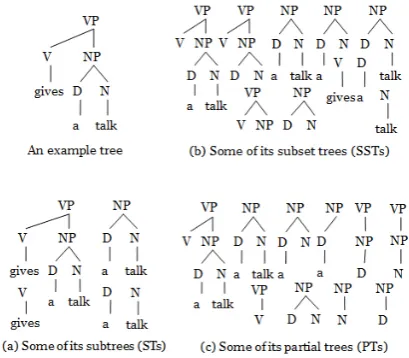
Tree kernels represent trees in terms of their sub-structures (called tree fragments). Such fragments form a feature space which, in turn, is mapped into a vector space. Tree kernels measure the similar-ity between pair of trees by counting the number of fragments in common. There are three impor-tant characterizations of fragment type: the Sub-Trees (ST), the SubSet Sub-Trees (SST) and the Partial Trees (PT). For sake of space, we do not report the mathematical description of them, which is avail-able in (Vishwanathan and Smola, 2002), (Collins and Duffy, 2001) and (Moschitti, 2006), respec-tively. In contrast, we report some descriptions in terms of feature space that may be useful to un-derstand the new engineered kernels.
In principle, a SubTree (ST) is defined by tak-ing any node along with its descendants. A SubSet Tree (SST) is a more general structure which does not necessarily include all the descendants. The distinction is that an SST must be generated by ap-plying the same grammatical rule set which gen-erated the original tree, as pointed out in (Collins and Duffy, 2001). A Partial Tree (PT) is a more general form of sub-structures obtained by relax-ing constraints over the SSTs. Figure 1 shows the overall fragment set of the ST, SST and PT kernels for the syntactic parse tree of the sentence
frag-Figure 1: Three kinds of tree kernels.
ment:gives a talk.
In the next section, we will define new struc-tures for tagged sequences of NEs which along with the application of the PT kernel produce in-novative tagging kernels for reranking.
3 Reranking Method
3.1 Reranking Strategy
As a baseline we trained the CRFs model to gen-erate10-best candidates per sentence, along with their probabilities. Each candidate was then rep-resented by a semantic tree together with a feature vector. We consider our reranking task as a binary classification problem where examples are pairs of hypotheses< Hi, Hj >.
Given a sentence “South African Breweries Ltd bought stakes in the Lech and Tychy brewers” and three of its candidate tagged sequences:
H1 B-ORG I-ORG I-ORG I-ORG O O O O B-ORG O
B-ORG O(the correct sequence)
H2 B-MISC I-MISC B-ORG I-ORG O O O O B-ORG
I-ORG I-ORG O
H3 B-ORG I-ORG I-ORG I-ORG O O O O B-ORG O
B-LOC O
where B-ORG, I-ORG, B-LOC, O are the gen-erated NE tags according to IOB notation as de-scribed in Section 3.2.
gener-ated< H1, H2 >,< H1, H3 >,< H2, H1 >and
< H3, H1 >, where the first two pairs are positive and the latter pairs are negative instances. Then a binary classifier based on SVMs and kernel meth-ods can be trained to discriminate between the best hypothesis, i.e. < H1 >and the others. At testing time the hypothesis receiving the highest score is selected (Collins and Duffy, 2001).
3.2 Representation of Tagged Sequences in Semantic Trees
We now consider the representation that exploits the most discriminative aspects of candidate struc-tures. As in the case of NER, an input can-didate is a sequence of word/tag pairs x = {w1/t1...wn/tn} where wi is the i0th word and tiis thei0th NE tag for that word. The first
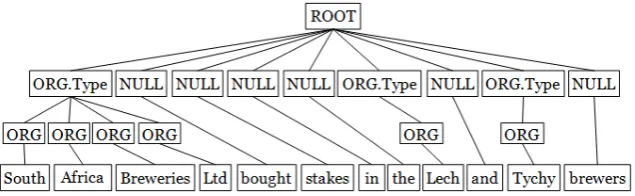
repre-sentation we consider is the tree structure. See fig-ure 2 as an example of candidate tagged sequence and its semantic tree.
With the sentence “South African Breweries Ltd bought stakes in the Lech and Tychy brewers” and three of its candidate tagged sequences in the previous section, the training algorithm considers to con-struct a tree for each sequence, with the named-entity tags as pre-terminals and the words as leaves. See figure 2 for an example of the seman-tic tree for the first tagged sequence.
With this tree representation, for a wordwi, the
target NE tag would be set at parent and the fea-tures for this word are at child nodes. This allows us to best exploit the inner product between com-peting candidates. Indeed, in the kernel space, the inner product counts the number of common subtrees thus sequences with similar NE tags are likely to have higher score. For example, the sim-ilarity betweenH1andH3will be higher than the similarity of the previous hypotheses withH2; this is reasonable since these two also have higherF1. It is worth noting that another useful modifica-tion is the flexibility of incorporate diverse, ar-bitrary features into this tree structure by adding children to the parent node that contains entity tag. These characteristics can be exploited efficiently with the PT kernel, which relaxes constraints of production rules. The inner product can implicitly include these features and deal better with sparse data.
3.3 Global features
Mixedn-gramsfeatures
In previous works, some global features have been used (Collins, 2002b; Collins, 2002a) but the employed algorithm just exploited arbitrary infor-mation regarding word types and linguistic pat-terns. In contrast, we define and study diverse features by also consideringn-gramspatterns pre-ceding, and following the target entity.
Complementarycontext
In supervised learning, NER systems often suf-fer from low recall, which is caused by lack of both resource and context. For example, a word like “Arkansas” may not appear in the training set and in the test set, there may not be enough con-text to infer its NE tag. In such cases, neither global features (Chieu and Ng, 2002) nor aggre-gated contexts (Chieu and Ng, 2003) can help.
To overcome this deficiency, we employed the following unsupervised procedure: first, the base-line NER is applied to the target un-annotated cor-pus. Second, we associate each word of the corpus with the most frequent NE category assigned in the previous step. Finally, the above tags are used as features during the training of the improved NER and also for building the feature represen-tation for a new classification instance.
This way, for any unknown wordwof the test
set, we can rely on the most probable NE category as feature. The advantage is that we derived it by using the average over many possible contexts of
w, which are in the different instances of the un-nanotated corpus.
The unlabeled corpus for Italian was collected from La Repubblica6and it contains over 20
mil-lions words. Whereas the unlabeled corpus for English was collected mainly from The New York Times7 and BBC news stories 8 with more than
35 millions words. Head word
As the head word of an entity plays an impor-tant role in information extraction (Bunescu and Mooney, 2005a; Surdeanu et al., 2003), it is
Figure 2: Semantic structure of the first sequence
cluded in the global set together with its ortho-graphic feature. We now describe some primitives for our global feature framework.
1. wifori= 1. . . nis thei0th word
2. tiis the NE tag ofwi
3. giis the gazetteer feature of the wordwi
4. fiis the most frequent NE tag seen in a large
corpus ofwi
5. hi is the head word of the entity. We
nor-mally set the head word of an entity as its last word. However, when a preposition exists in the entity string, its head word is set as the last word before the preposition. For exam-ple, the head word of the entity “University of Pennsylvania” is “University”.
6. Mixed n-grams features of the words and their gazetteers/frequent-tag before/after the start/end of an entity. In addition to the normal n-grams solely based on words, we mixed words with gazetteers/frequent-tag seen from a large corpus and create mixed
n-gramsfeatures.
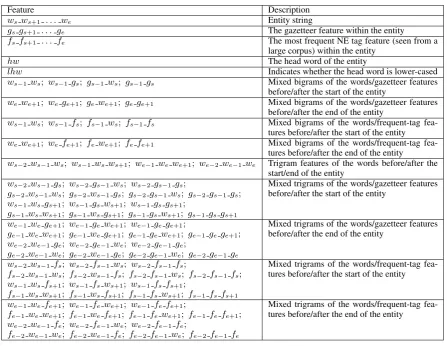
Table 2 shows the full set of global features in our reranking framework. Features are anchored to each entity instance and adapted to entity types. This helps to discriminate different entities with the same surface forms. Moreover, they can be combined withn-gramspatterns to learn and ex-plicitly push the score of the correct sequence above the score of competing sequences.
3.4 Reranking with Composite Kernel In this section we describe our novel tagging ker-nels based on diverse global features as well as semantic trees for reranking candidate tagged se-quences. As mentioned in the previous section, we can engineer kernels by combining tree and entity kernels. Thus we focus on the problem to define structure embedding the desired relational information among tagged sequences.
The Partial Tree Kernel
Let F = f1, f2, . . . , f|F| be a tree fragment
space of type PTs and let the indicator function
Ii(n)be equal to 1 if the targetf1is rooted at node
nand0otherwise, we define the PT kernel as:
K(T1, T2) = X
n1∈NT1 X
n2∈NT2
∆(n1, n2)
where NT1 and NT2 are the set of nodes in T1 and T2 respectively and ∆(n1, n2) = P|F|
i=1Ii(n1)Ii(n2), i.e. the number of common fragments rooted at the n1 and n2 nodes of the type shown in Figure 1.c.
The Polynomial Kernel
The polynomial kernel between two candidate tagged sequences is defined as:
K(x, y) = (1 +~x1·~x2)2,
where~x1and~x2are two feature vectors extracted from the two sequences with the global feature template.
The Tagging Kernels
Feature Description
ws ws+1 . . . we Entity string
gs gs+1 . . . ge The gazetteer feature within the entity fs fs+1 . . . fe The most frequent NE tag feature (seen from a
large corpus) within the entity
hw The head word of the entity
lhw Indicates whether the head word is lower-cased
ws−1 ws; ws−1 gs; gs−1 ws; gs−1 gs Mixed bigrams of the words/gazetteer features
before/after the start of the entity
we we+1; wege+1; ge we+1; ge ge+1 Mixed bigrams of the words/gazetteer features
before/after the end of the entity
ws−1 ws; ws−1 fs; fs−1 ws; fs−1 fs Mixed bigrams of the words/frequent-tag
fea-tures before/after the start of the entity we we+1; wefe+1; fe we+1; fe fe+1 Mixed bigrams of the words/frequent-tag
fea-tures before/after the end of the entity
ws−2 ws−1 ws; ws−1 ws ws+1; we−1 we we+1; we−2 we−1 we Trigram features of the words before/after the
start/end of the entity ws−2 ws−1 gs; ws−2 gs−1 ws; ws−2 gs−1 gs;
gs−2 ws−1 ws; gs−2 ws−1 gs; gs−2 gs−1 ws; gs−2 gs−1 gs; ws−1 ws gs+1; ws−1 gsws+1; ws−1 gs gs+1;
gs−1 ws ws+1; gs−1 wsgs+1; gs−1 gsws+1; gs−1 gs gs+1
Mixed trigrams of the words/gazetteer features before/after the start of the entity
we−1 we ge+1; we−1 ge we+1; we−1 ge ge+1;
ge−1 we we+1; ge−1 we ge+1; ge−1 ge we+1; ge−1 ge ge+1;
we−2 we−1 ge; we−2 ge−1 we; we−2 ge−1 ge;
ge−2 we−1 we; ge−2 we−1 ge; ge−2 ge−1 we; ge−2 ge−1 ge
Mixed trigrams of the words/gazetteer features before/after the end of the entity
ws−2 ws−1 fs; ws−2 fs−1 ws; ws−2 fs−1 fs;
fs−2 ws−1 ws; fs−2 ws−1 fs; fs−2 fs−1 ws; fs−2 fs−1 fs; ws−1 ws fs+1; ws−1 fs ws+1; ws−1 fsfs+1;
fs−1 ws ws+1; fs−1 ws fs+1; fs−1 fs ws+1; fs−1 fs fs+1
Mixed trigrams of the words/frequent-tag fea-tures before/after the start of the entity
we−1 we fe+1; we−1 fe we+1; we−1 fe fe+1;
fe−1 we we+1; fe−1 we fe+1; fe−1 fe we+1; fe−1 fe fe+1;
we−2 we−1 fe; we−2 fe−1 we; we−2 fe−1 fe;
fe−2 we−1 we; fe−2 we−1 fe; fe−2 fe−1 we; fe−2 fe−1 fe
Mixed trigrams of the words/frequent-tag fea-tures before/after the end of the entity
Table 2: Global features in the entity kernel for reranking. These features are anchored for each entity instance and adapted to entity categories. For example, the entity string (first feature) of the entity “United Nations” with entity type “ORG” is “ORG United Nations”.
• K(x, y) = L(x) ·L(y) is the basic kernel
where L(x) is the log probability of a
can-didate tagged sequencex under the original probability model.
• T K(x, y) =t(x)·t(y)is the partial tree
ker-nel under the structure representation
• F K(x, y) = f(x)·f(y) is the polynomial
kernel under the global features
The tagging kernels between two tagged se-quences are defined in the following combina-tions:
1. CT K=α·K+ (1−α)·T K
2. CF K=β·K+ (1−β)·F K
3. CT F K =γ·K+ (1−γ)·(T K+F K)
whereα, β, γare parameters weighting the two
participating terms. Experiments on the validation set showed that these combinations yield the best performance with α = 0.2 for both languages,
β = 0.4for English andβ = 0.3for and Italian,
γ = 0.24for English andγ = 0.2for Italian.
4 Experimens and Results
4.1 Experimental Setup
The top 10 hypotheses together with their log probabilities were recovered for each training sen-tence. Similarly, a model trained on the whole training data was used to produce 10 hypotheses for each sentence in the development set. For the reranking experiments, we applied different ker-nel setups to the two corpora described in Section 2.1. The three kernels were trained on the training portion.
Italian Test P R F
CRF s 83.43 77.48 80.34
CT K 84.97 78.03 81.35
CF K 84.93 79.13 81.93
CTFK 85.99 82.73 84.33
(Zanoli et al., 2009) 84.07 80.02 82.00
English Test P R F
CRF s 85.37 84.35 84.86
CT K 87.19 84.79 85.97
CF K 86.53 86.75 86.64
CTFK 88.07 88.25 88.16
(Ratinov and Roth, ) N/A N/A 90.57
Table 3: Reranking results of the three tagging kernels on the Italian and English testset.
4.2 Discussion
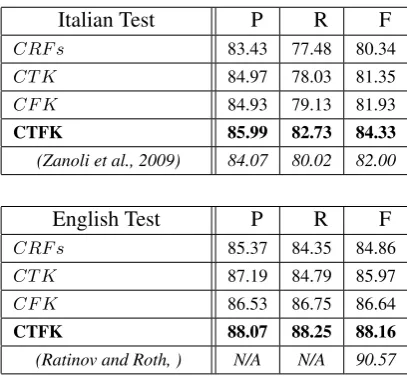
Table 3 presents the reranking results on the test data of both corpora. The results show a 20.29% relative improvement in F-measure for Italian and 21.79% for English.
CF K based on unstructured features achieves
higher accuracy than CT K based on structured
features. However, the huge amount of subtrees generated by the PT kernel may limit the expres-sivity of some structural features, e.g. many frag-ments may only generate noise. This problem is less important with the polynomial kernel where global features are tailored for individual entities. In any case, the experiments demonstrate that both tagging kernels CT K and CF K give
im-provement over the CRFs baseline in both lan-guages. This suggests that structured and unstruc-tured features are effective in discriminating be-tween competing NE annotations.
Furthermore, the combination of the two tag-ging kernels on both standard corpora shows a
large improvement in F-measure from 80.34% to 84.33% for Italian and from 84.86% to 88.16% for English data. This suggests that these two ker-nels, corresponding to two kinds of feature, com-plement each other.
To better collocate our results with previous work, we report the best NER outcome on the Italian (Zanoli et al., 2009) and the English (Rati-nov and Roth, ) datasets, in the last row (in italic) of each table. This shows that our model outper-forms the best Italian NER system and it is close to the state-of-art model for English, which ex-ploits many complex features9. Also note that we
are very close to the F1 achieved by the best sys-tem of CoNLL 2003, i.e. 88.8.
5 Conclusion
We analyzed the impact of kernel-based ap-proaches for modeling dependencies between tagged sequences for NER. Our study illustrates that each individual kernel, either with structured or with flat features clearly gives improvement to the base model. Most interestingly, as we showed, these contributions are independent and, the ap-proaches can be used together to yield better re-sults. The composite kernel, which combines both kinds of features, can outperform the state-of-the-art.
In the future, it will be very interesting to use syntactic/semantic kernels, as for example in (Basili et al., 2005; Bloehdorn and Moschitti, 2007a; Bloehdorn and Moschitti, 2007b). An-other promising direction is the use of syntactic trees, feature sequences and pairs of instances, e.g. (Nguyen et al., 2009; Moschitti, 2008).
Acknowledgments
We would like to thank Roberto Zanoli and Marco Dinarelli for helpful explanation about their work. This work has been par-tially funded by the LiveMemories project (http://www.livememories.org/) and Expert System (http://www.expertsystem.net/) research grant.
9In the future we will be able to integrate them with the
References
Basili, Roberto, Marco Cammisa, and Alessandro Moschitti. 2005. Effective use of WordNet seman-tics via kernel-based learning. InCoNLL.
Bloehdorn, Stephan and Alessandro Moschitti. 2007a. Combined syntactic and semantic kernels for text classification. InECIR.
Bloehdorn, Stephan and Alessandro Moschitti. 2007b. Structure and semantics for expressive text kernels. InCIKM.
Bunescu, Razvan C. and Raymond J. Mooney. 2005a. A shortest path dependency kernel for relation ex-traction. InEMNLP.
Carreras, Xavier, Llu´ıs M`arques, and Llus Padr´o. 2002. Named entity extraction using Adaboost. In
CoNLL.
Chieu, Hai Leong and Hwee Tou Ng. 2002. Named entity recognition: A maximum entropy approach using global information. InCOLING.
Chieu, Hai Leong and Hwee Tou Ng. 2003. Named entity recognition with a maximum entropy ap-proach. InCoNLL.
Chinchor, Nancy and Patricia Robinson. 1998. Muc-7 named entity task definition. Inthe MUC.
Collins, Michael and Nigel Duffy. 2001. Convolution kernels for natural language. InNIPS.
Collins, Michael and Terry Koo. 2000. Discriminative reranking for natural language parsing. InICML.
Collins, Michael. 2002a. New ranking algorithms for parsing and tagging: Kernels over discrete struc-tures, and the voted perceptron. InACL.
Collins, Michael. 2002b. Ranking algorithms for named-entity extraction boosting and the voted per-ceptron. InACL.
Dinarelli, Marco, Alessandro Moschitti, and Giuseppe Riccardi. 2009. Re-ranking models based on small training data for spoken language understanding. In
EMNLP.
Florian, Radu, Abe Ittycheriah, Hongyan Jing, and Tong Zhang. 2003. Named entity recognition through classifier combination. InCoNLL.
Huang, Liang. 2008. Forest reranking: Discriminative parsing with non-local features. InACL-HLT.
Lafferty, John, Andrew McCallum, and Fernando Pereira. 2001. Conditional random fields: Prob-abilistic models for segmenting and labeling se-quence data. InICML.
Lodhi, Huma, Craig Saunders, John Shawe Taylor, Nello Cristianini, , and Chris Watkins. 2002. Text classification using string kernels. Journal of Ma-chine Learning Research, pages 419–444.
Magnini, Bernardo, Emmanuele Pianta, Christian Gi-rardi, Matteo Negri, Lorenza Romano, Manuela Speranza, Valentina Bartalesi Lenzi, and Rachele Sprugnoli. 2006. I-CAB: the italian content anno-tation bank. InLREC.
Moschitti, Alessandro. 2004. A study on convolution kernels for shallow semantic parsing. InACL. Moschitti, Alessandro. 2006. Efficient convolution
kernels for dependency and constituent syntactic trees. InICML.
Moschitti, Alessandro. 2008. Kernel methods, syntax and semantics for relational text categorization. In
CIKM.
Nguyen, Truc-Vien T., Alessandro Moschitti, and Giuseppe Riccardi. 2009. Convolution kernels on constituent, dependency and sequential structures for relation extraction. InEMNLP.
Ratinov, Lev and Dan Roth. Design challenges and misconceptions in named entity recognition. In
CoNLL.
Rifkin, Ryan Michael and Tomaso Poggio. 2002. Ev-erything old is new again: a fresh look at historical approaches in machine learning. PhD thesis, MIT. Sang, Erik F. Tjong Kim and Fien De Meulder.
2003. Introduction to the conll-2003 shared task: Language-independent named entity recognition. InCoNLL.
Sch¨olkopf, Bernhard and Alexander J. Smola. 2001.
Learning with Kernels: Support Vector Machines, Regularization, Optimization, and Beyond. MIT Press, Cambridge, MA, USA.
Shen, Libin, Anoop Sarkar, and Franz Josef Och. 2004. Discriminative reranking for machine transla-tion. InHLT-NAACL, Boston, Massachusetts, USA. Surdeanu, Mihai, Sanda Harabagiu, John Williams, and Paul Aarseth. 2003. Using predicate-argument structures for information extraction. InACL. Vapnik, Vladimir N. 1998. Statistical Learning
The-ory. John Wiley and Sons, New York.
Vishwanathan, S.V.N. and Alexander J. Smola. 2002. Fast kernels on strings and trees. InNIPS.