A New Approach to Automatic Document Summarization
Xiaofeng Wu
National Laboratory of Pattern Recognition,
Institute of Automation,
Chinese Academy of Sciences
Beijing, China
[email protected]
Chengqing Zong
National Laboratory of Pattern Recognition,
Institute of Automation,
Chinese Academy of Sciences
Beijing, China
[email protected]
Abstract
In this paper we propose a new approach based on Sequence Segmentation Models
(SSM) to the extractive document summa-rization, in which summarizing is regarded as a segment labeling problem. Comparing with the previous work, the difference of our approach is that the employed features are obtained not only from the sentence level, but also from the segment level. In our approach, the semi-Markov CRF model is employed for segment labeling. The pre-liminary experiments have shown that the approach does outperform all other tradi-tional supervised and unsupervised ap-proaches to document summarization.
1
Introduction
Document summarization has been a rapidly evolving subfield of Information Retrieval (IR) since (Luhn, 1958). A summary can be loosely defined as a text that is produced from one or more texts and conveys important information of the original text(s). Usually it is no longer than half of the original text(s) or, significantly less (Radev et al., 2002). Recently, many evaluation competitions (like the Document Understanding Conference DUC “http://duc.nist.gov”, in the style of NIST’s TREC), provided some sets of training corpus. It is obvious that, in the age of information explosion, document summarization will be greatly helpful to the internet users; besides, the techniques it uses can also find their applications in speech tech-niques and multimedia document retrieval, etc.
The approach to summarizing can be catego-rized in many ways. Some of them are: 1) indica-tive, informative and evaluative, according to
func-tionality; 2) single-document and multi-document,
according to the amount of input documents; 3)
generic and query-oriented, according to
applica-tions. Yet the taxonomy currently widely em-ployed is to categorize summarization into abstrac-tive and extractive.
According to (Radev et al., 2002), all methods that are not explicitly extractive are categorized as abstractive. These approaches include ontological information, information fusion, and compression. Abstract-based summarization never goes beyond conceptual stage, though ever since the dawn of summarization it has been argued as an alternative for its extract-based counterpart. On the other hand, extractive summarization is still attracting a lot of researchers (Yeh et al., 2005) (Daum´e III and Marcu, 2006) and many practical systems, say, MEAD “http://www.summarization.com/mead/”, have been produced. Using supervised or unsuper-vised machine learning algorithms to extract sen-tences is currently the mainstream of the extractive summarization. However, all pervious methods focus on obtaining features from the sentence gra-nularity.
2
Related Work
Early researchers approached the summarization problem by scoring each sentence with a combina-tion of the features like word frequency and distri-bution, some proper names (Luhn, 1958), sentence positions in a paragraph (Baxendale, 1958), and sentence similarity (Gong, 2001) etc. The results were comparatively good. Most supervised extrac-tive methods nowadays focus on finding powerful machine learning algorithms that can properly combine these features.
Bayesian classifier was first applied to summari-zation by (Pedersen and Chen, 1995), the authors claimed that the corpus-trained feature weights were in agreement with (Edmundson, 1969), which employed a subjective combination of weighted features. Another usage of the naïve Bayesian model in summarization can be found in (Aone et al., 1997). Bayesian model treats each sentence individually, and misses the intrinsic connection between the sentences. (Yeh et al., 2005) employed genetic algorithm to calculate the belief or score of each sentence belonging to the summary, but it also bears this shortcoming.
To overcome this independence defect, (Conroy and O’leary, 2001) pioneered in deeming this prob-lem as a sequence labeling problem. The authors
used HMM, which has fewer independent assump-tions. However, HMM can not handle the rich lin-guistic features among the sentences either. Re-cently, as CRF (Lafferty and McCallum, 2001) has been proved to be successful in part-of-speech tag-ging and other sequence labeling problems, (Shen et al., 2007) attempted to employ this model in document summarization. CRF can leverage all those features despite their dependencies, and ab-sorb other summary system’s outcome. By intro-ducing proper features and making a comparison with SVM, HMM, etc., (Shen et al., 2007) claimed that CRF could achieve the best performance.
All these approaches above share the same viewpoint that features should be obtained at sen-tence level. Nevertheless, it can be easily seen that the non-summary or summary sentences tend to appear in a consecutive manner, namely, in seg-ments. These rich features of segments can surely not be managed by those traditional methods.
Recently, Sequence Segmentation Model (SSM) has attracted more and more attention in some traditional sequence learning tasks. SSM builds a
direct path to encapsulate the rich segmental features (e.g., entity length and the similarity with other entities, etc., in entity recognition). Semi-CRF (Sarawagi and Cohen, 2004) is one of the SSMs, and generally outperforms CRF.
3
Motivations
According to the analysis in Section 2, our basic idea is clear that we regard the supervised summa-rizing as a problem of sequence segmentation.
However, in our approach, the features are not only obtained on the sentence level but also on the seg-ment level.
Here a segment means one or more sentences sharing the same label (namely, non-summary or summary), and a text is regarded as a sequence of segments. Semi-CRF is a qualified model to ac-complish the task of segment labeling, besides it shares all the virtues of CRF. Using semi-CRF, we can easily leverage the features both in traditional sentence level and in the segment level. Some fea-tures, like Log Likelihood or Similarity, if obtained from each sentence, are inclined to give unex-pected results due to the small granularity. Fur-thermore, semi-CRF is a generalized version of CRF. The features designed for CRF can be used in semi-CRF directly, and it has been proved that semi-CRF outperforms CRF in some Natural Lan-guage Processing (NLP) problems (Sarawagi and Cohen, 2004).
In the subsections below, we first introduce semi-CRF then describe the features we used in our approach.
3.1 Semi-CRF
CRF was first introduced in (Lafferty and McCallum, 2001). It is a conditional model P(Y|X),
and here both X and Y may have complex structure.
3.1.1 CRF vs. Semi-CRF
Given an observed sentence sequence
X=(x1,x2,…,xM). The corresponding output labels are Y=(y1,y2,…,yM), where yigets its value from a fixed set Ψ. For document summarization, Ψ={0,1}. Here 1 for summary and 0 for non-summary. The goal of CRF is to find a sequence of
Y, that maximize the probability:
[image:3.612.314.539.75.158.2]
1
( | , ) exp( ( , ))
( )
P Y X W W F X Y
Z X
= ⋅ (1)
Here, is a vertical vector of size T. The vertical vector
1 ( , ) Mf ( , , )
i
F X Y =
∑
= i X Y1 2 '
f =( ,f f ,...,fT) means
there are T feature functions, and each of them can
be written as ft(i,X,Y)∈R,t∈(1,…,T),i∈(1,…,M). For example, in our experiment the 10th feature
function is expressed as: [if the length of current sentence is bigger than the predefined threshold value]&[if the current sentence is a summary]. When this feature function is acting upon the third sentence in text_1 with label_sequence_1, the
fol-lowing feature equation f10(3,text_1,
la-bel_sequence_1) means: in text_1 with la-bel_sequence_1, [if the length of the third sentence
is bigger than the predefined threshold value]&[if the third sentence is a summary]. W is a horizontal
vector of size T that represents the weights of these
features respectively. Equation (2) gives the defini-tion of Z(X), which is a normalization constant that
makes the probabilities of all state sequences sum to 1.
'
( ) Y exp( ( , '))
Z X =∑ W F X⋅ Y
|
(2) If we change the sequence vector X to S=<s1,s2,…,sN>, which means one way to split X into N segments, we have the semi-CRF. Each
element in S is a triple: Sj=<tj,uj,yj>, which de-notes the jth segment in this way of segmentation.
In the triple, tjdenotes the start point of the jth seg-ment, uj denotes its end position, and yj is the out-put label of the segment (recall the example at the beginning of this subsection that there is only one output for a segment). Under this definition, seg-ments should have no overlapping, and satisfy the following conditions:
1
| | |
N
j j
s X
= =
∑ (3)
t1 =1,uN =|X |,1≤ ≤tj uj ≤|X t|, j+1=u +1 (4)
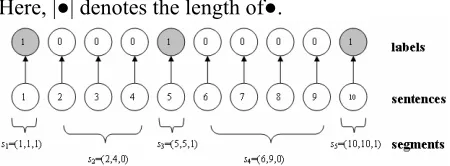
Here, |●| denotes the length of●.
Figure 1 A 10-sentences text with label sequence
For example, one way to segment a text of 10 sen-tences in Figure 1 is S=<(1,1,1),(2,4,0),(5,5,1),
(6,9,0),(10,10,1)> . The circles in the second row represent sentences, and actually are only some
properties of the corresponding sentences.
Consequently, the feature function f in CRF converts to the segmental feature function g=(g1,g2,…,g T’). Like f, gt(i,x,s) ∈R also maps a triple (i,x,s) to a real number. Similarly, we may
define . Now we give the
final equation used to estimate the probability of S.
Given a sequence X and feature weight W, we have
1
( , ) N g( , , ) i
G X S =
∑
= i X S1
( | , ) exp( ( , ))
( )
P S X W W G X S
Z X
= ⋅ (5)
Here,
'
( ) exp( ( , '))
S
Z X W G X
∈Δ
=
∑
⋅ S (6)Where, Δ ={all−segmentations−allowed}.
3.1.2 Inference
The inference or the testing problem of semi-CRF is to find the best S that maximizes Equation (5).
We use the following Viterbi-like algorithm to cal-culate the optimum path.
Suppose the longest segment in corpus is K, let
S1:i,y represent all possible segmentations starting from 1 to i, and the output of the last segment is y. V(i,y) denotes the biggest value of P(S’|X,W). Note
that it’s also the largest value of W·G(X,S’), S’∈S1:i,y.
Compared with the traditional Viterbi algorithm used in CRF, the inference for semi-CRF is more time-consuming. But by studying Algorithm 1, we can easily find out that the cost is only linear in K.
3.1.3 Parameter Estimation
Define the following function log ( | , ) ( ( , ) log (
l
W l l
l l l l
L P S X W
W G X S Z X
= ∑
=∑ ⋅ − )) (8)
In this approach, the problem of parameter estima-tion is to find the best weight W that maximizes LW. According to (Bishop, 2006), the Equation (8) is convex. So it can be optimized by gradient ascent. Various methods can be used to do this work (Pie-tra et al. 1997). In our system, we use L-BFGS, a quasi-Newton algorithm (Liu and Nocedal. 1989), because it has the fast converging speed and effi-cient memory usage. APIs we used for estimation and inference can be found in website “http:\\crf.sourcefourge.net”.
3.2 Features
(Shen et al. 2007) has made a thorough investiga-tion of the performances of CRF, HMM, and SVM. So, in order to simplify our work and make it com-parable to the previous work, we shape our desig-nation of features mainly under their framework.
The mid column in Table 1 lists all of the fea-tures we used in our semi-CRF approach. For the convenience of comparison, we also list the name of the features used in (Shen et al. 2007) in the right column, and name them Regular Features.
The features in bold-face in the mid column are the corresponding features tuned to fit for the usage of semi-CRF. We name them Extended Features.
There are some features that are not in bold-face in the mid column. These features are the same as the
Regular Features in the right column. We also
used them in our approach. The mark star denotes
that there is no counterpart. We number these fea-tures in the left column.
Algorithm 1:
Step1. Initialization:
Let V i( , ) 0, 0 No. semi-CRF CRF
1 Ex_Position Position
2 Ex_Length Length
3 Ex_Log_Likelihood Log Likeli-hood
4
Ex_Similarity_to_ Neighboring_ Segments
Similarity to Neighboring Sentences
5 Ex_Segment_
Length *
6 Thematic Thematic
7 Indicator Indicator
8 Upper Case Upper Case
y = for i=
Step2. Induction:
0
for i>
', 1,...,
( , ) max ( , ')
g( , ', , 1, ) y k K
V i y V i k y
W y y x i d i =
= −
+ ⋅ − + (7) Step3. Termination and path readout:
bestSegment=maxyV(|X |, )y
Table 1. Features List
The details of the features we used in semi-CRF are explained as follow.
Extended Features:
Ex_Position: is an extended version of the
Po-sition feature. It gives the description of the po-sition of a segment in the current segmentation. If the sentences in the current segment contain the beginning sentence of a paragraph, the value of this feature will be 1, 2 if it contains the end of a paragraph; and 3 otherwise;
Ex_Length: the number of words in the
cur-rent segment after removing some stop-words.
Ex_Log_Likelihood: the log likelihood of the
current segment being generated by the docu-ment. We use Equation (9) below to calculate this feature. N(wj,si) denotes the number of oc-currences of the word wj in the segment si, and we use ( , ) / ( , )
k
j w k
N w D
∑
N w D to estimate theprobability of a word being generated by a doc-ument.
log ( | ) ( , )log ( | )
j
i w j i j
P s D =
∑
N w s p w D (9)Ex_Similarity_to_Neighboring_Segments:
we define the cosine similarity based on the TF*IDF (Frakes &Baeza-Yates, 1992) between a segment and its neighbors. But unlike (Shen et al. 2007), in our work only the adjacent neighbors of the segment in our work are considered.
EX_Segment_Length: this feature describes
All these features above are actually an ex-tended version used in the regular CRF (or in other supervised model). It is easy to see that, if the segment length is equal to 1, then the fea-tures will degrade to their normal forms.
There are some features that are also used in semi-CRF but we don’t extend them like those features above. Because the extended version of these features leads to no improvement of our result. These features are:
Regular features we used:
Thematic: with removing of stop words, we
define the words with the highest frequency in the document to be the thematic words. And this feature gives the count of these words in each sentence.
Indicator: indicative words such as
“conclu-sion” and “briefly speaking” are very likely to be included in summary sentences, so we define this feature to signal if there are such words in a sentence.
Upper Case: some words with upper case are
of high probability to be a name, and sentences with such words together with other words which the author might want to emphasize are likely to be appeared in a summary sentence. So we use this feature to indicate whether there are such words in a sentence.
It should be noted that theoretically the num-ber of extended features obtained from the cor-pus goes linearly with K in Equation (7).
4
Experiments
4.1 Corpus & Evaluation Criteria
To evaluate our approach, we applied the widely used test corpus of (DUC2001), which is spon-sored by ARDA and run by NIST “http://www.nist.gov”. The basic aim of DUC 2001 is to further progress of summarization and enable researchers to participate into large-scale experiments. The corpus DUC2001 we used con-tains 147 news texts, each of which has been la-beled manually whether a sentence belongs to a summary or not. Because in (Shen et al. 2007) all the experiments were conducted upon DUC2001, we may make a comparison between the sequence labeling models and the sequence segmentation
modes we used. The only preprocessing we did is
to remove some stop words according to a stop word list.
We use F1 score as the evaluation criteria which is
defined as:
2*Precesion*Recall 1
Precesion+Recall
F = (10)
We used 10-fold cross validation in order to reduce the uncertainty of the model we trained. The final
F1 score reported is the average of all these 10
ex-periments.
All those steps above are strictly identical to the work in (Shen et al. 2007), and its result is taken as our baseline.
4.2 Results & Analysis
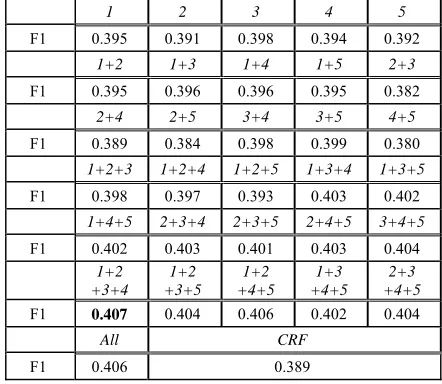
As we mentioned in Sub-Section 3.2, those ex-tended version of features only work when seg-ment length is bigger than one. So, each of these extended version of features or their combination can be used together with all the other regular fea-tures listed in the right column in Table 1. In order to give a complete test of the capacity of all these extended features and their combinations, we do the experiments according to the power set of {1, 2, 3, 4, 5} (the numbers are the IDs of these extended features as listed in Table 1), that is we need to do the test 25-1 times with different combinations of
the extended features. The results are given in Ta-ble 2. The rows with italic fonts (1, 3, 5, 7, 9, 11, 13), in Table 2 denote the extended features used. For example, ‘1+2’ means that the features
[image:5.612.325.546.509.701.2]Ex_Positon and the Ex_Length are together used with all other regular features are used.
Table 2. Experiment results.
1 2 3 4 5
F1 0.395 0.391 0.398 0.394 0.392
1+2 1+3 1+4 1+5 2+3
F1 0.395 0.396 0.396 0.395 0.382
2+4 2+5 3+4 3+5 4+5
F1 0.389 0.384 0.398 0.399 0.380
1+2+3 1+2+4 1+2+5 1+3+4 1+3+5
F1 0.398 0.397 0.393 0.403 0.402
1+4+5 2+3+4 2+3+5 2+4+5 3+4+5
F1 0.402 0.403 0.401 0.403 0.404
1+2 +3+4
1+2 +3+5
1+2 +4+5
1+3 +4+5
2+3 +4+5
F1 0.407 0.404 0.406 0.402 0.404
All CRF
Other rows (2, 4, 6, 8, 10, 12, 14) give F1 scores
corresponding to the features used.
In Table 3 we compare our approach with some of the most popular unsupervised methods, includ-ing LSA (Frakes & Baeza-Yates, 1992) and HITS (Mihalcea 2005). The experiments were conducted by (Shen et al. 2007).
Table 3 Comparison with unsupervised methods
From the results in Table 2 we can see that indi-vidually applying these extended features can im-prove the performance somewhat. The best one of these extended features is feature 3, as listed in the 2nd row, the 5th column. The highest improvement,
1.8%, is obtained by combining the features 1, 2, 3 and 4. Although a few of the combinations hurt the performance, most of them are helpful. This veri-fies our hypothesis that the extended features under SSM have greater power than the regular features. The results in Table 3 demonstrate that our ap-proach significantly outperforms the traditional unsupervised methods. 8.3% and 4.9% improve-ments are respectively gained comparing to LSA and HITS models
Currently, the main problem of our method is that the searching space goes large by using the extended features and semi-CRF, so the training procedure is time-consuming. However, it is not so unbearable, as it has been proved in (Sarawagi and Cohen, 2004).
5
Conclusion and Future Work
In this paper, we exploit the capacity of semi-CRF , we also make a test of most of the common fea-tures and their extended version designed for doc-ument summarization. We have compared our ap-proach with that of the regular CRF and some of the traditional unsupervised methods. The com-parison proves that, because summary sentences and non-summary sentences are very likely to show in a consecutive manner, it is more nature to obtain features from a lager granularity than sen-tence.
In our future work, we will test this approach on some other well known corpus, try the complex features used in (Shen et al. 2007), and reduce the time for training.
Acknowledgements
The research work described in this paper has been funded by the Natural Science Foundation of Chi-na under Grant No. 60375018 and 60121302.
References
C.Aone, N. Charocopos, J. Gorlinsky. 1997. An Intelligent Multilingual Information Browsing and Retrieval System Using Information Extraction. In
ANLP, 332-339.
P.B. Baxendale. 1958. Man-made Index for Tech-nical Literature -An Experiment. IBM Journal of Research and Development, 2(4):354-361.
C.M. Bishop. 2006. Linear Models for Classifica-tion, Pattern Recognition and Machine Learning, chapter 4, Springer.
J. M. Conroy and D. P. O’leary. 2001. Text Sum-marization via Hidden Markov Models. In SIGIR,
406-407.
Hal Daum´e III, and D. Marcu. 2006. Bayesian Query- Focused Summarization, In ACL
H. P. Edmundson. 1969. New Methods in Auto-matic Extracting. Journal of the Association for Computing Machinery, 16(2):264-285.
W. B. Frakes, R. Baeza-Yates, 1992, Information Retrieval Data Structures & Algorithms. Prentice
Hall PTR, New Jersey
Y. H. Gong and X. Liu. 2001. Generic text summa-rization using relevance measure and latent seman-tic analysis. In SIGIR, 19-25
J. Kupiec, J. Pedersen, and F. Chen. 1995. A Trainable Document Summarizer. Research and Development in Information Retrieval, 68-73
J. D. Lafferty, A. McCallum and F. C. N. Pereira. 2001. Conditional random fields: probabilistic models for segmenting and labeling sequence data.
ICML, 282-289.
D. C. Liu and J. Nocedal. 1989. On the limited memory BFGS method for large-scale optimiza-tion. Mathematic Programming, 45:503-528.
H. P. Luhn. 1958.The Automatic Creation of Lit-erature Abstracts. IBM Journal of Research and Development, 2(2): 159 -165.
LSA HITS Seim-CRF
A. McCallum, D. Freitag, and F. Pereira. 2000. Maximum entropy Markov models for information extraction and segmentation.In ICML, 591-598
Mihalcea R. Mihalcea. 2005. Language independ-ent extractive summarization. In AAAI, 1688-1689
S. D. Pietra, V. D. Pietra, and J. D. Lafferty. 1997. Inducing features of random fields. IEEE Tran. on Pattern Analysis and Machine Intelligence,
19(:)380–393.
D. R. Radev, E. Hovy and K. McKeown. 2002. Introduction to the Special Issue on Summarization.
Computational Linguistics, 28(4): 399-408.
S. Sarawagi and W.W. Cohen. 2004. Semi-markov conditional random fields for information extrac-tion.In NIPS
D. Shen, J. T. Sun, H. Li, Q. Yang, Z. Chen. 2007. Document Summarization using Conditional Ran-dom Fields’ In IJCAI, 1805-1813
J. Y. Yeh, H. R. Ke, W. P. Yang and I. H. Meng. 2005. Text summarization using trainable summar-izer and latent semantic analysis. IPM, 41(1): 75–