Parallel Diffusion Methods for Specialized Node
Regularity
1
S.V.N.Vamsidhar, 2 R. Neha Chowdary, 3 N. Sai jyothi & 4 Sk. Noor Mohammed
1
M.Tech, Asst.Professor, [email protected]
2,3,4
B.Tech Students, Tirumala Engineering College, Narasaraopet
2
[email protected], Mobile: +91 8639543739
Abstract: Social network analysis is one of the key areas of research during modern times. The social network is growing with more users and the ties between them day by day. It has two components: dividing the mobile social network into several communities by taking into account information diffusion and selecting communities to find influential nodes by a dynamic programming. A dynamic propagation model considering every the worldwide quality and individual attraction of the rumor is given supported realistic state of affairs to boot, altogether completely different from existing problems with influence reduction. In particular, every hub is allocated a resilience time limit. In the event that the piece time of every client surpasses that edge, the utility of the system will diminish. Our proposed method is able to find new communities based on the previous structure of the network without recomposing them from scratch. We present a survey of representative methods dealing with these issues and propose a taxonomy that summarizes the state-of-the-art. The objective is to provide a comprehensive analysis and guide of existing efforts around information diffusion in social networks. The proposed algorithm uses parallel processing engine to resolve this delay problem in the current scenario. The algorithm in parallel finds out the superior seed set in the network and expands it in parallel to find out the community. Experimental results on the synthetic and real-world social networks demonstrate that our method is both effective and efficient in discovering communities in dynamic social networks.
Index Terms: Social Network, Greedy algorithm, Information Diffusion, Rumor Influence, Location based community greedy algorithm.
1. INTRODUCTION
The speedy development and rising quality of large - scale social networks like Twitter, Facebook etc., many in numerable individual’s area unit ready to become friends and share every kind of knowledge with one another [1]. a rumor concerning associate degree approaching earthquake, which can cause chaos among the group and thus could hinder the conventional public order. during this case, it's necessary to discover the rumor Source and delete connected messages, which can be enough to stop the rumor from any spreading [2]. The aforementioned challenges have driven a proliferation of researches in the past decade on developing techniques for influence maximization few people could post on social networks talk concerning partner degree moving toward quake, which can cause mayhem among the gathering and in this way could prevent the traditional open request [3]. A static clustering method is applied on all snapshots and then, obtained communities will be compared with one another to track evolution of community structure over time [4]. Since computing communities is usually independent
Fig. 1. The survey’s overview
2. RELATED WORK
This section presents the prior works of the dynamic sensor networks. The author studied a tendency to advocate a recommendation support for active finding, wherever a user actively specifies a finding target to the most effective of our data [10]. We have a tendency to study the economical influence maximization from new complementary directions. One is to enhance the first greedy formula and its improvement to more scale back its period of time, and also the second is to propose new degree discount heuristics that improves influence unfold [11]. The social links between users besides viral marketing, IM is also the cornerstone in many other important applications such as network monitoring rumor control and social recommendation [12]. We address the matter of limiting the proliferation of bothersome things, similar to pc infections or noxious bits of rumor by obstruct a confined scope of connections [13]. Although they reached higher accuracy compared with the other local community detection methods, but due to high time complexity of their approach, it is not scalable in finding communities in large social networks. Seed-centric approach is not limited to the local community detection problem [14]. An OSN is formally represented by a graph, where nodes are users and edges are relationships that can be either directed or not depending on how the SNS manages relationships [15]. More precisely, it depends on whether it allows connecting in an unilateral manner. Messages are the main information vehicle in such services [16]. There is lot of seed selection algorithms available for different applications. Each application might have to
adopt different seed selection algorithms which match the application requirement. For example if the application is a marketing application, the out-degree centrality or the page rank centrality may be used for the seed selection process [17].
3. SYSTEM ARCHITECTURE
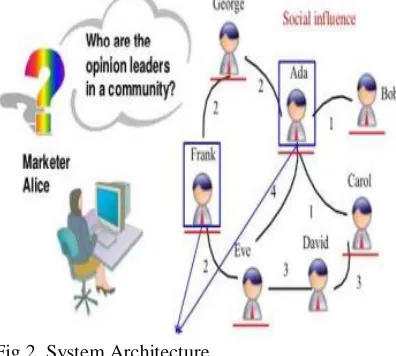
The traditional Influence Maximization problem aims at finding influential nodes for only one static social network real-world social networks are seldom static. Both the structure and also the influence strength associated with the edges change constantly [18]. Acceptance likelihood Maximization (APM), and develop a polynomial time rule known as Selective invite with Tree and In-Node Aggregation (SITINA), to seek out the best resolution. We have a tendency to implement a full of life finding service with SITINA on Face book to validate our plan [19]. The influence of any seed set is defined based on the information diffusion process among the users the information diffusion is viral marketing, where a company may wish to spread the adoption of a new product from some initial adopters through the social links between users [20].
Fig.2. System Architecture
4. PROPOSE SYSTEM
IM problem, namely Independent Cascade (IC) model, Linear Threshold (LT) model, Triggering (TR) model, and Time Aware model. We also briefly discuss typical non-progressive diffusion models [22]. Influential Node Tracking on Dynamic Social Network: An Interchange Greedy Approach: In this paper we have a tendency to investigate a one of a kind drawback, especially pertinent Node pursue drawback, as AN augmentation of Influence Maximization drawback to dynamic systems [23].
5. METHOD DESCRIPTION
The main idea A good community structure in a dynamic social network is one in which the members should have a strong structured similarity with each other and they should keep this similarity over time. As a result, any method whose aim is to detect and track communities in dynamic social networks should consider two main characteristics:
1) Detected communities should be modular at each time step. In other words, nodes tightly connected to one another, have to be grouped together in the same cluster [24].
Algorithm: K-means Algorithm
Let X = {x1,x2,x3,……..,xn} be the set of post and V = {v1,v2,…….,vc} be the set of users.
1) Arbitrarily select 'c' cluster focuses.
2) Calculate the connection between each tweet and (client) cluster focuses.
3) Assign the tweet to the cluster focus whose connection with cluster focus solid of all the cluster focuses.
4) Recalculate the new cluster focus utilizing: where, „ci‟ represents the number of data points in ith cluster.
5) Recalculate the connection amongst post and new acquired cluster focuses.
6) If no post was reassigned then stop, generally rehash from stage 3)
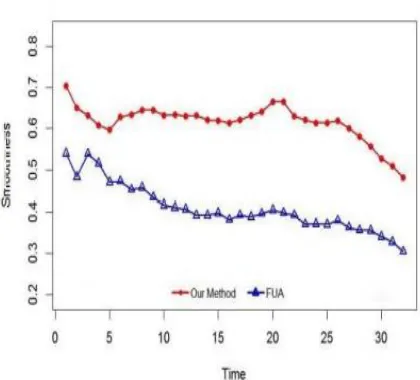
2) 2-Temporal smoothness of clusters over consecutive snapshots should be preserved; that is, in most of the cases, the communities of time t should not sharply differ from the ones of time t-1.
Algorithm: Dynamic Blocking Algorithm
Different from the greedy blocking algorithm, which is a type of static blocking algorithm, we propose a dynamic rumor blocking algorithm aiming to incrementally block the selected nodes instead of blocking them at once. In that case the blocking strategy is split into several rounds and each round can be regarded as a greedy algorithm. Thus, how to choose the number of rounds is also very important for the algorithm [25]. We will elaborate on the algorithm design and how we choose the specific parameters.
Input: Initial Edge matrix A0 Initialization: VB(t) = 0. for j = 1 to n do
for i = 1 to kj do
Δf = f (tj |s (tj-1); Ai-1) – f (tj |s (tj-1); Ai-1\ʋ), u = arg max {Δf},
Ai: = Ai-1\u,
VB(tj) = VB(tj) U {u}. end for
end for
Output: VB(t).
6. PARALLEL SUPERIOR SEED SET
SELECTION (P4S) ALGORITHM:
Fig.4. Parallel community detections framework
Algorithm Parallel Superior Seed Set Selection Algorithm (P4S)
1: procedure P4S(g, τ ) ◃ Parallel Superior Seed set selection(P4S)
2: READ graph G(V, E) 3: COMPUTE
4: degree centrality d 5: eigen value centrality e 6: local clustering coefficient l 7: page rank centrality p ◃ Parallel 8: SORT d, e, l, p
9: for δ do ◃ Parallel
10: Threshold τ ← vertex count/δ
11: Fetch τ count of top nodes from list of d, e, l, p 12: Intersect (d, e, l, p)
13: return Superior Seeds Set S(g)
The threshold value will be used to split the top ranks for all measures. Finally, set intersection of the top nodes from each centrality measure will be done to get the superior seed set depicts the process of finding the superior seed set.
7. EXPERIMENTAL RESULTS
The performance of the proposed method we conducted comprehensive experiments on both computer generated networks and real-world dynamic ones. Two networks generated by computer and also several real-world dynamic networks were investigated. Studying the persistence of the leaders and non-leader nodes on real-world social network proves that the community leaders of the proposed definition are much more stable in compare with follower nodes. Moreover the runtime results of these two datasets are ignored for Facet Net method since the corresponding process required more memory than the amount available in the test machine. It is obvious that the proposed method will be more scalable than the existing work, in confronting with big dynamic social network.
Fig 5: Temporal smoothness of dynamic clustering methods on real-world social network
8. CONCLUSION AND FUTURE WORK
The social networks are a significant research problem we proposed a fast parameter-free method to find meaningful communities in highly dynamic social network. Community based Greedy algorithm is used for mining top-K influential nodes. It has two components: dividing the mobile social network into several communities by taking into account information diffusion and selecting communities to find influential nodes by a dynamic programming. A dynamic rumor diffusion model incorporating both global rumor popularity and individual tendency is presented based on proposes a modified version of utility function to measure the relationship between the utility and blocking time. For future works, we plan to investigate the lifetime evolution of these promising members in various dynamic social networks. This information will be used to capture the main characteristics of such networks and enables us to predict the incoming structure of networks.
REFERENCES
[1] W. Chen, Y. Wang, and S. Yang, “Efficient influence maximization in social network,” in KDD, 2009, pp. 199–208.
[2] A. Arora, S. Galhotra, and S. Ranu, “Debunking the myths of influence maximization: An in-depth benchmarking study,” in SIGMOD, 2017, pp. 651–666.
maximization queries,” in EDBT, 2014, pp. 295– 306.
[4] N. Barbieri, F. Bonchi, and G. Manco, “Topic-aware social influence propagation models,” in ICDM, 2012, pp. 81–90.
[5] S. Bharathi, D. Kempe, and M. Salek, “Competitive influence maximization in social networks,” in WINE, 2007, pp. 306–311. [6] C. Borgs, M. Brautbar, J. Chayes, and B. Lucier,
“Maximizing social influence in nearly optimal time,” in SODA, 2014, pp. 946– 957, revision available at https://arxiv.org/abs/1212.0884. [7] A. Borodin, Y. Filmus, and J. Oren, “Threshold
models for competitive influence in social networks,” in WINE, 2010, pp. 539– 550. [8] C. Budak, D. Agrawal, and A. El Abbadi,
“Limiting the spread of misinformation in social networks,” in WWW, 2011, pp. 665–674. [9] T. Carnes, C. Nagarajan, S. M. Wild, and A. van
Zuylen, “Maximizing influence in a competitive social network: a follower’s perspective,” in ICEC, 2007, pp. 351–360.
[10] S. Chen, J. Fan, G. Li, J. Feng, K. Tan, and J. Tang, “Online topicaware influence maximization,” PVLDB, vol. 8, no. 6, pp. 666– 677, 2015.
[11]. Chen,W.;Wang, C.; andWang, Y. 2010. Scalable influence maximization for prevalent viral marketing in large-scale social networks. In Proceedings of the 16th ACM SIGKDD Internatioanl Conference on Knowledge Discovery and Data Mining, 1029–1038. [12]. Crane, R., and Sornette, D. 2008. Robust
dynamic classes revealed by measuring the response function of a social system. Proceedings of the National Academy of Sciences of the United States of America 105:15649–15653.
[13]. Fan, L.; Lu, Z.;Wu,W.; Thuraisingham, B.; Ma, H.; and Bi, Y. 2013. Least cost rumor blocking in social networks. In Proceedings of the 33rd International Conference on Distributed Computing Systems, 540–549.
[14]. Han, S.; Zhuang, F.; He, Q.; Shi, Z.; and Ao, X. 2014. Energy model for rumor propagation on social networks. In Proceedings of Physica A: Statistical Mechanics and its Applications, 99– 109.
[15]. Kempe, D.; Kleinberg, J.; and Tardos, E. 2003. Maximizing the spread of influence through a social network. In Proceedings of the 9th ACM SIGKDD Internatioanl Conference on
Knowledge Discovery and Data Mining, 1175– 1180.
[16] Y.-R. Lin, Y. Chi, S. Zhu, H. Sundaram, and B. L. Tseng, ”Analyzing communities and their evolutions in dynamic social networks,” ACM Trans. Knowl. Discov. Data, vol. 3, no. 2, pp. 131, Apr. 2009.
[17] G. Palla, I. Dernyi, I. Farkas, and T. Vicsek, ”Uncovering the overlapping community structure of complex networks in nature and society,” Nature, 2005.
[18] T. Hartmann, A. Kappes, and D. Wagner, ”Clustering evolving networks,” arXiv Prepr. arXiv1401.3516, 2014.
[19] P. J. Mucha, T. Richardson, K. Macon, M. a Porter, and J.-P. Onnela, ”Community structure in time-dependent, multiscale, and multiplex networks.,” Science, vol. 328, no. 5980, pp. 8768, May 2010.
[20] L. C. Freeman, T. J. Fararo, W. Bloomberg Jr, and M. H. Sunshine, ”Locating leaders in local communities: A comparison of some alternative approaches,” Am. Sociol. Rev., pp. 791798, 1963.
[21] R. Michalski, T. Kajdanowicz, P. Br´odka, and P. Kazienko. Seed selection for spread of influence in social networks: Temporal vs. static approach. New Generation Computing, 32(3-4):213–235, 2014.
[22] C. H. Mu, J. Xie, Y. Liu, F. Chen, Y. Liu, and L. C. Jiao. Memetic algorithm with simulated annealing strategy and tightness greedy optimization for community detection in networks. Applied Soft Computing Journal, 34:485–501, 2015.
[23] S. Salihoglu and J. Widom. GPS : A Graph Processing System. SSDBM Proceedings of the 25th International Conference on Scientific and Statistical Database Management, 2013.
[24] A. Sol, S. G. e-Ribalta, Manlio De Domenico, and A. A. Omez. Random walk centrality in interconnected multilayer networks. Physica D: Nonlinear Phenomena, 323-324:73–79, 2016. [25] L. Sol´a, M. Romance, R. Criado, J. Flores, A.
Garc´ıa del Amo, and S. Boccaletti. Eigenvector centrality of nodes in multiplex networks. Chaos, 23(3):1–11, 2013.