S
C
H
O
O
L
O
F
M
A
N
A
G
E
M
E
N
T
WORKING PAPER SERIES
THE EFFECT OF STUDENTS’ CULTURAL
VALUES ON THEIR STUDENT-DRIVEN
LEARNING PREFERENCE
Pat Foley
Email: [email protected]
Ann Mitsis
THE EFFECT OF STUDENTS’ CULTURAL VALUES ON THEIR
STUDENT-DRIVEN LEARNING PREFERENCE
Ann Mitsis School of Management Faculty of Business and Law Email: [email protected]
THE EFFECT OF STUDENTS’ CULTURAL VALUES ON THEIR
STUDENT-DRIVEN LEARNING PREFERENCE
ABSTRACT
This study examined the relationship between business students’ cultural orientation and Student-Driven learning styles of 364 higher education business students from Victoria University, Melbourne Australia. Two previously existing inventories were used: Robertson and Hoffman’s (2000) Cultural Values Scale, derived from the work of Hofstede (1980, 1991a, 1998), and Honey and Mumford’s (1992) Learning Style Questionnaire. One of the major findings of this study was that Student-Driven learning is characterised by students having high Masculinity, Confucian and Uncertainty Avoidance value ratings.
INTRODUCTION
Universities yet there is relatively little research into the extent students’ cultural values influence their learning preference.
The question this paper is trying to address is: what is the relationship between students’ cultural orientation and their preferred learning style? This research has wide ranging implications for Australia’s higher education sector as international student enrolment has grown significantly over the past decade and is anticipated to rise to more than one million students by 2025 (Roach 2003; Barron & Arcodia 2002).
LITERATURE REVIEW
Three of the most commonly used instruments for gauging learning styles are: Kolb’s (1976) Learning Style Inventory (see: De Ciantis & Kirton 1996, Drew & Ottewill 1998, Goby & Lewis 2000, Henson & Hwang 2002, Jones et al. 2003; Sharp 1997; Simon 2000; Loo 2002); Honey and Mumford’s (1992) Learning Style Questionnaire (see: Barron & Arcodia 2002, De Ciantis & Kirton 1996, De Vita; 2001, Van Zwanenberg et al. 2000); and the Surface Learning/Deep Learning Continuum (see: Hassall & Joyce 2001; Zhang & Sternberg 2000, Brown 2003a; Brown 2003b; Case & Gunstone 2003; Landrum 1999; Passman 2003).
The Learning Style Inventory produces six scores; one on each of the categories and two combination scores highlighting the individual’s: abstractness over concreteness (AC-CE); and active experimentation over reflection (AE-RO).
Honey and Mumford’s (1992) Learning Style Questionnaire (LSQ) was developed from Kolb’s (1976) theoretical framework. According to Honey and Mumford there are four learning styles. These are: Activists, Reflectors, Theorists, and Pragmatists. Good learning occurs according to Honey and Mumford when learners move through all stages. Activists are described as people who learn best from situations where they can engross themselves, in short ‘here and now’ activities, like business games and competitive teamwork tasks. Reflectors learn best from activities where they are able to stand back from events, listen and observe. Theorists learn best from activities where what is being offered is part of a system, model, concept or theory. Pragmatists learn best from activities where there is an obvious link between the subject matter, and the problem or opportunity on the job.
active learning style over time. Therefore Learning Style Preferences seem to be strongly affected by students’ Cultural Value Profiles.
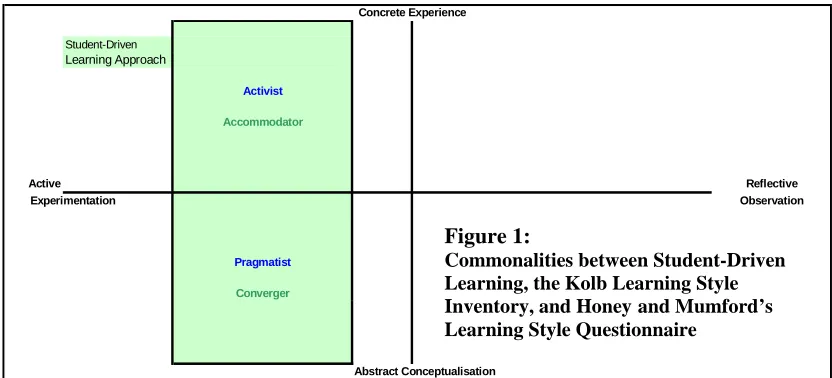
Kolb’s (1976) Learning Style Inventory and Honey and Mumford’s (1992) Learning Style Questionnaire do overlap conceptually, if the Kolb Model dimensions of: Concrete Experience, Reflective Observation, Abstract Conceptualisation, and Active Experimentation, are used as determining axes, see Figure 1. It becomes apparent that the Kolb ‘Accommodator’ construct, and Honey and Mumford’s ‘Activist’ construct, identify a similar type of learner; the Kolb ‘Converger’ construct, and Honey and Mumford’s ‘Pragmatist’ construct, also gauge the similar type of learner. The Student-Driven learning style therefore roughly encompasses the Accommodator/Activist construct, and the Converger/Pragmatist construct, as highlighted in Figure 1.
Student-Driven
Learning Approach
Active
Abstract Conceptualisation Concrete Experience
Activist
Accommodator
Pragmatist
Experimentation
Reflective Observation
Converger
Figure 1:
Commonalities between Student-Driven Learning, the Kolb Learning Style
Inventory, and Honeyand Mumford’s
Learning Style Questionnaire
Therefore Student-Driven (Surface) learning can be depicted as (Hancock et al., 2002) a less structured classroom where students influence time, methods of instruction and engage in open discussions of ideas. Furthermore teachers: are seen to be a channel to help students to establish and enforce their own rules; respond to student work by providing feedback and encourage students to provide additional responses; ask divergent questions to students; encourage students to select the learning task and the methods for completing it; encourage students to identify the rule of behaviour embedded within content; encourage students to summarise, review and conclude on lesson objectives; encourage students to experience new activities and topics to study; assess students readiness to move to the next learning activity.
acquire knowledge; minimal strategies; memorising materials; not recognising patterns and principles. These learners have been described by Lavelle and Guarino (2003) as being focused upon reproducing information. However this learning style could also be described as assessment focused learning and is consistent with pragmatic-activist learning preference. This preference sees learning as a means to an end rather than an end in itself.
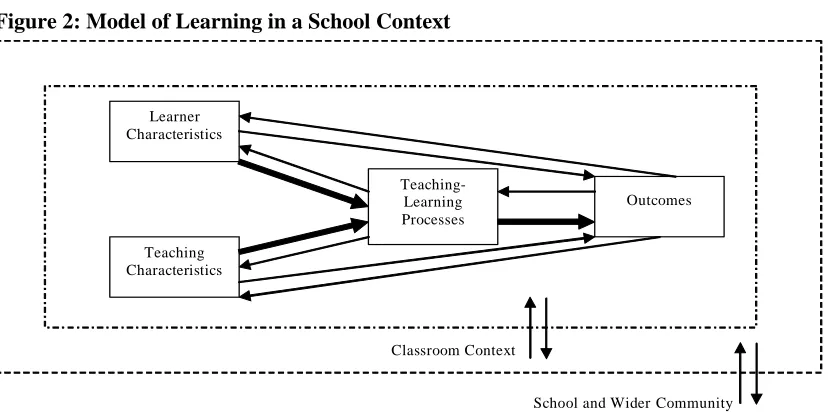
In Anglo-Saxon societies ‘good learning’ has traditionally been described as a sense of deep approaches, which is opposite to the Student-Driven or a surface learning preference (Biggs, 1994). Biggs’ view is consistent with Hassall and Joyce (2001) where they depict good learning occurring when students: use abstract frameworks to conceptualise tasks; plan and monitor their own progress; interpret outcomes; see learning as enjoyable and results based. Biggs and Moore (1993) present their position on ‘good learning’ as being more student-driven than teacher-driven . ‘Good learning’, (Biggs & Moore 1993) occurs when teachers vary their teaching methods and focus on Student-Driven learning through: cooperative group work, subject content being presented in meaningful contexts, small class sizes, teachers ensuring there is a warm classroom climate and assessment addressing high cognitive level outcomes and that is conducted in a non threatening way, see Figure 2.
Figure 2: Model of Learning in a School Context
Learner Characteristics
Teaching Characteristics
Teaching-Learning Processes
Outcomes
Classroom Context
School and WiderCommunity
(Source: Biggs and Moore, 1993, in SIN Research Matters (1996), p1)
One of the most common instruments used to gauge cultural differences based on values is Hofstede’s cultural dimensions, (Robertson 2000; Robertson & Hoffman 2000). Hofstede (1980) found that cultural differences exist across different national boundaries, and thus proposed a four dimensional framework of national culture and more recently added a fifth dimension (Hofstede & Bond 1988; Hofstede 1991b). Hofstede defined culture in terms of five dimensions, and these are: Power Distance, Uncertainty Avoidance, Individualism/Collectivism, Masculinity/Femininity and most recently Confucian Dynamism (Long-Term versus Short-Term Orientation).
may be more comfortable with educational innovations. The Individualism dimension according to Hofstede (1991b), is where the relationships between individuals are loose. Collectivism is its opposite, where relationships are highly respected and valued. He found the top four individualist national cultures to be all Anglo-Saxon, headed by the USA, followed by other European countries. Anglo-Saxon countries tend to score lower on the Collectivism dimension.
Masculinity refers to male dominated countries and they have been characterised (Hofstede 1998) by being competitive and assertive. Anglo-Saxon cultures tend to score higher on the Masculinity dimension that is low Femininity, than Asian cultures with the possible exception of Japan. In contrast to Masculinity, Femininity has been described as countries that tend to favour cooperation, good working relationships and security (Hofstede 1998, 1991a). Therefore students who hold high Masculine values can be described as being goal driven. Within an education context these goals could be in line with quick course completion, which may indeed lead towards students holding a surface or Student-Driven preference to learning. Students who hold low Masculine values or high Feminine values still see goals as important, but they also see gaining knowledge and experiences throughout their course of study as equally important.
Chan (1999) explains that Confucianism encourages the Chinese to respect hierarchical relationships between individuals. Therefore teachers are expected to teach as well as guide students. According to Ballard and Clanchy (1997) Asian students’ academic work style has certain characteristics. These characteristics are: attending all classes, taking detailed notes, seldom contributing to class discussions, and they only ask questions for clarity on a one to one basis with the lecturer. They also highlight the shock that International students face, and call it ‘learning shock’. Cases of learning shock include: lectures running at a very fast pace, rhetorical questions being asked during lectures, no clear ‘correct answer’ identified in lectures, and the feeling it’s impossible to take comprehensive notes of lectures. Therefore what constitutes ‘good learning’ is context and culturally dependent and a Student-Driven Learning Preference can be defined as: low Femininity, that is high Masculinity, low Power Distance, low Uncertainty Avoidance, low Confucian Dynamism (low Confucian) and low Collectivism that is high Individualism.
In contrast to Chan (1999), Woodrow and Sham (1997, 1998), and Biggs (1994), Barron and Arcodia (2002), found Confucian students who study hospitality and tourism in their home countries had a ‘Reflector’ learning style preference. Western students in these courses had an ‘Activist’ learning style orientation. Barron and Arcodia (2002), and Volet and Renshaw (1996) found that the Confucian students over a period of time while studying in Australia, adopted an ‘Activist’ learning style preference, similar to their Western peers. This again highlights that learning approaches are indeed influenced by students’ Cultural Value Profiles and the context for learning. The preceding discussion gives rise to the following Proposition:
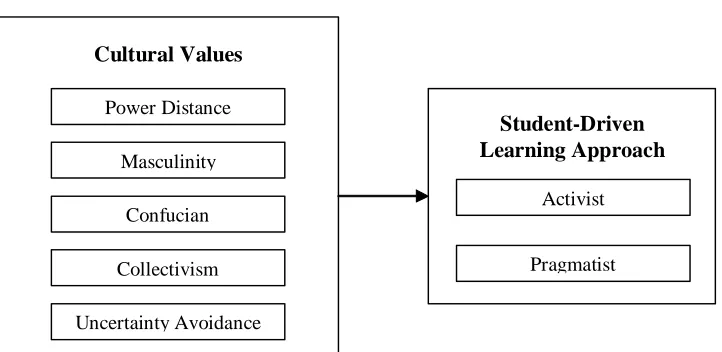
P: That low Femininity that is high Masculinity, Power Distance, Uncertainty Avoidance, Confucian Dynamism (Confucian) and low Collectivism that is high Individualism is positively related to the Student-Driven Learning Preference (the Activist and Pragmatist Learning Styles).
Figure 3: Summary of Variables
Power Distance
Masculinity
Confucian
Collectivism
Uncertainty Avoidance Cultural Values
Student-Driven Learning Approach
Activist
Pragmatist
METHOD
business students was chosen. A total of 455 students were asked to participate in the study. With 80 percent return rate the sample was 364. Robertson and Hoffman’s (2000) scale was used to collect data for the cultural values section, as it was designed to measure an individual’s beliefs along each of Hofstede’s four initial dimensions as well as the Confucian Dynamism dimension. This study focused on the future subset called Confucian in the results. The past/present subset of Confucian Dynamism did not statistically hold in this sample. The cultural values were coded: 1= strongly disagree through to 5 = strongly agree. Honey and Mumford’s (1992) Learning Style Questionnaire was chosen as an appropriate measure to gauge the Student-Driven preference as it was empirically developed from Kolb’s (1974, 1976) theoretical framework. The Student-Driven preference encompasses the Activist and Pragmatist learning styles described by Honey and Mumford (1992) and hence this instrument was used to collect Activist and Pragmatist learning styles data from the respondents. Students rated on a scale of 0 to 5 to what extent they agreed with these statements. The learning preferences were coded: 0 = strongly disagree to 5 = strongly agree. Data was entered into the SPSS version 11 statistical program.
RESULTS
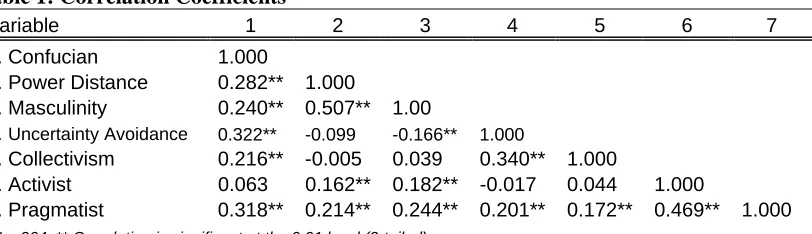
coefficients for the Cultural Values of: Confucian, Power Distance, Masculinity, Uncertainty Avoidance, and Collectivism; and the Student-Driven Learning Preference values of: Activist and Pragmatist are presented in Table 1 below.
Table 1: Correlation Coefficients
Variable 1 2 3 4 5 6 7
1. Confucian 1.000
2. Power Distance 0.282** 1.000
3. Masculinity 0.240** 0.507** 1.00
4. Uncertainty Avoidance 0.322** -0.099 -0.166** 1.000
5. Collectivism 0.216** -0.005 0.039 0.340** 1.000
6. Activist 0.063 0.162** 0.182** -0.017 0.044 1.000 7. Pragmatist 0.318** 0.214** 0.244** 0.201** 0.172** 0.469** 1.000
N = 364, ** Correlation is significant at the 0.01 level (2-tailed).
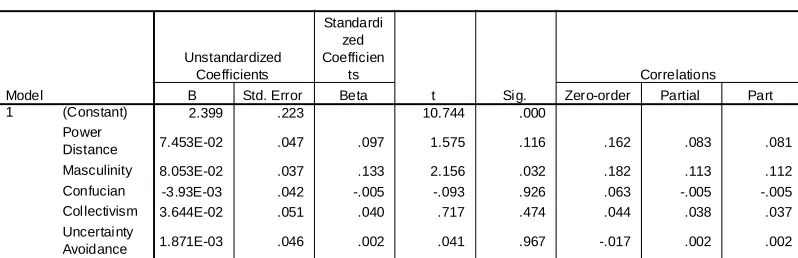
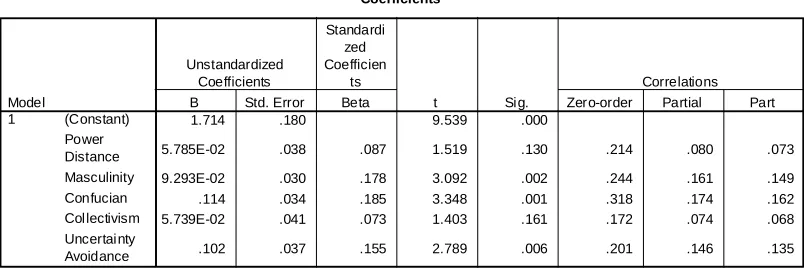
The second section comprises of two OLS regressions that were conducted to test the Proposition. The independent variables were: Power Distance, Masculinity, Confucian, Collectivism and Uncertainty Avoidance. The dependent variables were: the Activist learning style and the Pragmatist learning style in turn. As can be seen in Table 1, Power Distance and Masculinity were significantly correlated at the zero-order level with the Activist learning style. A standard multiple regression analysis was conducted between the Activist learning style and the independent variables of Power Distance, Masculinity, Confucian, Collectivism and Uncertainty Avoidance. The multiple R (0.203) for the regression was significantly different from zero, (F(5,358) = 3.092, p<0.01). In total 4% (3% adjusted) of variation in the Activist learning style was accounted by the variables (R2 = 0.041, adj. R2 = 0.028). Tables 2 and 3 below indicate that the standardized regression coefficient (Beta) for only one of the variables Masculinity was significant. Of the 4% explained variance, Masculinity explained 1.3%. Though Power Distance was also highly correlated to the Activist learning style, it did not produce significant semi-partial correlations when the other variables in the equation were controlled for.
Table 2: Activist Learning Style Model Summary
Model Summary
.203a .041 .028 .5246
Model 1
R R Square
Adjusted R Square
Std. Error of the Estimate
Table 3: Activist Learning Style OLS Regression
Coefficientsa
2.399 .223 10.744 .000
7.453E-02 .047 .097 1.575 .116 .162 .083 .081
8.053E-02 .037 .133 2.156 .032 .182 .113 .112
-3.93E-03 .042 -.005 -.093 .926 .063 -.005 -.005
3.644E-02 .051 .040 .717 .474 .044 .038 .037
1.871E-03 .046 .002 .041 .967 -.017 .002 .002
(Constant) Power Distance Masculinity Confucian Collectivism Uncertainty Avoidance Model 1
B Std. Error
Unstandardized Coefficients Beta Standardi zed Coefficien ts
t Sig. Zero-order Partial Part
Correlations
Dependent Variable: Activist a.
Table 4: Pragmatist Learning Style Model Summary
Model Summary
.406a .165 .153 .4222
Model 1
R R Square
Adjusted R Square
Std. Error of the Estimate
Predictors: (Constant), Uncertainty Avoidance, Power Distance, Collectivism, Confucian, Masculinity a.
Table 5: Pragmatist Learning Style OLS Regression
Coefficientsa
1.714 .180 9.539 .000
5.785E-02 .038 .087 1.519 .130 .214 .080 .073
9.293E-02 .030 .178 3.092 .002 .244 .161 .149
.114 .034 .185 3.348 .001 .318 .174 .162
5.739E-02 .041 .073 1.403 .161 .172 .074 .068
.102 .037 .155 2.789 .006 .201 .146 .135
(Constant) Power Distance Masculinity Confucian Collectivism Uncertainty Avoidance Model 1
B Std. Error
Unstandardized Coefficients Beta Standardi zed Coefficien ts
t Sig. Zero-order Partial Part
Correlations
Dependent Variable: Pragmatist a.
DISCUSSION
High Masculine (goal driven) beliefs (see Tables 3 and 5); High Confucian beliefs (see Table 5); High Uncertainty Avoidance beliefs (see Table 5) seem to be the cultural predictors of a Student-Driven learning preference. This suggests that students who hold a high rating of any combination of these cultural beliefs are more likely to have a Student-Driven learning preference. As expected students who hold high Masculine or goal driven beliefs are more likely to prefer a less structured classroom setting as highlighted by Hancock et al. (2002), Hassall and Joyce (2001), and Webb (1997).
with high Confucian and or Uncertainty Avoidance beliefs have been previously characterised as having a Teacher-Driven learning preference. That is a preference for more hierarchical relationships between students and teachers, and that teachers are expected to guide as well as teach students as suggested by Chan (1999), Woodrow and Sham (1997, 1998), Biggs (1994) and Mohamad (1994). These findings although unexpected could be due to a student learning style adaptation process as has been recorded in other Australian based studies like Barron and Arcodia’s (2002) and Volet and Renshaw’s (1996). Therefore these students who hold high Confucian and or Uncertainty Avoidance beliefs may indeed be in the transition process towards a more Student-Driven learning preference. Students who hold a Student-Driven Learning Preference are highly likely to be a mix of domestic and international students. These students could also be more likely to reduce the subject materials to ensure that they are able to reproduce the information at a later date (Hassall & Joyce 2001). These students may also be highly motivated by subject assessments and hence only focus upon materials and areas where marks are allocated.
as suggested earlier (Biggs 1994; Biggs & Moore 1993; Chan & Drover 1997; Hassall & Joyce 2001) is indeed influenced by students’ preferences towards a Student-Driven Learning approach, and in turn the Student-Driven Learning Preference is influenced by students’ cultural values.
A possible reason for this is that students who reach a tertiary level have been successful in the teaching environment they have studied in and may prefer to have a continuation of the environment they are used to. Therefore if this assumption is correct, Universities need to be aware of their student mix within a classroom setting to ensure appropriate motivations and stimulations are presented within their subject design.
LIMITATIONS
As this study is an exploratory cross-sectional one this research is unable to gauge any changes in business students’ Student-Driven Learning Preference over time. The unexpected findings of high Confucian and Uncertainty Avoidance cultural beliefs predicting the Student-Driven learning preference may indeed highlight a new concept about the student adaptation and learning process, although longitudinal studies that examine students learning preferences over time are needed. This study also only focused on one Australian University with campuses located in Australia. Studies that examine students longitudinally and use multiple campuses are also needed. Hopefully this study has identified some variables worthy of further examination.
Students who prefer the Student-Driven Learning Preference may have the potential to diminish Teacher or even Subject Evaluations if a Teacher-Driven Approach is applied to challenge students’ understanding and knowledge. With the ever increasing issue of quality assurance within the higher education sector and the globalisation of the industry, educators may need to be more sensitive to a Student-Driven Learning Preference if they are to receive favourable student evaluations of teaching.
There are also two other challenges that educators face within this globalised tertiary education sector. First, it is becoming more and more difficult to assess student populations’ learning style preferences based upon residential status (domestic versus international students). Second, student based evaluations may not clearly reflect students’ learning preferences as low satisfaction levels in teaching or subject evaluations may be due to a learning style mismatch.
CONCLUSION
(2002) and Volet and Renshaw (1996). That is, students increasingly become pragmatic in their learning and become assessment driven. Therefore educators need to assess a classroom learning style mix cautiously as domestic and international student status may not be fine grained enough to establish whether their classroom is Student-Driven or Teacher-Driven and commonly held assumptions may be misleading.
REFERENCE LIST
Ballard, B. & Clanchy, J. 1997, Teaching international students: a brief guide for lecturers and supervisors, IDP Education Australia, Deakin ACT.
Barron, P. & Arcodia, C. 2002, "Linking Learning Style Preferences and Ethnicity: International Students Studying Hospitality and Tourism Management in Australia", Journal of Hospitality, Leisure, Sport & Tourism Education, vol. 1, pp. 15-27. Biggs, J. 1994, "Asian learners through Western eyes: an astigmatic paradox",
Australian and New Zealand Journal of Vocational Education Research, vol. 2, pp. 40-63.
Biggs, J. & Moore, P. J. 1993, The process of learning, Prentice-Hall, Sydney. Brown, D. M. 2003a, "Learner-Centered Conditions that ensure Students' Success in Learning", Education, vol. 124, pp. 99-107.
Brown, K. L. 2003b, "From Teacher-Centered to Learner-Centered Curriculum: Improving Learning in Diverse Classroom", Education, vol. 124, pp. 49-54.
Caple, J. & Martin, P. 1994, "Reflections of Two Pragmatists: A Critique of Honey and Mumford's Learning Styles", Industrial and Commercial Training, vol. 26, pp.16-20. Case, J. & Gunstone, R. 2003, "Going Deeper than Deep and Surface Approaches: a study of students' perceptions of time", Teaching in Higher Education, vol. 8, pp. 55-69. Chan, D. & Drover, G. 1997, "Teaching and learning for overseas students: The Hong Kong connection", in Overseas students in higher education: issues in teaching and learning, Eds, D. McNamara & R. Harris, Routledge, London, pp. 46-61.
Chan, S. 1999, "The Chinese learner - a question of style", Education and Training, vol. 41, pp. 294-304.
De Ciantis, S. M. & Kirton, M. J. 1996, "A psychometric reexamination of Kolb's experiential learning cycle construct: A separation of level, style, and process", Educational & Psychological Measurement, vol. 56, pp. 809-820.
De Vita, G. 2001, "Learning Styles, Culture and Inclusive Instruction in the
Multicultural Classroom: A Business and Management Perspective", Innovations in Education and Training International, vol. 38, pp. 165-174.
Drew, F. & Ottewill, R. 1998, "Languages in Undergraduate Business Education: a clash of learning styles?" Studies in Higher Education, vol. 23, pp. 297-305.
Goby, V. P. & Lewis, J. H. 2000, "Using Experiential Learning Theory and the Myers-Briggs Type Indicator in Teaching Business Communication", Business Communication Quarterly, vol. 63, pp.39-48.
Hassall, T. & Joyce, J. 2001, "Approaches to learning of management accounting students", Education and Training, vol. 43, pp. 145-152.
Henson, R. K. & Hwang, D.-Y. 2002, "Variability and prediction of measurement error in Kolb's Learning Style Inventory scores: a reliability generalization study",
Educational & Psychological Measurement, vol. 62, pp. 712-727.
Hofstede, G. 1980, Culture's consequences: international differences in work-related values, Sage Publications, London.
Hofstede, G. 1991a, Cultures and Organisations: Software of the mind, McGraw-Hill, New York.
Hofstede, G. 1991b, Cultures and Organizations, Harper Collins Publishers, London. Hofstede, G. 1998, Masculinity and Femininity: The taboo dimension of national cultures, Cross-Cultual Psychology, London.
Hofstede, G. & Bond, M. H. 1988, "The Confucius Connection: From Cultural Roots to Economic Growth", Organizational Dynamics, vol. 16, pp. 5-21.
Honey, P. & Mumford, A. 1992, The Manual of Learning Styles, Peter Honey, Berkshire.
Honey, P. & Mumford, A. 1995, Using your learning styles, Peter Honey, Berkshire. Jones, C. Reichard, C. & Mokhtari, K. 2003, "Are students' learning styles discipline specific?" Community College Journal of Research and Practice, vol. 27, pp. 363-375. Kolb, D. A. 1974, "On Management and the Learning Process", in Organizational Psychology: a book of readings, Ed D.A. Kolb, Prentice Hall, New Jersey, pp. 27-42. Kolb, D. A. 1976, The learning styles inventory, McBer and Co., Boston.
Landrum, R. E. 1999, "Fifty-Plus Years As a Student-Centered Teacher: An Interview With Wilbert J. McKeachie", Teaching of Psychology, vol. 26, pp. 142-146.
Lavelle, E. & Guarino, A. J. 2003, "A Multidimensional Approach to Understanding College Writing Processes", Educational Psychology, vol. 23, pp. 295-305.
Loo, R. 2002, "A Meta-Analytic Examination of Kolb's Learning Style Preferences Among Business Majors", Journal of Education for Business, May-June, 252-256. Mohamad, O. 1994, "Malaysian students' learning profile: implications for teacher-counsellors' preparation", in 41st International Council of Education for Teaching World Assembly, Istanbul.
Mumford, A. 1996, "Four approaches to learning from experience", The Journal of Workplace Learning, vol. 8, pp. 22-29.
Passman, R. 2003, "Experiences with Student-Centred Teaching and Learning in High-Stakes Assessment Environments", Education, vol. 122, pp. 189-199.
Roach, D. 2003, "Europe's students head down under", Business Review Weekly, vol. 25, pp. 64-67.
Robertson, C. J. 2000, "The Global Dispersion of Chinese Values: A Three-Country Study of Confucian Dynamism", Management International Review, vol. 40, pp. 253-268.
Robertson, C. J. & Hoffman, J. J. 2000, "How different are we? An investigation of Confucian values in the United States", Journal of Managerial Issues, vol. 12, pp. 34-47.
Sharp, J. E. 1997, "Applying Kolb Learning Style Theory in the Communication Classroom", Focus on Teaching, vol. 60, pp. 129-134.
Simon, S. J. 2000, "The Relationship of Learning Style and Training Method to End-user Computer Satisfaction and Computer Use: a structural equation model",
Truluck, J. E. & Courtney, B. C. 1999, "Learning Style Preferences Among Older Adults", Educational Gerontology, vol. 25, pp. 221-236.
Van Zwanenberg, N. Wilkinson, L. J. & Anderson, A. 2000, "Fedler and Silverman's Index of Learning Styles and Honey and Mumford's Learning Styles Questionnaire: how do they compare and do they predict academic performance?" Educational Psychology, vol. 20, 365-380.
Volet, S. & Renshaw, P. 1996, "Chinese students at an Australian university: adaptability and continuity", in The Chinese learner: cultural, psychological and contextual influences, eds D. A. Watkins, & J.B. Biggs, ACER, Melbourne, pp. 205-220.
Way, N. 2003, "Export education eases uni cash pain", Business Review Weekly, vol. 25, pp. 18-19.
Webb, G. 1997, "Deconstructing deep and surface: Towards a critique of phenomenongraphy", Higher Education, vol. 33, pp. 195-212.
Wolfe, D. & Kolb, D. A. 1984; "Career development, personal growth, and experiential learning", in Organizational Psychology: Readings on Human Behaviour in
Organizations, ed D. A. Kolb, Prentice Hall, New Jersey, pp. 124-152.
Woodrow, D. & Sham, S. Y. M. 1997, "The Chinese Family Community and Social Intrusion", in British Educational Research Association Annual Conference, University of York.
Woodrow, D. & Sham, S. Y. M. 1998, "Chinese Pupils and their Learning