Attacking Scrambled Burrows-Wheeler Transform
Martin Stanek
Department of Computer Science, Comenius University Mlynsk´a dolina, 842 48 Bratislava, Slovak Republic
Abstract
Scrambled Burrows-Wheeler transform [6] is an attempt to com-bine privacy (encryption) and data compression. We show that the proposed approach is insecure. We present chosen plaintext and known plaintext attacks and estimate their complexity in various scenarios.
1
Introduction
The Burrows-Wheeler transform (BWT) [2] is a commonly used transform in lossless compression algorithms. The BWT does not compress the data itself, instead it is usually the first step in a sequence of algorithms trans-forming an input data into compressed data. The most prominent example of BWT-based compression is bzip2 program [8], which uses basically the following sequence of algorithms: the BWT, the move-to-front transform (MTF), and Huffman coding.
In practice, there are many situations with the simultaneous require-ments of data compression and privacy (encryption). A common approach is compress-then-encrypt paradigm with independent algorithms used for compression and encryption. While widely preferred, the algorithms should be properly combined in order to avoid possible attacks [1, 5]. Another approach is to unify compression and encryption. However, designing a se-cure, “encrypting” variant of compression method is not an easy task. Many attempts were broken successfully [3, 7, 9].
Our contribution We show that the proposed scrambled BWT with MTF is completely insecure and can be attacked easily (in the sense of cho-sen plaintext as well as known plaintext attacks). In case of known plaintext attacks we estimate experimentally the bit security of the scrambled BWT with MTF in various scenarios.
We briefly introduce the “standard” BWT, the MTF, and the scrambled BWT in Section 2. Section 3 contains our analysis of the proposal, and shows chosen-plaintext and known-plaintext attacks on the scrambled BWT with MTF.
2
Preliminaries
Let A be an alphabet with size L = |A|. Let N denotes a block length. A cyclic rotation of string/block x = x0x1. . . xN−1 ∈ AN with offset k
is string/block x(k) = xkxk+1. . . xk+N where all the indices are computed
moduloN. The w-th symbol ofx(k) is denoted as x(wk), for 0≤w < N.
For real-world scenarios one can expect L = 256 (using bytes as an alphabet) and the block size N several hundreds kilobytes (e.g. bzip2 uses default block size 900kB).
2.1 “Standard” BWT
Let x =x0x1. . . xN−1 ∈ AN be an input block. The BWT sorts all cyclic
rotations x(0), x(1), . . . , x(N−1) of input block x in lexicographic order. Let j0, j1, . . . , jN−1 be a permutation of{0,1, . . . , N−1} such that
x(j0)< x(j1)< . . . < x(jN−1).
Then the result of the BWT is a string consisting of the last symbols from each of the sorted cyclic rotations:
xN(j0−)1, x(Nj1−)1, . . . , x(jN−1) N−1 .
In order to facilitate the inversion transformation, an additional pointer is used to remember the position of the original string x = x(0), i.e. t such that jt = 0. Since the inversion transformation is not important for our
exposition, we will not describe it here.
Example 1. Let A={a,b,c,d} and N = 10. Let x=cdababcdaa be an input block. Applying BWT yields ddbaaabacc, and t= 7.
2.2 MTF
The MTF transforms an input string x = x0x1. . . xN−1 ∈ AN into
se-quence ofN numbers{pi}Ni=0−1, wherepi ∈ {0,1, . . . , L−1}. The algorithm
maintains a table T[0, . . . , L−1] of all symbols from A, initially sorted in lexicographic order. For each i= 0,1, . . . , N−1 the symbol xi is processed
as follows:
1. pi is the position of xi in tableT;
2. T is modified: xi is moved to the front/top of the table.
It is easy to see that the MTF is invertible. The main idea of MTF is that the recently used symbols are encoded as small integers. This makes its output a suitable data for subsequent compression by simple entropy coders such as Huffman or arithmetic coding.
Example 2. Letx=ddbaaabaccbe an input string. The output of MTF is 3022001130.
2.3 Scrambled BWT with MTF
O˘guzhan K¨ulekci [6] proposed scrambled BWT, where a secret (encryption) key is a secret lexicographic order of symbols in A. One of the claimed advantages is a large key space, for L = 256 it is 256! keys. The author observed, that using scrambled BWT is not secure enough, and can be at-tacked by exploiting known statistical relationships among plaintext symbols (e.g. digram frequencies). Therefore he accompanied the scrambled BWT (sBWT) with MTF, where the secret lexicographic order is applied as well (i.e. the initialization of T depends on this order):
“. . . Thus, initializing the alphabet ordering in MTF with the secret lexicographic order used in sBWT provides protection against that statistical attack.”
Example 3. Let x =cdababcdaa be an input block. We show the result of sBWT and MTF with various lexicographic orders:
key k sBWT with k MTF withk
c<a<d<b −→ baadbdccaa (t= 1) −→ 3203213030
d<c<b<a −→ ccabaaabdd (t= 2) −→ 1033100130
3
Security analysis
Let us denote the secret lexicographic order as k and the corresponding scrambled BWT as sBWTk. Similarly, the MTF with secret lexicographic
order is denoted as MTFk. Letxbe an input block. The author proposes [6]
the same secret key (secret lexicographic order) for both transformations: MTFk(sBWTk(x)).
Let us note that attacks described in this sections will work even for sit-uation with two independent secret keys: MTFk2(sBWTk1(x)). The attack
will “undo” the MTF (revealing the value of sBWTk1(x)), and the sBWT
part can be attacked by exploiting the statistical properties of plaintext as suggested in [6].
Remark 1. We can ignore other pre- and post-processing steps in the com-pression algorithm, since they do not depend on the key.
We base our analysis on the following observations:
1. The scrambled BWT, with secret lexicographic order as a key, keeps the frequencies of symbols intact, i.e. when symbol ‘a’ appearsltimes in an input block, then ‘a’ will appear exactly l times in the out-put block. One can view sBWTk as a key-dependent and
plaintext-dependent permutation cipher.
2. For any string z and any two lexicographic orders k1,k2, performing
y= MTF−k21(MTFk1(z)) can be viewed as a monoalphabetic
substitu-tion, i.e. it change the symbols but it does not change the frequencies. For example, ‘a’ can become ‘w’, ‘b’ can become ‘f’ . . . but in such case the number of a’s inz is the same as the number of w’s iny, the number of b’s inz is the same as the number of f’s in y etc.
For the rest of the section we denote an input block x and the resulting block y = MTFk(sBWTk(x)). Our analysis is done primarily with single
data block (it is sufficient for most scenarios). However, it can be extended to multiple blocks in a straightforward manner, see Section 3.3.
3.1 Chosen plaintext attack
The goal of the attack is to identify a secret key (lexicographic order):
1. Construct input blockx, where symbols fromAhave unique frequen-cies.
2. Compute z∗ = MTF−k01(y) for an arbitrary lexicographic order k0.
4. Reconstruct the key fromz and y.
Let A = {a1, . . . , aL}. The chosen input block can be, for example,
a1a2a2a3a3a3. . .finishing with L symbolsaL. Then we can reconstruct the
key from this single block as long as the block size is at least L+12 (for L= 256 it is 32 896). The complexity of the attack is Θ(L2) (counting all its steps).
Example 4. Let us illustrate the attack with the following toy example. Let
A= {a,b,c,d} and N = 10. We choose the input block x =abbcccdddd, and observe the output y = 3133001022. We apply inverse MTF with natural lexicographic order (a < b < c < d): z∗ = dacbbbccab. Pairing symbols with equal frequencies yieldsz =abcdddccbd. Knowing “middle” value z and the result of MTFk(z), i.e. y, we can easily reconstruct the
secret lexicographic order: b<d<c<a.
3.2 Known plaintext attack (single block)
Known plaintext attack extends the previous attack assuming that the at-tacker cannot control the frequencies of particular symbols in the input data. However, considering the block sizes used in practice (e.g. default 900kB block size in bzip2), the probability of equal frequencies of symbols is rather low. Moreover, longer blocks usually lead to better compression.
Remark 2. For short blocks, one can assume that the attacker will know the input data for multiple blocks. Therefore he can combine results from these blocks and significantly reduce the complexity of the attack further, see Section 3.3.
Let us denote by #v(x) the number of symbols v ∈ A in the string x.
LetC(x) = {#v(x) |v∈ A} be the set of all distinct values of #v(x). For
each valuer∈C(x) we define size(x, r) to be the number of symbols having exactlyr occurrences inx, i.e. size(x, r) =|{v∈ A |#v(x) =r}|.
The attacker proceeds similarly to the chosen plaintext attack, comput-ing z∗ = MTF−k01(y) for an arbitrary lexicographic order k0. Then he tries
to pair symbols in x and z∗ according their frequencies to recover the cor-rect “middle” valuez= sBWTk(x) = MTF−k1(y). However, this time there
in no guarantee of unique frequencies, therefore the attacker can perform an exhaustive search for all assignments of symbols in groups with equal frequencies. For each assignment, the attacker computes a corresponding lexicographic order and performs an inverse BWT with this order. Compar-ing the result with the original plaintext gives a confirmation/rejection of particular assignment. The size of the search space is
SS(x) = Y
r∈C(x)
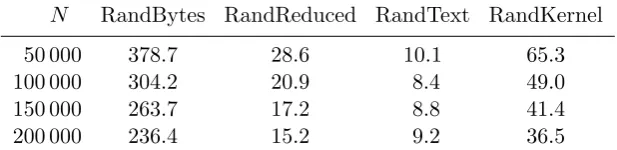
We measure the complexity of our known plaintext attack as bit security of the cipher, i.e. binary logarithm of the corresponding search space size: log2SS(x). In order to estimate the bit security, we performed the following experiments:
RandBytes We generate the input block as a stream of randomly and in-dependently generated bytes (i.e. L= 256) with uniform distribution. Since in real-world one can expect much more “compressible” input block (with greater variation of symbols frequencies), our model sim-ulates the worst situation for the attacker. Therefore, the estimations obtained in this experiment can be viewed as upper bounds for bit security of the cipher.
RandReduced This is a similar experiment as the previous one, but this time we restrict possible symbols to the set of L= 100 symbols (gen-erated with uniform distribution). The rest of the symbols are not generated.
RandText This and the last experiment (RandKernel) are probably the most realistic of our experiments. In RandText we model the input block as a stream of independently generated bytes, where the proba-bilities of individual symbols correspond to the probaproba-bilities of symbols in a novelCrime and Punishment [4].
RandKernel Similar experiment to RandText. However, this time the probabilities of individual symbols (bytes) correspond to the probabil-ities of symbols inkernel32.dll file in Windows 7.
We gradually increased N in each experiment and computed the aver-age bit security of the cipher. The averaver-age value was computed from 1000 samples. It is interesting to see the level of bit security degradation from the theoretical level: log2(256!)∼1684 bits. The values for RandReduced, RandText and RandKernel experiments show that the scrambled BWT with MTF offers practically no security. The results are shown in Table 1.
N RandBytes RandReduced RandText RandKernel
50 000 378.7 28.6 10.1 65.3
100 000 304.2 20.9 8.4 49.0
150 000 263.7 17.2 8.8 41.4
200 000 236.4 15.2 9.2 36.5
3.3 Known plaintext attack (multiple blocks)
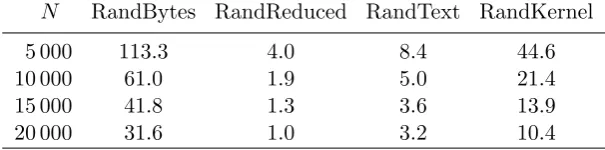
The known plaintext attack from previous section can be easily extended for multiple blocks, with improved performance. The majority of “ties” (groups of symbols with equal frequencies) in one block can be broken by consid-ering the frequencies in other blocks. In order to illustrate this effect, we performed experiments similar to those in the previous section (RandBytes, RandReduced, RandText, and RandKernel). However, this time we used two blocks of known plaintext and 10 times smaller block sizes. The results are shown in Table 2 (again, 1000 samples were used to estimate individual values). Even with such artificially small block sizes one can observe further decrease in the bit security of the scrambled BWT with MTF.
N RandBytes RandReduced RandText RandKernel
5 000 113.3 4.0 8.4 44.6
10 000 61.0 1.9 5.0 21.4
15 000 41.8 1.3 3.6 13.9
20 000 31.6 1.0 3.2 10.4
Table 2: Bit security for two blocks KPA (with block size N)
4
Conclusion
Usually, providing privacy (encryption) by modifying the data compression techniques is not a good idea in practice. We demonstrated the security problems of the scrambled BWT with MTF. Moreover, it seems that these problems cannot be easily fixed. Further extensions of our attacks can be aimed at known plaintext attack with only partial block knowledge, or even ciphertext only attacks. However, the already identified weaknesses of the cipher allow us to conclude that the cipher is insecure.
Acknowledgment This work was supported by P12/1.
References
[1] Eli Biham and Paul C. Kocher. A Known Plaintext Attack on the PKZIP Stream Cipher. Fast Software Encryption, FSE’94, Lecture Notes in Computer Science vol. 1008, Springer, pp. 144–153, 1995.
[3] John G. Cleary, Sean A. Irvine and Ingrid Rinsma-Melchert. On the insecurity of arithmetic coding. Computers & Security, 14(2):167–180, 1995.
[4] Fyodor M. Dostoevsky.Crime and Punishment. Project Guttenberg, vol. 2556, English translation by C. Garnett, 2006.http://www.gutenberg. org/ebooks/2554
[5] Tadayoshi Kohno. Attacking and repairing the winZip encryption scheme, ACM Conference on Computer and Communications Security, CCS’04, pp. 72–81, 2004.
[6] M. O˘guzhan K¨ulekci. On scrambling the Burrows-Wheeler transform to provide privacy in lossless compression,Computers & Security, 31(1):26– 32, 2012.
[7] Jen Lim, Colin Boyd and Ed Dawson. Cryptanalysis of Adaptive Arith-metic Coding Encryption Schemes. Information Security and Privacy, Second Australasian Conference, ACISP’97, Lecture Notes in Computer Science vol. 1270, Springer, pp. 216–227, 1997.
[8] J. Seward. bzip2,http://www.bzip.org, 1996-2012.