Available online: https://edupediapublications.org/journals/index.php/IJR/ P a g e | 811
Secure Data Split Schema for Functional Groups in the Cloud
Ch. Mallikarjuna1, B. Nagendra Reddy 2
1PG Scholar, Dept of CSE, Dr.Samuel George Institute of Engineering & Technology, Markapur, Prakasam Dist, AP.
2Associate Professor, Dept of CSE, Dr.Samuel George Institute of Engineering & Technology,
Markapur, Prakasam Dist,AP.
Abstract: Sharing group resource number of cloud users is a major problem so cloud computing provides low cost and efficient solution. Due to frequent change of membership sharing data in a multi-owner manner to an untrusted cloud is still a challenging models. The sharing of data in group members to split data and also provides security from untrusted users by providing security from entrusted users. It will also grants take data from the cloud to group members. In this proposition a protected multi- proprietor data sharing plan for element bunch in the cloud by giving AES encryption while procedure the data any cloud client can safely impart data to others. In the interim the capacity overhead and encryption calculation expense of the plan are free with the quantity dictions clients. We propose a secure data sharing method for dynamic membersto provide secure key distribution without any secure communication approach and the users securely obtain their security keys from group manager. It provides a multiple levels of security to share data number of multi-owner manner. First the user selects the text based password is known as OTP is generated automatically and sent to corresponding user e-mail account. After completion of authentication and key generation process it will encrypt the shared data by using security algorithm is implementing same concepts we can provide scalability and also provide more flexibility of shared data in cloud.
Index Terms: Cloud computing, Broadcast encryption, cryptography, security, group key, verification.anti-collusion, group manager, group user.
1.
INTRODUCTION
Cloud computing is Internet based
development and use of computer present generations it is a new computing in which
dynamically scalable and security
virtualization locations is provided as a service over the internet. One of the most importance services is offered by cloud providers are data storage isconsidering a practical data application [1]. A company takes its staffs in the same group to store and destitutions files in the cloud. It also
providea significant risk to the
confidentiality many stored files.
Available online: https://edupediapublications.org/journals/index.php/IJR/ P a g e | 812
updating the secret key of remaining user to
minimize the complexity of key
management. Security receipt is caused after every member revocation in group that minimizes multiple copy of encrypted file it can help to minimize computation cost [4]. The cloud computing privacy is a definite set of control based models and policies designed to changed and monitoring the data of rules and security the information and its data application and infrastructure linked with cloud computing to use [5]. Different procedures are proposed to check the new shared data[6]. The majority of the work proposes systems to confirm the honesty of single proprietor shared data as opposed to multi-proprietor information. Multi-proprietor data is information where every square is modify member of clients [7]
Fin No 1 Cloud Computing Model
2. RELATED WORK
S. Kamara[9] is proposed a security for customers to store and share their security data in the cryptographic cloud storage. It provides a basic encryption and decryption for providing the security. The locations operation is main performance killer in the
cryptographic access control system.E.
Goh[8] presented a SiRiUS, a secure file system designed to be layered over insecure network and P2P file systems such as NFS, CIFS, Ocean Store, and Yahoo! Briefcase. SiRiUS assumes the network storage is untrusted and provides its own read-write cryptographic access control for file level sharing. Key modifications and remove the
simple with minimal out-of-band
communication.[10] Presented
cryptographic storage system that enable secure data sharing. In this methods dividing file into the file group and security each file group with a file block key. In this method at the time of user revocation the file block key uses to be updated and shared to the user the system had a heavy key distribution overhead [11] Propose secure multiowner data sharing model named as Mona. He claimed his method achieve fine grained access control and revoked user is access the shared data again after he was revoked by the cloud and revoked user this model should be suffer from the collusion attack. Revoked users use his security key to decrypt the encrypted data after his revocation.In 2003, Kallahalla[12] It enables the secure file sharing on the untrusted cloud servers uses the cryptographic storage system the files are divided into the file groups and security both groups with a unique file block key. Now the user to share the file groups with the others by delivering the matching lock box keys. The lock box key is used for modifying the file-block keys. But this changes heavy key dispersion for the enormous amounts of file sharing.
3. SYSTEM ARCHITECTURE
Available online: https://edupediapublications.org/journals/index.php/IJR/ P a g e | 813
Level 1: Security at level 1 has been imposed by simple text based password.
Level 2: After the successful clearance of the above level the Level 2 Security System will then generate a one-time numeric password that would be valid just for that login session. The authentic user will be informed of this one time password on his email id.
Fig. 3.System Architecture
Secure environments security their resources against unauthorized access by enforcing access control model. So it increasing security is an issue text based passwords is enough to counter such problems. Using the
instant messaging service available in
internet user will change the One Time Password (OTP) after image authentication. This OTP is used by user to access their personal accounts. In this paper one time password to achieve high level of security in authenticating the user over the internet.
4. PROPOSED SYSTEM
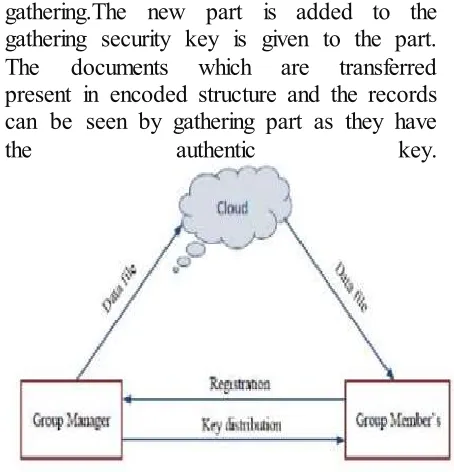
The gathering chief will keep up the renouncement rundown of the different ways. On the off chance that any of the part leavesto gathering the part detail to added rundown and the client won't have the
capacity to security login to that
gathering.The new part is added to the gathering security key is given to the part. The documents which are transferred present in encoded structure and the records can be seen by gathering part as they have
the authentic key.
Fig No 4. Proposed system Architecture
AES Encryption
The information 16 byte Plain data can be changed over into 4×4 square lattice.
The AES Encryption comprises of four distinct stages they are
Substitute Bytes: Uses a S-box to play out a byte-by- byte substitution of the square
Shift Rows: A Simple Permutation
Blend Columns: A substitution that makes utilization of number juggling
Include Round Key: A Simple Bitwise XOR of the present piece with the segment of the extended key (security key).
AES Decryption
The Decryption calculation makes
utilization of the key in the opposite request. it may the decoding calculation is not
indistinguishable to the encryption
Available online: https://edupediapublications.org/journals/index.php/IJR/ P a g e | 814
Admin or Group Owner
1. Group Creation Groups are creating by admin. A company accesses its staffs in the same group to store and share files in the cloud. Any member in a group is able to fully enjoy the data storing and sharing produces provided by the cloud in the multiple-owner manner.
2. User Registration For the registration of user with security identity ID the group manager randomly selects a number and characters for generate random key is used for group signature generation and file decryption.
3. Group Access ControlWhen a data shared occurs the tracing operation is performed by the group manager to find the real identity of the data owner. The requirement of access control is twofold. First group members isto use the cloud locations for data operations. Second unauthorized users cannot access the cloud resource at any time and removed users will be incapable of using the cloud again once they are removed.
4. File Deletion File stored in the cloud is deleted by either the group manager data owner. To delete a file ID data the group manager computes a signature ID data and sends the signature many ID data to the cloud.
5. Revoke UserUser revocation is
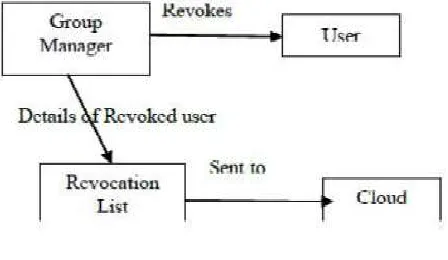
performed by the group manager in a public available revocation list RL, based on which group members is encrypt their data files and security the confidentiality against the revoked users.
6. OTP (One Time Password) OTPs is removed number of shortcomings the associated with traditional passwords. The
most important shortcoming that is
addressed by OTPs is thatin contrast to static passwordsis not vulnerable to replay attacks.
Generation of OTP Value The algorithm can be described in 3 steps:
Step 1: Generate the HMAC-SHA value Let HMK = HMAC-SHA(Key, T) // HMK is a 20-byte string
Step 2: Generate a hex code of the HMK. HexHMK=ToHex (HMK)
Step 3: Extract the 8-digit OTP value from the string OTP = Truncate (HexHMK) the Truncate function in Step 3 does the dynamic truncation and reduces the OTP to 8-digit.
Repudiate client from the gathering user renouncement is performed by gathering chief by executing a polynomial capacity done by gathering director alone. Once the client is denied from the gathering, then the gathering part is capable access the cloud assets and its information
Fig No 5 Group Revocation in Cloud
5. RESULTS AND DISCUSSION
Available online: https://edupediapublications.org/journals/index.php/IJR/ P a g e | 815
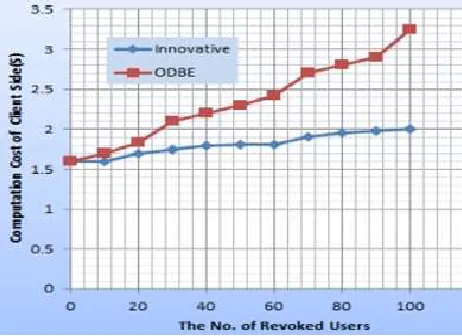
content sharing. The remaining users is used to update security preserved data sharing for dynamic groups in the cloud the method combines the group signature and signed receipt and dynamic broadcast encryption method.Specially, the group signature and signed receipt scheme enables usersto anonymously use the cloud location, and thedynamic broadcast encryption model access dataowners to securely share their data files with other including new joining users.
Fig No 6 ODBE Represent Model
6. CONCLUSION
It supports efficient user revocation and new user joining. More specially, efficient user revocation is achieved through a public revocation list without updating the security keys of the remaining users and new users can directly decrypt files stored in the cloud before their participation. Our scheme is support dynamic groups efficiently new user joins in the group or a user is revoked from the group the security keys of the other users do not need to be recomputed and updated. The cloud server contains all information within format of cipher and if any group member wants the particular file retrieves. We can provide more security of shared data
and low cost this system is users friendly. Tempest attack and Brute-force attack at the client side though 3-Level Security system is a time consuming models it will take to strong security where we need to store and maintain crucial and confidential data secure Such systems provide a secure channel of communication between the communicating entities
7. FUTURE WORK
In our plan we uses two sorts of calculations to scramble and unscramble the data put away in the cloud for more security is
utilized to make more troublesome
framework for assault. In this plan we uses sending instrument in which transferring client has power to forward his information to the next client and asked for client downloading client will take for data to the transferring client..
8. REFERENCES
[1] M. Armbrust, A. Fox, R. Griffith, A. D. Joseph, R. Katz, A. Konwinski, G. Lee, D. Patterson, A. Rabkin, I. Stoica, and M. Zaharia. “A View of Cloud Computing,” Comm. ACM, vol. 53, no. 4, pp. 50-58, Apr.2010
[2] M. Armbrust, A. Fox, R. Griffith, A.D. Joseph, R.H. Katz, A. Konwinski, G. Lee, D.A. Patterson, A. Rabkin, I. Stoica, and M. Zaharia, “A View of Cloud Computing,” Comm. ACM, vol. 53, no. 4, pp. 50-58, Apr. 2010.
Available online: https://edupediapublications.org/journals/index.php/IJR/ P a g e | 816
[4]. Jun Zheng and Abbas Jamalipour, “Wireless Sensor Networks: A Networking Perspective”, a book published by A John & Sons, Inc, and IEEEE, 2009.
[5]. Zhongma Zhu and Rui Jiang, “A secure anti-collusion data sharing scheme for dynamic groups in the cloud”, IEEE Transactions on parallel and distributed systems, vol.27, no.1, January 2016
[6] A. Fiat and M. Naor, “Broadcast
Encryption,” Proc. Int‟ lCryptology Conf.
Advances in Cryptology (CRYPTO), pp. 480-491, 1993.
[7] E. Goh, H. Shacham, N. Modadugu, and
D. Boneh, “Sirius: Securing Remote
Untrusted Storage,” Proc. Network and
Distributed Systems Security Symp.
(NDSS), pp. 131-145, 2003.
[8] M. Kallahalla, E. Riedel, R.
Swaminathan, Q. Wang, and K. Fu, “Plutus: Scalable Secure File Sharing on Untrusted Storage,” Proc. USENIX Conf. File and Storage Technologies, pp. 29-42, 2003.
[9] S. Kamara and K. Lauter,
“Cryptographic Cloud Storage,” Proc. Int‟ l
Conf. Financial Cryptography and Data Security (FC), pp. 136-149, Jan. 2010.
[10]. M. Kallahalla, E. Riedel, R.
Swaminathan, Q. Wang, and K. Fu, “Plutus: Scalable Secure File Sharing on Untrusted Storage,” Proc. USENIX Conf. File and Storage Technologies, pp. 29-42, 2003.
[11] Varun and VamseeMohan.B,” An Efficient Secure Multi Owner Data Sharing for Dynamic Groups in Cloud Computing”, International Journal of Computer Science and Mobile Computing, Vol.3 Issue.6, June- 2014, pg. 730-734
[12]. Jun Zheng and Abbas Jamalipour, “Wireless Sensor Networks: A Networking Perspective”, a book published by A John & Sons, Inc, and IEEEE, 2009.
Student details:
CH.MALLIKARJUNA Email:mallikarjunareddy.528 @gmail.com
Chinnapureddy Mallikarjuna is one of the author received
M.Tech (CSE) Degree from JNT
UNIVERSITY KAKINADA in 2016. He is studying M.Tech in Dr.Samuel George Institute of Engineering & Technology, Markapur, Prakasam District, AP.
Guide details:
B.Nagendra Reddy Email: