Available Online atwww.ijcsmc.com
International Journal of Computer Science and Mobile Computing
A Monthly Journal of Computer Science and Information Technology
ISSN 2320–088X
IJCSMC, Vol. 3, Issue. 2, February 2014, pg.100 – 104
RESEARCH ARTICLE
High Efficiency Data Access System
Architecture for Deblocking Filter Supporting
Multiple Video Coding Standards
S.Karthikeyan
1, K.Saran
21
Associate professor, Department of ECE, PSNA college of Engineering and Technology, Dindigul, India 2
Lecturer Department of CSE, PSNA College of Engineering and Technology, Dindigul, India Email: [email protected], [email protected]
Abstract--- In this Paper, we propose a novel algorithm for block artifact reduction for which Pseudo random noise masking is used. In H.264 Video Compression Standard, an In-loop Deblocking filter is implemented to reduce the quantization noise around the block boundaries. But there would still remain artifacts within blocks. These artifacts are known as Contour artifacts. These Contour artifacts further be reduced by our Proposed Pseudo Random Noise Masking Method. The Proposed method is selectively applied to macro-blocks damaged by block artifacts after H.264 Deblocking filtering. Its effectiveness will be clearly demonstrated for all the evaluation aspects. We estimate the level of block artifacts by measuring PSNR of the block artifact Video.
Keywords: Block Artifact image; Discrete Cosine transform; Deblocking Filter; Quantization; Multi Directional gradient Count.
I.INTRODUCTION
The deblocking filter (DF) [1] is an important feature in H.264/AVC, the most recent video coding standard [2]. It reduces blocking artifacts and offers up to 9% bit-rate-saving. Efficient implementation of the DF is essential for high-resolution video applications. High-definition TV (HDTV) is becoming increasingly common in many industrialized countries. Several companies have focused on achieving future ultra high resolution video. For example, NHK proposed a Super Hi-Vision [3] broadcasting system. Chi Mei Optoelectronics recently unveiled an advanced Quad Full High Definition (QFHD) LCD display panel. Among the H.264 baseline profile (BP) designs [3]-[5], the design [3] used a separate filter method with the original filter order defined by the standard. It filters all the vertical edges in a MB, and then filters all the horizontal edges.
inverse DCT transformed [6]. To enable interchange and distribution of visual information, highly efficient digital video-compression techniques are required. Applications include video conferencing, videophones, remote monitoring and control, information base retrieval, and video on demand [7]. Filtering solutions are predominantly “soft” in nature, leading to a probable process overhead and loss in real-time constraints as compared to a hardwired approach.
II.BLOCK ARTIFACT
In H.264,an in-loop Deblocking filter is utilized to reduce the quantization noise around block boundaries. However, there would still remain artifact with in blocks, which are known as contour artifacts. These Contour Artifacts are the unintentional result of quantization parameter (High QP) and it become visually distinct as the bit-depth of video is decreased.
To overcome this Problem in H.264,the Deblocking filter can be integrated with Our Proposed Pseudo Random Noise mask Method. Deblocking Filter does not consider whether the video is affected by Blocking Artifact or not. It works on all the pixels (which may be affected by Block Artifact or not).
The Deblocking Filter creates the noisy pixels when the non-blocking Artifact Video is being processed. It works well only on the Block Artifact affected Video. But Our Proposed Pseudo Random Noise Mask performs multi-stage refinement process using QP(Quantization Parameter),MB(Macro Block) Mode and Directional Gradients to find whether the block is affected by Blocking Artifact. If the processed Block is not affected by Blocking Artifact, then it skips to the Next Block of the Processing Video.
Fig 1: Occurring of Block Artifact in video
III.PROPOSED METHOD
The Proposed method is selectively applied to macro-blocks (MB’s) damaged by block artifacts after H.264 Deblocking filtering. For the Video format 4:2:0, there are W*H Luminance(Y) and (W*H)/4 -Cb values and (W*H)/4
-Cr values.
For the Block of 16*16 video(4:2:0 format) , there may be Luma: 16*16 and Chrominance: Cb =W/2 *H/2=8*8
Cr = W/2 *H/2=8*8
STEP: 1 Create Pseudo Random Noise Mask
The Pseudo Random Noise Mask consists of three components -1,0 and 1. These are randomly filled for 16*16 luma Blocks memory and 8*8 Cb Blocks memory and 8*8 Cr Blocks memory. Here the Occurrence Probability of each
component can vary depending on the level of the artifacts in a block.
STEP:2 SELECTION OF BLCOK ARTIFACT AFFECTED MB
To prevent the unnecessary Processing on normal MBs, we pick out such MBs that probably hold those artifacts. The Selection of Block Artifact affected MBs depends on the following multi-stage refinement process as follows: QP, MB Mode, Multiple Directional Gradients and Human Visual Characteristics.
From our analysis, it was found that MBs with potential block artifacts are highly related to those conditions that their QP values are greater than 23 and each of them is not a skip mode. To further refine the MB Candidates ,the Multi-direction gradients are used to quantify the flatness of an MB. The Artifacts are mainly occurred in MBs that are on a flat area.
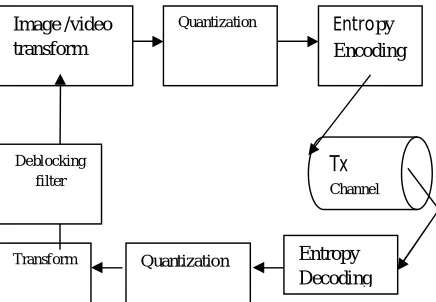
Tx Channel Image /video
transform
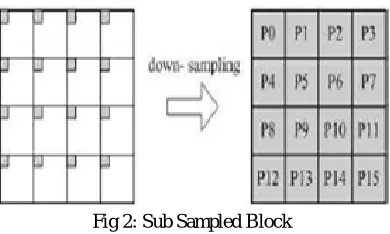
Fig 2: Sub Sampled Block
A luma MB, Consisting of sixteen 4*4 sub blocks ,is sub sampled in to a 4*4 block, xi,j,by extracting top-left
pixels from sub-blocks, where I and j are the horizontal and vertical indices of 0 to 3,respectively. Find the Multi-Directional Gradient Count (SGC) of 00,450, 900 and 1350:
If the calculated Multi-Directional Gradient Count is greater than 36, then the corresponding MB is decided as being flat.i.e.,MB is affected by Block Artifact. If the calculated Multi-Directional Gradient Count is lesser than 36, then the corresponding MB is decided as being non-flat MB.i.e.,MB is skipped by non-Processing of further Implementation.
Fig 3: Flowchart of Proposed Method START
END
Noise mask .cb.cr seting
(QPThe.&& Mb mode!=skip)?
Plane & sensitivity
mb?
STEP:3
In the final stage, for the MBs passed through the second stage, the noise masks set in the first stage are simply added to the input data. On the other hand, according to the human visual characteristic ,it is widely known that the human eye is more sensitive at the middle luminance region that at both low and high regions. Using this we can further refine the candidate MBs as limiting the noticable artifacts to those middle intensity regions of local area.
IV.SIMULATION RESULTS
There are two modes, DC offset mode and Default mode. In deblocking filter, one of the 2 modes will be selected based on the boundary pixel conditions. If the boundary is in very smooth region with blocking artifact, then DC Offset mode is selected, else default mode will be selected .If the level of Artifact is minimum in boundary or edge region, then default mode is preferred. But, if the level of Artifact in boundary or edge region is high, then DC offset mode is preferred. Take each 4 pixels (right and left) from the boundary or edge region. Let the pixels be v1,v2………..v8. Find the maximum value among these 8 pixels and noted as MAX. Find the minimum value among these 8 pixels and noted as MIN. Find the absolute difference between MAX and MIN. Compare this absolute difference value with Quantization Parameter(QP) and based on the comparison result, find the new artifact removed pixels v11 , v21 ………..v81 .Replace the old pixels v1,v2……..v8 with the new pixels v11,v21 ………..v8
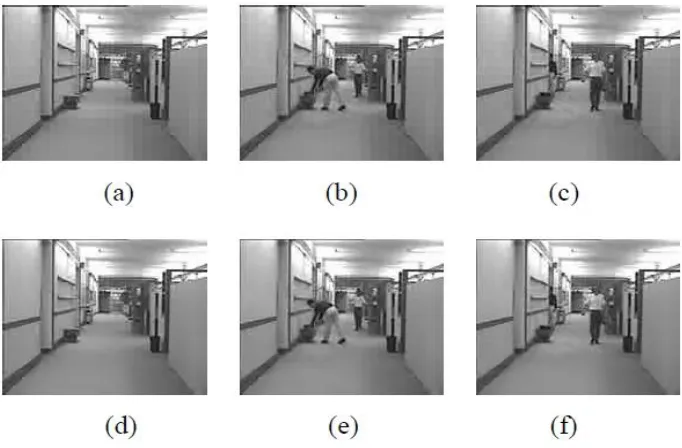
Fig 4.a,b,c artifact affected images-d,e,f artifact removed images
V.CONCLUSION
REFERENCES
[1] P. List, A. Joch, J. Lainema, G. Bjøntegaard, and M. Karczewicz, “Adaptive deblocking filter,” IEEE Trans. Circuits Syst. Video Technolo., Vol. 13, No. 7, pp. 614-619, July 2003.
[2] Paul A. High Performance Adaptive Deblocking Filter for H.264/AVC. IETE Tech Rev 2013; 30:157-61Y.
[3] W. Huang, T. W. Chen, B. Y. Hsieh, T. C. Wang, T. H. Chang, and L. G. Chen, ‘‘Architecture design for deblocking filter in H.264/JVT/AVC,’’ Proc. IEEE Int. Conf. Multimedia and Expo, Vol. 1, pp. I-693-696, Jul. 2003.
[4] T. M. Liu, W. P. Lee, T. A. Lin, and C. Y. Lee, ‘‘A memory-efficient deblocking filter for H.264/AVC video coding,’’ Proc. IEEE Int. Symp. Circuits Syst., vol. 3, pp. 2140--2143, May 2005.
[5] Zhigang Fan and Fu Li ,“Reducing artifacts in jpeg decompression by segmentation and smoothing”, Proc IEEE conf,1996.
[6] Thomas Meier, King N. Ngan, and Gregory Crebbin, “,Reduction of Blocking Artifacts in Image and Video Coding” , IEEE transactions on circuits and systems for video technology, vol. 9, no. 3, April 1999.
[7] Seungjoon Yang, Yu-Hen Hu,, Truong Q. Nguye, and Damon L. Tull,, “Maximum-Likelihood Parameter Estimation
for Image Ringing-Artifact Removal”, IEEE transactions on circuits and systems for video technology, vol. 11, no. 8, august 2001.