Toward A More Efficient Gröbner-based
Algebraic Cryptanalysis
Hossein Arabnezhad-Khanoki and Babak Sadeghiyan
Department of Computer Engineering & Information Technology, Amirkabir University of Technology, Tehran, Iran
{arabnezhad,basadegh}@aut.ac.ir
Abstract. In this paper, we propose a new method to launch a more efficient algebraic cryptanalysis. Algebraic cryptanalysis aims at finding the secret key of a cipher by solving a collection of polynomial equations that describe the internal structure of the cipher, while chosen correlated plaintexts, as what appear inhigher order differentialcryptanalysis and its derivatives such as cube attack or integral cryptanalysis, forces many linear relation between intermediate state bits in the cipher. In this pa-per, we take these polynomial relations into account, so it become possi-ble to simplify the equation system arising from algebraic cryptanalysis, and consequently solve the polynomial system more efficiently. We take advantage of Universal Proning technique to provide an efficient method to recover such linear polynomials. Another important parameter in al-gebraic cryptanalysis of ciphers is to effectively describe the cipher. We employ FWBW representation of S-boxes together with Universal Pron-ing to help provide a more powerful algebraic cryptanalysis based on Gröbner-basis computation. We show our method is more efficient than doing algebraic cryptanalysis with MQ representation, and also than em-ploying MQ together with Universal Proning. To show the effectiveness of our approach, we applied it for the cryptanalysis of several light weight block ciphers. A by-product of employing this approach is that we have achieved such an efficiency to algebraic cryptanalyse 12-round LBlock, 6-round MIBS, 7-round PRESENT and 9-round SKINNY light-weight block ciphers, so far.
Keywords: Algebraic Cryptanalysis, Gröbner basis, Universal Proning, S-box representation
1 Introduction
It is already known that highly structured plaintexts such as what appears in integral or cube attacks, impose some correlation between intermediate state bits with different plaintexts in the structure. For example, the multi-set of correlated plaintexts in integral cryptanalysis, or cubes in cube attack, cause the sum of some intermediate states bits over all plaintexts be a constant value, for some number rounds .
The idea in this paper is to use such relations to improve algebraic attacks that are based on computation of Gröbner basis. In integral cryptanalysis, these relations are computed by a specific algebra that is defined for the propagation of these relations on a multi-set through the block cipher. In cube attack, these relations are described as Boolean polynomials. With the probabilistic BLR lin-earity test [9] or its generalized form [7,10], it is possible to mark off them. Then if such a relation has been found to exist, the polynomial is recovered using another algorithms introduced in [7,10].Balancedness is one of properties that integral crypanalysis examines. Balancedness defines that the sum of some in-termediate variables for all vectors in the muli-set is equal to zero. This property is attained by constant superpoly in cube attack. Instead of the conventional methods to recover such polynomials for these attacks, we use the Universal Proning technique [11].
After recovering polynomials, we add them to the system that describe the block cipher. We found that using these polynomials in combination with FWBW representation of S-boxes, allows a more efficient algebraic cryptanalysis.
In this paper, we propose an improved Gröbner basis based algebraic crypt-analysis, with employing FWBW representation and Higher-order differential which is more efficient than previous algebraic cryptanalysis.
Contributions: To show the efficiency of our proposed method, we also employed our improved Gröbner basis based algebraic cryptanalysis on LBlock [12], MIBS [13], PRESENT [14] and SKINNY [15]. The main contributions of the work are as follows:
(a) proposing a new method to launch a more efficient Algebraic Cryptanalysis, with FWBW representation of S-boxes and Universal Proning.
(b) proposing a framework for evaluation of algebraic attacks on light-weight ciphers.
(c) presenting first algebraic attack on 12 rounds of LBlock
(d) presenting first algebraic attack on 8 and 9 rounds of SKINNY. (e) presenting first algebraic attack on 7 rounds of PRESENT.
(f) finding some unbalanced algebraic property for encryption and decryption of SKINNY family of ciphers.
2 Higher Order Differential Cryptanalysis
Higher order differential is a generalization of ordinary differential cryptanalysis and is introduced in [16]. Let define XOR as the group operation, then higher order derivative of binary functions is defined as follows:
Proposition 1 ([16]).LetL[a1, a2, . . . , ai]be the list of all possible linear
com-binations ofa1,a2,...,ai. Then,
∆(ai1),a2,...,aif(x) =
∑
c∈L[a1,a2,...,ai]
f(x⊕c)
defines the higher order derivative off onL.
Integral cryptanalysis and cube attack methods somehow take advantage of higher order derivative of binary functions.
2.1 Integral cryptanalysis
The square or integral attack [17] is first proposed as a dedicated attack for the Square cipher [17]. The technique study propagation of sum of intermedi-ate values through the block cipher. The name integral cryptanalysis coined by Knudsen et. al in [6] . Todo in [8], introduced generalized integral property to division property. Which not only consider summation of variables but also summation of monomials of higher degree for example two.
We just review the idea for integral property. Suppose intermediate values during the computation of block cipher are represented by a Boolean vector. Let S be a multi-set of vectors v. The integral over the multi-set S is defined as the sum of all vectors inS. Considering word-based block ciphers such as AES, the intermediate state is divided intonwords. The aim of attacker is to predict the integrals after some number of rounds of encryption. Three cases may be distinguished for the wordi of the intermediate state vectors.
case 1. For all v in S, we have vi = c. where c is a fixed value (known or unknown). This condition is denoted byC
case 2. The set ofvi’s takes all possible values, for allv in S . This condition is denoted byA
case 3. The sumvi always lead to fixed value, usually zero. This is denoted by S
The polynomial expression of the first case would be the set of polynomials such that:
{∀j:vi0=vji}
The second and third cases could be expressed by the polynomial such that: m
∑
2.2 AIDA/Cube Cryptanalysis
In block ciphers, any bit of ciphertext could be represented with a polynomialp on plaintext bits and key variables.
ci =pi(x1, ..., xn, k1, ..., km)
where variablesxi denote plaintext bits and variableskidenote key bits. These polynomials are of high degree and have enormous number of monomials. LetI be a set of indexes for plaintext variables andtI be the monomial from product of the variables with indexes in I. Then polynomial pi could be rewritten as follows:
pi(x1, ..., xn, k1, ..., km) =tIpS(I)+q(x1, ..., xn, k1, ..., km)
where pS(I) is called superpoly of tI in p, and monomials in pdoes not share a common variable with tI. The polynomial q does not have a monomial that contain all of variables intI .
Cube attack main observation. LetpI denote the sum of polynomial p over all possible 0/1 assignment to variables with indexes inI. Then we have pI =pS(I)(Theorem 1 in [7]).
Given the explicit description ofpi, it would be easy to factor the term tI, but usually due to the cryptographic properties of block ciphers the polynomial is already unknown or have an exponential length representation . The cube attack provide an efficient a way to manipulate these polynomials implicitly or as a black box.
If thepS(I)is linear polynomial or of small degree, we could easily compute thepS(I)through the computation of pI.
Attacker fixes the public variables that does not appear intI and then sum pi over all possible0/1assignments to variables intI.
One problem that arises here is that degree of pS(I) is not known a priori. Hopefully with BLR test [9] it is possible to check linearity of a polynomial with implicit description.
The test for linearity of the polynomialpS(I) is as follows: If for a random assignmentsxandyto secret variables, the following test is satisfied with a good probability (>0.5), the polynomialpS(I) is linear with high probability.
pI[0] +pI[x] +pI[y] +pI[x+y] = 0
If we repeat the test for sufficiently many times and the test is satisfied in all cases, we ensure that pS(I) is linear with probability near to one. In [7] a generalized version of BLR test proposed for detecting polynomials of degree 2. pI[0] +pI[x] +pI[y] +pI[z] +pI[x+y] +pI[y+z] +pI[x+z] +pI[x+y+z]
It could be also generalized to degree D[10].
3 S-box Representation
To attack a block cipher with Gröbner basis, first we need to describe the whole encryption operation with a set of polynomials. The block ciphers design usu-ally consists of applying a simple mixing function (round functions) repeatedly to achieve security. The round function usually consists of a non-linear layer which also called substitution layer and a diffusion layer which consists of linear transformations [18,19].
The algebraic description of S-boxes have direct effect on the efficiency of algebraic attack.n×mS-boxes are vectorial Boolean functions which translate a Boolean vector of dimension nto a Boolean vector of dimensionm.
S-boxes are usually implemented using look-up tables in software and logical gates in hardware. Yet, it is possible to derive a set of polynomials that relates input bits of S-box to it output bits, from hardware implementation. Courtois et al. [20] observe that the AES S-box could have low degree representation with overdefined Multivariate Quadraticequations. For example, the 4-bit S-box of PRESENT may be represented by 21 linear-independent equations of degree two [21].
In [4], the polynomials that relate each output bit of the S-box to some of input bits, are called Forward Equations. The following system of polynomials are forward equations for PRESENT cipher S-box.
y0+x0+x1x2+x2+x3= 0
y1+x0x1x2+x0x1x3+x0x2x3+x1x3+x1+x2x3+x3= 0 y2+x0x1x3+x0x1+x0x2x3+x0x3+x1x3+x2+x3+ 1 = 0
y3+x0x1x2+x0x1x3+x0x2x3+x0+x1x2+x1+x3+ 1 = 0
(1)
Conversely, the polynomials that relate each input bit to some of output bits, are called Backward Equations. The following system of polynomials expresses backward equations for PRESENT cipher S-box.
x0+y0+y1y3+y2+ 1 = 0
x1+y0y1y2+y0y1y3+y0y2y3+y0y2+y0+y1y3+y1+y2y3+y3= 0
x2+y0y1y2+y0y1y3+y0y1+y0y2y3+y0y2+y0y3+y1y2+y1y3+y3+ 1 = 0
x3+y0y1y2+y0y1+y0y2y3+y0+y1+y2+y3= 0
(2) The aggregation of Forward and Backward equations is called FWBW represen-tation [4]. It is experimentally shown in [4] that FWBW represenrepresen-tation would lead to more efficient algebraic cryptanalysis with Gröbner basis computation. Efficient attacks are also reported on 11-Round LBlock, Round MIBS and 6-Round PRESENT, following FWBW representation. In this paper, we follow Forward-Backward approach for algebraic representation of S-boxes.
4 Extracting all linear equations
intermediate states of cipher. In cube attack, these linear polynomials can be recovered by BLR test. In integral cryptanalysis, these polynomials are derived from its specific algebra. Utilizing linear algebra, it is possible to recover set of all linear polynomials containing above-mentioned polynomials.
In [3,11], Universal Proning is proposed to derive the set of all linear equations that arises from a set of plaintexts/ciphertexts and the structure of the cipher. The technique is similar to derivation of ANF for an S-box from its lookup table definition [22]. In this technique, all variables appearing in the system of equations are assigned to rows of a matrix. For each column, a key is assigned. Then we extract the values of variables from an encryption oracle, where they are evaluated under the corresponding key.
In [11,4], it is reported that choosing plaintext samples that are already employed in a successful cube attack and/or integral cryptanalysis improves the efficiency of algebraic cryptanalysis. This may be due to the fact that these samples have a special algebraic structure that cause many linear polynomials to appear (explicitly or implicitly) in the system of equations. So, we apply the Universal Proning technique on each set of plaintexts/ciphertexts to extract all linear equations, that simplify the polynomial system describing the cipher.
Universal Polynomials For this issue, we adopt notations of [11]. Informally, a Universal Polynomial is a polynomial that describes a relation in the cipher and evaluates to zero for all choices of encryption keys. Universal Proning is a technique for finding all such polynomials, however, we are interested specifically in linear ones. These polynomials allow us to simplify the system for algebraic cryptanalysis. By SX,Y,k we denote the polynomial system that describes the cipher for a specific set of plaintextsX and the set of corresponding ciphertexts Y under the keyk.
Therefore, the following ideals can be defined [11]:
– The ideal of universal polynomials for encryption under all keys, considering all plaintextsxin the setX, is defined asPX =
∩
k
⟨SX,⋆,k⟩.
– The ideal of universal polynomials for decryption under all keys, considering all ciphertextsy in the setY, is defined asCY =
∩ k
⟨S⋆,Y,k⟩.
– BX,Y =⟨SX,Y,⋆⟩: This ideal contains set of all linear polynomials that may relate intermediate state bits of encryption operation for plaintextsxin the setX and intermediate state bits of decryption operation for ciphertextsy in the setY, when the encryption and decryption are described by equations on different set of variables, considering the same key. For more detail please refer to [11].
We extract all linear polynomials belonging to the above three sets by linear algebra. Algorithm 1 is used to obtain linear polynomials from ideals PX and CY [11].
Algorithm 1Universal Forward/Backward Proning[11] Input: B⊆V : a subset of variables
Input: Oracle← OracleEnc orOracleDec Output: F: collection of linear polynomials
K← random subset of key space such that|K|=|B|+constant.value M← matrix of dimension|B| × |K|
for allk∈Kdo for allb∈B do
Mib,jk←Oraclek(b)
end for end for
ker←find left kernel of matrixM F←ker×B
return F
unique index ib is assigned, which refers to a unique row of the matrix. For keyk∈K, thejk column is assigned. The entryMib,jk is the value of variable
b in the encryption/decryption operation under the key k. Then, the basis for left nullspace of A is computed with Gaussian elimination. The set F, which contains the linear polynomials that reside in PX or CY, is calculated with the multiplicationker×B.
The original algorithm for Universal Proning requires to iterate over all pos-sible keys, which is not practical. Hence, as mentioned in[11], a small subset of key space is used and it is expected that with a high probability the recovered polynomials to be Universal. In our experiments, the number of random samples are just slightly more than the size ofB, which is|K|=|B|+constant.value . It should be noted that in [11],|K|= 50× |B|, which may lead to unnecessary computations. Insufficient number of keys may lead the Algorithm to detect a non-universal polynomial as a universal one [11]. In our experiments, we set constant.value = 256. With this number, we did not encounter any inconsis-tency in the system of equations.
To recover the linear polynomials from idealBX,Y, we use Algorithm 2 [11]. In this algorithm, for each variable two rows is assigned, one for the value of variables in the encryption and another row for the decryption. So, the indexes of variables have following relation:i′b=ib+|B|. In other words, the matrixM is comprised of two|B| × |K|matrices, where the rows of one of them is indexed byib and the rows of other one indexed byi′b.
We break the Proning into three steps:
Step 1. Universal Forward Proning: In this step, Algorithm 1 is run with en-cryption oracle and recovers linear polynomials resides inPX.
Step 2. Universal Backward Proning: In this step, Algorithm 1 is run with decryption oracle and recovers linear polynomials resides inCY.
Algorithm 2Universal Proning [11] Input: B⊆V : set of allowed variables Output: F: collection of linear polynomials
K← random subset of key space such that|K|=|B|+constant.value M← matrix of dimension2|B| × |K|
for allk∈Kdo for allb∈B do
Mib,jk← Oracle
Enc k (b) Mi′
b,jk← Oracle
Dec k (b) end for
end for
ker←left kernel of matrixM F←ker×(B||B)
return F
We join the recovered linear polynomials to form the set of universal poly-nomials.
5 Algebraic Cryptanalysis of Lightweight Ciphers
To present effectiveness of our method, we selected four light-weight ciphers LBlock, MIBS, PRESENT and SKINNY for algebraic cryptanalysis. The two first ciphers follow Fiestel structure but the two latter are designed based on SPN.
Table 1 present some results on algebraic attack reported in the literature on these ciphers [23,3,8,4].
Table 1.Algebraic attacks on LBlock, MIBS, PRESENT and SKINNY , w.r.t rounds
Nr g RunT ime Data note work LBlock
8 0/80 Not Reported 8 CP ElimLin [3]
9 0/80 O(247) 1184 CP Cube Attack Recover 33 bit [23] 10 0/80 Not Reported 16 CP ElimLin [3] 11 0/80 10106 s 128 CP PolyBoRi-FWBW [4]
PRESENT
6 0/80 2009.03 s 32 CP PolyBoRi-FWBW [4] 6 - - 263CP Integral-Distinguisher [8]
MIBS
6 0/80 68.46 s 12 CP PolyBoRi-FWBW [4]
In this section we report how to algebraic cryptanalyze the above mentioned ciphers with our method and compare the efficiency of our proposed method. Experiments are conducted on a desktop computer with 32 GB of RAM, clocked by a Core i7 4770 processor, and running a single core.
We usePolyBoRilibrary for comupting Gröbner basis [24]. Instead of using its recommended Python interface, we call it from our C++ environment. As the Python implementation for computing the Gröbner basis is more efficient than its implementation in C++, we also re-implemented the Python version in C++. We use M4RI C++ package [25] for operation on Boolean matrices. Our laboratory implementation of the tool can handle the set of plaintexts with up to 512 texts. We also slightly modified the Gröbner basis computation algorithm for finding keys, such that it is returned as soon as all key variables have been found.
After describing a cipher with FWBW representation of S-boxes, we sim-plify the system of equations by recovering linear polynomials with employing Proning technique . Then, we solve the final system with Gröbner basis com-putation. So, the following steps are taken after description of the cipher: First all linear polynomials are found with Universal Proning technique. Then, much of variables are eliminated from the system of equations, with recovered linear polynomials for the cipher. At the end,PolyBoRiis used to solve the resulting system and find the key.
For efficiency, the Universal Proning step is applied in several stages. The first type of Proning, i.e., Universal Forward Proning, is applied before on-line phase. Since the attack is a kind of chosen plain-text, some polynomials might also be derived without access to encryption oracle. The Universal Backward Proning and Universal Proning are applied after finding the corresponding ciphertexts. After each stage of Proning, we can eliminate some of variables from the system. Therefore, the final system of equations have fewer variables.
In our experiments, in chosen-plaintext scenario attacks, the plaintexts are selected based on integral characteristic for ciphers, except MIBS cipher. For MIBS, we just selected highly correlated message with cube structure. For other ciphers, integral distinguishers are found by the method that proposed in [26].
5.1 Attacking LBlock
Table 2.LBock S-boxes
s0 14, 9, 15, 0, 13, 4, 10, 11, 1, 2, 8, 3, 7, 6, 12, 5 s1 4, 11, 14, 9, 15, 13, 0, 10, 7, 12, 5, 6, 2, 8, 1, 3 s2 1, 14, 7, 12, 15, 13, 0, 6, 11, 5, 9, 3, 2, 4, 8, 10 s3 7, 6, 8, 11, 0, 15, 3, 14, 9, 10, 12, 13, 5, 2, 4, 1 s4 14, 5, 15, 0, 7, 2, 12, 13, 1, 8, 4, 9, 11, 10, 6, 3 s5 2, 13, 11, 12, 15, 14, 0, 9, 7, 10, 6, 3, 1, 8, 4, 5 s6 11, 9, 4, 14, 0, 15, 10, 13, 6, 12, 5, 7, 3, 8, 1, 2 s7 13, 10, 15, 0, 14, 4, 9, 11, 2, 1, 8, 3, 7, 5, 12, 6 s8 8, 7, 14, 5, 15, 13, 0, 6, 11, 12, 9, 10, 2, 4, 1, 3 s9 11, 5, 15, 0, 7, 2, 9, 13, 4, 8, 1, 12, 14, 10, 3, 6
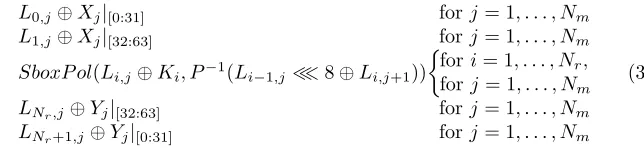
The polynomial system for LBlock cipher is generated by following :
L0,j⊕Xj|[0:31] forj= 1, . . . , Nm L1,j⊕Xj|[32:63] forj= 1, . . . , Nm SboxP ol(Li,j⊕Ki, P−1(Li−1,j ≪8⊕Li,j+1))
{
fori= 1, . . . , Nr, forj= 1, . . . , Nm LNr,j⊕Yj|[32:63] forj= 1, . . . , Nm
LNr+1,j⊕Yj|[0:31] forj= 1, . . . , Nm
(3)
In equation (3), and later equations (4),(5) and (6), that describe the above mentioned ciphers with system of polynomials, we use the following notations.j denotes the index of the plaintext that is being encrypted or index of the cipher-text that is being decrypted.idenotes the round number where1≤i≤Nr.Li,j denotes the intermediate state vector in encryption ofj-th plaintext, in thei-th round of the cipher. P denotes bit or nibble oriented permutation.M denotes Matrix multiplication operation in round functions.SboxP oldenotes the system of equation that describe the relation between input vector and output vector of the substitution layer. For LBlock and MIBS,Li,j is a vector of dimension 32. For PRESENT and SKINNY, its dimension is 64.
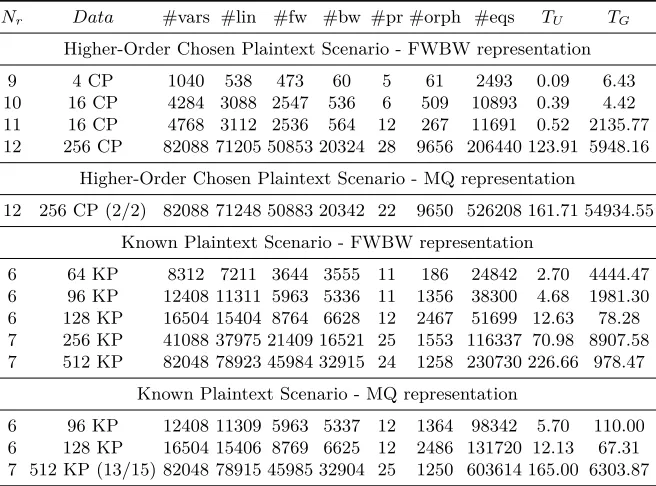
We managed to attack the cipher in both chosen plaintext and known plain-text scenarios. In a chosen-plainplain-text scenario, we could attack 9, 10, 11 and 12 rounds of LBlock cipher, but in a known-plaintext scenraio, we were able to break 6 and 7-round versions of LBlock. Table 3 shows the results.
In Table 3,Datadenotes the number of plaintexts used in the attack.#vars, shows the number of variables in the system of equations before elimination.
#lin denotes total number of linear polynomials that recovered by Proning Techniques.#f w,#bwand#prpresent the number of linear polynomials that recovered from PX,CY andBX,Y, respectively.
Table 3.Algebraic attacks on LBlock using FWBW description of S-boxes and Uni-versal Proning
Nr Data #vars #lin #fw #bw #pr #orph #eqs TU TG Higher-Order Chosen Plaintext Scenario - FWBW representation
9 4 CP 1040 538 473 60 5 61 2493 0.09 6.43
10 16 CP 4284 3088 2547 536 6 509 10893 0.39 4.42 11 16 CP 4768 3112 2536 564 12 267 11691 0.52 2135.77 12 256 CP 82088 71205 50853 20324 28 9656 206440 123.91 5948.16
Higher-Order Chosen Plaintext Scenario - MQ representation
12 256 CP (2/2) 82088 71248 50883 20342 22 9650 526208 161.71 54934.55
Known Plaintext Scenario - FWBW representation
6 64 KP 8312 7211 3644 3555 11 186 24842 2.70 4444.47 6 96 KP 12408 11311 5963 5336 11 1356 38300 4.68 1981.30 6 128 KP 16504 15404 8764 6628 12 2467 51699 12.63 78.28 7 256 KP 41088 37975 21409 16521 25 1553 116337 70.98 8907.58 7 512 KP 82048 78923 45984 32915 24 1258 230730 226.66 978.47
Known Plaintext Scenario - MQ representation
6 96 KP 12408 11309 5963 5337 12 1364 98342 5.70 110.00 6 128 KP 16504 15406 8769 6625 12 2486 131720 12.13 67.31 7 512 KP (13/15) 82048 78915 45985 32904 25 1250 603614 165.00 6303.87
In a chosen-plaintext scenario, the plaintexts are chosen and already known. Hence, we can recover polynomials in ⟨Sx,⋆,⋆⟩ before retrieving samples from target instance of the cipher. As, this step needs to be accomplished only once, we did not include the time of Universal Forward Proning inTU. The combina-tion of FWBW representacombina-tion of S-boxes with Universal Proning enabled us to successfully attack 12 rounds of LBlock with 256 chosen plaintexts, in average of 6,072.02 seconds . To our best knowledge, this is the first algebraic attack on 12-round LBlock. The average running time for Universal Proning is 123.91 seconds and for solving the system and finding the key is about 5948.11 seconds. We also managed to break 11 rounds of LBlock with 16 chosen plaintexts and a solving time of 2135.77 seconds in average. This is better than previous results reported in [4] with 128 plaintexts and 10106 seconds in average.
To investigate whether this results are due to Universal Proning or efficiency of S-boxes algebraic description, we also did some experiments with MQ repre-sentation, in both chosen plaintext and known plaintext attacks scenarios. In a chosen-plaintext attack scenario, we tried to cryptanalyze 12 rounds of LBlock with Universal Proning and MQ representation of S-boxes. Experiments on only two instances yield an average running time of 54934 seconds for solving the system, which is 10 times worse than the results with FWBW representation.
seconds, and the same with MQ is solved in just 110 seconds in average. For 128 known plaintexts the two representations, are near to each other in term of running time of computation of Gröbner basis. However, for 64 plaintexts with MQ representation the tool were not able to solve polynomial system. For FWBW, the polynomial system is solved in 4444.47 seconds in average.
Considering a known plaintext attack scenario for 7-round LBlock, the poly-nomial system with FWBW representation and 256 known plaintexts is solved in 8907.58, averagely. But, MQ did not yield any result with the same number of plaintexts. With 512 plaintexts, the system with FWBW representation is solved in 978.47 seconds in average, but the MQ representation lead to a solving time of 6303.87 seconds in average. It should be noted that with MQ represen-tation,PolyBoRilibrary failed to solve the system for two of instances, in this case.
With the above observations, we have evidences that FWBW is a better representation for Gröbner basis based algebraic cryptanalysis. Considering the results reported in [4], it seems that FWBW representation is the most con-venient description of S-boxes, among currently proposed representations, for algebraic cryptanalysis.
5.2 Attacking MIBS
Description of MIBS. MIBS [13] is a 64-bit light-weight block cipher based on Fiestel structure. It was presented in CANS 2009. Its round function consists of an S-box layer, a multiplication by 8-by-8 binary matrix and a permutation layer. This cipher consists of 32-rounds. Table 4 defines the MIBS cipher S-box.
Table 4.MIBS S-box
S 4,15,3,8,13,10,12,0,11,5,7,14,2,6,1,9
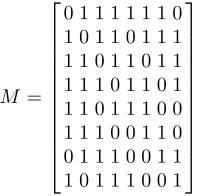
The binary matrix, represented with M, is given as follows:
M =
0 1 1 1 1 1 1 0 1 0 1 1 0 1 1 1 1 1 0 1 1 0 1 1 1 1 1 0 1 1 0 1 1 1 0 1 1 1 0 0 1 1 1 0 0 1 1 0 0 1 1 1 0 0 1 1 1 0 1 1 1 0 0 1
.
The polynomial system for MIBS cipher is generated as following:
L0,,j⊕Xj|[0:31] forj= 1, . . . , Nm L1,j⊕Xj|[32:63] forj= 1, . . . , Nm SboxP ol(Li,j⊕Ki, P−1(M−1(Li,j−1⊕Li,j+1)))
{
fori= 1, . . . , Nr, forj= 1, . . . , Nm LNr,j⊕Yj|[32:63] forj= 1, . . . , Nm
LNr+1,j⊕Yj|[0:31] forj= 1, . . . , Nm
(4)
We managed to attack 5 and 6 rounds of MIBS cipher with 5 and 12 chosen plaintexts, respectively. Table 5 present our result on MIBS cipher.
Table 5.Algebraic attacks on MIBS using FWBW description of S-boxes and Universal Proning
Nr Data #vars #lin #fw #bw #pr #orph #eqs TU TG Higher-Order Chosen Plaintext Scenario
5 5 CP 592 294 298 24 16 68 1748 0.09 7.61 6 12 CP 1656 831 842 292 8 16 4720 0.30 18.14
Using FWBW representation with Universal Proning technique, we were not able to improve the number of rounds in comparison with [4], but we achieved better running time for computation of Gröbner basis.
Intuitively it seems that adding more linear polynomials to the system should make the solving easier, but MIBS cipher was an exception. We found that adding Backward universal polynomials and Universal polynomials increases the running time for MIBS, significantly. Therefore, we did not add these polyno-mials to the final system.
5.3 Attacking PRESENT
Description of Present.PRESENT [14], presented in CHES 2007, is a light-weight block cipher based on SPN structure. It has block size of 64-bit and key size of 64/80 bits. Its round function consists of application of 16 4-bit S-boxes in parallel, then applying a bit oriented permutation. The cipher consists of 31 rounds. Table 6 defines PRESENT S-box.
It is also received much attention for cryptanalysis in the literature [31,32,27,4].
Table 6.PRESENT S-box
The polynomial system for PRESENT cipher is generated by the following : L0,j⊕Xj forj= 1, . . . , N m
SboxP ol(L0,j ⊕K1, L1,j) forj= 1, . . . , N m SboxP ol(P(Li−1,j)⊕Ki, Li,j)
{
fori= 2, . . . , N r, forj= 1, . . . , N m P(Li,N r)⊕KN r+1⊕Yj forj= 1, . . . , N m
(5)
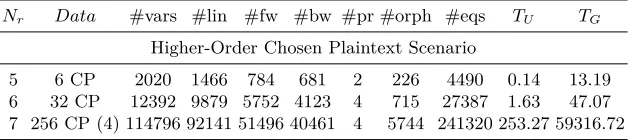
Using FWBW representation together with Universal Proning not only en-abled us to break 5 and 6 rounds of the cipher more efficient than our previous results, but also allowed to break 7 rounds of the cipher with 256 chosen plain-texts. To our best knowledge, this is the first algebraic attack on 7 rounds of PRESENT. The average running for attacking 6 rounds of the cipher reduced from around 2000 seconds to 48.7 seconds in average. 7 round version of the cipher is broken with 256 chosen plaintexts and 59316.72 seconds in average. Table 7 shows the results.
Table 7. Algebraic attacks on PRESENT using FWBW description of S-boxes and Universal Proning
Nr Data #vars #lin #fw #bw #pr #orph #eqs TU TG Higher-Order Chosen Plaintext Scenario
5 6 CP 2020 1466 784 681 2 226 4490 0.14 13.19 6 32 CP 12392 9879 5752 4123 4 715 27387 1.63 47.07 7 256 CP (4) 114796 92141 51496 40461 4 5744 241320 253.27 59316.72
5.4 Attacking SKINNY
Description of SKINNY. SKINNY [15] is a family of lightweight tweak-able block ciphers following AES design, but with some modification to min-imize hardware implementation costs. The major difference between AES and SKINNY is that SKINNY uses a binary matrix for MixColumn operation. The cipher has two variants: 64-bit and 128-bit versions. The first version operates on a state matrix with sixteen nibbles but the later version works on state matrix with sixteen bytes. The 64-bit version uses 4-bit S-boxes and the 128-bit version uses 8-bit ones. None of those S-boxes posses strong cryptographic properties, in deal with a light implementations.
Its round function consists of following four operation, similar to AES: 1. SubCells (SC): box is applied on nibbles (bytes) in parallel, 4-bit
S-boxes in 64-bit version and 8-bit S-S-boxes in 128-bit version. The 4-bit S-box is represented in following Table 8.
Table 8.SKINNY 4-bit S-box
S 12,6,9,0,1,10,2,11,3,8,5,13,4,14,7,15
3. AddRoundTweakey (ART): For SKINNY round keys depend on both the master key and the tweak. This operations adds such key material to half of the internal state.
4. ShiftRows (SR): Similar to AES shift row operation.
5. MixColumns (MC): Each column is multiplied by a binary matrix M given below.
M =
1 0 1 1 1 0 0 0 0 1 1 0 1 0 1 0
.
The polynomial system for SKINNY cipher is generated by following :
L0,j⊕Xj forj= 1, . . . , N m
SboxP ol(L0,j, L1,j) forj= 1, . . . , N m SboxP ol(M(P(Li−1,j⊕Ci−1⊕Ki−1)), Li,j)
{
fori= 2, . . . , N r, forj = 1, . . . , N m M(P(LN r,j⊕CN r⊕KN r))⊕Yj forj= 1, . . . , N m
(6)
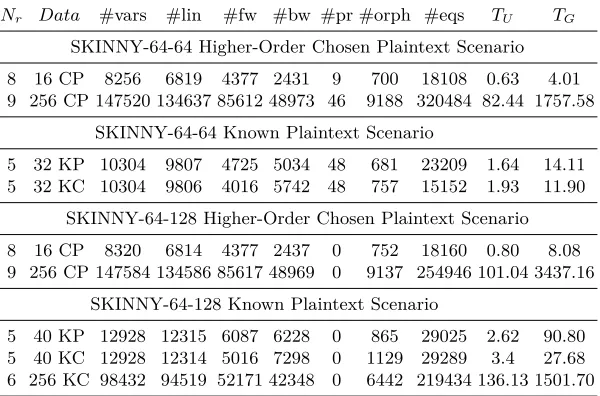
We applied our method to SKINNY with 64 bit block size and key sizes of 64 and 128 bits. Results are presented in Table 9.
We managed to attack 8 and 9 rounds of SKINNY with 16 and 256 chosen plaintexts, respectively. The running time for solving the system of equation for SKINNY-64-64 and SKINNY-64-128, is 1757.58 and 3437.16 seconds in average, respectively.
We also report attacks in known plaintext scenario on 5 and 6 rounds of SKINNY. In a known plaintext scenario, we noticed that encryption and de-cryption of SKINNY exhibit some unbalanced properties. Considering 5 rounds of SKINNY-64-128, number linear polynomials that recovered from decryption (backward) direction is more than the number recovered polynomials from en-cryption (forward) direction. So we tried the attack in a known ciphertext sce-nario which means recovering linear polynomials in backward direction first. It shows significant improvement inTG. Considering the observation we have been able to attack 6 rounds if SKINNY-64-128 with 256 known plaintexts.
5.5 A Comparison
Table 9. Algebraic attacks on SKINNY using FWBW description of S-boxes and Universal Proning
Nr Data #vars #lin #fw #bw #pr #orph #eqs TU TG SKINNY-64-64 Higher-Order Chosen Plaintext Scenario
8 16 CP 8256 6819 4377 2431 9 700 18108 0.63 4.01 9 256 CP 147520 134637 85612 48973 46 9188 320484 82.44 1757.58
SKINNY-64-64 Known Plaintext Scenario
5 32 KP 10304 9807 4725 5034 48 681 23209 1.64 14.11 5 32 KC 10304 9806 4016 5742 48 757 15152 1.93 11.90
SKINNY-64-128 Higher-Order Chosen Plaintext Scenario
8 16 CP 8320 6814 4377 2437 0 752 18160 0.80 8.08 9 256 CP 147584 134586 85617 48969 0 9137 254946 101.04 3437.16
SKINNY-64-128 Known Plaintext Scenario
5 40 KP 12928 12315 6087 6228 0 865 29025 2.62 90.80 5 40 KC 12928 12314 5016 7298 0 1129 29289 3.4 27.68 6 256 KC 98432 94519 52171 42348 0 6442 219434 136.13 1501.70
probabilistic and their efficiency can be relatively easily extrapolated, while al-gebraic attacks are deterministic and their success depends on solving a system of (nonlinear) relations. So far, a generic algorithm that would solve (efficiently) any system of nonlinear relations is not known, particularly the system of non-linear relations arising from block ciphers for large number of rounds. Due to the behaviour of solving algorithms, it is difficult to derive efficiency measurement, and tight bounds on data, time and memory requirements of the algorithm are not known. It is worth noting that algebraic cryptanalysis is still evolving and many of its aspects are yet to be discovered, and many results in this area are reported based only on experiments. So, we compare the attacks only based on the number of required plaintexts to be encrypted and the time needed for cryptanalysis in the experiments.
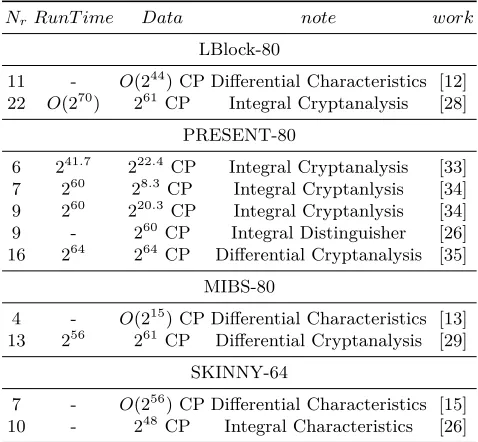
Table 10 details previous differential, integral and cube attacks for the ci-phers.
Let’s consider differential cryptanalysis of LBlock. The best differential char-acteristics for 11-round LBlock implies at least 22 active S-boxes [12]. If this characteristics is used in an 12-round key recovery attack, the data complexity of the attack would be of order O(244). Our algebraic attack requires a much smaller number of plaintexts, i.e., only 256 plaintexts. The work in [28] reports an integral attack on 22-round LBlock with data and time complexity of 261 and O(270), respectively, where the attack is based on a 15-round integral dis-tinguisher.
Table 10. Some integral and differential cryptanalysis of LBlock, MIBS, PRESENT and SKINNY
NrRunT ime Data note work LBlock-80
11 - O(244)CP Differential Characteristics [12] 22 O(270) 261 CP Integral Cryptanalysis [28]
PRESENT-80
6 241.7 222.4 CP Integral Cryptanalysis [33]
7 260 28.3 CP Integral Cryptanlysis [34] 9 260 220.3 CP Integral Cryptanlysis [34] 9 - 260 CP Integral Distinguisher [26] 16 264 264 CP Differential Cryptanalysis [35]
MIBS-80
4 - O(215)CP Differential Characteristics [13] 13 256 261 CP Differential Cryptanalysis [29]
SKINNY-64
7 - O(256)CP Differential Characteristics [15]
10 - 248 CP Integral Characteristics [26]
The data and time complexity of the attack is222.4and241.7, respectively. Our algebraic cryptanalysis attack requires only 32 chosen plaintexts only and a running time of about 48.7 seconds on average. We have been also able to attack 7-round PRESENT with just 256 chosen plaintexts. In [34], an integral attack for 7-round PRESENT is presented. The attack has data and time complexity of28.3 and260, respectively.
For MIBS cipher, the best 4-round differential characteristics has the proba-bility ofO(2−15)[13]. If this characteristics is used in a hypothetical key recovery attack on 6-round MIBS, it would require a data complexity of at leastO(215). In this paper, however, the 6-round MIBS cipher is broken with only 12 chosen plaintexts in an algebraic cryptanalysis attack. In [29], a differential cryptanal-ysis attack is proposed on 13 rounds of MIBS based on a 12-round differential characteristic, with data and time complexity of261and 256, respectively .
6 Conclusion and Discussion
In this paper, we proposed a new method to launch a more efficient Algebraic Cryptanalysis. In general, algebraic analysis takes two stages. In the first stage, a cipher is described by a system of equations. Algebraic cryptanalysis aims at finding the secret key of the cipher by solving the collection of polynomial equations that describes the cipher, usually in a known plaintext and/or chosen plaintext scenario. On the other hand, chosen correlated plaintexts, as what appear in Higher Order Differential Cryptanalysis and its derivatives such as cube attack or integral cryptanalysis, may force many linear relations between intermediate state bits in the cipher.
In the second stage, the system is solved using an ”appropriate” algorithm. There are many algorithms to solve such a system of equations, where computa-tion of Gröbner basis is one of such an approach. It is already well-known that the way a cipher is represented with a system of equations has impacts on the running time to obtain its solution employing a Gröbner-basis computation.
In this paper, we improved algebraic cryptanalysis of block ciphers in both stages. We employed effective FWBW representation of S-boxes for algebraic description of ciphers. Then, we showed that combining this representation with carefully selected plaintexts and Universal Proning in the solving stage improves the running time for solving the system to find key.
In this work, we have also done experiments on limited number of light-weight block ciphers with 4-bit S-boxes. These ciphers are designed based on different strategies and were able to report successful first algebraic attack on 12-round LBlock, 7-round PRESENT and 9-round SKINNY. Although, we do not yet have a theoretic result for effectiveness of our method, i.e., FWBW with Universal Proning, for algebraic cryptanalysis in general, but we can expect that the reported results should be extended to other ciphers as well. Consequently, our proposed method could be used as a criteria for the evaluation of resistance of light-weight ciphers against algebraic cryptanalysis, regarding the NIST com-petition of light-weight cryptography.
In general, Universal Proning technique alone helps to find many linear equa-tions. Since, these polynomials are universal and satisfied for all keys, they do not contribute to find the key, but help to simplify the system of equations by removing much of variables from the system [11]. For example, considering the attack on LBlock with 256 correlated plaintexts, we could remove 71205 vari-ables of total 98472 from the system, with universal proning. Hence, the resulting system of equations is much simplified. This may question the role of effective representation, for the next step. To answer the question, we also applied our method with MQ representation of S-boxes. As can be seen in Table 3, the av-erage running time of TG significantly increased in comparison with FWBW representation. Therefore, we can conclude that FWBW is an effective method for description of S-boxes.
Proning are taken into account. This contrasts the common intuition that re-moving variables or adding linear equations should result in more efficient solv-ing time. For SKINNY, we found that the cipher exhibits more linear equations in Backward (decryption) direction than Forward (encryption) direction, in a known plaintext scenario. As it is shown in Table 9, this leads to a more efficient attacks in both known/chosen ciphertext scenario. It’s worth investigating the effect of this unbalanced algebraic property in other types of attacks.
Our tool could not handle large system of equations that arises from large number of samples due limitation in employed software and hardware. Therefore, it is worth improving the implementation in order to better investigate limita-tions and capabilities of algebraic crypanalysis with Gröbner basis methods.
References
1. J.C. Faugère, L. Perret, in Information Security and Cryptology, ed. by F. Bao, M. Yung, D. Lin, J. Jing, no. 6151 in Lecture Notes in Computer Science (Springer Berlin Heidelberg, 2010), pp. 266–277
2. G.V. Bard, N.T. Courtois, J.N. Jr, P. Sepehrdad, B. Zhang, inProgress in Cryp-tology - INDOCRYPT 2010, ed. by G. Gong, K.C. Gupta, no. 6498 in Lecture Notes in Computer Science (Springer Berlin Heidelberg, 2010), pp. 176–196. URL http://link.springer.com/chapter/10.1007/978-3-642-17401-8_14
3. P. Sušil, P. Sepehrdad, S. Vaudenay, in Information Security and Privacy, ed. by W. Susilo, Y. Mu, no. 8544 in Lecture Notes in Computer Science (Springer International Publishing, 2014), pp. 50–65
4. H. Arabnezhad-Khanoki, B. Sadeghiyan, J. Pieprzyk: S-boxes representation and efficiency of algebraic attack. IET Information Security 13, 448–458(10) (Septem-ber 2019), https://digital-library.theiet.org/content/journals/10.1049/ iet-ifs.2018.5201
5. E. Biham, A. Shamir, Journal of Cryptology 4(1), 3 (1991). DOI 10.1007/ BF00630563. URL http://link.springer.com/article/10.1007/BF00630563. 02161
6. L. Knudsen, D. Wagner, in Fast Software Encryption (Springer, Berlin, Heidel-berg, 2002), pp. 112–127. DOI 10.1007/3-540-45661-9_9. URL https://link. springer.com/chapter/10.1007/3-540-45661-9_9
7. I. Dinur, A. Shamir, in Advances in Cryptology - EUROCRYPT 2009, ed. by A. Joux, no. 5479 in Lecture Notes in Computer Science (Springer Berlin Heidel-berg, 2009), pp. 278–299
8. Y. Todo, in Advances in Cryptology – EUROCRYPT 2015 (Springer, Berlin, Heidelberg), Lecture Notes in Computer Science, pp. 287–314. DOI 10.1007/ 978-3-662-46800-5_12. URL https://link.springer.com/chapter/10.1007/ 978-3-662-46800-5_12
9. M. Blum, M. Luby, R. Rubinfeld, Journal of computer and system sciences47(3), 549 (1993)
10. S.F. Abdul-Latip, M.R. Reyhanitabar, W. Susilo, J. Seberry, inProceedings of the 6th ACM Symposium on Information, Computer and Communications Security (ACM, New York, NY, USA, 2011), ASIACCS ’11, pp. 296–305. DOI 10.1145/ 1966913.1966952. URLhttp://doi.acm.org/10.1145/1966913.1966952. 00016 11. P. Sušil. Algebraic cryptanalysis of deterministic symmetric encryption. URL
12. W. Wu, L. Zhang, inApplied Cryptography and Network Security, ed. by J. Lopez, G. Tsudik, no. 6715 in Lecture Notes in Computer Science (Springer Berlin Hei-delberg, 2011), pp. 327–344
13. M. Izadi, B. Sadeghiyan, S.S. Sadeghian, H. Arabnezhad Khanooki, inCryptology and Network Security, ed. by J.A. Garay, A. Miyaji, A. Otsuka, no. 5888 in Lecture Notes in Computer Science (Springer Berlin Heidelberg, 2009), pp. 334–348 14. A. Bogdanov, L.R. Knudsen, G. Leander, C. Paar, A. Poschmann, M.J. Robshaw,
Y. Seurin, C. Vikkelsoe, inCryptographic Hardware and Embedded Systems-CHES 2007 (Springer, 2007), pp. 450–466
15. C. Beierle, J. Jean, S. Kölbl, G. Leander, A. Moradi, T. Peyrin, Y. Sasaki, P. Sas-drich, S.M. Sim, inAdvances in Cryptology – CRYPTO 2016, ed. by M. Robshaw, J. Katz (Springer Berlin Heidelberg, 2016), Lecture Notes in Computer Science, pp. 123–153
16. X. Lai, in Communications and Cryptography, ed. by R.E. Blahut, D.J.C. Jr, U. Maurer, T. Mittelholzer, no. 276 in The Springer International Se-ries in Engineering and Computer Science (Springer US, 1994), pp. 227– 233. URL http://link.springer.com/chapter/10.1007/978-1-4615-2694-0_ 23. DOI: 10.1007/978-1-4615-2694-0_23
17. J. Daemen, L. Knudsen, V. Rijmen, inFast Software Encryption(Springer, Berlin, Heidelberg, 1997), Lecture Notes in Computer Science, pp. 149–165. DOI 10.1007/ BFb0052343. URLhttps://link.springer.com/chapter/10.1007/BFb0052343 18. V. Rijmen, J. Daemen, B. Preneel, A. Bosselaers, E. De Win, in Fast Software
Encryption, ed. by D. Gollmann (Springer Berlin Heidelberg, Berlin, Heidelberg, 1996), pp. 99–111
19. J.L. Massey, in Fast Software Encryption, ed. by R. Anderson (Springer Berlin Heidelberg, Berlin, Heidelberg, 1994), pp. 1–17
20. N.T. Courtois, J. Pieprzyk, inAdvances in Cryptology — ASIACRYPT 2002, ed. by Y. Zheng, no. 2501 in Lecture Notes in Computer Science (Springer Berlin Heidelberg), pp. 267–287
21. J.N. Jr, P. Sepehrdad, B. Zhang, M. Wang, inCryptology and Network Security, ed. by J.A. Garay, A. Miyaji, A. Otsuka, no. 5888 in Lecture Notes in Computer Science (Springer Berlin Heidelberg, 2009), pp. 58–75
22. A. Biryukov, C.D. Cannière, inFast Software Encryption, ed. by T. Johansson, no. 2887 in Lecture Notes in Computer Science (Springer Berlin Heidelberg, 2003), pp. 274–289. DOI 10.1007/978-3-540-39887-5_21. URLhttp://link.springer.com/ chapter/10.1007/978-3-540-39887-5_21
23. S. Islam, M. Afzal, A. Rashdi, inSecurity Engineering and Intelligence Informatics (Springer, Berlin, Heidelberg), Lecture Notes in Computer Science, pp. 105–121. DOI 10.1007/978-3-642-40588-4_8. URLhttps://link.springer.com/chapter/ 10.1007/978-3-642-40588-4_8
24. M. Brickenstein, A. Dreyer, Journal of Symbolic Computation44(9), 1326 (2009) 25. M. Albrecht, G. Bard,The M4RI Library – Version 20140914. The M4RI Team
(2014). URLhttp://m4ri.sagemath.org
26. Z. Eskandari, A.B. Kidmose, S. Kölbl, T. Tiessen. Finding integral distinguishers with ease. Cryptology ePrint Archive, Report 2018/688 (2018). https://eprint. iacr.org/2018/688
28. Y. Sasaki, L. Wang, in Information Security and Cryptology – ICISC 2012, ed. by T. Kwon, M.K. Lee, D. Kwon, no. 7839 in Lecture Notes in Computer Sci-ence (Springer Berlin Heidelberg), pp. 156–169. URL http://link.springer. com/chapter/10.1007/978-3-642-37682-5_12. 00014
29. A. Bay, J. Nakahara, S. Vaudenay, inCryptology and Network Security, ed. by S.H. Heng, R.N. Wright, B.M. Goi (Springer Berlin Heidelberg, 2010), Lecture Notes in Computer Science, pp. 1–19
30. S. Wu, M. Wang, inProgress in Cryptology - INDOCRYPT 2012, ed. by S. Gal-braith, M. Nandi, no. 7668 in Lecture Notes in Computer Science (Springer Berlin Heidelberg, 2012). URL http://link.springer.com/chapter/10.1007/ 978-3-642-34931-7_17
31. M. Albrecht, C. Cid, inFast Software Encryption, ed. by O. Dunkelman, no. 5665 in Lecture Notes in Computer Science (Springer Berlin Heidelberg, 2009), pp. 193– 208. URL http://link.springer.com/chapter/10.1007/978-3-642-03317-9_ 12. 00074
32. B. Collard, F.X. Standaert, inTopics in Cryptology – CT-RSA 2009, ed. by M. Fis-chlin (Springer Berlin Heidelberg, 2009), Lecture Notes in Computer Science, pp. 195–210
33. M.R. Z’aba, H. Raddum, M. Henricksen, E. Dawson, inFast Software Encryption, ed. by K. Nyberg (Springer Berlin Heidelberg, Berlin, Heidelberg, 2008), pp. 363– 381
34. S. Wu, M. Wang, inInformation and Communications Security, ed. by S. Qing, J. Zhou, D. Liu (Springer, Cham, 2013), pp. 331–345
![Table 1 present some results on algebraic attack reported in the literature onthese ciphers [23,3,8,4].](https://thumb-us.123doks.com/thumbv2/123dok_us/7990073.1326121/8.612.171.444.487.664/table-present-results-algebraic-reported-literature-onthese-ciphers.webp)