Available Online at www.ijcsmc.com
International Journal of Computer Science and Mobile Computing
A Monthly Journal of Computer Science and Information Technology
ISSN 2320–088X
IJCSMC, Vol. 3, Issue. 6, June 2014, pg.144 – 151
RESEARCH ARTICLE
A Comparative Analysis of Pro-active
Routing Protocols in MANET
*
B. Kondaiah
M.Sc. (PhD)Research Scholar
Dept. of Computer Science and Technology Sri Krishnadevaraya University
**
Dr. M. Nagendra
M.Sc. M.Phil. PhDResearch Supervisor & Associate Professor Dept. of Computer Science and Technology
Sri Krishnadevaraya University
ABSTRACT: A mobile ad hoc network (MANET) is a collection of mobile nodes that is connected through a wireless medium forming rapidly changing topologies. A collection of mobile nodes that form a network without any fixed infrastructure. Therefore, routing in MANET is a critical task due to highly dynamic environment. Efficient Routing Protocols will make MANET reliable. The routing protocols in MANET classified into three categories proactive (Table driven), reactive (On demand) and Hybrid routing protocols. But we will discuss Proactive routing protocols DSDV and WRP. In This paper provides an overview of these protocols by presenting their characteristics, functionality, benefits and then their comparative analysis parameters. These protocols will be measured with suitable metrics.
Keywords: - MANET, DSDV, WRP
Introduction
Mobile Ad-hoc Networks (MANET) are specific network configurations that appear in the
context of these networks. They provide a powerful paradigm for modeling self-configuring
wireless networks which make them so appropriate to use in the fourth generation mobile
to their ease of deployment in response to some application needs together with the availability
of low cost peripherals equipped with wireless interfaces. The proactive protocols are
appropriate for less number of nodes in networks, as they need to update node entries for each
and every node in the routing table of every node. It results more Routing overhead problem.
There is consumption of more bandwidth in routing table.
Proactive routing Protocols (Table driven):
Proactive routing protocols maintain consistent and up to date routing information about
each node in the network[1]. These protocols require each node to store their routing information
and when there is a change in network topology the entire network has to be updated. The main
advantage is to minimize the delay in obtaining a route when initiating traffic to a destination and
quickly determines whether a destination is reachable. This process can also consume significant
network resources.
Some of the existing table driven protocols are given below.
Destination sequenced Distance vector routing(DSDV)
Wireless routing protocol (WRP)
Destination sequenced distance vector routing (DSDV)
DSDV is a table driven algorithm based on Bellmand-Ford routing mechanism (Ford Jr, and
Fulkerson, 1962). In DSDV, packets are routed between nodes within a network, using routing
tables stored at each node. Every node in the network has a routing table, which specifies all
possible destinations in the network and the number of hops to each destination is recorded. Each
entry is marked with the sequence numbers, which helps to identify the stale routes from new
ones. To maintain consistency updated table are transmitted periodically. Figure 1 illustrates the
routing procedure of DSDV[2]. Consider a packet which needs to be sent from node 1 to node 3.
From node 1, the next hop for the packet is node 4. When node 4 receives the packet, it looks up
the routing table with the destination address (node 3). As per the routing table entry in node 4, it
transmits the packet to the next hop as specified by node 5. This procedure repeats until the
packet finally reaches the destination. To reduce the network traffic overhead, updation can
employ two possible types of packets. The first is known as full dump. This type of packet
periods of occasional movement, these packets are transmitted infrequently. Incremental packets
are used to relay the information, which has changed since the last full dump. These broadcasts
should fit into a standard size Network Protocol Data Unit (NPDU), thereby decreasing the
amount of traffic generated. The mobile nodes maintain an additional table where they store the
data sent in the incremental routing information packets (Perkins and Bhaqat 1994). New routes,
which are broadcasted, contains the address of the destination, the number of hops to reach the
destination, the sequence number of the information received during the destination, as well as
new sequence number unique to broadcasts (Royer and Toh 1999. The route labelled with the
most recent sequence number is used. If two updates have the same sequence number, the one
with the smaller metric is used to shorten the path.
Figure:1 Destination sequenced distance vector routing
To avoid nodes and their neighbours generating conflict sequence numbers when topology
changes, nodes generate even sequence numbers for themselves and neighbours responding to
link changes generate odd sequence numbers[3]. DSDV has more procedures for handling
network layer addresses, dealing with non-mobile stations, damping fluctuations caused by
Advantages: By delaying the broadcast of updation and length of settling time, mobiles can
reduce network traffic and optimize routes by eliminating those broadcasts that would occur if a
better route was discovered in the near future.
Disadvantages: DSDV requires broadcasting periodic updates, regardless of network traffic. As
the number of nodes in the network grows, the size of the routing table and the bandwidth
required to update also grows. This remains as overhead, which has been found in simulation
with the network consisting of 50 nodes (Broch et al 1998). DSDV does not perform well when
there is a high rate of node mobility.
Wireless routing protocol (WRP)
Wireless routing protocol is a table-based protocol where it maintains the routing
information at all nodes in the network (Murthy, and Garcia, 1996)[4]. Each node in the network
maintains four tables.
• Distance table
• Routing table
• Link cost table
• Message retransmission list table (MRL)
The distance table of a node x contains the distance of each destination y via each
neighbour z of x. It also contains the distance information of downstream neighbor of z through
which the path is realized. The routing table of node x contains the distance of each destination
node y from node x, the predecessor and successor of node x on this path. It also contains a tag
entity to determine whether the entry is a simple path, a loop or invalid. Storing predecessor and
Successor in the table helps to detect loops and avoid count to infinity problems. The link cost
table contains cost of link to each neighbour of the node and the number of time-outs since an
error free message was received from that neighbour[5]. Each entry of MRL contains the
sequence number of update message, a retransmission counter, an acknowledgement required
flag vector with one entry per neighbour, lists of updates sent in the update message. MRL keeps
a record of which updates in an update message has to be retransmitted. The neighbours should
acknowledge the retransmission. Mobiles inform each other about the link changes with an
update message. Update message are sent between the neighbouring nodes, it contains a list of
Update messages are sent when there is a change in link and when there is a loss of link.
The neighbours then update their distance table entries and check for new possible paths through
other nodes. If any new paths are relayed back to the original nodes then they can update their
tables accordingly[6]. The existence of neighbours is known through the receipt of
acknowledgement and other messages. To ensure connectivity a node must send a hello message,
within a particular period of time. Lack of message from the node indicates a failure of link,
which causes a false alarm. When a hello message is received from a new node, the new node is
added to the mobile routing table and the mobile sends the new node a copy of its routing
information.
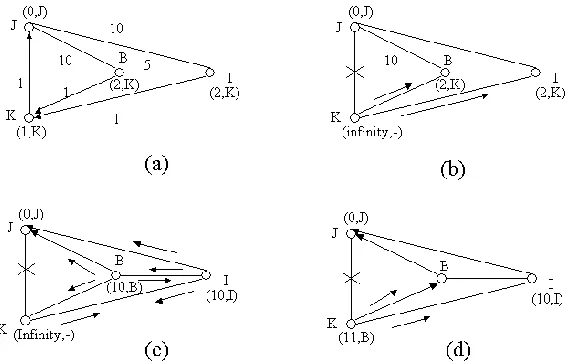
In Figure 2 there is a short example showing how WRP updates node's routing tables,
when a link failure occurs. Link costs are as indicated in the figure[7]. The arrows next to links
indicate the direction of update messages and the label in parentheses gives the distances and the
predecessor to destination J. The figure focuses on update messages to destination J only.
Advantages: Wireless routing protocol belongs to path finding algorithm. It eliminates looping
situation and provides faster route convergence when a link failure event occurs.
It enhances distance vector routing in four ways:
When there is no link change, wireless routing protocol exchanges hello messages rather
than exchanging the whole route table.
If there are topology changes, only the path vector tuples that reflect the updates are sent.
The path vector tuple contains destination, distance, and the predecessor node id
To improve reliability while delivering update message, every neighbor must send an
acknowledgement for the update packets received[8]. Retransmissions are made if
positive acknowledgements are not received within the particular period.
The predecessor node id information allows the protocol to recursively calculate the
entire path from source to destination[9]. With this information, wireless protocol
reduces looping situation, reduces the time for convergence and is less prone to count to
Figure 2: An example of WRP-routing protocol’s operation
COMPARISON OF PROTOCOLS
In this section we have presented a comparison between existing routing protocols. Table
1 below provides an overall comparison of the two categories of routing protocols property[10].
The comparisons basically consider the characteristic properties of routing protocols in high load
networks. In order to make flat addressing more efficient, the number of routing overheads
introduced in the networks
Protocol Property DSDV WRP
Routing Philosophy Flat Flat
Loop free Yes Yes, But not instantaneous Multicast Capability NO NO
Number of Required tables Two Four Frequency of Updates
transmission
Periodically and as
needed Periodically and as needed Update transmitted Neighbours Neighbours
Utilizes sequence numbers Yes Yes Utilizes hello messages Yes Yes
Critical Nodes No Yes
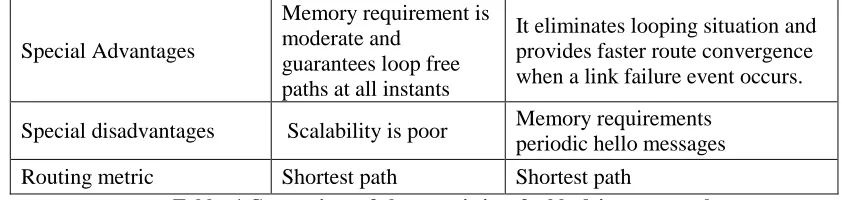
Special Advantages
Memory requirement is moderate and
guarantees loop free paths at all instants
It eliminates looping situation and provides faster route convergence when a link failure event occurs.
Special disadvantages Scalability is poor Memory requirements periodic hello messages Routing metric Shortest path Shortest path
Table :1 Comparison of characteristics of table driven protocols
Conclusion
There is vast number of different kinds of protocols. Each of these protocols has some
common goals. Every protocol has the ability of distributed routing calculations and every
protocol try to manage the consequences caused by mobility of nodes. DSDV protocol requires
each mobile node in the network to advertise its own routing table to its current neighbors.In
WRP nodes learn of the existence of their neighbors form the receipt of acknowledgements and
other messages. WRP reduces the number of cases in which a temporary routing loop can occur.
Since WRP, like DSDV, maintains an up-to-date view of the network, every node has a readily
available route to every destination node in the network. It differs from DSDV in table
maintenance and in the update procedures. WRP has the same advantage as that of DSDV. In
addition, it has faster convergence and involves fewer table updates. But the complexity of
maintenance of multiple tables demands a larger memory and greater processing power from
nodes in the ad hoc wireless network.
References
[1] Anuj K. Gupta, Harsh Sadawarti, and Anil K. Verma “Review of Various Routing Protocols for MANETs”
International Journal of Information and Electronics Engineering, Vol. 1, No. 3, November 2011
[2] N. S. Yadav and R.P. Yadav “Performance Comparison and Analysis of Table- Driven and On- Demand Routing Protocols for Mobile Adhoc Networks,” “International Journal of Information Technology”, vol.4, no. 2, pp 101-109, 2007
[3] C. E. Perkins and P. Bhagwat ―Highly Dynamic Destination Sequenced Distance-vector Routing (DSDV) for Mobile Computers, Proceedings of the ACM SIGCOMM ’94 Conference.
[4] J. Broch, D. A. Maltz, D. B. Johnson, Yih-Chun Hu and J. Jetcheva, A Performance Comparison of Multi-hop Wireless Ad Hoc Network Routing Protocols, Mobicom’98, Dallas Texas, 2530 October, 1998. [5] Anastasi G., Borgia E., Conti M., Gregori E, 2003. IEEE 802.11 Ad Hoc networks: protocols, performance
and open issues, in: S.Basagni, M.Conti, S.Giordano, Stojmenvoic (Eds.), Ad hoc Networking, IEEE Press Wiley, New York
[7] Camp T., Boleng J., and Davies V., 2002, A Survey of Mobility Models for Ad-Hoc Network Research, Wireless Communication and Mobile Computing (WCMC), Special issue on Mobile Ad-Hoc Networking Research Trends and Applications, Vol. 2 No 5, pp.483-502.
[8] Chiang C C., 1997, Routing in Clustered Multihop, Mobile Wireless Networks with Fading Channel, Proceedings IEEE SICON’97 Apr. 1997, pp.197-211.
[9] Corson M.S, and Macker J., 1999, Mobile Ad-Hoc Networking (MANET Routing Protocol Performance Issues and Evaluation Consideration, IETF RFC 2501, http://www.ietf.org/rfc/rfc2501.txt
[10] Das S R., Perkins C E., Royer E M., 2000, Performance comparison of two on-demand routing protocols for ad hoc networks, IEEE INFOCOM 2000, vol. 1, pp. 3 -12
[11] Geetha J and G Gopinath, 2007 (a), Ad Hoc Mobile Wireless Networks Routing Protocols – A Review,
Journal of Computer Science, Vol. 3, No.8 pp. 574-582.
[12] Geetha J and G Gopinath, 2007 (b), Performance Comparison of Mobile Ad-hoc Network Routing Protocol, IJCSNS International Journal of Computer Science and Network Security, Vol.7 No.11, pp. 77-84.
[13] Geetha J and G Gopinath, 2008 (a), Performance Comparison of MANET Protocols Based on Manhattan Grid Mobility Model, Journal of Mobile Communication, Vol. 2, No.1 pp. 18-26
[14] Murthy, S., and Garcia J J., 1996, An Efficient Routing Protocol for Wireless Networks, ACM Mobile Communication Networks and App. J., Special Issue on Routing in Mobile Communication Networks, pp.183-197.