Acne
FOR
DUMmIES
‰About the Author
Herbert P. Goodheart, MD, has been in the private practice of dermatology for over 25 years. He is a fellow of the American Academy of Dermatology and a member of the Greater New York Dermatological Society. For 20 years, Dr. Goodheart was an Assistant Clinical Professor of Medicine in the Division of Dermatology at the Albert Einstein College of Medicine, Bronx, New York, and is now an Assistant Clinical Professor in the Department of Dermatology at the Mount Sinai College of Medicine in New York City.
Dr. Goodheart is the author of Goodheart’s Photoguide of Common Skin Disorders, Diagnosis and Management,a clinical guide to assist the primary care provider and dermatologist-in-training in the iden-tification and treatment of common skin disorders. The book, which is in its second edition, was a unanimous choice for first prize in dermatology at the annual British Medical Association Book Awards for 2004.
He also is a contributing editor of Women’s Health in Primary Care,a medical journal for physicians and other healthcare professionals. Dr. Goodheart’s monthly column, “Dermatology Rounds,” provides information on the wide spectrum of skin disorders affecting women.
He lives in New York City with his wife Karen and his son David.
Dedication
Author’s Acknowledgments
This project proved to be far from a solo effort. Mike Baker, the pro-ject editor, was at my side throughout the entire propro-ject. With his steadfast patience, attention to detail, and great intelligence, he was a true partner in bringing this complicated project to completion. Thank you Mike — I really enjoyed working with you! The great acquisitions editor, Kathy Cox, deserves credit for her wonderful guidance in always keeping the book on course. Special thanks goes to Heather Dismore who was an indispensable support in helping me overcome some difficult obstacles. Jen Bingham, my copy editor, made many suggestions that were right on target and helped to make Acne For Dummiesboth clear and concise. I also want to thank the talented group at Wiley, including my illustrator, Kathryn Borne, and the entire production staff. They all deserve huge praise!
A big thanks to Linda Roghaar, my literary agent, who brought me to
For Dummiesand helped make this book a reality. My deep gratitude goes to my friends Jane Friedman Century and Richard Lieberman for their inspiration and helpful suggestions. I also wish to thank my dermatologist friends and colleagues, Drs. Hendrik Uyttendaele, Ross Levy, Diane Berson, Ron Shelton, and Peter Burk, for their assistance in working through difficult problems.
I deeply appreciate the efforts of my technical editor, Joe Eastern, MD, whose watchful eye assured the scientific and clinical integrity of the text. Also I would like to thank Sandra Mamis, RPA-C, physi-cian assistant par excellence,who helped to review some of my dif-ficult chapters, Ilene Buchalter, who knows how to run a dermatology office and helped me to describe it, and Lance Brown, MD, who provided me with material about acne scars.
Many thanks go to my colleagues at Derm-Chat/Derm-Rx, who keep me up to date on the latest diagnostic and therapeutic issues in dermatology. Art Huntley, MD, at UC Davis, who founded and main-tains this valuable online resource, deserves special credit. I also am indebted to my patients who taught me more than anyone about acne.
Publisher’s Acknowledgments
We’re proud of this book; please send us your comments through our Dummies online regis-tration form located at www.dummies.com/register/.
Some of the people who helped bring this book to market include the following:
Acquisitions, Editorial, and Media Development
Project Editor:Mike Baker
Acquisitions Editor:Kathleen M. Cox
Copy Editor:Jennifer Bingham
Technical Reviewer:Joseph Eastern, MD
Editorial Manager: Christine Meloy Beck
Editorial Assistants: David Lutton, Hanna Scott
Cartoons: Rich Tennant (www.the5thwave.com)
Composition Services
Project Coordinator: Erin Smith
Layout and Graphics: Carl Byers, Joyce Haughey, Stephanie D. Jumper, Lynsey Osborn
Special Art: Illustrations, Kathryn Born; Photos, Herbert P. Goodheart and Goodheart’s Photoguide of Common Skin Disorders,Sonya Seigafus, ed.,
Lippincott Williams & Wilkins, 2003.
Proofreaders: Leeann Harney, Carl Pierce, Charles Spencer, TECHBOOKS Production Services
Indexer: TECHBOOKS Production Services
Publishing and Editorial for Consumer Dummies
Diane Graves Steele, Vice President and Publisher, Consumer Dummies
Joyce Pepple, Acquisitions Director, Consumer Dummies
Kristin A. Cocks, Product Development Director, Consumer Dummies
Michael Spring, Vice President and Publisher, Travel
Kelly Regan,Editorial Director, Travel
Publishing for Technology Dummies
Andy Cummings,Vice President and Publisher, Dummies Technology/General User
Composition Services
Gerry Fahey,Vice President of Production Services
Contents at a Glance
Introduction...1
Part I: Facing Up to Acne ...7
Chapter 1: Dealing with Acne...9
Chapter 2: Getting Comfortable with the Skin You’re In ...17
Chapter 3: Tracing the Evolution of a Pimple...27
Part II: Figuring Out Your Acne and
How to Tackle It on Your Own ...37
Chapter 4: Examining Acne in Teens...39
Chapter 5: Addressing Acne in Adults ...49
Chapter 6: Evaluating Other Causes and Contributors: Myth and Reality ...61
Chapter 7: Taking Care of Acne Over the Counter ...73
Part III: Turning to the Pros to Treat
Your Type of Acne ...85
Chapter 8: Calling in the Experts...87
Chapter 9: Reviewing the Topical Tools at Your Dermatologist’s Disposal...101
Chapter 10: Taking the Oral Antibiotic Route...115
Chapter 11: Hormonal Treatment for Women ...129
Chapter 12: Managing Acne in Dark-Complexioned Skin ...137
Chapter 13: Attacking Acne with Accutane and Other Isotretinoins...151
Chapter 14: Searching for Weapons of Zit Destruction ...167
Chapter 15: Seeking Alternative Treatments ...177
Part IV: Dealing with Scars and
Associated Conditions...189
Chapter 16: Focusing on the Physical Scars ...191
Chapter 17: Coping with the Psychological Scars...203
Chapter 18: Reining in Rosacea and Other Acne Look-Alikes ...211
Chapter 19: Fighting the Feisty Follicle ...229
Chapter 20: Reviewing Endocrine Disorders Associated with Acne ...243
Part V: The Part of Tens...249
Chapter 21: Ten Terrific Acne and Rosacea Web Sites ...251
Chapter 22: Ten Tips for Healthy Skin ...255
Part VI: Appendixes...267
Appendix A: Glossary ...269 Appendix B: International Brand Names for Someof the Medications Listed in This Book ...279
Table of Contents
Introduction ...1
About This Book ...1
Conventions Used in This Book ...2
Foolish Assumptions ...2
How This Book Is Organized...3
Part I: Facing Up to Acne ...3
Part II: Figuring Out Your Acne and How to Tackle It on Your Own...3
Part III: Turning to the Pros to Treat Your Type of Acne...4
Part IV: Dealing with Scars and Associated Conditions ...4
Part VI: The Part of Tens...4
Part VII: Appendixes...4
Icons Used in This Book...5
Where to Go from Here ...6
Part I: Facing Up to Acne...7
Chapter 1: Dealing with Acne. . . 9
Acne Explained...9
Waking up to whiteheads, blackheads, and zits ...10
Taking it on the chin later in life ...11
Creating Your Acne-Treating Program ...12
Meeting the players...13
Deciding whether to treat yourself ...13
Relying on the experts ...14
Avoiding quickie, quacky cures ...15
Recognizing Impostors and Related Conditions...16
Chapter 2: Getting Comfortable
with the Skin You’re In . . . 17
Exploring Your Largest Organ ...17
Getting above it all: Hey, your epidermis is showing! ...18
Scratching the surface: Now your dermis is showing! ...20
Digging deeper: Your subcutaneous layer...21
Basic Operating Instructions: Taking Care of Your Skin ...23
Washing your face ...23
Dealing with dry skin ...25
Chapter 3: Tracing the Evolution of a Pimple. . . 27
Paying the High Price for Oil ...27
Priming the pump with hormones...29
Clogging your pores and narrowing the hair canal ....30
Forming blackheads and whiteheads ...31
Battling bacteria ...32
Scarring: Your skin’s repair kit ...34
Classifying Acne ...35
Part II: Figuring Out Your Acne and
How to Tackle It on Your Own...37
Chapter 4: Examining Acne in Teens. . . 39
Identifying Teenage Acne ...39
Taking a look at teen skin ...41
Exploring teen acne...41
Tracking acne’s footsteps...42
Understanding the Causes of Teenage Acne ...44
Passing through puberty: Hormones gone wild ...44
Thanking your family: The heredity factor ...46
Acknowledging the Emotional...47
Chapter 5: Addressing Acne in Adults . . . 49
Identifying Adult-Onset Acne ...50
Describing the symptoms...50
Taking an emotional toll ...52
Emerging at Any Age...52
Acne and your menstrual cycle ...53
New baby, new bumps: Acne and pregnancy...54
You’re never too old ...59
Facing Acne As an Adult Man ...60
Chapter 6: Evaluating Other Causes and
Contributors: Myth and Reality . . . 61
Debunking Dirt and Grease Theories ...62
Dismissing the Diet — For the Most Part ...63
Frying up an acne fable...63
Here’s the beef — and the milk...64
No, it’s the sweets: A disease of Western civilization? ...64
No, it’s the iodides...65
Salmon saves the day, or does it?...65
Understanding Stress and Acne ...66
Addressing some Aggravating Agents...66
Drugs that can induce acne...67
Making Up and Breaking Out? ...70
Reading the ingredients ...71
Living in an oil-free world ...72
Chapter 7: Taking Care of Acne Over the Counter . . . . 73
Taking Action Topically: A Primer ...74
The Lazy Bums! Inactive Ingredients...75
Getting In on the Active Ingredients...77
The benefits of benzoyl peroxide ...77
Trying salicylic acid ...79
Other OTC medications ...81
A Word about Acne Soaps, Cleansing Strips, Et Al ...83
Evaluating Advertisers’ Claims ...84
Part III: Turning to the Pros
to Treat Your Type of Acne...85
Chapter 8: Calling in the Experts . . . 87
Establishing Basic Goals of Treatment...87
Seeing Your Primary Healthcare Provider ...88
Working together to treat your acne...88
Requesting a referral to see a specialist...90
Finding the Right Dermatologist for You ...91
Using networking techniques...92
Checking in with professional associations ...92
Looking at your insurance directory ...93
Perusing the phone book and advertisements ...93
Going to the Dermatologist for the First Visit ...94
Taking stock of your medical history...94
Preparing on the day of your visit...95
Meeting the doc ...96
Launching a Good Working Relationship...97
Following instructions ...97
Being a “patient” patient...98
Telephoning the dermatologist with questions...98
Deciding to change dermatologists...100
Chapter 9: Reviewing the Topical Tools at Your
Dermatologist’s Disposal . . . 101
Taking the Topical Route ...102
Opening Up the Tool Chest...103
Reviewing topical retinoids...103
Turning to topical antibiotics ...108
Combining benzoyl peroxide with topical antibiotics ...109
Looking at other topicals...112
Chapter 10: Taking the Oral Antibiotic Route . . . 115
Calling In the Reinforcements ...115
Deciding it’s time for oral antibiotics...116
Addressing some common concerns ...116
Tetracyclines: The First Team ...118
Reviewing warnings, risks, and side effects of tetracyclines...119
Taking generic (“plain”) tetracycline ...120
Taking minocycline...121
Taking doxycycline ...123
Second-Line Oral Antibiotics...124
Surveying Strategies to Reduce Antibiotic Use...125
Your Guides to Your Medications ...126
Chapter 11: Hormonal Treatment for Women. . . 129
Using Oral Contraceptives...130
Suppressing the cycle — and the acne ...131
Taking the best pills for acne ...132
Looking out for side effects ...133
Trying Anti-androgens...134
Chapter 12: Managing Acne in
Dark-Complexioned Skin . . . 137
Recognizing Diversity...137
Figuring Out Those Dark Spots! ...138
How dark spots are formed ...139
Deterring the dark spots...140
Keeping Acne and Dark Spots at Bay with OTC Medications ...141
Benzoyl peroxide and salicylic acid ...141
Over-the-counter bleaches ...142
Getting Professional Help ...143
Treating your acne and PIP with topical drugs ...144
Peeling the pigment away...145
Managing the scars...146
Oral acne therapy to prevent scars and PIP ...147
Looking at Pomade Acne ...147
Cosmetics for Women of Various Ethnic Groups ...148
Chapter 13: Attacking Acne with Accutane
and Other Isotretinoins . . . 151
You Say Accutane, I Say Isotretinoin ...152
Getting to Know the Drug and Its Uses ...153
Preparing for Treatment ...154
Procedures all patients must follow...155
Knowing What to Expect when You Take Isotretinoin ...160
Taking your pills and observing results ...160
What not to do when you’re taking isotretinoin...161
Sizing up side effects ...161
The risk of depression and suicide ...164
Chapter 14: Searching for Weapons of
Zit Destruction . . . 167
You Light Up My Face: Zapping the Zits ...167
Honing in on P. acnes with photodynamic therapy ...169
Looking ahead: Stopping oil at the source and other promising paths ...170
Avoiding ultraviolet light ...171
Taking It from the Top ...172
Experiencing an AHA or BHA peel...174
Trying out a TCA peel ...175
Chapter 15: Seeking Alternative Treatments . . . 177
Does Alternative Medicine Work?...177
Exploring Traditional Chinese Medicine...178
Trying Chinese herbs ...178
Trying acupuncture for acne...180
Going Natural: Herbs and Supplements Are All around You ...180
Fighting bacteria with botanicals ...181
Reducing inflammation with herbs ...181
Herbs at the cosmetic counter ...182
Finding a professional herbalist ...182
Going natural with minerals and vitamins ...183
Checking Out the Ancient Art of Ayurveda ...183
Taking a Deep Breath: Aromatherapy ...184
Considering Homeopathy ...185
Practicing Mind/Body Medicine...186
Practicing yoga ...187
Meditation: Contemplating nothing ...187
Biofeedback and cognitive imagery ...188
Hypnosis ...188
Part IV: Dealing with Scars and
Associated Conditions ...189
Chapter 16: Focusing on the Physical Scars . . . 191
Examining Acne Scars ...191
Pulling in: Scars caused by loss of tissue ...192
Treating razor bumps on your own...233
Getting professional help...235
Dealing with Those Hairs ...237
Removing hairs temporarily...237
Removing hairs permanently ...239
Slowing down the hairs...240
Recognizing and Feeling Keratosis Pilaris: “Hair Bumps” ...240
Distinguishing KP from acne ...241
Treating the hair bumps ...241
Chapter 20: Reviewing Endocrine Disorders
Associated with Acne . . . 243
Connecting Androgen Excess and Acne...244
Testing for endocrine imbalances ...245
Considering the most common cause of androgen excess: PCOS ...246
Touching On Other Endocrine Disorders ...247
Congenital adrenal hyperplasia ...247
Cushing’s disease and Cushing’s syndrome...248
Part V: The Part of Tens...249
Chapter 21: Ten Terrific Acne
and Rosacea Web Sites . . . 251
AcneNet ...251
American Society for Dermatologic Surgeons...252
DermNet NZ ...252
eMedicine.com ...252
MedLine Plus: Acne ...253
Omni: Acne Vulgaris ...253
RosaceaNet ...253
Stop Spots ...253
Acne Support Group ...254
Dermatology in the Cinema ...254
Chapter 22: Ten Tips for Healthy Skin . . . 255
Steering Clear of Excessive Sun Exposure ...255
Opting for Sunless Tanning...256
Dimming the Shine of Oily Skin ...257
Humidifying Dry Skin...258
Soothing Sensitive Skin ...258
Promoting a Youthful Glow...259
Caring for the Bumps ...259
Minimizing Stress ...259
Visiting a Dermatologist...260
Chapter 23: Ten Things You Should Never Do
to Your Skin . . . 261
Picking, Popping, or Squeezing ...261
Pre-tanning at a Salon...262
Smoking ...262
Taking Too Much Vitamin A...262
Traveling the Perilous Peel and Dermabrasion Route ...263
Treating Rosacea with Over-the-Counter Medications ...263
Applying Topical Steroids to Your Face ...263
Shaving with Four-In-One Razor Blades ...264
Using Mystery Products...264
Looking in the Mirror too Much...265
Part VI: Appendixes ...267
Appendix A: Glossary. . . 269
Appendix B: International Brand Names for Some
of the Medications Listed in This Book . . . 279
Acne
FOR
DUMmIES
‰About the Author
Herbert P. Goodheart, MD, has been in the private practice of dermatology for over 25 years. He is a fellow of the American Academy of Dermatology and a member of the Greater New York Dermatological Society. For 20 years, Dr. Goodheart was an Assistant Clinical Professor of Medicine in the Division of Dermatology at the Albert Einstein College of Medicine, Bronx, New York, and is now an Assistant Clinical Professor in the Department of Dermatology at the Mount Sinai College of Medicine in New York City.
Dr. Goodheart is the author of Goodheart’s Photoguide of Common Skin Disorders, Diagnosis and Management,a clinical guide to assist the primary care provider and dermatologist-in-training in the iden-tification and treatment of common skin disorders. The book, which is in its second edition, was a unanimous choice for first prize in dermatology at the annual British Medical Association Book Awards for 2004.
He also is a contributing editor of Women’s Health in Primary Care,a medical journal for physicians and other healthcare professionals. Dr. Goodheart’s monthly column, “Dermatology Rounds,” provides information on the wide spectrum of skin disorders affecting women.
He lives in New York City with his wife Karen and his son David.
Dedication
Author’s Acknowledgments
This project proved to be far from a solo effort. Mike Baker, the pro-ject editor, was at my side throughout the entire propro-ject. With his steadfast patience, attention to detail, and great intelligence, he was a true partner in bringing this complicated project to completion. Thank you Mike — I really enjoyed working with you! The great acquisitions editor, Kathy Cox, deserves credit for her wonderful guidance in always keeping the book on course. Special thanks goes to Heather Dismore who was an indispensable support in helping me overcome some difficult obstacles. Jen Bingham, my copy editor, made many suggestions that were right on target and helped to make Acne For Dummiesboth clear and concise. I also want to thank the talented group at Wiley, including my illustrator, Kathryn Borne, and the entire production staff. They all deserve huge praise!
A big thanks to Linda Roghaar, my literary agent, who brought me to
For Dummiesand helped make this book a reality. My deep gratitude goes to my friends Jane Friedman Century and Richard Lieberman for their inspiration and helpful suggestions. I also wish to thank my dermatologist friends and colleagues, Drs. Hendrik Uyttendaele, Ross Levy, Diane Berson, Ron Shelton, and Peter Burk, for their assistance in working through difficult problems.
I deeply appreciate the efforts of my technical editor, Joe Eastern, MD, whose watchful eye assured the scientific and clinical integrity of the text. Also I would like to thank Sandra Mamis, RPA-C, physi-cian assistant par excellence,who helped to review some of my dif-ficult chapters, Ilene Buchalter, who knows how to run a dermatology office and helped me to describe it, and Lance Brown, MD, who provided me with material about acne scars.
Many thanks go to my colleagues at Derm-Chat/Derm-Rx, who keep me up to date on the latest diagnostic and therapeutic issues in dermatology. Art Huntley, MD, at UC Davis, who founded and main-tains this valuable online resource, deserves special credit. I also am indebted to my patients who taught me more than anyone about acne.
Publisher’s Acknowledgments
We’re proud of this book; please send us your comments through our Dummies online regis-tration form located at www.dummies.com/register/.
Some of the people who helped bring this book to market include the following:
Acquisitions, Editorial, and Media Development
Project Editor:Mike Baker
Acquisitions Editor:Kathleen M. Cox
Copy Editor:Jennifer Bingham
Technical Reviewer:Joseph Eastern, MD
Editorial Manager: Christine Meloy Beck
Editorial Assistants: David Lutton, Hanna Scott
Cartoons: Rich Tennant (www.the5thwave.com)
Composition Services
Project Coordinator: Erin Smith
Layout and Graphics: Carl Byers, Joyce Haughey, Stephanie D. Jumper, Lynsey Osborn
Special Art: Illustrations, Kathryn Born; Photos, Herbert P. Goodheart and Goodheart’s Photoguide of Common Skin Disorders,Sonya Seigafus, ed.,
Lippincott Williams & Wilkins, 2003.
Proofreaders: Leeann Harney, Carl Pierce, Charles Spencer, TECHBOOKS Production Services
Indexer: TECHBOOKS Production Services
Publishing and Editorial for Consumer Dummies
Diane Graves Steele, Vice President and Publisher, Consumer Dummies
Joyce Pepple, Acquisitions Director, Consumer Dummies
Kristin A. Cocks, Product Development Director, Consumer Dummies
Michael Spring, Vice President and Publisher, Travel
Kelly Regan,Editorial Director, Travel
Publishing for Technology Dummies
Andy Cummings,Vice President and Publisher, Dummies Technology/General User
Composition Services
Gerry Fahey,Vice President of Production Services
Contents at a Glance
Introduction...1
Part I: Facing Up to Acne ...7
Chapter 1: Dealing with Acne...9 Chapter 2: Getting Comfortable with the Skin You’re In ...17 Chapter 3: Tracing the Evolution of a Pimple...27Part II: Figuring Out Your Acne and
How to Tackle It on Your Own ...37
Chapter 4: Examining Acne in Teens...39 Chapter 5: Addressing Acne in Adults ...49 Chapter 6: Evaluating Other Causes andContributors: Myth and Reality ...61 Chapter 7: Taking Care of Acne Over the Counter ...73
Part III: Turning to the Pros to Treat
Your Type of Acne ...85
Chapter 8: Calling in the Experts...87 Chapter 9: Reviewing the Topical Toolsat Your Dermatologist’s Disposal...101 Chapter 10: Taking the Oral Antibiotic Route...115 Chapter 11: Hormonal Treatment for Women ...129 Chapter 12: Managing Acne in Dark-Complexioned Skin ...137 Chapter 13: Attacking Acne with Accutane
and Other Isotretinoins...151 Chapter 14: Searching for Weapons of Zit Destruction ...167 Chapter 15: Seeking Alternative Treatments ...177
Part IV: Dealing with Scars and
Associated Conditions...189
Chapter 16: Focusing on the Physical Scars ...191 Chapter 17: Coping with the Psychological Scars...203 Chapter 18: Reining in Rosacea and Other Acne Look-Alikes ...211 Chapter 19: Fighting the Feisty Follicle ...229 Chapter 20: Reviewing Endocrine DisordersAssociated with Acne ...243
Part VI: Appendixes...267
Appendix A: Glossary ...269 Appendix B: International Brand Names for Someof the Medications Listed in This Book ...279
Table of Contents
Introduction ...1
About This Book ...1 Conventions Used in This Book ...2 Foolish Assumptions ...2 How This Book Is Organized...3 Part I: Facing Up to Acne ...3 Part II: Figuring Out Your Acne andHow to Tackle It on Your Own...3 Part III: Turning to the Pros to Treat
Your Type of Acne...4 Part IV: Dealing with Scars and
Associated Conditions ...4 Part VI: The Part of Tens...4 Part VII: Appendixes...4 Icons Used in This Book...5 Where to Go from Here ...6
Part I: Facing Up to Acne...7
Chapter 1: Dealing with Acne. . . 9
Acne Explained...9 Waking up to whiteheads, blackheads, and zits ...10 Taking it on the chin later in life ...11 Creating Your Acne-Treating Program ...12 Meeting the players...13 Deciding whether to treat yourself ...13 Relying on the experts ...14 Avoiding quickie, quacky cures ...15 Recognizing Impostors and Related Conditions...16
Chapter 2: Getting Comfortable
with the Skin You’re In . . . 17
Exploring Your Largest Organ ...17 Getting above it all: Hey, your epidermis
is showing! ...18 Scratching the surface: Now your dermis
Chapter 3: Tracing the Evolution of a Pimple. . . 27
Paying the High Price for Oil ...27 Priming the pump with hormones...29 Clogging your pores and narrowing the hair canal ....30 Forming blackheads and whiteheads ...31 Battling bacteria ...32 Scarring: Your skin’s repair kit ...34 Classifying Acne ...35
Part II: Figuring Out Your Acne and
How to Tackle It on Your Own...37
Chapter 4: Examining Acne in Teens. . . 39
Identifying Teenage Acne ...39 Taking a look at teen skin ...41 Exploring teen acne...41 Tracking acne’s footsteps...42 Understanding the Causes of Teenage Acne ...44 Passing through puberty: Hormones gone wild ...44 Thanking your family: The heredity factor ...46 Acknowledging the Emotional...47
Chapter 5: Addressing Acne in Adults . . . 49
Identifying Adult-Onset Acne ...50 Describing the symptoms...50 Taking an emotional toll ...52 Emerging at Any Age...52 Acne and your menstrual cycle ...53 New baby, new bumps: Acne and pregnancy...54 You’re never too old ...59 Facing Acne As an Adult Man ...60
Chapter 6: Evaluating Other Causes and
Contributors: Myth and Reality . . . 61
Debunking Dirt and Grease Theories ...62 Dismissing the Diet — For the Most Part ...63 Frying up an acne fable...63 Here’s the beef — and the milk...64 No, it’s the sweets: A disease of
Making Up and Breaking Out? ...70 Reading the ingredients ...71 Living in an oil-free world ...72
Chapter 7: Taking Care of Acne Over the Counter . . . . 73
Taking Action Topically: A Primer ...74 The Lazy Bums! Inactive Ingredients...75 Getting In on the Active Ingredients...77 The benefits of benzoyl peroxide ...77 Trying salicylic acid ...79 Other OTC medications ...81 A Word about Acne Soaps, Cleansing Strips, Et Al ...83 Evaluating Advertisers’ Claims ...84
Part III: Turning to the Pros
to Treat Your Type of Acne...85
Chapter 8: Calling in the Experts . . . 87
Establishing Basic Goals of Treatment...87 Seeing Your Primary Healthcare Provider ...88 Working together to treat your acne...88 Requesting a referral to see a specialist...90 Finding the Right Dermatologist for You ...91 Using networking techniques...92 Checking in with professional associations ...92 Looking at your insurance directory ...93 Perusing the phone book and advertisements ...93 Going to the Dermatologist for the First Visit ...94 Taking stock of your medical history...94 Preparing on the day of your visit...95 Meeting the doc ...96 Launching a Good Working Relationship...97 Following instructions ...97 Being a “patient” patient...98 Telephoning the dermatologist with questions...98 Deciding to change dermatologists...100
Chapter 9: Reviewing the Topical Tools at Your
Dermatologist’s Disposal . . . 101
Taking the Topical Route ...102 Opening Up the Tool Chest...103 Reviewing topical retinoids...103 Turning to topical antibiotics ...108 Combining benzoyl peroxide with
Chapter 10: Taking the Oral Antibiotic Route . . . 115
Calling In the Reinforcements ...115 Deciding it’s time for oral antibiotics...116 Addressing some common concerns ...116 Tetracyclines: The First Team ...118
Reviewing warnings, risks, and side effects
of tetracyclines...119 Taking generic (“plain”) tetracycline ...120 Taking minocycline...121 Taking doxycycline ...123 Second-Line Oral Antibiotics...124 Surveying Strategies to Reduce Antibiotic Use...125 Your Guides to Your Medications ...126
Chapter 11: Hormonal Treatment for Women. . . 129
Using Oral Contraceptives...130 Suppressing the cycle — and the acne ...131 Taking the best pills for acne ...132 Looking out for side effects ...133 Trying Anti-androgens...134
Chapter 12: Managing Acne in
Dark-Complexioned Skin . . . 137
Recognizing Diversity...137 Figuring Out Those Dark Spots! ...138 How dark spots are formed ...139 Deterring the dark spots...140 Keeping Acne and Dark Spots at Bay
with OTC Medications ...141 Benzoyl peroxide and salicylic acid ...141 Over-the-counter bleaches ...142 Getting Professional Help ...143 Treating your acne and PIP with topical drugs ...144 Peeling the pigment away...145 Managing the scars...146 Oral acne therapy to prevent scars and PIP ...147 Looking at Pomade Acne ...147 Cosmetics for Women of Various Ethnic Groups ...148
Chapter 13: Attacking Acne with Accutane
and Other Isotretinoins . . . 151
Knowing What to Expect when You Take Isotretinoin ...160 Taking your pills and observing results ...160 What not to do when you’re taking isotretinoin...161 Sizing up side effects ...161 The risk of depression and suicide ...164
Chapter 14: Searching for Weapons of
Zit Destruction . . . 167
You Light Up My Face: Zapping the Zits ...167 Honing in on P. acnes with
photodynamic therapy ...169 Looking ahead: Stopping oil at the source
and other promising paths ...170 Avoiding ultraviolet light ...171 Taking It from the Top ...172 Experiencing an AHA or BHA peel...174 Trying out a TCA peel ...175
Chapter 15: Seeking Alternative Treatments . . . 177
Does Alternative Medicine Work?...177 Exploring Traditional Chinese Medicine...178 Trying Chinese herbs ...178 Trying acupuncture for acne...180 Going Natural: Herbs and Supplements
Are All around You ...180 Fighting bacteria with botanicals ...181 Reducing inflammation with herbs ...181 Herbs at the cosmetic counter ...182 Finding a professional herbalist ...182 Going natural with minerals and vitamins ...183 Checking Out the Ancient Art of Ayurveda ...183 Taking a Deep Breath: Aromatherapy ...184 Considering Homeopathy ...185 Practicing Mind/Body Medicine...186 Practicing yoga ...187 Meditation: Contemplating nothing ...187 Biofeedback and cognitive imagery ...188 Hypnosis ...188
Part IV: Dealing with Scars and
Associated Conditions ...189
Chapter 16: Focusing on the Physical Scars . . . 191
Treating razor bumps on your own...233 Getting professional help...235 Dealing with Those Hairs ...237 Removing hairs temporarily...237 Removing hairs permanently ...239 Slowing down the hairs...240 Recognizing and Feeling Keratosis Pilaris:
“Hair Bumps” ...240 Distinguishing KP from acne ...241 Treating the hair bumps ...241
Chapter 20: Reviewing Endocrine Disorders
Associated with Acne . . . 243
Connecting Androgen Excess and Acne...244 Testing for endocrine imbalances ...245 Considering the most common cause
of androgen excess: PCOS ...246 Touching On Other Endocrine Disorders ...247 Congenital adrenal hyperplasia ...247 Cushing’s disease and Cushing’s syndrome...248
Part V: The Part of Tens...249
Chapter 21: Ten Terrific Acne
and Rosacea Web Sites . . . 251
AcneNet ...251 American Society for Dermatologic Surgeons...252 DermNet NZ ...252 eMedicine.com ...252 MedLine Plus: Acne ...253 Omni: Acne Vulgaris ...253 RosaceaNet ...253 Stop Spots ...253 Acne Support Group ...254 Dermatology in the Cinema ...254
Chapter 22: Ten Tips for Healthy Skin . . . 255
Chapter 23: Ten Things You Should Never Do
to Your Skin . . . 261
Picking, Popping, or Squeezing ...261 Pre-tanning at a Salon...262 Smoking ...262 Taking Too Much Vitamin A...262 Traveling the Perilous Peel and Dermabrasion Route ...263 Treating Rosacea with Over-the-Counter Medications ...263 Applying Topical Steroids to Your Face ...263 Shaving with Four-In-One Razor Blades ...264 Using Mystery Products...264 Looking in the Mirror too Much...265
Part VI: Appendixes ...267
Appendix A: Glossary. . . 269
Appendix B: International Brand Names for Some
of the Medications Listed in This Book . . . 279
Introduction
A
cne — it’s not exactly a subject that you like to talk about every day. At social events, you do your best to conceal it under makeup (although if you’re a man, makeup is usually not a realistic option). For kids, acne is more than just a stage of adolescence — it’s the pits! In fact, acne can be a problem for people of any age. Even newborns and seniors can develop acne!Americans currently spend more than $4 billion a year on skin treatments, nearly $100 million of which goes toward nonprescrip-tion acne medicanonprescrip-tions alone. We lavish millions on expensive spe-cial soaps and cleansers, prescription therapies, and visits to physicians. Besides money, we also spend an enormous amount of time at beauty counters, salons, spas, and tanning parlors.
Much of this extravagance is encouraged by the messages we get from the media that market unrealistic promises. Ad campaigns promote skin care products using models and movie stars that have perfect, radiant skin. They perpetuate the idea that clear, youthful appearing skin is the only way to go; imperfections are to be looked down on as something to be ashamed of. Many myths and misconceptions about skin care in general, and acne specifi-cally, continue to be widely believed.
During my 25 years of practicing dermatology, I’ve observed my patients trying to cope with the embarrassment of acne and related skin disorders. That’s what motivated me to write a realis-tic, practical guide for the understanding and treatment of acne and related conditions. My goal is to dispel many of the myths and misconceptions and to help the reader find out more about his or her condition and manage it more successfully.
Keep in mind that attractiveness to others is much more than physical beauty. It also includes such factors as intelligence and personality. Remember — beauty and acne are only skin deep!
About This Book
When I reviewed the existing books on acne that are intended for the general public, I discovered that most of them offer limited, and at times misleading, information. Many adopt a self-serving manner selling products or trying to prove that their point of view is the acne “cure.”
Although some of these books describe well-accepted therapies, others promise results that can’t be realistically delivered, and are based solely upon the authors’ opinions without any credible research to back up their claims. Furthermore, these publications often fail to address African-Americans and other minority groups; they’re targeted to a white, mostly adult-female, audience.
This book is intended to have a wide appeal to readers of all ages: teens and their parents, women and men of all ages, persons of color and of various ethnic backgrounds. I also want it to serve as a source of information for pediatricians, primary care providers, physician assistants, nurse practitioners, school nurses, school librarians, healthcare providers in the military, and anyone else who cares for people with acne and related disorders.
Conventions Used in This Book
To help you find your way in this book, I use the following conventions:⻬Web page addresses appear in monofont.
⻬Italicsare used both for emphasis and to point out new words or terms that are defined.
⻬Bold highlights the keywords in bulleted lists or action parts of numbered steps.
⻬Sidebars, which look like text enclosed in a shaded gray box, consist of information that’s interesting to know but not nec-essarily critical to your understanding of the chapter or sec-tion’s topic.
Foolish Assumptions
Every author has to make some assumptions about his audience, and I’m not any different. So, I assume that:
⻬You or someone you know has acne or an acnelike condition. (How’s that for a wild guess?)
⻬You want a concise and easy-to-understand guide to over-the-counter and prescription acne medications and treatment options. You want to know what works and what doesn’t. ⻬You want to find simple, clear explanations about caring for
your skin without all the hype.
⻬You’re looking for information on acnelike conditions, such as rosacea and razor bumps.
⻬You’re a healthcare provider who’s looking for an easy-to-use reference for yourself and your patients.
Well, if one or more of these descriptions sounds about right, you’ve come to the right place.
How This Book Is Organized
Acne For Dummies is organized into seven major parts — the following sections give a quick rundown on what you’ll find in each of them. You don’t have to read this book cover to cover (although I wouldn’t mind if you did). You can just jump in anywhere you like because each section is self-contained.
Part I: Facing Up to Acne
In Part I of this book, I give you the essentials of acne: its defini-tion, its causes, its appearance, how it arises in your skin, and whom it affects. I also provide you with some general information about the scene of the crime — your skin — and how to determine whether you should treat it on your own or call on a doctor.
Part II: Figuring Out Your Acne and
How to Tackle It on Your Own
Part III: Turning to the Pros
to Treat Your Type of Acne
Part III is loaded with an abundant supply of information tailored to focus on the right professional treatment for all types of acne. I start off by helping you find a dermatologist or other medical pro-fessional to help you get your treatment underway. Then I discuss the many choices you have among medications, lights, lasers, and surgery, as well as alternative methods to treat acne. Discussions of acne in teens, adults, folks with dark complexions, the elderly, the very young, and the expectant mother — they’re all here.
Part IV: Dealing with Scars and
Associated Conditions
In this part, I get physical and emotional. I give you tips on how to treat acne scars based on the kinds of scars you have and the kind of skin you have. Because acne can be so emotionally devastating, I also delve into the emotional hurdles that you or your friends and family have to contend with and how to help avoid, manage, and prevent them. I help you figure out when to seek professional help and what treatments might be right for you.
I then complete the picture with skin conditions that look like acne — the acne impersonators such as rosacea and pseudofolli-culitis (shaving bumps). I also tell you what symptoms may sug-gest an associated hormonal disorder.
Part VI: The Part of Tens
The parts of tens are a mainstay feature of For Dummies books. In this grouping of top ten lists, I go over ten terrific Web sites where you can find additional reliable information about acne and rosacea. You can also find my top ten tips for keeping your skin looking its best. And finally, I include my ten recommendations for things to never, ever do to, for, or with your skin.
Part VII: Appendixes
acne world. Here you’ll find terms your dermatologist uses, unfa-miliar terms that are on the carton of your over-the-counter acne medicines, and even some that are on the TV commercials we all get to see while we’re watching The OC, Desperate Housewives, or whatever programs geared toward teens or adult women might be on. I define each word when I use it the first time, but you may find it easier to check the glossary if you’re skipping through the book.
I also have an appendix that lists all the medications I cover throughout this book and includes the various brand names that acne and rosacea drugs can go under in different countries.
Icons Used in This Book
The cute little round pictures that you see in the margins are like road signs that tell you about the things you should pay attention to while you’re reading or browsing this book. They also tell you about the material you can avoid reading because it goes into too much technical detail.
This icon points out important information. It’s the real “take home” stuff. Even, if you miss what’s above or below, keep these tidbits in mind.
These chunks of information are helpful hints to really help you take better care of your skin and, sometimes, your pocketbook. This information is useful and important.
This icon indicates that there’s lots of jargon and extra material. It’s not critical and you can skip it if you’re not very interested. On the other hand, if you’re a budding dermatologist or just like tech-nical, jargony bits, definitely don’t skip ’em. It’s your call.
This icon alerts you to things that you should avoid or be very cautious about — stuff that can be harmful to your health or your bank account. Definitely pay attention to this advice!
Where to Go from Here
Where you start in this book completely depends on you. If you need to figure out what kind of acne you have, definitely go to Part II. If you’re interested in how these pesky little zits form, Chapter 3 is a must-read. If you only want to look at treatment options, skip to Part III. If your acne has cleared up, but you want to manage and improve the lingering scars, check out Chapter 17. As with any For Dummies
Part I
In this part . . .
Chapter 1
Dealing with Acne
In This Chapter
䊳Putting your best face forward
䊳Outlining treatment options
䊳Seeking the cure
䊳Looking at the look-alikes
B
enjamin Franklin said, “In this world nothing can be said to be certain, except death and taxes,” to which I would add a third certainty — acne. Acne is one of those equally dreaded, nearly uni-versal experiences through which most of us pass during our teen years and, more recently, is increasingly coming back to revisit many of us as adults. In this chapter, you find out that you’re not alone in your desire to have clear skin. Along the way, you discover that acne is a treatable condition and many of the treatment options are made to order for your type of acne.Acne Explained
Acne is the most common skin disorder in the world. Blemishes, bumps, papules, pustules, spots, whiteheads, zits, goobers, the plague,or whatever you call it, almost everyone is liable to get it. In the United States and Canada, acne affects 45 to 55 million indi-viduals at some point in their lives, the vast majority of whom are teenagers. In fact, nearly 80 percent of all young people will face at least an occasional breakout of acne. Acne imposes itself on young men and young women about equally, but young men are likelier to have more severe forms of acne.
of bacteria, and you have the makings of a breakout. For the full story on your skin, check out Chapter 2. And for a more detailed description about how pimples form, see Chapter 3.
Doctors believe that these events, and acne itself, result from sev-eral related factors, including your hormones (which are responsi-ble for increasing oil production) and heredity (the tendency to develop acne is often inherited from parents and other relatives).
Less commonly, acne can occur as a reaction to certain drugs and chemicals, and other physical factors may exacerbate the problem. I cover all of these issues, including the myths and misinformation concerning the causes of acne, in Chapter 6 (and I review several hormonal disorders that can result in acne in Chapter 20), but I’ll put one myth to bed right now that will come as good news.
Pizza, French fries, and other greasy foods don’t cause acne or make it worse. You’re welcome. (I’m a doctor, so I’m compelled to remind you that though these foods won’t affect your acne, they aren’t the building blocks of a healthy diet.) But before you snidely bring this mistaken notion to your mom’s attention, another one of her common statements is right on the money: “Quit playing with your face.” Picking does make zits worse!
Waking up to whiteheads,
blackheads, and zits
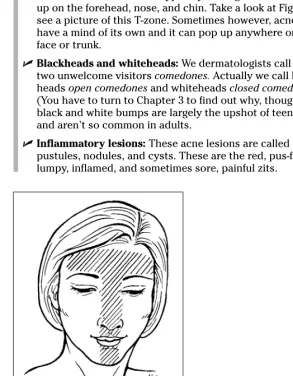
In most cases, acne starts between the ages of 10 and 13 and usu-ally lasts for 5 to 10 years. The appearance of teenage acne (acne vulgarisis the technical term that I throw around here and there in the book) is largely the result of your body’s increased production of hormones. The good news is that those embarrassing blemishes usually go away and are often gone for good by the time you reach your early 20s.
Taking it on the chin later in life
Although acne is typically thought of as a condition of youth, an ever-growing number of women (less often men) get acne for the first time as adults. Acne is no longer just a teenage affliction. There’s definitely been a rise in the number of adult women in their 20s and 30s with acne — even those who never had a pimple before!Teenage and adult-onset acne have somewhat different character-istics. For one thing, the appearance is different: Adults have fewer blackheads and whiteheads; for another, adult acne tends to be more often located on the lower part of a woman’s face. Also, the appearance of female adult-onset acne is often closely linked to a woman’s menstrual cycle as well as increased sensitivity to hor-mones such as those brought about by pregnancy, starting or stop-ping birth control pills, and other hormonal abnormalities.
If you’re really unlucky, you have adult-onset acne and have also brought along some acne vulgaris from your teenage years. I pro-vide the full story on acne in adult women in Chapter 5.
Lights, camera, acne!
Whether you’re a teenager who is noticing acne for the first time or an adult who antic-ipated permanently waving goodbye to it forever, you’re in good company. The careers of Cameron Diaz, P. Diddy, Jessica Simpson, Alicia Keyes, Mike Myers, and Vanessa Williams have thrived despite their continuing complexion problems with acne.
And think about some of those rugged faces from the silver screen. From the looks of it, Tommy Lee Jones, Laurence Fishburne, Bill Murray, Edward James Olmos, James Woods, and the great British actor and movie star Richard Burton (who mar-ried Elizabeth Taylor, considered to be one of the most beautiful women in the world) more than likely had pretty wicked acne when they were teenagers.
Of course, heavy makeup, favorable lighting, medications, and experienced der-matologists have also probably helped them. I won’t be able to supply your own per-sonal makeup artist or a lighting technician to accompany you to school or work, but I do provide tons of recommendations on how to use acne-fighting medications and find a good dermatologist in this book.
Creating Your Acne-Treating
Program
If you have acne in the 21st century, you’re fortunate. Why? Because there are so many great ways to treat it and there are many more to come. But there are no quick cures for acne; in fact, there aren’t really any cures. The goal of treatment is to manage your acne, help control it, prevent it from scarring, and help you look your best. The truth is that acne tends to heal itself over time, but the right therapy can make your skin look better.
Ye olde pimple remedies
For those of you who are squeamish or are dog lovers, skip to the next paragraph. Seventeenth-century Britons were as concerned about pimples as we are today. According to an old manuscript of home remedies that was recently discovered, people with acne were advised to cut the heads off two puppies, hang them up by their heels to bleed, collect the blood, mix the blood with white wine, and apply the concoction to the face. Yeech! Don’t try it; it won’t work!
At the beginning of the 20th century, most of the acne treatments involved the cor-rection of intestinal disorders such as indigestion and constipation. Recommended anti-acne regimens included low-fat and low-sugar diets. Sound familiar? Excessive sweating was discouraged, and — get this — some doctors recommended that erotic preoccupation be avoided (without doubt, a difficult prescription to follow).
Active surgical treatment at that time included opening up and draining acne lesions (they’re the zits), vigorous scrubbing, steaming, and washing with soap and hot water. All of this was followed by the application of foul-smelling chemicals includ-ing sulfur. For difficult-to-manage acne in middle-aged women, arsenic — both applied to the skin and injected into it — was sometimes used!
Meeting the players
Until the last couple of decades, there was very little anyone could do to treat acne. But we’ve now come a long way from the “dark ages” of arsenic and puppy blood (see the sidebar “Ye olde pimple remedies”). Now we have excellent methods to treat acne and the future looks even brighter. There are
⻬Over-the-counter topical(applied to the skin) products that contain such tried-and-true medicines as benzoyl peroxide (see Chapter 7 for a complete list of products, their pros and cons, and how to use them effectively)
⻬Topical antibiotics and retinoids (I discuss these in Chapter 9) ⻬Oral antibiotics (take a look at Chapter 10)
⻬Hormones and anti-androgens for females (see Chapter 11) ⻬Oral retinoids, like Accutane (see Chapter 13)
⻬Chemical peels, special lasers, and lights (see Chapter 14)
Some people also claim that various alternative and complemen-tary approaches have helped improve their acne (in Chapter 15, I outline the possibilities and give you my input and advice on such matters).
Deciding whether to treat yourself
If you’re just starting to get breakouts or you have really mild acne with a few blemishes here and there, the over-the-counter (OTC), do-it-yourself route that I describe in Chapter 7 may be just the ticket for you. Look in the mirror. If you see a few blackheads and whiteheads or a few pimples, you can probably find ways to treat them on your own.You can find many acne products waiting for you at your local drugstores and cosmetic counters. You can do many things to improve the appearance of your skin without a prescription if you’re a teenager just starting to get acne. Shelves are also stocked with products specifically geared toward adult women.
Although going to a doctor generally costs more than buying a cream at your local drugstore, you’ll likely save money in the long run and get better results than you’ll get by running through the gamut of OTC acne products.
Relying on the experts
For some folks, acne can be more serious. In fact, by their mid-teens, more than 40 percent of adolescents have acne severe enough to require some treatment by a physician or a dermatolo-gist who is an authority when it comes to acne. And adult women who are having problems getting their acne to respond to treat-ment often need to make an appointtreat-ment with a doctor.
But no matter who you are, you should definitely have your acne evaluated by a knowledgeable healthcare provider if:
⻬Your acne didn’t respond to home remedies, diets, herbal medications, facials, special soaps, or nonprescription OTC treatments.
⻬Your skin can’t tolerate the OTC preparations.
⻬Your acne is widespread and it involves your chest and back. ⻬Your acne is beginning to scar or has already scarred. ⻬Your acne has become more severe.
⻬You are a female who develops facial hair or has irregular periods (I address this issue in Chapter 20).
⻬You’re not a “do-it-yourselfer” and you want the pros to handle your acne.
⻬You have dark skin, and patches that are darker than your normal skin appear after your acne lesions clear. (For treat-ment considerations particular to folks with darker skin, turn to Chapter 12.)
In addition, you may need help dealing with acne scars, both the physical and emotional:
⻬Healing the inner scars:The emotional effects of acne haven’t always been fully appreciated, but many studies have demon-strated its damaging psychological impact. Nowadays there is a much greater interest in preventing and healing the inner scars of acne. In Chapter 17, I talk about the psychological and social scars of acne.
Avoiding quickie, quacky cures
Because your acne appears on your face and everyone can see it, you may feel desperate to make it go away. But because it’s not life threatening, you may feel reluctant or embarrassed to go to your healthcare provider about it. Certain people prey on that knowl-edge. They want to sell you expensive over-the-counter acne “cures” that don’t do you any good, or get you to order them after watching testimonial-filled infomercials.
The people giving those acne “testimonials” on TV are almost always professional actors reading a script. And even those stories that are “real” generally mean nothing. You can always find one or two success stories while ignoring 99.9 percent of failures.
Even if it’s on TV, on the radio, the Internet, or in magazines, that doesn’t mean it’s necessarily true. The world of acne fighting is filled with snake oils and false promises.
There are promises that guarantee “five day cures” for your acne, and there are the real slow pokes that state, “try this all time-tested home treatment for acne and have clearer blemish-free skin within 30 days of use.” You can find many similar “cures” if you search the Internet, so check out Chapter 21 where I give you some roadmaps to some realistic acne advice you can find on the Web.
Recognizing Impostors and
Related Conditions
Chapter 2
Getting Comfortable with
the Skin You’re In
In This Chapter
䊳Peeling back the layers
䊳Finding ways to keep your skin in shape
D
o you know what the biggest organ in your body is? It’s not your brain, and it’s not your large intestine. Give up? The sub-ject of this book may have given the answer away, so I’ll suspend any further guesswork and tell you: It’s your skin. That’s right; your skin is an organ (just like your heart, lungs, and liver). And if you spread out the skin of the average adult it would measure 20 square feet, about the size of a twin-sized bed sheet!In this chapter, I cover the ins and outs of your skin so that you can see just where your acne originates. I acquaint you with the many functions that your “largest organ” performs and tell you a little about how to take care of it.
Exploring Your Largest Organ
You may not really think of the skin as an organ, like the heart and lungs. To many people, skin seems more like a simple cover to pre-vent their insides from falling out. An organ is a somewhat inde-pendent part of the human body that performs a specific function. Once you know that, you can see that the skin isan organ, because it performs the following specific functions (in addition to others):
⻬Protects your body from infection
⻬Serves as a waterproof barrier between you and the outside world
⻬Provides cushioning like a shock absorber that defends you from injury
⻬Insulates your body and keeps your temperature right around a cozy 98.6 degrees Fahrenheit (37 degrees Celsius)
⻬Acts as an energy reserve
⻬Alerts you to potential harm through your sensations of touch and pain
⻬Repairs itself (that’s why cuts heal) ⻬Produces vitamin D
Because your skin has so many functions, you may not be sur-prised to discover that it also has a rather complicated structure with many working parts. It contains hairs that have their own oil glands and tiny muscles — I’ll bet that you didn’t know that hairs have muscles! Your skin has sensory nerves — hot, cold, touch, and pressure receptors. It also is home to blood vessels, lymph vessels, and sweat glands. Plus, your skin has microscopic pigment-producing cells, cells that work on your immunity, as well as cells that protect and replace themselves. With all that going on, you may be surprised that your skin doesn’t have its own zip code.
Human skin is made up of three layers. First come the top two layers — the epidermis (the outside layer of skin that you can touch and see) and the dermis(which is located directly beneath the epi-dermis). Then comes the third, bottom fatty layer that the epidermis and dermis rest upon, which is called the subcutaneous layer.
The prefix epimeans “upon” and dermmeans “skin,” so, together, they form epidermis(upon the skin). And obviously, dermismeans “skin.” The prefix submeans “under” and cutaneousis another ref-erence to “skin,” so the word subcutaneousmeans “under the skin.” (I guess they should have named it the “subdermis” if they wanted to be totally consistent.)
In the sections that follow, I take you on a guided tour of each of these layers. And like any good tour guide, I provide you with a map in Figure 2-1.
Getting above it all: Hey, your
epidermis is showing!
Figure 2-1: A cross section of your skin.
The Latin term for cells is “cytes.” Therefore, keratino-cytes,by defi-nition, are cells (cytes) comprised of keratin.
Just as your skin has more then one layer (epidermis, dermis, and subcutaneous layer), the epidermis itself has three layers. Within these layers, there’s constant cellular motion going on.
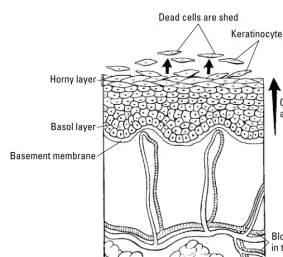
⻬Outer layer:The outermost layer of the epidermis is known as the stratum corneum, also known as the horny layer.This layer provides your body with a durable overcoat that protects deeper cells from damage, infection, and from drying out.
This layer of your skin is actually made up of dead skin cells. (Your hair and nails are made of dead cells too!) So when you look at your skin, you’re really seeing skin that is dead. But these deceased skin cells only stick around for a little while. Soon, they flake off — like when you wash, scratch yourself, go shopping, sit in class, fall asleep, and even read this book. Basically, all the time. In fact, every minute of the day we lose about 30,000 to 40,000 dead skin cells off the sur-face of our body.
Hair
Sebaceous (oil) gland
Sweat gland Follicle
Nerve Subcutanous
layer
Fatty tissue Muscle
Dermis Epidermis
⻬Middle layer:This layer is known as the stratum spinosum.
The cells in this layer looked kind of spiny to the scientists who first described them.
⻬Inner layer:Known as the basal layer, the inner layer is like a production facility for the new skin cells (keratinocytes) that eventually make their way up through the stratum spinosum to the outer stratum corneum to replace the dead older cells you lose from the surface.
The keratinocytes in the basal layer stand up like little sol-diers at attention on what’s called the basement membrane,a barrier that separates the epidermis from the dermis; it’s the anchor that joins the epidermis and dermis together. The ker-atinocytes are kept alive by the underlying dermis — which serves as their blood supply because the epidermis has no blood supply of its own. But their upward journey carries them farther away from their supply lines, and as they approach the top, they begin to die. By the time they’ve reached the outer layer of the epidermis, they’ve lost virtually all of their cellular contents except for tough keratin fibers and other solid proteins. Even as they dry up and die, they become much more resilient and durable and become the flat-tened cells that form the stratum corneum. This one-way trip takes about two weeks to a month to accomplish. Figure 2-2 demonstrates the process.
When an injury or an acne pimple penetrates the basement membrane, a scar may result. (I describe acne scarring in Chapter 16.)
Scratching the surface: Now your
dermis is showing!
Your dermis, the layer of skin that lies just under your epidermis, has an intimate relationship with your epidermis. It comes equipped with sensory nerves, sweat glands, blood vessels, and hair follicles. It nourishes the epidermis by providing gases such as oxygen and carbon dioxide, which reach the epidermis by diffusing through the basement membrane. The epidermis can’t survive without the dermis, because it has no nerves or blood supply of its own.
Throughout the dermis are collagen and elastin fibers. Collagenis a resilient protein that provides rigidity and strength to the dermis.
Figure 2-2: The maturation and upward migration of epidermal cells.
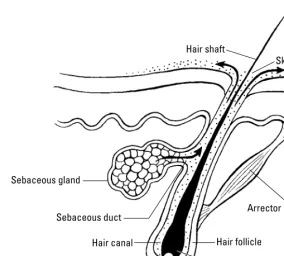
Also located in the dermis is the hair follicle (refer to Figure 2-1). A
hair follicleis a hair-containing canal; a tube-shaped sheath that surrounds the part of the hair that is under the skin. It’s located in the epidermis and the dermis. Blocked hair follicles are often at the root of the acne problem. In fact, it seems like the hair follicle is the central focus of this entire book! (To read a detailed descrip-tion of how a follicle becomes blocked and a pimple forms, skip ahead to Chapter 3.)
Styes, boils, shaving bumps — I could go on and on — all have their origins in the hair follicle. In Chapter 19, I go into a few of these conditions that folks often mistake for acne.
Digging deeper: Your
subcutaneous layer
Fat cells known as lipocytes reside in the subcutaneous layer.Our visit to the subcutaneous layer will be brief because as far as acne is concerned, there’s not much action going on here.
Dead cells are shed
Basement membrane
Keratinocytes
Cells mature and flatten
Blood vessels in the dermis Basol layer
But if you’re interested, your subcutaneous layer is what your outer layers of skin rest upon. Your fatty layer is your body’s insu-lator, cushion, and natural shock absorber (and it also helps to keep the diet industry in business!). The subcutaneous layer con-tains arteries, veins, lymph vessels, and nerves that are larger than those found in your dermis. If you go any deeper, you’ll come upon muscles and possibly some of your inner organs. That’s out of bounds! So I’ll end the anatomical tour right here in Fat City.
The skinny on skin
Here are some skin facts you can use to impress your friends and family:
⻬ Skin is your heaviest organ. It accounts for about 15 percent of your body weight. That means that the skin of a 400-pound sumo wrestler can weigh in at as much as 60 pounds! The skin of an average adult woman weighs about 20 pounds.
⻬ The thickness of the average epidermis varies from 0.5 millimeters on your eyelids to 4.0 millimeters or more on the palms of your hands and the soles of your feet.
⻬ You produce a totally new epidermis about every 30 days!
⻬ Most of the dust in your classroom or bedroom is made of tiny fragments of human skin. In just one minute, 30,000 to 40,000 skin cells fall unseen from the surface of your body. That means you lose around 15 million or so skin cells in one year. (Imagine how dusty it must be in that sumo wrestler’s bedroom!)
⻬ Your dermis is several times thicker than the epidermis and is particularly thick on the upper back. Our thick upper back may have protected us from saber-toothed tigers when we walked on all fours. On second thought, I doubt it.
⻬ “Goosebumps” come from tiny muscles called erector pili. These muscles attach to each of our hairs and make them stand at attention when we’re cold or afraid. We can see this phenomenon on a frightened cat whose fur stands on end. It’s meant to make kitty look bigger and scarier to other animals. And when we had more body hair during the Stone Age, it probably did the same for us. ⻬ You have about 3 to 5 million hairs on your body.
Basic Operating Instructions:
Taking Care of Your Skin
Different people and different skin types need to do different things for their skin. We have an old expression in dermatology that still rings true: “If it’s dry, wet it; if it’s wet, dry it.” In recent decades, another truism has been added: “If it’s fair, shield it; if it’s dark, you’re probably very fortunate.” That’s because your melanin pro-tects you from skin cancers, wrinkling, and keeps you looking young.
If your skin is fair, if you burn easily, or if you have a personal or family history of skin cancer, you should protect yourself from the sun by wearing hats and caps, using sunscreens, and avoiding going to tanning parlors. If your skin is dark, you may have other reasons to protect it from the sun (see Chapter 12 where I talk about the dark spots that occur in dark skin). People with dark complexioned or Asian skin may have other reasons to be very sensitive and prone to irritation and possibly less tolerant of many of the topical medications that are used to treat acne.
The ultimate operating instruction: Whether you have dry, regular, or oily skin, a big acne breakout or smooth sailing on the pimple front, there’s something that’ll keep your face looking its best and most attractive to the rest of the world and is guaranteed to help you make friends and influence people. I suggest that you simply exercise your muscles of facial expression — and smile!
Washing your face
Rocket science? Maybe not. But as a dermatologist, I have a few reasons for walking you through a little face-washing tutorial. First, I often begin my instructions for applying medications in later chapters with phrases like “Wash your skin . . .” or “To a clean, dry face, apply . . .” so, it seemed to make sense that I fill you in on the details. The second reason for this bit of Face Washing 101 is even simpler — many people screw it up. But don’t worry: I’m here to help. And, if you’re like many folks, my face-washing routine can simplify your mornings and evenings and save you some cash.
oatmeal, avocado, citrus, aloe vera, sandalwood, wintergreen, pep-permint, patchouli, and vitamin E to name a few.
Many types of cleansers are also available. Some exfoliate as they clean, and the medicated ones generally contain benzoyl peroxide or salicylic acid in various concentrations. Overcleansing with these products can be irritating. More often than not, these items will only dry out and irritate your skin, particularly if you’re already applying a topical anti-acne medication (see Chapters 7 and 9).
Washing excessively — more than twice a day — with any soap (regular soaps, acne soaps, antibacterial soaps, soaps with abra-sives, or even gentle soaps) has little positive impact on your acne. In fact, if you have acne, your skin may be red and inflamed, and frequent washing only makes it redder.
Washing your face with a mild soap just twice a day is the best tactic, regardless of your skin type or acne activity. I recommend the follow-ing soaps and cleansers, dependfollow-ing on your skin type. These tried-and-true recommendations may not sound as exciting as a Provencal honey-lavender soap with grape seeds, but they flat out work:
⻬Oily skin:Ivory soap ⻬Dry skin:Dove soap
⻬Extra-sensitive skin or allergic reaction to soaps:Nonsoap cleanser such as Cetaphil, Aquanil, or Neutrogena Extra Gentle Cleanser
At the risk of sounding like a parent — with the whole “wash behind your ears” thing — now that you have your soap, here’s how to use it:
1. Get the soap wet, using lukewarm water.
2. Using your fingertips or a soft washcloth, apply the soap to your skin and rub it gently into your skin using a cir-cular motion.Don’t use loofah sponges, brushes, or sand-paper please.
3. Splash your face with lukewarm water until the soap is completely gone.Expect to rinse your face for just a few seconds — perhaps as long as it would take to sing “Happy Birthday.”
4. Pat — don’t rub — your skin until it’s dry.Use a soft cotton towel.
Dealing with dry skin
If you have overly dry skin (known as xerosis in the medical world), it’s probably more of a problem for you when the weather is cold and the humidity is low. This occurs most often in the winter months in northern climates. In Western societies, our modern lifestyles also emphasize overbathing, which only serves to worsen the dryness. On top of that, we often live and work in overheated spaces.
If your skin is dry, keep it moist by using only mild soaps or soap substitutes as I recommend in the preceding section. You could also consider moving to a more humid climate — think rain forest. If you’re already using a mild soap (and assuming a move to the Amazon is out of the question), apply moisturizers regularly, partic-ularly when your skin is still damp(check out the “Giving your skin a drink!” sidebar in this chapter to find out why). Finding the right moisturizer for your