Word-based Partial Annotation for Efficient Corpus
Construction
Graham Neubig
Shinsuke Mori
Kyoto University
Yoshidahonmachi, Sakyo-ku, Kyoto, Japan
[email protected]
[email protected]
1
Introduction
While empirical methods have led to great ad-vances in natural language processing (NLP) tech-nology, the cost of annotating training data for such methods can be immense. This is particu-larly true when applying methods to specialized domains, as annotators that are both familiar with the annotation standard and the target domain are hard-to-find and costly. When a corpus ex-ists in the general domain, it is possible to create a partially annotated corpus in the target domain that augments the domain-specific areas not cov-ered well by the general domain corpus. This helps reduce the amount of annotation required, allowing for efficient development of linguistic resources.
Much previous work in partial annotation has used the sentence as the basic unit of annotation (Ringger et al., 2007). This allows for easy in-tegration with existing language processing tech-niques, which generally use sentences as the unit for training and analysis. However, as only one or two words in any particular sentence may be ambiguous, annotating entire sentences results in annotation of large amounts of redundant informa-tion. An obvious solution to this problem is to an-notate not whole sentences, but only specific words that are able to effectively increase the accuracy of a system of interest.
In this paper, we examine the benefit of anno-tating only particular words in a sentence, as op-posed to the entire sentence. Using the task of Japanese pronunciation estimation as an example, we devise a machine learning method that can be trained on data annotated word-by-word. This is done by dividing the estimation process into two steps (word segmentation and word-based pronun-ciation estimation), and introducing a point-wise estimator that makes each decision independent of the other decisions made for a particular sen-tence. In an evaluation, the proposed strategy is shown to provide greater increases in accuracy us-ing a smaller number of annotated words than tra-ditional sentence-based annotation techniques.
2
Task Definition and Traditional
Methods
Estimating the pronunciation of words in written text is essential for creating systems such as text-to-speech (TTS) or automatic speech recognition (ASR). In languages such as Japanese, which are written without spacing between words, it is also necessary to segment unspaced character strings into appropriate units. Thus, the process of esti-mating the pronunciation of a Japanese essentially consists of two steps:
• Word Segmentation (WS): Dividing an un-spaced character string into appropriate units.
• Pronunciation Estimation (PE): Estimation of the pronunciation of each segmented unit.
Traditional methods for Japanese PE generally treat WS and word-based PE as a single step, going directly from an unsegmented character string to a string of word/pronunciation pairs.
2.1 Sequence-based Models
Previous systems for Japanese PE generally use sequence-based methods such as n-gram models (Nagano et al., 2005). In addition, CRFs on POS-word pairs for morphological analysis (Kudo, 2009) can be extended to PE, but as of yet no experi-mental result of CRFs on PE have been reported. For training, methods such asn-grams and CRFs generally require fully annotated training sentences to estimate parameters. Morphological analyzers (Kudo, 2009), which are often used for PE, further require that sentences be annotated with parts of speech and other linguistic information.
In the evaluation, we used a tri-gram model based on word-pronunciation pairs as a representa-tive of these sequence based models. This is similar to the method proposed in (Nagano et al., 2005)1.
2.2 Required Resources
Generally speaking, three types of resources are required to train models for pronunciation estima-tion.
1which additionally uses triplets including accent
Figure 1: The pronunciation estimation process.
Figure 2: Character and character type 3-gram fea-tures with a window width of 2.
Figure 3: Dictionary word features.
selected, and only characters within this win-dow are used in analysis, allowing for the lim-iting of the parameter space (see Figure 2.)
2. Character typen-grams: Japanese charac-ters can be broadly grouped into 6 types, Chi-nese ideographs, katakana (used in phonetic spelling of foreign names), hiragana (used in conjugation and Japanese origin words), ro-man characters, digits, and other characters. As changes in character type often indicate word boundaries, this information is useful to incorporate in a word segmentation system. Character type information was incorporated by adding features similar to the previously mentioned character n-grams, only replacing the character itself with the character type.
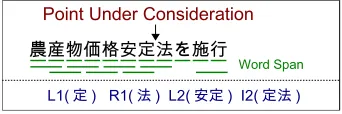
3. Dictionary Word Features: In order to al-low for the use of a dictionary in the segmen-tation process, three types of features describ-ing the presence of words in the dictionary are included in the feature set. First, when judg-ing about whether a word boundary exists be-tween charactersxiandxi+1, if a word starts
at character xi+1 a feature “R” (right)
indi-cating a word exists to the right of the point is added. Likewise, if a word ends at charac-terxi a feature “L” (left) is added. Finally, if
a word spans bothxi andxi+1, a feature “I”
(included) is added. All of these features are annotated with the length of the word under consideration, so if a word of three characters ends at characterxi, a feature “L3” will be
in-cluded in the estimation process. An example of these features is shown in figure 3.
These features are calculated for each potential word boundary betweenxi andxi+1, and a
classi-fier is used to determine the presence or absence of the word boundary. In the evaluation presented in Section 4, the linear support vector machine (SVM) implementation provided by the LIBLIN-EAR software package (Fan et al., 2008) was used to solve this classifying task.
SVMs are well suited to this task, as focusing on the annotation of difficult or rare cases tends to in-crease the number of outliers that are included in the training data. Many machine learning methods are heavily influenced by these outliers, resulting in a reduction of accuracy on more common phe-nomena. SVM, on the other hand, are relatively robust to the inclusion of rare instances, resulting in little reduction of accuracy, even when these rare cases are included.
3.4 Features/Implementation for PE
Words that have multiple readings in the cor-pus are estimated using a classifier trained on the instances in the corpus. This classifier uses the charactern-grams and character typen-grams described in the previous section. Words that only have a single pronunciation in the corpus, or only occur in the dictionary are given that reading. Unknown words are estimated using a character-based language model annotated with character/pronunciation pairs.
4
Evaluation
4.1 Conditions of the Experiments
The general-domain resources used are as follows:
• Balanced Corpus of Contemporary Japanese (BCCWJ):A 898k word general-domain corpus fully annotated with word boundaries and pronunciations (Maekawa, 2008).
• UniDic (Version 1.3.12): An 212k word dictionary of Japanese words and proper names with an average of 1.05 pronunciations per word (Den et al., 2008).
• Number Dictionary: A dictionary of two digit and four digit numbers that often appear as years.
For domain adaptation and testing, we created a corpus of fully annotated sentences from the Nikkei newspaper with word boundaries and pronuncia-tions. Nikkei is a business newspaper, and dif-fers significantly in writing style from the general domain corpus. 10% of the corpus (29k words) was used as testing data, and the other 90% (263k words) was used as training data to be fully or partially annotated.
For full annotation, the training corpus was shuf-fled in random order, and sentences were chosen from the head of the shuffled corpus. For partial annotation, the following annotation strategy was used:
1. Frequencies of all character bi-grams in the target domain corpus are counted.
2. Bi-grams that occur at least once in the gen-eral domain corpus are removed.
3. In descending order of frequency, one instance of each remaining character bi-gram is anno-tated with word boundaries and pronuncia-tions until a certain set number of bi-grams has been annotated.
This strategy has the advantage of being sim-ple, while still covering the great majority of mis-segmented and unknown words.
4.2 Evaluation Criterion
WS accuracy is measured using point-wise accu-racy. For each point between two characters in the corpus, WS judges whether a word boundary ex-ists or not. The WS accuracy is measured by the number of times this judgment is correct, divided by the total number of points between characters in the corpus.
PE is evaluated using mora F-measure. The longest common subsequence (LCS) of mora is
Table 1: Accuracy of the point-wise and tri-gram Models (%).
Training Data Point-wise Tri-gram
WS PE WS PE
BCCWJ Only 98.82 98.31 98.73 98.16 BCCWJ+NKN 99.41 99.26 99.34 99.15
found between the correct answer and system out-put, and given precision (P) and recall (R),
P = |LCS|
|Sys-out| R=
|LCS|
|Correct|.
F-measure can be found given the harmonic mean of precision and recall:
F = 2×P×R/(P+R).
4.3 Strategies
We tested the performance of three different strate-gies:
Strategy S: A pair-based tri-gram model using full annotation.
Strategy F: A point-wise estimator using full annotation.
Strategy P: A point-wise estimator using partial annotation.
4.4 Evaluation
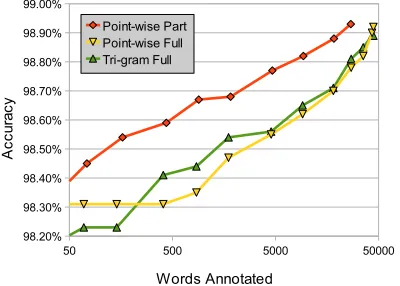
We compared the accuracies of the three models over various data sizes. The accuracies using none and all of the target-domain data are shown in Ta-ble 1 as a baseline and gold standard respectively. Figure 4 and Figure 5 show the WS and PE accu-racies for various data sizes and strategies. Strate-giesS and F both perform similarly on PE when using fully annotated corpora. Strategy P per-forms significantly better than bothS andF, par-ticularly when few words have been annotated.
In the two figures, it seems as though the differ-ence betweenPandFis saturating at higher data sizes. This is because the corpus that we are using in the target domain is relatively small, at 263k words. However, in reality a far greater amount of unannotated target-domain data will be available, and performance will likely continue to increase, even after larger numbers of words are annotated.
5
Conclusion
Figure 4: Accuracy of various models on word seg-mentation.
Figure 5: Accuracy of various models on pronun-ciation estimation.
data, we decomposed the problem of Japanese pro-nunciation estimation into two parts, and devel-oped a point-wise estimator that can be trained on incomplete annotations. This annotation strategy proved effective in reducing the amount of anno-tation necessary for equal gains in accuracy. From these results we can conclude that when we prepare language resources for NLP applications that it is important to consider both the annotation strat-egy and the machine learning techniques, as well as the compatibility between the two.
A promising future research direction in this area is the development of a more intelligent method to select words to annotate, such as active learning. Another possible direction would be the applica-tion of this technique to other domains such as Japanese morphological analysis or POS tagging in English or other languages.
References
Yasuharu Den, Junpei Nakamura, Toshinobu Ogiso, and Hideki Ogura. 2008. A proper approach to Japanese morphological analysis: Dictionary, model, and evaluation. In Proc. LREC2008.
Rong-En Fan, Kai-Wei Chang, Cho-Jui Hsieh, Xiang-Rui Wang, and Chih-Jen Lin. 2008. LIB-LINEAR: A library for large linear classification.
Journal of Machine Learning Research, 9:1871– 1874.
Taku Kudo. 2009. MeCab: yet
an-other part-of-speech and morphological ana-lyzer. http://mecab.sourceforge.net.
Kikuo Maekawa. 2008. Balanced corpus of con-temporary written Japanese. In Proceedings of the 6th Workshop on Asian Language Resources, pages 101–102.
Tohru Nagano, Shinsuke Mori, and Masafumi Nishimura. 2005. A stochastic approach to phoneme and accent estimation. In Proc. In-terSpeech2005, pages 3293–3296.
Eric Ringger, Peter Mcclanahan, Robbie Haertel, George Busby, Marc Carmen, James Carroll, and Deryle Lonsdale. 2007. Active learning for part-of-speech tagging: Accelerating corpus an-notation. InProc. LAW2007, pages 101–108.