Seismic Structural Response using Anti
Seismic Bricks
T. Naga Sai Visalakshi
1, T. Harish
2P.G Student, Department of Civil Engineering, SVU College of Engineering, SV University, Tirupathi,
Andhra Pradesh, India
1Assistant Professor, Department of Civil Engineering, Audisankara Institute of Technology, Gudur,
Andhra Pradesh, India
2ABSTRACT:
Earthquakes constitute one of the greatest hazards of life and property on earth. Due to suddenness of
their occurrence, they are least understood and most dreaded. The earthquake resistant construction is considered to be
very important to its effects. In this paper Seismic isolation and energy dissipating systems present an effective way to
common seismic design for improving the seismic performance of structures. These techniques reduce the seismic
forces by changing the stiffness and/or damping in the structures, whereas conventional seismic design is required for
an additional strength and ductility to resist seismic forces, to the building structures having existed for a relatively long
period of time.
In This paper presents a brief history of A new form of anti-seismic brick promises to improve the earthquake
resistance of buildings, by designing a partition wall for the buildings by anti-seismic brick’s ,Because of the unique
combination of the materials it enhance the way to behave in response to seismic force. Anti-Seismic brick’s also
absorbs horizontal seismic motion, in addition to supporting the vertical loads in the form of partition walls.
During the earthquake, the brick’s ability to absorb the horizontal movements enables it to act as a form of seismic
insulation in the event of earthquakes by isolating the primary structure from the horizontal force affecting the partition
walls , so impact on overall structural integrity in the face of an earthquakes is greatly reduced, without requiring
expensive structural interventions.
This technique is not yet very common, but a number of research activities is going on in order to investigate the
behavior of the anti-seismic brick buildings. Civil engineers, architects, constructors and owners have great
responsibilities concerning applications of these systems, but especially the users have sanction, therefore widely use
of the earthquake protective systems will be provided by the users’ awareness.
KEYWORDS:
ceramic powder, superplastizer, 6mm of steel rods.
I. INTRODUCTION
The purpose of earthquake prevention of buildings is to provide the structural safety and comfort by controlling the
internal forces and displacement within the particular limits. The common method for protecting the structures against
the destructive effects of earthquakes is to damp the seismic energy for limiting the seismic energy by the structural
elements, thus providing the resistance against the earthquake. In spite of using this method for a certain level of
protection, the structure could be damaged for real sometimes. Another method for protection of the structures against
the earthquake is to isolate the building from the ground and/or to install seismic energy dissipating elements at the
appropriate places of the building. With this method, better protection could be provided, by designing correctly against
the earthquakeandthereforesignificantstructuraldamagelevelcouldbeminimized.
Application of earthquake protection systems in buildings whether will be constructed and were constructed -especially the historical ones-, increases the importance of these technologies. But construction of this technologies is very difficult at all so compensate to overcome all this difficulties ANTI-SISMIC BRICK as a remedy.
A. ANTI SISMIC BRICK AS A REMEDY
Sisbrick is a new class of earthquake-resistant building material that seismically isolates partition walls from the main building structure, significantly reducing the tension between these two elements and, therefore, the damage incurred.
Researchers have designed a new seismic isolator that improves the way buildings respond to earthquakes. The key to the Sisbrick, as the invention is known, lies in the way different materials have been combined to achieve two main effects: it is able to absorb horizontal seismic movements, while also supporting vertical loads (for instance, partition walls) that act on the integrity of the building frame. Designed specifically for use in partition walls, its brick form means it can be readily incorporated into traditional construction techniques, without the need for additional measures or equipment.
Techniques and special bricks to improve the way buildings respond to earthquakes are already available on the market. However, what sets Sisbrick apart is its approach to partition walls. As researcher Luis Pallarés at the UPV’s Concrete Science and Technology Institute (ICITECH) explains, these structures greatly condition a building’s response to a seismic event. Merely making partition walls more resistant does not address the more widespread damage caused by earthquakes. The Sisbrick’s large capacity to absorb the horizontal movements caused by earthquakes seismically isolates the partition walls from the main building frame: “They effectively serve as an insulating barrier, avoiding the transfer of loads from these partition elements to the main structure. By doing so, their impact on overall structural integrity in the face of an earthquake is greatly reduced”
This also brings real seismic response into line with projected seismic response as calculated at the building design stage. Francisco Javier Pallerés, also of ICITECH, tells us that “today, seismic calculations only take into consideration the structure of the building frame and do not consider the partition walls, despite the clear and widely-reported influence they have on a building’s response to earthquakes”. By isolating the partition walls from the main frame, these calculations become more reliable.
On top of the convenient brick form, only a relatively small amount of these bricks is needed to achieve this seismic isolation. Laboratory testing proves that, if the bricks are arranged in a specific way, just a small amount can afford significant gains in seismic wave absorption. Specifically, partition walls that incorporate Sis bricks can absorb horizontal movements in the order of three times greater than those that do not. This translates into considerably less tension in the partition walls, meaning correspondingly less tension is transferred to the building frame during earthquakes.
II. ANTI SISMIC BRICK CONSIDERATIONS
A.WHAT IS SISBRICK
SISBRICK is a seismic isolator shaped conventional brick or block. It consists of a matrix formulation which gives special properties to achieve seismic isolation sought . This is also contributing inserted in its matrix elements , endowing it with improved properties for behaviour outside the plane.
B. DIFFERENT SIZES OF ANTI-SISMIC BRICK
SISBRICK 7 MEDIUM SIZE
Length 24 cm
Wide 7 cm
High 11 cm SISBRICK 7LARGE SIZE
length33cm
Wide 7cm
Height 16 cm
SISBRICK 9 MEDIUM SIZE
Length 24 cm
Width 9 cm
Height11 cm
SISBRICK 9 LARGE FORMAT
33cm long
Width 9 cm
Fig1: Anti Sisbrick
III. STRUCTURAL RESPONSE USING SISBRICKDURING EARTH QUAKE
A. SEISMIC STRUCTURAL RESPONSE USING “NORMALBRICK”
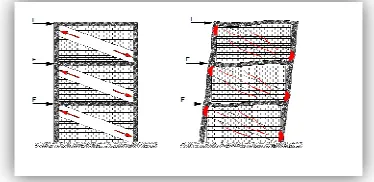
When an earthquake on a building constructed of reinforced frames concrete or metal occurs, a horizontal relative displacement occurs between a plant and another, commonly called ' drift ' or ' drift' . The deformation and stresses occurring as a result of horizontal forces introduced on the resistant structure normally considered in seismic calculations.
When the frames are filled with brick or block walls, the overall structure is stiffened together and the seismic response is different from that provided for in the calculations without considering the internal partition. The drift of each plant produces in partitions compression connecting rods whose ends terminate in the head and the base of the pillars that make up each closed frame.
FIG 2: Deformation porch coerced by the interior walls. Cranks diagonal compression acting on head and base columns. Right) Damage usual pillars and partition walls.
A. SEISMIC STRUCTURAL RESPONSE USING “SISBRICK”
By using SISBRICK , device insulator seismic , deformation of the structural frame without total constraint of partitioning it is allowed , so the appearance of dangerous diagonal compression struts are difficult and gantry behaves similarly to as it has been calculated without the interaction of the partition . They thus facilitate the knots and twists that can be developed modes of failure ultimate limit state specified in the design phase with modern methods of calculation based on the formation of plastic hinges.
FIG: 3 Deformation of the porch to horizontal seismic forces using insulating brick SISBRICK.
being able to withstand loads in the desired direction. With this movement absorption and having stiffness lower than the brick wall and the building structure, makes the formation of the diagonal compression struts causing damage to the heads and sockets of the pillars, and damage to the septum.
FIG4: Deformation porch coerced by the interior walls. Cranks diagonal compression acting on head and base columns. Right) Damage usual pillars and partition walls.
C. UTILIZATION
SISBRICK put in work in the traditional way, like a ceramic brick or block is involved. The septum is made with the usual materials using the conventional technique, and a small number of key locations SISBRICK elements in the partition is arranged to achieve the desired seismic isolation. Thus SISBRICK is responsible for absorbing the relative movements between the wall and the building structure, protecting the cutting pillars diagonals introduced by compression struts, and reducing stresses in the partitions.
The seismic isolation system consists SISBRICK two types of elements. Elements that are in contact with the pillars (blue in the figures), which allow absorption horizontal movements, and elements that contact beams (in roj0 in the figures), which allow absorption vertical movements.
Typical dimensions for partitioning, here are some recommended system utilization SISBRICK provisions are shown to cover contacts between pillars and beams.
FIG: 5 Different configurations depending on the size and degree of isolation septum.
It is also recommended to SISBRICK for incomplete partition pillar.
FIG: 6 (Left)creating short and damage in the same incomplete partition pillar. (Right) Protection of short pillars using SISBRICK.
D. ADVANTAGES
Irregularities in the distribution allows partitioning, both in plan and elevation, affecting the overall rigidity of the building and can result in additional torques.
Allows architectural flexibility, to place or remove partitions without recalculating the original structure, it facilitates structural insulation.
It helps reduce human and economic losses in case of earthquake.
IV. CONCLUSION
Constructions by using Anti Seismic Bricks gives good result, used bricks in at the four corners of the partition wall. When compared to the other techniques. Depending up on experiments' what they did.
Testing is currently being carried out into the thermal and acoustic isolation .Even if this experiments give good result this technique will be a revelonatry one in construction of “ANTI-SEISMIC BUILDING”.
REFERENCES
1. Ambrose, J., & Vergun, D. (1995). Simplified Building for Wind and Earthquake Forces (Third Edition ed.). New York,NY, USA: John Wiley & Sons, Inc.
2. Battersby, S.(2009). House of Straw, Retrieved February 15, 2010, from http://nees.unr.edu/projects/straw_bale_house/house_of_straw.pdf
3. BBC News: One Minute World News, Americas. (2010, February 10). Retrieved February 10, 2010, from BBC News Website:
http://news.bbc.co.uk/2/hi/americas/8507531.stm
4. Blondet, M., M., G. V., & Brzev, S. (2003, March). Earthquake-Resistant Construction of Adobe Building: ATutorial. Retrieved February 3, 2010, from http://www.worldHousing.net/uploads/WHETutorial_Adobe_English.pdf
5. Joyce, C. (2010, January 14). NPR News: Top Stories. Retrieved February 10, 2010, from Npr News Website:
http://m.npr.org/news/front/122547242?singlePage=true
6. San Francisco Earthquake History 1915-1989. (n.d.). Retrieved February 9, 2010, from The Virtual Museum of City of San Fransisco:
http://www.sfmuseum.org/alm/quakes3.html
7. Sarkar, R. (2006). Post Earthquake Housing Construction Uusing Low Cost Building Material. Retrieved February 3, 2010, from
http://conf.ncree.org.tw/Proceedings/i0951012/data/pdf%5C4ICEE-0275.pdf
8. Scawthorn, C. (2007). Designing and mitigating earthquakes, Inaccessscience@McGrawHill, Retrieved February 5, 2010, from http://www.inacessscience.com DOI-8542.YBO70130
9. S.Beveridge, Trans Memoirs of Babur, Vol 1 (Babur name in Turkish) (Lahore: Sange- Meelpublications) 1975, pp. 247-248
10. Yamanouchi, H and et al (2000). Performance based engineering for structural design of building, BRI research paper No.146, Building research institute, 135p.
11. Ilyas, M, 2005. M. Wieland, Chairman of the International Commission on Large Dams (ICOLD) Committee on Seismic Aspects of Dam design. Knowledge Management cell (KMC). Pakistan. swww.erra.pk/othersections/KMC/contacts.asp
12. Miura, K. Koyamada, K. and Iiba, M. (2000). Response spectrum method for evaluating nonlinear amplification of surface strata, “proceedings, 12th world conference on earthquake engineering, Auckland, new Zealand, paper ID 509.