
Doctoral Thesis
Network Virtualization in
Next Generation Cellular Networks
Author: GeorgiaTseliou Supervisors: Dr. Ferran Adelantado Dr. ChristosVerikoukis Tutor: Dr. Ramon Ferr´us
Signal Theory and Communications Department
The complexity of operation and management of emerging cellular networks significantly increases, as they evolve to correspond to increasing QoS needs, data rates and diversity of offered services. Thus critical challenges appear regarding their performance. At the same time, network sustainability pushes toward the utilization of sharing Radio Access Network (RAN) infrastructure between Mobile Network Operators (MNOs). This re-quires advanced network management techniques which have to be developed based on characteristics of these networks and traffic demands. Therefore it is necessary to pro-vide solutions enabling the creation of logically isolated network partitions over shared physical network infrastructure. Multiple heterogeneous virtual networks should simul-taneously coexist and support resource aggregation so as to appear as a single resource to serve different traffic types on demand.
Hence in this thesis, we study RAN virtualization and slicing solutions destined to tackle these challenges. In the first part, we present our approach to map virtual network el-ements onto radio resources of the substrate physical network, in a dense multi-tier LTE-A scenario owned by a MNO. We propose a virtualization solution at BS level, where baseband modules of distributed BSs, interconnected via logical point-to-point X2 interface, cooperate to reallocate radio resources on a traffic need basis. Our pro-posal enhances system performance by achieving 53% throughput gain compared with benchmark schemes without substantial signaling overhead. In the second part of the thesis, we concentrate on facilitating resource provisioning between multiple Virtual MNOs (MVNOs), by integrating the capacity broker in the 3GPP network manage-ment architecture with minimum set of enhancemanage-ments. A MNO owns the network and provides RAN access on demand to several MVNOs. Furthermore we propose an algo-rithm for on-demand resource allocation considering two types of traffic. Our proposal achieves 50% more admitted requests without Service Level Agreement (SLA) violation compared with benchmark schemes. In the third part, we devise and study a solution for BS agnostic network slicing leveraging BS virtualization in a multi-tenant scenario. This scenario is composed of different traffic types (e.g., tight latency requirements and high data rate demands) along with BSs characterized by different access and transport capabilities (i.e., Remote Radio Heads, RRHs, Small Cells, SCs and future 5G NodeBs, gNBs with various functional splits having ideal and non-ideal transport network). Our solution achieves 67% average spectrum usage gain and 16.6% Baseband Unit process-ing load reduction compared with baseline scenarios. Finally, we conclude the thesis by providing insightful research challenges for future works.
La complejidad de la operaci´on y la gestion de las emergentes redes celulares aumenta a medida que evolucionan para hacer frente a las crecientes necesidades de calidad de servicio (QoS), las tasas de datos y la diversidad de los servicios ofrecidos. De esta forma aparecen desaf´ıos cr´ıticos con respecto a su rendimiento. Al mismo tiempo, la sosteni-bilidad de la red empuja hacia la utilizaci´on de la infraestructura de red de acceso radio (RAN) compartida entre operadores de redes m´oviles (MNO). Esto requiere t´ecnicas avanzadas de gesti´on de redes que deben desarrollarse en funci´on de las caracter´ısticas especiales de estas redes y las demandas de tr´afico. Por lo tanto, es necesario propor-cionar soluciones que permitan la creaci´on de particiones de red aisladas l´ogicamente sobre la infraestructura de red f´ısica compartida.
Para ello, en esta tesis, estudiamos soluciones de virtualizaci´on de la RAN destinadas a abordar estos desaf´ıos. En la primera parte, nos centramos en mapear elementos de red virtual en recursos de radio de la red f´ısica, en un escenario LTE-A que es propiedad de un solo MNO. Proponemos una soluci´on de virtualizaci´on a nivel de estaci´on base (BS), donde los m´odulos de banda base de BSs distribuidas, interconectadas a trav´es de la interfaz l´ogica X2, cooperan para reasignar los recursos radio en funci´on de las necesidades de tr´afico. Nuestra propuesta mejora el rendimiento del sistema al obtener un rendimiento 53% en comparaci´on con esquemas de referencia. En la segunda parte nos concentramos en facilitar el aprovisionamiento de recursos entre muchos operadores de redes virtuales m´oviles (MVNO), al integrar el capacity broker en la arquitectura de administraci´on de red 3GPP. En este escenario, un MNO es el propietario de la red y proporciona acceso bajo demanda (en ingl´es on-demand) a varios MVNOs. Adem´as proponemos un algoritmo para la asignaci´on de recursos bajo demanda, considerando dos tipos de tr´afico. Nuestra propuesta alcanza 50 % m´as de solicitudes admitidas sin violaci´on del Acuerdo de Nivel de Servicio (SLA) en comparaci´on con otros esquemas. En la tercera parte, estudiamos una soluci´on para el slicing de red independiente del tipo de BS, considerando la virtualizaci´on de BS en un escenario de m´ultiples MVNOs (multi-tenants)). Este escenario se compone de diferentes tipos de tr´afico junto con BSs caracterizadas por diferentes capacidades de acceso y transporte (por ejemplo, Remote Radio Heads, RRHs, Small cells, SC y 5G NodeBs, gNBs con varias divisiones funcionales que tienen una red de transporte ideal y no ideal). Nuestra soluci´on logra una ganancia promedio de uso de espectro de 67% y una reducci´on de la carga de procesamiento de la banda base de 16.6 % en comparaci´on con escenarios de referencia. Finalmente concluimos la tesis al proporcionando los retos de investigaci´on para trabajos futuros.
I would like to sincerely thank the people who have helped, inspired and motivated me during the course of my study.
My research would have been impossible without the aid and support of my supervisors Dr. Ferran Adelantado i Freixer and Dr. Christos Verikoukis. Heartfelt thanks for teaching me how to think as a researcher and always be curious on how to solve ap-plied problems in the field of wireless telecommunications. The guidance, support and motivation throughout my PhD studies has been valuable.
Furthermore I would like to thank my friend Maria for sharing many good and challeng-ing moments durchalleng-ing the years of our PhD studies.
Last but not the least, I would like to thank my family: my parents, Maria and Kostas, and my sister, Katerina, for always supporting me in any possible way and believing in my capabilities. They are the most important people in my world and I dedicate this thesis to them.
Abstract i
Resumen ii
Acknowledgements iii
Contents iv
List of Figures viii
List of Tables x
Abbreviations xi
1 Introduction 1
1.1 Motivation . . . 1
1.2 Structure of the Thesis and Contributions . . . 5
1.3 Research Contributions . . . 7
1.4 Other Research Contributions . . . 8
2 Background 9 2.1 Introduction. . . 9
2.2 Reference Architectures . . . 9
2.2.1 Distributed RAN: LTE-A Cellular Networks. . . 9
2.2.2 Centralized Radio Access Network (C-RAN) Architecture . . . 13
2.2.3 Hybrid D-RAN and C-RAN Future Architectures. . . 15
2.3 Virtualization of Radio Access Network . . . 17
2.3.1 Flexible BS Virtualization and Functional Splits . . . 17
2.3.2 Managing Virtualized Wireless Resources . . . 18
2.4 Radio Access Network Sharing . . . 20
2.4.1 RAN Sharing Configurations . . . 20
2.4.2 Spectrum Sharing . . . 21
2.4.3 Use-cases and Business Requirements . . . 22
2.5 Radio Access Network Slicing . . . 23
2.5.1 Dynamic Resource Slicing . . . 23 iv
2.5.2 5G Slicing and FrontHaul / BackHaul Integration . . . 25
2.6 Tools for Network Virtualization . . . 26
2.6.1 Software Defined Networks (SDN) . . . 26
2.6.2 Network Functions Virtualization (NFV) . . . 27
3 Scalable RAN Virtualization in Multi-Tenant LTE-A Networks 29 3.1 Introduction. . . 29
3.2 State of the Art. . . 31
3.3 Contribution . . . 32
3.3.1 RENEV in Small Cell Deployment . . . 32
3.3.2 RENEV in HetNet Deployment . . . 33
3.4 Resources Negotiation for Network Virtualization (RENEV) . . . 35
3.4.1 Network Configuration and Assumptions. . . 35
3.4.2 Radio Resource Management Functions . . . 36
3.4.3 RENEV in Small Cell Deployment . . . 37
3.4.4 RENEV in HetNet Deployment . . . 38
3.4.4.1 Detection phase . . . 40
3.4.4.2 Transfer phase . . . 41
3.4.5 Discussion on RENEV . . . 42
3.4.5.1 RAN Virtualization Properties . . . 42
3.4.5.2 Differences with Joint Resource Allocation and Generic Resource Sharing . . . 43
3.4.5.3 Interaction with existing Virtualization Proposals . . . . 44
3.5 Signaling Design Considerations. . . 45
3.5.1 Detection phase signaling . . . 46
3.5.2 Transfer phase signaling . . . 47
3.5.3 Discussion on the Time Scale of RENEV . . . 48
3.6 Throughput Analysis . . . 48
3.6.1 System Model. . . 48
3.6.2 General Throughput Formulation. . . 49
3.6.3 Aggregate Throughput with RENEV. . . 50
3.6.4 Aggregate Throughput without RENEV . . . 51
3.7 Additional Signaling Overhead Analysis . . . 52
3.8 Performance Evaluation . . . 55
3.8.1 RENEV in Small Cell Deployment . . . 55
3.8.1.1 Simulation Scenario and Parameters . . . 55
3.8.1.2 Network Performance . . . 56
3.8.2 RENEV in HetNet Deployment . . . 58
3.8.2.1 Simulation Scenario and Parameters . . . 58
3.8.2.2 Network Performance . . . 59
3.8.2.3 User’s Throughput. . . 62
3.8.2.4 Signaling Overhead . . . 63
3.9 Conclusion . . . 64
4 A Capacity Broker Framework for Multi-tenant LTE-A Networks 65 4.1 Introduction. . . 65
4.2 State of the Art. . . 66
4.3 3GPP Network Sharing Management Architecture . . . 67
4.4 Multi-tenant Resource Slicing Framework . . . 69
4.4.1 System Model. . . 69
4.4.2 MuSli: Algorithm for Multi-tenant Slicing of Capacity . . . 70
4.4.2.1 Guaranteed Requests . . . 70
4.4.2.2 Best Effort Requests. . . 71
4.4.3 Capacity Forecasting . . . 72
4.4.4 Forecasting Error and Confidence Degree . . . 73
4.5 Performance Evaluation . . . 73
4.5.1 Simulation Environment and Parameters . . . 73
4.5.2 Forecasting Evaluation. . . 74
4.5.3 MuSli Results. . . 75
4.5.3.1 Admission of Incoming Requests . . . 75
4.5.3.2 Resource Block Utilization . . . 76
4.5.4 Impact of Traffic Load Aspects . . . 78
4.6 Conclusion . . . 80
5 NetSliC: Base Station Agnostic Framework for Network SliCing 81 5.1 Introduction. . . 81
5.1.1 Motivation . . . 81
5.1.2 Related Work . . . 84
5.1.3 Contribution and Structure . . . 85
5.2 System model . . . 86
5.2.1 Characterization of the traffic and users . . . 86
5.2.2 Characterization of the Base Stations . . . 86
5.2.3 Downlink Transmission . . . 87
5.2.4 Processing load in the BBU pool . . . 89
5.2.5 FrontHaul characterization . . . 90
5.2.6 BackHaul characterization . . . 91
5.2.7 Functional Splits . . . 93
5.3 NetSliC: Base Station Agnostic Framework for Network SliCing . . . 94
5.3.1 Problem Formulation . . . 95
5.3.2 Conditions . . . 96
5.3.2.1 Condition 1: Bandwidth in the air interface. . . 96
5.3.2.2 Condition 2: Processing Load in the BBU. . . 96
5.3.2.3 Condition 3: Delay . . . 96
5.3.3 Algorithm description . . . 97
5.3.4 Complexity and Convergence . . . 100
5.3.5 Implementation Details . . . 101
5.3.6 Discussion on Optimality Degree . . . 101
5.4 Performance Evaluation . . . 102
5.4.1 Simulation Scenario and Parameters . . . 102
5.4.2 Overall Network Throughput . . . 104
5.4.2.1 Average Values. . . 104
5.4.2.2 95% Confidence Interval. . . 107
5.4.3.1 SCs and RRHs . . . 107 5.4.3.2 SCs, RRHs and gNBs . . . 107 5.4.4 Convergence Study . . . 111 5.4.4.1 Static Scenario . . . 111 5.4.4.2 Mobile Scenario . . . 111 5.5 Conclusion . . . 114
6 Conclusions and Future Challenges 115 6.1 Conclusions . . . 115
6.2 Future Challenges . . . 116
A Appendix A: Calculations for Chapter 3 119 A.1 MCS Selection Probability . . . 119
A.2 Derivation of throughput by users in SCs tier . . . 120
A.3 Set of Feasible Future States . . . 122
A.4 Derivation ofP(Q=q|N, M) . . . 123
1.1 Traffic Imbalance in spatial and temporal dimensions [1].. . . 2
1.2 Vision of this thesis for RAN virtualization. . . 5
2.1 Overall E-UTRAN Architecture with deployed SCs (i.e., HeNBs) [14-16]. 10 2.2 E-UTRAN Network Entities of Release 13 3GPP [14-16].. . . 11
2.3 General deployment of two tier scenario with macro eNB and SCs in different frequencies [17, 18].. . . 13
2.4 Centralized RAN architecture by NGMN [20-22]. . . 14
2.5 a) Virtualized-CRAN architecture; b) illustration of joint optimization of resources. c) illustration of joint transmission [19]. . . 15
2.6 Traditional Distributed RAN (D-RAN) vs Cloud RAN (C-RAN) vs Next-Generation Fronthaul (Crosshaul) [25]. . . 16
2.7 A high-level overview of the different functional split options [26]. . . 18
2.8 RAN sharing configurations supported by 3GPP [27, 28]. . . 20
3.1 RENEV for a Heterogeneous Deployment. . . 39
3.2 Call Flow of the messages for UE Attachment and RENEV. . . 46
3.3 Call Flow of the messages UE Context Exchange and RENEV. . . 47
3.4 Aggregate System Throughput for different offered loads in SC tier. . . . 56
3.5 Percentage of transferred Resource Blocks in SC tier. . . 57
3.6 Aggregate System Throughput for different number of Offered Loads in HetNet. . . 60
3.7 (a) Percentage of transferred RBs by each tier. (b) Traffic Served by each tier in HetNet. . . 61
3.8 CDF of user Throughput in HetNet for (a) 42Mb/s, (b) 66Mb/s and (c) 78Mb/s Offered Load. . . 62
3.9 (a) Percentage of successful requests for different number of SCs per clus-ter. (b) Number of exchanged X2 messages per SC in HetNet.. . . 63
4.1 Capacity Broker in 3GPP Network Sharing Management Architecture. . . 68
4.2 (a) Rejected Guaranteed Requests and (b) Rejected BE Requests. . . 75
4.3 (a) RB utilization and (b) SLA violation. . . 77
5.1 Scenario comprising SCs with non-ideal BH, RRHs connected to the BBU with ideal FH and gNBs with 5G FH. . . 83
5.2 Message flow for implementing NetSliC in the standard [6]. . . 99
5.3 (a) Overall Network Throughput vs. (b) Processing load in the BBU while serving VoIP and FTP (50% - 50%) traffic with differentδin a deployment with 10 SCs and 10 RRHs and comparison with baseline schemes. . . 105
5.4 (a) Dropped VoIP and (b) FTP traffic while serving VoIP and FTP (50% - 50%) traffic with different δ in a deployment with 10 SCs and 10 RRHs and comparison with baseline schemes. . . 106 5.5 (a) Overall Network Throughput vs. (b) Processing load in the BBU while
serving VoIP and FTP (50% - 50%) traffic with differentδin a deployment with 10 SCs and 10 RRHs and comparison with baseline schemes. Mean values and 95% confidence interval. . . 108 5.6 Average traffic throughput per slice in a deployment with 10 SCs and 10
RRHs for VoIP (a) and FTP (b). . . 109 5.7 Average traffic throughput per slice and type of BS in a deployment with
10 SCs, 5 RRHs and 5 gNBs for VoIP (a) and FTP (b). . . 109 5.8 Convergence for a static scenario with different offered loads in a
deploy-ment with 10 SCs and 10 RRHs. . . 110 5.9 Choice of periodicity of triggering, ∆(t), in a scenario with mobility (25.48
Mb/s offered load) in a deployment with 10 SCs and 10 RRHs. . . 112 5.10 (a) Dropped VoIP and (b) FTP traffic while serving mobile VoIP and
FPT users (50% - 50%) with differentδ in a deployment with 10 SCs and 10 RRHs. . . 113
3.1 Basic System Parameters used in the HetNet Simulation, RENEV . . . . 59 4.1 Basic System Parameters used in the Simulation, MuSli . . . 74 4.2 RMSE of the studied Forecasting Methods. . . 74
2G Second Generation access network
3G Third Generation access network
3GPP Third-Generation Partnership Project
5G Fifth Generation Networks
AAS Antenna Array System
AI Artificial Intelligence
AMC Adaptive Modulation and Coding
AWGN Additive White Gaussian Noise
AxC Antenna Carrier
BBU Base Band Unit
BE Best-Effort
BH BackHaul
BS Base Station
C-RAN Centralized RAN
CA Carrier Aggregation
CAC Call Admission Control
CAPEX Capital Expenditure
CB Coordinated Beamforming
CBR Constant Bit Rate
CD Confidence Degree
CDF Cumulative Distribution Function
CDMA Code division multiple access
CN Core Network
CO Central Office
CoMP Coordinated Multi-Point
CPRI Common Public Radio Interface
CS Coordinated Scheduling
CSI Channel Status Information
CSIR Channel State Information at the Receiver
CSIT Channel State Information at the Transmitter
CU Centralized / Central Unit
D-RAN Distributed RAN
DeNB Donor eNB
DU Distributed Unit
E-UTRAN Evolved Universal Terrestrial Radio Access
eICIC Enhanced ICIC
eICIC enhanced Inter-Cell Interference Coordination
eMBB enhanced Mobile Broadband
eNB E-UTRAN macro NodeB
EP Elementary Procedure
EPC Evolved Packet Core
EvDO Evolution-Data Only or Evolution-Data Optimized
FFT Fast Fourier Transform
FH FrontHaul
FTP File Transfer Protocol
gNB 5G New Radio (NR) NodeB
GPP General-Purpose Processor
GWCN GateWay Core Network
HeNB GW Home eNB Gateway
HeNB Home Evolved Universal Terrestrial Radio Access (E-UTRA) NodeB
HetNet Heterogeneous network
HPLMN Home Public Land Mobile Network
IA Interference Alignment
ICIC Inter-Cell Interference Coordination
IE Information Element
IFFT Inverse Fast Fourier Transform
IPsec Internet Protocol Security
ISD Inter-site Distance
ISP Internet Service Provider
ISV Independent Software Vendor
Itf-B Type 1 interface
Itf-N Type 2 interface
ITU International Telecommunications Union
KDE Kernel Density Estimation Technique
LTE-A Long-Term Evolution Advanced
MAC Medium Access Control
MCS Modulation and Coding Scheme
MIN-RATE-S Minimum Rate Slicing
MME Mobility Management Entity
mMTC massive Machine Type Communications
MO-NM Master Operator-Network Manager
MO-SR-DM Master Operator-Shared RAN-Domain Manager
MOCN Multi-Operator Core Network
MORAN Multi-Operator RAN
MuSli Multi-tenant Slicing
MVNO Mobile Virtual Network Operator
NetSliC BS agnostic framework for Network SliCing
NFV Network Functions Virtualization
NGC Next Generation Core
NGFI Next Generation FH Interface
NVS Network Virtualization Substrate
OFDM Orthogonal Frequency Division
OPEX Operational Expenditure
OTT Over-the-Top Provider
PDCP Packet Data Convergence Protocol
PDF Probability Distribution Function
PDSCH Physical Downlink Shared Channel
PER Probability Error Rate
PGW Packet Delivery Network Gateway
PLMN Public Land Mobile Network
PON Passive Optical Network
PoP Point of Presence
PRB Physical Resource Block
PRR Partial Resource Reservation
QoE Quality of Experience
RAC Radio Admission Control
RAN Radio Access Network
RB Resource Block
RBC Radio Bearer Control
RENEV Resources nEgotiation for NEtwork Virtualization
RF Radio Frequency
RLC Radio Link Control
RMSE Root Mean Square Error
RN Relay Node
RO Regional Office
RRC Radio Resource Control
RRH Radio Remote Radio Head
RRM Radio Resource Management
SC Small Cell
SCTP Stream Control Transmission Protocol
SDN Software Defined Network
SDR Software Defined Radio
SGW Serving Gateway
SIB Subscriber Information Base
SINR-S SINR-based Slicing
SISO Single Input Single Output
SLA Service Level Agreement
SLN Service with Leased Network
SNR Signal-to-Noise-Ratio
SO-NM Sharing Operator-Network Manager
SS Spectrum Sharing
TAC Tracking Area Code
TCP Transmission Control Protocol
TTI Transmission Time Interval
UE User Equipment
UMi Urban Micro
URLLC Ultra-Reliable Low Latency Communications
V-BS Virtualized BS
V-CRAN Virtualized cloud radio access network
VPLMN Visited Public Land Mobile Network
VPON Virtualized Passive Optical Network
WiMAX Worldwide Interoperability for Microwave Access
xDSL x Digital Subscriber Line
my parents Maria and Kostas
Introduction
1.1
Motivation
Cellular communications are evolving to facilitate the current and expected increasing needs of Quality of Service (QoS), high data rates, and diversity of offered services. Mobile networks accommodate not only conventional terminals (i.e., feature phones and smartphones), but also a number of terminals assumed to be embedded in devices are emerging, which in turn create a variety of service demands. As a result, mobile traffic patterns present high temporal and spatial variations as shown in Fig. 1.1. In addition several Mobile Network Operators (MNOs) are expected to operate and manage mobile Radio Access Network (RAN) and Core Network (CN) infrastructure. Thus, new challenges are generated by diversification of terminal requirements, traffic patterns and the plurality of MNOs. Moreover as users are typically shifting between different areas (e.g., residential and office) during the day, peak transmission bandwidth requirements may be as much as 10 times higher than during off-peak hours. The traditional network provisioning approach of considering only busy hours is no longer acceptable. It leads to an inefficient resource usage with high Capital (CAPEX) and Operational Expenditures (OPEX). Thus, operators have to find practical, flexible, and cost-efficient solutions for their networks taking into account the scarce amount of radio resources. Furthermore the appearance of Mobile Virtual Network Operators (MVNOs), which aim to provide specific services without owning infrastructure, is seen as a definitive trend that will modify the mobile infrastructure ownership landscape [1].
In addition Fifth Generation (5G) Networks will become a unified service platform to serve services covering enhanced Mobile Broadband (eMBB), massive Machine Type Communications (mMTC) and Ultra-Reliable Low Latency Communications (URLLC) [2–4] as defined by ITU-R. Certainly new network architecture and technologies are
Europe aggregated network traffic profile*
* Further Study on Critical C-RAN Technologies by NGMN Alliance, Deliverable, March 2015.
Day night traffic profile for office and residential areas*
Spatial Traffic Imbalance Temporal Traffic Imbalance
Figure 1.1: Traffic Imbalance in spatial and temporal dimensions [1].
required to fuel such a wide spectrum of services. The increasing complexity in 5G RANs [5], which constitute an emerging paradigm, and their coexistence with legacy infrastructure calls for a new network design. Beyond the requirements described by the three ITU categories, the pace and success of the 5G technology roll-out will rely on the ability of the network to accommodate service needs of vertical industries. Good examples of that are Virtual Reality / Augmented Reality (VR/AR) or 3D video as eMBB, smart cities or logistic applications as mMTC, and industrial automation, remote surgery or Vehicle-to-everything (V2X) as URLLC.
In that sense, and aiming to meet such a diverse set of QoS requirements, flexibility and adaptability are the main premises on which 5G has been designed. With an ar-chitecture based on Software Defined Networking (SDN), 5G decouples control plane from forwarding hardware, thereby improving the network programmability, enabling the creation of tailored virtual networks on top of the physical network and facilitating the upgrade and introduction of new services, as proposed in [5,6]. Such programmabil-ity and flexibilprogrammabil-ity are key enablers for the Radio Access Network (RAN) slicing, a new concept that allows the differentiated traffic handling depending on the service type, by dynamically allocating software and hardware resources in a customized manner. However, the traffic diversity is not the unique source of complexity 5G has to face. Unlike the previous LTE standard, 5G New Radio (NR) has been standardized as a non-standalone network at a first stage, and as a standalone network at a subsequent stage.
Indeed 5G introduces the concept of network slicing, which is based on virtualization and softwarization. In [7] a full set of 5G RAN architecture options are described and dis-cussed, ranging from the complete standalone 5G RAN option -NR node (gNB) directly connected to the Next Generation Core (NGC)- to the non-standalone option -gNB connected to the Evolved Packet Core (EPC) through an Evolved Universal Terrestrial Radio Access Network (E-UTRAN) Node B (eNB).
This range of architecture options means that coexistence and inter-working with pre-vious standards are design objectives of the 5G RAN to allow a gradual migration from 2G/3G/4G to 5G, thereby reducing time to market and minimizing initial MNOs’ in-vestment.Thus, initial 5G deployments will be multi-standard networks, resulting in a composite of different 3GPP -and eventually non-3GPP- network architectures jointly operated.
The scarcity of available spectrum to fuel the operation of 5G has also become a key element in rolling out the new standard [8,9]. On the one hand, MNOs aim to achieve full coverage, which makes imperative the allocation of low bands -below 1 GHz- and mid bands -below 6 GHz. On the other hand, eMBB or URLLC call for the deployment of acapacity tier, which requires the allocation of high spectrum bands -e.g. 24-28 GHz, 37-40 GHz or 64-71 GHz. Hence, MNOs will have to develop a spectrum strategy to define the transition from the current allocation of spectrum for 2G/3G/4G towards a new spectrum allocation.
Therefore, the management of 5G networks face complexity in three dimensions:
• Traffic dimension: Vertical industries will define a wide range of services with extremely differentiated QoS requirements.
• Technology dimension: MNOs will manage multi-standard networks.
• Spectrum dimension: 5G will operate on a wide range of spectrum bands.
RAN virtualization and network slicing are the key solutions destined to tackle the challenges that the distinct dimensions create. Generally as a concept, network virtual-ization refers to the architecture and related enabling solutions allowing the deployment of multiple virtual networks on top of a common infrastructure. In essence, it aims at decoupling and isolating virtual networks from the underlying physical substrate infras-tructure. However the general definition assumes different nuances as a function of each specific context of the current application. The main objective of network virtualiza-tion is to reduce the total OPEX and CAPEX by sharing network resources while still maintaining isolation among them. Regarding network slicing, physical resources that
are pooled together are sliced when and as needed per traffic type, to deliver a service, leading to higher resource utilization and further expenditure reduction. The concept of network slicing has been proposed to address the diversified service requirements in 5G under the background of the aforementioned technologies [10]. From the RAN perspec-tive, the virtualization and network slicing facilitate the orchestration of radio resources as well as the efficient management and sharing of spectrum among different tenants. Within the context of network infrastructure sharing and multi-tenancy, network virtual-ization is conceived as an enabler allowing different virtual radio networks (i.e., MVNOs) to operate on a common shared infrastructure. Key element in network virtualization research is the provision of resources for co-existing MNOs to provide isolation between them. Isolation can be provided by a fixed division of the resources but this can be highly inefficient, since efficient utilization is sacrificed [11]. The management of the increase of co-channel interference due to cell densification and the sharing mode of the different wireless resources are basic challenges that must be confronted.
Network virtualization also enables completely new value chains. Small players can come into the market and provide new services to their customers using a virtual network. This also allows completely new future networks, e.g., isolating one virtual network (like a banking network) from a best effort Internet access network [12]. Hence, the design of solutions both in terms of frameworks and architecture that implement RAN virtualization is imperative.
The combination of these challenges lead to the motivation of the current thesis that ad-dresses the need of creating RAN virtualization solutions at the Base Station (BS)1 level and network slicing solutions for efficient management of varying radio resources shared among operators and guaranteeing agreed Service Level Agreements (SLAs) between distinct types of services. The design of future architectures favors multiple coexisting solutions, designed and customized to satisfy specific network requirements, rather than trying to achieve a global architecture that fits all.
To that end, in this thesis, we attempt to fill the gap in literature regarding the com-bined study of RAN virtualization solutions in multi-tenant scenarios in terms of distinct services and operators. First we design a scalable virtualization solution at the BS level for a two tier deployment with a macro cell overlaid with numerous small cells within a Long-Term Evolution Advanced (LTE-A) architecture. The requirements imposed by this scenario are the geographical variations of introduced traffic and cell densification. These issues create a number of challenges to be faced when applying resource sharing and isolation among interconnected BSs. Then we propose a capacity broker framework 1In this thesis with the general term BS we refer to any RAN node offering service capability to a user, such as macro BS, small cell, RRH, gNB, unless stated otherwise.
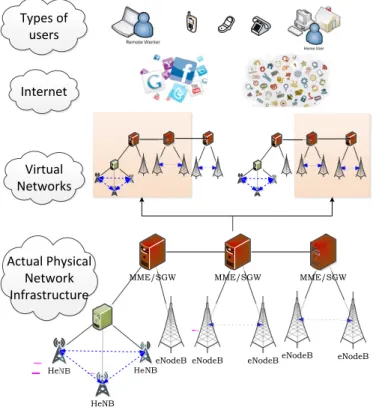
and architecture for a scenario where a MNO owns the RAN infrastructure and many MVNOs act as resellers of their host network’s capacity under their own brands, to their own customers. Finally we devise and test a framework that creates wireless slices inde-pendently of the type of BS (i.e., BS agnostic) and on the same time achieves desirable service capability across the various traffic profiles. This framework is applied in an architecture combining both legacy and future RAN nodes that leverage the concept of functional splits. Our holistic vision for RAN virtualization is depicted in Fig. 1.2. In particular we consider that RAN resources and nodes can be shared in isolation among participating tenants (i.e., either these are BSs, MNOs or traffic types) based on their particular service demands.
HeNB HeNB
HeNB
MME/SGW MME/SGW
eNodeB eNodeB eNodeB MME/SGW eNodeB eNodeB Internet Actual Physical Network Infrastructure Virtual Networks Types of users
Figure 1.2: Vision of this thesis for RAN virtualization.
The structure of the thesis and the main contributions of this work will be discussed in detail in the following section.
1.2
Structure of the Thesis and Contributions
The remaining part of the thesis consists of six chapters.
Chapter2 provides some necessary background information on the reference legacy and future architectures that we use within our study. Then we define RAN virtualization at the BS level by discussing about functional splits and management of virtualized
wireless resources. Furthermore we present use cases and business requirements about RAN sharing. In addition we present network slicing principles along with future 5G slicing and the basics of FrontHaul (FH) / BackHaul (BH) integration. Finally we discuss about several tools and architectures in the literature to implement network virtualization.
The innovative contributions of the thesis are organized into three chapters: i) in chapter 3 we study radio resource management principles and propose Resources nEgotiation for NEtwork Virtualization (RENEV), a solution that achieves slicing and on-demand delivery of resources at the BS level, ii) chapter 4wherein we propose the Multi-tenant Slicing (MuSli) of capacity algorithm, to allocate resources towards MVNOs in coarse time scales and iii) in chapter 5 we propose the BS agnostic framework for Network SliCing (NetSliC) to be adopted by the MNOs for creating a virtualization layer in a scenario wherein future and current cellular RAN nodes co-exist. In the following, the main contributions of the thesis will be outlined in more detail.
In our first approach to create a mapping of virtual network elements onto radio re-sources of the existing physical network, we propose the RENEV algorithm, which is suitable for application in heterogeneous networks in LTE-A environments, consisting of a macro evolved Node B overlaid with Small Cells (SCs). This work is described in chap-ter3. By exploiting radio resource management principles, RENEV achieves slicing and on-demand delivery of resources at BS level. Leveraging the multi-tenancy approach, radio resources are transferred in terms of physical radio resource blocks among multiple heterogeneous BSs (i.e., macro cell and SCs), which are interconnected via the X2 inter-face. The main target is to deal with traffic variations in geographical dimension. All signaling design considerations under the Third-Generation Partnership Project (3GPP) LTE-A architecture are also investigated. Analytical studies and simulation experiments are conducted to evaluate RENEV in terms of network’s throughput and additional sig-naling overhead. Moreover we show that RENEV can be applied independently on top of already proposed schemes for RAN virtualization to improve their performance. The results indicate that significant advantages are achieved both from network’s and users’ perspective and that it is a scalable solution for different numbers of SCs.
In chapter 4we study network slicing in the scenario where a MNO owns the RAN and many MVNOs act as resellers of their host network’s capacity under their own brands, to their own customers. Resource allocation in multi-operator scenarios requires an es-timate of the tenants’ traffic needs (i.e., MVNOs with different service requirements). In such scenarios, the forecasted MVNO traffic is the basis for providing resources suit-able with the corresponding MVNOs’ demand. To that end, the dynamic provision of resources among MVNOs should be performed in flexible, short-term time scales. In
chapter4, we effectively address this issue by integrating the capacity broker entity into the 3GPP network management architecture using the minimum set of enhancements. In addition, to fully exploit its capabilities, we propose the Multi-tenant Slicing (MuSli) of capacity algorithm, to allocate resources towards MVNOs in coarse time scales. MuSli considers the estimated capacity and the impact of the traffic type (i.e., guaranteed QoS and Best-Effort) in each MVNO, to provide better utilization of the host network’s capacity. Our results highlight the gains in the number of served requests without com-promising their service quality.
In chapter5we propose the BS Agnostic Framework for Network SliCing, NetSliC, that creates network slices for the RAN based on the distinct service requirements. In this chapter we create a scenario wherein the RAN is a heterogeneous complex architecture, comprising legacy distributed SCs, Radio Remote Radio Heads (RRHs) connected to a centralized Base Band Unit (BBU), and future 5G BSs (gNBs) leveraging virtualization with different functional splits, serving distinct traffic profiles. Thus, NetSliC is a com-mon language that manages and controls this heterogeneous infrastructure. We consider several criteria for creating network slices in this particularly interesting future scenario that are applicable to all different types of access and transport interfaces of the distinct BSs. This chapter concludes the vision of this thesis to propose a virtualization layer running on top of the substrate network; our proposal, NetSliC, constitutes a framework that creates wireless slices independently of the type of BS (i.e., BS agnostic) and on the same time achieves desirable service capability across the various traffic profiles. Finally, chapter6discusses the conclusions of the presented work and identifies potential lines for future investigation.
1.3
Research Contributions
All the work presented in this thesis, has been published in three journals and two international conferences. The list of publications follows:
[J3] A Base Station Agnostic Network Slicing Framework for 5G, G. Tseliou, F. Ade-lantado and C. Verikoukis,IEEE Network Magazine, Accepted as a paper on 22 March 2019, to appear.
[J2] NetSliC: Base Station Agnostic Framework for Network SliCing, G. Tseliou, F. Adelantado and C. Verikoukis, IEEE Transactions on Vehicular Technology, Vol. 68, no. 4, pp. 3820-3832, Apr. 2019 (Published online: 28 February 2019).
[J1] Scalable RAN Virtualization in Multi-Tenant LTE-A Heterogeneous Networks, G. Tseliou, F. Adelantado and C. Verikoukis,IEEE Transactions on Vehicular Technology, Vol. 65, Issue: 8, Aug. 2016 (Published online: 1 September 2015).
URL: https://ieeexplore.ieee.org/abstract/document/7234933
[C2] A Capacity Broker Architecture and Framework for Multi-tenant support in LTE-A Networks, G. Tseliou, K. Samdanis, F. Adelantado, X. Costa P´erez and C. Verik-oukis, In: IEEE International Conference on Communications (IEEE ICC 2016), Kuala-Lumpur, Malaysia, May 23-27 2016.
URL: https://ieeexplore.ieee.org/abstract/document/7511042
[C1] Resources Negotiation for Network Virtualization in LTE-A Networks,G. Tseliou, F. Adelantado and C. Verikoukis, In: IEEE International Conference on Communica-tions (IEEE ICC 2014), Sydney, Australia, June 10-14, 2014.
URL: https://ieeexplore.ieee.org/abstract/document/6883804
1.4
Other Research Contributions
Although the aforementioned research contributions compose the main body of the the-sis, there is a publication and other activities that took place during the course of this PhD. As these works are not fully aligned with this thesis, they were not included therein. However, we believe that the following publication should be mentioned in this section:
[C3] An SDN QoE-service for dynamically enhancing the performance of OTT applica-tions, E. Liotou,G. Tseliou, K. Samdanis, D. Tsolkas, F. Adelantado and C. Verikoukis In: Seventh International Workshop on Quality of Multimedia Experience (QoMEX), Costa Navarino, Greece, May 26-29 2015.
Background
2.1
Introduction
The main objective of this thesis is to design and evaluate solutions that leverage the concept of RAN virtualization and network slicing, in current and future cellular archi-tectures wherein service types pose distinct requirements. To that end, in this chapter, we will provide the background behind our proposals that will facilitate the understand-ing of the contributions of this thesis.
Hence, Section 2.2discusses the reference architectures of Distributed RAN (D-RAN), Centralized RAN (C-RAN) as well as Hybrid architectures combining both distributed and centralized characteristics. Section 2.3 presents the concept of RAN virtualization both at Base Station (BS) and radio resource level. Section 2.4 shows different types of sharing configurations as well as use cases and business requirements whereas 2.5 discusses the role of network slicing in the RAN domain. Finally, section 2.6 presents different tools for implementing RAN virtualization.
2.2
Reference Architectures
2.2.1 Distributed RAN: LTE-A Cellular Networks
Third Generation Partnership (3GPP) defines the standards for LTE and 5G. In par-ticular LTE-Advanced includes all work from 3GPP Release 10 till 3GPP Release 14 [13–15] and it is the leading architecture that meets International Telecommunications Union’s (ITU) IMT-Advanced requirements. Consequently, it is of critical importance to
Figure 2.1: Overall E-UTRAN Architecture with deployed SCs (i.e., HeNBs) [14-16].
investigate how to incorporate network virtualization in LTE-A access nodes and radio resources, which constitutes our work presented in chapter 3.
Fig. 2.1 presents 3GPP Release 13 ([14–16]). We study this architecture in chapter 3 and we further refer to as legacy / traditional D-RAN architecture. Fig. 2.1 defines a heterogeneous environment consisting of E-UTRAN macro NodeBs (eNBs) and Small Cells (SCs) such as Pico eNBs, Relay Nodes (RNs) and Home eNBs (HeNBs). Evolved Packet Core (EPC) and the Radio Access Network (RAN), called Evolved Universal Terrestrial Radio Access (E-UTRAN) are shown in this figure. 3GPP Release 13 as described in [16] and as shown in Fig.2.2does not offer the flexibility of providing RAN sharing on demand to support diverse and bandwidth hungry services. Except from this, signaling is also caused due to abrupt mobility of the involved devices.
The SC densification leads to frequent handovers within the participant tiers. Thus the signaling load is increased due to user mobility and the perceived service quality is decreased due to the degradation of application throughput. The efficient management of a heterogeneous environment, where operators are competing at the service layer, creates the need of separate virtual networks on the same physical infrastructure. Network virtualization lends itself to spectrum and cost savings, efficiency and flexibility. In addition to that, resource virtualization avoids over-provisioning by assigning resources intelligently and elastically per operator and service type based on the actual need. Therefore there is imminent need to implement it in the network. Below we describe the main elements of the architecture to identify where our proposed solutions are applied. It is pointed out that this thesis studies RAN virtualization. For the sake of completeness
Figure 2.2: E-UTRAN Network Entities of Release 13 3GPP [14-16].
we provide a holistic view of the architectural elements in this chapter but more detail is provided for the RAN as shown in Fig.2.2.
To start off with, the Core Network (CN) consists of the following nodes: Mobility Man-agement Entity (MME), Service Gateway (SGW) and Packet Delivery Network Gateway (PGW). Generally, MME is responsible for the control plane of the LTE-A architecture and the key control-node for LTE-A RAN. In more detail, it is responsible for the idle mode User Equipment (UE) tracking, the paging procedure when retransmissions are required as well as activation and deactivation of the bearer process. Moreover, within its responsibilities lies the user authentication and the provision of control plane function for mobility between LTE and Second / Third Generation (2G/3G) access networks. Next, SGW node routes and forwards user data packets by being the mobility anchor for the user plane during inter-eNB handovers. It also acts as the mobility anchor for the user plane during inter-eNB handovers and as the anchor for mobility between LTE and other 3GPP technologies. Finally it performs replication of user traffic in case of a potential lawful interception. The last node of EPC, PGW, provides connectivity from the UE to external packet data networks by being the point of exit and entry of traffic for the UE. It also performs policy enforcement, packet filtering for each user, charging support, lawful interception and packet screening. It is the anchor for mobility between 3GPP and non-3GPP technologies such as Worldwide Interoperability for Microwave Access (WiMAX) standard and 3GPP2 (Code division multiple access (CDMA) and Evolution-Data Only or Evolution-Data Optimized (EvDO)).
Furthermore Fig. 2.2 presents the different E-UTRAN (or for the sake of simplicity RAN) network entities included in the release of LTE-A [14] under study. E-UTRAN consists of eNBs, HeNBs and RNs. These nodes have been introduced in LTE-A for efficient heterogeneous network planning. The RNs are low power eNBs that provide enhanced coverage and capacity at cell edges. One of the main benefits of relaying is to provide extended LTE coverage in targeted areas at low cost. The RN is connected to the Donor eNB (DeNB) via radio interface, Un, a modified version of E-UTRAN air interface Uu. DeNB also serves its own UE as usual, in addition to sharing its radio resources for RNs [16]. eNBs and HeNBs are interconnected with each other by means of the X2 interface. They are also connected by means of the S1 interface to the EPC, more specifically to the MME by means of the S1-MME interface and to the Serving Gateway (SGW) by means of the S1-U interface. S1 interface supports many-to-many relations between MMEs / SGWs and eNBs / HeNBs. It is very interesting to note that in real deployments all these nodes are located in different geographical areas. For instance it is very common to group several eNBs of each region to a same Central Office (CO). Every CO is connected to the Regional Office (RO), where network elements such as the core nodes (i.e. MMEs / SGWs) are located.
The functions supported by the SCs (i.e., HeNBs) are the same as those supported by the macro BS (i.e., eNB). The same holds for the procedures run between a SC and the corresponding EPC. In any case both types of BSs 1 (i.e., macro BS or SC) comply to the same set of physical standards but their configuration and parametrization may be different due to the different transmission power. The different coverage scale of each BS has an impact on their role in resources negotiation. The main difference of macro and SC in this case lies in the different transmission bandwidth that each one accommodates, since the one allocated to the SC is quite restricted.
LTE-A is an Orthogonal Frequency Division (OFDM) based system where the system bandwidth is available for a BS. However, not all subcarriers are used simultaneously in a specific set of cells, i.e., according to Inter-Cell Interference Coordination (ICIC) techniques each subcarrier is not usually allocated to more than one BS simultaneously. Actually, ICIC techniques are aimed to reduce the interference level, particularly in cell edge. ICIC actually tries to reuse resources only if interference is low enough (i.e., the interfering source is at a minimum distance), but resources are nevertheless reused. In LTE-A, Enhanced ICIC (eICIC) is further defined, which is an adjusted version of ICIC for HetNet, and Coordinated Multi-Point (CoMP) which uses Channel Status Information (CSI) reported by UE. The basic scenarios where this thesis will focus on, are deployments consisting of numerous SCs with and without the inclusion of an 1Throughout the rest of the thesis, the exact definition of the term BS is given for all the particular scenarios when required.
Figure 2.3: General deployment of two tier scenario with macro eNB and SCs in
different frequencies [17, 18].
eNB. Figure 2.3 gives an overview of a Heterogeneous Two Tier deployment with the coexistence of macro BS and different categories of SCs [17,18].
2.2.2 Centralized Radio Access Network (C-RAN) Architecture
Traditional D-RAN supports the dense deployment of standalone SCs to increase area spectral efficiency. However, it has been quickly observed that non-ideal BackHaul (BH), such as X2 interface, limits the coordination among SCs. Incremental advancements on traditional D-RAN architecture are not able to satisfy high QoS requirements [19]. In order to cope with the increasing capacity demand and new service requirements, the Cloud / Centralized (C-RAN) paradigm has been introduced to increase the degree of cooperation between cells [20–22]. In this model RAN functions are split between the Base Band Unit (BBU), hosted in the cloud, and Remote Radio Heads (RRHs) / units (RRUs) that provide antenna equipment and radio access, as presented in Fig. 2.4. The main difference of this architecture in comparison to the LTE-A architecture, shown in chapter 2.2.1, is that it leverages principles of cloud computing. Its goal is to move functionality, especially BBU processing, from the antenna site to a central location [23]. At this central location, which can be several kilometers away from the antenna site, the baseband system modules of several antenna sites are pooled. Thus, the antenna consists only of a relatively simple Radio Frequency (RF) unit which is connected to the central location via optical fibre. Cloud concept and its potential use in wireless networks is also investigated in [24].
The main concept of C-RAN is de-constructing traditional BS to leave a low power unit at the cell site, integrating antenna and radio, while centralizing all the BBU activity and
Figure 2.4: Centralized RAN architecture by NGMN [20-22].
supporting a plurality of sites. In [20] the authors present a system consisting of a BBU which is a digital unit that implements the Medium Access Control (MAC), Physical (PHY) and Antenna Array System (AAS) functionality and the RRH that contains the base station’s RF circuitry plus analog-to-digital or digital-to-analog converters and up-/down converters. C-RAN brings to RAN the advantages of the cloud: resource-sharing, elasticity, on-demand and pay-as-you-go. Based on real-time virtualization technology, C-RAN minimizes CAPEX and OPEX costs, by aggregating multiple BBUs per central office. It enables the fast, flexible and optimized deployment and upgrade of RANs, supporting pay-per-use models. It also eases the flexible and on-demand adaptation of resources to non-uniform traffic. Besides this, the centralized processing of a large cluster of RRUs also enables the efficient operation of inter-cell interference reduction and CoMP transmission and reception mechanisms, and eases mobility between RRHs / RRUs.
However, the centralization of BBU into a common shared BBU pool poses strict ca-pacity requirements to the FrontHaul (FH) connection (i.e., interface between RRH / RRU and BBU). Furthermore the availability of high speed fiber links (i.e., ideal FH), especially in urban deployments, is controversial due to high implementation cost. This is due to the stringent requirements on the FH, which can only be met in practice by costly fiber point to point links.
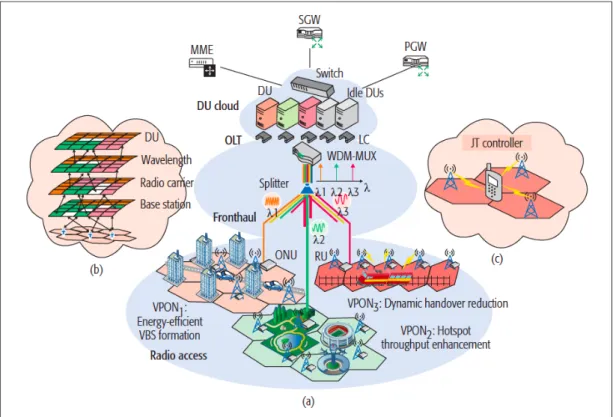
Figure 2.5: a) Virtualized-CRAN architecture; b) illustration of joint optimization
of resources. c) illustration of joint transmission [19].
2.2.3 Hybrid D-RAN and C-RAN Future Architectures
Both D-RAN and C-RAN architectures face challenges with regard to the implemen-tation of virtualization and joint control / management of transport, computing, and radio resources. First, network resources must be virtualized and provisioned dynam-ically, so virtualization techniques used in the IT industry must be tailored to satisfy time-sensitive wireless tasks. Second, there is a trade-off between virtualization gain and implementation complexity, for example, whether to allocate resources on a per-user or per-cell basis.
To that end several intermediate architectures have emerged and proposed for 5G (i.e., all the 3GPP specifications from Release 15 onwards). For instance the authors in [19] present a new 5G architecture, called virtualized cloud radio access network (V-CRAN), moving toward a cell-less network architecture as depicted in Fig. 2.5. They leverage the concept of a virtualized BS (V-BS) that can be optimally formed by exploiting several enabling technologies such as software defined radio (SDR) and CoMP transmission /reception. A V-BS can be formed on a per-cell basis or per-user basis by allocating virtualized resources on demand. For the FH solution, the authors exploit the Passive Optical Network (PON), where a wavelength can be dynamically assigned and shared to form a Virtualized Passive Optical Network (VPON).
Figure 2.6: Traditional Distributed RAN (D-RAN) vs Cloud RAN (C-RAN) vs
Next-Generation Fronthaul (Crosshaul) [25].
Another architecture that achieves flexible centralization is introduced in [25] and de-picted in Fig. 2.6. In this architecture FH and BH coexist in a common packet-based network, creating a new interface called Next Generation FH Interface (NGFI). Each ac-cess node, i.e., BS, adopts flexible splits of RAN functionality. More detailed information about the functional splits can be found in section 2.3.1. The idea is to divide a classic BS into a set of functions that can either be processed at the Distributed Unit (DU) or offloaded into a Centralized Unit (CU), depending on the transport requirements and centralization needs. In this way we can better balance cost / performance (i.e., the more aggressive the offloading, the higher the gains) and requirements (i.e., the softer the offloading, the more relaxed the network constraints). In [25] the authors propose optimization mechanisms that maximize the degree of centralization while meeting the transport constraints of the BSs. The proposed frameworks jointly perform routing and select dynamically the optimal functional split for each BS.
2.3
Virtualization of Radio Access Network
Network virtualization can be applied in several parts of the network. Also in the case of cellular networks two options for its application arise: CN and RAN. This thesis is going to focus on the RAN part that makes possible the easy creation and management of virtual networks, opening up a range of new business models. RAN offers a wide field for potential solutions based on network virtualization. The partitioning and/or pooling of radio physical resources can be introduced by enabling more efficient management of RAN capacity. In this context, the imposed challenges require the development of new concepts such as the design of RRM algorithms that take into advantage the dense heterogeneous architecture of legacy D-RAN and future C-RAN and Hybrid cellular deployments as well as different traffic characterization and geographical distribution. Moreover, virtualization of radio spectrum and BS resources makes possible the creation and management of virtual networks on demand, opening up a range of new business models through which network owners can increase the revenue from their networks. The following two sections define two categories for interpreting RAN virtualization in cellular networks: section2.3.1introduces the flexible BS virtualization and the notion of functional splits and section2.3.2discusses about the management of virtual resources.
2.3.1 Flexible BS Virtualization and Functional Splits
RAN virtualization is based on the notion of BS softwarization, which allows certain RAN functions to run at remote cloud platforms [7]. The FH link is the foundation enabler for the virtualized use cases to be viable. While it is accepted that dedicated fiber links permit extremely low latency and high bandwidth connections, it is considered cost prohibitive for the volumes of SCs projected and is therefore a barrier to scale. A summary of the split architectures for the use cases is introduced in [26] and depicted in Fig 2.7. Functions to the left of the split are virtualized in the CU, while functions to the right reside in the remote DU. The use cases are presented from left to right as gradually more of the SC functionality is virtualized. For the MAC and PHY use cases exist where the functionality is divided between the CU and DUs, to represent this they are divided into upper and lower components, in these split use cases the upper portion resides in the CU and the lower part in the remote DU.
The most common functional splits are detailed further:
• PHY-layer option provides the highest centralization and can be realized only with an ideal FH, i.e., a high data rate and low latency optical fiber.
Figure 2.7: A high-level overview of the different functional split options [26].
• MAC-layer option where the MAC layer and the layers above it are virtualized and run on a BBU with real time scheduling performed aggregately for multiple RRHs. This option leverages the benefits of connecting distributed RRH physical layers to a common MAC, which allows coordinated scheduling and dynamic point selection, i.e., CoMP. However, this option requires a low latency FH as some of the MAC procedures are time critical (e.g., UE scheduling) and need to generate a configuration at the Transmission Time Interval (TTI) level.
• RLC-layer option where the RLC layer and other layers above it are virtualized at the BBU allowing multiple MAC entities to be associated with a common RLC entity. This option reduces the FH latency constraints as real time scheduling is performed locally in the RRH.
• PDCP-layer option is non-time critical. It runs the PDCP functions at the BBU and may use any type of FH network. The main advantage of this option is the possibility to have an aggregation of different RRH technologies (e.g., 5G, LTE, and WiFi).
2.3.2 Managing Virtualized Wireless Resources
The term wireless resource virtualization refers to the variety of ways that resources are treated within the RAN. The state of the art solutions that we present in this chapter focus on creating a substrate within the BS for monitoring wireless resources of a cellular network delivered to the BS itself. Virtualizing wireless resources in cellular networks fosters several interesting deployment scenarios that are of interest [27,28]:
• Active RAN sharing: Sharing of RAN resources that enables significant reduction in equipment in low traffic areas and results in at-least 100% increased rollout
speed with a given cost. Further details on RAN sharing can be found in section 2.4.
• MVNO: In the recent past, several MVNOs have emerged as strong players in the cellular market providing enhanced services. Such MVNOs often do not own spectrum and rely on sharing the wireless resources of a MNO in that region. Virtualization encourages the partition of resources in a network infrastructure owned by a third party (i.e., MNO) effectively, thereby encouraging stricter and fine-grained SLAs between MVNOs and MNOs.
• Corporate Bundle Plans: Currently, MNOs offer data plans to enterprises and cor-porations that allow sharing of bandwidth dynamically across their users. How-ever, no bandwidth guarantees are provided. Virtualization may help realize better guarantees on resource allocation, and hence fosters more sophisticated data plans. • Controlled evaluation: Virtualization enables MNOs to isolate partial wireless resources to deploy and test novel ideas without affecting the operational networks. Currently, MNOs often use dedicated / small scale deployments to test new ideas. • Services with Leased Networks (SLNs): With the increased use of wireless and mobile networks for Internet services, we envision application service providers reserving bandwidth with MNOs and paying on the behalf of their users to en-hance Quality of Experience (QoE). Virtualization helps in ensuring that such reservations are met.
Another study on managing the virtualized wireless resources has been published in the context of the FLAVIA project [29]. The key concept of the project’s work is to expose flexible programmable interfaces enabling service customization and performance optimization through software-based exploitation of low-level operations and control primitives. The separation of the control and data planes in LTE networks is one of the main principles where the project’s ideas were based on. In one of the project’s dissemination results, the authors propose a generic MAC architecture for both LTE and WiMAX wireless networks [30]. In this paper, both technologies are being analyzed with the goal of finding common functional subsets which can be used as building blocks for a generic and extensible MAC for future mobile cellular networks. To this end, the authors propose a systematic categorization into services, interfaces, functions and primitives as a first step towards achieving generic architecture. In this architecture, it is very interesting to notice, a potential solution of virtualization. The upper part of Layer 2 is considered suitable for hosting the functions that would be responsible for virtualization of the resources delivered to the eNB.
Figure 2.8: RAN sharing configurations supported by 3GPP [27, 28].
2.4
Radio Access Network Sharing
2.4.1 RAN Sharing Configurations
Cellular network sharing among operators, is a key building block for virtualizing future mobile carrier networks. 3GPP has recognized the importance of supporting network sharing among operators by defining a set of architectural elements [31] and technical specifications [32]. Indeed, 3GPP has defined and ratified different kinds of architecture with varying degrees of sharing:
• Multi-Operator RAN (MORAN): only equipment is shared;
• Multi-Operator Core Network (MOCN): both spectrum and equipment are shared; and
• GateWay Core Network (GWCN), in which both the RAN and some elements of the CN are shared.
The following two architectural network sharing configurations are of interest in the context of this thesis: GWCN and MOCN. In GWCN configuration, CN operators share control nodes in addition to RAN elements whereas in MOCN, multiple control nodes owned by different operators are connected to a shared RAN. In Fig. 2.8 we present the two general configurations for network sharing as identified by 3GPP [33]. The user behavior in both configurations is the same. No information concerning the configuration is indicated to the UE. If the RAN is shared by multiple operators, the system information broadcasted in each shared cell contains the Public Land Mobile Net-work (PLMN)-id of each operator (i.e., up to 6 in legacy D-RAN scenarios) and a single
Tracking Area Code (TAC) valid within all the PLMNs sharing the RAN resources [33]. The infrastructure owner provides the underlying physical network whereas by referring to network operator, we denote every operator having its users connected to the RAN (without necessarily owning infrastructure). In both configurations the network shar-ing agreement between operators is transparent to the end users. Although, operators may share network elements (i.e., RAN / control nodes), radio resource virtualization is required to cover their actual requirements, in isolation per BS. Therefore, in both MOCN and GWCN sharing configurations, virtualization of resources is necessary in order to allow users to have access to the complete set of available resources. Existing network virtualization techniques, can be grouped into solutions for the Evolved Packet Core (EPC) Network and the RAN [34].
2.4.2 Spectrum Sharing
Spectrum sharing is a key technique in RAN virtualization; it can be used at air interface to adapt to traffic load variations of different virtual networks. Many spectrum sharing proposals are designed to adapt the radio interface of the eNB to traffic load variations of distinct virtual networks [27, 35–39]. This is achieved by allowing multiple virtual networks to share the spectrum allocated to a particular physical eNB. A preliminary approach for virtualizing a BS in LTE is described in [35]. A controlling entity called hypervisor was proposed in order to make use of a-priori knowledge (e.g., user chan-nel conditions, operator sharing contracts, traffic load etc.) to schedule the Resource Blocks (RBs) of a BS among different mobile operators. In addition, the authors of [36] evaluate several sharing options, ranging from simple approaches feasible in traditional infrastructure to complex methods requiring a specialized one.
In advancing the basic BS virtualization, works [27,37] and [38] introduce the concept of Network Virtualization Substrate (NVS) that operates closely to the MAC scheduler. NVS adopts a two-step scheduling process, one managed by the infrastructure provider for controlling the resource allocation towards each virtual instance of an eNB and the second controlled by each virtual instance itself providing scheduling customization within the allocated resources. Additionally, [39] extends NVS solution by investigating the provision of active LTE RAN sharing with Partial Resource Reservation (PRR). In this scheme, each slice is guaranteed a specific minimum share of radio resources to be available to the operator that owns them. The remaining common part is shared among traffic flows belonging to different operators.
The authors in [40] propose a Markovian approach to characterize the resource sharing in multi tenant scenarios with diverse guaranteed bit rate services by considering a slice
aware admission control policy. After describing the Markov model and its implementa-tion and discussing its suitability, the model is applied to study the performance attained in a scenario with two different slices, one for enhanced mobile broadband communica-tions and the other for mission critical services. In general Markovian approaches are well suitable to characterize resource sharing and they have been used in the literature.
2.4.3 Use-cases and Business Requirements
In this section we describe the general on roles in RAN Sharing as defined in [41]. The arrangements for network sharing between the involved entities can vary widely, being influenced by a number of factors including business, technical, network deployment and regulatory conditions. Despite the variety of factors, there is a set of common roles centered on connecting network facilities between the parties involved in a network sharing agreement.
• Hosting RAN Provider: It is identified as the owner RAN, which is shared with one or more Participating Operators. The Hosting RAN Provider or in other words the MNO has primary operational access to particular licensed spectrum which is part of the network sharing arrangement. This does not necessarily imply that the MNO owns licensed spectrum but has agreement to operate in that spectrum. Furthermore, the MNO owns a set of RAN nodes in a specific geographic region covered under the network sharing arrangement and provides facilities allowing Participating Operators (or MVNOs) to share the RAN covered under the network sharing arrangement.
• Participating Operator: It is identified as the entity that uses shared RAN facilities provided by a Hosting RAN Provider, possibly alongside other Participating Op-erators (MVNOs). The characteristics of the Participating Operator include the use of a portion of particular shared licensed spectrum to provide communication services under its own control to its own subscribers and the use of a portion of shared RAN in the specific geographic region covered under the network sharing arrangement.
• Roaming operators: This category consists of Home Public Land Mobile Net-work (HPLMN) and Visited Public Land Mobile NetNet-work (VPLMN) operators. Roaming agreements between operators, provide similar capability to RAN shar-ing where a HPLMN subscriber can obtain services while roamshar-ing into a VPLMN. This can be viewed as a form of sharing where VPLMN shares the use of its RAN with the HPLMN for each HPLMN subscriber roaming into the VPLMN. The dis-tinction between roaming and RAN sharing is that when roaming, the subscriber
uses the VPLMN when outside of the HPLMN geographic coverage and within the VPLMN geographic coverage. In a RAN sharing arrangement, all the participants provide the same geographic coverage through the Hosting RAN.
• Operators with multiple roles: Operators can take on multiple roles at the same time depending on business needs. For the purposes of [41], each specific network set (i.e., spectrum-region-RAN) can be considered independently and combined with other network sets in various combinations. Indicative examples include:
– An operator has its own spectrum, which does not share and additionally uses the shared RAN in the same region (Participating Operator) provided by Hosting RAN Provider.
– Two operators set up a joint venture to build and operate a shared network. The two operators are both Participating Operators and the joint venture is a Hosting RAN Provider.
– Two operators A and B, divide a region covered by a joint spectrum license and each build and operate the RAN in their portion of the region. In the re-gion covered by operator A’s RAN, operator A is the Hosting RAN Provider and at the same time Participating operator while operator B is only Partic-ipating Operator. In the region covered by operator B’s RAN, operators A and B are the Participating Operators and operator B is the Hosting RAN Provider.
According to [41] a Hosting RAN Provider may share RAN resources with Participating Operators in various ways. Therefore, it is assumed that at least a set of radio resources in addition to physical BSs are shared for use by Participating Operators.
2.5
Radio Access Network Slicing
Network slicing in a mobile network is highly related to network sharing, particularly to RAN sharing in the case of mobile networks. It is important to point out that network slicing enables different network architectures for different service needs. In this chapter we focus in particular, on solutions for dynamic resource slicing and the idea of slicing resources between FrontHaul (FH) and BackHaul (BH).
2.5.1 Dynamic Resource Slicing
Dynamic resource slicing is another category of solutions based on the concept of RAN virtualization. The authors of [28] have proposed CellSlice; a dynamic framework to
achieve active RAN sharing by remotely controlling the scheduling decisions, ensuring that each entity receives its share of the wireless resources. This idea does not require the modification of the BS schedulers but it controls the BS scheduling decisions from a remote gateway. Slicing can be done with either a BS-level solution or a gateway-level solution. Compared to BS-level solution, remotely slicing wireless resources makes the proposal easily deployable, enables easier network-wide resource reservations for slices, and guarantees the operation with BS from multiple vendors, some or all of which may not support native virtualization. The work focuses on remote uplink slicing, since wireless resource reservation requests from the clients for uplink transmissions terminate at the BS and they are not visible at the gateways.
With regard to the dynamic resources’ slicing, further interesting proposals are pre-sented in [42–44]. In [42–44], the authors present software defined cellular network architectures, allowing remote gateway level controller applications to perform resource slicing without modifying the BSs’ MAC schedulers. Such solutions express real-time, fine-grained policies based on subscribers attributes rather than network addresses and locations.
There are different slice resource management models depending on the level of resource isolation, which may handle frequency spectrum as a dedicated medium per slice or shared resource among specific slices [45]. In the dedicated resource model, a RAN slice consists of isolated resources in terms of the control and user plane traffic, MAC scheduler and spectrum. Each slice has access to its own Radio Resource Control, Packet Data Convergence Protocol, Radio Link Control, Medium Access Control ( RRC / PDCP / RLC / MAC) instances and a percentage of dedicated Physical Resource Blocks (PRBs) or a subset of channels. Although the dedicated resource model ensures committed resources per slice, i.e., assuring delay and capacity constraints, it reduces resource elasticity and limits the multiplexing gain. Indeed, the dedicated resource model restricts the slice owner to modify the amount of resources (i.e., PRB) committed to a slice during its life-cycle, even if they are not utilized. On the other hand, the shared resource model allows slices to share the control plane, MAC scheduler and spectrum. In addition network slicing can be associated with service chain embedding problem for diversified 5G requirements, considering the sharing property of VNFs. Leveraging on network function virtualization (NFV), the network operator performs service chain embedding (SCE) to create the logical slices.For instance the authors in [46] present a fine-grained network slicing model for resource and QoS requirements of slices and their traffic flows. They propose an optimization formulation that yields an embedding solution, routing path and resource allocation for each slice.
Another aspect in network slicing solutions lies on how to determine the relationship among tra
![Figure 1.1: Traffic Imbalance in spatial and temporal dimensions [1].](https://thumb-us.123doks.com/thumbv2/123dok_us/507627.2559902/19.893.167.779.139.443/figure-traffic-imbalance-spatial-temporal-dimensions.webp)
![Figure 2.1: Overall E-UTRAN Architecture with deployed SCs (i.e., HeNBs) [14-16].](https://thumb-us.123doks.com/thumbv2/123dok_us/507627.2559902/27.893.179.784.121.437/figure-overall-e-utran-architecture-deployed-scs-henbs.webp)
![Figure 2.2: E-UTRAN Network Entities of Release 13 3GPP [14-16].](https://thumb-us.123doks.com/thumbv2/123dok_us/507627.2559902/28.893.224.725.142.471/figure-e-utran-network-entities-of-release-gpp.webp)
![Figure 2.3: General deployment of two tier scenario with macro eNB and SCs in different frequencies [17, 18].](https://thumb-us.123doks.com/thumbv2/123dok_us/507627.2559902/30.893.259.676.136.381/figure-general-deployment-tier-scenario-macro-different-frequencies.webp)
![Figure 2.4: Centralized RAN architecture by NGMN [20-22].](https://thumb-us.123doks.com/thumbv2/123dok_us/507627.2559902/31.893.167.781.120.516/figure-centralized-ran-architecture-by-ngmn.webp)
![Figure 2.6: Traditional Distributed RAN (D-RAN) vs Cloud RAN (C-RAN) vs Next-Generation Fronthaul (Crosshaul) [25].](https://thumb-us.123doks.com/thumbv2/123dok_us/507627.2559902/33.893.240.712.122.688/figure-traditional-distributed-ran-cloud-generation-fronthaul-crosshaul.webp)
![Figure 2.7: A high-level overview of the different functional split options [26].](https://thumb-us.123doks.com/thumbv2/123dok_us/507627.2559902/35.893.204.754.132.332/figure-high-level-overview-different-functional-split-options.webp)
![Figure 2.8: RAN sharing configurations supported by 3GPP [27, 28].](https://thumb-us.123doks.com/thumbv2/123dok_us/507627.2559902/37.893.169.785.129.396/figure-ran-sharing-configurations-supported-gpp.webp)
