Vol. 7, No. 3, pp. 2605-2610, October 2013 Online ISSN: 1920-3853; Print ISSN: 1715-9997
MULTIOBJECTIVE OPTIMIZATION (MO) OF CHEMICAL BATH DEPOSITION
PROCESS FOR CDS THIN FILM USING GENETIC ALGORITHM
*Awodugba A O1 and Araromi D O2
1
Department of Pure and Applied Physics, Ladoke Akintola University of Technology, Ogbomoso
2
Depatment of Chemical Engineering, Ladoke Akintola University of Technology Ogbomoso
ABSTRACT
Chemical bath deposition (CBD) has been adjudged as a simple and convenient process of producing large area thin films, favourable for photovoltaic application. However, there is competing undesirable homogeneous precipitation reaction and molecular level heterogeneous precipitation surface reaction that can affect the film quality. Degree of supersaturation of solution in CBD depends on which of these reactions reign supereme. pH of the reacting solution and ammonia concentration are two contrasting factors affecting both film thickness and supersaturation ratio. Hence, there is need to find correct pH and ammonia concentration that will put the solution at supersaturation ratio within the acceptable range for good guality film as well as the desired thickness at less deposition time. In this work, genetic algorithm (GA) in the frame multiobjective optimization (MO) was used to search for optimal pH, ammonia concentration and deposition time in order to minimize supersaturation ratio to the acceptable range for good quality film and maximize film thickness at the optimal deposition time. Multiobjective functions were formulated with constraint decision variables to evalutate fitness function for GA searching. Other genetic manupulative factors were fixed except population size which were varied from 30 to 90 in the step of 30 to search for near optimal solutions. The results show that population size of 90 gives best result with film thickness of 1.36µm and supersaturation ratio of 7.94 at deposition time 600s. The pH and ammonia concentration that evaluated these results are respectively 12.0 and 0.001142mol/cm3.
Keywords: Chemical bath deposition, film thickness, supersaturation, multiobjective functions genetic algorithm.
INTRODUCTION
Chemical bath deposition (CBD) is a method, which makes use of a controlled chemical reaction to bring about formation of a thin film by precipitation. CBD is known to be a simple, low temperature, and inexpensive technique for large area deposition (Kostoglou et al., 2000; Khallaf et al., 2008).
In the method, a surface, which serves as substrate, is immersed in an alkaline solution containing the chalcogenide source, free metal ion that is buffered at a low concentration and a chelating agent that is used to control the release of the metal ion. The process depends on slow decomposition of chalcogen source into anions an alkaline solution and formation of complex metal ions. The essence of complex ion formation is to obtain small metal cation concentration that will bring about controlled homogeneous precipitation of thin films on the substrate (Pentia et al., 2000).
Thin film formation by chemical bath deposition takes place through different reaction steps at the substrate surface. The first step is the formation of nucleation centers in the solution and on the substrate and the second
step is the growth of particle. The formation of film commences when the ionic product of metal ion and chalcogen ion exceeds the solubility product. The ions combine to form nucleation center on the substrate. The centre then acts as a catalyst for the further deposition of fresh products to form layer of material. The layer grows further by adsorbing more and more ions from the solution to give a uniform and continuous film. The complete growth can happens by either ion-by-ion or cluster-by-cluster process. The ion-by-ion growth produces thin, uniform and adherent films while the cluster-by-cluster growth leads to thick, powdery and diffusely reflecting films (Kostoglou et al., 2000; Khallaf et al., 2008).
CdS is rated as an outstanding heterojunction associate for p-type CdTe or as a cushion layer in p-CuInSe2 solar
cells. CBD process is found suitable for these applications because only a thin layer of around 50 to 1000nm thickness is required. CBD, which had being in use for the deposition of cadmium sulfide (CdS) semi conductor thin films since the 1960s, is proven to improve the performance of CdS window used in solar cell applications (Khallaf et al., 2008). The CBD process of CdS preparation involves the slow release of sulfide ions *Corresponding author email: [email protected]
via the controlled hydrolysis of thiourea and cadmium ions in the presence of a cadmium salt and a chelating agent (commonly NH3 in an aqueous alkaline bath leading
to the precipitation of CdS on glass substrates mounted in the bath (Kostoglou et al., 2000; Khallaf et al., 2008). The thickness of CdS film in the range of (400-500nm) between 2-4 hours can be obtained by a batch CBD (Oladeji and Chow, 1997).
CdS thin film formation entails a multi-stage reaction in which there is competing undesirable homogeneous precipitation reaction and molecular level heterogeneous precipitation surface reaction (Oladeji and Chow, 1997; Hodes, 2003). Heterogeneous precipitation reaction takes place on the substrate surface while homogeneous precipitation reaction takes place in the bulk solution phase (Ortega-Lincot, 1993; Kostoglou et al., 2000). Through the heterogeneous precipitation reaction, initially nuclei are continuously formed on the substrate and get bigger as discrete “surface” particles. Gradually ,with ion-by-ion process, these particles have a tendency to “coalesce” with nearest ones, as new nuclei countinue developing and increasing, resulting in the formation of a coherent film. Some of CdS colloidal or cluster aggregates produced from the homogeneous precipitation reaction in the bulk solution stick on the substrate over the specularly reflecting layer to form less adherent porous overlayer, due to a “cluster by cluster” growth mechanism (Kostoglou et al., 2000). Cadmium sulafate, cadmium acetate, cadmium iodide, Cadmium nitrate and cadmium chloride are different cadmium sources used in the deposition of CdS semiconductor (Pentia et al., 2000; Khallaf et al., 2008). Quality and adherence characteristics of the film depend strongly on pH of bath solution, nature of substrate and choice of chelating agent. Several works have been carried out on the optimization of chemical bath deposition process improve on film thickness and qualities. optimization conditions such as temperature (Nair et al., 1988) and reagent concentration (Guillen et al., 1998) on CdS reaction have been studied. Oladeji and Chow (1997) carried out optimization of CdS thin film grown by chemical bath deposition where homogenous reactions are minimized and the thickness of the deposited film in a single dip maximixed. Contreras et al. (2002) presented an optimization of the CdS chemical bath deposition process as applied to high-efficiency Cu(In,Ga)Se2 photovoltaic thin-film absorber materials.
Isah et al. (2008) reported the deposition and optimization of the growth parameters that maximizes the thickness of the deposited film in alkaline solution. Barote et al. (2011) optimized parameters such as bath composition, pH of the reaction solution, deposition temperature and time, speed of the substrate rotation and the complexing agent on growth process for good quality films. Most of the optimization works on chemical bath deposition for an opto-electronic material are experimental based. Obviously, experimental optimization is highly
cumbersome, time consuming and highly restricted to study the influnce of one varaible at a time while keeping constant other variables. Mathematical optimization can overcome these problems and it can be possible to study the combined effect of the variables and to recognice an suitable narrow range of conditions for experimental optimization (Kostoglou et al., 2000). In BCD, there are two contending reaction rates to optimized, heterogeneous precipitation reaction which must be maximized in order to get thicker film deposition and homogeneous reaction precipitation rate which must be minimized in order to obtain film of good quality.
The two factors effecting these reactions are NH3 and OH
-concentrations. On the one hand, a decrease in ammonia concentration brings about increase in the film growth rate, but on the other hand, it leads to enhacement in supersaturation ratio which is known to promote undersirable homogeneous precipitation reaction leading to a reduction in the film quality. On the contrary, an increase of the OH concentration promotes film growth rate with decrease in the typical film formation time. However, there is maximum to which concentration of OH must reach in order to avoid Cd(OH)2 precipitation
(Kostoglou et al., 2000; Kostoglou et al., 2003). Thus, there must be optimum ammonia and OH concentrations for best quality film thickness.
Mathematical optimization of this process turns out to be multiobjective optimization problem in which undesirable homogeneous precipitation reaction will be minimized and heterogeneous precipation reaction will be maximized using NH3 and pH concentrations as decision varaibles.
Multiobjective optimization (MO) concerns the minimization of a set of objectives simultaneously. It can handle problem with conflicting objective functions. The solution approaches to multiobjective problem can be one in which a single solution is returned or in which a set of solutions is returned. In a single solution approach, either individual functions are combined into a single composite function or all but one objective function are moved to the constraint set. Functions combination can be achieved by using methods such as utility theory, weighted sum methods, etc. The main problem associated with this method is the choice of appropriate weights or utility function for the problem at hand (Kulturel et al., 2006). In addition, evaluating values for constraint set to move the objective functions can be herculean task. In a multi-solution approach, a set of optimal multi-solutions known as Pareto optimal solution set are returned at each optimization step. A solution is said to be Pareto optimal if it is not dominated by any other solution in the solution space. Solution A dominates solution B if A has a lower cost than B for at least one of the objective functions and is not worse with respect to the remaining objective functions. The main goal of a multi-objective
optimization algorithm is to identify solutions in the Pareto optimal set. The size of the Pareto set is a function of the number of objectives. Pareto optimal solution sets are found to be more suitable than single solutions for real-life problems (Kulturel et al., 2006). In this work, a multiobjective genetic algorithm (GAMULTIOBJ) is employed to minimize the supersaturation ratio, which is a function of homogenous reactions, and to maximize the thickness of the deposited film.
Model used for the Optimization
The model used in this work was adopted from Kostoglou
et al. (2000). Model equations used to described CBD
process are based the thiourea balance, the overall cadium balance, sulpur balance, the particle population balance, the equation for the film growth due to colloidal particle deposition, ionic addition and the chemical equilibria algebraic relations between the various species. The developed comprehensive model equations were based on a population balance formulation for the sequence variation of reactant concentrations as well as solid phase, both in the bulk and on the substrate. The model contains a system of five ordinary and one partial integrodifferential equations. The strong interaction between continuous nucleation and growth rendered the model to be very complex. A simplified version of the model was obtained by substituting the continuous nucleation and growth phenomena with instantaneous ones occurring at some (phenomenological) supersaturation value (Sc). The model was shown to be coherent with obtainable experimental data on film thickness evolution A complete description of the model and the solution technique used can be found in Kostoglou et al. (2000).
The following equations for the evolution of film thickness by surface reaction and supersaturation are simplified version of the model.
1 2 where
h= thickness of the film =molecular weight of CdS = the surface reaction rate obtained
= solubility constant of CdS = thiourea hydrolysis rate
=ionic equilibrium constant of NH3
S= Supersaturation ratio
From these quantities, the subscript “o” denotes the initial concentration.
As mentioned by Kostoglou et al. (2000), there is competing effects of ammonia in the film growth process. The presence of ammonia in low concentration inhibits undesirable homogeneous precipitation by forming complexes with Cd ions thus enhancing the film growth rate and on the contrary, it slows down the surface reaction. A decrease in the ammonia concentration tends to enhance the film thickness. Initially, the film get thicker in a linear fashion with time at almost constant reactants concentration with simuteanous increase in supersaturation. The growth continues until supersaturation attains a certain value high enough for the onset of bulk nucleation and crystal growth leading to reduction in reactant concentration. This phenomenon brings about a drastic slowdown in film growth rate and eventually stop its growth (Kostoglou et al., 2001).
Defining the optimization problem
The optimization problem consists of two objectives: i. the maximization of film thickness and ii. the minimization of supersaturation ratio.
Simultaneous attainment of the two objectives has to be achieved with satisfying experimental supersaturation ratio range (Kostoglou et al., 2003) in order to produce high quality film. The problem is therefore defined as follows;
3
The decision variable vector consists of concentrations of NH3 and OH. Each of these variables is constrined to
lie between a lower bound and an upper bounds. Besides, supersaturation ratio S, is constrained to lie within the range that will give the best quality film.
Multi-Objective GA Implementation.
The problem was solved by applying the gamultiobj function in MATLAB GA toolbox. A controlled elitist GA, which is a variant of NSGA-II (Deb 2001) was used to build the function. Controlled elitist GA makes use of individuals with better fitness value (rank) and individuals with a lower fitness value that can improve the diversity of the population in order to arrive at to an optimal Pareto front. Pareto fraction and Distance function are used to control the elitism. Pareto fraction was used to control the number of individuals on the Pareto front while distance function is used to maintain diversity on a front by giving chance to individuals that are relatively far away on the front.
On running the algorithm, the population type was set to double vector (real coded) with population size varying between 30 and 90. Arithmetic function and constraint
dependent function were used for crossover and mutation operations respectively. The crossover probability (pc) and mutation probability (pm) are 0.8 and 0.2 respectively, and the Pareto fraction set at 0.5. Each optimization procedure was run at least five times from different initial populations to build a confidence in the obtained optimized solutions. The optimization was carried for eight deposition times in order to get the optimal time.
The parameters used for the Model
The initial concentration values for reactants used for the bath solution were obtained from Oladeji and Chow (1997) where = 0.002 M and
= 0.012M. other parameters such as =144.6 g/mole, = 1.61*106 cm4mole-1s-1, = 0.0263 cm3mole-1s-1 were obtained from Su (2011). Thermodynamic solubility constant = 27.8 was obtained from Kostoglou et al. (2003). The following variable bounds for and are set to allow the optimizer a substantial search space to look for optimized solutions: lower bond [ 3.1623 e-006 0.8*10^-3 ] and upper bond [1.0000e-0051.8*10^-3 ].
RESULTS AND DISCUSSION
Figure 1 shows the tradeoff between film thickness (objective 1) and supersaturation (objective 2). It is a plot of noninferior solutions called Pareto optima for the
multiobjective optimization. They are noninferior solution points because an improvement in one objective requires degradation in the other objective. Literally, the curve in the figure shows maximum values of film thickness with respect to different minimum values of superstation. There is need to mention here that, in using GA toolboxes in MATLAB for maximization problem, the objective function must be made negative and that is why we have negative values for film thickness. The Figure shows that all pareto fonts overlap each other except for deposition times T=200s and T=400s. This may be because at the time up to 400s is an induction period that is a delay before the film starts growing linearly (Kostoglou et al., 2000). The linear growth is an indication of heterogeneous precipitation, which is good for film quality.
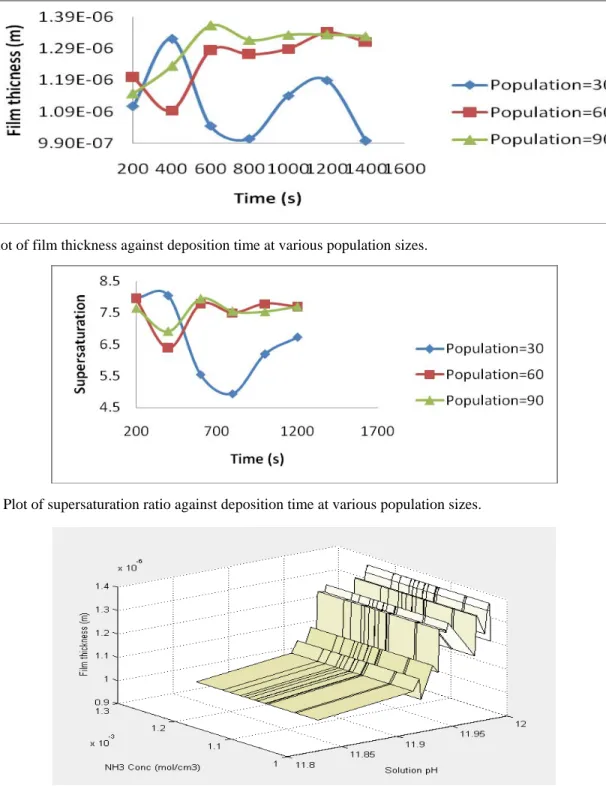
Further data screening was carried on the pareto fonts obtained in figure 1 in order to find suitable supersaturation ratio range that will give good quality film. It has been shown experimentally that supersaturation is one of the major contributing factors affecting film thickness, adhererence and overall quality and there is a narrow range of values of supersaturation ratios between 5 and 8 over which the best performance is obtained in CBD (Kostoglou et al., 2003). Based on this fact, film thickness corresponding to this range were selected for various three genetic population sizes (30, 60, 90) in order to obtain best film thickness at different final deposition times. The result is shown in figure 2 and figure 3 for film thickness and supersautation ratio respectively. Figure 2 shows that optimization with
Fig. 1. Pareto fonts for the two objective functions at different deposition times.
population size 30 gives best thickness at 400s, however this can not be taken real because at 400s the process may still be at induction period according to our observation in figure 1. In addition to the fact that the supersaturation ratio has almost fallen outside the upper value of the feasible range i.e (5-8) figure 3. Optimization with population size 60 gives its highest film thickness with value 1.3µm with a corresponding supersaturation ratio of
7.78 at 1200s. The peak value of film thickness for population size 90 is a little bit higher than 1.36 µm at 600s. Figure 4 gives the surface plot of optimal film thickness values as a function ammonia concentration and pH value which serves as decision variables. The figure also shows a strong dependence of film thickness on the decision variables which agrees with the results obtained by Kostoglou et al. (2000). For comparative purposes, Fig. 2. Plot of film thickness against deposition time at various population sizes.
Fig. 3. Plot of supersaturation ratio against deposition time at various population sizes.
table 1 shows the summary of the best values for different population sizes considered along with decision variables to arrive at these values. The tabulation indicates that the best film thickness is obtained for population size 90 which has value of 1.36µm. This means that the optimal deposition time is 600 s and optimal values for
and pH are respectively 0.001142 mol/cm3 and 12.00.
CONCLUSION
Genetic algorithm has used to solve multiobjective optimization problem arising from batch reaction deposition process for CdS film deposition. Population size was varied in order to get near optimal values for minimization of supersaturation ratio and maximization of film thickness using ammonia concentration and pH of reacting solution as decision variables. Population size 90 gives the best thickness of 1.36µm with a supersaturation ratio of 7.94 at the optimal deposition time 600s. The surface plot can be used to fix ammonia concentration and pH of reacting solution for optimal design of the process.
ACKNOWLEDGEMENTS
One of the authors wishes to acknowledge the research grant by the Faculty of Pure and Applied Sciences of the Ladoke Akintola University of Technology.
REFERENCES
Barote, MA.,Yadav,AA. andMasumdar, EU. 2011. Effect of deposition parameters on growth and characterization of chemically deposited Cd1-x PbxS thin films.
Chalcogenide letters. 8(2):129-138.
Contreras, M., Romero, MB., Hasoon, F., Noufi, R., Ward, S. and Ramanathan, K. 2002. Optimization of CBD CdS Process in High-Efficiency Cu (In, Ga) Se2-Based Solar Cells. Thin Solid Films. 403-404 (579):204-211.
Deb, K. 2001. Multi-Objective Optimization Using Evolutionary Algorithms. John Wiley & Sons. 143-157. Guillen, C., Martinez, MA. and Herrero, J. 1998. Accurate control of thin film CdS growth process by adjusting the chemical bath deposition parameters. Thin Solid Films. 335:37-42.
Hodes, G. 2003. Chemical Solution Deposition of Semiconductor Films. Marcel Dekker Inc., New York, USA.
Isah, KU., Narayanan, H. and Anthony, O. 2008. Optimization of Process Parameters of Chemical Bath Deposition of Cd1-xZnxS Thin Film. Leonardo Journal of
Sciences. 12:111-120.
Khallaf, H., Isaiah, O., Oladeji, GC. and Lee, C. 2008. Characterization of CdS thin films grown by Chemical Bath Deposition. Thin Solid Films. 516:7306-7312. Kostoglou, M., Andritsos, N. and Karabelas, AJ. 2000. Modeling Thin Film CdS Development in a Chemical Bath. Ind. Eng. Chem. Res.39:3272-3283.
Kostoglou, M., Andritsos, N. and Karabelas, AJ. 2003. Incipient CdS thin film formation. Journal of Colloid and Interface Science. 263:177-189.
Kostoglou, M., Andritsos, N. and Karabelas, AJ. 2001. Progress towards modelling the CdS chemical bath deposition process. Thin Solid Films. 387:115-117. Kulturel-Konak, S., Smith, AE. and Norman, BA. 2006. Multi-objective Tabu search using a multinomial probability mass function. European Journal of Operational Research. 169(3):918-931.
Nair, MTS., Nair, PK. and Campos, J. 1988. Effect of bath temperature on the optoelectronic characteristics of chemically deposited CdS thin-films. Thin Solid Films.161:21-34.
Oladeji, IO. and Chow, L. 1997. Optimization of chemical bath deposited cadmium sulfide thin films. J. Electrochem Soc. (144):2342-2346.
Ortega-Borges, R. and Lincot, D. 1993. Mechanism of chemical bath deposition of cadmium sulfide thin films in the ammonia-thiourea.140:3464.
Pentia, E., Pintilie, L., Pintilie, I. and Botila, T. 2000. "The Influence of Cadmium Salt Anion on the Growth Mechanism. Journal of Optoelectronics and Advanced Materials. (2)5:593-601.
Su, Yu-Wei. 2011. CdS Nanocrystalline Thin Films Deposited by the Continuous Microreactor-Assisted Solution Deposition (MASD) Process: Growth Mechanisms and Film Characterizations. PhD Thesis. Oregon State University.
Received: May 31, 2013; Accepted: July 31, 2013 Table 1. Optimal Results from Multiobjective Optimization.
Population Size Time (s) Film Thickness (µm) Supersaturation ratio pH NH3(mol/cm3)
30 400 1.32 8.04 11.99 0.001117
60 1200 1.34 7.68 11.99 0.001151