ATTRIBUTES AND BARRIERS THAT INFLUENCE THE ADOPTION AND DIFFUSION OF A LEARNING MANAGEMENT SYSTEM
A Dissertation by
DARRELL SCOTT WALKER
Submitted to the Office of Graduate and Professional Studies of Texas A&M University
in partial fulfillment of the requirements for the degree of DOCTOR OF PHILOSOPHY
Chair of Committee, James R. Lindner Committee Members, Kim E. Dooley
Timothy H. Murphy James R. Snell Head of Department, John F. Elliot
May 2014
Major Subject: Agricultural Leadership, Education, and Communications
ii ABSTRACT
Several theories and technology acceptance models have been developed over the last several decades to predict user adoption. Most all of the models and theories have a foundation based from psychological and environmental factors that affect behavior intention, perception, and attitude towards accepting or rejecting a new innovation or technology. This study will examine such factors of influence towards adoption of a learning management system (LMS) at a large-scale university.
The population for the study included participants from the three user groups: faculty (4,014), staff (5,997), and students (48,460). A stratified random sample from each group was determined using Cochran’s correction formula for categorical data. Sample size calculations assumed a confidence level a priori at .05 and an acceptable level of sampling error at 5% with a degree of variability of .5 and yielded sample sizes of faculty (350), staff (360), and students (381).
A conceptual model was used for the study based from the Technology Acceptance and the Unified Theory of Acceptance and Use of Technology models which proved useful in determining the relationships of external factors on user perception and attitude towards adoption and diffusion. Strategies can therefore be formed and implemented to aid in the diffusion process for the LMS at the university. The study used a cross-sectional research design to observe how the different user groups were influenced by the external factors. Data collection was done over a four-week period with data analysis done afterwards using SPSS.
iii
Results revealed 92.1% of the respondents used the LMS with 91.6% agreeing that web based education (e-Learning) is an important delivery strategy used by faculty. Length of use ranged from less than one year to over six years with the level of
experience ranging from a low level to a fully online level. The LMS showed
widespread representation encompassing all colleges and departments of the university. Results also showed 61.6% of the respondents felt comfortable with using the LMS. Differences were identified between several of the attributes and barriers of adoption. However, one attribute and two barriers showed no statistical significant difference between the user groups.
The study findings support the relationship between behavioral intention and actual behavior as presented by the Theory of Reasoned Action and Theory of Planned Behavior towards adoption of the LMS. As observed, the external factors played a role in user perception and attitude towards adopting and using the LMS, although the results showed no predictability of LMS preference based on university role or the combined factors of influence on user perception and attitude.
iv
DEDICATION
I dedicate this document to all the people who love to learn, strive through life’s busy schedule, but make the time to further their education. For my Granddaddy, August Frederick Restmeyer, and my Pappaw, Walter Elbridge “Dutch” Walker, I love you, I miss you, and I hope to make you proud of all that I do.
v
ACKNOWLEDGEMENTS
My love and my gratitude go to my parents, Joe and Charlotte Walker, for laying the foundation for success in my life. They taught me to have good values, work hard, and have faith in God. They provided a firm foundation for my two brothers, my sister and me, while always encouraging us to explore new places, try new things, and make life commitments and memories, which would eventually shape the type of adults we would become. Most of all, they always believed I could accomplish whatever I set my mind to, and they never let me settle for anything less than achieving my potential. Although my mother is no longer here on earth to share this moment, I know she is smiling in Heaven. Mom, Dad, I love you both.
I was fortunate to have a solid committee of faculty members who understood my desire to research and study using technology for teaching and learning. They really cared about seeing me succeed as a student: Drs. James Lindner, Kim Dooley, Tim Murphy and James Snell. Dr. Lindner, my chair, met with me in the summer of 2008 and listened while I explained why I wanted to get my graduate degree. He offered to take me on as a graduate student and chair my committee, where he has done so much more than what was required of him. He has been a true mentor and friend to me as I
journeyed through my graduate program and research. To Drs. Dooley, Murphy and Snell, I thank you for your time, wisdom and inspiration in which you contributed to the completion of my research. Even though you were not on my committee, Dr. Briers, I thank you for helping me get intimate with my data.
vi
I want to thank my two sons and daughter-in-laws, Robert and Kristina, Thomas Joe and Courtney, for family support when I needed it most. Thank you also for giving Jeri and me four beautiful grandchildren, Jordan Ray, Elexis Elizabeth, Gwenevere Grace, and Brylie Rae, Grammy and Poppy love all of you.
Special thanks to my two Labradors, Cassie and Daisy, which have been my faithful companions throughout the entire journey. During late night paper writing, journal readings, and class homework, they often laid by my feet or sat watching patiently as I worked. They always agreed with me and never talked back on any topic that I discussed with them, instead they would just sit at attention and smile. They
claimed I did a stellar job practicing my dissertation defense and I promise to repay them with much love and the biggest rawhide bones I can find.
Most of all, I cannot express enough thankfulness to my beautiful wife, Jeri Ruth, for her love and support throughout the years dedicated to my graduate school journey. Your love, support and faith enabled me to achieve something special. This was not always an easy journey and our path together was uneasy at times, but she supported me whole-heartedly through the good times and the bad. This has only strengthened us and I look forward to starting the next phase of our life together.
vii
NOMENCLATURE
ADA Americans with Disabilities Act ANOVA Analysis of Variance
Bb Blackboard, Inc.
CLE Collaborative Learning Environment
CMS Course Management System
EIS Enterprise Information System
LMS Learning Management System
IOR Instructor of Record
IT Information Technology
ITS Instructional Technology Services MOOC Massive Open Online Course
MOODLE Modular Object-Oriented Dynamic Learning Environment
SET Self-efficacy Theory
SIS Student Information System
SPSS Statistical Package for Social Sciences
TAM Technology Acceptance Model
TAM2 Technology Acceptance Model 2 TAM3 Technology Acceptance Model 3
TAMU Texas A&M University – College Station Campus TAMUG Texas A&M University – Galveston Campus
viii
TAMUQ Texas A&M University – Qatar Campus TPB Theory of Planned Behavior
TRA Theory of Reasoned Action
UIN University Identification Number
UTAUT Unified Theory of Acceptance and Use of Technology Model
VM Virtual Machine
WBT Web-Based Training
ix TABLE OF CONTENTS Page ABSTRACT ... ii DEDICATION ... iv ACKNOWLEDGEMENTS ... v NOMENCLATURE ... vii TABLE OF CONTENTS ... ix
LIST OF FIGURES ... xiii
LIST OF TABLES ... xiv
CHAPTER I INTRODUCTION TO THE STUDY ... 1
Background Information ... 1
Overview of Learning Management Systems ... 3
Blackboard Learn ... 3 Moodle ... 4 Sakai ... 4 Problem Statement ... 5 Purpose of Study ... 7 Research Objectives ... 8 Conceptual Framework ... 9 Significance of Study ... 13
Limitations, Assumptions, and Delimitations ... 14
Definition of Key Terms ... 16
CHAPTER II REVIEW OF LITERATURE ... 19
Introduction ... 19
Learning Management System ... 19
User Concerns and Perception ... 25
Technology Adoption Models and Theories ... 28
Theory of Reasoned Action ... 28
Theory of Planned Behavior ... 30
x
Page
Technology Acceptance Model 2 ... 33
Technology Acceptance Model 3 ... 34
Unified Theory of Acceptance and Use of Technology Model ... 35
Diffusion of the LMS ... 37
User Group Classification ... 40
Attributes to Adoption ... 42
Brand Name and Reputation ... 42
Locus of Control ... 43
Support and Training ... 43
System Features ... 44
System Integration ... 44
Trialability ... 44
Barriers to Adoption ... 45
Cost Concerns ... 45
Fear of Change and New Technology ... 46
Migration Process ... 46
System Complexity and Usability ... 47
System Support Concerns ... 47
Time Concerns ... 47
Theoretical Framework ... 48
CHAPTER III METHODOLOGY ... 50
Design Overview ... 50 Sampling Method ... 51 Research Instrument ... 52 Research Method ... 54 Research Threats ... 55 Data Collection ... 57 Data Analysis ... 57 CHAPTER IV FINDINGS ... 58 Response Rate ... 58 Non-Response Error ... 59 Research Objectives ... 59 Objective 1 ... 59 Objective 2 ... 89 Objective 3 ... 89 Objective 4 ... 89 Objective 5 ... 90 Objective 6 ... 90
xi Page Objective 7 ... 91 Objective 8 ... 92 Objective 9 ... 93 Objective 10 ... 93 Objective 11 ... 93 Objective 12 ... 94 Objective 13 ... 94 Objective 14 ... 95 Objective 15 ... 95
CHAPTER V CONCLUSIONS, IMPLICATIONS, AND RECOMMENDATIONS ... 99
Purpose of Study ... 99
Research Objectives ... 99
Summary of Limitations ... 101
Summary of Literature Review ... 101
Learning Management System ... 101
User Concerns and Perception ... 102
Technology Adoption Models and Theories ... 103
Diffusion of the LMS ... 103
User Group Classification ... 104
Attributes to Adoption ... 104
Barriers to Adoption ... 104
Problem Statement ... 105
Summary of Methodology ... 107
Summary of Findings for Each Research Objective ... 108
Objective 1 ... 108 Objective 2 ... 109 Objective 3 ... 110 Objective 4 ... 110 Objective 5 ... 110 Objective 6 ... 111 Objective 7 ... 111 Objective 8 ... 112 Objective 9 ... 112 Objective 10 ... 112 Objective 11 ... 113 Objective 12 ... 113 Objective 13 ... 113 Objective 14 ... 114 Objective 15 ... 114
xii
Page
Conclusions and Implications ... 115
Recommendations for Practice ... 117
Recommendations for Future Research ... 123
REFERENCES ... 125
APPENDIX A ... 135
APPENDIX B ... 137
xiii
LIST OF FIGURES
FIGURE Page
1 Conceptual Diagram ... 12
2 Characteristics of a LMS ... 26
3 Individual Concerns for Adoption ... 28
4 Theory of Reasoned Action Model ... 29
5 Theory of Planned Behavior Model ... 31
6 Technology Acceptance Model ... 32
7 Technology Acceptance Model 2 ... 34
8 Technology Acceptance Model 3 ... 35
9 Unified Theory of Acceptance and Use of Technology Model ... 37
10 Theoretical Framework Diagram ... 49
11 Cross-sectional Research Design ... 55
xiv
LIST OF TABLES
TABLE Page
1 Calculated Sample Sizes Using Cochran’s Correction Formula ... 51
2 Participant Response Rate ... 59
3 Participant Response by Role ... 60
4 Participant Response to Ice-breaker Question ... 61
5 Respondent Usage of Current LMS ... 61
6 Respondent Reason for Not Using the LMS ... 62
7 Respondent Length of Use ... 63
8 Respondent Level of Experience ... 64
9 Responsibility of Courses in LMS ... 65
10 Respondent Attitude Towards Using the LMS ... 65
11 Respondent Use of Other LMS Platforms ... 66
12 Participant University Association ... 67
13 Respondent Gender ... 68
14 Respondent Feeling with the LMS ... 68
15 Participant Perception of Attributes and Barriers Towards LMS Adoption 70 16 Participant Perception of Attributes and Barriers Towards LMS Adoption (Dispersion of Data) ... 76
17 Attributes and Barriers Inferential Statistics ... 87
18 LMS Preference Predictability from Attributes and Barriers ... 91
1 CHAPTER I
INTRODUCTION TO THE STUDY
Background Information
Information technology advancements over the last decade have led to an increase in usage of a learning management system (LMS) in business organizations, high schools, and on most university campuses. Today, online teaching and learning using the internet and mobile devices have become the norm, with faculty controlling the teaching methods and students controlling the learning styles.
The advancements of information technology in the educational environment, especially with online learning, have created more uses for the LMS within the university. Distance education programs, non-student certification programs, parental access, financial aid services, campus portals, library resources, research studies, human resources, travel services, staff training, and non-academic organizations are all needing integration with the LMS of today. Can the LMS of yesteryear fulfill these services and survive the advances of technology?
Demski (2012) wrote that new cutting-edge technologies and progressive faculty usage, for those wanting to do all within the LMS, will push the technology of yesterday to the limit when it comes to the older LMS. B. Perez and T. Perez (2011) also noted that it would be hard for faculty, students, and administrators to survive without a robust LMS in the 21st century. This presents a major problem for any organization or university using a LMS based on older technology.
2
Texas A&M University (TAMU) is a nationally ranked tier one research
university and faces such a challenge (U. S. News, 2013). Founded in 1876, Texas A&M University became the first public institution of higher education in the State of Texas and currently serves a student body of 50,000 (TAMU, 2013). The main campus is located in College Station, Texas and supports two remote campuses; Galveston, Texas with 1,870 students and Doha, Qatar with 560 students. The university also supports several distance and continuing education certificate programs for reaching non-credit seeking students and adult learners.
The university began using a commercial LMS provided by Web Course Tools (WebCT), Inc., using the Campus Edition version in 1998 as part of the teaching with technology initiative engagement. In 2002, the university created a department called Instructional Technology Services (ITS) that would centrally support and manage the LMS for faculty, staff, and students of the university. During 2004, the university moved from WebCT CE to WebCT Vista, an enterprise level LMS platform. Since that time, the LMS has solidified as a useful support tool for faculty in delivering instructional content, engaging students in collaborative discussions, empowering students to learn outside of the traditional classroom, and opening other avenues for research and information gathering.
Since 2002, usage of the current LMS has increased every year at the university. As of May 2012, 40% of all course offerings of the university had some presence in the LMS and 95% of the student body utilizes the LMS in some fashion (ITS, 2013). Some
3
learners simply check grades and download a course syllabus, while others collaborate with online teams, take assessments and quizzes, and complete assignments.
Blackboard, Inc. purchased WebCT in 2006 and announced in June 2009 that the Blackboard Vista LMS application currently in use at the university will become an end-of-life product and be discontinued by December 31, 2013. The announcement prompted the formation of a LMS selection committee by the ITS department, whose task was to evaluate and submit to university officials a ranked-ordered list of possible replacement systems for the current Blackboard Vista LMS application.
The LMS selection committee explored several LMS options and decided on three major LMS platforms for consideration to evaluate: Blackboard Learn, Moodle, and Sakai. These systems are well-known and widely used in the educational sector by several universities and organizations worldwide (Petri, Rangin, Richwine, &
Thompson, 2012).
Overview of Learning Management Systems Blackboard Learn
Founded in 1997 by Michael Chasen and Matthew Pittinsky, Blackboard LLC served only 15 clients (Blackboard, 2013a). Merging with CourseInfo LLC in 1998 to form Blackboard Inc., the company began forming partnerships with other companies with similar interests and vision (Blackboard, 2013b). Over a span of 15 years, Blackboard has acquired other innovations to expand the LMS product line. Today, Blackboard is known around the world as an industry leader for learning management systems and related services. Blackboard currently supports over 30,000 clients
4
worldwide (Blackboard, 2013c). In 2006, Blackboard merged with WebCT, Inc., and began developing a new concept for a different model of a learning management system (Perez & Perez, 2011). The new LMS named Blackboard Learn (Bb Learn) is
modularized for integration with other information technology (IT) systems within the institution infrastructure, thus creating a complete solution for the many needs of an institution in sharing data.
Moodle
Released in 2002 as a modular object-oriented dynamic learning environment (MOODLE) product, Moodle is an open source course management system originally created by Martin Dougiamas to provide collaboration, interaction, and organization of course content for educators (Moodle, 2013a). Moodle originated from the
constructivism philosophy of having learners contribute to the learning experience as part of a community system of social learning (Moodle, 2013b). Moodle’s high adoption rate for many K-12 schools is due to the simplicity of use and no product cost. However, there is also a strong presence of Moodle in higher education and business environments. Moodle’s current user base is approximately 77,194 registered sites worldwide (Moodle, 2013c).
Sakai
In 2005, a community of higher education academic institutions, a small group of individuals, and some commercial organizations formed the Sakai Project, which was tasked to provide a Collaborative Learning Environment (CLE) to be used at higher educational organizations and universities (Sakai, 2013a). Sakai, named after the famous
5
Iron Chef Hiroyuki Sakai, was born as an open source application provided at no cost for use which led many universities to adopt the Sakai CLE system for distribution of course content, thus making the application operate as a learning management system (Sakai, 2013b). Today, the Sakai Foundation supports and maintains the core product
infrastructure and has a current user base of approximately 350 institutions worldwide (Sakai, 2013c).
Problem Statement
The effectiveness of the current LMS at TAMU has been studied because of technological advancements, company mergers, and corporate buy-outs relating to the LMS market that have taken place over the last few years. University administration started to have concerns about the efficiency of the current LMS. Questions such as who is actually using the LMS? How are they using the system? What features are used the most? What features are used the least? Should the university explore purchasing a newer LMS? Can a new LMS integrate with other business units within the university? Do the current users want a new LMS? Given a choice of LMS platforms, which LMS would the current users prefer? How will the users react to change and adopt the new LMS? How will the university initiate the diffusion of the new LMS among the different user groups? (Cantrell, P., & Snell, J., personal communication, October 25, 2010).
The current LMS has been used for some ten years now and is inefficient because of running on older technology hardware. The infrastructure is non-virtualized with a number of single servers racked altogether creating a large footprint in a data center that has limited space. The annual cost of maintaining this older equipment is
6
more expensive than a one-time purchase of new modern blade type servers that can be virtualized. Newer LMS applications can take advantage of this new technology and hardware with newer processors producing higher performance, more bandwidth, and a smaller footprint that saves data center space (Goldworm, 2006).
Scalability of the current infrastructure to allow for future e-learning initiatives, increased enrollments, and many other demands such as communities, organizations, shared content, and possibly massive open online courses (MOOCs) is another concern. The older servers were not designed with scalability in mind. Newer server technology of today is designed to be scalable, such as virtual machines (VMs) running on blade servers, which can be expanded quickly as the demand warrants.
Features in the current LMS are somewhat limited and built around teaching and learning methods from a decade ago. New features that allow for mobile access,
collaboration, alert notification, content sharing, and third-party integration, are also lacking in the current LMS. The current LMS creates unwanted limitations for the university in ways to outreach students, and provide flexibility in teaching and learning methods to meet the anytime-anywhere learning style of students today (Berthold, D., Conway, S., Jasperson, J., Snell, J., & Wilkinson, H., personal communication, March, 11, 2011).
Accordingly, most of the faculty, staff, and students feel that the LMS is just another tool used for teaching and learning. However, this perception is incorrect as newer LMS applications allow for advanced teaching and learning features, while
7
university. It will be the focus of the university, specifically the ITS department, to change this perception of the users in order to achieve a successful diffusion of a new LMS (Henrichs, C., Jasperson, J., & Snell, J., personal communication, March, 11, 2011).
All of these problems and concerns, along with the product end-of-life
announcement by the vendor justify the need for this study. To address the problems and concerns, the need to determine an evaluation process, develop selection criteria, and attain successful diffusion of a new LMS through an understanding of current system usage, user perception and attitude, defining of attributes and barriers related to user adoption, and investigating the available LMS products on the market will be of crucial interest.
Purpose of Study
In order to meet the future e-learning needs of the university and provide
guidance for determining a replacement LMS, an understanding of how the LMS is used by the different user groups, and how the LMS is perceived psychologically within the university environment is needed. User perception and attitude towards using the LMS is greatly influenced by a number of external stimuli, therefore the understanding of how such factors influence user perception and attitude is vitally important in the diffusion process of a new replacement LMS.
The purpose of the study was to examine the current LMS user base, noting usage characteristics; describe and measure factors (external stimuli) that are known to influence user perception and attitude towards adoption of the LMS across the different
8
user groups; and observer possible relationships among the user characteristics that could predict a preferred LMS system.
Research Objectives 1. Describe the current user characteristics of the LMS.
2. Describe the attribute of locus of control and determine if differences exist between the user groups that could influence LMS adoption.
3. Describe the attribute of support and training and determine if differences exist between the user groups that could influence LMS adoption.
4. Describe the attribute of trialability and determine if differences exist between the user groups that could influence LMS adoption.
5. Describe the attribute of system integration and determine if differences exist between the user groups that could influence LMS adoption.
6. Describe the attribute of system features and determine if differences exist between the user groups that could influence LMS adoption.
7. Describe the attribute of brand name and reputation and determine if differences exist between the user groups that could influence LMS adoption.
8. Describe the barrier of system cost and determine if differences exist between the user groups that could influence LMS adoption.
9. Describe the barrier of fear of change and new technology and determine if differences exist between the user groups that could influence LMS adoption. 10. Describe the barrier of migration process and determine if differences exist
9
11. Describe the barrier of system support and determine if differences exist between the user groups that could influence LMS adoption.
12. Describe the barrier of system complexity and determine if differences exist between the user groups that could influence LMS adoption.
13. Describe the barrier of time concern and determine if differences exist between the user groups that could influence LMS adoption.
14. Determine prediction of LMS preference based on all attributes and barriers. 15. Determine prediction of LMS preference based on university role.
Conceptual Framework
Research in the area of information technology concentrated towards e-learning revolves around LMS adoption and often produces findings that conflict (Betts, 1998; Schifter, 2000; Smylie, 1988). Identifying and focusing on specific variables pertinent to the population is vital to drawing valid conclusions from the study. This is true for the LMS used for e-learning within the university environment. The study focuses on the relationship between external factors and user perception, and will examine how the external factors influence user perception and attitude, therefore affecting user adoption and diffusion of a new LMS at the university.
Six common attributes were identified as having a positive contribution towards usage of the LMS and noted as: Having control and the ability to do things within the LMS (Locus of Control), Available support and training (Support and Training), Being able to test-drive features or functionality within the LMS (Trialability), Being able to use third-party resources or systems (System Integration), Having features that are
10
useful, time saving, and mobile (System Features), and product brand name (Brand Name and Reputation).
Six common barriers were identified as having a negative contribution towards usage of the LMS and noted as: Cost of the LMS (Cost Concerns), Anxiety and fear of change (Fear of Change), Being able to use current content in a new LMS (Migration Process), Available support of the LMS from the vendor (System Support Concerns), Being too hard to use or too complex (System Complexity and Usability), and Time constraints to learn the new LMS (Time Concerns). (Berthold, D., Conway, S., Henrichs, C., Jasperson, J., Snell, J., & Wilkinson, H., personal communication, March, 11, 2011). The twelve external factors will act as the independent variables for the study and be divided into sets of positive influences (attributes) and negative influences (barriers). User perception and attitude towards ease of use and usefulness will act as the dependent variable for the study.
Adoption of the LMS is dependent on the user’s perception and attitude, which causes behavioral reaction to accept or reject using the LMS. Ajzen and Fishbein (1969) developed the Theory of Reasoned Action (TRA) model around individual behavior, looking at the relationship of variables that make a person act a particular way and why. Sheppard, Hartwick, and Warsaw (1988) also theorize that individual behavior is based on attitude and subjective norm. A third variable of behavioral control was then added to the TRA creating the Theory of Planned Behavior (TPB) in the mid-1980s (Ajzen, 1991).
Building on the TRA and TPB models, Davis (1986) developed the Technology Acceptance Model (TAM) as a new theoretical approach to measuring technology
11
acceptance through external variables that influence the user’s cognitive reasoning process concerning the usefulness or ease of use of a new technology or innovation, thus changing attitude and behavioral patterns in a positive or negative manner towards adopting and using the technology.
Through later years of research, the TAM has been redeveloped by adding new variables of interest therefore fitting to a broader range of environments pertaining to technology acceptance. Venkatesh and Davis (2000) identified these new constructs as external determinants of social influences related to personal image, experience, and job relevance, allowing for cognitive processes related to things such as motivation, goals, and personal beliefs for making technology adoption decisions. This became widely known in research as the Technology Acceptance Model 2 (TAM 2).
Venkatesh and Bala (2008) further refined the TAM2 into the development of the Technology Acceptance Model 3 (TAM3) which extended the model for more social and environmental type influences, user experience, and personal preference. Of interest to this study, the TAM 3 address user perceptions and experience with technology, along with user control and fear of change (anxiety) which is a variable of interest for this study. Venkatesh, Morris, Davis, and Davis (2003) attempted to simplify the previous TAM models by including a common set of personal variables that relate to technology acceptance which led to the development of the Unified Theory of Acceptance and Use of Technology (UTAUT) model.
The conceptual framework for the study relies upon an understanding of these models however the main foundation is derived from the TAM (Davis, 1986) and
12
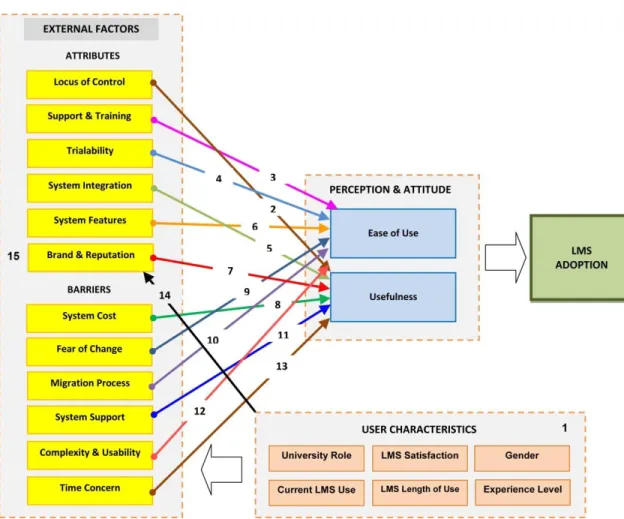
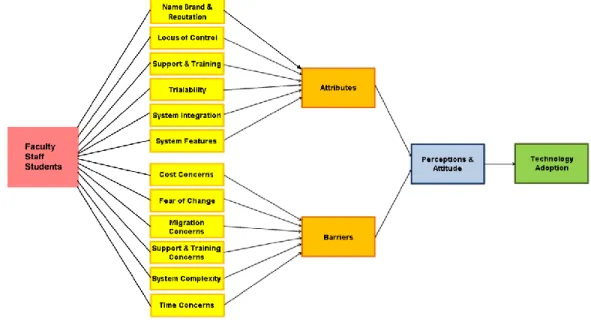
UTAUT (Venkatesh et al., 2003) models. The study conceptual model is modified to align more properly with the variables identified by faculty, staff, and students and relevant for this study. Figure 1 presents the conceptual diagram of the external factors that influence user perception and attitude towards ease of use and usefulness leading to the adoption of the LMS.
Figure 1. Conceptual Diagram. The block diagram displays the two sets of external factors and the relationships (numbered per objective) on user perception and attitude (See appendix A for enlarged diagram).
13
Significance of Study
Historically, the overall significance of using a LMS has always been a debate that originates from whether online teaching and learning is equivalent to the face-to-face traditional style of teaching and learning. Many studies have been concluded over the last decade that have shown there is no significant difference between teaching and learning online or at a distance using a LMS as compared to the traditional face-to-face teaching and learning in a classroom (Russell, 2001). Russell (2001) also states that no matter what or who is being taught, there can be more than one type of medium used to produce desired learning results. This is true of using an LMS for teaching and learning.
The research and findings from the study will provide needed direction for the university administration and ITS department in selecting a new LMS platform and provide the best options for diffusion of the new LMS across the user groups. In as such, the significance of understanding the current user base and how they use the current LMS will allow for possible future improvements and enhancements as follows:
Increase of student outreach through distance education and online courses. Incorporate new features and tools for online teaching and learning.
Improved student engagement and collaboration.
Provide seamless integration for faculty, students, and staff to other university applications.
Configuration of preferred tools and features within the LMS. Improved system performance, stability and scalability. Streamlining of procedures and workflows.
14
Identification of training areas for users to be more effective in using the LMS.
Provide mobile device capabilities.
Conform to accessibility requirements for users with disabilities. Incorporate future use of massive open online courses.
For the university, conclusions and recommendations based from the findings will provide possible direction for university administration and ITS technical staff in promoting usage of the new LMS. This information can also then be used strategically in mitigating user rejection towards adoption of the LMS. The data may also yield
invaluable information which could indicate the priority of features used, training deficiencies, and integration services needed to help with the diffusion process and overcome user rejection towards using the LMS. This study will also provide practical knowledge for other universities, organizations, or businesses that are facing the similar challenge of selecting and moving to a new LMS.
Limitations, Assumptions, and Delimitations
Although practical knowledge can be used from the study, results and findings were limited to Texas A&M University, and the environment for which the LMS is used. Recommendations and conclusions may not be generalizable to other universities,
organizations, or businesses with different demographics.
The study did not consider the teaching and learning methods or learning objective outcomes from the LMS as a measurement of effectiveness, nor did the study consider user level of experience or length of use as a measure of overall LMS
15
effectiveness. Length of use and level of experience were examined only as a user demographic characteristic and LMS brand name predictability within the study. Instrument reliability was sufficient for the study however three of the variable scales were considered below the desired level and should be revised, strengthened, and improved for future studies.
In recent months, MOOCs have become a topic of interest and concern for universities. Although this study did not address this latest phenomenon, the LMS may play an important role in the future of MOOCs and future research in this area is potentially relevant, but not included as part of this study.
The study assumes that the participants have; (a) some level of experience with the LMS, (b) willingly took the survey, and (c) completed the survey with honest answers reflecting personal perceptions and preference. The research for the study assumes that the theoretical framework used for the study is grounded on sound
foundations, proven accurate as tested over time. The research for the study also assumes a direct relationship between user perception and attitude with ease of use and usefulness as being a determinant of user behavior towards LMS adoption. The researcher assumes the variables defined for the study are valid and accurately measured with the instrument being used and that the instrument is valid and reliable.
Participants in the study were delimited to; (a) active users of the LMS during the 2011 spring semester, (b) from the College Station, Galveston, and Qatar campuses, and (c) not ITS department personnel or members of the LMS selection committee.
16
with a specifically designed instrument for the study that was pilot-tested and approved by a panel of university faculty that has expertise in this type of research and members of the committee. LMS trialability and evaluation for the study was restricted to three LMS platforms (a) Blackboard Learn, (b) Moodle, and (c) Sakai as determined by the LMS selection committee.
Definition of Key Terms
Adoption: An individual’s acceptance to use an innovation or technology (Rogers, 2003).
Diffusion: The wide-spread usage of an innovation or technology among a culture, social group, or organization (Rogers, 2003).
E-learning: An application or technology used for online instructional teaching and learning purposes.
Fear of Change: The psychological state (anxiety) of an individual, which influences their perception of using a new technology caused by a disruption of a normal routine (a change) and is considered a potential barrier to the adoption of new
technology (Speek, 2013; Wu, 1995).
Learning Management System (LMS): An application or platform consisting of software and hardware technology used to deliver course content and material that facilitates teaching and learning.
Locus of Control: Individual control over course presentation, interface, content and teaching tools which leads to a personalized perception considered a potential attribute to the adoption of new technology.
17
Migration Process: The process related to migrating course content and/or other course related material from one LMS to another considered a potential barrier to the adoption of new technology.
Self-efficacy: An individual’s ability to complete a task and reach a particular goal (Ajzen, 2002).
Support and Training: Specialized instruction through hands-on training,
workshops, or documentation towards using the LMS considered a potential attribute to the adoption of new technology.
System Complexity and Usability: The level of user friendliness of an e-learning system considered a potential barrier to the adoption of new technology.
System Cost: Items such as consulting, hardware, software licenses, etc…that are cost related and considered a potential barrier to the adoption of the LMS.
System Features: New enhancements or tools for teaching and learning within the LMS that are not currently available considered a potential attribute to the adoption of new technology.
System Integration: The ability to link or integrate to other sources of data or information from the LMS to enhance its value considered a potential barrier to the adoption of new technology.
System Support: Items such as lack of vendor support, training, or technical assistance in implementing, configuration, and operation of a LMS considered as a potential barrier to the adoption of the LMS.
18
Time Concern: Items that are time consuming such as extended training, course development, content migration, etc… considered a potential barrier to the adoption of the LMS.
Trialability: The degree to which an innovation or new technology can be experimented with by potential adopters (Rogers, 2003).
19 CHAPTER II
REVIEW OF LITERATURE
Introduction
This literature review will explore prior research related to key areas of the study and provide a framework in order to draw conclusions from the data once analyzed that could possibly be applied (generalized) to other environments. The literature review will describe and explore existing models and theories which relate to the study, and use them as a foundation towards a theoretical framework and conceptual model for the study. In order to determine an effective evaluation and implementation process that will lead to greater user adoption and seamless diffusion of a new LMS at the university, basic knowledge consisting of LMS definition and characteristics; examination of existing theories and models used for technology adoption; classification of users; identification of attributes and barriers which influence adoption; and an overview of the diffusion process; will be vital towards measuring, analyzing, and interpreting the data presented from the study.
Learning Management System
The LMS has become one of the most widespread and highly adopted
technologies used today in higher education (Chung, Pasquini, & Koh, 2013; Harrington, Gordon, & Schibik, 2004; Kats, 2010; Piña, 2008; Simonson, 2007). While the LMS was originally used by universities for distance education initiatives, the present-day role of the LMS goes beyond the online outreaching of students and in many cases used as a
20
supplement for face-to-face courses on many university campuses. The LMS was once thought of as only a web-based content delivery mechanism, but has recently evolved into an integrated system that supports both synchronous (real-time) and asynchronous (anytime) teaching methods, student tracking, collaboration, social media, assignments, grades, knowledge assessment, portfolios, and learning outcomes. The educational industry, as well as other business industries that provide online training, are becoming addicted to the LMS for teaching, learning, and distribution of content.
The definition of the LMS varies greatly across the literature. Simonson (2007) gave a basic definition of a LMS as “a software system designed to assist in the
management of educational courses for students, especially by helping teachers and learners with course administration” (p, vii). Brown and Johnson (2007) indicated the LMS is a very successful vehicle when used for training, evaluating, and tracking results of learners and use the LMS definition of “an information system that administers instructor-led e-learning courses and keeps track of student progress, used internally by large enterprises for their employees or by universities for students, an LMS can be used to monitor the effectiveness of the organization's education and training” (p. 1).
White and Larusson (2010) gave the definition as “an online digital environment that allows information to be shared between students and faculty and provides access to content and administrative procedures for specific courses” (p. 2). Yet, Chung, Pasquini, and Koh (2013) wrote the definition of the LMS as “a particular type of software system designed and promoted for instructors and learners to utilize in teaching and learning activities” (p. 27).
21
Taking into consideration the environment and the historical presence of the LMS at the university, the following operational LMS definition is presented by this researcher and is appropriate for this study: A platform consisting of a software application and a hardware infrastructure designed to enhance learning and teaching through the use of integrated tools and features that provide flexible functionality and services to the users of the system.
The definition of a LMS is inconsistent throughout the literature, and differs according to the type of functionality, environment, and customer base that it serves. With so many different definitions of the LMS, the importance of knowing which user needs are to be met by the LMS is crucial. User needs are most commonly related to LMS characteristics.
Malikowski, Thompson, and Theis (2007) presents five core LMS characteristics as content and course-related information (content and organization), student evaluation (assessments and quizzes), course evaluation (surveys and questionnaires),
communication (discussions and forums), and delivery (instructional sequencing). However, Kats (2010) noted that the LMS characteristics presented by Malikowski, Thompson, and Theis lack one important characteristic, that of collaboration and provides a basic definition for the LMS that encompasses these characteristics: “An e-learning platform (LMS) is a system which provides integrated support for the six activities – creation, organization, delivery, communication, collaboration, and assessment – in an educational context” (p. 31).
22
Yet, Ferriman (2013) wrote that characteristics of a LMS should be simplified, therefore he presents only three characteristics: “Industry support, customization flexibility, and constantly evolving” (para. 6). He also points out that many universities or organizations get caught up in the LMS feature list and functionality as main criteria when making a selection of a new LMS, but a broader overall picture should be more of a concern for university administrators or management, and include the three previously mentioned characteristics, along with user integration. Ferriman makes a valid argument in pointing out that “a solid foundation (user characteristics) is needed before moving forward and selecting a LMS” (para. 2).
How does a university go about in selecting a LMS when the definition and characteristics are so wide-ranging? To address this question, one must take a holistic view of the environment to which the LMS will be used. The literature presents as many best practices for selecting an LMS as there are definitions and characteristics for the LMS, so defining the user base and determining the services needed from the LMS, will be critical in the selection process. To put this concept into perspective, several
observations of LMS usage from different business areas can be looked upon for guidance.
Examining a LMS from an organizational training perspective, Kerschenbaum and Biehn (2012) presents fifteen best practices for selecting a LMS as described in a white paper submitted to the MASIE Center Learning Consortium
(http://www.masie.com) and are listed below: Online registration, delivery, and tracking
23
Online training and test authoring capability Online testing, certification, and accreditation Online evaluation
Online collaboration and communication Integration with legacy system
Support and training
Support multiple user roles or classes Support for multiple time zones Support for mobile devices
Skill and competency management Reporting
Customization Financial tracking
From the educational perspective, the fundamental keys for a LMS
implementation according to Kerschenbaum and Biehn (2012) are identifying the
stakeholders (users) of the LMS and how the educational organization plans on using the LMS (p. 13). This is consistent with the previous definition and characteristics of the LMS as presented from the literature. In addition to the fore-mentioned educational perspective, Sampathkumar (2013) recommended that any university or organization investing in a LMS in order to make it effective, must considered the following ten core characteristics:
24 Administration Capability Authoring Tools Communication Tools Media Support Scalability Database Capacity
Inclusiveness (mobility and accessibility) Security
Cost
These characteristics were adequate for the basis of this study, but were expanded upon based on concerns voiced during open forum discussions with faculty, students, and staff. The addition of these new characteristics allow for better alignment and suitably to the environment of the university, as well as providing a conceptual and theoretical framework for the study. The expanded list based from the faculty, students, and staff discussions include:
Content creation, sharing, and delivery
Collaboration tools (discussions, chat rooms, wikis, blogs) Assessment tools (quizzes, exams, peer review)
Communication tools (email, chat, notifications, announcements) Student tracking and reporting
Portfolio support
25 Grade book with SIS integration Community area
Learning outcomes & Retention reporting System performance & scalability
System administration (user accounts, course creation, enrollment) This list provides the items of focus used within the study, noted as items of importance to the user base. An important part of the user adoption and diffusion process for the LMS is the need to create value, specifically more value with the new system versus the old system. Therefore, consideration of these items is important. Figure 2 shows a visual representation of these characteristics along with the core LMS integration pieces.
User Concerns and Perception
So what makes an individual use an innovation or technology such as a LMS? According to Engsbo and Sandhu (2007) “adoption decisions may be based on the dimensions of adoption initiative and innovation stimulus, making the adoption decision process as pro-active, reactive, forced, or even arbitrary” (p. 292). Research also shows that prior adopters of a technology or innovation can impact the perception of future users in adopting the technology, and that internal and external stimuli are key drivers in user attitude towards adoption. Some of these determinants as defined by Engsbo and Sandhu include technology complexity, economic factors, social associations, and organizational environment (p. 293).
26
Figure 2. Characteristics of a LMS. The LMS application and integration with the external features and functionality that creates value to the user base. Adapted from “LMS Characteristics”E\1RUPDQ
As technology becomes an increasing role in the life of most individuals, the integration of such causes a change in user attitude and perception. This process also takes time as the adoption process takes place. Recognizing this process, Dirksen and Tharp (1997) noted “the systematic integration of technology requires time and carefully planned strategies to facilitate the adoption process” (p. 1064). They also note that
27
“change is a process, not an event, and it takes time to institute change in an organization” (p. 1065).
This process of change is built around user perception and attitude based on stimuli that affects the psychological state of a user as to accept or reject the adoption of a technology. The change process for a user is a very personal experience with attitude and perception greatly influencing the overall outcome. Dirksen and Tharp go on to state that “the integration of technology depends upon the faculty and staff receiving training and guidance if the vision [of adoption] is to become reality” and “the adoption of instructional technologies and the movement through the change process requires time and appropriate intervention strategies to be successful” (p. 1067).
The assumption that the adoption of a technology is static in nature is incorrect, in fact, it is a social process taking place over time with users and the organization both going through significant changes such as learning, adaptation, and growth (Chowdhury, 1999; Harris et al., 2004). Individuals must let go of past system perceptions and
attitude, experience a change in behavior, and move forward with the adoption of the new technology. Harris, Stanz, Zaaiman, and Groenewald (2004) give a definition of user concern as “the mental activity composed of questioning, analyzing, consideration to alternatives, reactions, state of personal feeling, and perception” (p. 56). To put a picture to this definition, Figure 3 displays individual concerns for adoption based on internal and external stimuli that influence user perception and attitude towards adoption. To observe, attempt to measure, and predict influence on adoption, many theories and models have been developed over the years.
28
Figure 3. Individual Concerns for Adoption. The image depicts several internal and external stimuli that influence user perception and attitude towards adoption.
Technology Adoption Models and Theories
Many models have been created over the last few decades that try to explain and lend answers to the question of why users adopt a particular technology or innovation. Some of the most well-known models for technology adoption which lend prior knowledge and research to the study are presented here from the literature. Theory of Reasoned Action
From the social psychology field, Ajzen and Fishbein (1969) studied attitude as a factor of individual behavior, looking at the relationship of why a person acts a particular way and as such, can the behavior be predicted or changed. The study led to the
29
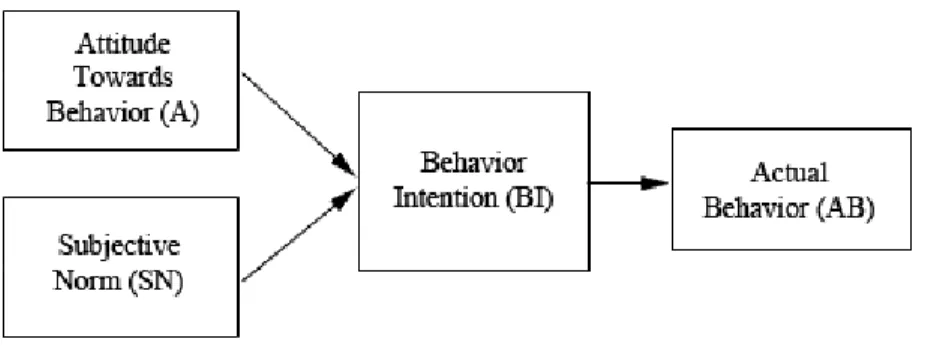
development of the Theory of Reasoned Action (TRA) in 1975 which examined two independent constructs, attitude (A) towards behavior and subjective norm (SN) to be determinants of two dependent constructs of behavior intention (BI) and actual behavior (AB). The behavior intention is based on the individual’s attitude and subjective norms towards the actual behavior (Fishbein & Ajzen, 1975; Sheppard, Hartwick, & Warsaw, 1988). Attitude towards behavior is based upon external influences of a person’s beliefs about the associated consequences of the behavior. Subjective norm is based upon the individual’s perception of what people think about doing or not doing the behavior. A block diagram of the model is presented in Figure 4.
Figure 4. Theory of Reasoned Action Model. The model predicts behavior based on the influence of attitude and subject norm. Adapted from “User acceptance of computer technology: A comparison of two theoretical models” by Davis, Bagozzi, & Warshaw, 1989, p. 984.
This model has been modified through years of research, spanning other
30
modifications done in the later models spawn from trying to fit the constructs into different environments being studied, such as marketing, corporate training, or
information technology. Other modifications for the inclusion of additional influences such as social memberships, personal values, perception, and global environments where also done.
The phenomenon of predicting how a person’s behavior can be influenced has long been studied throughout the literature. Businesses want to know how to get customers to buy their products. Companies want to know how to make employees become more productive. The importance of understanding how external variables can influence individual behavior based on attitude and perception is therefore important towards adoption and diffusion of a new innovation or technology.
Theory of Planned Behavior
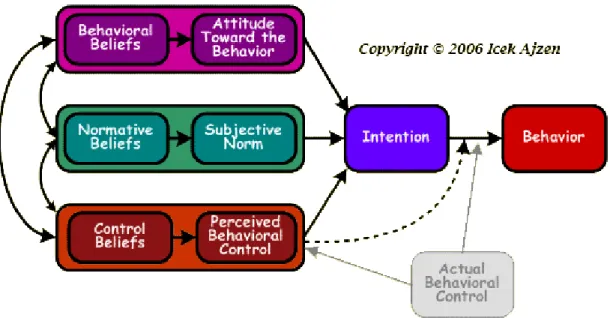
With criticism of the TRA, Ajzen and Fishbein (1980) redefined the theory and included another construct, perceived behavior control. In 1985, the Theory of Planned Behavior (TPB) was presented publicly based on findings from several studies (Ajzen, 1991). The model now addressed user ability to perform the behavior, the ease or difficulty of change based on the behavior. This new construct was based from the Self-efficacy Theory (SET) by Bandura (1977) and draws the relationship between behavioral intention and actual behavior. The TPB model is shown in Figure 5.
31
Figure 5. Theory of Planned Behavior Model. The image depicts the TRA model with added construct of perceived behavioral control. Adapted from “TPB Diagram” by
Ajzen
Technology Acceptance Model
The Technology Acceptance Model (TAM) was developed by Davis (1986) to provide a method for determining user acceptance of technology based on two
constructs, perceived usefulness and perceived ease of use. The TAM was derived from the TRA, but presented a new theoretical approach to measuring technology acceptance through external variables that influence the cognitive reasoning process concerning the usefulness or ease of use of the technology or innovation, thus changing attitude and behavioral patterns of users in a positive manner will aid to the adoption process. Today, the TAM is widely accepted in the field of information technology as a well-known
32
predictor of technology acceptance (Sentosa & Nik Mat, 2012). Figure 6 illustrates the block diagram of the model.
Figure 6. Technology Acceptance Model. External variables influence user perception of usefulness and ease of use in forming attitude towards behavioral intention and actual use. Adapted (as cited by Venkatesh) from “User acceptance of computer technology: A comparison of two theoretical models” by Davis, Bagozzi, & Warshaw, 1989, p. 985.
The TAM examines two independent constructs, ease of use (E) and perceived usefulness (U), as determinants of two dependent constructs of attitude (A) and behavior intention (BI) towards the actual behavior. The model is based on the individual’s perception of usefulness and ease of use which influences attitude and behavioral
intention towards the actual behavior (Davis, Bagozzi, & Warshaw, 1989). Of interest to this study, the TAM can be used to address concerns about user acceptance or rejection of a technology and how the acceptance or rejection is influenced by external
33
that educational organizations can influence perceived usefulness of potential users by demonstrating an added value from the system. However, the theoretical weakness of this model lies in that of the external variables, how they are defined and how they relate to the users.
Technology Acceptance Model 2
Continuous research in areas related to social influence and cognitive reasoning led to the addition of new external influences or determinants to the original TAM, creating the TAM2. Venkatesh and Davis (2000) identified these two new areas as social influences and cognitive instrumental processes, consisting of determinants related to subjective norm, personal image, experience, voluntariness, job relevance, output quality, and result demonstrability. With the addition of the cognitive process aspect of this new model, influence from the individual’s motivation, goals, and adoption
decisions can be measured towards technology acceptance and adoption (p. 191). Figure 7 displays the extension of the original TAM that led to the creation of the TAM2 model.
34
Figure 7. Technology Acceptance Model 2. Social influences and cognitive reasoning processes are related to perceived usefulness and can therefore change usage behavior. Adapted from “A theoretical extension of the technology acceptance model: Four longitudinal field studies” by Venkatesh & Davis, 2000, p. 188.
Technology Acceptance Model 3
Venkatesh and Bala (2008) further refined the TAM2 into the development of the Technology Acceptance Model 3 (TAM3) which again extended the model for more social influences, environmental influences, user experience, and personal preference. For the interest of this study, the TAM3 addresses user perceptions and experience with technology, along with personal control, and fear of change (anxiety). Figure 8 displays the block diagram of the TAM3 with the additional determinants and relationships among the constructs.
35
Figure 8. Technology Acceptance Model 3. Further extension of the TAM model to include new determinants that influence behavior. Adapted from “Technology
acceptance model 3 and a research agenda on interventions” by Venkatesh & Bala, 2008, p. 280.
Unified Theory of Acceptance and Use of Technology Model
Bagozzi (2007) wrote that all of the TAM versions were too simple and did not take into account the end goals or objectives of the user related to technology acceptance
36
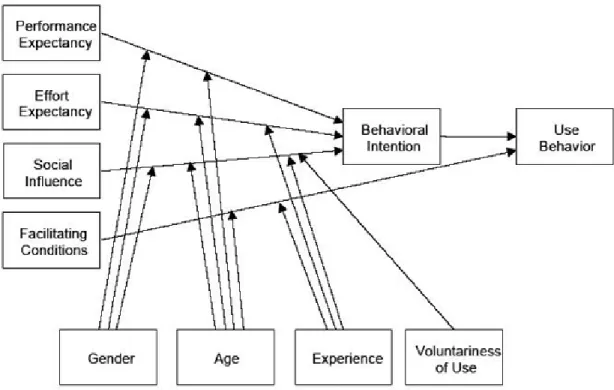
and usage. Rather, he believed that technology adoption, acceptance, or rejection by the user should be goal oriented, not behavior oriented as with the previous TAM models. During this same time, the creation of the Unified Theory of Acceptance and Use of Technology Model (UTAUT) developed by Venkatesh et al. (2003) in an attempt to also simplify the TAM models with a compilation of several other technology theories and include more technology related constructs.
Psychological aspects such as emotions and attitude can play a role in the decision process of an individual, but are not considered in the TAM models. Many researchers have acknowledged this argument from Bagozzi however, most believe that the psychological aspects are inherent to the overall diffusion process as theorized by Rogers (2003). It is also the opinion of this researcher that emotions, perceptions, and attitude can be influenced through collaboration and communication amongst users, thus acting as the change agent role within Rogers’ diffusion of innovation theory. Figure 9 displays the block diagram for the UTAUT model.
37
Figure 9. Unified Theory of Acceptance and Use of Technology Model. Adapted from “User acceptance of information technology: Toward a unified view” by Venkatesh, Morris, Davis, & Davis, 2003, p. 447.
Diffusion of the LMS
A new LMS represents a major change for the university and the users. Change is always difficult for the adoption of a new technology. Rogers (2003) defined diffusion as “the process in which an innovation is communicated through certain channels over time among the members of a social system” (p. 5). The goal of the diffusion process is to focus adoption techniques towards the early adopters and early majority users in order to help them persuade the late majority and laggards to adopt the new innovation or
38
technology. In real-world practice however, 100% adoption of an innovation or technology is rarely met, although the diffusion theory is based on such a goal.
Another major concern after selecting and implementing a new LMS is that of system adoption by the users. Rogers (2003) uses a normal distribution curve to classify users into five categories based on time of adoption. These five categories represent partitions that classify users based on standard deviations from the average user adoption time (center of the normal distribution curve) and an assumed 100% adoption by all users. Descriptions of each user category and corresponding characteristics are as follows:
Innovators: Idealists, daring, risk takers, venturesome individuals. These are the first users to push for adoption of an innovation, generally advocating how the
innovation makes something better than before (added value) based on a new vision or idea (p. 282).
Early Adopters: These are the first true users of the innovation from a business perspective by integrating with the innovation in a physical sense. These users will become role models (and change agents) for other users and are crucial to triggering the critical mass adoption of an innovation (p. 283).
Early Majority: Evaluators, deliberators, careful and purposeful thinkers. These users make up the larger portion of the critical mass and rely on evaluation and
recommendations from peers (innovators and early adopters) before adopting an innovation (p. 283). These users are accepting to change, but want to know how the change will benefit them in some fashion.
39
Late Majority: Skeptical, cautious, and slow thinkers. These users postpone adoption until the innovation has been proven, used for some amount of time, and rely on convincing evidence and persuasion from the critical mass to accept the innovation as a necessary change (p. 284).
Laggards: Traditionalists, suspicious, and reluctant to change. These users make up the last portion of the user group categories and are normally forced to change and adopt a new innovation (p. 284).
The relationship between each user category plays a unique role in achieving critical mass. Critical mass is the point at which the adoption of an innovation is self-sustaining, in other words, being continuously adopted by future users (p. 363). The study does not determine the individual users within the three defined groups and how they fit into the adoption categories, instead the literature review information is to expand the knowledge of the researcher and university administration to better prepare for the adoption and diffusion process based on findings from the study.
The concept of critical mass (Rogers, 2003; Schelling, 1978) notes that human behavior of an individual or group often depends on the perceptions and attitudes of other individuals, specifically on technology adoption. Simply stated, people tend to make decisions on trying some new technology (and adopting it) based on how others have perceived the new technology. Therefore, the importance of the study to measure and understand user perceptions and attitude of attributes and barriers within the current LMS, will be vital in determining any diffusion process of a replacement LMS.
40 User Group Classification
The study defined three distinct user groups that use the LMS on a daily basis. The groups are faculty, students, and staff. The basic definitions for these user groups as related to the study are as follows:
Faculty: Those users that are labeled as instructor of record (IOR) for a course in the student information system (SIS). Faculty primarily use the LMS for creating, uploading, and sharing of course content with students, but also use the grade book, assessment, and assignment features of the LMS to evaluate student learning.
Students: Those users that are labeled as students enrolled in a course in the student information system (SIS). Students primarily use the LMS for consumption of course content, but also use the communication, discussion, assignment, assessment, and grade features of the LMS for collaboration with instructors and other students.
Staff: Those users that are not labeled as an instructor of record (IOR) or a student in the student information system (SIS). Staff employees primarily use the LMS for the sharing of information, creating communities or special interest groups, and collaboration.
Rogers (2003) defined a five-stage adoption decision process of individuals for the diffusion of an innovation. The stages are defined as knowledge, persuasion, decision, implementation, and confirmation (p. 170).
Knowledge – Individual is first exposed to the innovation.
41
Decision – Individual evaluates the advantages and disadvantages of using the innovation and decides to accept or reject.
Implementation – Individual uses the innovation and determines usefulness.
Confirmation – Individual makes final decision to continue or discontinue usage. The user decision process starts with the initial stage of gathering knowledge about the technology or innovation where the individual assesses prior practice with the technology, notes barriers to overcome with using the technology, how others are using the technology, how the technology fits into the environment, and starts to define the added value to be gained from using the new technology. The decision process then flows from knowledge gathering stage to the persuasion stage of the process.
In the persuasion stage, the user assesses the added value from the technology by trialability (hands-on usage of the system; pilot or beta user), observing complexity and compatibility with the business usage of the technology within the user’s environment. The decision process then flows to the decision stage.
In the decision stage, the user decides on accepting or rejecting the technology based on prior knowledge and persuasion stages. At this point in the decision process, the user eithers accepts the new technology and any associated change by adopting it or rejects the new technology. If the user rejects the new technology, the decision process starts over with the gathering of additional knowledge and different persuasive
approaches which are needed to influence change and later adoption of the new technology during the next decision stage.
42
The implementation stage follows the decision stage if the user accepts the new technology. In this stage, the user begins using the new technology in the day-to-day routine of activities. In the case of an educational setting such as a LMS, the user would begin migrating course content from the older LMS and building new course content and functionality that makes use of new features within the LMS. This stage then flows into the confirmation stage of the decision process.
In the confirmation stage, the user then evaluates how the adoption of the new technology has improved their job, teaching methods, or similar. Continuous
improvement and change can also occur during this stage as more responsibility and confidence is gained by the user to expand knowledge and usage of the technology. Attributes to Adoption
The attributes of the study are theorized and considered as positive influence factors on user perception and attitude towards adoption of the LMS. The assumption is that the existence of these factors will improve and possibly increase user adoption during the diffusion of the new LMS once selected and implemented by the university. Brief overviews of each previously identified attribute are listed below along with the importance of each attribute to the diffusion process.
Brand Name and Reputation. Research has shown that company reputation and product brand name has an effect on the mental aspect of an individual and influences user perception and attitude (Jansen, Zhang, & Schultz, 2009). “In the cognitive area, brand image has been shown to stimulate certain areas of the human brain” (Born, Meindl, Poeppel, Schoenberg, & Reiser, 2006). Since prior research indicates user