BARRIER COVERAGE WITH WIRELESS SENSOR
NETWORKS
Mohsen Eftekhari Hesari
A thesis In the Department
of
Computer Science & Software Engineering
Presented in Partial Fulfillment of the Requirements For the Degree of
Doctor of Philosophy (Computer Science) at Concordia University
Montr´eal, Qu´ebec, Canada
April 2014 c
Concordia University
School of Graduate Studies
This is to certify that the thesis preparedBy: Mr. Mohsen Eftekhari Hesari
Entitled: Barrier Coverage with Wireless Sensor Networks
and submitted in partial fulfillment of the requirements for the degree of Doctor of Philosophy (Computer Science)
complies with the regulations of this University and meets the accepted standards with respect to originality and quality.
Signed by the final examining committee:
Chair Dr. Sheldon S. Williamson External Examiner Dr. Binay Bhattacharya External to Program Dr. Chadi Assi Examiner Dr. Hovhannes A. Harutyunyan Examiner Dr. Thomas G. Fevens Thesis Supervisor Dr. Lata Narayanan Thesis Supervisor Dr. Jaroslav Opatrny Approved by
Dr. Volker Haarslev, Graduate Program Director
2014
Dr. Christopher W. Trueman, Interim Dean Faculty of Engineering and Computer Science
Abstract
Barrier Coverage with Wireless Sensor Networks
Mohsen Eftekhari Hesari, Ph.D.Concordia University, 2014
We study the problem ofbarrier coverage with a wireless sensor network. Each sensor is modelled by a point in the plane and a sensing disk or coverage area centered at the sensor’s position. The barriers are usually modelled as a set of line segments on the plane. The barrier coverage problem is to add new sensors or move existing sensors on the barriers such that every point on every barrier is within the coverage area of some sensors. Barrier coverage using sensors has important applications, including intruder detection or monitoring the perimeter of a region.
Given a set of barriers and a set of sensors initially located at general positions in the plane, we study three problems for relocatable sensors in the centralized setting: the feasibility problem, and the problems of minimizing the maximum or the aver-age relocation distances of sensors (MinMax and MinSum respectively) for barrier coverage. We show that the MinMax problem is strongly NP-complete when sensors have arbitrary ranges and can move to arbitrary positions on the barrier. We also study the case when sensors are restricted to use perpendicular movement to one of the barriers. We show that when the barriers are parallel, both the MinMax and MinSum problems can be solved in polynomial time. In contrast, we show that even the feasibility problem is strongly NP-complete if two perpendicular barriers are to be covered.
For the barrier coverage problem in distributed settings, we give the first dis-tributed local algorithms for fully synchronous unoriented sensors. Our algorithms achieve barrier coverage for a line segment barrier when there are enough sensors to cover the entire barrier. Our first algorithm is oblivious and terminates in Θ(n2) time, whereas our second one uses two bits of memory at each sensor, and takes Θ(n) steps, which is asymptotically optimal. However, if the sensors are semi-synchronous, and do not share the same orientation, we show that no algorithm exists that always terminates within finite time. Finally, for sensors that share the same orientation we give an algorithm that terminates within finite time, even if all sensors are fully asynchronous.
Finally, we study barrier coverage with multi-round random deployment using stationary sensors. We analyze the probability of barrier coverage with uniformly dispersed sensors as a function of parameters such as length of the barrier, the width of the intruder, the sensing range of sensors, as well as the density of deployed sensors. We propose two specific deployment strategies and analyze the expected number of deployment rounds and deployed sensors for each strategy. We present a cost model for multi-round sensor deployments, and for each deployment strategy we find the optimal density of sensors to be deployed in each round that minimizes the total expected cost. Our results are validated by extensive simulations.
Acknowledgments
I wish to express my gratitude to my supervisors, Prof. Narayanan and Prof. Opatrny. Their encouragement, guidance, and deep support during my study enabled me to develop an understanding of the subject. Their wide knowledge and detailed and constructive comments have been a great value for me.
I am grateful to all my student colleagues for their help and support. I would like to specially thank Sirma Altay, Puspal Bhabak, Hayk Grigoryan, and Louisa Harutyunyan for their friendship and help.
I owe my best friends, Abolfazl, Arash, Atefeh, Behnam, and Nona a lot for their continued moral support.
Lastly, and most importantly, I wish to thank my parents and my sisters, Samaneh and Mahsa, for their understanding, support and encouragement. They have lost a lot due to my studies abroad. To them I dedicate this thesis.
Contents
List of Figures ix
List of Tables xii
1 Introduction 1
1.1 Model and Definitions . . . 2
1.1.1 Barrier . . . 3
1.1.2 Sensors . . . 3
1.1.3 Intruder . . . 5
1.1.4 Mobility Model . . . 5
1.1.5 Sensor Deployment Policies . . . 6
1.1.6 Coverage Redundancy . . . 7
1.2 Problem Statement . . . 8
1.2.1 Centralized Barrier Coverage of Multiple Barriers with Relo-catable Sensors . . . 8
1.2.2 Distributed Barrier Coverage of A Single Barrier with Relocat-able Sensors . . . 9
1.2.3 Barrier Coverage of A Single Barrier with Stationary Sensors and Random Deployment . . . 9
1.3.1 Centralized Algorithms for Barrier Coverage of Multiple
Barri-ers with Relocatable Sensors . . . 10
1.3.2 Distributed Algorithms for Barrier Coverage of A Single Barrier with Relocatable Sensors . . . 11
1.3.3 Barrier Coverage of A Single Barrier with Stationary Sensors and Random Deployment . . . 12
1.4 Outline of Thesis . . . 12
2 Related Work 14 2.1 Barrier Coverage with Relocatable Sensors . . . 15
2.1.1 Centralized Algorithms . . . 15
2.1.2 Distributed Algorithms . . . 18
2.2 Barrier Coverage with Stationary Sensors . . . 22
3 Centralized Algorithms Using Relocatable Sensors 25 3.1 Computational Model and Preliminaries . . . 25
3.2 Our Results . . . 27
3.3 Arbitrary Final Positions . . . 28
3.4 Perpendicular Movement: Parallel Barriers . . . 31
3.4.1 One Barrier . . . 32
3.4.2 Multiple Parallel Barriers . . . 33
3.5 Perpendicular Movement: Two Perpendicular Barriers . . . 38
3.5.1 Special Cases . . . 49
3.5.2 Approximation Algorithms . . . 53
3.6 Conclusions . . . 59
4 Synchronous Distributed Algorithms Using Relocatable Sensors 60 4.1 Our results . . . 61
4.2 Computational Model and Preliminaries . . . 61
4.3 An Oblivious Distributed Algorithm for Barrier Coverage . . . 66
4.4 A Constant-Memory Algorithm for Barrier Coverage . . . 83
4.5 Conclusions . . . 90
5 Asynchronous Distributed Algorithms Using Relocatable Sensors 92 5.1 Computational Model and Preliminaries . . . 92
5.1.1 Synchronization Models of Sensors . . . 94
5.2 Impossibility of Algorithms for Barrier Coverage in SSYNC . . . 95
5.3 Sensors with Orientation . . . 100
5.4 Conclusions . . . 107
6 Multi-Round Random Deployment Using Stationary Sensors 109 6.1 Network Model . . . 110
6.2 Probability of (k, w)-coverage for Complete deployment Strategies . . 111
6.2.1 Expected Minimum Number of Sensors for (k, w)-Coverage . . 117
6.3 Cost Analysis of Multi-Round Sensor Deployment . . . 118
6.3.1 Fixed-Density Complete Deployment . . . 119
6.3.2 Fixed-Density Partial Deployment . . . 120
6.4 Simulation Results . . . 123
6.5 Conclusions . . . 129
7 Conclusions and Future Directions 132
List of Figures
3.1 (a) A given barrier coverage problem (b) a possible covering assignment 26
3.2 Reduction from 3-partition to the MinMax problem . . . 31
3.3 An example of a barrier coverage problem with two parallel barriers . 34 3.4 Barrier coverage instance corresponding to Example 3.1 . . . 43
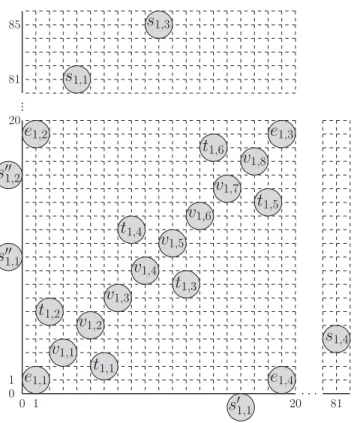
3.5 Bound sensors: In any covering assignment, sensors s1, s2, . . . , s5 al-ways move in the same direction. . . 45
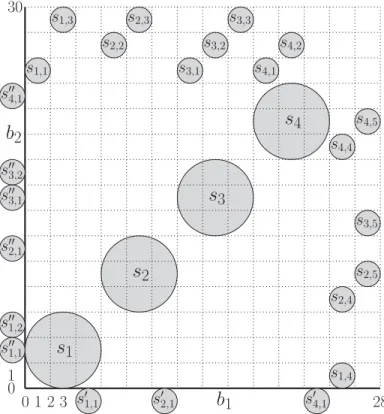
3.6 Partial example: Barrier coverage instance corresponding to Example 3.1 48 3.7 A non-overlapping arrangement of sensors. Each interval on the x-axis and y-axis delineated by dotted lines is represented by a sensor in the corresponding bipartite graph. . . 49
3.8 Sufficiency of potential 3-coverage. . . 52
3.9 An example of an arrangement where b1 and b2 are 2 and 3-coverable and yet there exists no covering assignment for the arrangement. . . . 53
3.10 An arrangement where b1 and b2 are 2 and 1-coverable respectively. . 56
4.1 An example of a (heavy) pile. The shaded areas are gaps. . . 65
4.2 Algorithm 4.1 example, r= 1 . . . 67
4.3 The different possibilities for the rightmost sensor stk+1. . . 71
4.4 A worst case input for Algorithm 4.1 . . . 75
4.5 An example of sensors at time t1 with a gap and an NSP. . . 78
4.7 Sub-case where there exists two NSGs with no NSP between them . . 81 4.8 An example where Algorithm 4.1 takes Ω(n) time to terminate while
an optimal algorithm terminates in one step. . . 82 4.9 The shaded areas show the collections of the pile P at consecutive
steps, r= 2. . . 85 4.10 An example where Algorithm 4.2 takes Ω(n) time to terminate while
an optimal algorithm terminates in one step. . . 90 5.1 The three types of sensors under consideration . . . 96 5.2 Arrangement for proof of Lemma 5.1 . . . 96 5.3 Arrangement for proof of Lemma 5.1 (p, q ∈ N are chosen so that
p e=q a) . . . 97 5.4 Arrangement for proof of Lemma 5.3 . . . 99 5.5 Arrangement for proof of Theorem 5.1 (p, q ∈ N are chosen so that
p b=q c . . . 101 6.1 Simulation results for the probability of (k, w)-coverage with complete
deployments. l= 5000, τ = 15. . . 124 6.2 Fixed-Density Complete Deployment: Expected number of dispersed
sensors until (1, w)-coverage is achieved. l = 5000 andτ = 15. . . 125 6.3 Fixed-Density Complete Deployment: Expected number of rounds
un-til (1, w)-coverage is achieved. l = 5000 and τ = 15. . . 125 6.4 Fixed Density Complete Deployment: Expected number of rounds
un-til (1, w)-coverage is achieved. l = 5000 and τ = 15. . . 126 6.5 Fixed Density Complete Deployment: E[Ctot
Cn ] as a function of λ for
different values of Cr
6.6 Fixed Density Complete Deployment: comparing total cost given by simulations and by analysis. For every Cr
Cn optimalλ is calculated from
Eq. 6.25 l= 5000, τ = 15 . . . 127 6.7 Fixed Density Complete Deployment: Percentage increase in total cost
using λ∗ given by analysis versus optimal cost given by simulations.
l= 5000, τ = 15 . . . 128 6.8 Fixed Density Partial Deployment: Expected number of necessary
sen-sors for (1, w)-coverage. l= 5000 and τ = 15. . . 129 6.9 Fixed Density Complete vs Partial Deployment: Expected number of
necessary sensors for (1, w)-coverage. l= 5000 and τ = 15. . . 130 6.10 Fixed Density Complete vs Partial Deployment: Minimum expected
List of Tables
3.1 Summary of our results. We assume sensors are ordered with respect to thex-coordinates of leftmost points in their coverage areas. . . 28
Chapter 1
Introduction
A wireless ad hoc network is an infrastructure-less network consisting of many wireless nodes. The data propagation in a wireless ad hoc network does not rely on any pre-existing infrastructure e.g. routers or access points; instead, wireless nodes forward data from other nodes. A wireless sensor network is an ad hoc network in which every node has a microcontroller, a communication module and sensing modules. For convenience, in the rest of this thesis, we refer to the nodes of a wireless sensor network simply assensors. The goal of a wireless sensor network is to monitor some aspects of the environment. Each sensor is equipped with a set of sensing module (e.g. motion, light, temperature and humidity) and gathers information from its surrounding environment. Each sensor is also equipped with a communication module that enables it to communicate with other sensors or base stations. Every sensor in the network gathers information from its surrounding environment and passes it on to the base station(s) possibly through other sensors. The applications of wireless sensor networks are broad, ranging from temperature or humidity control in a building to habitat monitoring or surveillance of a restricted area and localization and tracking of an entity of interest (for examples see [ZG04]).
sensor networks. The goal of a surveillance system is to detect the entrance of entities of interest in a restricted area. For simplicity we use the termsintruder andintrusion detection to refer to the entity of interest and its detection by the network respectively. However this usage of the terms does not imply any illegal or unfavorable entrance or activity of the entity of interest. The literature on intrusion detection using wireless sensors can be classified into two major categories:
Area Coverage The goal of area coverage is the monitoring of an entire region [HT03, KLB04, MKPS01], on the assumption that the intruder might appear at any point in the region and must be detected within a fixed time delay.
Barrier Coverage In contrast to area monitoring, the focus of barrier coverage is on monitoring the entire boundary or a part of the boundary of a given region [BBSK07, BBH+09, CKK+09, CKK+10, KLA05].
Assuming that an intruder cannot enter a region without crossing its boundary, monitoring the boundary of the region is sufficient to detect all intruders with pos-sibly fewer sensors. Wireless sensors can be deployed to monitor the perimeter of a restricted area, thereby creating a virtual barrier. Compared to wired alternatives, a wireless sensor-based monitoring system can provide a cost-effective solution for surveillance and intrusion detection.
The focus of this thesis is on the barrier coverage problem with wireless sensors. In the following we first present the models that we use to study barrier coverage and then we present the problems that we tackle in this thesis.
1.1
Model and Definitions
We proceed to define three essential entities: barrier, sensor, and intruder. We go on to discuss the various mobility models we use in this thesis, the possible sensor
deployment policies, and coverage redundancy. A barrier is the boundary, or a part of the boundary, of a restricted area that we wish to monitor. Examples are the border between two countries with the purpose of monitoring and regulating movement of people and vehicles between the two countries or a border between two sides of a jungle to study the movements of animals between the two sides. The sensors are the small pieces of equipment that are scattered along the barrier to monitor it. Finally the intruder is an entity of interest that crosses the barrier. To formulate the problem we need to first define model(s) for each of these three entities. We start with the barrier:
1.1.1
Barrier
There are two common models for a barrier in the literature:
• A barrier can be modelled as a long narrow band with a relatively small width compared to its length [KLA05, CKL07, LDWS08]
• The barrier can be modelled as a line segment, given that its width is zero [CKK+09, CKK+10, MNO11].
The problem may involve more than one barrier segment. For example arbitrary curved barriers can be modelled as a set of barrier segments. In fact in many problems we consider a set of barriers as an input.
1.1.2
Sensors
In a monitoring system each sensor is equipped with the essential sensing module and may or may not have other optional modules. Here are the list of the modules that we need for our problem formulation:
Sensing module: The sensing module may be a motion detector, heat detector, or detector of any other type of property that can be used to detect intruders. In this thesis, we do not go into details of the sensing module but look at it as a provided interface. For any sensor there is a neighborhood in which the sensor is capable of detecting intruders. We call this neighborhood the sensing area. In general, the sensing area of a sensor can have any shape and the event detection probability could be non-homogeneous throughout the sensing area of the sensor (depending on the sensor module, the environment properties, etc.) but in this thesis we only consider sensors with unit disk sensing areas and we assume that a sensor can detect an intruder if and only if it is within the sensing disk of the sensor. This is a model which is commonly used in the literature of wireless sensor networks.
Mobility module: In general, mobility of sensors may help barrier coverage by al-lowing sensors to move from overly monitored areas to those areas that do not have sufficient sensors for intended coverage. The mobility of sensors may be restricted in different ways, for example, the direction or the maximum distance that a sensor can move. Throughout this thesis we are using different mobility assumptions which are explained in more detail later on in this chapter.
Visibility module: The visibility module enables the sensor to locate other neigh-boring sensors when they are close enough. Visibility is different from sensing: the visibility module enables detection of othersensors, while the sensing mod-ule detects intruders. As in the case of sensing module, we define a visibility range for each sensor and assume that a sensor u can see another sensor v if and only if v lies within u’s visibility range. We generally assume that when u
Communication module: A communication module enables sensors to communi-cate to each other or predefined base stations, for example to report collected sensor data or collaboratively compute or aggregate a function of this data. However in this thesis we are only concerned with the establishment of barrier coverage and not the collection of sensor data. In general communication gives more power to sensors e.g. local or even global knowledge of network topology, possibility of having centralized algorithms etc. However, the algorithms in this thesis do not use any communication between sensor nodes. Nevertheless, one way to achieve visibility of nearby sensors could be via carrier sensing which utilizes the radio transceiver of the communication module.
1.1.3
Intruder
An intruder can be modelled as a 2-dimensional shape in the plane whose trajectory is a curve that intersects the barrier. In this thesis we consider the intruder as an object with non-zero area. We assume that a sensor detects an intruder if and only if the intersection of the sensing range of the sensor and the intruder area is non-zero.
As mentioned earlier, different mobility capabilities can be considered for sensors. In the following we discuss the models that we use throughout this thesis in more detail.
1.1.4
Mobility Model
As stated earlier, the mobility module enables a sensor to move from its initial de-ployment to a new position. Sensor networks can be divided into 3 categories based on the ability of sensors to move:
Stationary sensors : sensors have no movement module and do not have any mo-bility capamo-bility.
Relocatable sensors : All or some sensors can relocate to new positions after the initial deployment but after reaching their final positions, they stay stationary. During the border monitoring phase sensors do not move.
Mobile sensors : All or some sensors are moving constantly (patrolling) after the deployment and during the border monitoring phase.
Relocatable and mobile sensors can increase the performance of the barrier coverage by covering the previously uncovered areas of the barrier. Our set of problems consider sensors that are either all stationary or all relocatable.
Even for mobile and relocatable sensors, the mobility can be limited in many ways. Limitations on both the distance and the direction that a sensor moves can be assumed.
1.1.5
Sensor Deployment Policies
A key decision in the design and implementation of a wireless sensor monitoring system is choosing the method of deploying the sensors.
There are three major sensor deployment strategies:
1. Deterministic deployment
2. Multi-round random deployment
3. Ad hoc deployment using relocatable sensors
In a deterministic deployment, sensors are deployed in predetermined positions. Whereas in a multi-round random deployment, sensors are dispersed randomly on the barrier in rounds. A new round of deployment is necessitated if the intended barrier coverage is not achieved in the previous rounds [YQ10]. Finally, in an ad hoc deployment with mobile sensors, sensors are initially located at arbitrary positions
and then some of the sensors may relocate to new positions such that the entire barrier is covered [SCLP08, CKK+09, CKK+10, CGLW12]. It is not difficult to see that with a deterministic deployment or the use of relocatable sensors, possibly fewer sensors are needed. However, deterministic deployment or use of relocatable sensors may not be feasible in many situations (e.g. hazardous or mountainous areas). On the other hand, with random deployment it is hard if not impossible to guarantee achieving barrier coverage in finite number of deployment rounds. Finally, the installation cost of the system as a combination of deployment cost and sensors cost should also be taken into account when deciding the deployment strategy.
In this thesis we consider two of the deployment strategies: multi-round random deployment and ad hoc deployment using relocatable sensors.
1.1.6
Coverage Redundancy
One challenge in the design of wireless sensor monitoring systems is errors in intrusion detection. There are errors related to the sensing modules of the sensors: false positive and true negative. Also it is possible that although a sensor correctly detects an intruder the information cannot reach a base station due to communication problems. In general, one way to reduce the rate of errors in a sensor network is deploying redundant sensors on the barrier. We say a border is (k, w)-covered if any intruder with a width greater than or equal towis detected by at leastk distinct sensors. The concept is similar to weak k-barrier coverage defined in [KLA05], and differs only in generalizing the notion of intruders considered there.
1.2
Problem Statement
The problems that we tackle in this thesis can be categorized into three sets. In the following we describe each set of problems separately.
1.2.1
Centralized Barrier Coverage of Multiple Barriers with
Relocatable Sensors
In this set of problems, we assume that there exists a centralized entity that has global knowledge about the entire barrier and the sensors on it. Therefore this entity can determine if any portion of the barrier is not covered and then, if necessary, make the decision about which sensor to move to which position such that the intended barrier coverage is achieved. In this thesis, we study the problem with respect to different constraints:
• Feasibility problem: Given an input of sensors and barriers the problem is to decide whether there exists a set of final positions (one for each sensor) such that all the barriers are fully covered.
• MinSum problem: Given the input the problem is to find a feasible solution such that the sum of all movements (displacements of sensors) is minimized.
• MinMax problem: Similar to MinSum but instead of the sum of movements the maximum movement is the subject of minimization.
The study of the MinSum and the MinMax problems, is motivated by the mini-mization of the overall energy consumption of sensors, and the minimini-mization of the deployment time (e.g. the time that the last sensor takes to reach its final position), respectively.
1.2.2
Distributed Barrier Coverage of A Single Barrier with
Relocatable Sensors
For this set of problems, we assume that sensors are autonomous robots, each with localized information gathered from within its visibility radius. Here again depending on the assumed properties of sensors (whether sensors have a local or global sense of orientation, sensing model of sensors, time synchronization between sensors and the barrier shape) the results vary from giving optimal algorithms to proving non-existence of any distributed algorithm for the problem.
1.2.3
Barrier Coverage of A Single Barrier with Stationary
Sensors and Random Deployment
Finally, in the last set of problems, we assume that sensors are dispersed randomly along the barrier and they cannot move once they are deployed. Assuming sensors with fixed sensing ranges much less than the barrier length, and finite number of deployed sensors, the intended barrier coverage is achieved with some probability
p less than 1. This implies that with probability 1−p the barrier is not covered and since sensors cannot move, more sensors needed to be deployed on the barrier. However if these new sensors added in the second round are also randomly deployed, still there may be a chance that the barrier is not covered after the second round of deployment and therefore more rounds of deployment may be needed until intended coverage is achieved. In this thesis we study severalmulti-round random deployment
1.3
Contributions of Thesis
In this section we summarize our contributions in each of the sub-problems introduced in the previous section:
1.3.1
Centralized Algorithms for Barrier Coverage of
Multi-ple Barriers with Relocatable Sensors
We consider several variations of the problem of covering a set of barriers (modelled as line segments) using relocatable sensors. Unlike the previous studies that only considered initial positions of sensors being on the line containing the barrier, we consider sensors initially located at general positions in the plane. Given a set of barriers and a set of sensors located in the plane, we study three problems: (i) the feasibility of barrier coverage, (ii) the MinMax problem, and (iii) the MinSum problem. When sensors are permitted to move to arbitrary positions on the barrier, the MinMax problem is shown to be strongly NP-complete for sensors with arbitrary ranges. We also study the case when sensors are restricted to use perpendicular movement to one of the barriers. We show that when the barriers are parallel, both the MinMax and MinSum problems can be solved in polynomial time. In contrast, we show that even the feasibility problem is strongly NP-complete if two perpendicular barriers are to be covered, even if the sensors are located at integer positions, and have same sensing ranges. On the other hand, we give polytime algorithms for special cases of the feasibility problem. We also present several approximation algorithms for the problem.
1.3.2
Distributed Algorithms for Barrier Coverage of A
Sin-gle Barrier with Relocatable Sensors
We study barrier coverage with relocatable sensors that have same sensing ranges and are initially located at arbitrary positions on the barrier and can relocate along the barrier. We study the problem in the distributed settings for the first time. We as-sume that each sensor has aconstant visibility rangeand can move only aconstant dis-tancein every cycle. Furthermore we consider three different synchronization schemes for the sensors: fully synchronous (FSYNC), semi-synchronous (SSYNC) and asyn-chronous (ASYNC) sensors. The results vary extensively based on the model used.
For fully synchronous sensors, we give the first two distributed algorithms that achieve barrier coverage for a line segment barrier when there are enough sensors in the network to cover the entire barrier. Our algorithms are local in the sense that sensors make their decisions independently based only on what they see within their constant visibility range. One of our algorithms is oblivious whereas the other uses two bits of memory at each sensor to store the type of move made in the previous step. We show that our oblivious algorithm terminates within Θ(n2) steps with the barrier fully covered, while the constant-memory algorithm is shown to take Θ(n) steps to terminate in the worst case. Since any algorithm that can only move a constant distance in one step requires Ω(n) steps on some inputs, our second algorithm is asymptotically optimal.
We show that if there is no agreement between sensors on a global orientation (sensors are unoriented), then there is no algorithm for barrier coverage that always terminates. Obviously, the non-existence results also hold true for asynchronous sensors.
for barrier coverage that terminates after finite time even if sensors are fully asyn-chronous.
1.3.3
Barrier Coverage of A Single Barrier with Stationary
Sensors and Random Deployment
We study multi-round wireless sensor deployment on a border modelled as a line segment. We present two different classes of deployment strategies: complete and
partial. In complete strategies, in every round, sensors are deployed over the entire border segment, while in partial strategies, sensors are deployed over only some part(s) of the border. First, we analyze the probability of (k, w)-coverage for any complete strategy as a function of parameters such as length of barrier to be covered, the width of the intruder, the sensing range of sensors, as well as the density of deployed sensors. Second, we propose two specific deployment strategies -Fixed-Density Complete and
Fixed-Density Partial - and analyze the expected number of deployment rounds and expected total number of deployed sensors for each strategy. Next, we present a model for cost analysis of multi-round sensor deployment and calculate, for each deployment strategy, the expected total cost as a function of problem parameters and density of sensor deployment. Finally we find the optimal density of sensors in each round that minimizes the total expected cost of deployment for each deployment strategy. We validate our analysis by extensive simulation results.
1.4
Outline of Thesis
The rest of this thesis is organized as follows: In Chapter 2 we summarize the related work on the barrier coverage problem. Centralized algorithms for barrier coverage with relocatable sensors are studied in Chapter 3. In Chapters 4 we study distributed
algorithms for barrier coverage with fully synchronous sensors while Chapter 5 is de-voted to barrier coverage problem using semi-synchronous and asynchronous sensors. In Chapter 6 we study the multi-round random deployment of stationary sensors and finally in Chapter 7 we conclude this thesis and give directions for future research.
Chapter 2
Related Work
In this chapter we review the current state of the research in the area of barrier coverage with wireless sensors. The concept of barrier coverage with sensor networks was first introduced in [Gag92] as one possible application for WSNs. Based on the mobility capabilities of sensors, we classify the literature on barrier coverage into three categories: barrier coverage with stationary sensors, barrier coverage with relocatable sensors and barrier coverage with mobile sensors.
Sensors with mobility can possibly increase the number of solutions to a barrier coverage problem. Mobile sensors, if redundant in their initial position, can relo-cate to cover gaps on the barrier which require new deployments otherwise [BJY+10, CGLW12, CKK+09, CKK+10, MLC+12, MNO11, SLX+10]. Also continuously mov-ing sensors (patrollmov-ing) can increase the chance of an intruder bemov-ing detected [HCL+12, KLZ10]. However in this thesis we do not study mobile sensors (see [KLZ10] and [HCL+12] as examples on barrier coverage with mobile sensors).
Also another solution to covering the gaps on the barrier can be obtained by increasing the sensing ranges of currently deployed sensors. In [MLC+12] the sensing range of sensors which results in minimum total power consumption of sensors as a function of the sensing range is calculated. However, in this thesis we do not consider
changing the initial sensing range of sensors.
In the following we summarize the previous literature on barrier coverage with relocatable and stationary sensors:
2.1
Barrier Coverage with Relocatable Sensors
Relocating the sensors after the initial deployment is studied in many previous works [BBH+09, CKK+09, CKK+10, SLX+10, MNO11]. As mentioned in Chapter 1, re-locating sensors is one way to achieve barrier coverage after the initial deployment. Given initial positions of the sensors, the goal of a sensor relocating algorithm is to determine how the sensors should move to new positions such that the entire bar-rier is fully covered. These algorithms can be classified into two major categories: centralized versus distributed algorithms. In the following we study the literature in each category separately:
2.1.1
Centralized Algorithms
The centralized version of the problem has been studied with respect to different constraints: minimizing the maximum distance traveled by every sensor (MinMax), minimizing the sum of the distances traveled by all sensors (MinSum), or minimizing the number of sensors that moved (MinNum).
In [SLX+10] barrier coverage using sensor relocatable sensors is studied. The deployment strategy is as follows: In the first phase, sensors are dropped aiming for some pre-determined locations on parallel lines (k parallel lines to achieve k-barrier coverage). Because of the deployment error the drop location might be within an error range of the pre-determined location. In the second phase each sensor moves to its final position within its moving range and stays stationary afterward. Based on
this model, the authors introduced an algorithm to minimize the maximum moving distance of sensors while keeping strongk-barrier coverage property. Their algorithm is basically discretizing the problem and solving it by a mixture of binary search technique and a maximum flow algorithm.
In [DHM+09] different optimization problems in the area of mobile sensors are studied. Minimizing the maximum, sum or number of movements to obtain a specific property (e.g. obtain a connected network, or a connected path) is studied. Although the studied problems is not directly related to barrier coverage, the measures and techniques are used in barrier coverage problem as well.
In [BBH+09] the problem of relocating sensors which were initially deployed inside a circular or simple polygon area is studied. The objective is to solve the MinMax and MinSum problems. The authors assumed that the sensing range of the sensors are large enough to cover the entire perimeter of the area. Different variations of the problem are studied. The authors provided polynomial time algorithms for the MinMax problem when sensors are located inside or on the perimeter of a circle or simple polygon. Also they provided approximation algorithms for the MinSum problem. The question whether the MinSum problem is NP-complete or not is left as an open problem. It was also shown that there exists a trivial solution to the problem of MinSum when sensors are located initially on a line segment barrier or on the perimeter of a circular barrier.
In [CKK+09, CKK+10, MNO11] the authors considered a model in which sensors are initially located on a line segment. The sensors are relocated (by moving left or right) to new positions to achieve coverage of the whole barrier. In contrast to [BBH+09], in all these papers the sensing range of the sensors are also taken into account.
In [CKK+09] different variations of the MinMax (minimizing the maximum move-ment of sensors to achieve coverage) problem are studied. The authors considered two cases: 1) sensors have same sensing range 2) sensors have different sensing range. A quadratic time algorithm is introduced for the MinMax problem when sensors have the same sensing range. Also a linear time 2-approximation algorithm is introduced to find the solution to the MinMax problem when the coverage is feasible (sum of the sensing range of sensors is greater than the length of the barrier). The complexity of the general MinMax problem with sensors of different sensing range was left as an open problem. But a variation of the problem where the position of one sensor is fixed is shown to be NP-complete.
Recently, in [CGLW12] it was shown that the MinMax is polytime solvable even when sensors have different sensing ranges. Also authors introduced an O(nlogn) algorithm for the problem when sensors have the same sensing range. Furthermore a linear time algorithm is provided for the case where sensors are initially located on the barrier itself.
In [CKK+10] the authors studied the problem of minimizing the sum of the move-ments to achieve coverage (MinSum) when sensors are initially located on a line and the barrier is a portion of the same line. The authors took into account the sensing range of the sensors and the possibility of a sensor being initially positioned outside the barrier. The problem is shown to be NP-complete when sensors have different sensing ranges and polynomial time algorithms are introduced for the case where sen-sors have the same sensing range. Considering the MinSum problem where sensen-sors have identical sensing ranges, for the case where total sensing range of the sensors is equal to the length of the barrier, linear time algorithms are given to calculate the optimal solution. Also for the case where sensing range of the sensors is greater than the length of the barrier an algorithm of O(n2) running time is introduced.
In [MNO11] the problem of minimizing thenumber of relocated sensors to achieve coverage (Min-Num) of a linear barrier when sensors are located on the barrier is stud-ied. The authors showed that the problem is NP-hard when sensors have different sensing range. Also the Min-Num problem is shown to have a polynomial solution when all sensors have the same sensing range. All the cases when sensors have the same sensing range, are studied and for each case a polynomial algorithm is intro-duced. The authors also studied the case where the barrier is the perimeter of a circle and sensors are located on it. It is shown that the problem is NP-hard if sensors have different sensing ranges and a polynomial time algorithm is provided for the case where all sensors have the same sensing range. The Min-Num problem when the barrier consists of more than one line segment or when there are constant number of different sensing ranges, is left as an open problem.
2.1.2
Distributed Algorithms
While to our knowledge, the barrier coverage problem has not been studied in the dis-tributed setting, there is a large body of recent work on the capabilities ofautonomous mobile robotsthat is related to our work; see for example [FPS12, Mat94, PS06, SY99]. Initially the robots are assumed to be at arbitrary positions on the plane. Their goal is to collectively solve a given task; a typically studied task is the formation of some kind of pattern in the plane. Each robot repeatedly performs a Look-Compute-Move
cycle. First it looks at the positions of the other robots, then it computes its own next position, and finally it moves to this new position. The robots are anonymous and identical, have no centralized coordination, nor do they communicate with each other; their decisions are made solely based on their observations of their surround-ings. Different variations of the model exist based on whether or not the robots are synchronous, have agreement on a coordinate system, and have a local memory.
The computation model we use in Chapters 4 and 5 falls into the same general framework. Indeed, our sensors follow a Look-Compute-Move cycle, and have partial agreement on a coordinate system. However, our sensors have two important restric-tions compared to the standard model of autonomous mobile robots. The sensors in our model have a constant visibility range, and in each cycle, they move a constant distance. Both these restrictions are more realistic for sensors. There are two other differences between our sensors and the typical autonomous mobile robot. First, the sensors may not be identical; for example, their sensing ranges could be different. Second, the sensors are not points on the plane; indeed they are similar to the fat robots studied in [CGP09, DDCM13], in the sense that they can detect each other’s presence when their sensing ranges overlap.
Limited visibility is indeed an important restriction, and some papers have studied the impact of this restriction. As mentioned in [ASY95], there is no deterministic algorithm for the point formation or gathering problem, even for two robots under limited visibility, if they don’t see each other at first. The authors give a synchronous algorithm that solves point formation for sensors in the same visibility graph, even if they don’t share a coordinate system. In [FPSW01], an asynchronous algorithm for the same problem is given under limited visibility and a common coordinate system. In terms of movement capabilities, in the autonomous mobile robot literature, while the distance a robot can move in one cycle is assumed to be finite, there is no fixed bound on this distance.
The two problems that are closest to the barrier coverage problem and have been studied in the context of autonomous robots are the line or circle formation problem
and the spreading problem. In the line formation problem, n robots are initially placed at arbitrary positions on the plane, and they must move to place themselves on a line, which is not specified in advance. The problem can be solved with total or
partial agreement on the coordinate system and unlimited visibility. Our problems in Chapter 4 and 5 differ in that the sensors are already on the barrier (a line segment or a circle); they must move to achieve complete coverage of the barrier. In the spreading problem [CP06], n robots are initially placed on a line, and must move to equidistant positions between the leftmost and rightmost robots. Clearly in a fully synchronous model and transparent sensors, where each robot can see all the other robots, the problem can be solved in one step, and is similar to the line formation problem. However, the authors of [CP06] make an assumption of a particular type of limited visibility: a robot can only see the robots that are closest to it (e.g. sensors are opaque). They show that the simple strategy of moving to the midpoint of the two neighbors converges to sensors with equidistant positions. Also a version of the algorithm in which sensors are fully synchronous and every sensor knows the number of other sensors on its left and right, is shown to terminate aftern−2 time steps where
n is the number of sensors. It is important to point out that in contrast to [CP06], in our model, a sensor only sees sensors in its visibility range, and therefore may not even see the sensor that is closest to it. Additionally, it cannot move an arbitrary distance in one cycle as in [CP06], it can move only a fixed distance independent of the distance between any two sensors.
The authors in [FPS08] studied the spreading of mobile sensors on a ring. They showed that if the ring is not directed (sensors do not share a common orientation of the ring) then there is no algorithm that can achieve exact spreading where the distance between every two consecutive sensors is the same. The negative result holds even if sensors have unlimited visibility range, unbounded memory and computational power and all their actions (computations and movements) are instantaneous. How-ever when it comes to an oriented ring, the authors presented an exact algorithm for
spreading problem when sensors are aware of the final required distance between con-secutive sensors. An approximation algorithm that converges to uniform spreading of sensors is presented when this distance is unknown to the sensors. The positive results hold true even if sensors are oblivious (have no memory of the past), asynchronous and have fixed visibility range.
In [EB09] authors extended the study of the spreading problem on a ring with oblivious agents. The authors assume that agents agree on a grid coordinate and they move only on the grid positions. Also every agent has a fixed visibility range of d∗. Let n and k denote the length of the ring and the number of sensors. The authors show that if d∗ < n/k and the ring is undirected (no global agreement between agents on the orientation of the ring), the spreading task is impossible. However an algorithm for the spreading problem is given whend∗ ≥ n/kand the ring is directed. Note that in the given algorithm agents may never stop moving although spreading is achieved. However when agents are required to spread and stop (quiescent spread) authors showed that the task is impossible under the presented model. An algorithm which achieves quiescent and almost uniform spread is presented.
The barrier coverage problem has the same input as the spreading problem, but it differs in that the final positions are not required to be equidistant; instead they are required to achieve coverage. Equidistant positions are neither necessary nor sufficient for barrier coverage in general, though in the situation where the number and range of identical sensors is exactly enough to cover the barrier, the final positions of sensors would have to be equidistant. The difference in the problem requirements leads to different results. For example in Chapter 4 under certain conditions (e.g. extra sensor), we show how our algorithms can be extended for barrier coverage of a ring whereas the spreading problem in the same model is shown to be impossible. However our results conform to the previous results when the spreading and barrier
coverage requirements coincide (e.g. when the number of sensors are exactly enough to cover the barrier).
The focus of [FPS08] and [EB09] are sensors/agents located on a ring which is different than our main focus in this thesis. However some of our results are also extended for circular barriers.
2.2
Barrier Coverage with Stationary Sensors
The study of barrier coverage with random deployment was initiated in the seminal paper of Kumar et. al. [KLA05]. The authors introduced the notion of strong and weak k-barrier coverage for barriers modelled with narrow strips and intruders trajectories modelled as crossing paths. Strong k-barrier coverage guarantees the detection of any intruder that crosses the barrier by at least k distinct sensors. In contrast, weak k-barrier coverage only guarantees the detection of intruders along paths that are orthogonalto the barrier. It can be seen that strong coverage implies weak coverage but not vice versa. The authors studied the weak k-barrier coverage problem on narrow strips with width proportional to the inverse of the length. Critical conditions for weak k-barrier coverage are calculated when the length of the barrier goes to infinity. It was shown that to ensure barrier coverage with high probability, there should be at least logn active sensors on each orthogonal crossing path where
n denotes the total number of sensors. Also an optimal deterministic deployment strategy to obtain k-barrier coverage (k parallel rows of sensors) with fewest possible number of sensors is presented.
In [CKL07] a new measure for barrier coverage called L-local k-barrier coverage
is introduced. In contrast with strong barrier coverage, this new measure can be determined locally by sensors. A barrier isL-localk-barrier covered if and only if any crossing path that fits in a segment of length Lof the barrier is detected by at least
k distinct sensors. Algorithms to determine whether the barrier is L-local k-barrier covered are introduced.
In [LDWS08] the work of [KLA05] is extended by removing the constraint on the width of the barrier and showing that strong barrier coverage can be achieved with high probability (whp) at a certain sensor density if width of the barrier is Ω(logl), where l denotes the length of the barrier. They also proved that strong barrier coverage cannot be achieved whp if the width of the barrier is o(logl) regardless of the density of the sensors. The authors also studied the construction of sensor barriers with the help of so-called vertical barriers, which improve the chance of barrier coverage by dividing the barrier into smaller segments.
In [LZS+11] weak k-barrier coverage is studied when sensors are deployed ran-domly. Given a barrier of finite length and total number of deployed sensors, a lower bound on the probability that the barrier is weakly k-barrier covered is calculated. Simulation results show the tightness of the estimated lower bound when k is small. The authors also provided an algorithm that determines whether a given barrier is weakly k-barrier covered and if not, to calculate the percentage of the barrier which is not weakly k-barrier covered.
In [YQ10] a multi-round deployment strategy is studied. Randomness in the deployment is modelled using an error range Rerr. At each round of deployment, the intended location of sensors is determined using the uncovered distances (gaps) and number of available sensors for that round. In the deployment phase, due to the randomness of the deployment, rather than falling at its intended location, each sensor might fall at a distance from it. However, this distance from the intended location is bounded by Rerr. After the end of a round of deployment, the remaining new gaps are calculated and the procedure is repeated until all gaps are covered. The goal is to minimize the total number of sensors used to cover the entire barrier. The
authors derived the optimal solution for the generaln-round deployment and showed that the optimal number of sensors can always be achieved by using only two rounds. The probability of path coverage is studied in [NMA10]. The authors considered Poisson-distributed sensors on a closed curve (belt) of finite length and a given width. The probability of a barrier being 1-weak barrier-covered is calculated as a function of the number and sensing range of sensors. Also an estimate of the number of coverage gaps, and the length of gaps is derived. In their model, sensors are not necessarily located on the barrier but in a strip of some width.
Chapter 3
Centralized Algorithms Using
Relocatable Sensors
1
In this chapter we consider the algorithmic complexity of several natural generaliza-tions of the barrier coverage problem with sensors of arbitrary ranges. We generalize the work in [CGLW12, CKK+09, CKK+10, MNO11] in two significant ways. First, we assume that the initial positions of sensors are arbitrary points in the two-dimensional plane, not necessarily on the line containing the barrier. This assumption is justified since in many situations, initial dispersal of sensors on the line containing the barrier might not be practical. Second, we allow more than one barriers that are parallel or perpendicular to each other. This generalization is motivated by barrier coverage of the perimeter of an area.
3.1
Computational Model and Preliminaries
Throughout this chapter, we assume that a set of sensors S = {s1, s2, . . . , sn} is given where sensors s1, s2, . . . , sn are located in the plane in positions p1, p2, . . . , pn
respectively, with pi = (xi, yi) for some real values xi, yi. The sensing ranges of the sensors are positive real values r1, r2, . . . , rn, respectively. A sensorsi can detect any intruder in the closed circular area around pi of radius ri. We assume that sensor si
is mobile and thus can relocate itself from its initial location pi to another specified location pi. A barrier b is a line segment in the plane. We define an arrangement
as an ordered pair A = (S,B) comprising a set S of sensors and a set B of barriers. Given an arrangement A = (S,B) with B={b1, b2, . . . , bk}, and S ={s1, s2, . . . , sn}
and sensors located at p1, p2, . . . , pn in the plane, of sensing ranges r1, r2, . . . , rn, the
barrier coverage problem is to determine for each si its final position pi on one of the barriers, so that all barriers are collectively covered by the sensing ranges of the sensors. We call such an assignment of final positions a covering assignment. Figure 3.1 shows an example of a barrier coverage problem and a possible covering assignment. We are also interested in optimizing some measure of the movement of sensors involved to achieve coverage, such as MinMax and MinSum. We use standard cost measures such as Euclidean or rectilinear distance. The distance between the initial position pand a final position p of a sensor is denoted by d(p, p).
p4 p2 p3 p1 (a) p1 b1 b2 p3 p2 p4 b1 b2 (b)
Figure 3.1: (a) A given barrier coverage problem (b) a possible covering assignment
We are interested in the algorithmic complexity of three problems:
Feasibility problem: Given an arrangementA = (S,B) with sensors inSlocated in the plane atp1, p2, . . . , pn, determine if there exists a valid covering assignment, i.e. determine whether there exist final sensor positions p1, p2, . . . , pn on the barriers such that all barriers inB are covered.
MinMax problem: Given an arrangement A= (S,B) with sensors in S located in the plane atp1, p2, . . . , pn, find final sensor positionsp1, p2, . . . , pnon the barriers so that all barriers in B are covered and max1≤i≤n{d(pi, pi)} is minimized. MinSum problem: Given an arrangement A = (S,B) with sensors in S located
in the plane at p1, p2, . . . , pn, find final sensor positions p1, p2, . . . , pn on the barriers so that all barriers inB are covered, and ni=1d(pi, pi) is minimized.
3.2
Our Results
Throughout the chapter, we consider the barrier coverage problem with sensors of arbitrary ranges, initially located at arbitrary locations in the plane. In Section 3.3, we assume that sensors can move to arbitrary positions on any of the barriers. While feasibility is trivial in the case of one barrier, it is straightforward to show that it is NP-complete for even two barriers. The NP-completeness of the MinSum problem for one barrier follows trivially from the result in [CKK+10]. In this chapter, we show that the MinMax problem is strongly NP-complete even for a single barrier. We show that this holds both when the cost measure is Euclidean distance and when it is rectilinear distance.
In light of these hardness results, in the rest of the chapter, we consider a more restricted but natural movement. We assume that once a sensor has been ordered to relocate to a particular barrier, it moves to the closest point on a line containing a barrier. We call thisperpendicular movement. Note that it is possible for a sensor that is not located on the barrier to cover part of the barrier. However, we require final positions of sensors to be on the line containing the barrier. Section 3.4.1 considers the case of one barrier and perpendicular movement, while Section 3.4.2 considers the case of perpendicular movement and multiple parallelbarriers. We show that all
three of our problems are solvable in polynomial time. Finally, in Section 3.5, we consider the case of perpendicular movement and two barriers perpendicular to each other. We show that even the feasibility problem is strongly NP-complete in this case. The NP-completeness result holds even in the case when the given positions of the sensors have integer values and the sensing ranges of sensors are limited to two different integer sensing ranges. In contrast, we give anO(n1.5) algorithm for finding a covering assignment for a natural restriction of the problem that includes the case when all sensors are located in integer positions and the sensing ranges of all sensors are of diameter 1. Furthermore, we give a sufficient condition for the problem where a covering assignment can be calculated in linear time. Finally, we present three approximation algorithms for maximizing the fraction of the covered segments on the barriers. Our results are summarized in Table 3.1 below.
Barriers Movement Feasibility MinMax MinSum
one Arbitrary O(n) NPC NPC [CKK+10]
two Arbitrary NPC NPC NPC
one Perpendicular O(n) O(nlogn) O(n2)
k parallel Perpendicular O(kn) O(knk+1) O(knk+1)
2 perpendicular Perpendicular NPC NPC NPC
Table 3.1: Summary of our results. We assume sensors are ordered with respect to the x-coordinates of leftmost points in their coverage areas.
3.3
Arbitrary Final Positions
In this section, we assume that sensors are allowed to relocate to any final positions on the barrier(s). We consider first the case of a single barrier b. Without loss of generality, we assume that b is located on the x-axis between (0,0) and (L,0) for someL. The feasibility of barrier coverage in this case is simply a matter of checking
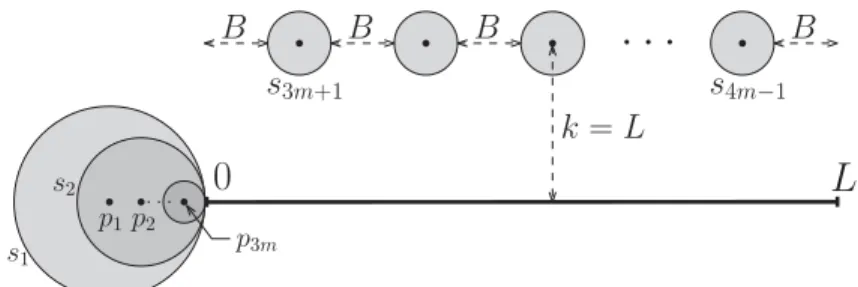
whether Σni=12ri ≥L. For the MinSum problem, it was shown in [CKK+10] that even if the initial positions of sensors are on the line containing the barrier, the problem is NP-complete; therefore the more general version of the problem studied here is clearly NP-complete. Recently, it was shown in [CGLW12] that if the initial positions of sensors are on the line containing the barrier, the MinMax problem is solvable in polynomial time. We proceed to study the complexity of the MinMax problem when initial positions of sensors can be anywhere on the plane, and the final positions can be anywhere on the barrier. See Figure 3.2 for an example of the initial placement of sensors.
Theorem 3.1. Consider an arrangement A = (S,{b}). Let S = {s1, s2, . . . , sn}
be a set of sensors of ranges r1, r2, . . . , rn initially located in the plane at positions
p1, p2, . . . , pn. Let the barrier b be a line segment between (0,0) and (L,0). Given an integer k, the problem of determining if there is a covering assignment such that the maximum relocation distance (Euclidean/rectilinear) of the sensors is at most k
is strongly NP-complete.
Proof. The problem is trivially in NP; we give here a reduction from the 3-partition problem [GJ90]. We are given a multiset A ={a1 ≥a2 ≥ · · · ≥a3m} of 3m positive integers such that B/4 < ai < B/2 for 1 ≤ i ≤ 3m and 3i=1m ai = mB for some B. The problem is to decide whetherA can be partitioned into m triples T1, T2, . . . , Tm
such that the sum of the numbers in each triple is equal toB. We create an instance of the barrier coverage problem as follows: LetL=mB+m−1, the barrierbbe a line segment from (0,0) to (L,0), and let k =L. Place a sensor si of range ai/2 at−ai/2 where 1≤i≤3m. In addition, place m−1 sensorss3m+1, s3m+2, . . . , s4m−1 of range 1/2 at positions (B+1/2, k),(2B+3/2, k),(3B+5/2, k), . . . ,((m−1)B+(2m−3)/2, k). See Figure 3.2 for an example. Since L = 4i=1m−12ri, all sensors must move to the barrier in any covering assignment. Observe that the distance from any of the m−1
sensors located above the barrier to the barrier is k, and when all of them move this distance, there are gaps of length B between these sensors on the barrier.
If there is a partition of S into m triples T1, T2, . . . , Tm, the sum of each triple being B, then there is a solution to the movement of the sensors such that the three sensors corresponding to triple Ti are moved to fill the ith gap in the barrier b. The maximal move of the three sensors corresponding to Ti into ith gap is at most L, and the maximum of the moves of all sensors is k in this case. If such a partition does not exist, then any covering assignment for the barrier b corresponds to moving at least one of the sensors above the x-axis by k+ 1 (rectilinear distance), and by
√
k2+ 1> k (Euclidean distance).
It remains to show that the transformation from the 3-partition problem to the sensor movement problem is polynomial. Since 3-partition is strongly NP-complete [GJ90], we may assume that the values a1, a2, . . . , a3m are bounded by a polynomial
c(3m)j for some constants cand j. The 3-partition problem can be represented using
O(mlogm) bits. Therefore, B ≤ c1mj and k ≤ c2mj+1 for some constants c1 and
c2. Our reduction uses n = 4m−1 sensors. In the corresponding barrier coverage problem we need O(nlogn) bits for the positions and sizes of sensors s1, s2, . . . , sn
and we needO(nlogn) bits to represent the position and size of each sensor of size 1. Thus we needO(nlogn) bits to represent the corresponding barrier coverage problem, which shows that the transformation is polynomial.
By adding one additional sensor at distance > k above the barrier, we can create an instance of the problem where 4i=1m−12ri > L, and the proof remains exactly the
same as that sensor cannot be involved in a covering assignment that has maximum relocation distance k.
Finally, it is straightforward to see that any given covering assignment can be verified in polynomial time, completing the proof of strong NP-completeness.
L
. . .0
B B B. . .
B k=L s3m+1 s4m−1 p1p2 p3m s1 s2Figure 3.2: Reduction from 3-partition to the MinMax problem
It is easy to see that when there are two barriers to be covered, even feasibility of coverage is NP-complete. This can be shown by reducing the Partition problem [GJ90] to an appropriate 2-barrier coverage problem, as in [CKK+09]. It follows that
k-barrier coverage is also NP-complete.
3.4
Perpendicular Movement: Parallel Barriers
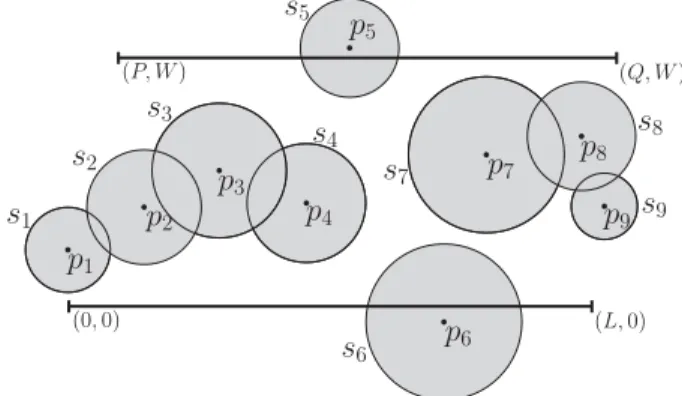
In this section, we assume that all sensors use only perpendicular movement to a barrier. Furthermore, in the case of several barriers, the barriers are parallel to each other. Figure 3.3 illustrates an example of such a problem. Without loss of generality, we assume barriers b1, b2, . . . , bk, k ≥1 are parallel to the x-axis. Thus, sensors may only move in a vertical direction. Let the set of n sensors s1, s2, . . . , sn be initially located at positions p1, p2, . . . , pn respectively, where pi = (xi, yi). We assume that the sensors are listed in the order of the leftmost x-coordinates they can cover, i.e.,
x1 −r1 ≤ x2 −r2 ≤ · · · ≤ xn−rn. For simplicity we assume all points of interest
(sensor locations, left/right endpoints of sensor ranges and barriers) are distinct. Since there are k barriers, there are up to k points on barriers with the same x -coordinate. We therefore speak of sensors beingcandidates forx-coordinates: a sensor
s in position p = (x, y) with sensing range r is a candidate sensor for x-coordinate
x if x−r ≤ x < x+r. Alternatively we say s potentially covers the x-coordinate
this definition simplifies our algorithms. Furthermore, for any intervalI on a barrier, we call it k-coverable iff for every point on I there are at least k distinct candidate sensors in S. We first consider the simpler case of k= 1.
3.4.1
One Barrier
Without loss of generality, let the barrierb =b1be the line segment between (0,0) and (L,0). Since they-coordinate of all points on the barrier are the same, we sometimes represent the barrier or a segment of the barrier by an interval of x-coordinates. For technical reasons, we denote the segment of the barrier between the points (i,0) and (j,0) by the half-open interval [i, j).
We first show a necessary and sufficient condition on the sensors for the barrier to be covered. We give a dynamic programming formulation for the MinSum problem. We denote the set of sensors{si, si+1, . . . , sn}bySi. If the barrier is an empty interval, then the cost is 0. If no sensor is a candidate for the left endpoint of the barrier, or if the sensor set is empty while the barrier is a non-empty interval, then clearly the problem is infeasible and the cost is infinity. If not, observe that the optimal solution to the MinSum problem either involves moving sensors1 to the barrier or it doesn’t. In the first case, the cost of the optimal solution is the sum of|y1|, the cost of moving the first sensor to the barrier, and the optimal cost of the subproblem of covering the interval [x1 +r1, L) with the remaining sensors S2 = S− {s1}. In the second case, the optimal solution is the optimal cost of covering the original interval [0, L) with