
Calhoun: The NPS Institutional Archive
Theses and Dissertations Thesis Collection
2013-09
Affine equivalence and con-structions of
cryptographically strong Boolean functions
Chung, Jong Ho.
Monterey, California: Naval Postgraduate School http://hdl.handle.net/10945/37602
MONTEREY, CALIFORNIA
DISSERTATION
AFFINE EQUIVALENCE AND CONSTRUCTIONS OF CRYPTOGRAPHICALLY STRONG BOOLEAN
FUNCTIONS by
September 2013
Dissertation Supervisor: Pantelimon Stanica
Approved for public release; distribution is unlimited Jong H. Chung
REPORT DOCUMENTATION PAGE Form Approved OMB No. 0704-0188
Public reporting burden for this collection of information is estimated to average 1 hour per response, including the time for reviewing instruction, searching existing data sources, gathering and maintaining the data needed, and completing and reviewing the collection of information. Send comments regarding this burden estimate or any other aspect of this collection of information, including suggestions for reducing this burden, to Washington headquarters Services, Directorate for Information Operations and Reports, 1215 Jefferson Davis Highway, Suite 1204, Arlington, VA 22202-4302, and to the Office of Management and Budget, Paperwork Reduction Project (0704-0188) Washington DC 20503.
1. AGENCY USE ONLY (Leave blank) 2. REPORT DATE
September 2013
3. REPORT TYPE AND DATES COVERED
Dissertation – Jan 09 - Sep 13
4. TITLE AND SUBTITLE: AFFINE EQUIVALENCE AND CON-STRUCTIONS OF CRYPTOGRAPHICALLY STRONG BOOLEAN FUNCTIONS
5. FUNDING NUMBERS
6. AUTHOR(S): Jong H. Chung
7. PERFORMING ORGANIZATION NAME(S) AND ADDRESS(ES)
Naval Postgraduate School Monterey, CA 94942-5000
8. PERFORMING ORGANIZATION REPORT NUMBER
9. SPONSORING/MONITORING AGENCY NAME(S) AND ADDRESS(ES) 10. SPONSORING/MONITORING AGENCY REPORT NUMBER
11. SUPPLEMENTARY NOTES: The views expressed in this thesis are those of the author and do not reflect the official policy or position of the Department of Defense or the U.S. Government. I.R.B. Protocol number N/A.
12a. DISTRIBUTION / AVAILABILITY STATEMENT
Approved for public release; distribution is unlimited
12b. DISTRIBUTION CODE
A
13. ABSTRACT (maximum 200 words)
In this thesis, we study a type of affine equivalence for the monomial rotation-symmetric (MRS) Boolean func-tions and two new construction techniques for cryptographic Boolean funcfunc-tions based on the affine equivalence of cryptographically strong base functions and fast Boolean operations. Affine equivalence of cryptographic Boolean functions presents a formidable challenge to researchers, due to its complexity and size of the search space. We focus on an affine equivalence based on permutation of variables for MRS Boolean functions and their relationship to circulant matrices over the binary fieldF2and regular graphs. We first establish a relationship between generalized
inverses of circulant matrices inF2and their generating polynomials. We then apply the relationship to gain insight
into necessary conditions for the affine equivalence, based on permutations of variables for MRS Boolean functions. We also propose a theoretical connection between regular graphs and MRS Boolean functions to further our study in affine equivalence. Finally, we present two constructions for Boolean functions with good cryptographic properties. The constructions take advantage of two affine-equivalent base functions with strong cryptographic properties. We analyze the cryptographic properties of the constructions and demonstrate an application with these base functions, called the hidden weighted-bit functions.
14. SUBJECT TERMS
Boolean Function, Cryptography, Affine Equivalence
15. NUMBER OF PAGES 175 16. PRICE CODE 17. SECURITY CLASSIFICATION OF REPORT Unclassified 18. SECURITY CLASSIFICATION OF THIS PAGE Unclassified 19. SECURITY CLASSIFICATION OF ABSTRACT Unclassified 20. LIMITATION OF ABSTRACT UU
NSN 7540-01-280-5500 Standard Form 298 (Rev. 2-89)
Approved for public release; distribution is unlimited
AFFINE EQUIVALENCE AND CONSTRUCTIONS OF CRYPTOGRAPHICALLY STRONG BOOLEAN FUNCTIONS
Jong H. Chung Major, United States Army
B.S. Applied Mathematics, University of California Los Angeles, Los Angeles, CA, 1996 M.S. Applied Mathematics, Georgia Institute of Technology, GA 2005
Submitted in partial fulfillment of the requirements for the degree of DOCTOR OF PHILOSOPHY IN
APPLIED MATHEMATICS from the
NAVAL POSTGRADUATE SCHOOL September 2013 Author: Jong Ho Chung Approved By: Pantelimon Stanica Professor
Department of Appl. Math. Dissertation Supervisor
Jon T. Butler
Distinguished Professor Department of Elec. and Comp. Eng.
David R. Canright Associate Professor
Department of Appl. Math.
Harold Fredricksen Professor Emeritus
Department of Appl. Math.
Ralucca Gera Associate Professor
Department of Appl. Math.
Craig W. Rasmussen Professor
Department of Appl. Math. Approved By:
Carlos F. Borges, Professor and Chair, Department of Appl. Math. Approved By:
ABSTRACT
In this thesis, we study a type of affine equivalence for the monomial rotation-symmetric (MRS) Boolean functions and two new construction techniques for cryptographic Boolean functions based on the affine equivalence of cryptographically strong base functions and fast Boolean operations. Affine equivalence of cryptographic Boolean functions presents a formidable challenge to researchers, due to its complexity and size of the search space. We focus on an affine equivalence based on permutation of variables for MRS Boolean functions and their relationship to circulant matrices over the binary field F2 and regular
graphs. We first establish a relationship between generalized inverses of circulant matri-ces inF2 and their generating polynomials. We then apply the relationship to gain insight
into necessary conditions for the affine equivalence, based on permutations of variables for MRS Boolean functions. We also propose a theoretical connection between regular graphs and MRS Boolean functions to further our study in affine equivalence. Finally, we present two constructions for Boolean functions with good cryptographic properties. The con-structions take advantage of two affine-equivalent base functions with strong cryptographic properties. We analyze the cryptographic properties of the constructions and demonstrate an application with these base functions, called the hidden weighted-bit functions.
TABLE OF CONTENTS
1. INTRODUCTION . . . 1
2. CHARACTERISTICS OF CRYPTOGRAPHIC BOOLEAN FUNCTIONS 7 2.1. Basic Definitions and Fundamental Properties . . . 7
2.2. Application of Cryptographic Boolean Functions . . . 17
2.2.1. Block Ciphers . . . 17
2.2.2. Stream Ciphers . . . 19
2.2.3. Hash Functions. . . 21
2.3. Cryptographic Characteristics of Boolean Functions . . . 22
2.3.1. Balancedness . . . 23
2.3.2. Algebraic Degree. . . 23
2.3.3. Nonlinearity . . . 23
2.3.4. Avalanche and Propagation Criteria . . . 25
2.3.4.1.Strict Avalanche Criterion (SAC) . . . 25
2.3.4.2.Propagation Criteria . . . 26
2.3.5. Global Avalanche Criterion (GAC) . . . 26
2.3.6. Correlation Immunity and Resilience . . . 27
2.3.7. Algebraic Immunity . . . 29
2.3.8. Normality . . . 30
2.4. Tradeoffs between Cryptographic Properties . . . 31
2.4.1. Correlation Immunity and Degree . . . 31
2.4.2. Correlation Immunity and Nonlinearity . . . 31
2.4.3. Algebraic Immunity and Nonlinearity . . . 32
3. AFFINE EQUIVALENCE OF MONOMIAL ROTATION-SYMMETRIC BOOLEAN FUNCTIONS . . . 33
3.1. Introduction . . . 33
3.2. Affine Equivalence of Boolean Functions . . . 35
3.3. Rotation-Symmetric Boolean Functions . . . 37
3.4. Circulant Matrices . . . 40
3.5. S-Equivalence of MRS Boolean Functions . . . 51
4. MRS BOOLEAN FUNCTIONS AND GRAPHS . . . 71
4.2. Example of Graph Representation of Boolean Functions. . . 71
4.2.1. Definitions and Fundamentals of a Graph . . . 71
4.2.2. An Example of Application of Graph Theory to Crypto-graphic Boolean Function . . . 73
4.3. A Graph Representation of Rotation-Symmetric Boolean Functions 74 5. TWO CONSTRUCTIONS OF BOOLEAN FUNCTIONS WITH GOOD CRYPTOGRAPHIC PROPERTIES . . . 99
5.1. Introduction . . . 99
5.2. Construction Techniques of Cryptographic Boolean Functions . . 99
5.2.1. Concatenation . . . 100
5.2.2. Kronecker Product . . . 102
5.2.3. Affine Operations . . . 103
5.3. Two Constructions to Address Security and Speed . . . 103
5.4. Cryptographic Properties of the Two Constructions . . . 107
6. AN APPLICATION OF THE TWO CONSTRUCTIONS . . . 127
6.1. Introduction . . . 127
6.2. Binary Decision Diagram (BDD) . . . 127
6.3. Hidden Weighted-Bit Function (HWBF) . . . 129
6.3.1. Definition of HWBF . . . 129
6.3.2. Affine Structure within HWBF . . . 130
6.3.3. Cryptographic Properties of HWBF . . . 132
6.4. Construction Based on HWBF . . . 133
7. CONCLUSION AND FUTURE RESEARCH . . . 143
7.1. Conclusion . . . 143
7.2. Future Work . . . 144
LIST OF REFERENCES . . . 147
LIST OF FIGURES
Figure 1.1. Data Encryption Standard (DES) Diagram From [2] . . . 3
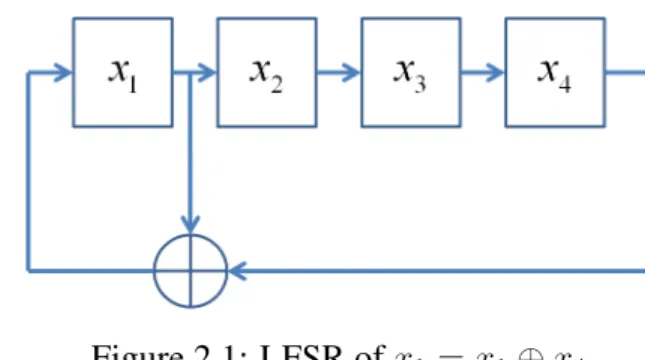
Figure 2.1. LFSR ofx1 =x1 ⊕x4 . . . 19
Figure 2.2. Nonlinear Filter . . . 20
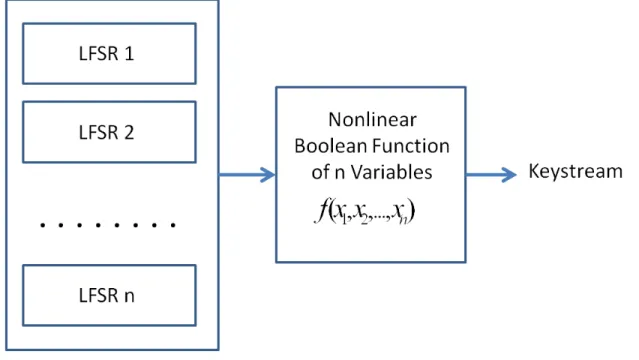
Figure 2.3. Nonlinear Combiner . . . 21
Figure 4.1. Simple Graphs . . . 73
Figure 4.2. Cayley Graph Classes of4-Variable Boolean Function From [64] . . . 76
Figure 4.3. A Cycle Combination of an MRS Boolean Function . . . 77
Figure 4.4. Two Graphs Generated by the Same SANF . . . 78
Figure 4.5. Isomorphic Cycle Combination Graph Classesn = 2to5 . . . 83
Figure 4.6. Cycle Combination Graphsn= 6 . . . 85
Figure 4.7. An Impossible CCGn= 6 . . . 86
Figure 4.8. CCG off =x1x3x6x9(OSAN F) . . . 96
Figure 6.1. A Tree Representation off . . . 128
LIST OF TABLES
Table 2.1. Binary Operation XOR . . . 7
Table 2.2. Binary Operation· . . . 7
Table 2.3. Various Representation of a Boolean functionf(x) . . . 12
Table 2.4. 1stS-box of DES in Decimal From [4, p. 170] . . . 18
Table 2.5. 1stS-box of DES in Binary . . . 18
Table 2.6. Boolean Function Representation of the First Row of the FirstS-box of DES . . . 18
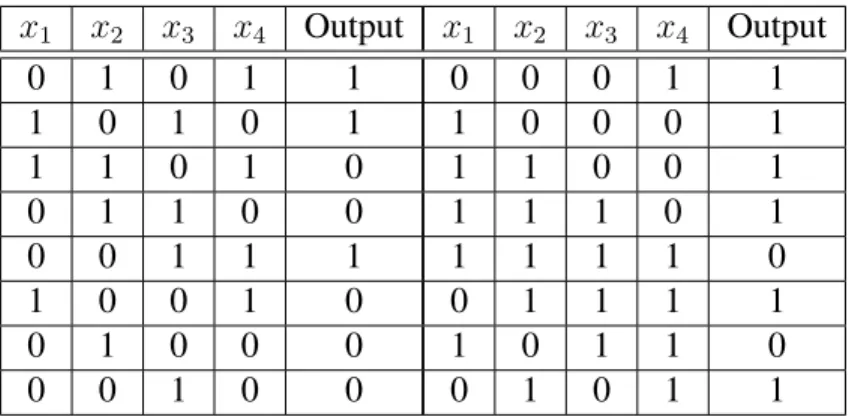
Table 2.7. Bit Stream Generated by LFSR of x1 = x1 ⊕x4 with Initial Vector 0101 . . . 20
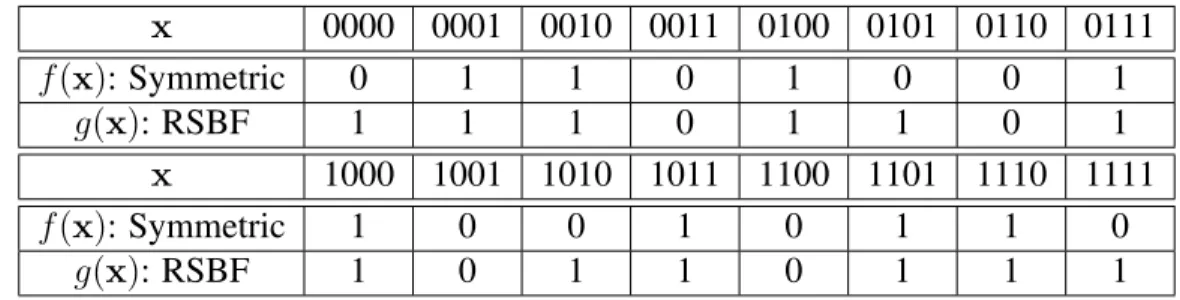
Table 2.8. Comparison of a Symmetric and Rotation-Symmetric Boolean Function 22 Table 2.9. A 3-variable Function Which Satisfies the SAC . . . 26
Table 2.10. A three-variable function with CI(1) . . . 29
Table 3.1. Affine Equivalence Classes inBn . . . 34
Table 4.1. Affine Equivalence Classes of 4-Variable Boolean Functions From [64] . . . 75
Table 4.2. Vertex Structure of a Cycle Combination Graph of a MRS Function . 79 Table 4.3. Vertex 1 and its Neighbors . . . 80
Table 4.4. 2dNeighbors of Arbitrary Vertexm . . . 81
Table 5.1. Truth Table off andg . . . 101
Table 5.2. Truth Table ofh=f kg . . . 101
Table 6.1. Truth Table of a Boolean Functionf From [102, p. 205] . . . 128
Table 6.2. A HWBF withn = 4 . . . 130
Table 6.3. Hidden Weighted-Bit Functions . . . 131
Table 6.4. Algebraic immunity and nonlinearity of the HWBF-basedf and the HWBFhFrom [27] . . . 141
Table 6.5. Behavior of the HWBF-based functionf against Fast Algebraic At-tacks From [27] . . . 141
LIST OF ACRONYMS AND ABBREVIATIONS
AES Advanced Encryption Standard
ANF Algebraic Normal Form
BDD Binary Decision Diagram
CDMA Code Division Multiple Access DES Data Encryption Standard GAC Global Avalanche Criterion
GSM Global Systems for Mobile Communications HWBF Hidden Weighted-Bit Function
LFSR Linear Feedback Shift Register
MRS Monomial Rotation Symmetric
OSANF Ordered Short Algebraic Normal Form PRBG Pseudo-Random Bit Generator
RSA Ron Rivest, Adi Shamir, Leonard Adleman SAC Strict Avalanche Criterion
SANF Short Algebraic Normal Form
S-box Substitution Box
SPN Substitution Permutation Network XOR Exclusive OR (logical operation)
ACKNOWLEDGEMENTS
I thank God for leading me through my life. I feel very blessed.
I thank the National Security Agency for the scholarship, which made this journey possible. I also thank the U.S. Army for allowing me to take part in this opportunity.
I express my gratitude to the PhD committee members. I want to thank my advisor Pro-fessor Stanica for teaching me everything I know about Boolean functions, inspiring me in the research, being patient, and being a good friend. I would not have been able to do this without all the visits to his office. I want to thank Professor Fredricksen for showing me the light in discrete mathematics, being a wise mentor, and occasionally challenging me with hard but engrossing problems that developed my skills. Working on the problems kept me going in tough times. I want to thank Professor Owen for leading me through the most fundamental math in research, Professor Gera for being an excellent teacher and helping me develop clearer vision in graph theory, Professor Canright for helping me better understand the fundamentals of cryptography. I want to thank Professor Butler for show-ing me how to navigate the complicated world of parallel computshow-ing. I thank Professor Rasmussen for being someone to talk to when I needed and helping me understand the academics at the Naval Postgraduate School. I also want to acknowledge professors Carlos Borges, Frank Giraldo, Wei Kang, and Clyde Scandrett for sound guidance and encourag-ing words. Numerous other faculty members here at NPS have also helped me overcome various stumbling blocks along the way to this dissertation. Thank you.
I thank my peers and the students at the math department and the post-docs for meaningful conversations, friendship and support. Special thanks to doctors Cesar Aguilar and Eric Choate for sharing their experience and technical expertise.
Finally, I thank my family for accompanying me for the long, adventurous journey. I thank my son, Joseph Minwoo, for all the wonderful things that he is. I thank my wife, Eun Ha, for her prayers, spiritual guidance for the family, and being a wonderful mom and a faithful wife.
1.
INTRODUCTION
As we connect to the Internet with increasing frequency for various services, the need for secure communication is higher than ever before. The ability to email or socialize electronically with the world in a secure and stable manner is crucial for today’s global citizen. We want our financial transactions over the Internet to get processed without error. Cyber warfare between nations and industrial espionage among corporations are common-place. A nation’s infrastructure networks need impregnable protection. We are living in a fast moving, networked world, and any compromised or misintended information may result in catastrophic consequences. It is therefore a paramount requirement of every elec-tronic communications network system that it provide every authorized user.
Due to the Internet revolution, the application of cryptography is no longer limited to corporations or government agencies. Any entity on the Internet has the need to protect information in storage and data in transit to another part of the network. This protection, attained via complex (mostly mathematical) schemes called cryptosystems, is an integral part of any reliable network service. At the heart of every cryptosystem is a cipher. A cipher is a set of algorithms used to encrypt and decrypt a message. An encrypted message in any language is called ciphertext, and an unencrypted message is called plaintext. In general, there are two types of cryptosystems; asymmetric and symmetric. The security of a modern electronic cipher often depends on secret keys that are essential for encryption and decryption processes. An asymmetric cipher uses different keys to encrypt and decrypt a message, and the connection between the encryption and decryption keys is based upon a known (and well studied) mathematical problem. RSA (the initials of the surnames of its designers, Ron Rivest, Adi Shamir and Leonard Adleman) is a well known asymmetric cipher. Compared to symmetric ciphers, asymmetric ciphers are generally slow. However, asymmetric ciphers have added more functionality, such as message authentication and digital signature and are more efficient in secret-key management, since they require fewer secret keys. A symmetric cipher uses the same secret key to encrypt and decrypt a message.
It is faster than asymmetric cipher, but requires more secret keys, since each pair of users on the network needs to have a unique key. This makes secret-key management a difficult task. Depending on how a symmetric cipher processes a message before encryption or de-cryption, a symmetric cipher can be further classified into a block or stream cipher. A block cipher breaks down a message into 64, 128, 192 or 256 binary bit blocks and encrypts the message by blocks. The decryption of a block cipher is usually accomplished by revers-ing the encryption process. Data Encryption Standard (DES) and Advanced Encryption Standard (AES) are well known examples of block ciphers. On the other hand, a stream cipher encrypts and decrypts a bit at a time. For example, GSM (Global System for Mobile Communications), a wireless communications protocol, uses a stream cipher called A5/1.
The subject of this thesis, cryptographic Boolean functions, applies to both ciphers — asymmetric and symmetric. Boolean functions can be key components to hashing al-gorithms of asymmetric ciphers. Cryptographic Boolean functions can also be an element for block cipher design and analysis. A good illustration of this is DES. Figure 1.1 shows the DES encryption process. Despite all the seemingly complex procedures and diagrams, the only nonlinear component in DES is the substitution process in the functionf, which uses a lookup table called substitution box or S-box to simply shuffle data. Surprisingly, in DES, the S-boxes are the only component that integrates significant complexity to the cipher. TheS-box is the keystone of the security of DES. The same is true for AES. It is possible to analyze anS-box with cryptographic Boolean functions and measure the secu-rity of a block cipher against known attacks. We can also design another set ofS-boxes for DES, which optimizes certain cryptographic properties of Boolean functions [1].
The two important qualities of a cipher are security and speed. They often con-flict with each other and affect the decision to choose the optimum cryptographic Boolean functions for a cipher. The two broad topics of this thesis are the affine equivalence and construction of Boolean functions with good cryptographic properties. A cryptographic Boolean function ofnvariables takes anndimensional Boolean vector and maps it to0or
Figure 1.1: Data Encryption Standard (DES) Diagram From [2]
a set of affine transformations. By reflexivity, symmetry, and transitivity, the affine equiv-alence is an equivequiv-alence relation. Therefore, it partitions any set of Boolean functions into equivalence classes. A cryptanalyst can take advantage of the partitioning to devise an ef-ficient algorithm to test the security of a cipher. He needs only to consider the equivalence classes instead of all possible Boolean functions for the cipher, since affine transformations preserve many of the cryptographic properties. On the other hand, cryptographic engineers can integrate affine equivalent functions with good cryptographic properties for speed and simplicity. For example, instead of using the same function, they may use affine equiva-lence classes of the function to increase security. They can also avoid the equivaequiva-lence class of a cryptographically weak function, since they are inherently a security risk. Affine equiv-alence is notoriously complex and often requires unrealistic computing resources. In this thesis, we focus on an affine equivalence of monomial rotation-symmetric (MRS) Boolean functions. A rotation-symmetric Boolean function (RSBF) is a Boolean function such that a Boolean vector and its rotation equivalents render the same function value. For example, if a Boolean functionf(x)is a RSBF of three variables x = (x1, x2, x3), then the vector
(0,0,1)and its rotation equivalents(1,0,0)and(0,1,0)have the same function value. In other words, f((0,0,1)) = f((0,0,1)) = f((0,0,1)). RSBFs are well known for their speed [3], and some cryptographically strong Boolean functions are rotation symmetric. An MRS Boolean function is a special type of RSBF, which we formally define in Chapter 4. Construction techniques of cryptographic Boolean functions may be less relevant to the ciphers, such as DES and AES, since they use key-invariant S-boxes. However, ciphers such as BLOWFISH and TWOFISH use key-dependent S-boxes. Efficient construction techniques for S-boxes can be a crucial part of the ciphers with dynamic S-boxes. We study two techniques using affine equivalence of cryptographically strong base functions and two simple Boolean operations, concatenation and complementation. These construc-tions provide the flexibility to choose a customized base function with good cryptographic properties, as well as speed due to the simplicity of the Boolean operations. We also present an application of our methods, using the hidden weighted-bit function, which is resistant to a binary decision diagram (BDD)-related attack.
The rest of the dissertation is outlined as follows.
In Chapter 2, we formally define basic terminology and principles of cryptographic Boolean functions. We illustrate applications of cryptographic Boolean functions and re-view common cryptographic properties.
In Chapter 3, we delve into circulant matrices and introduce some results regarding the general inverse of circulant matrices. We study a necessary condition for an affine equivalence based on a permutation of input variables for MRS Boolean functions.
In Chapter 4, we study the relationship between MRS Boolean functions and regular graphs. We establish a basic relationship and suggest other possibilities.
In Chapter 5, we study two different ways to construct Boolean functions with good cryptographic properties via affine transformation, concatenations, and complementations of cryptographically strong base functions.
In Chapter 6, we briefly introduce BDD and cryptanalysis based on its properties. We present an application based on hidden weighted-bit function for our construction meth-ods. We analyze cryptographic properties of these constructions.
In Chapter 7, we summarize and reflect on the main contribution of this thesis. We also suggest some ideas for future research.
2.
CHARACTERISTICS OF CRYPTOGRAPHIC BOOLEAN
FUNCTIONS
2.1. BASIC DEFINITIONS AND FUNDAMENTAL PROPERTIES
First, we introduce a commutative binary operation, “exclusive-or” or XOR, de-noted by “L
” over the set{0, 1}. The Table 2.1 shows the truth table for the XOR opera-tion.
L
0 1
0 0 1
1 1 0
Table 2.1: Binary Operation XOR
We also define a multiplication in{0,1}in the usual way. This operation is equiva-lent to logical “AND” operation. The Table 2.2 shows the truth table for the multiplication operation.
· 0 1
0 0 0
1 0 1
Table 2.2: Binary Operation·
We note that{0, 1}with⊕and·forms the smallest Galois field.
Definition 2.1.1. Let the set{0,1} with the XOR operation and the usual multiplication be thebinaryorBoolean field,denoted byF2. The set ofn-tuples(x1, x2, . . . , xn), denoted
byFn2 wherexi ∈F2with1≤i≤nis anndimensional vector space overF2.
We use the terms Boolean vectors and Boolean strings interchangeably. The Boolean vector space has many common properties of other vector spaces, such asRnandCn.
Definition 2.1.2. We define a Boolean functionf ofnvariables as a mapping
f : Fn2 −→F2.
A Boolean functionf takes anndimensional vector of 1’s and 0’s as input, and returns 1 or 0 as the function value. We denote the set of all Boolean functions of all variables asB, and the set of allnvariable Boolean functions asBn. We use the terms “Boolean function
ofnvariables” and “Boolean function” interchangeably.
By applying the product rule of combinatorics, we observe that the domain of
f ∈ Bn has cardinality 2n. We usually order the domain in a lexicographical order. We
distinguish two types of lexicographical ordering, depending on how the elements of the vector domain are ordered. One is thebackward ordering, where we order the components of the vector xsuch that x = (xn, xn−1, . . . , x2, x1). Therefore, the domain vectors are
lexicographically ordered such that (0,0, . . . ,0,0), (0,0, . . . ,0,1),...,(1,1, . . . ,1,1). The other is the forward ordering, where we order the components of the vector xsuch that
x = (x1, x2, . . . , xn−1, xn). Therefore, the domain vectors are lexicographically ordered
such that(0,0, . . . ,0,0), (1,0, . . . ,0,0),...,(1,1, . . . ,1,1). When we say “lexicographical order”, we mean the backward ordering, unless stated otherwise. For convenience, we regard the vectors as row vectors and use forward ordering unless stated otherwise.
The most popular way to define a Boolean function of n variable is to list the function values as they match the lexicographically ordered domain, which results in a
2ndimensional Boolean vector or string. The first column of Table 2.3 depicts a Boolean
function of3variables,f(x)with its truthtable10011101.
Remark 2.1.3. For convenience, we note thatf means the truth table representation of a Boolean functionf, andf(x)means the function value at the particular vectorx.
We observe that f¯merely flips or changes the function values of f. That is, if
f(x) = 1, thenf¯(x) = 0, and iff(x) = 0, thenf¯(x) = 1. The complement of the function
on Table 2.3 is01100010.
Lemma 2.1.5. f ⊕f =0, andf ⊕f¯=1where0= (0,0, . . . ,0)and1= (1,1, . . . ,1). Remark 2.1.6. For convenience, we use string and vector notations interchangeably in this thesis. For example,10011101 = (1,0,0,1,1,1,0,1).
By the product rule of combinatorics, there are22nBoolean functions ofnvariables. Another operation commonly used inFn
2 is concatenation.
Definition 2.1.7. Given two Boolean vectors, f = a1a2. . . am and g = b1b2. . . bn with
ai, bj ∈F2 andmandninN, the concatenation off andg, denoted byf kg, is anm+n
vector obtained by simply combining the elements off andgin order. That is,
f kg =a1a2. . . amb1b2. . . bn.
Example 2.1.8. Table 2.3 shows the various expression of a Boolean function. It is inter-esting to note thatf = 1001k1101, where1001, 1101∈ B2andf ∈ B3.
Another way to express the truth table is to take −1to the power of the function value. This set up gives us more options to aggregate some Boolean measures inR. Definition 2.1.9. Given the truth table of a Boolean functionf(x), we define the character form or sign function [4, p. 6] off(x), denoted byfˆ(x)
ˆ
f(x) = (−1)f(x).
It is clear thatfˆ(x)∈ {−1, 1}, and alsofˆ(x) = 1−2·f(x).
The second column of Table 2.3 depicts a Boolean function of 3 variables f(x), as−1,1,1,−1,−1,−1,1,−1in sign function. The next lemma describes the relationship between the truth table and the sign function.
Lemma 2.1.10. [4, p. 6]Iff, g∈ Bnandh=f ⊕g, thenˆh= ˆfgˆ.
We call a multiplication term of Boolean variables, regardless of the power of each variable, a monomial. For example, x1 · x02 ·x3 = x1x3 is a monomial. Given x =
(xn, . . . , x1)withxi ={0, 1}and1≤i≤n, we observe that
(xi)k=xi·xi·. . .·xi =xi,
fork ∈N. We can write a polynomial-like expression for Boolean functions, using mono-mials and⊕. When we list the all the possible monomials in lexicographical order, we can regard the set of all the Boolean functions ofnvariables as the set of the all possible XOR-combinations ofnvariable monomials. We can also assign a unique2ndimensional vector overF2 to all possible monomials to write an XOR combination ofn variable monomials
in the following way.
Definition 2.1.11. The algebraic normal form (ANF) of a Boolean function f(x) is an XOR sum of monomials such that
f(x) = j=2n M a∈Fn2 j=1 cj ·xa11x a2 2 · · ·x an n ,
where a = (a1, a2, . . . an), c = (c1, c2, . . . , c2n), and ai, cj ∈ F2 for i = 1,2, . . . , orn
andj = 1,2, . . . , or2n.
Example 2.1.12. The expression below illustrates the ANF of f(x)below. Typically, we order the vector alexicographically and obtain binary stringf(x) = 0001000000001000
f(x) = x1x2 ⊕x3x4
= 0·x01x02x03x04⊕0·x11x02x03x04⊕0·x01x21x03x04⊕1·x11x12x03x04⊕0·x01x02x13x04⊕ · · ·
· · · ⊕1·x01x02x13x14⊕. . .⊕0·x11x12x13x04⊕0·x11x12x13x14.
We also note that the ANF of a Boolean function is unique.
A Boolean function may be better understood with one expression type off(x) than an-other. We transform an ANF of a Boolean function f(x) to the truth table of f(x) by simply evaluating the function value with the ANF. We can transform a truth table in Table 2.3 into an ANF expression by adding the monomials derived by the input valuesxsuch
thatf(x) = 1. We demonstrate this process in the next example.
Example 2.1.13. The truth table of the Boolean function,f(x)on Table 2.3 is 10100111, wheref(000) = f(010) = f(101) = f(110) = f(111) = 1. We construct each term to ensure thatf(x) = 1 wheneverx happens to be one of the vectors listed. For example, sincef(011) = 1, we want to have the termx1x2(x3⊕1)forx1 = 1, x2 = 1, x3 = 0. And
we apply this to eachxwithf(x) = 1to obtain
f(x) = (x3⊕1)(x2⊕1)(x1⊕1)⊕(x3⊕1)x2x1⊕x3(x2⊕1)x1
⊕x3x2(x1 ⊕1)⊕x3x2x1
n = 3 f(x) fˆ(x) AN F(f(x)) 000 1 -1 1 001 0 1 1 010 0 1 1 011 1 -1 0 100 1 -1 0 101 1 -1 1 110 0 1 0 111 1 -1 1
Table 2.3: Various Representation of a Boolean functionf(x)
There is a more efficient way to construct the ANF from the truth table (and vice versa), calledtranseunt triangle, and we refer to [5].
Definition 2.1.14. The ANF of a Boolean function gives us some important measures on the function. In an ANF, the number of variables in the highest-order monomial with nonzero coefficient is called the degree of the Boolean function. A Boolean function is homogeneousif all its ANF terms have the same degree. A Boolean function is nonhomo-geneousif it is nothomogeneous.
Example 2.1.15. The function in Example 2.1.12 is a homogeneous Boolean function with degree 2, whereas the function below is anonhomogeneousBoolean function with degree 5.
f(x) =x1x2⊕x1x2x3x4x5.
The degree of a Boolean function is one of the most important cryptographic proper-ties in a cipher. We discuss the cryptographic implications of the degree in the next section. A Boolean function of degree “at most, one” is anaffinefunction. An affine function with the constant term equal to zero is called a linearfunction. The set of alln variable affine (respectively linear) functions is denoted byAn(respectivelyLn).
Letf ∈ BnandEbe any flat (that is, a coset of a vector subspace). If the restriction
f|E of f to E is constant (respectively affine), then E is called a constant (respectively
Let
1f ={x∈Fn2|f(x) = 1}
be the support of a Boolean functionf. We define the complement of the support
0f ={x∈Fn2|f(x) = 0}.
We also note the usual dot-product operation of two vectors in the context of Boolean vectors. Let x = (xn, . . . , x1)and w = (wn, . . . , w1)both belonging to Fn2 and x·w =
xnwn⊕. . .⊕x1w1.
Definition 2.1.16. The number of 1’s in a binary string or vectorxdenoted by wt(x), is called theHamming weight.
We can apply the same idea to the truth table of a Boolean functionf. The Ham-ming weight off is the Hamming weight of the truth table of f. The Hamming weight of the Boolean function on Table 2.3 is 5. We also observe that the cardinality of 1f is the
Hamming weight off. Lemma 2.1.17. Givenf ∈ Bn, wt(f) = X x∈Fn2 f(x) = 2n− X x∈Fn2 ˆ f(x) .
Definition 2.1.18. Given two binary vectors (or strings) of same length,x= (x1, x2, . . . xn)
andy= (y1, y2, . . . yn). TheHamming distance, denoted byd(x,y),between the two
vec-tors is the number of indices where they have different binary values.
For example, ifx= (0,1,0,0,0,0,0) andy= (1,1,1,1,1,1,0),d(x,y) = 5since the elements ofxandyare different in the indices 1, 3, 4, 5, 6.
Lemma 2.1.19. Given two Boolean functions of n variables f = x1, x2, . . . xk and g =
Lemma 2.1.20. For two Boolean functionsf andg,
d(f, g) = 2n−1− 1
2 ˆ f·ˆg.
Next, we introduce an important measure of Boolean functions.
Definition 2.1.21. [4, p. 7] Given a Boolean function f, the Walsh transform of f on a vectorwis an integer value function defined by
W(f)(w) = X
x∈Fn
2
f(x)(−1)w·x.
We can recoverf by the inverse Walsh transform,
f(x) = 1 2n
X
x∈Fn2
W(f)(w)(−1)w·x.
Another way to measure a Boolean function is the Walsh transform offˆonw, denoted by
Wf(w). We refer to it as the Walsh–Hadamard transform off(x).
Wf(w) = X x∈Fn2 ˆ f(x)(−1)w·x = X x∈Fn2 (−1)f(x)+w·x
The Walsh transform of f on w essentially measures the Hamming distance be-tweenf and the linear function defined by the vectorw, which is
w·x=w1x1 ⊕w2x2⊕ · · · ⊕wnxn.
Next, we discuss a concept analogous to a “directional derivative” [4, p. 38]. Given a Boolean functionf(x)and an arbitrary vectoru, we can consider a measure onf(x)with respect to a vectoru.
Definition 2.1.22. Given a Boolean functionf, the derivative off with respect to a vector
u, denoted byDuf, is defined by
Duf =f(x)⊕f(x⊕u).
If f(x) = f(x⊕u), Duf = 0. If f(x) 6= f(x⊕ u), Duf = 1. Therefore, P
x∈Fn2
Duf(x)counts the number of input values in which function values change when the
change in direction of uis applied. We can apply the same idea to fˆand obtain Dufˆ=
ˆ
f(x) ˆf(x⊕u), so thatDufˆ∈ {−1, 1}. When we aggregateDufˆover x ∈ Fn2, we have
the following definition for measuring how sensitive a Boolean function is in the domain. Definition 2.1.23. [4, p. 8] Theautocorrelation functionoff ∈ Bnwith respect tou∈Fn2,
denotedCf(u)is defined by Cfˆ(u) = X x∈Fn2 ˆ f(x)·fˆ(x⊕u) = X x∈Fn2 (−1)f(x)⊕f(x⊕u). We note thatCfˆ(0) = 2n.
The autocorrelation function measures the overall change offas a result of the shift or change caused by a vectoruin the domain. We argue that if the overall change is half of2n, the statistical impact of the shift ofu is zero. This notion gives us a cryptographic
property called the strict avalanche criterion (SAC), a concept invented by Webster and Tavares and published inCrypto 85, which we elaborate in the next section. We can apply
a similar idea to the autocorrelation function of two Boolean functions and measure how they are related to each other with respect to a vector.
Definition 2.1.24. [4, p. 8] The correlation between two Boolean functions f and g is defined by
C(f, g) = 1− d(f, g)
2n−1 .
The correlation function between f and g with respect to u ∈ Fn
2 is an integer
valued function defined by
C( ˆf, ˆg)(u) = X
x∈Fn
2 ˆ
f(x)ˆg(x⊕u).
S-boxes of block ciphers may employ multiple cryptographic Boolean functions. We want to reduce the correlation between functions as well as the autocorrelation function values of each function used, to minimize the risk of a correlation attack.
The concept of a derivative gives us another interesting measure of a cryptographic function, namelylinear structure.
Definition 2.1.25. [6], [7] If the derivative of f ∈ Bn in respect to the u ∈ Fn2, Duf is constant, thenuis a linear structure of f. If the linear structures of f form a subspace in Fn2, we call this subspace alinear spaceoff.
Depending on the constant derivative, we can further classify a linear structure u
into two types0−linear structure, denoted byLS0(f)ifDuf = 0, and1−linear structure, denoted byLS1(f)ifDuf = 1.
Theorem 2.1.26. [8]IfLS1(f)6=φ, the dimension of the entire linear space off is equal
to
In [9], the concept of linear structure was used to show that the strict avalanche criterion is local in the sense of a derivative, and may not be enough to protect a block cipher from a statistical attack.
2.2. APPLICATION OF CRYPTOGRAPHIC BOOLEAN FUNCTIONS
In this section, we briefly comment on some applications of cryptographic Boolean functions. Boolean functions are typically used for the construction ofS-boxes for block ciphers, nonlinear filters for a linear-feedback shift register (LFSR), nonlinear combiners for multiple LFSRs in a stream cipher, or hashing functions in an asymmetric cipher.
2.2.1. Block Ciphers
A block cipher breaks down the text into blocks of some size, and enciphers and de-ciphers it block by block. Boolean functions play a crucial role in analyzing and designing block ciphers. The two prominent techniques to design a block cipher are Feistel ciphers and substitution permutation networks (SPNs). Regardless of the scheme, it uses substitu-tion boxes orS-boxes. For example, DES uses eight fixedS-boxes, which convert a six-bit input string to a four-bit string. Table 2.4 shows the first S-box of DES, which consists of four lookup tables numbered 0 through 15. Each row can be represented by a vecto-rial Boolean function, F(x) : F42 → F4
2, which can be composed with four four-variable
Boolean functions. Each function takes a six-bit string and extracts the first and the last bit to determine which row of the table to use. Then, the middle four bits process through the vectorial function to output the substitution value. Table 2.5 shows the Boolean represen-tation of the first S-box, and Table 2.6 lists the four cryptographic Boolean functions for the first row of the firstS-box.
Typically,S-boxes are the only nonlinear features in a block cipher. Without non-linearS-boxes, almost all block ciphers could be solved with little effort. Therefore, when designing an S-box for a block cipher, we must consider known relevant cryptographic characteristics ofS-boxes to optimize their security. In [1], a complete set of replacement
Row\Col 0 1 2 3 4 5 6 7 8 9 10 11 12 13 14 15
0 14 4 13 1 2 15 11 8 3 10 6 12 5 9 0 7
1 0 15 7 4 14 2 13 1 10 6 12 11 9 5 3 8
2 4 1 14 8 13 6 2 11 15 12 9 7 3 10 5 0
3 15 12 8 2 4 9 1 7 5 11 3 14 10 0 6 13
Table 2.4: 1stS-box of DES in Decimal From [4, p. 170] Row\Col 0000 0001 0010 0011 0100 0101 0110 0111 00 1110 0100 1101 0001 0010 1111 1011 1000 01 0000 1111 0111 0100 1110 0010 1101 0001 10 0100 0001 1110 1000 1101 0110 0010 1011 11 1111 1100 1000 0010 0100 1001 0001 0111 Row\Col 1000 1001 1010 1011 1100 1101 1110 1111 00 0011 1010 0110 1100 0101 1001 0000 0111 01 1010 0110 1100 1011 1001 0101 0011 1000 10 1111 1100 1001 0111 0011 1010 0101 0000 11 0101 1011 0011 1110 1010 0000 0110 1101
Table 2.5: 1stS-box of DES in Binary
Col Boolean Function (ANF and Truth Table)
1 1⊕x1⊕x3⊕x4⊕x2x3⊕x3x4⊕x1x2x3⊕x2x3x4 1010011101010100 2 1⊕x3⊕x4⊕x1x2⊕x1x3⊕x2x4⊕x1x2x4 1110010000111001 3 1⊕x1⊕x2⊕x1x2⊕x1x3⊕x2x3⊕x1x4 ⊕x2x4⊕x3x4⊕x1x3x4⊕x2x3x4 1000111011100001 4 x2⊕x4⊕x1x3⊕x1x4⊕x1x2x4 0011011010001101
Table 2.6: Boolean Function Representation of the First Row of the FirstS-box of DES
TheS-boxes in DES are predetermined and typically implemented as a lookup table for simplicity. However, block ciphers, such as BLOWFISH [10] and TWOFISH [11], do not use fixed lookup tables (S-boxes), since they generate S-boxes from the key for each session.
2.2.2. Stream Ciphers
A stream cipher encrypts a plaintext bit by bit with secret-key stream bits. In gen-eral, an XOR operation of a plaintext bit and secret-key stream bit results in a ciphertext bit. A stream cipher integrates pseudo-random bit generators (PRBG) to produce a key stream. In electronic circuits, a shift resister is a sequential logic circuit for storage of binary data. It is set up in a linear fashion such that the stored data is shifted to a predetermined direction when the circuit is on. A linear-feedback shift register (LFSR) is a shift register which takes the output of a linear function of two or more bits from its previous state [4, p. 19]. We assume an LFSR has n ≥ 1variables. Table 2.7 shows the LFSR sequence generated by the Boolean function of4variables,x1⊕x4 with the initial vectorx=x1x2x3x4 = 0101.
For example, from the initial vector,x1 = 0andx4 = 1. Therefore,x1⊕x4 = 0⊕1 = 1.
This feedback sets the nextx1 = 1, and the previousx1,x2, andx3 shift tox2,x3, andx4,
respectively, which sets the next state,x= x1x2x3x4 = 1010. It repeats this process until
the LFSR obtains the initial vector again. The number of steps needed to reach the initial vector is called the cycle of an LFSR. We note that the LFSR on Table 2.7 has a cycle of
24−1 = 15, which is the maximum cycle possible.
Figure 2.1: LFSR ofx1 =x1⊕x4
We can integrate a nonlinear filter or an n variable Boolean function with good cryptographic properties to generate secure key streams.
One way to construct a PRBG is to combine LFSRs and cryptographic Boolean functions. We consider two applications of cryptographic Boolean functions in stream ciphers: a nonlinear filter and a nonlinear combiner. In the nonlinear filter setup, an LFSR and a cryptographic Boolean function as a nonlinear filter can generate a secret-key stream.
x1 x2 x3 x4 Output 0 1 0 1 1 1 0 1 0 1 1 1 0 1 0 0 1 1 0 0 0 0 1 1 1 1 0 0 1 0 0 1 0 0 0 0 0 1 0 0 x1 x2 x3 x4 Output 0 0 0 1 1 1 0 0 0 1 1 1 0 0 1 1 1 1 0 1 1 1 1 1 0 0 1 1 1 1 1 0 1 1 0 0 1 0 1 1
Table 2.7: Bit Stream Generated by LFSR ofx1 =x1⊕x4with Initial Vector 0101
As the LFSR shifts through the states, the nonlinear filter processesnvariables from each state and outputs a key bit. Table 2.2 illustrates this process.
Figure 2.2: Nonlinear Filter
Turing is a stream cipher developed for CDMA (Code Division Multiple Access), which is a wireless communication protocol developed by Qualcomm [12]. Turing gener-ates 160 bits of output in each round by applying a nonlinear filter to the internal state of an LFSR [13]. In the nonlinear combiner setup, ann variable Boolean function with good
cryptographic properties takes n output bits, each from n distinct LFSRs, and outputs a secret stream bit. Figure 2.3 illustrates a nonlinear combiner ofn LFSRs. An example for this setup is A5/2, which is the stream cipher used to encrypt voice transmissions in the GSM cellular telephone network. A5/2 is based on four LFSRs and a nonlinear combiner.
Figure 2.3: Nonlinear Combiner
2.2.3. Hash Functions
Some secure communications protocols and asymmetric ciphers use hash functions to ensure authenticity, integrity, and nonrepudiation of a message. A hashing function can be integrated into a secure communication system to detect an unauthorized modification or tampering. Secure email systems can employ a digital-signature scheme that uses hashing functions to ensure the reliability of a message. Since a hashing function does not require a decryption or recovery of the original message, in a software-based implementation we can use a fast Boolean function with good cryptographic properties. Some candidates for this purpose are symmetric and rotation-symmetric Boolean functions, since we can evaluate them faster due to their simple structures. A Boolean function is symmetric if vectors with
x 0000 0001 0010 0011 0100 0101 0110 0111 f(x): Symmetric 0 1 1 0 1 0 0 1 g(x): RSBF 1 1 1 0 1 1 0 1 x 1000 1001 1010 1011 1100 1101 1110 1111 f(x): Symmetric 1 0 0 1 0 1 1 0 g(x): RSBF 1 0 1 1 0 1 1 1
Table 2.8: Comparison of a Symmetric and Rotation-Symmetric Boolean Function
the same Hamming weight have the same function value. A Boolean function is rotation symmetric if the function renders the same function value for an input vector and its rotation equivalents.
Table 2.8 illustrates the symmetric and rotation-symmetric functions. The function
f(x)is symmetric, since has the same function values for the vectors with each Hamming weight. The functiong(x)is rotation symmetric, since each vector and its rotation equiva-lents have the same function values. We note that if a function is symmetric, then it is also rotation symmetric. However, the converse of the previous statement is not true, since a rotation equivalent of a vector with a Hamming weightk and a non-rotation equivalent of the vector with the same Hamming weight may have different function values in a rotation-symmetric function. We give a proper definition of rotation-rotation-symmetric Boolean functions and their properties in the next chapter.
2.3. CRYPTOGRAPHIC CHARACTERISTICS OF BOOLEAN FUNCTIONS
In [14], Shannon establishes two important principles in designing a cipher: confu-sion and diffuconfu-sion. He introduces the principle of confuconfu-sion to ensure that the relationship between the ciphertext and the encryption or decryption key is complex and complicated as possible, and the principle of diffusion to ensure the plaintexts are dissipated into the space of ciphertext. Most cryptographic characteristics discussed here are well studied and address Shannon’s confusion and diffusion principles in a cipher. We review some well-studied characteristics and outline significance of the corresponding property.
2.3.1. Balancedness
A Boolean functionf ∈ Bnis balancedif the truth table off has2n−1 zeros and
2n−1 ones. We observe that iff is balancedwt(f) = 2n−1. A balanced Boolean function counters statistics-based attacks and correlation attacks. We can measure how close the Boolean function is to a balanced one by the following measure.
Definition 2.3.1. [15] Theimbalanceof Boolean functionIf is defined as follows
If = X x∈Fn 2 ˆ f(x).
The correlation between f(x)and the constant functionf(x) = 0or 1is−1 ≤ If
2n ≤ 1.
A balanced function f has zero correlation to a constant function, since If = 0. The
balancedness can be checked by the Walsh–Hadamard transform as shown in the lemma below.
Lemma 2.3.2. A Boolean functionf is balanced if and only ifWf(0) = 0.
2.3.2. Algebraic Degree
Consider a Boolean function in ANF, f(x) =
j=2n L a∈Fn2 j=1 cj · xa11x a2 2 · · ·xann as in
Defi-nition 2.1.11. The algebraic degree of f(x) is the largest number of variables in a term
cj·xa11x
a2
2 · · ·xann withai =cj = 1withi= 1,2, . . . n. We denote the algebraic degree of
f ∈ Bnasdeg(f). Using interpolation cryptanalysis [16] and high-order differential
crypt-analysis [17], a cryptanalyst can carry out an effective attack on some ciphers employing low-degree Boolean functions.
2.3.3. Nonlinearity
The use of affine Boolean functions in a cipher is undesirable, due to the simple algebraic structure of affine functions. We want to use Boolean functions that are far away from an affine function, which gives us the following measure.
Definition 2.3.3. [4, p. 7] LetAnbe a set of all affine Boolean functions ofnvariables. The
nonlinearityof a Boolean function, denoted bynl(f) is the minimum Hamming distance betweenf and any function inAn.
Theorem 2.3.4. [4, p. 13]Forf ∈ Bn,
nl(f) = 2n−1− 1
2maxu∈Fn2
|Wf(u)|,
The following upper limit for the nonlinearity is well known (see Seberry and Zhang [18]).
Theorem 2.3.5. [18]Forf ∈ Bn,
nl(f)≤2n−1−2n/2−1.
We observe that2n/2−1in Theorem 2.3.5 is not an integer ifn is odd. Ifn is even, we have a special family of functions, calledbent functions, that achieve the nonlinearity bound.
Definition 2.3.6. Letf ∈ Bnandnbe even. Thenf is abent functionif
nl(f)≤2n−1−2n/2−1.
Ifnis odd withn= 2k+ 1,k= 0, 1, 2, . . ., thebent concatenation boundis defined as
22k−2k.
It is known that the algebraic degree of a bent function is bounded above by n2 [4, p. 80]. The r-order nonlinearity, denoted bynlr(f), is its distance from the set of all n
variable functions of algebraic degrees at mostr. A Boolean function needs to have higher
r-order nonlinearity to resist a fast algebraic attack [19]. We can also devise a statistical measure using nonlinearity.
Definition 2.3.7. Given a Boolean functionf, the bias of nonlinearityfor f, denoted by (f)is (f) = 1 2− nl(f) 2n .
The fast correlation attack onfhas an on-line complexity proportional to 12[20]. 2.3.4. Avalanche and Propagation Criteria
2.3.4.1. Strict Avalanche Criterion (SAC)
The strict avalanche criterion is one of the cryptographic characteristics that cover the diffusion principle. The main point is that when we change an element of the input vector, we want the effect of the change equally distributed throughout the truth table. This idea was first introduced by Webster and Tavares in [21]. Given f(x) ∈ Bn
and an input x = (x1x2, . . . , xn), if we select an xk in x with 1 ≤ k ≤ n, then we
can envision the domain Fn
2 as two equivalence classes, A = {(x1, . . . , xn)|xk = 0}and
B ={(x1, . . . , xn)|xk = 1}. We note that there are2n−1 unique pairs(x,y)withx ∈ A
andy ∈ B such that xi = yi withi = 1,2, . . . n except for wheni = k. Without loss of
generality, assumexk = 0. Asxk changes from 0 to 1, some pairs have the same function
values (are not affected by the change), and the others have their function values changed from 0 to 1 or 1 to 0. The Boolean functionf satisfies the SAC, if exactly half of the pairs change their function values for allk.
Example 2.3.8. [4, p. 25] In Table 2.9, if we fixx2 = 0, we havef(000) = 1,f(001) = 1,
f(100) = 0, andf(101) = 1. When x2 becomes1, we havef(010) = 1, f(011) = 0,
f(110) = 1, andf(111) = 1. We observe that as x2 changes from 0 to 1, f(0x20)and
f(1x21) do not change, but f(0x21)and f(1x20)change. We can check x1 and x2 in a
similar manner and observe the same result. Therefore,f satisfies the SAC.
The next lemma is a well-known equivalent statement to the definition of the SAC.
x 000 001 010 011 100 101 110 111
f(x) 1 1 1 0 0 1 1 1
Table 2.9: A 3-variable Function Which Satisfies the SAC
Lemma 2.3.9. [21]A Boolean functionf satisfies the SAC if and only ifCfˆ(w) = 0for all
wt(w) = 1wherew= (w1, w2, . . . , wn)and1≤i≤n.
Using Lemma 2.3.9, we can develop a computational tool to verify if a Boolean function satisfies the SAC.
2.3.4.2. Propagation Criteria
The concept of the propagation criterion generalizes the SAC. Preneel et al. [22] first introduced this idea.
Definition 2.3.10. [4, p. 38] A Boolean function f satisfies the propagation criterion of degreekorP C(k)if changing the value of anyielements of the input vector with1≤i≤
k ≤nchanges exactly the half of the function values of the affected vectors. We can extend Lemma 2.3.9 to cover theP C(k)functions.
Lemma 2.3.11. A Boolean function f satisfies PC(k) if and only if Cfˆ(w) = 0 for all
wt(w) = mwherew= (w1, w2, . . . , wn)and1≤m ≤k.
2.3.5. Global Avalanche Criterion (GAC)
In [9], Zhang and Zheng first introduced the concept of GAC. They noted that the functions with SAC provide some level of security, but the SAC is only “local” and does not cover all possible linear structures in a Boolean function. P C(k) on the other hand covers all possibilities. It seems that a large k implies better security. However, whenk
is even and k = n, the function is a bent function. Despite the highest nonlinearity, a bent function is not balanced. To address these issues, they introduced GAC, in which we measure the avalanche effects throughout all possiblen-variable Boolean vectors using the two measures below.
Definition 2.3.12. [9] Given a Boolean functionf(x), thesum-of-squares indicatorfor the avalanche characteristic off(x)is σf = X α∈Fn2 Cf2ˆ(α),
and theabsolute indicatorfor the characteristic is
4f = max α∈Fn2 Cfˆ(α) , whereCfˆ(α) = P x∈Fn 2 (−1)f(x)⊕f(x⊕α).
Some cryptographic properties conflict with one another. In this case we see three conflicting properties, namely balance, nonlinearity, and propagation criteria. The GAC provides us with two general measures that we can minimize.
2.3.6. Correlation Immunity and Resilience
Given some Boolean function valuesf(x), an attacker may guess the relationship between the elements of input,xi ofx= (x1, x2, . . . xn)andf(x). Therefore, we want to
engineer a principle into our function to deal with this kind of situation. Siegenthaler [23] first conceived the notion ofcorrelation immunityto address this issue.
Definition 2.3.13. [4, p. 49] Letxc1, xc2, . . . xci ofx = (x1, x2, . . . xn)be anyivariables
withi ≤ k of inputx. A Boolean functionf(x) ∈ Bn hascorrelation immunityof order
k, denoted byCI(k), if givenf(x), the probability ofxc1, xc2, . . . xci being certain value
is 2−i. In other words, f(x) is statistically independent with respect to any subset of k
variables. In particular, f(x) is called a resilient function of order k if it is CI(k) and balanced.
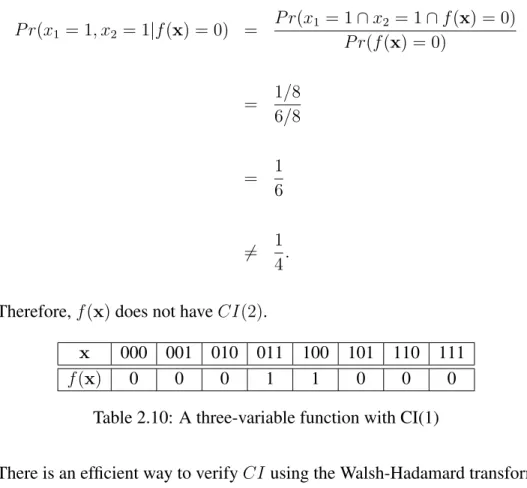
Example 2.3.14. The Boolean function in the Table 2.10 has CI(1). For example, if
P r(x1 = 0|f(x) = 0) = P r(x1 = 0∩f(x) = 0) P r(f(x) = 0) = 3/8 6/8 = 1 2
the conditional probability withxi = 1,
P r(x1 = 1|f(x) = 0) = P r(x1 = 1∩f(x) = 0) P r(f(x) = 0) = 3/8 6/8 = 1 2.
The same procedures can check forxi = x2, x3 to conclude that the function has
P r(x1 = 1, x2 = 1|f(x) = 0) = P r(x1 = 1∩x2 = 1∩f(x) = 0) P r(f(x) = 0) = 1/8 6/8 = 1 6 6 = 1 4.
Therefore,f(x)does not haveCI(2).
x 000 001 010 011 100 101 110 111
f(x) 0 0 0 1 1 0 0 0
Table 2.10: A three-variable function with CI(1)
There is an efficient way to verifyCIusing the Walsh-Hadamard transform. Lemma 2.3.15. [4, p. 50]Letf ∈ Bn. CI(f) =k with1≤k≤nif and only if
Wf(w) =
X
x∈Fn2
(−1)f(x)⊕w·x = 0
for allwwhere1≤wt(w)≤k. 2.3.7. Algebraic Immunity
For decades, linearization and some of its variations have been used to attack a stream cipher employing a Boolean function. They typically use Gaussian elimination as a core algorithm. By choosing a Boolean function with a high degree, we can substantially increase the computing resources needed to carry out an attack, which renders linearization useless as a practical technique to solve a stream cipher. However, a new class of attack
was introduced in 2003. It was shown that if a stream cipher employs a Boolean function
f orf ⊕1with a low-degree function such thatf g= 0or(f⊕1)g = 0, the cipher can be methodically solved by the algebraic attack discussed in [24] and [25].
Definition 2.3.16. For anyf ∈ Bn, a nonzero functiong ∈ Bnis called anannihilatorof
f iff g=0, and thealgebraic immunityoff, denoted byAI(f), is the minimum value of
dsuch thatf orf⊕1admits an annihilator of degreed[26].
The following two cases are algebraic attack possibilities [24].
Case 1: Assume that there exists a function g of low algebraic degree such that
f g =h, wherehis a nontrivial function with low algebraic degree.
Case 2: Assume that there exists a function g of low algebraic degree such that
f g = 0. In 2003, Courtois and Meier showed that the algebraic immunity of annvariable Boolean function is bounded above bydn
2e.
Remark 2.3.17. [27] While algebraic immunity is an important cryptographic property, it is not enough to resist fast algebraic attacks, a more efficient form of algebraic attacks. If we can findg of low degree andhof algebraic degree not much larger thann/2, such that
f g =h, thenf is susceptible to fast algebraic attacks [24], [28]. 2.3.8. Normality
The normality was first discussed by Dobbertin while examining bent functions in [29]. Since the number of variables in a bent function is even, the initial focus was on the even variable functions, which are invariant with respect to the vectors in a flat. Dobbertin called a Boolean function of even variables “normal” if it is invariant on a flat of the dimension n
2. Later this concept was generalized for odd variable functions invariant in
a flat of dimensiondn
2e. Dobbertin conjectured that all bent functions are normal. However,
some non-normal bent functions were discovered by Canteaut el al. [30], and the notion of normality became an independent measure for general Boolean functions. Later, it was shown that there are very few normal functions, and the definition below was established by Carlet [31].
Definition 2.3.18. A Boolean functionf ∈ Bnis calledk-normalif there exist ak
dimen-sional flatGsuch thatfis constant. We denote such condition asf |G= 0or1. Ifk =d
n 2e, f is simply called anormalfunction.
General information on the normality can be found in [32].
2.4. TRADEOFFS BETWEEN CRYPTOGRAPHIC PROPERTIES
Unfortunately, composing or finding good cryptographic Boolean functions has a few obstacles, since there are some cryptographic properties that we cannot optimize si-multaneously. We present common dilemmas among cryptographic properties with the relevant theorems.
2.4.1. Correlation Immunity and Degree
In 1984, Siegenthaler [23] showed that there is a necessary tradeoff between achiev-ing high-degree and high-correlation immunity.
Theorem 2.4.1. [23, Theorem 1]If a Boolean functionf is CI(k), then the degree off is at mostn−k. If f is CI(k) withk < n−1and balanced, then the degree off is at most
n−k−1.
2.4.2. Correlation Immunity and Nonlinearity
Theorem 2.4.2 illustrates the tradeoff between correlation immunity and nonlinear-ity of Boolean functions.
Theorem 2.4.2. [33]If a Boolean functionf is CI(k) withk ≤n−2,
nl(f)≤2n−1−2k+1.
We can combine Theorems 2.4.1 and 2.4.2 and obtain the following theorems. Theorem 2.4.3. [4, p. 71] If f is balanced and CI(k) with k ≤ n −2, then equality is possible in Theorem 2.4.2 only iff has its maximum possible degreen−k−1.
If deg(f)< n−k−1, then
nl(f)≤2n−1−2k+2.
The following theorem by Carlet improves Theorem 2.4.3 to incorporate the degree of the function in the upperbound [4, p. 72].
Theorem 2.4.4. [34] If a balanced Boolean function f with degree d is CI(k) with k ≤
n−2, then
nl(f)≤2n−1−2k+1+b(n−k−2)/dc.
2.4.3. Algebraic Immunity and Nonlinearity
The following theorem describes the limit (commonly called “Lobanov’s bound”). The theorem implies that we can increase the algebraic immunity of a function along with the nonlinearity, but at the expense of decreasing the correlation immunity due to Theorem 2.4.2.
Theorem 2.4.5. [35]Iff ∈ Bnhas algebraic immunityk,
nl(f)≥2 k−2 X i=0 n−1 i .
3.
AFFINE EQUIVALENCE OF MONOMIAL
ROTATION-SYMMETRIC BOOLEAN FUNCTIONS
3.1. INTRODUCTION
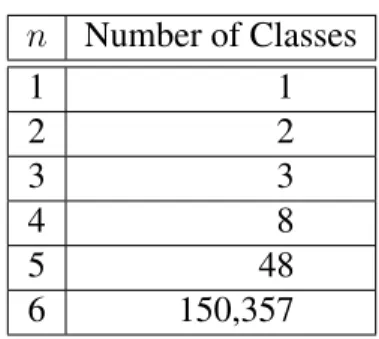
In this chapter, we study the affine equivalence of monomial rotation-symmetric (MRS) Boolean functions. A general affine equivalence problem for Boolean functions is a complete partitioning of then-variable Boolean function space based on an affine equiv-alence relation. A greedy algorithm for affine equivequiv-alence verification requires checking all elements of GLn(F2), and has computational complexity O(2n
2
). This implies that if n ≥ 7, the problem becomes quite a challenge for current computing platforms. The first notable effort to solve an affine equivalence problem is found in [36], published in 1964. Berlekamp and Welch [37] in 1972 found all equivalence classes for all five vari-able Boolean functions. In 1991, Maiorana [38] computed 150,357 equivalence classes of six variable Boolean functions. Due to its complexity and size, affine equivalence still remains a tough problem to deal with, especially for a general solution, which addresses anyn ∈ N. Besides the pure mathematical perspective, an affine equivalence can be ap-plied to cryptanalysis and cryptographic engineering. For example, differential and linear cryptanalyses are two major techniques to solve the S-boxes of block ciphers. If an S -box is vulnerable to differential or linear cryptanalysis, so are theS-boxes realizing affine equivalence functions. This fact simplifies the tasks of cryptanalysts, since they just need to choose and analyze an (easy) representative of an equivalence class. On the other hand, the cryptographic engineers may take advantage of affine equivalent S-boxes of aS-box that is strongly resistant to these attacks, since affine transformations have small delays and preserve much of the cryptographic properties of the original function.
A rotation-symmetric Boolean function (RSBF) is invariant under the rotation or circular shift of a input. For example, if f ∈ B3 is rotation symmetric, then f(001) =
re-n Number of Classes 1 1 2 2 3 3 4 8 5 48 6 150,357
Table 3.1: Affine Equivalence Classes inBn
peated function values, it is relatively fast. However, despite being seemingly simple func-tions to evaluate, the class of RSBFs contain many funcfunc-tions richly endowed with good cryptographic properties. For example, the famous Patterson–Wiedemann function inB15
[39] that achieves nonlinearity 16276, which is strictly greater than the bent concatenation bound, 215−1 −2(15−1)/2 = 16256is rotation symmetric [4, p. 112]. Moreover, Kavut et al. [40], [41], [42] proved that there exist rotation-symmetric functions of nine variables with the nonlinearity 241 and 242, which is also strictly greater than the bent concatenation bound 29−1 −2(9−1)/2 = 240 [4, p. 112]. Due to their speed and the prospect of being
good cryptographic Boolean functions, RSBFs have received a lot of attention from cryp-tographic researchers. In [43], Filiol and Fontaine initially studied crypcryp-tographic properties of RSBFs (they used the term, “idempotent” function instead of RSBF), mainly focusing on nonlinearity [4, p. 112]. Later, the nonlinearity and correlation immunity of RSBFs were studied thoroughly in [44], [45], [46], [47], and [48]. The RSBF’s speed and poten-tial to have good cryptographic properties make them suitable for such an application as hashing algorithms. Pieprzyk and Qu studied the use of RSBFs in a hashing algorithm in [3]. We note the papers [49] and [50] dealing with algebraic immunity of RSBF. The class of RSBFs are interesting to apply the notion of affine equivalence into, as the function space is much smaller (≈ 22
n
n ) than the total space of Boolean functions (22n), and the
set contains functions with very good cryptographic properties. It has been experimentally demonstrated that there are RSBFs that are simultaneously good in terms of balancedness, nonlinearity, correlation immunity, algebraic degree, and algebraic immunity.
There has been consistent effort to investigate the affine equivalence of RSBFs. Some recent efforts include [51], [52], [53], [54], and [55]. In this chapter, we focus on a type of affine equivalence named “S-equivalence” applied to monomial rotation-symmetric (MRS) functions. The material in this chapter is based on Chung and Stanica [56].
3.2. AFFINE EQUIVALENCE OF BOOLEAN FUNCTIONS
Definition 3.2.1. We say that f, g ∈ Bn are affine equivalent if there exists an n × n
invertible matrix A over the finite field F2, the vectorsb,c ∈ Fn2 and d ∈ F2 such that
g(x) =f(xA⊕b)⊕c·x⊕d.
Some researchers prefer a simplified version of equivalence wherec=0andd= 0. Definition 3.2.2. [55] We say that two Boolean functionsf(x)andg(x)inBnare
equiva-lent under an affine transformationifg(x) = f(xA⊕b), whereAis ann×nnonsingular matrix over the finite fieldF2andbis ann-dimensional vector overF2. We sayf(xA⊕b)
is anonsingular affine transformationoff(x).
In this thesis, we focus on a type of affine equivalence whereb = 0, c= 0, d= 0, andA is permutation matrix. We will define this notion called “S-equivalence” in a later section.
f = x1x2⊕x3x4x5 f1 = x1x2⊕x3x4x5⊕x1 ⊕x3 f2 = x1x2⊕x3x4x5⊕x2 ⊕x3 ⊕x5 ⊕1 f3 = x3x4⊕x1x2x5⊕x1 ⊕x3 ⊕1 f4 = (x4⊕1)x3⊕x1x2(x5⊕1)⊕x1⊕x3⊕1 = x3x4⊕x1x2x5⊕x1x2⊕x1⊕1
We see thatf1 = f ⊕c·x,wherec = (1,0,1,0,0). f2 = f ⊕c·x⊕d, where c= (0,1,1,0,1)andd = 1. f3 =f(xA)⊕c·x⊕d, where A= 0 0 0 0 1 0 0 1 0 0 0 1 0 0 0 1 0 0 0 0 0 0 0 1 0 ,
c= (1,0,1,0,0), andd= 1. f4 =f(xA⊕b)⊕c·x⊕d, whereA, c, anddare same as
f3withb= (1,0,0,1,0).
Essentially, a permutation transformation rearranges the order of input, which pre-serves the Hamming weight of the truth table. Clearly, if f and g are equivalent under
affine transformation, thenwt(f) = wt(g)andnl(f) = nl(g). However, the sufficiency only holds for quadratic Boolean functions.
Theorem 3.2.4. [56]Two quadratic functions f and g inBn are equivalent under affine
transformation if and only ifwt(f) = wt(g)andnl(f) = nl(g).
Unfortunately, the result cannot be extended to higher degrees. In S-equivalence, we obtain a similar result for degrees≥2. If two functionsf andg inBnare S-equivalent,
thenwt(f) = wt(g)andnl(f) = nl(g). The converse of the statement does not hold. We can still use the result to show non-equivalence in many cases.
3.3. ROTATION-SYMMETRIC BOOLEAN FUNCTIONS
Definition 3.3.1. Letxi ∈F2 for1≤i≤n. For1≤k ≤n, we define the permutationρkn
on(x1, x2, . . . , xn)∈Fn2 such that ρkn((x1, x2, . . . , xn−1, xn)) = (ρkn(x1), ρkn(x2), . . . , ρkn(xn−1), ρkn(xn)), where ρkn(xi) = xi+kifi+k ≤n and ρkn(xi) = xi+k−nifi+k > n.
Hence,ρknacts ask-cyclic rotation on ann-bit vector.
Definition 3.3.2. A Boolean function f is called rotation symmetric if, for each vector
(x1, . . . , xn)inFn2,
f(ρkn(x1, . . . , xn)) =f(x1, . . . , xn), for 1≤k≤n.
Definition 3.3.2 implies that the rotation-symmetric Boolean functions (RSBFs) are invariant under a cyclic rotation of input vectors. Clearly, the input vectors in a rotation class are in a equivalence relation. Therefore, the inputs of a rotation-symmetric Boolean function can be divided into partitions so that each partition consists of all cyclic shifts of one input. A partition is generated by say Gn(x1, x2, . . . , xn) = {ρkn(x1, x2, . . . , xn)|1 ≤
k ≤ n}, and we denote the number of such partitions gn. By the product rule of
combi-natorics, the number ofn-variable RSBFs is2gn. Letφ(k)be Euler’sphi-function. Then,
from Burnside’s lemma [48],
gn= 1 n X k|n φ(k)2nk.
Letgn,w denote the number of partitions withw, the common weight of the vectors in
par-tition. The papers [45], [47], and [48] address the formula on how to calculate gn,w for
arbitrarynandw. It is also noteworthy that Zhang and Deng [57] corrected the enumera-tion ofGn(x1, x2, . . . , xn)such that |Gn(x1, x2, . . . , xn)| = n in [48] and generalized the
enumeration for|Gn(x1, x2, . . . , xn)|=rwherer|n.
Definition 3.3.3. Let
Gn(x1, . . . , xn) = {ρkn(x1, . . . , xn), for1≤k ≤n},
be the orbit of(x1, . . . , xn)under the action ofρkn,1≤k≤n. It is clear thatGn(x1, . . . , xn)
generates a partition in the set Fn
written (for short) as
a0⊕a1x1⊕
X
a1jx1xj ⊕ · · · ⊕a12...nx1x2. . . xn(SAN F),
where the coefficientsa0, a1, a1j, . . . , a12...n ∈ {0,1}, and the existence of a representative
termx1xi2. . . xil implies the existence of all the terms fromGn(x1xi2. . . xil)in the ANF.
We call this representation off theshort algebraic normal form(SANF) off.
Remark 3.3.4. We note that the SANF is not unique, since one can choose any represen-tative inGn(x1xi2. . . xil).
Example 3.3.5. 5-variable RSBFsf andg are shown in ANF and SANF below.
f(x) = x1(SAN F)
= x1⊕x2⊕x3⊕x4⊕x5
g(x) = x1⊕x1x2x5(SAN F)
= x1⊕x2⊕x3⊕x4⊕x5⊕x1x2x5 ⊕ · · · ⊕x5x1x4
If the SANF of a RSBF contains only one term, we call such a function amonomial rotation-symmetric(MRS) function. A simple number theoretic deduction gives us that the ANF of a monomial rotation-symmetric function contains a divisor ofnnumber of terms. If that divisor is in fact n, we call the function a full-cycle MRS, otherwise, ashort-cycle MRS.
![Figure 1.1: Data Encryption Standard (DES) Diagram From [2]](https://thumb-us.123doks.com/thumbv2/123dok_us/530363.2562489/22.918.300.608.108.457/figure-data-encryption-standard-des-diagram.webp)

![Table 4.1: Affine Equivalence Classes of 4-Variable Boolean Functions From [64]](https://thumb-us.123doks.com/thumbv2/123dok_us/530363.2562489/94.918.169.745.93.565/table-affine-equivalence-classes-variable-boolean-functions.webp)
