
P
ROVENANCE IN
B
IOINFORMATICS
W
ORKFLOWS AND
ENABLING
INTEROPERABLE
C
OMPUTATIONAL
A
NALYSIS
S
HARING
Farah Zaib Khan
Submitted in total fulfillment of the requirements of the
degree of
Doctor of Philosophy
School of Computing and Information Systems
T
HEU
NIVERSITY OFM
ELBOURNEDecember 2018
All rights reserved. No part of the publication may be reproduced in any form by print, photoprint, microfilm or any other means without written permission from the author.
The automation of computational analyses in data-intensive domains such as ge-nomics through scientific workflows is a widely adopted practice in many fields of research nowadays. Computationally driven data-intensive experiments us-ing workflows enable Automation, Scalus-ing, Adaption and Provenance support (ASAP). Provenance data collection is an essential factor for any computational workflow-centric research to achieve reproducibility, transparency and support trust in the published results. At present capture of provenance information across the plethora of workflow management systems and custom software plat-forms in the bioinformatics domain is not well supported and as such, there exist numerous challenges associated with the effective sharing, publication, under-standability, reproducibility and repeatability of scientific workflows.
This thesis focuses on providing a unified, interoperable and systematised view of provenance with specific focus on workflow environments in the bioin-formatics domain. We identify and overcome the current disconnect between var-ious workflows systems and their existing provenance representations. Through empirical analysis of complex genomic data analysis workflows using three ex-emplar workflow systems, we identify implicit assumptions that arise. These assumptions produce an incomplete view of provenance resulting in insufficient details that impact on workflow enactment requirements and ultimately on the
and capture complete provenance information that can subsequently be used for re-enacting workflows in other contexts and potentially using other workflow platforms.
Based on this empirical case study and pragmatic analysis of related literature, we define a hierarchical provenance framework offering“Levels of Provenance and Resource Sharing”. Each level of this framework addresses specific provenance recommendations and supports the capture of rich provenance information, with the topmost layer enabling the sharing of comprehensive and executable work-flows utilising retrospective provenance. To realise this framework, we lever-age community-driven, domain-neutral, platform-independent and open-source standards to implement“CWLProv”- a format for the methodical representation of provenance supporting workflow enactment aggregating resources specific to the given enactment and associated workflow configuration settings. We realise CWLProv through the Common Workflow Language (CWL) for workflow defini-tion and utilise Research Objects (ROs) for resource aggregadefini-tion and PROV-Data Model (PROV-DM) to support the capture of retrospective provenance informa-tion as required for subsequent workflow enactments.
To demonstrate the applicability ofCWLProv, we extend an existing workflow executor (cwltool) to provide a reference implementation that generates metadata and provenance-rich interoperable workflow-centric ROs. This approach aggre-gates and preserves data and methods needed to support the coherent sharing of computational analyses and experiments. Evaluation of CWLProv using real-life bioinformatics pipelines is demonstrated to highlight the utility of the approach demonstrating the interoperability of workflow analyses and the benefits to re-search reproducibility more generally.
This is to certify that
1. the thesis comprises only my original work towards the PhD,
2. due acknowledgement has been made in the text to all other material used, 3. the thesis is less than 100,000 words in length, exclusive of tables, maps,
bibliographies and appendices.
Farah Zaib Khan, December 2018
The motivation to begin my PhD journey, the morale to keep going and the en-couragement to complete it –all were borrowed from or gifted by the unbeliev-ably supportive individuals in my life for whom I owe a debt of gratitude
I am grateful to ALLAH Almighty for blessing me with more than I deserve and for presenting me with more opportunities that one could ever dream of.
My deepest gratitude goes to my supervisors A.Prof Andrew Lonie and Prof. Richard Sinnott for accepting me as their student to undertake this PhD and for the guidance, support, advice and opportunities they provided throughout my candidature. These few words can never do justice to the continuous mentoring, timely feedback and constant encouragement they provided, without which it would have been impossible to develop the research skills required to complete this journey.
I would also like to thank my collaborators Stian Soiland-Reyes and Michael R. Crusoe for their valuable feedback, insightful comments on my research, stim-ulating discussions and above all for being there whenever I needed help. I wish to thank The University of Melbourne for the scholarship awarded to me to carry out this research. Thanks to the staff at UniMelb especially Rhonda Smithies & Dr. Antonette Mendoza for always listening to my concerns and offering help.
in the first place. I owe him much more than I can express in these few words. I wish to thank the friends in Melbourne who were my family away from home throughout my PhD journey. Neelofar, Sehrish & Shafqat! You kept my morale high in my time of need and shared laughter in times of happiness. Thank you for being true and honest friends.
My uttermost gratitude to my loving family, without whom I would not be the person I am today. Abbu for making me strong and independent, for trusting me with everything, for showing confidence in me and always encouraging me to broaden my horizons. Thank you Amma for teaching me selflessness and the devotion that one should have to their cause; for dedicating your life to your kids and for the continuous love, respect & appreciation you have showered us with. Special thanks to my sisters Neelam, Anam & Summaiya and my little brothers Osama & Hamza for being understanding and encouraging me in all my pursuits. Finally, my dearest husband Ahsen! Thank you for giving me a reason to look forward to every December and the motivation to work for the rest of the year; for giving me strength every day even though we are 6 hours & 9,230 km apart; for signing up for this journey with me; for telling that you are proud of me and waiting for me patiently while I chase my dreams. Thank you for your faithful companionship and for supporting me through thick and thin for the past seven years. Because of your efforts and patience we are together. Thank you for everything!
This thesis research has been carried out at School of Computing & Information Systems, The University of Melbourne. The contributions of this thesis are dis-cussed in Chapter 2 - 6 which are based on the following publications.
Publications from the PhD Research
• Published: Kanwal, Sehrish andKhan, Farah Zaiband Lonie, Andrew and Sinnott, Richard O.Investigating reproducibility and tracking provenance A genomic workflow case study.In: BMC bioinformatics 18.1 (2017), p. 337 (doi: 10.1186/s12859-017-1747-0)
First and Second author contributed equally.
• Submitted:Khan, Farah Zaiband Soiland-Reyes, Stian and Sinnott, Richard O. and Lonie, Andrew and Goble, Carole and Crusoe, Michael R.”Sharing interoperable workflow provenance: A review of best practices and their practical application in CWLProv”.In: GigaScience
(doi: 10.5281/zenodo.1966881)
Poster, Abstract Submissions and Presentations
• Abstract & Long Talk: Kanwal, Sehrish and Khan, Farah Zaiband Lonie, Andrew and Sinnott, Richard O.“Reproducibility and Provenance
• Poster: Kanwal, Sehrish andKhan, Farah Zaiband Lonie, Andrew and Sin-nott, Richard O.“Reproducibility of Computational Genomic Workflows”
In: Galaxy Australasia Meeting, 2017, Melbourne, Australia
• Abstract & Poster: Khan, Farah Zaib and Soiland-Reyes, Stian and Lonie, Andrew and Sinnott, Richard O.
CWL+Research Object == Complete ProvenanceIn: Bioinformatics Open Science Conference (BOSC), 2017, Prague, Czech Republic
(doi: 10.7490/f1000research.1114781.1)
• Abstract & Long Talk: Khan, Farah Zaiband Soiland-Reyes, Stian and Sin-nott, Richard O. and Lonie, Andrew and Crusoe, Michael R. CWLProv –Interoperable retrospective provenance capture and its challenges In: Galaxy Community Conference & Bioinformatics Open Science Conference (GCC-BOSC), 2018, Portland Oregon, USA
(doi: 10.7490/f1000research.1115721.1)
• Abstract & Long Talk: Soiland-Reyes, Stian andKhan, Farah Zaiband Sin-nott, Richard O. and Lonie, Andrew and Crusoe, Michael R. and Goble, Carole. Capturing interoperable reproducible workflows with Common Workflow LanguageIn Workshop on Research Objects (RO 2018), Amster-dam, Netherlands.
(doi: 10.5281/zenodo.1312623)
• Lightning talk: Khan, Farah Zaib et al. CWLProv –Towards Reproducible & Interoperable Scientific WorkflowsIn: From replication crisis to credi-bility revolution, 2018, Melbourne, Australia
Open Source Project Contribution
the CWL workflow enactment & its provenance as part of this thesis research.
The strength of my life who always believed in me & encouraged me to be
the best version of myself
To
my mother
The hope of my life who devoted her life to me & was selflessly there
whenever I needed her
To
my husband
The love of my life who made me believe in true love & stood by my side
through the toughest times
Common Workflow Language CWL
Directed Acyclic Graph DAG
Research Object RO
Genome Analysis Toolkit GATK
Genomics Virtual Lab GVL
Next Generation Sequencing NGS
High Performance Computing HPC
Operating System OS
Workflow Management System WMS
National eResearch Collaboration Tools and Resources NeCTAR
PROVenance Data Model PROV-DM
1 Introduction 1
1.1 Problem Statement . . . 4
1.2 Research Objectives . . . 7
1.3 Research Questions & Research Activities . . . 8
1.4 Scope of the Study . . . 13
1.5 Structure of the Thesis . . . 15
2 Literature Review 19 2.1 Introduction . . . 19 2.2 Provenance Taxonomy . . . 20 2.2.1 Provenance Context . . . 20 2.2.1.1 Database Provenance . . . 24 2.2.1.2 Workflow Provenance . . . 25
2.2.2 Workflow Provenance Classes . . . 33
2.2.2.1 Prospective Provenance . . . 34
2.2.2.2 Retrospective Provenance . . . 35
2.2.2.3 Workflow Evolution Provenance . . . 37
2.2.3 Provenance Applications . . . 39
2.2.3.1 Understandability . . . 39
2.2.3.2 Attribution . . . 40
2.2.3.3 Reproducibility . . . 41 xvi
2.2.3.5 Quality Assurance . . . 42
2.2.4 Provenance Standards and Models . . . 44
2.2.4.1 Open Provenance Model (OPM) . . . 45
2.2.4.2 W3C PROV . . . 47
2.2.4.3 Wf4Ever Provenance Ontologies . . . 51
2.2.5 Provenance Capture Mechanisms . . . 52
2.2.5.1 Script-based Capture . . . 53
2.2.5.2 Workflow Management Systems with Built-in Prove-nance Capture . . . 54
2.2.5.3 Standalone Tools for capture . . . 55
2.2.6 Provenance Data Analytics . . . 56
2.2.7 Resources Supporting Provenance Applications . . . 57
2.2.7.1 Workflow Software Environment Capture . . . 58
2.2.7.2 Data/Method Preservation, Aggregation & Sharing 62 2.2.8 Putting the Pieces Together . . . 66
2.3 Workflow Definition & Implementation Approaches . . . 68
2.3.1 Evolution of Workflow Management Systems . . . 68
2.3.2 Classification of Workflow Approaches . . . 70
2.3.2.1 Domain-specific Pre-built Pipelines . . . 70
2.3.2.2 Graphical User Interface (GUI)-based Integrative Workbenches . . . 72
2.3.2.3 Standardised & Declarative Approach to Workflow Definition . . . 73
2.4 Evaluation of Exemplar Approaches . . . 74
2.4.1 Exemplar Bioinformatics-specific Pre-built Pipelines . . . . 74
2.4.1.1 Cpipe . . . 75 xvii
2.4.1.3 Omics-Pipe . . . 76
2.4.2 Exemplar GUI-based Workbenches . . . 77
2.4.2.1 Galaxy . . . 78 2.4.2.2 Taverna . . . 79 2.4.2.3 Kepler . . . 79 2.4.2.4 Pegasus . . . 80 2.4.2.5 VisTrails . . . 81 2.4.2.6 BioWorkbench . . . 82
2.4.3 Exemplar Standardised & Declarative Approaches . . . 83
2.4.3.1 Common Workflow Language (CWL) . . . 84
2.4.3.2 Nextflow . . . 85
2.4.3.3 Workflow Definition Language (WDL) . . . 85
2.5 Conclusions . . . 86
3 Empirical Case Study to Understand Provenance Requirements 88 3.1 Introduction . . . 88
3.2 Case Study . . . 90
3.2.1 Datasets . . . 91
3.3 Workflow Design and Enactment . . . 91
3.3.1 Cpipe . . . 92
3.3.2 Galaxy . . . 93
3.3.3 Common Workflow Language (CWL) . . . 96
3.4 Features of Bioinformatics Workflow Provenance . . . 99
3.4.1 Workflow Enactment Environment . . . 100
3.4.1.1 Analysis Environment . . . 101
3.4.3 Abstract Representation of Workflow . . . 104
3.4.4 Compute & Storage Requirements . . . 106
3.4.5 Online Resource Challenges . . . 106
3.4.6 Proprietary & Copyrighted Resources . . . 107
3.5 Why Declarative Systems? . . . 108
3.6 Conclusions . . . 109
4 Levels of Provenance and Resource Sharing 113 4.1 Introduction . . . 113
4.2 Best Practice Recommendations . . . 114
4.3 Resources Supporting Provenance Applications . . . 118
4.3.1 Parameter Settings . . . 118
4.3.2 Automating the Whole Process . . . 119
4.3.3 Data Sharing . . . 120
4.3.3.1 Raw Input Data . . . 120
4.3.3.2 Intermediate Results . . . 121
4.3.3.3 Example Input & Sample Output . . . 121
4.3.4 Workflow Specifications & Abstract Representation . . . 122
4.3.5 Attributions & Provenance Trace . . . 123
4.3.6 Software Environment . . . 124
4.3.7 Versions & Persistent Identifiers . . . 125
4.3.8 Metadata & Annotations . . . 126
4.3.9 Open Source Licensing . . . 128
4.4 Levels of Provenance . . . 129
4.4.1 Level 0–Trust, Prospective Provenance & Reuse . . . 131
4.4.3 Level 2–Towards White-box Enactment . . . 136
4.4.4 Level 3–Understandability & Specificity . . . 137
4.5 Conclusions . . . 139
5 CWLProv–Format of Workflow Enactment Representation 141 5.1 Introduction . . . 141
5.2 Applied Standards and Vocabularies . . . 143
5.2.1 Common Workflow Language (CWL) . . . 144
5.2.1.1 CWL Process Description Document . . . 147
5.2.1.2 Declarative Constructs . . . 147
5.2.2 Research Object (RO) . . . 152
5.2.2.1 Specialised Workflow Provenance Ontologies . . . 153
5.2.2.2 Serialisation Format –BagIt . . . 153
5.2.3 PROV Data Model (PROV-DM) . . . 155
5.3 CWLProvFormat . . . 156 5.3.1 data/ . . . 157 5.3.2 workflow/ . . . 159 5.3.3 snapshot/ . . . 160 5.3.4 metadata/ . . . 160 5.3.4.1 RO Manifest . . . 161 5.3.4.2 logs/ . . . 161 5.3.4.3 provenance/ . . . 162 5.3.4.4 URI scheme . . . 163
5.4 Retrospective Provenance Profile . . . 163
5.4.1 wfdesc . . . 165
5.4.2 wfprov . . . 165 xx
5.4.5 Agent . . . 167 5.4.6 wasAssociatedWith . . . 167 5.4.7 wasStartedBy . . . 169 5.4.8 Used . . . 169 5.4.9 wasGeneratedBy . . . 169 5.4.10 wasEndedBy . . . 170 5.4.11 has provenance . . . 170
5.5 Practical Realisation ofCWLProv . . . 171
5.5.1 Reference Implementation . . . 171
5.5.2 CWLProvInvocation . . . 172
5.5.3 Process Flow . . . 172
5.5.4 Achieving recommendations with provenance levels . . . . 175
5.6 Conclusions . . . 177
6 CWLProvEvaluation –Bioinformatics Workflow Case Studies 179 6.1 Introduction . . . 179
6.1.1 Scenarios . . . 181
6.1.1.1 Verify Results . . . 181
6.1.1.2 Reuse Methods/Data . . . 183
6.1.1.3 Data Derivation History . . . 183
6.1.1.4 Communication Requirements . . . 184
6.1.2 Interoperability . . . 185
6.2 Bioinformatics Workflows . . . 186
6.2.1 RNA-seq Analysis Workflow . . . 186
6.2.2 Alignment Workflow . . . 188 xxi
6.3 CWLProvEvaluation Activity . . . 192 6.4 Evaluation Results . . . 195 6.4.1 CWLProvand Interoperability . . . 195 6.4.2 Evaluating Provenance Profile . . . 196 6.4.2.1 Workflow Runs . . . 197 6.4.2.2 Attribution . . . 197 6.4.2.3 Input/Output of a Process . . . 198 6.4.2.4 Partial Re-runs . . . 198 6.4.3 Temporal and Spatial Overhead with Provenance . . . 198 6.4.4 Output Comparison Across Enactments . . . 201 6.5 Discussion . . . 201 6.5.1 Compute and Storage Resources . . . 202 6.5.2 Provenance Profile Augmented with Domain Knowledge . 203 6.5.3 Big-omicsData . . . 204 6.5.4 CustomisedCWLProvRO with Selected Jobs Provenance . . 205 6.6 Enforcement of Best Practices –An Open Problem . . . 206
7 Conclusions & Future Work 209
7.1 Contributions . . . 212 7.2 Limitations & Future Work . . . 218 7.3 Impact . . . 220
1.1 Venn Diagram highlighting the area of research with the innermost subset indicating the scope of this thesis . . . 14 1.2 Focus Area of the Thesis . . . 16 1.3 Thesis Outline mapping the Research Activities (defined in Section
1.1) that how they are performed in each chapter . . . 18 2.1 Workflow lifecycle . . . 28 2.2 An example workflow showingblack-boxness . . . 33
2.3 Data-flow example workflow . . . 35 2.4 Relationship between prospective and retrospective view of
work-flow provenance . . . 37 2.5 Open Provenance Model nodes and edges . . . 46 2.6 Core concepts of the PROV Data Model. Adapted from W3C PROV
Model Primer [114]. . . 48 2.7 Scientific Workflow Provenance Taxonomy . . . 67 2.8 Classification of Workflow definition Approaches . . . 71 3.1 Implicit steps in Galaxy . . . 95 3.2 CWL workflow elements . . . 97 3.3 Complete graphical representation of the GATK workflow . . . 103
4.1 EDAM ontology in use . . . 127 4.2 Levels of Provenance and their Associated Implications . . . 132 5.1 Standards integrated inCWLProv including their individual
func-tionalities and their overlapping principles. . . 144 5.2 Components of a command line tool description forhmmsearch[279].146
5.3 Example description included as part of a workflow [280]. . . 150 5.4 Resources typically aggregated in a workflow-centric Research
Ob-ject (from [35]). . . 153 5.5 Example of a Valid BagIt structure adapted from [165]. . . 154 5.6 Core concepts of the PROV Data Model. Adapted from W3C PROV
Model Primer [114]. . . 155 5.7 Customised BagIt structure with tagged directories and files given
asCWLProvROs. . . 158
5.8 CWLProvformat . . . 164
5.9 High level process flow representation of workflow provenance capture . . . 173 6.1 Three use-cases focused on the evaluation of CWLProv
interoper-ability. . . 182 6.2 Portion of a RNA-seq workflow generated by CWL viewer. . . 187 6.3 Alignment workflow representation generated by the CWL viewer. 189 6.4 Visual representation of the bcbio somatic variant calling
work-flow adapted from [328] with subworkwork-flow images generated by the CWL viewer. . . 191
1.1 Methods used in this thesis to address the Research Questions . . . 13 3.1 Summary of assumptions and corresponding recommendations
re-garding workflow environments . . . 111 4.1 Summary of recommendations from various studies covering best
practices on reproducibility, accessibility, interoperability and porta-bility of workflows . . . 117 5.1 CWLProv profile of W3C PROV, extended with Research Object
Model’swfdescandwfprov. . . 168
5.2 Recommendations and provenance levels implemented inCWLProv 176
6.1 CWLProv evaluation summary and status for the bioinformatics case studies. . . 194 6.2 Run-time comparison for the workflow enactments done
cross-executor and cross-platform . . . 199 7.1 Contributions made in this thesis to answer the Research Questions 214
I
NTRODUCTION
In describing the goals of the scholarly communication of scientific research via publications, Mesirov [1] said:
“Scientific publications have at least two goals: (i) to announce a result and (ii) to convince readers that the result is correct.”
Convincing readers to accept results as presented, without providing the means to validate the experiment or verify the results, is at best an inequitable expec-tation. Ideally, given a scientific publication, a reader should be able to verify the presented claims seamlessly using the information provided by the authors. However, establishing trust of experiments and their outcomes is subject to levels of transparency maintained in the communication of the methodology employed in the reported experiments. Transparent and comprehensive communication of the research process followed in any scientific publication requires document-ing information that can answer questions such as “what was used to generate this output?”, “where did this data come from?”, “why was a particular method preferred over others?” and “How was the output generated?”. Information pro-viding answers to such fundamental queries is known asprovenance(see the more formal definition inChapter 2).
Dataflow-oriented scientific workflows are proposed [2] and have been ac-tively used for data-intensivein silicoexperiments making them an integral part of the scholarly knowledge-cycle [1]. Such workflows enableAutomation,Scaling,
Adaption andProvenance support (ASAP) [3] and ideally be“key enablers for re-producibility of experiments involving large-scope computations” [4]. With the exten-sive use of workflows as computational methods, many Workflow Management Systems (WMSs) have been designed for systematising the representation and management of complex computational experiments comprised of inter depen-dent data analysis tasks. Along with various advantages such as efficient task scheduling, data management, modular methods and improved debugging, such systems are expected to enable the automated capture of provenance information (data) to document data dependencies and the derivation process. There exist a wide range of domain-agnostic WMS [5, 6, 7] that address the needs of differ-ent scidiffer-entific communities and domain-specific systems such as Galaxy [8] and GenePattern [9] for-omicsdata analysis.
The recent and rapid evolution in the field of genomics, driven by advances in massively parallel DNA sequencing technologies combined with the uptake of genomics as a mechanism for clinical genetic testing, have resulted in high expec-tations from clinicians and the biomedical community at large regarding the reli-able, reproducible, effective and timely use of genomic data to realise the vision of personalised medicine and for improved understanding of various diseases. There has been a contemporaneous upsurge in the number of techniques and platforms developed to support genomic data analysis [10] ,and computational bioinformatics workflows consisting of community generated tools [11] and li-braries [12, 13] are often deployed to deal with the data processing requirements. It has therefore become crucial to evolve and optimise Next Generation Sequenc-ing (NGS) data processSequenc-ing and analysis pipelines (workflows) to keep pace with exponentially increasing amounts of genomics data being produced. The ability
to produce digital forms of DNA sequences and other-omicsdata, has outrun the ability to store, transmit and interpret such data. Hence, the major bottleneck in complex experiments involving NGS data is the data processing and associated knowledge generation.
Although there is a large amount of published literature on the use and impor-tance of-omicsdata in research, far less exists on translation into clinical settings [14]. The committee on the review of -omics-based tests for predicting patient outcomes in clinical trials [15] attributed this discrepancy to two primary causes: inadequate design of pre-clinical studies and weak bioinformatics rigour. The scientific community has paid special attention to benchmarking-omics analysis for quality assurance, analytical validity and accuracy of bioinformatics pipelines [16]. Efforts to define quality standards, good practices, well-articulated check-lists and reference materials (e.g. reference data, methods and standards) [15, 17, 18] have been proposed to improve the quality of bioinformatics experiments. However, incomplete provenance documentation of the computational analy-ses processing -omics data, e.g. lacking the information about software names, versions and associated parameter settings adversely impact the interpretation, transparency and reproducibility of these experiments [19, 20].
Despite wide recognition of the need for sharing comprehensive provenance information on experiments, scientific workflows often suffer from what is com-monly known asworkflow decay [21], referring to “broken” workflows, i.e. they are either not comprehensible or reproducible. Four important aspects are con-sidered responsible for workflow decay: volatile third party resources; missing example data; missing execution environment information; and a lack of descrip-tion of the workflows themselves [22]. With the excepdescrip-tion of volatile third party resources, comprehensive provenance information can, at least in principle, be used to tackle the other identified workflow decay issues. Thus capturing
com-plete provenance documentation including the availability of resources initially used to generate a set of results/claims is of paramount importance to scientific rigour.
Other challenges that often occur during the validation/verification of scien-tific claims lie in restricted or no access to the primary data [23], underlying soft-ware and associated computational artefacts including the workflow specifica-tions; limited means to reproduce the workflow platform/environment; reliance on proprietary software; and unstructured organisation of associated artefacts. If/when shared these often have little or no annotations and/or descriptions to help guide future users. Therefore, it is imperative to devise formal strategies for the effective communication of computational experiments.
1.1
Problem Statement
Given a published research paper based on a scientific workflow, the expecta-tion is that end-users should be able to build new research by exploiting suffi-cient provenance information including systematic methods and associated data documented in that paper. This should allow end-users to fully understand the methods/data-derivation, verify results if need be or use the resources for re-lated research objectives. These expectations naturally extend to assuming that end-users can effectively make use of workflow provenance to address queries about the whole process that transformed a particular input dataset into one or many outputs reported in the paper. Often lack of understanding and documen-tation of crucial information results in coarse-grained and incomplete provenance capture, rendering it insufficient to convey the entire research process.
de-signed to address specific compute and data requirements of diverse research communities. A plethora of approaches have been taken to design and imple-ment computational analyses and sharing mechanisms resulting in diverse and heterogeneous platforms, hence it can be a challenge to immediately comprehend published workflow related artefacts. The situation has been exacerbated due to lack of a unified mechanism to enforce the adoption of existing efforts and stan-dards as well as best practices associated with workflow-centric study designs and their communication. This results in inconsistent granularity and typically, poor quality workflow provenance information. The repercussions of this situa-tion include inadequate understanding of research processes/analysis, resulting in a lack of reproducibility and hence compromising the validity of published scientific claims.
Due to the limited adoption of standardisation practices and the absence of agreement on methods to design or publish new research, the already demand-ing data and compute-intensivein silicoworkflow-centric bioinformatics research is complicated further. Analysing exponentially growing -omics data through workflows requires an in-depth understanding of the impact of particular tools, configuration settings, underpinning infrastructure and associated datasets. The heterogeneity of WMSs, customised logging of provenance information, insuffi-cient information shared about crucial domain-aware decisions and limited ac-cess to resources utilised makes the understanding and reproducibility of a given bioinformatics analysis extremely difficult and often impossible. As a result, the ability to make new scientific discoveries through extending existing experiments and their experimental infrastructure is seldom fulfilled [19].
To address WMS heterogeneity issues, there have been several initiatives fo-cused on standardisation of individual components/aspects of workflow anal-yses focused on promoting consensus and interoperability of workflow-based
analyses. Some notable efforts to standardise provenance information and repre-sentation include the Open Provenance Model (OPM) [24] and the World Wide Web Consortium PROV Data Model (W3C PROV-DM) [25]. These efforts how-ever are not adopted by all the WMSs and the vast majority of existing systems generate customised logs associated with their workflow enactment. Similarly, efforts for richly annotated representation and preservation of methods and data including the Open Archives Initiative Object Re-use & Exchange (OAI-ORE) [26], DataOne Packages [27], ReproZip [28] and Research Objects (RO) [29] ex-ist but are not (yet) widely adopted.
An open problem in leveraging existing initiatives to produce research out-puts is in aggregating methods, data and detailed provenance of analyses such that any outputs are understood and can be used across different WMS and dif-ferent computing platforms. Due to the specificity and heterogeneity of workflow descriptions, such standardisation efforts are still largely isolated. At present no inter-connected and consolidated solution for workflow analysis representation and dissemination has been widely endorsed and adopted.
Having consensus on a single WMS, a single standard or an aggregation ap-proach for publishing results is unlikely. There are many reasons for this. Each approach has its own pros and cons which makes it suitable for specific cases. The scientific research communities from different domains have adopted their own solutions and frameworks for workflow management. As a result, many solutions exist addressing different problems individually leading to division of efforts from the scientific community. It is highly desirable to develop an ab-stract layer on top of the existing solutions that is interoperable enough so that the contents of research represented using this abstraction can be understood and utilised across various WMS on different underpinning platforms.
1.2
Research Objectives
The overall aim of this thesis is to facilitate bioinformatics workflow-centric re-search understanding, improve reproducibility and enable re-use by analysing existing workflow definition approaches and identifying the fundamental ele-ments of workflow provenance information. Building on this, we aim to devise techniques supporting the complete and transparent communication of research. More specifically the objectives of this research are:
O1: To investigate how various workflow definition approaches are addressing the key aspects of provenance;
O2: To identify implicit and explicit assumptions of workflow definition ap-proaches that lead to incomplete provenance documentation;
O3: To develop an understanding of the essential factors/artefacts/resources that must be captured as part of provenance in light of the identified as-sumptions in O2;
O4: To extend the understanding of such resources from O3 by revisiting liter-ature dedicated to designing best practise recommendations for workflow-centric research and compiling these recommendations;
O5: To devise a conceptual provenance framework utilising the compilation done in O4 to capture the fundamental artefacts identified in O3 and O4 in a hierarchical fashion;
O6: To demonstrate the working of the framework from O5 by formulating a standardised format for interoperable workflow-centric analysis represen-tation, and
O7: To assess the effectiveness of the solution achieved after meeting with real-world bioinformatics workflows.
These objectives translate into three major lines of work supporting the im-proved understanding and capture of workflow provenance. Firstly, the identi-fication and understanding of key artefacts of bioinformatics workflow prove-nance that must be captured. This results in detailed (white-box) provenance capture during workflow enactments.
Secondly, atheoretical/conceptual provenance guidethat can serve as a prin-cipled approach to be used by researchers for improving the state of workflow provenance and reproducibility in the design process of studies as well as in the analysis process of published studies.
Thirdly, thestandardisation of research representation and sharingis closely related to the conceptual provenance guide. A standardised and unified format for workflow-centric analyses representation should result in enhanced interop-erability and understandability of workflow studies across various platforms.
These objectives are revisited in the final chapter of the thesis (Chapter 7) to assess the extent that this thesis has met these objectives and hence the contribu-tion made.
1.3
Research Questions & Research Activities
This section presents the main hypothesis that motivates this thesis and drives the subsequent research questions and methods adopted. The overarching hy-pothesis is:
Declarative and platform-agnostic workflow definitions with high degrees of abstrac-tion that leverage standardised and provenance-aware resource aggregaabstrac-tion can help ad-dress the reproducibility and interoperability issues present in workflow-centric scientific research.
Subsequent research questions are investigated and used to evaluate this hy-pothesis, considering the three major lines of work identified in Section 1.2. Lim-ited understanding of the implications of provenance completeness, results in coarse-grained and insufficient provenance knowledge that impacts on the shar-ing and reproducibility of workflow-centric experiments. It is vital to identify the approaches taken by different WMSs to handle provenance capture and identify the critical factors that need to be documented as part of workflow provenance. This brings us to the two research questions, the first is:
RQ1: How do existing WMSs handle different aspects of governance?
To answer this question, we investigated the provenance literature and devised a taxonomy. In addition, we categorised the existing workflow definition ap-proaches generally employed to design bioinformatics workflows. Both classifi-cations help in evaluation of the existing WMSs with respect to their provenance capabilities. As evident from the literature, there is inconsistent granularity in provenance offered by many WMSs, due to limited understanding of essential provenance elements; this motivated us to investigate the second research ques-tion:
RQ2: What are the key artefacts that must be documented for comprehensive provenance capture in bioinformatics workflows?
To address this question, we first identify the implicit assumptions of different workflow definition approaches that can lead to incomplete provenance
doc-umentation. Through such assumptions, we identify key resources and arte-facts of bioinformatics workflows, and propose recommendations to capture fine-grained provenance of bioinformatics workflows. These recommendations are based on an empirical case study, however we identify that there are several re-lated studies focused on addressing the similar problem, i.e. complete communi-cation of scientific analyses. To extend our understanding of the crucial artefacts that must be captured in provenance, we consider existing literature focused on defining best practices and recommendations to improve the design of workflow-centric studies by focusing on various aspects of their provenance capture, acces-sibility of the utilised resources and standardisation support. Having identified the key artefacts of provenance, we attempt to resolve the third core research question:
RQ3: How can we devise a hierarchical provenance framework encompassing community experiences that can serve as a guiding principle to determine the state of prove-nance of a given published analysis designed using a particular workflow definition approach?
This research question focuses on devising a conceptual incremental provenance framework based on the understanding developed in addressing RQ2. In ad-dressing RQ2, we identify that declarative workflow definition approaches make the least assumptions on their execution environment and provide constructs to facilitate fine-grained provenance capture. The conceptual provenance frame-work resulting from RQ3 and the findings from RQ2 are the driving factors that shape our work on a standard format for the representation of provenance en-abled workflow-centric analysis. This brings us to our fourth and final research question:
the provenance framework and demonstrate its utility?
We will revisit these research questions in the final chapter of this thesis ( Chap-ter 7) when the contributions of this thesis are mapped to the research questions. In terms of the signposting of the thesis itself, we performed the following re-search activities in this thesis to tackle the above stated rere-search questions:
RA1: Literature Classification -We provide a detailed assessment and review of the current research literature focused on categorising the related concepts of provenance, workflow definitions and best practices to design and share workflow-centric studies. This includes:
RA1(a)- Taxonomy definition covering concepts related to provenance that are re-visited in the thesis several times.
RA1(b) - Classification of workflow definition approaches covering three major approaches due to the diversity and heterogeneity of environments. This classification covers the broad spectrum of existing systems with re-spect to workflow design and the underlying assumptions of each category.
RA1(c)covers a compilation of best practices carried out by pragmatically analysing existing studies that have the goal of improving workflow-centric study design and dissemination.
RA2: Comparative Literature Survey -This thesis provides a systematic and com-parative survey of exemplar workflow definition approaches and WMS with respect to their provenance support including mechanisms in place (if any) for facilitating the sharing of related workflow resources. This survey in-cludes the analysis of the state of the art WMSs extensively used in bioin-formatics studies and related efforts that aim to achieve similar objectives as described in Section 1.2.
RA3: Empirical Case Study -We implemented a complex variant calling work-flow in systems exemplifying each category of workwork-flow definition approach, to understand the implicit details that are often considered too obvious to be documented yet result in reproducibility challenges. These intricate un-derlying details are referred to asassumptionsof each approach in this the-sis. They have direct implications on the completeness of workflow prove-nance.
RA4: Theoretical/Conceptual Modelling -We explore existing literature and best practices and recommendations from the scientific community (RA1(c)) to establish a conceptual provenance framework. The hierarchical provenance framework is established in light of the experiences of existing research dedicated to improving workflow development and computational analysis sharing, and specifically to ensure that it is not tied to one specific execution environment or approach.
RA5: Standardisation -We utilise well-defined and community-driven initiatives to devise a standard format for the representation of workflow analysis. This format inherits key characteristics of the underlying standards such as abstraction, domain-independence, support for rich annotations and stan-dardised descriptions.
RA6: Practical Realisation -We extend an existing workflow executor to practi-cally demonstrate the realisation of the conceptual framework devised in RA4 using the standard format developed in RA5.
RA7: Case-based Evaluation -Finally we use three real-life bioinformatics work-flows designed by independent research groups to showcase the syntactic, semantic and pragmatic interoperability of the workflow-centric analyses that is supported.
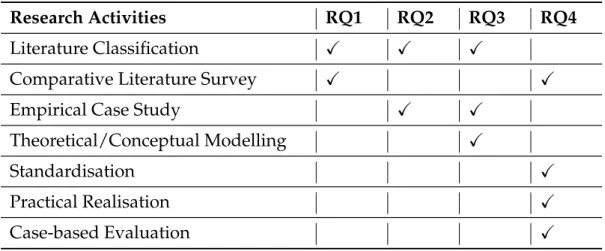
Table 1.1: Methods used in this thesis to address the Research Questions
Research Activities RQ1 RQ2 RQ3 RQ4
Literature Classification X X X
Comparative Literature Survey X X
Empirical Case Study X X
Theoretical/Conceptual Modelling X
Standardisation X
Practical Realisation X
Case-based Evaluation X
The mapping of these research activities to the corresponding research ques-tions is summarised in Table 1.1.
1.4
Scope of the Study
Provenance of scientific workflows has been an active topic of discussion and ex-ploration over the past decade with various collective community-driven initia-tives focused on understanding the many different aspects of provenance. These efforts explore topics such as provenance capture, persistent storage, analytics including querying/visualisation, standardised representation, and provenance sharing [30]. In addition, many different classes of provenance as described in Section 2.2.2 exist in the case of workflow provenance. In this thesis, we focus on the capture of provenance data related to workflow enactment, which is referred to as “Retrospective Provenance” (formally defined in Section 2.2.2.2). In the later chapters, the thesis also briefly discusses aspects of “Prospective Provenance” es-pecially when identifying key artefacts of workflow provenance in empirical and pragmatic analyses.
Bioinformatics Workflows Provenance
Annotated & Structured Resource Aggregation
Structured Representation of Bioinformatics Workflows w/ Aggregated Provenance and other key
artefacts Bioinformatics workflows w/ Provenance Bioinformatics workflows w/ associated resources Structured resource aggregation w/ provenance
Figure 1.1: Venn Diagram highlighting the area of research with the innermost subset indicating the scope of this thesis
The second important dimension defining the scope of this thesis is the do-main of research. This thesis focuses primarily on improving the understand-ing of provenance with respect to bioinformatics workflows. Various technolo-gies such as the Common Workflow Language (CWL) [31], Research Objects, the Provenance Data Model (PROV-DM) [32] and Provenance Specifications [33] are exploited in devising the solution to bioinformatics workflow provenance cap-ture and representation. For the most part, these are domain-agnostic and can be utilised in any scientific workflow. However, the requirements analysis un-dertaken in this thesis is based on use of empirical and pragmatic analysis of bioinformatics workflows and bioinformatics research publications only. Figure 1.1 shows the three main focus areas of this thesis discussed in this section.
The third focal point is devising a mechanism to systematically organise and communicate workflows and all related artefacts identified as crucial elements for understanding an analysis, to enable re-using individual components or the whole workflow, and most importantly for artefacts that are essential for repro-ducing a given analysis. A provenance trace as a document alone is of limited utility with limited or no access to the resources required to enact the workflow. Therefore, the third area of focus is producing structured and annotated aggre-gations of key resources that allow end users to benefit from published research results based on workflows as computational methods.
The ultimate goal of this thesis is: to improve the provenance documentation of bioinformatics workflows by understanding and characterising key resources; to propose a conceptual provenance framework which helps the research com-munity differentiate between different levels of provenance satisfied by authors when publishing studies, and to devise experimental demonstrations applying the provenance framework using existing standards/technologies and real-life bioinformatics workflows. Figure 1.2 summarises the focal point of this thesis and shows the context in which the research of this thesis is applicable.
1.5
Structure of the Thesis
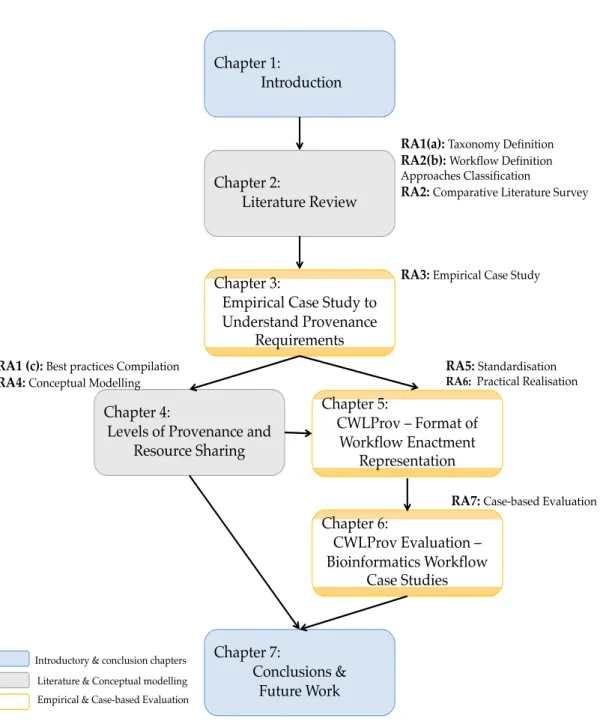
The rest of the thesis as shown in Figure 1.3 is structured as follows:
Chapter 2 provides the background on provenance, provenance taxonomy, classification of workflow definition approaches and comparative literature sur-veys of leading WMS in the bioinformatics domain with focus on their prove-nance support and approaches to aggregate resources utilised in a given analysis.
uctur e of the Thesis 16 Workflow Execution Resource Mapping Workflow Design
Provenance and Metadata Bioinformatician
Workflow Life Cycle* Raw Input Data
Option 1 Option 2
Interpretable Results
Interpretable Results and supporting artefacts**
Publication Space Shared Space
Reviewers Editor
Verify the results
Submitted for peer review
Scientist – wants to reproduce the experiment
Shared with fellow researchers
Collaborators – want to understand the experiment
Scientist – wants to reuse the experiment resources
Thesis focuses on improving provenance capture and resource aggregation during workflow life-cycle
Published
Bench Biologists
samples sequencing
Figure 1.2: Overview of a typical bioinformatics workflow life cycle. The grey highlighted area shows the focus of this thesis. (*)The workflow life cycle is adapted from [34] and (**) the aggregation representation is adapted from
Chapter 3presents an empirical case study analysis by implementing a variant calling workflow on an exemplar systems using different workflow definition ap-proaches. This chapter also provides details regarding the implicit assumptions made by each approach and their implications on the provenance of the workflow under investigation.
Chapter 4 focuses on the essential elements of provenance and the choices of technologies that impact on re-use and reproducibility of a study. This chapter includes detailed comparisons of the state of the art research undertaken by vari-ous groups focusing on improving workflow design, representation, sharing and publication. This chapter also presents the conceptual hierarchical provenance framework culminating from these analyses.
Chapter 5introducesCWLProv, a standard format for representation of work-flows, utilising existing community-driven and open-source initiatives proposed to overcome the issues with heterogeneity of workflow definition, provenance representation and resource aggregation. This chapter also includes details of the practical implementation ofCWLProvby extending an existing implementation.
Chapter 6focuses on illustratingCWLProvwith respect to interoperability and reproducibility using a variety of open-source real-world workflows developed by independent groups on separate platforms. This chapter also discusses the overheads incurred as a result of provenance capture and the remaining open challenges.
FinallyChapter 7concludes this thesis. It includes a summary of the contribu-tions of this thesis, limitacontribu-tions and potential future lines of work. It also discusses the impact of this research on the current and future studies.
Chapter 4:
Levels of Provenance and Resource Sharing
Chapter 3:
Empirical Case Study to Understand Provenance Requirements Chapter 7: Conclusions & Future Work Chapter 1: Introduction Chapter 2: Literature Review Chapter 5: CWLProv – Format of Workflow Enactment Representation Chapter 6: CWLProv Evaluation – Bioinformatics Workflow Case Studies
Introductory & conclusion chapters Literature & Conceptual modelling Empirical & Case-based Evaluation
RA1(a): Taxonomy Definition
RA2(b): Workflow Definition Approaches Classification
RA2: Comparative Literature Survey
RA3: Empirical Case Study
RA1 (c): Best practices Compilation
RA4: Conceptual Modelling
RA5: Standardisation RA6: Practical Realisation
RA7: Case-based Evaluation
Figure 1.3: Thesis Outline mapping the Research Activities (defined in Section 1.1) that how they are performed in each chapter
L
ITERATURE
R
EVIEW
The investigation of the truth is in one way hard, in another easy. An indication of this is found in the fact that no one is able to attain the truth adequately, while, on the other hand, no one fails entirely, but everyone says something true about the nature of all things, and while individually they contribute little or nothing to the truth, by the union of all a considerable amount is amassed. –Aristotle
2.1
Introduction
In this chapter we introduce the workflow-oriented provenance taxonomy that forms the basis for the research in this thesis. The term“provenance”has numer-ous related concepts that apply or have been adopted in different domains, hence we provide clarity in what we mean by provenance with regards to this thesis. Building on this we present studies capturing and standardising provenance, and associated attempts to implement these standards and approaches by the broader scientific community. We focus especially on life sciences research and the impor-tance of bioinformatics workflows and evaluate the leading workflow systems and their specific demands for provenance. We classify existing workflow sys-tems into distinct, meaningful categories. The chapter concludes with a detailed evaluation of the current state of the art workflow systems.
It is noted that parts of this chapter have been published in peer reviewed academic articles listed in the Preface of this thesis.
2.2
Provenance Taxonomy
The term Provenance has historically originated from the arts and humanities where it was applied to trace the origin of the artwork. More recently the term has been adopted in disciplines such as geography, astronomy and computer science with various intended meanings and with sometimes overlapping definitions. Provenance has historically been referred to as lineage [36], data pedigree [37], dataset dependence [38], execution trace [39] and audit trail [40] in many studies dedicated to solving open problems in provenance tracking. The following sec-tion summarises the origin of the term and how it has been defined in different contexts.
2.2.1
Provenance Context
The termProvenancewas predominantly used in the arts and especially in archiv-ing domains to determine the authenticity, quality and ownership of a piece of art. The Merriam Webster dictionary defines it as:
“The history of ownership of a valued object or work of art or literature”
The Oxford dictionary has a similar definition:
“A record of ownership of a work of art or an antique, used as a guide to authenticity or quality”
These definitions depict a view of provenance and its role in establishing au-thenticity of a given artifact e.g. a painting, such that trust can be established and value of that artifact determined correctly. Although subsequently used in dif-ferent domains, the underlying usage and rationale behind recording and keep-ing track of provenance is well aligned with these definitions, where the “val-ued object”could be any domain-specific artefact e.g. historical records in case of archival science, proof of origin of life in case of palaeontology or the source of big data-sets in case of astronomy. Hence, the termprovenance is not limited to any specific domain, but rather widely adopted in present day language, serving these basic applications as well as many others described later in this chapter.
In Computer Science, thevalued objectcan be any digital artefact. Provenance-oriented studies have focused on developing methods, standards, definitions and formalisation of Computational Provenance tracking of valued objects. The idea of formally keeping track of provenance traces back to when Bench-Caponet al.
provided aprovenance toolfor validation and verification of knowledge-based sys-tems [41]. Tennenhouse used the term ‘sample provenance urging researchers to keep information about data samples that could aid future researchers in under-standing and repeating scientific experiments [42].
Resources that do not explicitly capture provenance as a primary goal can still aid in provenance tracking. Cheneyet al. proposed that provenance can be captured and supported implicitly through application version control, the op-erating system logs, the curated database entries, the file systems through to the web browser history information. Such information can aid in debugging, audit-ing and error handlaudit-ing [43]. These operations, although servaudit-ing the purpose of provenance capture, were not particularly designed for it. Rather they represent a retrospective ad hoc information capture system that contribute to supporting provenance without being directly identified at the outset to support its tracking.
In past two decades, the topic of provenance tracking has gained much atten-tion due to the increased demands for trust and authenticity of digital artefacts published on the Web [44]. Groth et al. explain the importance of Provenance Systemsby calling them the “equivalent of the scientist's logbook for in silico experi-mentation”. The termProvenanceis very broad and as such it is difficult to attain a single definition. With an increasing number of studies and research groups working on this topic, there are more than one viewpoint associated with the same term. Considering there are perspectives, it is of course critical to establish the definition of provenance used and followed in this thesis. Below we discuss few definitions presented in different studies and conclude this subsection with the one followed in this thesis.
Simmhanet al.[45] defineComputational Provenanceas:
“metadata that pertains to the derivation history of a data product starting from its original sources.”
Zhaoet al. [46] state thatin silicoexperiments should be equipped with prove-nance traces. They define proveprove-nance as:
“Provenance is a kind of metadata, recording the process of biological experiments for e-Science, the purpose and results of experiments as well as annotations and notes about experiments by scientists.”
Grothet al. [47] present a different view, defining provenance as a concept and emphasising the documentation of theprocessthat produces the data artefact:
“the provenance of a piece of data is the process that led to that piece of data”
The community-sourced efforts of the World Wide Web Consortium (W3C) Provenance Incubator Group focused on understanding the importance of the
standardisation of provenance related to semantic web technologies provided recommendations in this respect and proposed the following working definition
1:
“Provenance of a resource is a record that describes entities and processes involved in producing and delivering or otherwise influencing that resource. Provenance provides a critical foundation for assessing authenticity, enabling trust, and allowing reproducibil-ity. Provenance assertions are a form of contextual metadata and can themselves become important records with their own provenance.”
In case of Computational Provenance involving digital artefact generation, its formal representation and sharing over the web, the term “resource” in the above definition refers to digital artefacts. Later W3C Provenance Working Group when realising the recommendations of the W3C Provenance Incubator Group to stan-dardise provenance representation (details in Section 2.2.4) define provenance [25] as:
“Provenance is information about entities, activities, and people involved in produc-ing a piece of data or thproduc-ing, which can be used to form assessments about its quality, reliability or trustworthiness.”
We follow the above stated definition in the remaining chapters of this the-sis. This definition and its associated concepts e.g. entities and activities emerge from two years of disciplined community-wide effort aggregating experiences of participants from a range of application domains representing over fifty organisa-tions. These group members contributed to the empirical and practical efforts by bringing unique requirements of their respective research domain. This definition fits well with the concepts of Computational Provenancewith respect to database systems as well as workflows. The focus of this thesis is provenance related to
scientific workflows, hence we provide only a brief discussion of database prove-nance and business workflows.
2.2.1.1 Database Provenance
Databases have been used extensively for storing scientific data for decades [48]; consequently provenance studies with respect to databases have been thoroughly investigated. As any data artefact, provenance of database entries and records also require identification of the origin, attribution and history of the data to es-tablish trust and validity [44]. Provenance in database systems is alternatively calleddata lineageand it focuses especially on determining the source of data for a given data item [49].
Buneman et al. exploited the concept of data provenance in the context of databases and referred to it as keeping a record of the origin of a piece of data as well as the process of its creation [37]. In another study, Bunemanet al. [50] adopted the concept ofwhy-provenance, i.e. ”Why is a given piece of data in the database?”. An alternate view provided by [51] defineshow-provenance, i.e. ”How was a data item produced/generated?”. [52] introduced a different notion, where-provenance, i.e. ”Where did it come from?”. Another equivalent term used for
where-provenanceby [49] isinput provenancewhich is defined as:
“given a piece of data X, the input provenance of X is all data that contributed to X being as it is”
Provenance in databases is considered asfine-grained[53] andwhite-box prove-nance [54] because the inner working details of each database query are explicit and the computational details are readily available for further analysis or query-ing. The approaches to capturing and recording database provenance are
gen-erally classified as either eager or lazy [55]. Cheney et al. describe an eager ap-proach as anannotationapproach where queries are re-engineered to make them
provenance-enabled, including additional annotations for provenance-rich outputs. In thelazyapproach, the provenance is only computed when required by looking into available resources such as input data, available queries and the associated output data.
A number of reviews have addressed and summarised provenance capture and querying in the database domain, e.g. [56, 54, 55, 57]. Since the focus of this thesis is on provenance with respect to workflows, we do not discuss database provenance further.
2.2.1.2 Workflow Provenance
Before exploring what provenance means in the context of workflows, it is neces-sary to discuss what a computational workflow is, what the termscientific work-flowmeans specifically, and, importantly, how it differs from a business workflow.
2.2.1.2.1 Business Workflows
The concept ofcomputational workfloworiginated from the business domain where it was formally defined by the Workflow Management Coalition [58] as:
“The computerised facilitation or automation of a business process, in whole or part. Workflow is concerned with the automation of procedures where documents, information or tasks are passed between participants according to a defined set of rules to achieve, or contribute to, an overall business goal”
Workflows have been extensively used in the business domain to achieve automation of business-oriented (repetitive) tasks and processes. Many studies
have been dedicated to define a standard for modelling these workflows. Main-stream approaches have included Business Process Execution Language (BPEL) [59], Yet Another Workflow Language (YAWL) [60], XML Process Definition Lan-guage (XPDL) [61], Web Services Choreography Description LanLan-guage (WS-CDL) [62], and others. Indeed there are a wide variety of languages, standards and frameworks for workflows resulting in considerable heterogeneity.
2.2.1.2.2 Scientific Workflows
While the basic definition of a computational workflow for the business domain is at its core also applicable to the scientific disciplines, in order to automate the analysis of large-scale scientific data exploiting, for example, High Performance Computing (HPC) resources, a specialised termscientific workflowwas coined and defined in [63] as:
”scientific workflows are networks of analytical steps that may involve, e.g., database access and querying steps, data analysis and mining steps, and many other steps includ-ing computationally intensive jobs on high performance cluster computers”
Altintaset al.[64] refer to scientific workflows as:
“the automated process that combines data and processes in a structured set of steps to implement computational solutions to a scientific problem”
Discussing data modelling challenges and approaches, Bowen [65] defined
scientific workflows as directed graphs where each task constitutes a node con-nected to other nodes through a data-flow or through control-flow edges:
“A scientific workflow is a high-level description of the processes used to carry out (often complex) computational and analytical experiments. Scientific workflows are mod-elled as directed graphs consisting of task nodes and data-flow or control-flow edges
denoting execution dependencies among tasks. Each task within a scientific workflow represents a specific computational step (e.g., within a simulation study), data analysis step, or data management step”
Ludascher et al. list some distinctive features differentiating business work-flows from their scientific workflow counterparts [66]. The most striking is the data-driven approach ofscientific workflows making them dataflow oriented -versus the process-oriented approach ofbusiness workflowswhich results in mod-els based around control-flow. Moreover business workflows are specifically de-signed to achieve business goals and the outcome of such workflows is often known even before the execution. On the other hand,scientific workflowsare often given as scientific experiments where the purpose is to use them as a tool to serve an experimental goal. Given the extensive use and emphasis on automation of computational processes using workflows to address the complexity of scientific analyses,scientific workflowsare now considered avalued commodityaccording to [67], who states:
“As a consequence of the lengthy, iterative design process, workflows become avalued commodityand a source of intellectual capital. The output of workflows or workflows themselves may be used as a basis for future research, either by the scientists who gen-erated the data, or colleagues in a related field.[..] These workflows should be reused, refined over time, andsharedwith other scientists in the field. Scientific workflows must be fullyreproducible. In order for a workflow to be reproduced,provenanceinformation must be recorded that indicates where the data originated, how it was altered, and which components and what parameter settings were used. This will allow other scientists to re-conduct the experiment, confirming the results”
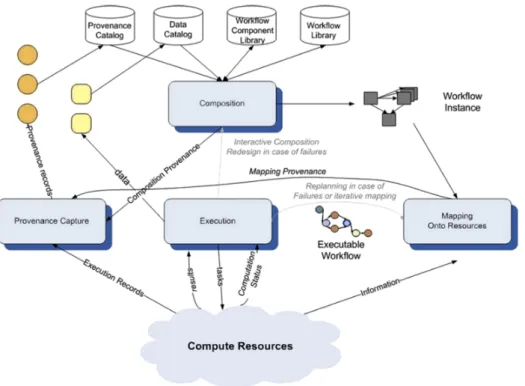
Deelmanet al. [34] postulate that workflows have enabled the automation of data building processes and their associated provenance. The authors classified the lifecycle of a typical workflow into four stages as shown in Figure 2.1.
Figure 2.1: Workflow lifecycle comprised of four stages: composition, mapping, execution and provenance capture where the last stage can overlap with the pre-vious stages
We consider the aspects of a typical workflow lifecycle.
• Composition, Representation and Data Model: The first stage is to create a workflow either from scratch or by re-using existing workflows obtained from collaborators or open access repositories. The users can use various composition methods, e.g. workflow language representations, higher level scripting languages or Graphical User Interfaces (GUI). The representation of the workflow is most commonly given as a Directed Cyclic Graph (DCG) or as a Directed Acyclic Graph (DAG). It is the composition stage when workflow authors define whether the workflow is data-driven (the task de-pendencies and connections are managed by the flow of data from one task to the other) or control-driven (flow of control such that execution of a given task depends on completion of the preceding task).
• Mapping: This stage allows users to either perform resource mapping for a workflow execution directly or use a system which is designed for work-flow execution. The composition should ideally result in anabstract workflow
that can be mapped to any target execution environment. Mapping results in resource bindings to the available resources such as tools, compute, stor-age, external services, etc. Deelmanet al.discuss partitioning the workflow into ”sub-workflows” before mapping occurs to improve scheduling in case of distributed computing and if possible, running the tasks in parallel. • Execution:Once the workflow has been mapped to the available resources,
it can be executed (often referred to as ”enacted”) using an execution engine or any enactment system. An important aspect at this stage is utilising fault tolerance which can be at the Operating System (OS) level, at the applica-tion/tool level or in the workflow itself.
• Metadata and Provenance: The lifecycle of a scientific workflow comes to fruition with the collection of metadata and provenance information. Deel-man et al. argue that if a data artefact was generated by a workflow, then there must be a way to store the history of the creation process. They used three key terms for provenance: Data Provenance, Design Provenance and
Workflow Execution Provenance. The authors also believe that although this stage is categorised separately, it can overlap the first three stages includ-ing collectinclud-ing data, metadata and provenance information throughout the workflow lifecycle.
A similar classification of the scientific workflow lifecycle is put forward by Ludascher et al. [66]. The authors state that each workflow is directed towards achieving an experimental goal or testing a scientific hypothesis. They identify four key stages: workflow design and composition, workflow resource planning, work-flow execution,workflow execution analysisandworkflow and result sharing. The
work-flow design and compositionis equivalent to theComposition, Representation and Data Model stage presented by Deelman et al.. The workflow resource planning is well aligned with the Mapping and workflow execution with the Execution stage. The fourth stageworkflow execution analysisfocuses on analysis, debugging and evalu-ation of data products, execution traces and data dependencies on the workflow. The last stage in this case is more analysis-oriented and uses metadata and prove-nance information, unlike the fourth stage by Deelmanet al. where the focus is only on collection of such details but not the post-analysis part of the workflow cycle. The fifth stageworkflow and method sharing refers to publishing and mak-ing the methods and data used in an experiment available, ideally via a shared repository.
Cuevas-Vicentt´ın et al. [3] also assert that scientific workflowdesign and man-agement has become an essential part of many computationally driven data-intensive analyses, enabling Automation, Scaling, Adaptationand Provenance sup-port (ASAP). The authors identify that the goals of scientific workflows are in facilitating easy workflow design, re-use, scalable execution and ultimately repro-ducible scienceexplicitly through provenance support.
Davidson at al. [68] illustrate the importance of provenance information of a workflow by discussing its uses. The authors put forward the idea that not only can provenance be used for data interpretation, but also for trouble-shooting and optimising efficiency. For example, multiple re-runs of a workflow for evaluation and experimental purposes can typically require altering the parameter space for any tool. In this case, the provenance can improve efficiency by providing infor-mation about a specific checkpoint in a workflow run and re-running the work-flow from that point. Alper et al. [69] indicate that, using provenance traces of workflows when generating a dataset, it is possible to automatically satisfy the requirements of provenance and context of metadata provision along with the
published dataset. This was also identified by the Open Archival Information System (OAIS) Reference Model [70].
2.2.1.2.3 Provenance and Scientific Workflows
It is evident from the above studies that provenance capture is considered an es-sential feature of scientific workflows. The termcomputational provenancehas been re-defined, categorised, and updated to cater the specialised needs and require-ments of workflow-centric research.
Simmhan et al. [45] defined workflow provenance with respect to scientific data analysis in the context of Service-oriented Architecture (SOA) as:
“metadata describing the workflows execution and associated service invocations. Workflow provenance typically includes information on the services invoked, the order and time of invocations, parameters passed and returned, and faults that occurred, among others.”
Theservicesin this definition can be replaced by any pre-built local computa-tional tool used to achieve a task in the workflow if a SOA is not used for work-flow execution. Another closely related definition of scientific workwork-flow is put forward by Boher in his art


![Figure 2.2: An example workflow adapted from [54] to show the coarse-grained nature of workflow provenance](https://thumb-us.123doks.com/thumbv2/123dok_us/630633.2575959/58.892.209.736.184.451/figure-example-workflow-adapted-coarse-grained-workflow-provenance.webp)
![Figure 2.3: Example data-flow workflow defined in the Common Workflow Lan- Lan-guage [31] depicting prospective provenance](https://thumb-us.123doks.com/thumbv2/123dok_us/630633.2575959/60.892.213.722.189.600/figure-example-workflow-defined-workflow-depicting-prospective-provenance.webp)
![Figure 2.5: Artifacts represented by ellipses and processes as rectangles can be linked to each other other and edges are labelled based on the nature of the de-pendency [103]](https://thumb-us.123doks.com/thumbv2/123dok_us/630633.2575959/71.892.324.619.198.620/figure-artifacts-represented-ellipses-processes-rectangles-labelled-pendency.webp)
![Figure 2.6: Core concepts of the PROV Data Model. Adapted from W3C PROV Model Primer [114].](https://thumb-us.123doks.com/thumbv2/123dok_us/630633.2575959/73.892.250.693.188.490/figure-core-concepts-prov-model-adapted-model-primer.webp)
