David Alexander Molnar
Electrical Engineering and Computer Sciences
University of California at Berkeley
Technical Report No. UCB/EECS-2009-157
http://www.eecs.berkeley.edu/Pubs/TechRpts/2009/EECS-2009-157.html
November 12, 2009
Permission to make digital or hard copies of all or part of this work for
personal or classroom use is granted without fee provided that copies are
not made or distributed for profit or commercial advantage and that copies
bear this notice and the full citation on the first page. To copy otherwise, to
republish, to post on servers or to redistribute to lists, requires prior specific
permission.
Acknowledgement
I could not have done this work without my advisors and mentors David
Wagner, Patrice Godefroid, and Michael Levin. I could also not have done
this without my PhD committee members Sanjit Seshia and David Aldous.
Thank you, all of you.
by
David Alexander Molnar
A.B. (Harvard College) 2003
M.S. (University of California, Berkeley) 2006
A dissertation submitted in partial satisfaction of the requirements for the degree of
Doctor of Philosophy in Computer Science in the GRADUATE DIVISION of the
UNIVERSITY OF CALIFORNIA, BERKELEY
Committee in charge: Professor David A. Wagner, Chair
Professor Sanjit Seshia Professor David Aldous
Chair Date
Date
Date
University of California, Berkeley
Copyright 2009 by
Abstract
Dynamic Test Generation for Large Binary Programs
by
David Alexander Molnar
Doctor of Philosophy in Computer Science
University of California, Berkeley
Professor David A. Wagner, Chair
This thesis develops new methods for addressing the problem of software security bugs, shows that these methods scale to large commodity software, and lays the foundation for a service that makes automatic, effective security testing available at a modest cost per bug found. We make the following contributions:
• We introduce a new search algorithm for systematic test generation that is optimized for large applications with large input files and exhibiting long execution traces where the search is bound to be incomplete (Chapter 2);
• We introduce optimizations for checking multiple properties of a program simultane-ously using dynamic test generation, and we formalize the notion of active property checking (Chapter 3);
• We describe the implementation of tools that implement dynamic test generation of large binary programs for Windows and for Linux: SAGE and SmartFuzz. We
explain the engineering choices behind their symbolic execution algorithm and the key optimization techniques enabling both tools to scale to program traces with hundreds of millions of instructions (Chapters 2 and 4);
• We develop methods for coordinating large scale experiments with fuzz testing tech-niques, including methods to address the defect triage problem (Chapter 4);
Professor David A. Wagner Dissertation Committee Chair
To my family,
who have always been there,
Contents
List of Figures iv
List of Tables viii
1 Introduction 1
1.1 Whitebox Fuzz Testing . . . 3
1.2 Active Property Checking . . . 5
1.3 Putting It All Together . . . 8
1.4 SMT Solvers and Security . . . 10
1.5 Contributions and Statement on Joint Work . . . 11
2 Automated Whitebox Fuzz Testing 13 2.1 A Whitebox Fuzzing Algorithm . . . 13
2.1.1 Limitations . . . 16
2.1.2 Generational Search . . . 17
2.2 The SAGE System . . . 23
2.2.1 System Architecture . . . 23
2.2.2 Trace-based x86 Constraint Generation . . . 24
2.2.3 Constraint Generation . . . 26
2.2.4 Constraint Optimization . . . 29
2.3 Experiments . . . 32
2.3.1 Initial Experiences . . . 33
2.3.2 Experiment Setup . . . 36
2.3.3 Results and Observations . . . 38
2.4 Other Related Work . . . 42
2.5 Conclusion . . . 44
2.6 Additional Search Statistics . . . 45
3 Active Property Checking 51 3.1 Introduction . . . 51
3.2 Systematic Dynamic Test Generation . . . 56
3.4 Active Type Checking . . . 63
3.4.1 Judgments and Rules . . . 65
3.5 Optimizations . . . 82
3.5.1 Minimizing Calls to the Constraint Solver . . . 82
3.5.2 Minimizing Formulas . . . 85 3.5.3 Caching Strategies . . . 87 3.6 Implementation . . . 89 3.7 Evaluation . . . 92 3.7.1 Microbenchmarks . . . 93 3.7.2 Macrobenchmarks . . . 97 3.8 Conclusion . . . 102
4 Integer Bugs, Linux Programs, and Reporting at Scale 104 4.1 Introduction . . . 104
4.2 Integer Bugs . . . 109
4.3 Related Work . . . 111
4.4 Dynamic Test Generation . . . 114
4.4.1 Architecture . . . 115
4.4.2 Design Choices . . . 117
4.5 Techniques for Finding Integer Bugs . . . 122
4.6 Triage and Reporting at Scale . . . 126
4.6.1 Problems and Techniques . . . 126
4.7 Results . . . 130 4.7.1 Preliminary Experience . . . 130 4.7.2 Experiment Setup . . . 131 4.7.3 Bug Statistics . . . 133 4.7.4 SmartFuzz Statistics . . . 141 4.7.5 Solver Statistics . . . 143 4.8 Conclusion . . . 144 5 Conclusion 145 5.1 Whitebox Fuzz Testing: Future Directions . . . 145
5.1.1 More Application Classes . . . 146
5.1.2 The Unreasonable Effectiveness of SMT Solvers . . . 147
5.1.3 Learning and Hot Spot Prioritization . . . 148
5.1.4 State explosion . . . 149
5.1.5 When Should We Stop Testing? . . . 149
5.1.6 Cooperative Whitebox Fuzz Testing . . . 150
5.1.7 Streaming Algorithms and Whitebox Fuzzing . . . 151
5.2 Beyond Bug Finding . . . 151
5.3 Final Thoughts . . . 152
List of Figures
2.1 Example of program. . . 14
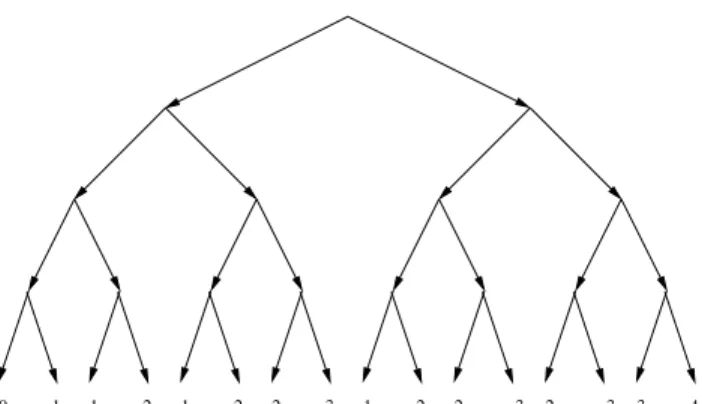
2.2 Search space for the example of Figure 2.1 with the value of the variable cnt at the end of each run and the corresponding input string. . . 15
2.3 Search algorithm. . . 18
2.4 Computing new children. . . 19
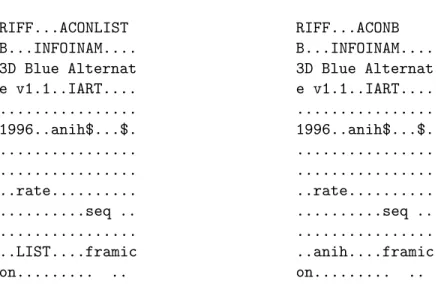
2.5 On the left, an ASCII rendering of a prefix of the seed ANI file used for our search. On the right, the SAGE-generated crash for MS07-017. Note how the SAGE test case changes the LIST to an additional anih record on the next-to-last line. . . 34
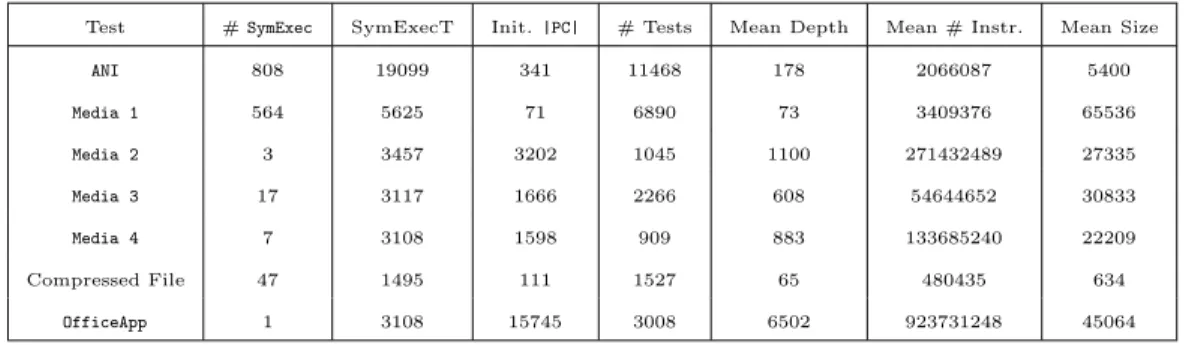
2.6 Statistics from 10-hour searches on seven test applications, each seeded with a well-formed input file. We report the number of SymbolicExecutortasks during the search, the total time spent in all SymbolicExecutor tasks in seconds, the number of constraints generated from the seed file, the total number of test cases generated, the mean depth per test case in number of constraints, the mean number of instructions executed after reading the input file, and the mean size of the symbolic input in bytes. . . 35
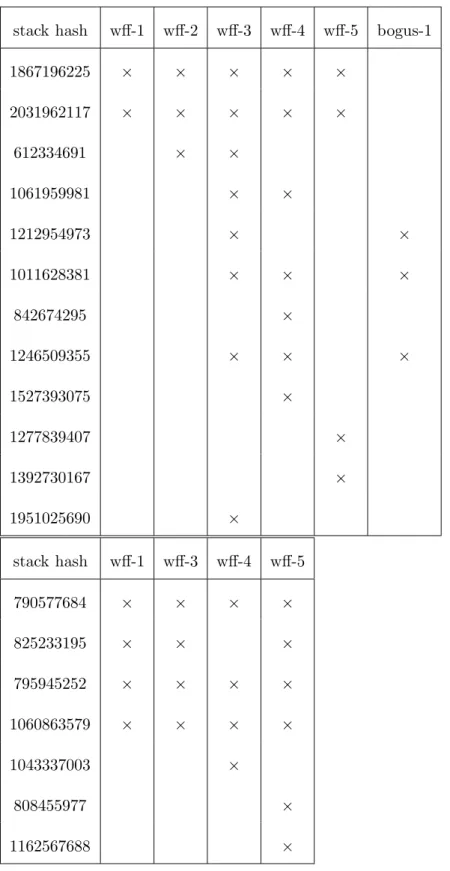
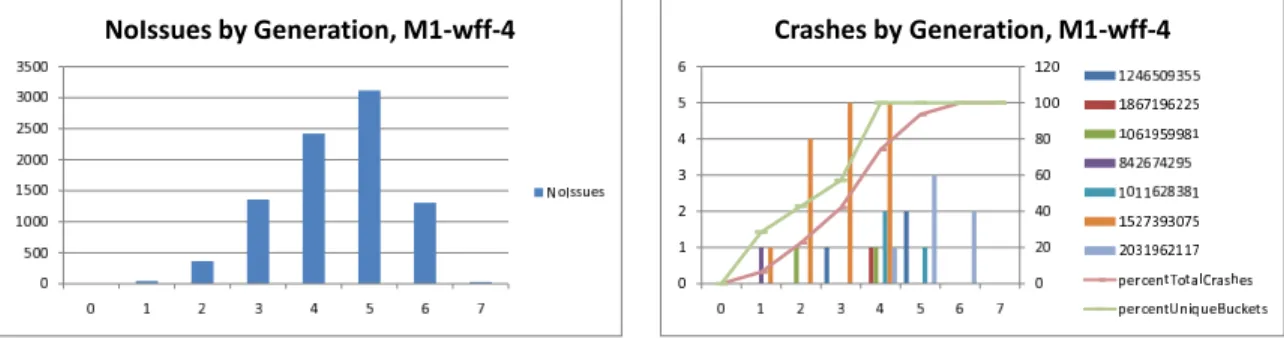
2.7 SAGE found 12 distinct stack hashes (shown left) from 357 Media 1 crashing files and 7 distinct stack hashes (shown right) from 88 Media 2 crashing files. 47 2.8 Histograms of test cases and of crashes by generation for Media 1 seeded with wff-4. . . 48
2.9 Coverage and initial discovery of stack hashes for Media 1 seeded withwff-4 andwff-2. The leftmost bar represents multiple distinct crashes found early in the search; all other bars represent a single distinct crash first found at this position in the search. . . 48
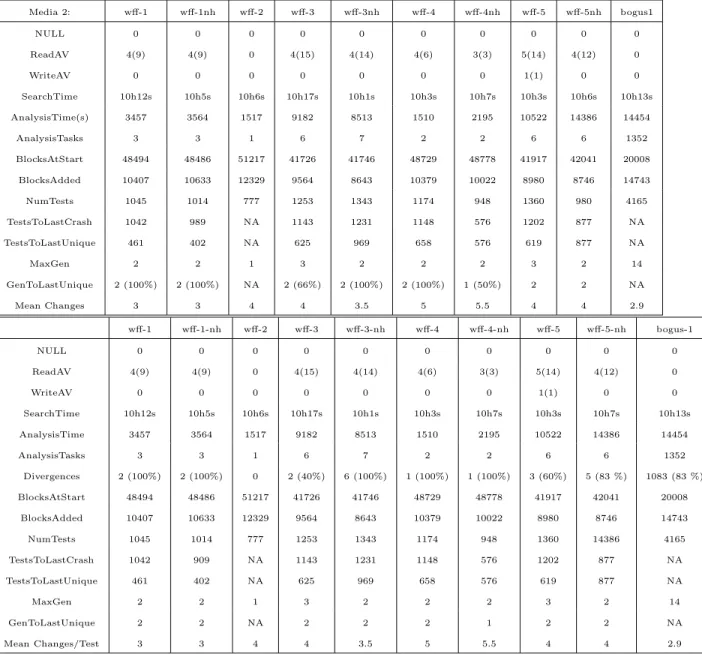
2.10 Search statistics for Media 1. . . 49
2.11 Search statistics for Media 2. . . 50
3.1 Example of program with buffer overflows. . . 59
3.3 A small program with an active check for division by zero. The left column shows the original program. The middle column shows the program with a type cast inserted as an assignment guard. The right column shows the values of the path condition pc and the set of checker expressionsch for the
input α= 2. . . 65
3.4 Judgments. . . 66
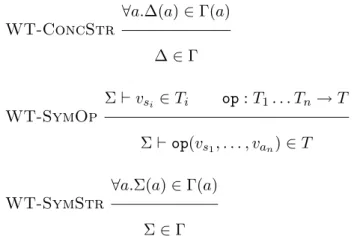
3.5 Typing judgments for concrete and symbolic stores. . . 69
3.6 Rules for checking type guards and updating checkers. . . 69
3.7 Type rules. . . 71
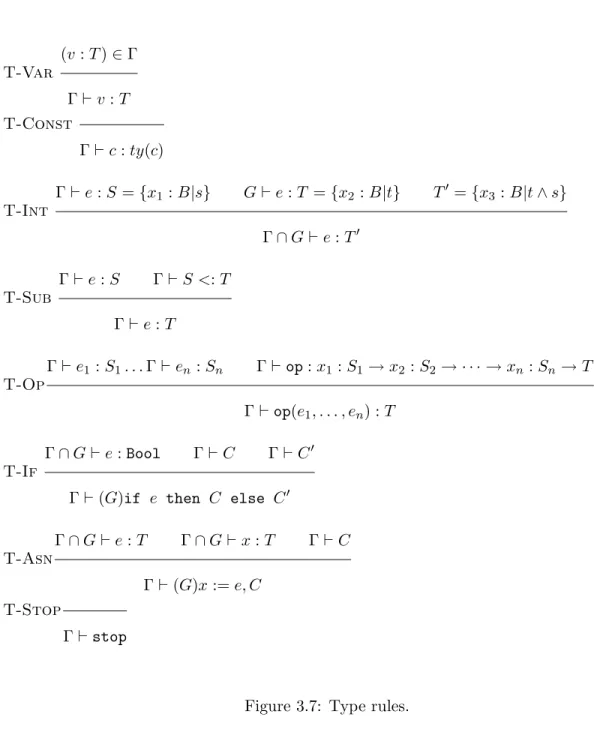
3.8 Rules for consistent substitution and subtyping. . . 72
3.9 Evaluation rules. TheE-IFTrueandE-IFFalserules use the concrete state to specify how to update the path condition pcand check guards during the evaluation of the condition e. The E-CHK-Asn rule shows evaluation of type casts. During evaluation, if a cast hTiie fails, evaluation stops. Oth-erwise, each cast updates the set of checker constraints ch with a symbolic membership check for the typehTii. . . 74
3.10 Rules for compilation with type cast insertion. Casts are inserted on as-signments, operator arguments, and on operator return values. The special variable resrepresents the result of an operator evaluation. While we show only the rules for when all arguments or no arguments require casts, we allow any subset of arguments to have casts inserted. . . 75
3.11 Type and implementation for the division operator. . . 76
3.12 Types for an integer overflow checker. . . 77
3.13 Function to compute a strongly-sound combination of active checkers. . . . 83
3.14 A program with O(2k) possible execution paths. A naive application of a NULL dereference active checker results in O(k·2k) additional calls to the constraint solver, while local constraint caching eliminates the need for any additional calls to the constraint solver. . . 87
3.15 Active checkers implemented. . . 90
3.16 Statistics from a single symbolic execution and test generation task with a naive combination of all 13 checkers. We report the checker types that injected constraints, the total time for symbolic execution test generation, the number of constraints in the total path constraint, the total number of injected checker constraints, the number of tests generated, the number of instructions executed after the first file read, and the number of symbolic input bytes. . . 93
3.17 Microbenchmark statistics. . . 94
3.18 Crash buckets found for Media 1 by 10-hour searches with “No” active check-ers, with a “W”eak and “S”trong combinations of active checkers. A total of 41658 tests were generated and tested in 30 hours, with 783 crashing files in 12 buckets. . . 98
3.19 Crash buckets found for Media 2 by 10-hours searches with “No” active checkers, with a “W”eak and “S”trong combinations of active checkers. A total of 11849 tests were generated and tested in 30 hours, with 25 crashing files in 4 buckets. . . 98 3.20 Constraints injected by checker types, solved, crashes, and yield for Media 1,
over both weak and strong combination for 10-hour searches. . . 99 3.21 Constraints injected by checker types, solved, crashes, and yield for Media 2,
over both weak and strong combination for 10-hour searches. . . 100 4.1 Examples of three types of integer bugs. . . 111 4.2 Dynamic test generation includes four stages: symbolic execution, solving to
obtain new test cases, then triage to determine whether to report a bug or score the test case for addition to the pool of unexplored test cases. . . 115 4.3 A simple test case for dynamic type inference and query generation. The
signed comparisonn > 800and unsignedsize targument tomemcpyassign the type “Bottom” to the value associated with n. When we solve for an input that makesnnegative, we obtain a test case that reveals the error. . . 123 4.4 The size of our test programs. We report the source lines of code for each
test program and the size of one of our seed files, as measured by David A. Wheeler’s sloccount. Then we run the test program on that seed file and report the total number of branches, x86 instructions, Valgrind IR state-ments, STP assert statestate-ments, and STP query statements for that run. We ran symbolic execution for a maximum of 12 hours, which was sufficient for all programs exceptmplayer, which terminated during symbolic execution. 131 4.5 The number of each query type for each test program after a single 24-hour
run. . . 132 4.6 The number of bugs found, by query type, over all test runs. The fourth
column shows the number of distinct bugs found from test cases produced by the given type of query, as classified using our fuzzy stack hash. . . 134 4.7 The number of bugs, after fuzzy stack hashing, found by SmartFuzz (the
number on the left in each column) andzzuf(the number on the right). We also report the cost per bug, assuming $0.10 per small compute-hour, $0.40 per large compute-hour, and 3 runs of 24 hours each per target for each tool. 136 4.8 The number of bugs found by zzuf on two different sets of 24 hour
experi-ments with three seed files. The number on the right in each column is the number of bug buckets found in the first set of experiments of each type. The number on the left is the number of bug buckets of each type found in the second set. . . 136 4.9 Coverage metrics: the initial number of basic blocks, before testing; the
number of blocks added during testing; and the percentage of blocks added. 140 4.10 The percentage of time spent in each of the phases of SmartFuzz. The second
column reports the total wall-clock time, in seconds, for the run; the remain-ing columns are a percentage of this total. The “other” column includes the time spent solving STP queries. . . 142
4.11 On the left, average query size before and after related constraint optimiza-tion for each test program. On the right, an empirical CDF of solver times. 143
Acknowledgments
I could not have done this work without my advisors and mentors David Wagner, Patrice Godefroid, and Michael Levin. I could also not have done this without my PhD committee members Sanjit Seshia and David Aldous. Thank you, all of you.
I am indebted to Chris Marsh and Dennis Jeffries for important contributions to SAGE, and to Hunter Hudson for championing the SAGE project from the very beginning. SAGE builds on the work of the TruScan team, including Andrew Edwards and Jordan Tigani, and the Disolver team, including Youssf Hamadi and Lucas Bordeaux, for which I am grateful. I thank Tom Ball, Manuvir Das and Jim Larus for their support and feedback on this project. Various internal test teams provided valuable feedback during the development of SAGE, including some of the bugs described here, for which I thank them. I thank Derrick Coetzee, Ben Livshits and David Wagner for their comments on drafts of our paper, and Nikolaj Bjorner and Leonardo de Moura for discussions on constraint solving and using the Z3 solver. I thank Chris Walker for helpful discussions regarding security.
I thank Sanjit Seshia, Doug Tygar, and David Aldous for feedback and advice during this project, and for serving on my qualifying exam committee. I am indebted to Vijay Ganesh and David Dill for the use of the STP tool, and for numerous improvements to STP that dramatically increased performance on our test cases. I thank Jason Waddle, Dean McNamee, Ben Laurie, and Daniel Wilkerson for helpful discussions. I thank posters to the
[email protected] list, including Jared DeMott, Disco Jonny, and Ari Takanen, for discussions on fuzzing tradeoffs. Martin Vuganoux sent me pointers to his
For the work in Chapter4, I thank Cristian Cadar, Daniel Dunbar, Dawson Engler, Patrice Godefoid, Michael Levin, and Paul Twohey for discussions about their respective systems and dynamic test generation. I thank Paul Twohey for helpful tips on the engi-neering of test machines. I thank Chris Karlof for reading a draft of our paper on short notice. I thank the SUPERB TRUST 2008 team for their work with Metafuzz and Smart-Fuzz during Summer 2008. I thank Li-Wen Hsu and Alex Fabrikant for their help with the metafuzz.com web site, and Sushant Shankar, Shiuan-Tzuo Shen, and Mark Winterrowd for their comments. I also thank Erinn Clark, Charlie Miller, Prateek Saxena, Dawn Song, the Berkeley BitBlaze group, and the anonymous referees of Oakland and Usenix Security for feedback on earlier drafts of this work. Chris Kugel served as shepherd for the conference version of this work, for which I am thankful. Xue Cong Li was a joy to work with as an undergraduate research partner and did early work on the infrastructure to power our Amazon EC2 experiments.
In addition, I am pleased to have worked with several great colleagues on projects related to the work in this thesis or which concern the SmartFuzz system but are only tangentially mentioned here. My thanks to Vijay Ganesh, Susmit Jha, Rhishi Limaye, Sushant Shankar, Shiuan-Tzuo Shen, Sanjit Seshia, and Mark Winterrowd.
I have been lucky to receive funding through several different sources over the course of this work. I am thankful to the NSF Graduate Fellowship program, the NSF TRUST center, Microsoft Research, and DARPA for their generous research support.
Without the support of my friends and colleagues, I could not have completed this dissertation. A big thank you to Alex Fabrikant, Nicole Holland, Alex Simma, Jill Blaxton,
Karl Chen, Jimmy Su, Jason Waddle, Christine Robson, the Cult of Levitating Plywood, Noisebridge, and Bab5. Thanks to Arvind Narayanan and Adam Bossy for always being there to talk about commercial ideas. My special thanks to Tracy, my lovely girlfriend, who puts up with my odd schedules, and my inexplicable inability to write at any other time than two in the morning. My apologies to the many other people I have likely have forgotten as an oversight.
Finally, I am indebted to my family. Mom, Dad, Susan, I couldn’t have made it here without you.
Chapter 1
Introduction
This thesis develops new methods for addressing the problem of software security bugs, shows that these methods scale to large commodity software, and it lays the foundation for a service that helps developers protect their users from the dangers of insecure software. Security bugs are examples of vulnerabilities in computer software. A vulnerability is a bug that could potentially be used by an adversary to violate the security policy of a victim’s computer system. An exploit, in contrast, refers to the actual code that uses the vulnerability to violate the security policy. For example, the vulnerability might be a buffer overflow bug in a piece of code that displays image files. An exploit would be a carefully crafted image file that uses the buffer overflow bug to run arbitrary code on the computer processing the image.
Vulnerabilities exist in all types of software, both “traditional” desktop and server software and in software used to develop Web applications. While vulnerabilities in Web software have grown to become the third most commonly reported vulnerability by vendors
in 2005 and 2006 [23], the work of this thesis will focus on vulnerabilities in file-reading, client-side software. This category of software includes such software as image processors, decompression libraries, office document readers, and music players.
We focus on such software because the Internet users often view images, play music, or download files from arbitrary sites. For example, vulnerabilities in a web browser plugin, such as Flash, may allow an adversary to take control of a machine should the user surf to the wrong web site. Nevis Labs notes that recent years have seen fewer public disclosures of “remote” vulnerabilities, i.e. those that could be used without needing user interaction. Because such vulnerabilities appear to be harder to find, Nevis suggests that work will shift to finding bugs in client-side code [58].
Furthermore, despite the availability of memory-safe languages, buffer overflows continue to be prominent. MITRE reports that buffer overflows were the number one issue reported by operating system vendors in 2006 [23]. Symantec’s 2008 threat report states that memory corruption vulnerabilities accounted for the majority of vulnerabilities in browser plug-ins, with 271 vulnerabilities [24]. MITRE also notes thatinteger overflows
jumped from barely in the top 10 issues overall to number 2 for OS vendor advisories in 2006-2007. Later in this thesis, we will develop techniques that are particularly suited for finding integer overflow bugs.
Regardless of the type of software, managing software security bugs requires mul-tiple different approaches. We can organize these approaches using abug cycle as a tool to help understand the relationship of different techniques. In this cycle, we start when when a programmerwrites a buginto a piece of software. The next stage comes when someonefinds
the bug, either through deliberate testing or by accident. After that, we report the bug to the developers, who must thenfix the bug by modifying the software. Future modifications can then introduce new bugs, thereby starting the cycle anew.
Each stage of the bug cycle offers us an opportunity to reduce the severity of software security bugs. For example, there has been intense research into building programs that are correct by construction. This work comes into play at the write bug part of the cycle. If we can use these methods, we should, because they allow us to eliminate security bugs before they have an opportunity to affect software users.
Unfortunately, creating software that is correct by construction is not always prac-tical. For example, we may need to work with legacy software or with software libraries not under our control. Therefore, the work of this thesis focuses on the find and on thereport
stages of the bug cycle. By reducing the cost for software developers to find security bugs, we make it easier to catch bugs before deployment. In particular, we develop a new method for finding bugs in file-reading client side software that automatically discovers bugs missed by human code review, static analysis, and previous dynamic testing methods.
1.1
Whitebox Fuzz Testing
The starting point for our new method of finding bugs is fuzz testing. Since the “Month of Browser Bugs” released a new bug each day of July 2006 [71], fuzz testing has leapt to prominence as a quick and cost-effective method for finding serious security defects in large applications. Fuzz testing is a form of blackbox random testing which randomly mutates well-formed inputs and tests the program on the resulting data [35, 79, 1, 8].
In some cases, grammars are used to generate the well-formed inputs, which also allows encoding application-specific knowledge and test heuristics.
Although fuzz testing can be remarkably effective, the limitations of blackbox test-ing approaches are well-known. For instance, thethenbranch of the conditional statement “if (x==10) then” has only one in 232 chances of being exercised if xis a randomly cho-sen 32-bit input value. This intuitively explains why random testing usually provides low code coverage [77]. In the security context, these limitations mean that potentially serious security bugs, such as buffer overflows, may be missed because the code that contains the bug is not even exercised.
We propose a conceptually simple but different approach ofwhitebox fuzz testing. This work is inspired by recent advances in systematic dynamic test generation [40, 17]. Starting with a fixed input, our algorithm symbolically executes the program, gathering input constraints from conditional statements encountered along the way. The collected constraints are then systematically negated and solved with a constraint solver, yielding new inputs that exercise different execution paths in the program.
For example, symbolic execution of the above fragment on the input x= 0 gen-erates the constraint x6= 10. Once this constraint is negated and solved, it yields x=10, which gives us a new input that causes the program to follow thethenbranch of the given conditional statement. This allows us to exercise and test additional code for security bugs, even without specific knowledge of the input format. Furthermore, this approach automat-ically discovers and tests “corner cases” where programmers may fail to properly allocate memory or manipulate buffers, leading to security vulnerabilities.
In theory, systematic dynamic test generation can lead to full program path cov-erage, giving us program verification [40]. In practice, however, the search is incomplete. The incompleteness stems from the fact that the number of execution paths in the program under test is huge, too large to exhaustively search in a reasonable amount of time with the techniques of this thesis. Furthermore, symbolic execution, constraint generation, and constraint solving are necessarily imprecise.
Therefore, we are forced to explore practical tradeoffs. We propose a novel search algorithm, the generational search, with a coverage-maximizing heuristic designed to find defects as fast as possible. The generational search responds to an engineering reality we have discovered with large applications, which is thatgenerating symbolic traces is expensive, but solving constraints is cheap. Therefore, we want to leverage the expensive work of tracing an application to obtain a path condition over many new test cases. Each test case is a “bite at the apple” that could find a new high value software security bug. In Chapter 2 we describe the generational search, and we show that it is highly effective at finding bugs in commodity software.
1.2
Active Property Checking
The basic dynamic test generation approach creates new test cases which cover different paths through the program. Traditional runtime checking tools like Purify [50], Valgrind [74] and AppVerifier [22], however, check a single program execution against a large set of properties, such as the absence of buffer overflows, use of uninitialized variables or memory leaks. We want a way to generate test cases which violate these properties and
exhibit a bug, if any such test cases exist.
Our insight is that these traditional passive runtime property checkers can be extended toactivelysearch for property violations. Consider the simple program:
int divide(int n,int d) { // n and d are inputs return (n/d); // division-by-zero error if d==0 }
The program divide takes two integers n and d as inputs and computes their division. If the denominator d is zero, an error occurs. To catch this error, a traditional runtime checker for division-by-zero would simply check whether the concrete value of d
satisfies (d==0)just before the division is performed in that specific execution, but would not provide any insight or guarantee concerning other executions. Testing this program with random values for n and d is unlikely to detect the error, as d has only one chance out of 232to be zero if dis a 32-bit integer. Static and dynamic test generation techniques
that attempt to cover specific or all feasible paths in a program will also likely miss the error since this program has a single program path which is covered no matter what inputs are used. However, the latter techniques could be helpful provided that a test if (d==0) error() was inserted before the division (n/d): they could then attempt to generate an input value fordthat satisfies the constraint(d==0), now present in the program path, and detect the error. This is essentially whatactive property checkingdoes: it injectsat runtime
additional symbolic constraints that, when solvable by a constraint solver, will generate new test inputs leading to property violations.
We introduceactive property checking, which extends runtime checking by checking whether the property is satisfied by allprogram executions that follow the same program path. This check is performed on a dynamic symbolic execution of the given program path
using a constraint solver. If the check fails, the constraint solver generates an alternative program input triggering a new program execution that follows the same program path but exhibits a property violation. We call this “active” checking because a constraint solver is used to “actively” look for inputs that cause a runtime check to fail. Chapter 3 describes our formalism for active property checking, as well as reports on the effectiveness of several active checkers.
A particular class of interest for active property checking involves integer bugs. Integer bugs result from a mismatch between machine arithmetic and mathematical arith-metic. For example, machine arithmetic has bounded precision; if an expression has a value greater than the maximum integer that can be represented, the value wraps around to fit in machine precision. This can cause the value stored to be smaller than expected by the programmer. If, for example, a wrapped value is used as an argument tomalloc, the result is an object that is smaller than expected, which can lead to a buffer overflow later if the programmer is not careful. This kind of bug is often known as an integer overflow bug.
Integer overflow bugs recently became the second most common bug type in secu-rity advisories from OS vendors [23]. These kinds of bugs are pervasive and can, in many cases, cause serious security vulnerabilities. Therefore, eliminating such bugs is important for improving software security. Unfortunately, traditional static and dynamic analysis techniques are poorly suited to detecting integer-related bugs. Static analysis yields false positives due to the difficulty of reasoning precisely about integer values for variables, and dynamic analysis may kill program executions that exhibit harmless integer overflows. Dy-namic test generation is better suited to finding such bugs, in contrast, because we can use
active property checking for integer bugs as a way to guide the search but notify a human being only when a test case that crashes the program is found.
We develop new methods for finding a broad class of integer bugs with dynamic test generation. Of special note aresigned/unsigned conversion errors, which are bugs that require reasoning about the entire trace of the program execution. This reasoning goes beyond the scope of our formalism for active property checking in Chapter 3 and requires new ideas. Therefore, we devise methods for performing such reasoning in a memory efficient way that allows us to scale the inference to traces of millions of instructions. In Chapter 4 we describe these methods and report on their effectiveness.
1.3
Putting It All Together
We have implemented whitebox fuzz testing with active property checking in two different systems, both of which scale to applications with millions of instructions in an execution trace. The first is SAGE, short forScalable, Automated, Guided Execution, which a whole-program whitebox file fuzzing tool for x86 Windows applications. The second is SmartFuzz, which is a whole-program file fuzzing tool for Linux applications using the Val-grind framework. Both systems focus on file reading programs such as media players or image conversion tools, but the techniques in this thesis could also apply to networked or distributed applications. In addition to the practical benefits of having the technique avail-able on multiple platforms, the performance of whitebox fuzz testing on different platforms with different implementations gives us information about the technique’s effectiveness in itself, as opposed to the effectiveness of a particular implementation.
Our results show that dynamic test generation is remarkably effective in finding new defects in large applications that were previously well-tested. In particular, Whitebox fuzzing is capable of finding bugs that are beyond the reach of blackbox fuzzers. For instance, without any format-specific knowledge, SAGE detects the critical MS07-017 ANI vulnerability, which was missed by extensive blackbox fuzzing and static analysis.
Furthermore both whitebox and blackbox fuzz testing find so many test cases exhibiting bugs that we must address the bug triage problem. That is, given a test case, is the bug it exhibits new, and if it is new, how serious is it? The bug triage problem is common in static program analysis and blackbox fuzzing, but has not been faced until now in the context of dynamic test generation [40, 17, 81, 70, 57, 46].
To help us prioritize and manage these bug reports and streamline the process of reporting them to developers, we built Metafuzz, a web service for tracking test cases and bugs. Metafuzz helps minimize the amount of human time required to find high-quality bugs and report them to developers, which is important because human time is the most expensive resource in a testing framework. We also develop new methods forbug bucketing, the process of grouping test cases by the bugs they exhibit. We used Metafuzz to coordinate large scale experiments with SmartFuzz and with thezzufblackbox fuzz testing tool, running on the Amazon Elastic Compute Cloud.
Our goal is a service to run dynamic test generation continuously on a wide range of software, automatically finding high-value bugs and reporting them with a minimum of human effort. Our work shows this goal is within reach.
1.4
SMT Solvers and Security
Our work makes use of solvers for satisfiability modulo theories, also known as
SMT solvers. These solvers take sentences that consist of statements in some underlying theory combined with first-order logic connectives. The output of the solver is a model that makes the sentence true. Many recent SMT solvers make use of an underlying solver for Boolean satisfiability, taking advantage of the rapid recent progress in such solvers.
While these kinds of decision procedures have a long and distinguished history, their application to software security is much more recent. For example, Ganapathy et al. created a model for the sprintf function, then used the UCLID solver [13] to find format string vulnerabilities in the function, in which a specially crafted format string causes a memory corruption error. Chirstodorescu et al. also used a decision procedure to identify “semantic no-op” code patterns and defeat code obfuscation [21]. Xie and Aiken use a SAT solver directly to perform static analysis of the entire Linux kernel looking for violations of lock discipline and memory safety errors, which can lead to security vulnerabilities [88]. Such SAT solvers have also found their way into traditional interactive verification tasks [29]. More recently, Heelan has begun applying SMT solvers to the question of generating exploits for known vulnerabilities [51].
Most closely related to our work, DART, EXE, and KLEE also use SMT solvers for creating test cases using dynamic analysis of the code under test [40, 17, 18]. In fact, EXE and KLEE use the same solver, STP, as we do in our SmartFuzz tool. Both DART and the version of the SAGE tool described in this thesis, on the other hand, use a linear equation solver that does not understand the full theory of bitvector arithmetic; non-linear
equations are “concretized” using the values for variables observed on a program run. All of this work depends on the existence of solvers that can quickly handle large instances arising from program analysis. The SMT-COMP competition has been a key factor in spurring advances in such solvers [5]. One of the early fast solvers was Yices, which won the 2006 SMT-COMP competition [32]. More recently, solvers such as STP, z3, and Beaver have been developed specifically for use in software analysis applications [36] [28] [54]. Malik and Zhang survey recent advances in SAT solvers, while Barrett et al. survey the current state of SMT solvers [66, 4].
1.5
Contributions and Statement on Joint Work
This thesis makes the following contributions:
• We introduce a new search algorithm for systematic test generation that is optimized for large applications with large input files and exhibiting long execution traces where the search is bound to be incomplete (Chapter 2);
• We introduce optimizations for checking multiple properties of a program simultane-ously using dynamic test generation, and we formalize the notion of active property checking (Chapter 3);
• We describe the implementation of SAGE and SmartFuzz: the engineering choices behind their symbolic execution algorithm and the key optimization techniques en-abling both tools to scale to program traces with hundreds of millions of instructions (Chapters 2 and 4);
• We develop methods for coordinating large scale experiments with fuzz testing tech-niques, including methods to address the defect triage problem (Chapter 4);
• We report on extensive experiments with these tools, including examples of discovered defects, the effectiveness of active property checking techniques, the performance of the constraint solvers used, and the cost per bug when running fuzz testing with the Amazon Elastic Compute Cloud framework (Chapters 2, 3, and 4).
Chapter 2 is joint work with Patrice Godefroid and Michael Y. Levin, and it appeared at the 2008 Network Distributed Security Systems Conference [43]. Chapter 3 is joint work with Patrice Godefroid and Michael Y. Levin, and it appeared at the 2008 ACM EMSOFT conference [41]. Chapter 4 is joint work with Xue Cong Li and David Wagner, and it appeared at the Usenix Security 2009 conference [69].
The development of the SAGE system was led by Michael Y. Levin. In addition to David Molnar, contributors include Patrice Godefroid, Dennis Jeffries, and Adam Kiezun. The SAGE system builds on the iDNA/Time Travel Debugging and Nirvana infrastructure produced by the Microsoft Center for Software Excellence [7].
The development of the SmartFuzz system was led by David Molnar. In addition to David Molnar, contributors include Xue Cong Li, Sushant Shankar, Shiuan-Tzuo Shen, David Wagner, and Mark Winterrowd. The SmartFuzz system builds on the Valgrind infrastructure produced by Nicholas Nethercote and Julian Seward [74].
Chapter 2
Automated Whitebox Fuzz Testing
2.1
A Whitebox Fuzzing Algorithm
Consider the program shown in Figure 2.1. This program takes 4 bytes as input and contains an error when the value of the variablecntis greater than or equal to3at the end of the functiontop. Running the program with random values for the 4 input bytes is unlikely to discover the error: there are 5 values leading to the error out of 2(8∗4) possible
values for 4 bytes, i.e., a probability of about 1/230 to hit the error with random testing,
including blackbox fuzzing. This problem is typical of random testing: it is difficult to generate input values that will drive the program through all its possible execution paths.
In contrast, whitebox dynamic test generation can easily find the error in this program: it consists in executing the program starting with some initial inputs, performing a dynamic symbolic execution to collect constraints on inputs gathered from predicates in branch statements along the execution, and then using a constraint solver to infer variants of the previous inputs in order to steer the next executions of the program towards alternative
void top(char input[4]) { int cnt=0; if (input[0] == ’b’) cnt++; if (input[1] == ’a’) cnt++; if (input[2] == ’d’) cnt++; if (input[3] == ’!’) cnt++; if (cnt >= 3) abort(); // error }
Figure 2.1: Example of program.
program branches. This process is repeated until a given specific program statement or path is executed [57, 46], or until all (or many) feasible program paths of the program are exercised [40, 17].
For the example above, assume we start running the functiontopwith the initial 4-letters stringgood. Figure 2.2 shows the set of all feasible program paths for the function
top. The leftmost path represents the first run of the program on input goodand corre-sponds to the program path ρ including all 4 else-branches of all conditional if-statements in the program. The leaf for that path is labeled with 0to denote the value of the variable
cnt at the end of the run. Intertwined with the normal execution, a symbolic execution collects the predicates i0 6=b, i1 6=a, i2 6=d and i3 6= ! according to how the conditionals
evaluate, and where i0, i1, i2 and i3 are symbolic variables that represent the values of the
bad! 0 1 1 2 1 2 2 3 1 2 2 3 2 3 3 4 good goo! godd god! gaod gao! gadd gad! bood boo! bodd bod! baod bao! badd
Figure 2.2: Search space for the example of Figure 2.1 with the value of the variablecntat the end of each run and the corresponding input string.
respectively.
The path constraintφρ=hi0 6=b, i1 =6 a, i2 6=d, i3 6= !i represents an equivalence
class of input vectors, namely all the input vectors that drive the program through the path that was just executed. To force the program through a different equivalence class, one can calculate a solution to a different path constraint, say, hi0 6= b, i1 =6 a, i2 6= d, i3 = !i
obtained by negating the last predicate of the current path constraint. A solution to this path constraint is (i0 = g, i1 = o, i2 = o, i3 = !). Running the program top with this
new input goo! exercises a new program path depicted by the second leftmost path in Figure 2.2. By repeating this process, the set of all 16 possible execution paths of this program can be exercised. If this systematic search is performed in depth-first order, these 16 executions are explored from left to right on the Figure. The error is then reached for the first time with cnt==3during the 8th run, and full branch/block coverage is achieved after the 9th run.
2.1.1 Limitations
Systematic dynamic test generation [40, 17] as briefly described above has two main limitations.
Path explosion: systematically executing all feasible program paths does not scale to large, realistic programs. Path explosion can be alleviated by performing dynamic test generation compositionally [38], by testing functions in isolation, encoding test results asfunction summariesexpressed using function input preconditions and output postcondi-tions, and then re-using those summaries when testing higher-level functions. Although the use of summaries in software testing seems promising, achieving full path coverage when testing large applications with hundreds of millions of instructions is still problematic within a limited search period, say, one night, even when using summaries.
Imperfect symbolic execution: symbolic execution of large programs is bound to be imprecise due to complex program statements (pointer manipulations, arithmetic oper-ations, etc.) and calls to operating-system and library functions that are hard or impossible to reason about symbolically with good enough precision at a reasonable cost. Whenever symbolic execution is not possible, concrete values can be used to simplify constraints and carry on with a simplified, partial symbolic execution [40]. Randomization can also help by suggesting concrete values whenever automated reasoning is difficult. Whenever an actual execution path does not match the program path predicted by symbolic execution for a given input vector, we say that a divergence has occurred. A divergence can be detected by recording a predicted execution path as a bit vector (one bit for each conditional branch outcome) and checking that the expected path is actually taken in the subsequent test run.
2.1.2 Generational Search
We now present a new search algorithm that is designed to address these fun-damental practical limitations. Specifically, our algorithm has the following prominent features:
• it is designed to systematically yet partially explore the state spaces of large appli-cations executed with large inputs (thousands of symbolic variables) and with very deep paths (hundreds of millions of instructions);
• it maximizes the number of new tests generated from each symbolic execution (which are long and expensive in our context) while avoiding any redundancy in the search; • it uses heuristics to maximize code coverage as quickly as possible, with the goal of
finding bugs faster;
• it is resilient to divergences: whenever divergences occur, the search is able to recover and continue.
This new search algorithm is presented in two parts in Figures 2.3 and 2.4. The main Search procedure of Figure 2.3 is mostly standard. It places the initial in-put inputSeed in a workList (line 3) and runs the program to check whether any bugs are detected during the first execution (line 4). The inputs in the workList are then pro-cessed (line 5) by selecting an element (line 6) and expanding it (line 7) to generate new inputs with the functionExpandExecutiondescribed later in Figure 2.4. For each of those
childInputs, the program under test is run with that input. This execution is checked for errors (line 10) and is assigned aScore(line 11), as discussed below, before being added to
1 Search(inputSeed){
2 inputSeed.bound = 0;
3 workList = {inputSeed};
4 Run&Check(inputSeed);
5 while (workList not empty) {//new children
6 input = PickFirstItem(workList);
7 childInputs = ExpandExecution(input);
8 while (childInputs not empty) {
9 newInput = PickOneItem(childInputs);
10 Run&Check(newInput);
11 Score(newInput);
12 workList = workList + newInput;
13 }
14 }
15 }
Figure 2.3: Search algorithm.
theworkList(line 12) which is sorted by those scores.
The main originality of our search algorithm is in the way children are expanded as shown in Figure 2.4. Given aninput(line 1), the function ExpandExecutionsymbolically executes the program under test with that input and generates a path constraint PC (line 4) as defined earlier. PC is a conjunction of |PC| constraints, each corresponding to a conditional statement in the program and expressed using symbolic variables representing values of input parameters. Then, our algorithm attempts to expand every constraint in
1 ExpandExecution(input) {
2 childInputs = {};
3 // symbolically execute (program,input)
4 PC = ComputePathConstraint(input);
5 for (j=input.bound; j < |PC|; j++) {
6 if((PC[0..(j-1)] and not(PC[j]))
has a solution I){
7 newInput = input + I;
8 newInput.bound = j;
9 childInputs = childInputs + newInput;
10 }
11 return childInputs;
12 }
Figure 2.4: Computing new children.
the path constraint (at a position j greater or equal to a parameter called input.bound
which is initially 0). This is done by checking whether the conjunction of the part of the path constraint prior to the jth constraint PC[0..(j-1)]and of the negation of the jth constraint not(PC[j])is satisfiable. If so, a solution Ito this new path constraint is used to update the previous solution input while values of input parameters not involved in the path constraint are preserved (this update is denoted by input + I on line 7). The resulting new input value is saved for future evaluation (line 9).
In other words, starting with an initial inputinputSeedand initial path constraint
|PC|constraints inPC, instead of just the last one with adepth-first search, or the first one with abreadth-first search. To prevent these child sub-searches from redundantly exploring overlapping parts of the search space, a parameter bound is used to limit the backtracking of each sub-search above the branch where the sub-search started off its parent. Because each execution is typically expanded with many children, we call such a search order a
generational search.
Consider again the program shown in Figure 2.1. Assuming the initial input is the 4-letters string good, the leftmost path in the tree of Figure 2.2 represents the first run of the program on that input. From this parent run, a generational search generates four first-generation children which correspond to the four paths whose leafs are labeled with1. Indeed, those four paths each correspond to negatingoneconstraint in the original path constraint of the leftmost parent run. Each of those first generation execution paths can in turn be expanded by the procedure of Figure 2.4 to generate (zero or more) second-generation children. There are six of those and each one is depicted with a leaf label of 2
to the right of their (first-generation) parent in Figure 2.2. By repeating this process, all feasible execution paths of the functiontopare eventually generated exactly once. For this example, the value of the variablecntdenotes exactly the generation number of each run. Since the procedure ExpandExecution of Figure 2.4 expands all constraints in the current path constraint (below the current bound) instead of just one, it maximizes the number of new test inputs generated from each symbolic execution. Although this optimization is perhaps not significant when exhaustively exploring all execution paths of small programs like the one of Figure 2.1, it is important when symbolic execution takes a
long time, as is the case for large applications where exercising all execution paths is virtually hopeless anyway. This point will be further discussed in Section 2.2 and illustrated with the experiments reported in Section 2.3.
In this scenario, we want to exploit as much as possible the first symbolic execution performed with an initial input and to systematically explore all its first-generation children. This search strategy works best if that initial input is well formed. Indeed, it will be more likely to exercise more of the program’s code and hence generate more constraints to be negated, thus more children, as will be shown with experiments in Section 2.3. The importance given to the first input is similar to what is done with traditional, blackbox fuzz testing, hence our use of the term whitebox fuzzing for the search technique introduced in this paper.
The expansion of the children of the first parent run is itself prioritized by using a heuristic to attempt to maximize block coverage as quickly as possible, with the hope of finding more bugs faster. The function Score (line 11 of Figure 2.3) computes the incremental block coverage obtained by executing the newInput compared to all previous runs. For instance, anewInputthat triggers an execution uncovering 100 new blocks would be assigned a score of 100. Next, (line 12), the newInput is inserted into the workList
according to its score, with the highest scores placed at the head of the list. Note that all children compete with each other to be expanded next, regardless of their generation number.
Our block-coverage heuristic is related to the “Best-First Search” of EXE [17]. However, the overall search strategy is different: while EXE uses a depth-first search that
occasionally picks the next child to explore using a block-coverage heuristic, a generational search tests all children of each expanded execution, and scores their entire runs before picking the best one from the resultingworkList.
The block-coverage heuristics computed with the functionScorealso helps dealing with divergencesas defined in the previous section, i.e., executions diverging from the ex-pected path constraint to be taken next. The occurrence of a single divergence compromises the completeness of the search, but this is not the main issue in practice since the search is bound to be incomplete for very large search spaces anyway. A more worrisome issue is that divergences may prevent the search from making any progress. For instance, a depth-first search which diverges from a path p to a previously explored path p′ would cycle forever
between that path p′ and the subsequent divergent run p. In contrast, our generational
search tolerates divergences and can recover from this pathological case. Indeed, each run spawns many children, instead of a single one as with a depth-first search, and, if a child run pdivergences to a previous onep′, that childpwill have a zero score and hence be placed at
the end of theworkListwithout hampering the expansion of other, non-divergent children. Dealing with divergences is another important feature of our algorithm for handling large applications for which symbolic execution is bound to be imperfect/incomplete, as will be demonstrated in Section 2.3.
Finally, we note that a generational search parallelizes well, since children can be checked and scored independently; only the work list and overall block coverage need to be shared.
2.2
The SAGE System
The generational search algorithm presented in the previous section has been im-plemented in a new tool named SAGE, which stands forScalable, Automated, Guided Exe-cution. SAGE can test any file-reading program running on Windows by treating bytes read from files as symbolic inputs. Another key novelty of SAGE is that it performs symbolic execution of program traces at the x86 binary level. This section justifies this design choice by arguing how it allows SAGE to handle a wide variety of large production applications. This design decision raises challenges that are different from those faced by source-code level symbolic execution. We describe these challenges and show how they are addressed in our implementation. Finally, we outline key optimizations that are crucial in scaling to large programs.
2.2.1 System Architecture
SAGE performs a generational search by repeating four different types of tasks. The Tester task implements the function Run&Check by executing a program under test on a test input and looking for unusual events such as access violation exceptions and extreme memory consumption. The subsequent tasks proceed only if the Tester task did not encounter any such errors. IfTesterdetects an error, it saves the test case and performs automated triage as discussed in Section 2.3.
TheTracer task runs the target program on the same input file again, this time recording a log of the run which will be used by the following tasks to replay the program execution offline. This task uses theiDNAframework [7] to collect complete execution traces
at the machine-instruction level.
The CoverageCollector task replays the recorded execution to compute which basic blocks were executed during the run. SAGE uses this information to implement the functionScore discussed in the previous section.
Lastly, theSymbolicExecutortask implements the function ExpandExecutionof Section 2.1.2 by replaying the recorded execution once again, this time to collect input-related constraints and generate new inputs using the constraint solver Disolver[49].
Both the CoverageCollector and SymbolicExecutor tasks are built on top of the trace replay frameworkTruScan [73] which consumes trace files generated byiDNAand virtually re-executes the recorded runs. TruScan offers several features that substantially simplify symbolic execution. These include instruction decoding, providing an interface to program symbol information, monitoring various input/output system calls, keeping track of heap and stack frame allocations, and tracking the flow of data through the program structures.
2.2.2 Trace-based x86 Constraint Generation
SAGE’s constraint generation differs from previous dynamic test generation imple-mentations [40, 81, 17] in two main ways. First, instead of a source-based instrumentation, SAGE adopts a machine-code-basedapproach for three main reasons:
Multitude of languages and build processes. Source-based instrumentation must support the specific language, compiler, and build process for the program under test. There is a large upfront cost for adapting the instrumentation to a new language, compiler, or build tool. Covering many applications developed in a large company with a variety of
incompatible build processes and compiler versions is a logistical nightmare. In contrast, a machine-code based symbolic-execution engine, while complicated, need be implemented only once per architecture. As we will see in Section 2.3, this choice has let us apply SAGE to a large spectrum of production software applications.
Compiler and post-build transformations. By performing symbolic execution on the binary code that actually ships, SAGE makes it possible to catch bugs not only in the target program but also in the compilation and post-processing tools, such as code obfuscators and basic block transformers, that may introduce subtle differences between the semantics of the source and the final product.
Unavailability of source. It might be difficult to obtain source code of third-party components, or even components from different groups of the same organization. Source-based instrumentation may also be difficult for self-modifying or JITed code. SAGE avoids these issues by working at the machine-code level. While source code does have information about types and structure not immediately visible at the machine code level, we do not need this information for SAGE’s path exploration.
Second, instead of an online instrumentation, SAGE adopts anoffline trace-based
constraint generation. With online generation, constraints are generated as the program is executed either by statically injected instrumentation code or with the help of dynamic binary instrumentation tools such as Nirvana [7] orValgrind[74] (Catchconvis an example of the latter approach [70].) SAGE adopts offline trace-based constraint generation for two reasons. First, a single program may involve a large number of binary components some of which may be protected by the operating system or obfuscated, making it hard to
replace them with instrumented versions. Second, inherent nondeterminism in large target programs makes debugging online constraint generation difficult. If something goes wrong in the constraint generation engine, we are unlikely to reproduce the environment leading to the problem. In contrast, constraint generation in SAGE is completely deterministic because it works from the execution trace that captures the outcome of all nondeterministic events encountered during the recorded run.
2.2.3 Constraint Generation
SAGE maintains the concrete and symbolic state of the program represented by a pair of stores associating every memory locations and registers to a byte-sized value and a symbolic tag respectively. A symbolic tag is an expression representing either an input value or a function of some input value. SAGE supports several kinds of tags: input(m) represents the mth byte of the input; c represents a constant; t1 op t2 denotes the result
of some arithmetic or bitwise operation op on the values represented by the tags t1 and
t2; the sequence tag ht0. . . tni where n = 1 or n = 3 describes a word- or
double-word-sized value obtained by grouping byte-double-word-sized values represented by tags t0. . . tm together;
subtag(t, i) wherei ∈ {0. . .3} corresponds to the i-th byte in the word- or double-word-sized value represented by t. Note that SAGE does not currently reason about symbolic pointer dereferences. SAGE defines a fresh symbolic variable for each non-constant symbolic tag. Provided there is no confusion, we do not distinguish a tag from its associated symbolic variable in the rest of this section.
As SAGE replays the recorded program trace, it updates the concrete and symbolic stores according to the semantics of each visited instruction.
In addition to performing symbolic tag propagation, SAGE also generates con-straints on input values. Constraints are relations over symbolic variables; for example, given a variable xthat corresponds to the tag input(4), the constraint x <10 denotes the fact that the fifth byte of the input is less than 10.
When the algorithm encounters an input-dependent conditional jump, it creates a constraint modeling the outcome of the branch and adds it to the path constraint composed of the constraints encountered so far.
The following simple example illustrates the process of tracking symbolic tags and collecting constraints.
# read 10 byte file into a
# buffer beginning at address 1000
mov ebx, 1005
mov al, byte [ebx]
dec al # Decrement al
jz LabelForIfZero # Jump if al == 0
The beginning of this fragment uses a system call to read a 10 byte file into the memory range starting from address 1000. For brevity, we omit the actual instruction sequence. As a result of replaying these instructions, SAGE updates the symbolic store by associating addresses 1000. . . 1009 with symbolic tagsinput(0). . . input(9) respectively. The twomov
instructions have the effect of loading the fifth input byte into register al. After replaying these instructions, SAGE updates the symbolic store with a mapping of al to input(5). The effect of the last two instructions is to decrementaland to make a conditional jump to
depending on the outcome of the branch, SAGE will add one of two constraints t = 0 or t 6= 0 wheret =input(5)−1. The former constraint is added if the branch is taken; the latter if the branch is not taken.
This leads us to one of the key difficulties in generating constraints from a stream of x86 machine instructions—dealing with the two-stage nature of conditional expressions. When a comparison is made, it is not known how it will be used until a conditional jump instruction is executed later. The processor has a special register eflags that packs a collection of status flags such as cf, sf, af, pf, of, and zf. How these flags are set is determined by the outcome of various instructions. For example, cf—the first bit of eflags—is the carry flag that is influenced by various arithmetic operations. In particular, it is set to 1 by a subtraction instruction whose first argument is less than the second. zf is the zero flag located at the seventh bit of eflags; it is set by a subtraction instruction if its arguments are equal. Complicating matters even further, some instructions such as
seteand pushfaccesseflags directly.
For sound handling ofeflags, SAGE defines bitvector tags of the formhf0. . . fn−1i describing ann-bit value whose bits are set according to the constraints f0. . . fn−1. In the
example above, when SAGE replays thedecinstruction, it updates the symbolic store map-ping for al and for eflags. The former becomes mapped to input(5)−1; the latter—to the bitvector taght <0. . . t= 0. . .iwheret=input(5)−1 and the two shown constraints are located at offsets 0 and 6 of the bitvector—the offsets corresponding to the positions of cf and zfin theeflags register.
word objects. Even if the main code of the program under test does not contain explicit casts, it will invariably invoke some run-time library function such as atol, malloc, or
memcpythat does.
SAGE implements sound handling of casts with the help of subtag and sequence tags. This is illustrated by the following example.
mov ch, byte [...]
mov cl, byte [...]
inc cx # Increment cx
Let us assume that the two mov instructions read addresses associated with the symbolic tags t1 and t2. After SAGE replays these instructions, it updates the symbolic store with
the mappingscl7→t1andch7→t2. The next instruction incrementscx—the 16-bit register
containingclandchas the low and high bytes respectively. Right before the increment, the contents of cxcan be represented by the sequence taght1, t2i. The result of the increment
then is the word-sized tag t = (ht1, t2i+ 1). To finalize the effect of the inc instruction,
SAGE updates the symbolic store with the byte-sized mappings cl 7→ subtag(t,0) and
ch7→ subtag(t,1). SAGE encodes the subtag relation by the constraintx =x′+ 256∗x′′
where the word-sized symbolic variablex corresponds totand the two byte-sized symbolic variables x′ and x′′ correspond tosubtag(t,0) andsubtag(t,1) respectively.
2.2.4 Constraint Optimization
SAGE employs a number of optimization techniques whose goal is to improve the speed and memory usage of constraint generation: tag caching ensures that structurally equivalent tags are mapped to the same physical object; unrelated constraint elimination
reduces the size of constraint solver queries by removing the constraints which do not share symbolic variables with the negated constraint;local constraint cachingskips a constraint if it has already been added to the path constraint; flip count limitestablishes the maximum number of times a constraint generated from a particular program instruction can be flipped;
concretization reduces the symbolic tags involving bitwise and multiplicative operators into their corresponding concrete values.
These optimizations are fairly standard in dynamic test generation. The rest of this section describesconstraint subsumption, an optimization we found particularly useful for analyzing structured-file parsing applications.
The constraint subsumption optimization keeps track of the constraints generated from a given branch instruction. When a new constraint f is created, SAGE uses a fast syntactic check to determine whetherf definitely implies or is definitely implied by another constraint generated from the same instruction. If this is the case, the implied constraint is removed from the path constraint.
The subsumption optimization has a critical impact on many programs processing structured files such as various image parsers and media players. For example, in one of the Media 2 searches described in Section 2.3, we have observed a ten-fold decrease in the number of constraints because of subsumption. Without this optimization, SAGE runs out of memory and overwhelms the constraint solver with a huge number of redundant queries. Let us look at the details of the constraint subsumption optimization with the help of the following example:
mov cl, byte [...]
dec cl # Decrement cl
ja 2 # Jump if cl > 0
This code fragment loads a byte into cl and decrements it in a loop until it becomes 0. Assuming that the byte read by the mov instruction is mapped to a symbolic tag t0, the
algorithm outlined in Section 2.2.3 will generate constraintst1>0,. . .,tk−1 >0, andtk ≤0
where k is the concrete value of the loaded byte and ti+1 = ti−1 fori ∈ {1. . . k}. Here,
the memory cost is linear in the number of loop iterations because each iteration produces a new constraint and a new symbolic tag.
The subsumption technique allows us to remove the firstk−2 constraints because they are implied by the following constraints. We still have to hold on to a linear number of symbolic tags because each one is defined in terms of the preceding tag. To achieve constant space behavior, constraint subsumption must be performed in conjunction with constant folding during tag creation: (t−c)−1 =t−(c+ 1). The net effect of the algorithm with constraint subsumption and constant folding on the above fragment is the path constraint with two constraints t0−(k−1)>0 and t0−k≤0.
Another hurdle arises from multi-byte tags. Consider the following loop which is similar to the loop above except that the byte-sized registerclis replaced by the word-sized registercx.
mov cx, word [...]
dec cx # Decrement cx
Assuming that the two bytes read by the mov instruction are mapped to tags t′
0 and t′′0,
this fragment yields constraintss1 >0,. . .,sk−1 >0, and sk≤0 wheresi+1 =ht′i, t′′ii −1
with t′
i =subtag(si,0) and t′′i =subtag(si,1) for i∈ {1. . . k}. Constant folding becomes
hard because each loop iteration introduces syntactically unique but semantically redundant word-size sequence tags. SAGE solves this with the help ofsequence tag simplificationwhich rewriteshsubtag(t,0),subtag(t,1)iintotavoiding duplicating equivalent tags and enabling constant folding.
Constraint subsumption, constant folding, and sequence tag simplification are suf-ficient to guarantee constant space replay of the above fragment generating constraints ht′
0, t′′0i −(k−1) > 0 and ht′0, t′′0i −k ≤ 0. More generally, these three simple techniques
enable SAGE to effectively fuzz real-world structured-file-parsing applications in which the input-bound loop pattern is pervasive.
2.3
Experiments
We first describe our initial experiences with SAGE, including several bugs found by SAGE that were missed by blackbox fuzzing efforts. Inspired by these experiences, we pursue a more systematic study of SAGE’s behavior on two media-parsing applications. In particular, we focus on the importance of the starting input file for the search, the effect of our generational search vs. depth-first search, and the impact of our block coverage heuristic. In some cases, we withold details concerning the exact application tested because the bugs are still in the process of being fixed.
2.3.1 Initial Experiences
MS07-017. On 3 April 2007, Microsoft released an out of band critical security patch for code that parses ANI format animated cursors. The vulnerability was originally reported to Microsoft in December 2006 by Alex Sotirov of Determina Security Research, then made public after exploit code appeared in the wild [83]. This was only the third such out-of-band patch released by Microsoft since January 2006, indicating the seriousness of the bug. The Microsoft SDL Policy Weblog states that extensive blackbox fuzz testing of this code failed to uncover the bug, and that existing static analysis tools are not capable of finding the bug without excessive false positives [53]. SAGE, in contrast, synthesizes a new input file exhibiting the bug within hours of starting from a well-formed ANI file.
In more detail, the vulnerability results from an incomplete patch to MS05-006, which also concerned ANI parsing code. The root cause of this bug was a failure to validate a size parameter read from an anih record in an ANI file. Unfortunately, the patch for MS05-006 is incomplete. Only the length of thefirst anihrecord is checked. If a file has an initialanihrecord of 36 bytes or less, the check is satisfied but then an icon loading function is called on all anihrecords. The length fields of the second and subsequent records are not checked, so any of these records can trigger memory corruption.
Therefore, a test case needs at least twoanihrecords to trigger the MS07-017 bug. The SDL Policy Weblog attributes the failure of blackbox fuzz testing to find MS07-017 to the fact that all of the seed files used for blackbox testing had only one anihrecord, and so none of the test cases generated would break the MS05-006 patch. While of course one could write a grammar that generates such test cases for blackbox fuzzing, this requires