Real-time Supply Chain Planning and Control
– A Case Study from the Norwegian Food Industry
Heidi C. Dreyer1, Ragnhild Bjartnes2,Torbjørn Netland2, Jan Ola Strandhagen1
1
Norwegian University of Science and Technology Department of Production and Quality Engineering
N-7465 Trondheim 2
SINTEF Technology and Society Department of Operations Management
N-7465 Trondheim
ABSTRACT
Supply chain planning and control is about balancing resources and supply with market demand in a supply chain context. Increased focus on supply chain optimisation and need for responsiveness has significantly increased the importance and complexity of this task. Competitiveness today is achieved by demand-driven supply chain planning and control systems, which again require visibility of data and visualisation of appropriate decision information. This paper argues that access to real-time information, enabled by automatic real-time and continuous data acquisition from RFID-technology, will contribute to a shift towards more demand driven supply chains. The discussion is based on a case study from Norwegian food industry, where the main characteristics of future planning and control are expected to be automated and intelligent control, online and continuous re-planning and handling of deviations, replenishment responsibility transferred upwards in the supply chain, information visibility, and differentiated control. Important areas for further research are development of new control concepts, principles and algorithms, development of unified control models for supply chains, the new working environment and development of new collaborative models and contract types.
Keywords: Supply chain management, Planning and control, RFID
INTRODUCTION
Nowadays there is a clear trend towards optimisation of entire supply chains rather than single companies. The modern supply chain perspective implies orchestration, coordination and integration of a broad set of activities and resources across companies which are characterised by a decentralised geographical structure and a high degree of operational complexity (e.g. Rudberg and Olhager, 2002; Cooper and Gardner, 2003; Jonsson and Mattson, 2003; Busi and Dreyer, 2004). Moreover, a growing need for responsiveness according to more sophisticated and ever-changing customer demands is apparent (Chopra and Meindl, 2007). Therefore, supply chain planning and control is gaining increased attention.
Today planning and control is often performed on the basis of previous demand and event information such as past sales and budgets in combination with control concepts such as MRP and MRPII. This leads to a time gap between sudden events and corrective actions. Thus, this “lag” planning and control environment has substantial improvement potential according to responsiveness, stock turnover, and lead-times. In addition, ineffective information exchange and lack of visibility in the supply chain may lead to poor quality on forecasts and additional loops for adjustment and operational control. The consequence is that control and decision making is based on a fundament which could be weeks’ old information, and not on the current real-time situation. ICT developments have led to innovations of data capturing technologies such as RFID and information processing systems such as EPCIS (Electronic Product Code Information Systems), BI (Business Intelligence) and more advanced ERP-systems. RFID and related IT-systems makes access to a large number of real-time information on material flow and supply chain events possible. As RFID tags today are getting better and cheaper and EPC standards are evolving, the new possibilities for using RFID-captured information for planning and controlling supply chain operations in real-time are present. For the control activity in the supply chain this could imply a paradigm shift, going in the direction of real-time control and decision making, closing the time gap between when events take place and their corrective actions. In this paper we address how real-time information will affect the supply chain planning and control process and how this could be used in order to create a higher degree of demand-driven supply chains. The following research question is stated:
How will supply chain planning and control shift from being based on historical transaction information to be based on real-time demand information, made possible by the utilisation of RFID-technology?
In order to answer the research question, a case research strategy (Yin, 1993) is chosen. According to Yin (2003) case research is suitable when the research question is stated as a “how” or “why” question as it is here. In this paper we describe an actual AS-IS planning and control situation in a Norwegian supply chain, and propose a conceptual future TO-BE situation, which is developed through a discussion based on theoretical and case-specific input. The change from the AS-IS to the TO-BE supply chain planning and control model, is used to discuss how access to real-time information has the potential to change supply chain planning and control practices, and which obstacles are to be solved. It is stressed that the suggested model is yet not implemented in the case companies.
THEORETICAL BACKGROUND
Supply chain planning and control is the act of facilitating an efficient and effective use of resources and assets, while producing and delivering products according to market demand and the customers’ requirements (Jonsson 2008; Vollman 2005). The aim is to decide what and how much to produce and deliver when and where; and also how products and information should flow throughout the supply chain. From a supply chain planning and control view this includes activities such as overall resource planning, sales and operations management, demand and supplier management, performance
measurement and management, and event management, in addition to more operative activities for capacity and material planning and shop floor scheduling systems.
Towards demand-driven supply chain planning and control
Compared to classic planning and control thinking, the supply chain management approach has lead to a shift in planning philosophy. The complexity has increased due to the inter-organisational dimension covering two or more company units, a broadened set of planning issues and the need for unifying different interests (Simchi-Levi et al, 2007). With supply chain management, the development of demand oriented planning and control concepts is stressed due to the holistic view on lean resource utilisation. Thus planning and control is no longer fairly simplified tools for inventory control, and push-based material and manufacturing management, which are employed mainly inside single firms. Today planning and control deals with processes in two or more units where demand and pull principles is becoming more important. However, typical for classic planning and control principles, is that the demand information used, is captured from historical sources and situations, which leads to plans based on what have happened in the past. The consequence is a time gap between the push-based plans and the ever-changing need for handling sudden demand-driven events.
Concepts such as efficient consumer response (ECR), quick response (QR), vendor managed inventory (VMI), collaborating planning replenishment and control (CPFR), and automated replenishment programs (ARP) are all examples on supply chain concepts moving towards cross-company planning and control. These concepts are based on the exchange of more or less real-time demand information (Jonsson 2008; Christopher, 2005; Danese, 2005; Sabath and Autry, 2001; Skjoett-Larsen, 2003). Information such as point-of-sale (POS) data, stock levels, and advanced forecasts and so on is used to estimated demand and the need for replenishment and production in order to prevent stock out situations or excessive stocks. The key to competitiveness is to continuously get access to an increasing number of real-time transaction data through-out the supply chain.
Need for increased visibility and visualisation of real-time demand in supply chains In supply chain planning and control the issues of orchestrating and coordinating the supply chain and the novelty value of demand information has major importance. Orchestrating and coordinating is about linking the different units together in a unified planning and control system for the best of the system as a whole. In order to be able to do so visibility and visualisation are keys. There is a demand for cross-company visibility of data, which again is made available as information for decision makers through tailored visualisation.
Visibility into real-time demand information is a vital element in the planning and control environment. Accurate and updated information of existing and future demand and market developments is important in order to reduce uncertainty and forecast errors and can reduce both planning time and resources. In addition the decision makers need visibility into production processes, transaction processes and supply processes, in order to balance supply and demand at all times. Thus access to continuously updated information is a pre-requisite for competitive supply chain planning and control.
RFID as enabling technology
Access to continuously updated real-time demand and events information is expected to lead to a shift in the planning and control concepts, allowing pure demand driven supply chains. This will close the time gap between when events take place and when it is corrected. A significant enabler will be technology such as radio frequency identification (RFID), sensor technology and standards such as Electronic Product Code Global (EPCglobal) which will allow the access to real-time information more frequent than existing technology such as barcodes. Integrated RFID-tags and sensor technology contains information that can be read simultaneously from distance, which considerably increase the number of points where data can be obtained through-out the supply chain compared with barcode-systems which to a large degree require manual reading-operations of one-and-one item.
RFID technology is developing fast, and the use is exponentially increasing in industry. As RFID tags are getting more advanced, cheaper and EPC standards are evolving, new possibilities in the use of RFID for controlling operations arise. It is claimed that it is no longer the technology and the RFID infrastructure that is the obstacle for adopting RFID, but the main challenge is to develop knowledge and solutions for how to fully exploit and utilise the technology in the supply chain. Tajima (2007) claims that this is about how to realise process automation, solutions for information processing which will create visibility, innovation and change in organisational and supply chain practises. Today we are at the beginning of integrating RFID into business workflows and cross company supply chains (Chao et al, 2007).
Summary
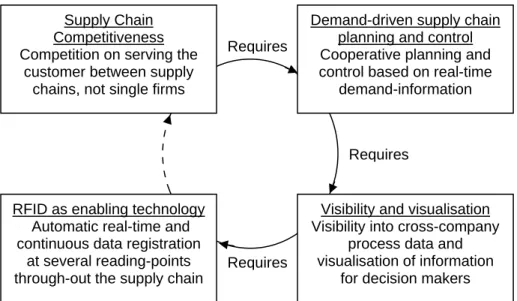
Summing up the theoretical discussion, Figure 1 illustrates how supply chain competitiveness requires demand-driven supply chain planning and control systems, which again requires visibility of data and visualisation of information, which again is made possible by automatic real-time and continuous data registration at several reading-points through-out the supply chain (for example by using RFID-technology). Thus RFID has the potential to increase competitiveness in supply chains.
Figure 1: The winning circle: How demand-driven supply chain planning and control, visibility, visualisation and RFID contribute to overall competitiveness
Supply Chain Competitiveness Competition on serving the
customer between supply chains, not single firms
Demand-driven supply chain planning and control Cooperative planning and control based on real-time
demand-information
Visibility and visualisation Visibility into cross-company
process data and visualisation of information
for decision makers RFID as enabling technology
Automatic real-time and continuous data registration
at several reading-points through-out the supply chain
Requires
Requires
CASE STUDY
The discussion in this paper is based on a case study in a research project in the Norwegian grocery industry (Smart Flow of Goods). Smart Flow of Goods is a research and development project aiming at developing tomorrow’s intelligent, responsive and efficient supply chains by utilising the full potential of RFID-technology. Supply chains in the Norwegian grocery industry face a situation where requirements from customers, government and the competitive situation call for improved and innovative control concepts, and technology developments (e.g. RFID) are expected to be important enablers for these developments. Industrial partners in the projects constitute a network of dominant actors in the Norwegian grocery industry, including a retailer chain, a wholesaler and a meat processor.
AS-IS Supply Chain Planning and Control
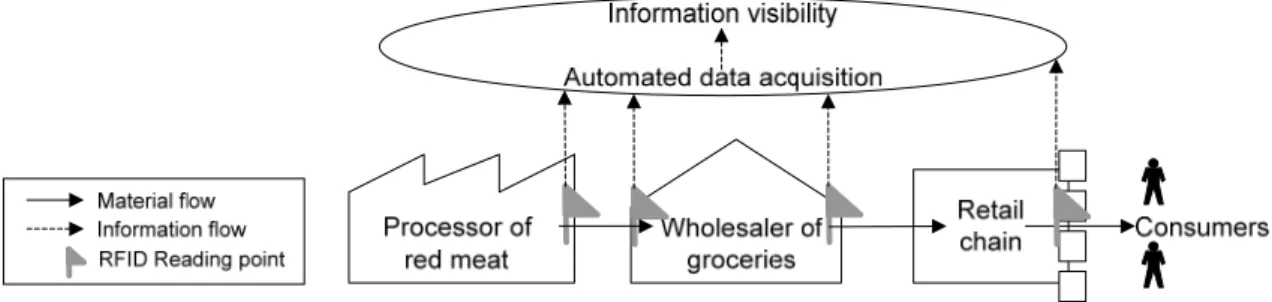
The discussed supply produces and delivers meat products to consumers in retail stores (c.f. Figure 2). Sales are carried out in a traditional and labour intensive process. The customer does part of the job by finding and picking the products, before store personnel manually scan products at the desk. Information revealing sales (POS) is collected and stored, but is not shared with the supplier and not utilised to control replenishment. At each store the targeted amount of products of one specific type is calculated based on historical data and expected sales. Ordering of products is carried out through a process where personnel conduct a visual check of levels at the shelves, and when needed orders are placed by scanning the products bar code and manually specifying the number of items to be purchased. Orders are then sent to the processor by EDI with a deadline twice a week, with a copy to the wholesaler. At the processor, picking lists are prepared and printed, while an order confirmation is sent to the retailer by fax or e-mail. Products are picked for each store, and transported to the wholesaler for cross-docking. The wholesaler performs temperature checks on some randomly selected shipments, and also checks if the received products are in accordance with orders. The main function for the wholesaler is further to gather the different products going to the same store. After short time, the products are then transported to the right retailer stores
Figure 2: Smart Flow of Goods Supply Chain
The dominant control concepts in this supply chain are push- and forecasting based planning and control, such as MRP based production and ordering based on expected sales. Consumer demand is in many cases not accessible; due to lack of or infrequent information sharing, and those who have access to this information does not necessarily utilize it for control purposes. The insight and practises on how to utilise this information is also limited in the industry. Although measures have been taken in order to streamline the supply chain, neither information nor products can be described as having a seamless and demand driven flow from suppliers to customers. The result is a supply chain with limited responsiveness and substantial potential for efficiency
improvements. For the participants in the case study, track and trace requirements are another important incentive to improve their control capabilities. Due to food safety considerations, they have to be able to withdraw products from the market if it is suspected that ingredients or processes might involve health consequences. Without satisfactory supply chain control, such a market withdrawal will be extensive, costly and harmful for the public reputation.
Analysis of this supply chain reveals that there are several important improvement areas related to supply chain planning and control, such as inefficiencies in coordination and routines, lack of responsiveness and poor handling of food safety issues. The fundamental for the Smart Flow of Goods project is a joint effort to close the gap on these improvement areas, through the utilisation of RFID technology and EPC standards.
TOWARDS REAL-TIME SUPPLY CHAIN CONTROL
As described in the theoretical background, RFID is expected to bring along new opportunities for real-time supply chain planning and control. This section develops how this opportunity, integrated with other ICT enabling technologies can be utilised in the supply chain under study.
Real-time supply chain planning and control involves tagging products with RFID at an aggregated level (primary on distribution packages, but later it is expected to be implemented on consumer packages). As shown in figure 3, data will be read and captured on selected places in the supply chain, and then immediately shared and utilised without time delay.
Figure 3: Supply Chain real-time control
The following discussion outlines the main characteristics of the TO-BE real-time supply chain control.
Demand information and stock level information at each plant, stock and store are continuously, electronically and real-time available, due to the combination of RFID registrations and sale/POS data. The replenishment process both at the processor and the wholesaler constitutes of monitoring inventory levels and demand patterns at several inventories and stores, and then delivering products according to optimal utilisation of available products, transport utilisation, product self-life and demand. If a delay or an unexpected event occurs somewhere in the supply chain, an alert is activated or the plan will automatically be altered in order to respond to the new situation.
The following shifts in supply chain planning and control are foreseen to be realised in the TO-BE solution:
• Automated and intelligent control
• Online and continuous re-planning and handling of deviations • Replenishment responsibility transferred upwards
• Information visibility • Differentiated control
Automated and intelligent control
The access to the comprehensive information that RFID technology enables calls for extensive in-built intelligence in IT-systems in order to actually yield the targeted effective control. The fundament in this system is an electronic and unified control model developed for each specific supply chain, which regulates the flow of products and information by the use of detailed control principles and methodology. The control principles will be converted into mathematical expressions and logic, and are combined with electronic software solutions and data calculation capacities, in order to ensure a flow where products are automatically pulled through the supply chain.
The systematic and accurate RFID data capturing will construct a unique information source which is a significant information input into an electronic and unified control model. Based on the RFID captured demand information the control models will calculate and automatically decide when to replenish, deliver, and produce and so on. This calls for an advanced ICT architecture which will provide for the necessary information processing and sharing.
The TO-BE situation assumes that the autonomous participants in the supply chain will have to agree on a unified control model where control is the question of what is best for the supply chain as a whole and not for each specific participant. The control aspect is one of the central elements in supply chain management and resistance against reducing influence and control strength is considered to be one of the strongest obstacles in order to achieve holistic supply chain systems. Thus in order to be able to realize a unified control model, incentive mechanisms for cooperation and data-sharing between partners has to be developed.
Online and continuous re-planning and handling of deviations
A key element in the TO-BE solution is the advanced and unified information technology platform created which will connect separate parts in time and distance, at different levels and with different functionality. The technological platform will create, transmit, process and display the complex volume of information and by this constitute the core element in the planning and control task and decision making in the supply chain. Planning and control by remote control functionality and visualisation technology is the new work environment which emphasis the socio-technical interface, and which call for new competence and knowledge in operations of the system.
Replenishment responsibility transferred upwards
delivering products to each inventory and store, based on up-dated stock level information. Real-time information and visibility is thus used to move the order decoupling point, upwards the supply chain, and closer to the manufacturing processes and thus improve the utilization of manufacturing, inventory and transportation resources. When the processor have the exact access to information of what is sold in each specific store, then it can decide what will be a optimal production and delivery sequence in the supply chain.
Information visibility
The main control philosophy in the TO-BE control concept is “demand one – make one” indicating that RFID and real-time information is an enabler for implementing a pull based supply chain. Part of the motivation for this new control, is that the supply chain needs to be more responsive to deviations and unexpected changes. Supply decisions will be inline with present demand and needs, and be simultaneously accessible for all participants. Thus information visibility is a key characteristic of the new solution. Decision makers will have access to information extended along several dimensions. Firstly, information is collected continuously and accessible in real-time. Secondly, information should be accessible along the supply chain, typically visualising supply chain inventory levels. Thirdly, information should be accessible across a tier in the supply chain, typically from a number of stores.
Differentiated control
The details in how the supply chain is controlled will be differentiated based on product- and demand characteristics (Fisher, 1997). An example is that replenishment frequency can be depended on these characteristics, and that some products are replenished from the wholesaler, others from the processor. Track and trace solutions continuously identifies the product and its identity. In the new control concepts this will be utilized to differentiate, both in the manufacturing process to decide the optimal use of materials and resources, and in the supply chain deciding where to store and sell which products. Electronic product identification and differentiation enables sophisticated control models which builds intelligence into the planning and control system allowing a broadened span of control.
Challenges in realisation of real-time supply chain planning and control
A number of challenges arise when realising this concept. From the case study the following challenges have been identified as most important:
• Develop the new control concepts, principles and algorithms • The need for a unified control model in the supply chain • The new working environment
• Develop new collaborative models and contract types
New control concepts, principles and algorithms must be developed for the supply chain to allow for “demand one – make one. They must integrate planning concepts, optimisation and simulation functionality for automated and intelligent processing and decision making.
The need for a unified control model in the supply chain is a requirement often overlooked. Each actor normally operates their part of the supply chain based on what is best for them. Real-time supply chain planning and control requires all-to-all insight in the various control principles applied, in order to develop the global supply chain control model. Only a common control model will allow for this to be realised.
A new working environment for all personnel involved in planning, purchasing, order reception and logistics will be apparent. There is a need to find out more about the effects from changes in technology, roles, responsibilities, knowledge requirements, working hours and so on.
New collaborative models and contract types are required as responsibilities, roles, costs and benefits are changed in a real-time controlled supply chains. A particular focus must be put into the issue of ownership of information and responsibility of maintaining information.
CONCLUSION
Competitiveness and increased market shares are incentives for developing new supply chain solutions which compress the time element and increase responsiveness. Thus demand driven supply chain planning and control principles will play a major role in new the planning and control paradigms, with special emphasis on visibility and visualisation and the possibilities created through new data-capturing technology such as RFID.
The case described in this paper and the developed TO-BE real-time control concept for this case, shows how supply chain planning and control alters from being based on historical data and expected demand to a situation characterised by the following elements:
• Continuously updated and accurate real-time information as basis for decisions • New technology platform for supply chain planning and control
• Online and continuous re-planning and handling of deviations • Sharing of real-time information throughout the supply chain
• Responsibility for replenishment is moved upwards toward the wholesaler and processor instead of at each retail store
• Differentiation through track-and-trace solutions where each product or groups of products, can be identified and controlled separately according to its characteristics However, developing this real-time planning and control solution is a major research and development task addressing several challenges. From a supply chain planning and control perspective the following areas needs further research:
• Develop the new control concepts, principles and algorithms • The need for a unified control model in the supply chain • Develop new collaborative models and contract types • The new working environment
REFERENCES
Busi, M., and Dreyer, H.C., 2004. Collaboration or business as usual? Suggested matrix to categorize and develop collaboration. Proceedings of the 16th Annual Conference for Nordic Researchers in Logistics. NOFOMA, Linköping, Sweden
Chao, C.-C.; Yang, J. M., Jen, W-Y 2007, Determining technology trends and forecasts of RFID by a historical review and bibliometric analysis from 1991 to 2005, Technovation 27(5): 268-279 Chopra, S.; Meindl, P. 2007, Supply Chain Management: Strategy, Planning, and Operation, 3rd ed.
Upper Saddle River, New Jersey
Christopher, M., 2005, Logistics and supply chain management, 3rd edition, Prentice Hall Financial Times. London
Cooper, M. C, and Gardner, J. T., 2003. Strategic Supply Chain Mapping Approaches. Journal of Business Logistics, Vol. 24, Iss. 2, pp. 37-64.
Danese, P., 2005, “The extended VMI for coordination the whole supply network”, Journal of Manufacturing Technology Management, Vol. 17, Iss. 7, pp. 888-907.
Fisher, M.L., 1997. What is the Right Supply Chain for Tour Product?. Harvard Business Review, March-April, pp. 105-116.
Glover, B.; Bhatt, H. 2005, RFID essentials, Sebastopol, Calif., O'Reilly
Jonsson, P. 2008, Exploring problems related to the materials planning user environment, International Journal of Production Economics, Vol. 113, No. 1, pp. 383-400.
Jonsson, P. and Mattsson, S.A., 2003. The implications of fit between planning environments and manufacturing planning and control methods. International Journal of Operations & Production management, Vol. 23, Iss.1, pp. 872-900
Rudberg, M. and Olhager, J., 2002. Manufacturing networks and supply chains: an operations strategy perspective. Omega Vol 31, Iss.1, pp. 29-39.
Sabath, R. E. and Autry, C. W., 2001, “Automatic Replenishment Programs: The impact of Organizational Structure”, Journal of Business Logistics, Vol. 22, Iss. 1
Simchi-Levi, D.; Kaminsky, P.; Simchi-Levi E. 2007, Designing and Managing the Supply Chain, 3rd ed. McGraw-Hill
Skjoett-Larsen, T., Thernøe, C. and Andersen C., 2003,”Supply chain collaboration, Theoretical perspectives and empirical evidence”, International Journal of Physical Distribution & Logistics Management, Vol. 33, Iss. 6, pp. 531-549
Tajima, M., 2007, “Strategic value of RFID in supply chain management”, Journal of Purchasing & Supply Management, Vol 13, 22261-273
Vollmann, T.E., Berry, W.L., Whybark, D.C. and Jacobs, F.R., 2005, Manufacturing planning and control for supply chain management, McGrawHill, Singapore