In Search of the Best Human Resource Practices in China’s Chain Stores
Irene Hau-siu Chow Department of Management The Chinese University of Hong Kong
Shatin, N. T. Hong Kong Tel: (852) 2609-7798 Fax: (852) 2603-6840 Email: [email protected] & S.S. Liu
Department of Business Management School of Management
South China University of Technology Tel/Fax (020) 87113235
In Search of the Best Human Resource Practices in China’s Chain Stores Abstract
This paper analysed a recent survey of human resource practices from 83 chain stores in China. It differentiated managerial staff (core) and operating employees according to different types of human resource configurations. It also identified high and low adoption based on bundling of HR practices using cluster analysis. The impact of HR practices alignment on enhancing firm
performance was evaluated using high adoption cluster. The findings advance our knowledge in the HPWS literature and offer important insights for executives in formulating effective HRM strategies.
Keywords: High performance work systems, human resource practices, chain stores, China
The effective utilization of human capital will be the ultimate determinant of
organisational performance (Adler, 1988). Managing people is a central challenge in every organisation. A firm’s intangible assets, such as the way it manages its employees, are more likely to gain competitive advantage than its tangible assets (Jackson & Schuler, 1995; Barney, 1995). From the resource-based theory, the complexities of human resource value creation process can be treated as a source of sustained competitive advantage because the types of activities performed add value to the firm, such as more effective response to market demands (Wright, McMahan, and McWillians, 1994). A pool of skills and experience of workforce is unique, rare and not easily imitated or substitutable (Barney, 1991). In order to sustain the
competitive advantage through people, organizations need to manage their employees with a set of complementary HR practices in the form of high performance systems that will enable them to achieve simultaneously more flexibility, greater efficiency and the ability to gain maximum economic results. Thus more innovative practices and high performance systems are adopted to foster high performance.
A literature search shows an extensive study of high performance work systems (HPWS) in the last two decades (Becker and Huselid, 1998). The importance of HR alignment as a basis of competitive advantage is repeatedly iterated. Empirical studies revealed a strong and direct relationship between the quality of HR practices and return on shareholder investment (Delery & Doty, 1996). HRM practices, in the form of high performance work systems, are associated with positive performance outcomes (Appelbaum et al, 2000; Kravetz, 1988; Levering & Moskowitz, 1993; Huselid, 1995; Berg,1999), and higher financial success (Huselid, 1995; Lawler et al, 1995; Varma et al, 1999). The HRM system has a direct impact on employee skills, motivation and job design/work structure. These attributes elicit greater productivity, creativity, performance and ultimately to profits, growth, and market value (Neal & Tromley, 1995).
High performance work systems have been shown to contribute to firm performance in U.S. and other countries. Majority of previous studies were based in the Western context. Very few studies have been conducted on HR alignment in China. The present study focuses on alignment of HR practices in chain stores in southern China. Different institutional mechanisms may shape HR policies and strategies (Paauwe & Boselie 2003). Given the different institutional environment and the high growth of the service sector in China’s economy, it would be
interesting to find out how effective management of HR might contribute to positive
become the major growth industry in China. The huge consumer base offers a lot of potential for multinational firms to enter the China market. The purpose of this study is to identify a number of key coherent HRM dimensions of staffing, training, performance appraisal, reward, work structure and job security and their impact on firm performance. The proposed relationship will be empirically tested by surveying a sample of 83 chain stores in Guangzhou to find out whether HPWS could be successfully transferred to the Chinese context. Results from the present study will draw meaningful and practical implications. It provides valuable information to both HR academics and practitioners by illustrating how effective human resource management can add value to organisations.
REVIEW OF THE RELEVANT STUDIES
Two major themes emerge in the HR research. First, the current studies tend to adopt a systems approach. The focus is moved away from separate HRM practices and employee
performance to a more macro focus on the overall complementary set of HRM practices and firm performance. HR is moving away from its traditional micro-focused role and is moving towards a macro strategic paradigm, linking HR and business strategy. The strategic perspective HRM examines the “fit” between various HRM practices and the company’s business strategies (Delery 1998). Organisations are simultaneously seeking external fit between the HR function and organisation strategy, at the same time achieving an internal fit among individual HR practices.
The second theme is HRM control systems (Snell 1992). Organisations are increasingly transition from controlling employees to eliciting commitment from employees (Pil and
union issues. Training is viewed as expenses to be minimized, not as investments;
communication was mostly top-down; rewards were based on fixed guidelines; and there was little employee involvement. HR practices were standardized and reactive. In contrast, high-involvement, commitment-based culture utilized cross-functional teams and employee
involvement. Bae and Lawler’s (2000) involvement--enhancing HR incentives include highly selective staffing, extensive training, empowerment, performance-based pay and broad job design. Other HR initiatives included information sharing and provision of communication channels, lifelong learning, extensive benefits, formal dispute resolution procedures, training and retraining instead of redundancies during the period of economic crisis. Such trend signifies a shift away from employee control and toward emphasis on employee commitment.
The last two decades have witnessed considerable experimentation and research on innovative work practices, such as high-involvement workplace, cross-training and flexible job assignments, and self-directed work teams (Gerard & Varma, 1998). Existing literature has demonstrated that the presence or absence of high performance work systems (HPWS) and other types of high investment HRM systems can have a significant effect on employee attitudes, behavior, and firm performance (Guthrie, 2001; Huselid, 1995). The underlying premise of HPWS is to create an environment that fosters commitment toward the long-term well-being and development of the organisation’s employees.
Huselid, Jackson and Schuler (1997) defined high performance work systems as "an internally consistent set of policies and practices that ensure that a firm's human capital
contributes to the achievement of business objectives" (p.171). The underlying principles that support high-performance work systems are: employees shared timely and accurate information about business performance, plans and strategies in a rapidly changing environment. The nature
of competition continues to change, employees' knowledge and skills must also change. They need to learn continuously to support the organisation's needs. Performance-reward linkage aligns employees intention and behaviors with the needs of the firm helps them engage in activities that are mutually benefits to themselves and the organisation. Employees will become more involved in their work, organisational performance is improved while the quality of work life is simultaneously increased. The guiding principle of these studies is creating a working environment that supports internal and external alignment leading to higher firm performance.
There is increasing evidence that HRM practices, in the form of HPWS, are associated with positive performance outcomes, and higher financial success (Appelbaum et al, 2000; Kravetz, 1988; MacMiffie 1995). Ichniowski et al, (1997) and Berg (1999) studied high performance work systems in the steel industry and found the presence of more innovative systems was associated with significantly higher productivity. In manufacturing firms, Appelbaum, et al, (2000) found the use of HPWS was associated with substantially higher stock market value and labour productivity. Similar results were found in assessing the effectiveness of HPWS initiative in the service sector (Varma et al, 1999). Huselid (1995) found that HPWS resulted in decreased turnover rate, increasing productivity and improved corporate financial performance using publicly held organizations from various industries. Levering & Moskowitz (1993) surveyed 100 best companies to work for in America and Lawler et al (1995) surveyed Fortune 1000
companies found making use of employee involvement and TQM practices reported significantly higher financial success. These effects are most pronounced when such work practices are
implemented together as a system. It pays off to combine the appropriate HRM policies and practices into an internally coherent system that is directly aligned with business initiative to create value.
Despite the growing evidence that HR practices affect firm performance, the existing literature is far from being conclusive about what explains the existence of high performance work systems. Cappelli and Neumark (2001) found statistically weak evidence that these practices enhance productivity. The adoption of HPWS had little effect on overall labour
efficiency (output per dollar spent on labour). The discrepancy may lie in what constitute the best HR practices in HPWS.
After an extensive review of existing literature in this area, notable differences exist across studies on what constitutes “best” practices because the studies used different measures. Not only did the different empirical studies use different measures of best practices, but they also showed inconsistent effects from individual practices included in the set. Even though there is no universal agreement about which practices or combination of relevant practices constitute a high performance workplace, some common principles were mentioned in many of the studies. The typical features of HPWS include selective staffing procedures, extensive training to enhance workforce skills, generous pay and benefits to attract better qualified workers, together with greater use of employee participation.
HR Practices Alignment and Organizational Performance
Organisations can adopt various HRM practices to enhance productivity. Currently there is a growing acceptance of the idea that a bundle of appropriate HRM practices is needed to realize the synergistic effects--that HR practices need to be applied as a set of complementary practices aligned with the firm's goals and strategies before they are effective. This systems perspective is based on the notion that HR practices often complement each other, so that the adoption of a particular practice is only effective when it is adopted in combination with other
supporting practices. Bundles of interrelated and internally consistent HR practices, rather than individual practices, create a synergistic package, mutually reinforcing conditions that support employee motivation and skill acquisition. Based on existing literature, the effects of different HR practices are additive. The strengths and weaknesses of using an additive approach when creating a HPWS unitary index see Becker and Huselid (1998) and Delery (1998).
A systems perspective supports coherent and integrated ‘bundles’ of HRM leads to increased organisational performance (MacDuffie, 1995; Ichniowski et al, 1997).. Selective recruitment and staffing procedures together with rigorous training enhance workforce skills, while higher base pay and benefits attract better-qualified workers. Performance-based pay, job security, and information sharing are expected to enhance employee motivation. Recognizing the contribution that employees make, as well as soliciting employee input and encouraging employees to participate in decision, are expected to enhance employee involvement. Specific practices such as training, performance-based pay systems, and employee involvement are correlated with higher productivity (Youndt, et al., 1996). Individual HRM practices will not yield their full benefits unless they are combined together with the appropriate complementary practices, in coherent packages. It is necessary to bundle together the appropriate combinations of HRM practices to realize the synergistic effects. It follows that HPWS framework promotes vertical (external fit with business strategy and attainment of organisational goals) and horizontal (internal fit of HR practices) linkage (alignment). Thus, the internal HR practices alignment is proposed to enhance organisational performance.
DATA AND METHOD Research setting
China was chosen as an appropriate research setting for its high growth rate in the retail sector. China has experienced a rapid economic growth. During the last two decades, its GNP increased more than six-fold. Even facing with the Asian financial crisis, it was able to sustain an
impressive growth rate of over 7%. Service sector accounted for 32.9% of GDP in 1999 in China, arising from merely 21.4% a decade ago. Guangzhou has a population of 6.7 million, having the highest income consumers in China. Consumption expenditure in urban cities increased 4 times from 1992 to 2000. Shopping habits of the Chinese consumers are changing. They prefer to shop in chain stores, supermarkets and convenience stores. There were 50 chains (37 in retailing and 13 in catering) and 1134 outlets employing 39068 persons and total sale revenues of 10931 million yuan in 2002. A total of 133 supermarket outlets and 522 specialty stores were operating in Guangdong by the end of 2002. Number of outlets per 10,000 persons was 225 (Guangzhou Statistical Year book 2003, p.546). Chain stores are gaining popular for the purpose of achieving the advantage of economy of scales in terms of distribution, warehousing, training and
management. The present study examines the human resource practices in this fast growing sector in southern China.
This research employs a triangulation method of inquiry. In-depth face-to-face interviews provide richer and deeper insights, and fuller contextual information. These interviews offer a better understanding of the HR issues arising in their daily operations. Data were gathered from multiple sources of informants-- different level of employees, CEOs, line managers and HR managers using both interviews and survey, as well as secondary sources such as internal documents and newspaper reports. For qualitative method, senior management teams from 28 chain stores were interviewed. These chain stores included supermarkets, shopping malls, department stores and drug stores. A team of three interviewers asked probing questions on HR
practices, and cross-checked views from different sources to ensure accuracy of the obtained information.
Based on the interviews and extensive review of the secondary sources on chain stores in China, a survey questionnaire was constructed. Questionnaires were sent by the Association of Chain Stores in Guangdong. The survey respondents were drawn from personnel, finance and general managers. One hundred forty three questionnaires were distributed, 96 were returned. Excluding the incomplete, 83 questionnaires were usable. The overall effective response rate was 58%. The present study focuses on an industry specific context (chain store) to restrain
variations contributed by a single industry. The advantage of an industry –based study as oppose to large-scale inter-industry cross-sectional data is to control for the influence of context and environment differences across industries.
Measures
Based on the literature pertinent to HR best practices, a survey instrument was constructed to examine the relative importance of a broad range of HR practices. The respondents were asked to rate the extent to which HR practices were used in their firms, using a six-point scale of 1 (not at all) to 6 (very extensively). These HR practices included in the present study can be classified into six areas: (1) staffing, (2) training and development, (3) performance appraisal. (4) reward and compensation, (5) work information sharing and participation in decision-making, and (6) job security. Each of these areas was measured by 3 to 5 HR practices.
Individual HR practices were combined into an overall HR index reflecting the extent to which the surveyed organisations have adopted the HRM practices. HPWS index was
practices (selection, formal training, performance appraisal, reward systems, work structure and job security). The use of an index reflects the HR system is consistent with both the emphasis on "bundles"and "systems" that is emerging in the literature (Youndt et al., 1996, MacDuffie 1995). We operationalised two sets of HR practices as additive indices, one for managerial staff (core) and another for operating employees.
Firm performance is commonly measured by employee turnover, financial profit, and market share. Because not all surveyed organizations are public listed companies, objective financial data are sensitive and not available. The dependent variables in the present study include three subjective performance indicators. Respondents were asked to indicate their firm’s performance over the last two years as compared to their industry’s average in terms of
profitability, market share and growth in sales. A five-point scale of 1 (very poor) to 5 (very good) was used.
We control for firm size and ownership types of the organisations surveyed. Firms with superior resources will be able to formulate and implement unique strategies. Therefore, large firms have more resources advantages. Firm size was measured by number of full-time
employees. We take natural logarithmic transformation to normalize the distributions and make the measure more consistent with existing literature. As for types of ownership, state-owned firms tend to be more embedded in institutional constrains and therefore less flexible in adopting innovative HR practices. Ownership types was coded 1 for state-owned and collectives, 0 for others.
FINDINGS
The result is based on the data from 83 questionnaires from China’s chain stores in our survey and 28 interviews with top management. Among the 83 surveyed chain stores, 8.4% were
state-owned and 62.7% were collectives. The average number of employees was 1495 with a range of 110 to 10000. The ratio of managerial to operating staff was 38.8%. On average, the HR
department had 10 persons. Turnover rates in the last two years for managerial staff and workers were 10.75% and 20.21% respectively.
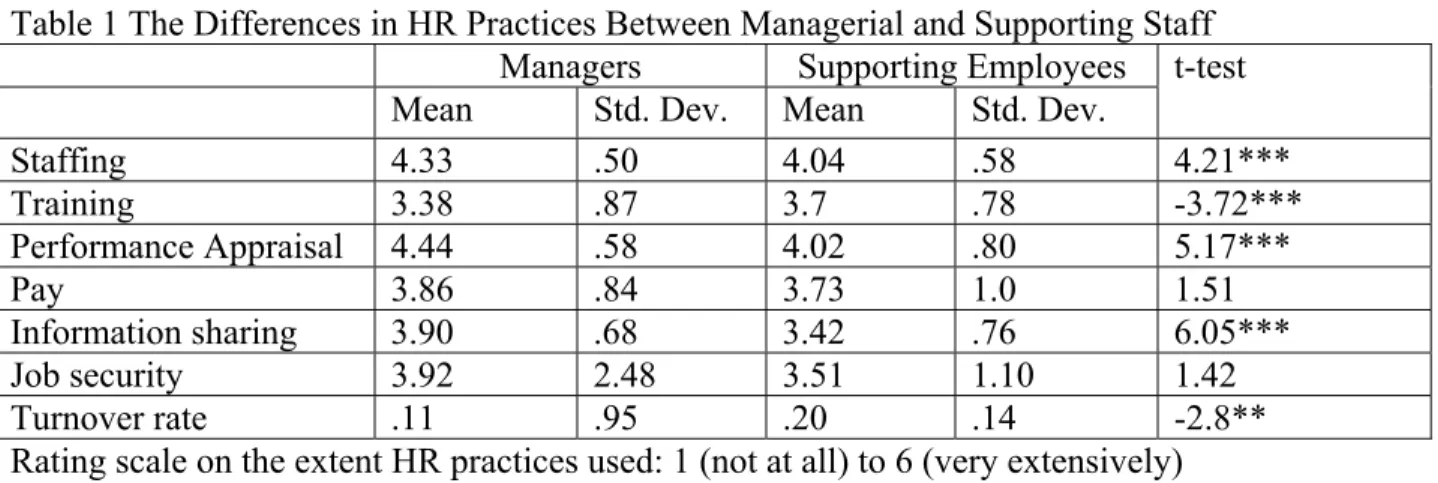
The HR practices apply to managerial and operating staff may be quite different (Fey, et al., 2000). The means of the HRM dimensions for managerial and operating employees are reported in Table 1. An overall index of high performance work practices was computed by totaling six dimensions of HR practices in an organisation. Staffing and performance appraisal had higher mean scores for both managers and operating employees. Managers scored
significantly higher than operating employees in staffing, performance evaluation and
information sharing but significantly lower in training and turnover rate as indicated by t-tests. The results show no significant differences in pay and job security for the two groups. Results from the present study confirm low wage differential reported in previous study by Goodall and Warner (1997). Moving from predominantly egalitarian wage payment system to one that is more individualized performance-related payseems to be the trend in HPWS, at least not in the present study of chain stores.
Cluster analysis allows us to focus on the pattern whether there is any systematic
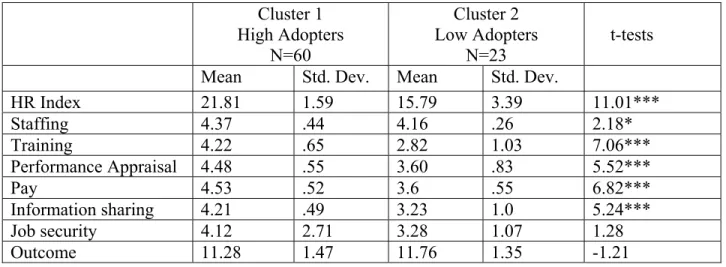
differences in the ways firms design their HR strategies. The purpose is to identify high and low performing firms. Using K-mean cluster analysis, two clusters of firm with remarkably different HR strategies were identified, resulting in 60 high adopters and 23 low adopters based on the overall HR index (summation of the six dimensions scores). Once cluster solution has been found, we examine the difference in level of human resource management between the clusters. The comparison of high and low HR practices firms is given in Table 2. There were significant
differences between these two groups of firms in most of the HR dimensions except job security. There was considerable variation in their use of these HR practices. Firms with HPWS adopt HR management practices very different from those adopted by firms with low performance work systems. HPWS firms devoted considerably more resources to recruitment and selection, train with greater vigor, do a lot more performance management and tie compensation to performance. The differences in HR activities reflect the level of investment in human capital. There was no significant difference in job security between the two clusters. Legal regulation imposes obligations on enterprises in their treatment of surplus workers. Massive layoff of surplus workers is still difficult. Workers enjoy high degree of job security. The outcome measures associated with the two clusters showed no substantial difference.
When these 6 dimensions were factor analyzed, they all merged into two factors, accounting for 42.91% and 18.36% of the variance respectively. The first factor is competence enhancing HR practices consisting of training, performance appraisal, pay and sharing
information. These are primary HR practices firms use to elicit and reinforce desired behaviors. The second factor is employment (staffing and job security). To a certain extent, the results showed a coherent HR strategy.
Correlations between HR practices with outcome measures are given in Table 3. The three outcome measures were highly correlated. Firm size as measured by number of employees (log) and ownership types are significantly correlated with market share. Larger firms and state-owned enterprises occupied higher market share. None of the HR practices were significantly correlated with market share. Growth in sales was correlated with performance appraisal only but not with other HR practices. Performance appraisal was significantly correlated with profit and sales. Turnover rate had no significant correlation with any variables in the study. Job security, pay,
training, staffing and HR index were not correlated with any of the performance indicators. This contradicts previous study that human capital enhancing strategies, such as competitive pay, intensive training and rigorous selection will lead to high performance (Delaney & Huselid, 1996).
Effects of HPWS on Organisational Performance
Hierarchical regression was used to investigate the effects of HR practices on
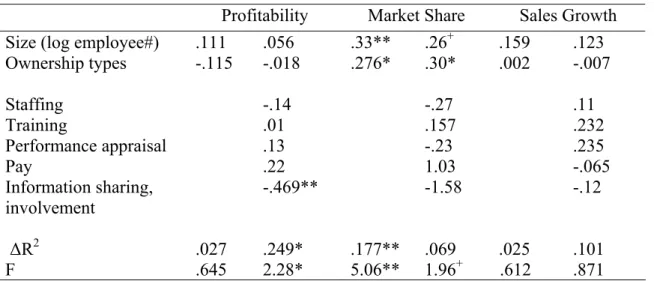
performance measures. To determine which factors may account for the observed differences in the three performance measures, separate hierarchical regression analyses were conducted on each of the dependent outcome variables. Results are presented in Table 4. Size measured in employee number (log) and types of ownership were first entered as control variables. Size and ownership had significant effect on market share. Because larger organisations have more resources, they can afford to implement more high quality practices to capture a large market share. Both size and ownership types had no effect on profitability and sales growth.
When the HR practices were entered as predictors, there was a significant effect on profitability. Adding all the HR practices increased the explained variance significantly by 25%. For individual HR practices, information sharing and involvement showed a significant but negative effect on profitability as indicated by the standardized Beta coefficient. It should be noted that there was no significant effect of the HR practices on growth in market share and sales. None of the proposal relationships holds for Low HR index group. Low HR level firms are not willing to invest in their human capital. The result was further reiterated by cluster analysis of two clusters of firm with remarkably different HR strategies.
DISCUSSION AND CONCLUSION
The purpose of this paper is to extend the emerging empirical studies on firm level impact of HR practices on performance measures in the Chinese context. While the literature on HPWS from the Western countries presents an overwhelmingly positive result, results from the present study on chain stores in China are positive but not as strong or clear. The findings add to the growing empirical evidence in the Asian context. Consistent with previous studies, the results partially support for a positive relationship between the presence of HPWS and firm performance (subjective measures of profitability).
The present study supports that internally coherent HR practices are positively related to the perceptual measures of organisation performance. Empirical evidence demonstrated
statistically significant relationship between measure of HR practices and firm profitability. An important message is building profit by putting people first. To a certain extent, there is strong coherent among the different HR practices, but alignment with the firm's business initiative is low. This explains why there is no significant impact on some of the performance measures (market share and sales growth). Another explanation may be due to the industry specific nature of the retail chain stores. The high growth in the industry creates shortage of well-trained skilled workers. The high turnover and low-skill labour is a critical issue in the study of high
performance work systems. Turnover rates for managerial staff and operating employees were 10% and 20% respectively as reported by the respondents in the survey. High turnover is a problem in the retail industry. Difficulty in attracting and retaining high caliber is mentioned frequently in the interviews. With high turnover rate, the much needed job specific tacit knowledge is difficult to accumulate. Organisations need to pay more attention to attract and
retain employees simply because employee loyalty (low turnover) drives productivity/ performance (Batt 2002).
The present study finds weak evidence that HR practices enhance performance. One possible explanation is the current status of HR management in China’s chain stores remains in the early stage of the diffusion process. HR is stuck in administrative role of doing low-value added activities like keeping payroll records, administrating benefits. Most retail chains pursue a low cost strategy, employing mainly low skilled, poorly educated, and inadequately trained workers. HR function was playing a traditional “personnel’ role rather than being a strategic partner. They are slow in adopting high performance work practices. Heavy investment in human resource development and uncertainty regarding the related costs and benefits are substantial obstacles to be overcome. Risk involved in implementing these practices is high. Companies are reluctant to adopt very innovative HR practices. Some of these companies are particularly keen to search for guidance, emulating successful firms as their model.
In the western literature, employee involvement plays an important role in the success of the HPWS initiatives. Quality and productivity payoff based on more participatory work
organisation. More participatory work organisation is accompanied by a complementary set of HRM practices that enhance skills and provides incentives for discretionary effort. This may not be the case in high power distance and authoritative corporate culture in the Chinese context. High power distance societies place less value on subordinate input and participation. The participative/involvement practice is incongruence with some cultural barriers that need to be considered for effective implementation of HPWS in Chinese society, including hierarchical power distance, reluctant to share power with subordinates, unwilling to delegate power during decision-making processes, and unwilling to confront others in the workplace due to a desire for
harmonious work relationships. In addition, high performance work practices require more autonomy, greater task variety, or more effective use of knowledge and skill, by increasing employees’ motivation, and enhancing retention of quality employees (Jones & Wright, 1992). This may not hold in case of present status of chain store in China. The main concern is control-based HR system to achieve cost effectiveness instead of enabling mechanism or commitment system. Commitment based-HR practices were not used extensively. One may challenge the adoption of HPWS because these systems may not fit the Chinese culture and institutional arrangements. This casts some doubt on the viability and effectiveness of HPWS in certain Asian contexts, at least not at the current stage of the diffusion process. Further research in this area is needed.
Now China has joined the WTO, together with the multinational giant Wal-Mart entering the China market, the competitive landscape in the retailing industry is experiencing
revolutionary change. Changes in the increasingly competitive environment have placed new demands on human resource practices. Recruiting better trained with a sufficient numbers and retaining them in organization become increasingly important. Local firms are adaptive and quick to copy HR activities from successful companies.
The contribution of HRM to firm performance is to facilitate organisational alignment such as responding to changes in strategy and the external environment. It is important that these practices are internally coherent and consistent with firm strategies; the individual HR practices per se are not so important because their effectiveness strongly depends upon the organisational context. An organisation’s employees constitute a potential source of sustained competitive advantage, and it is through HR practices that organisations are able to leverage the value of people in ways that result in positive performance outcomes. Furthermore, high performing firms
excel in many areas other than HR, and these areas must be accounted for by the HR-performance relationship.
Limitations and Direction for Future Research
Implications of our findings should be interpreted with care as the respondents are drawing from China’s chain stores only. Common method variance is a potential problem
whenever data are collected from a single source. It relies on perceptual measures of organisation outcomes. Even though subjective measures are regularly used in research (Babin and Boles, 1998), objective measures of firm performance are more desirable. Future research should consider using both objective and subjective measures of firm performance. The measure of HRM practices is by no means complete. Firms adopt different form and structure of compensation systems and different types of HR practices. The configuration of elements
constituting a HPWS is not clearly defined or researched. A contingency approach suggests that there are different configurations of HRM, organisation, and strategic orientation. This is an important area for future study.
Because of the above limitations and exploratory nature of the study, generalization should be interpreted cautiously. Future studies should be extended to other part of China or Asian countries for comparison. The current study is cross-sectional in nature, results cannot be conclusive as to rule out direction of causality. Future research should look at the direction of causality. Longitudinal study tracking the changes and development of progressive and innovative HR management practices and their effects on economic measures of organisation success is highly desirable.
To conclude, the results partially support previous studies that alignment of HR systems enhances organisational performance. Results from the present study add to the understanding of a much-debated topic in the field, particularly in the under-researched Chinese context. It
contributes to the HRM literature by focusing on high performance work practices in China’s chain stores. The finding provides an important reference and new insight for practitioners in understanding how human resources are managed. Although these results should be treated as preliminary because of data limitations, this study provides a foundation to study the important HR strategies and organisational outcomes in a Chinese context. As more multinational firms entering the China market, results from the present study offer some implications for both research and practice. As for practical implications, the findings from present study offer important insights for executives in formulating effective HRM strategies.
REFERENCES
Adler, P. S. (1988). ‘Managing flexible automation’. California Management Review, 30:3, 34-56.
Appelbaum, E., Bailey, T., Berg, P. and Kalleberg, A. L. (2000). Manufacturing advantage: Why high performance work systems pay off. Ithaca, NY: Cornell University Press. Babin, B.J. and Boles, J.S. (1998). ‘Employee Behavior in a Service Environment: A model and
Test of Potential Differences between Men and Women’. Journal of Marketing, 62(April):77-91.
Bae, J. and Lawler, J. J. (2000). Organizational and HRM strategies in Korea: Impact on firm performance in an emerging economy. Academy of Management Journal, 43(3): 5002-517. Barney, J. B. (1991). ‘Firm resources and sustained competitive advantage’. Journal of
Management, 17:1, 99-120.
Barney, J. (1995). ‘Looking inside for competitive advantage’. The Academy of Management Executive, 9: 49-61.
Batt, R.(2002). ‘Managing customer services: Human resource practices, quit rates and sales growth’. Academy of Management Journal, 45:3, 587-597.
Becker, B.E., and Huselid, M.A. (1998). ‘High performance work systems and firm
performance: A synthesis of research and managerial implications’. In G. R. Ferris (Ed.), Research in personnel and human resources management. Stamford, CT: JAI Pres, 53-1-2, Berg, P. (1999). ‘The effects of high performance work practices on job satisfaction in the
United States steel industry’. Relations Industrielles, 54:1, 111-134.
Cappelli, P. & Neumark D. (2001), ‘Do High performance Work Practices Improve
Establishment-Level Outcomes?’ Industrial and Labor Relations Review, 54: 4, 737-775. Delery, J.E. (1998). ‘Issues of fit in strategic human resource management: Implications for
research’. Human Resource Management Review, 8: 289-309.
Delery, J. E. & Doty, D. H. (1996). Modes of theorizing in strategic human resource management: Tests of universalistic, contingency, and configurational performance predictors. Academy of Management Journal, 39(4), 802-835.
Delaney, J. M. & Huselid, M. A. (1996). ‘The impact of human resource management practices on perceptions of organizational performance’. Academy of Management Journal, 39:4, 949-949.
Fey, D. F.; Bjorkamn, I.; and Pavlovskaya, A. (2000). ‘The effect of human resource
management practices on firm performance in Russia’. International Journal of Human Resource Management, 11:1, 1-18.
Gerard, F. F. & Varma, A. (1998). ‘Research update: High performance work systems: What we know and what we need to know’. Human Resource Planning, 21:2, 50-54.
Goodall, K. and Warner, M. (1997). ‘Human resources in Sinoelectronic-foreign joint ventures: selected case studies in Shanghai compared with Beijing’. International Journal of Human Resource Management, 8:5, 569-594.
Guthrie, J. P. (2001), ‘High involvement work practices, turnover and productivity: Evidence from New Zealand’. Academy of Management Journal, 44:1, 180-190.
Huselid, M. A. (1995). ‘The impact of human resource management practices on turnover, productivity, and corporate financial performance’. Academy of Management Journal, 38:3, 635-672.
Huselid, M.; Jackson, S. E.; & Schuler, R. S. (1997). ‘Technical and strategic human resource management effectiveness as determinants of firm performance’. Academy of Management Journal, 40:1, 171-188.
Ichniowski, C. K., Shaw, K., & Prennushi, G. (1997). ‘The effects of human management practices on productivity: A study of steel finishing lines’. American Economic Review, 87:3, 291-312.
Jackson, S. E. & Schuler, R. S. (1995). ‘Understanding human resource management in the context of organisations and their environments’. In J. T. Spence, J.M. Darley, & D. J. Foss (Eds.), Annual Review of Psychology, 46: 237-264. Palo Alto, CA: Annual Reviews, Inc.
Jones, G. R. & Wright, P.M. (1992). An economic approach to conceptualizing the utility of human resource management practices. In K. Rowland & G. Ferris (Eds.), Research in personnel and human resources management, 10: 271-299. Greenwich, CT: JAI Press. Kravetz, D. (1988). The Human Resources Revolution. San Francisco: Jossey-Bass.
Lawler, E.E., Mohrman, S. A., and Ledford Jr., G. E. (1995). Creating high performance organisations: Practices and results of employee involvement and total quality management in Fortune 1000 companies. SF: Jossey-Bass.
Levering, R. & Moskowitz, M. (1993). The 100 Best Companies to Work for in America. New York: Doubleday.
MacMuffie, J. P. (1995). ‘Human resource bundles and manufacturing performance:
Organisational logic and flexible production systems in the world auto industry’. Industrial and Labor Relations Reviews, 48” 197-221.
National Bureau of Statistics of China, Guangzhou Statistical Yearbook 2003, China Statistics Press.
Neal, J. A. & Tromley, C. L. (1995). ‘From incremental change to retrofit: Creating high performance work systems’. Academy of Management Executive, 9:1, 42-54. Paauwe, J. & Boselie, P. (2003). ‘Challenging ‘strategic HRM’ and the relevance of the
institutional setting’. Human Resource Management Journal, 13:3, 56-70.
Pil, F. K., and MacDuffie, J. P. (1996). ‘The adoption of high-involvement work practice’. Industrial Relations, 35:3, 423-455.
Snell, S. A. (1992). ‘Control theory in strategic human resource management: The mediating effect of administrative information’. Academy of Management Journal, 35:2, 292-327. Varma, A. Beatty, R. W., Schneier, C. E. & Ulrich, D. O. (1999). ‘High performance work
systems: Exciting discovery or passing fad?’ Human Resource Planning, 22:1, 26-37. Wright, P.M., McMahan, C. G., and McWillians, A. (1994). ‘Human resources and sustained
competitive advantage: A resource-based view perspective’. International Journal of Human Resource Management, 5: 201-326.
Youndt, M.A., Snell, S. A., Dean, J. W. Jr., & Lepak, D. P. (1996). ‘Human resource
management, manufacturing strategy, and firm performance’. Academy of Management Journal, 39:4, 836-866.
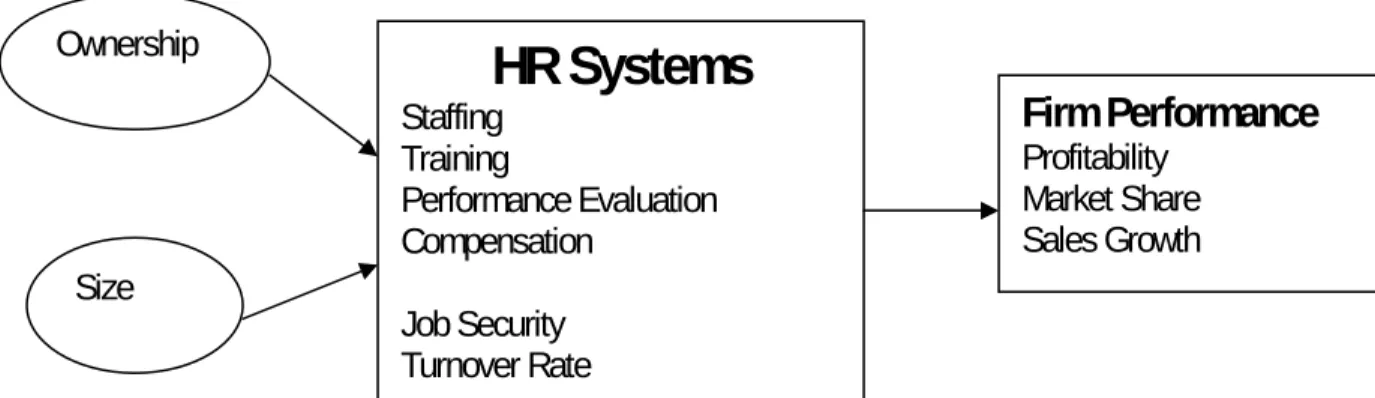
Figure 1 Theoretical Framework
Firm Performance
Profitability Market Share Sales Growth Size OwnershipHR Systems
Staffing Training Performance Evaluation Compensation Job Security Turnover Rate
Table 1 The Differences in HR Practices Between Managerial and Supporting Staff
Managers Supporting Employees
Mean Std. Dev. Mean Std. Dev.
t-test Staffing 4.33 .50 4.04 .58 4.21*** Training 3.38 .87 3.7 .78 -3.72*** Performance Appraisal 4.44 .58 4.02 .80 5.17*** Pay 3.86 .84 3.73 1.0 1.51 Information sharing 3.90 .68 3.42 .76 6.05*** Job security 3.92 2.48 3.51 1.10 1.42 Turnover rate .11 .95 .20 .14 -2.8**
Rating scale on the extent HR practices used: 1 (not at all) to 6 (very extensively) *P<.05; **P<.01; ***p<.001
Table 2 The Differences between High and Low HR Practices Adopters Cluster 1 High Adopters N=60 Cluster 2 Low Adopters N=23 t-tests Mean Std. Dev. Mean Std. Dev.
HR Index 21.81 1.59 15.79 3.39 11.01*** Staffing 4.37 .44 4.16 .26 2.18* Training 4.22 .65 2.82 1.03 7.06*** Performance Appraisal 4.48 .55 3.60 .83 5.52*** Pay 4.53 .52 3.6 .55 6.82*** Information sharing 4.21 .49 3.23 1.0 5.24*** Job security 4.12 2.71 3.28 1.07 1.28 Outcome 11.28 1.47 11.76 1.35 -1.21
Outcome is a composite measure of profitability, market share and sales growth. *P<.05; ***P<.001
Market Share .389** Sales Growth .655*** .478*** log employee # .117 .318* .159 Ownership -.149 .226+ -.044 -.053 Staffing -.201 .086 .029 .046 .318* Training .185 -.001 .139 -.134 -.052 -.293* Appraisal .271* .040 .253* .079 .005 .050 .092 Pay -.065 -.082 -.037 -.304* -.024 .044 .201 .143 Inf. Share Involvement -.22+ -.089 .002 -.195 .095 .138 .328** .207 .211 Job Security .000 -.090 -.052 -.267+ .085 -.063 -.061 -.115 .120 .030 Turnover -.058 -.242 -.225 -.028 .163 -.138 .094 -.072 -.239 -.086 .024 HRindex -.008 -.094 .017 -.352* .123 .091 .236+ .146 .483*** .368** .848*** -.067 +
Table 4 Regression Results of HR Activities on Performance Measures
Profitability Market Share Sales Growth
Size (log employee#) .111 .056 .33** .26+ .159 .123
Ownership types -.115 -.018 .276* .30* .002 -.007 Staffing -.14 -.27 .11 Training .01 .157 .232 Performance appraisal .13 -.23 .235 Pay .22 1.03 -.065 Information sharing, involvement -.469** -1.58 -.12 ∆R2 .027 .249* .177** .069 .025 .101 F .645 2.28* 5.06** 1.96+ .612 .871
Standardised Beta coefficients are reported in the table. + P<.1; *P<.05; **P<.01