*For correspondence. (e-mail: [email protected])
Epidemics and climate change in India
Neethi V. Rao* and Harini Nagendra
Azim Premji University, PES Campus Pixel Park, B Block Electronics City, Hosur Road, Beside Nice Road, Bengaluru 560 100, India As the world deals with COVID-19, there is increasing
attention to the threat of emerging and re-emerging infectious diseases. India is especially vulnerable to climate-induced health risks and a hotspot for infec-tious diseases. In this study we use a scoping review to synthesize evidence on the impact of climate on infec-tious diseases. We use this to uncover gaps and under-stand the implications for policymaking and health system preparedness. There is a strong evidence base linking climate change to disease outbreaks, both directly and indirectly. Socio-economic factors are the modifiers that determine disease severity in different populations and locations.
Keywords: Climate change, epidemics, health systems, infectious diseases, public health.
THE world is in the midst of the COVID-19 pandemic, designated as a Public Health Emergency of International Concern by the World Health Organization on 30 January 2020. This brings back memories of SARS, Ebola, avian flu and Zika virus that similarly threatened global health security. The increasing burden of infectious diseases is among the major health risks of climate change, identi-fied over a decade ago, viz. 2007 by the Intergovernmen-tal Panel on Climate Change (IPCC). Recent epidemics seem to be reinforcing this assessment, increasing atten-tion to the preparedness of health systems1. Despite the rising number and frequency, countries across the world remain poorly prepared for epidemics of infectious dis-eases, as revealed by the Global Health Security Index of 2019 and evidenced by the performance of even devel-oped countries in the face of the pandemic2.
In recent years, India has witnessed an increasing number of outbreaks of infectious disease across the country. Diseases like malaria, dengue, chikungunya, filariasis, kala-azar and Japanese encephalitis have been endemic in India for a long time. In addition, in recent years we have witnessed epidemics of lesser known zoo-notic diseases like the Nipah fever and Kysanur forest disease. Other infectious diseases like avian influenza, West Nile fever, Congo fever and acute encephalitis have been emerging and re-emerging in the country, raising fears that India is fast becoming a hotspot for infectious diseases3,4. While not all epidemics are directly attributa-ble to climate change, the re-emergence of diseases with
increased severity and frequency in recent years makes it very likely that climate variability has played a big role in turning these diseases into epidemics.
In this article, we analyse the recent literature on infec-tious diseases that are linked to climate variability in India, summarizing existing knowledge and identifying gaps. The results of this scoping literature review are fur-ther examined in the context of the existing public health programme for infectious diseases in India. We seek to understand the implications of available knowledge on climate-associated epidemic disease risk in the country for health policymaking and health system preparedness.
Methods
We conducted a scoping review of the published and grey literature using keywords on ‘climate change’, ‘climate variability’ AND ‘epidemics’, ‘infectious disease’, ‘communicable disease’, ‘vector-borne disease’ AND ‘India’ in various combinations. We limited our search to the literature in English, published in or after 2010. We included articles that provided information on how cli-matic parameters impact the risk of communicable dis-eases in India, as well as descriptions of the public health and/policy response to these risks. We excluded articles that described associations of climate with health risks other than infectious diseases, as well as those on coun-tries other than India, although global studies that referred to India could remain. Articles that did not expli-citly mention climate as a factor in prevalence or spread of infectious diseases were not considered.
Results
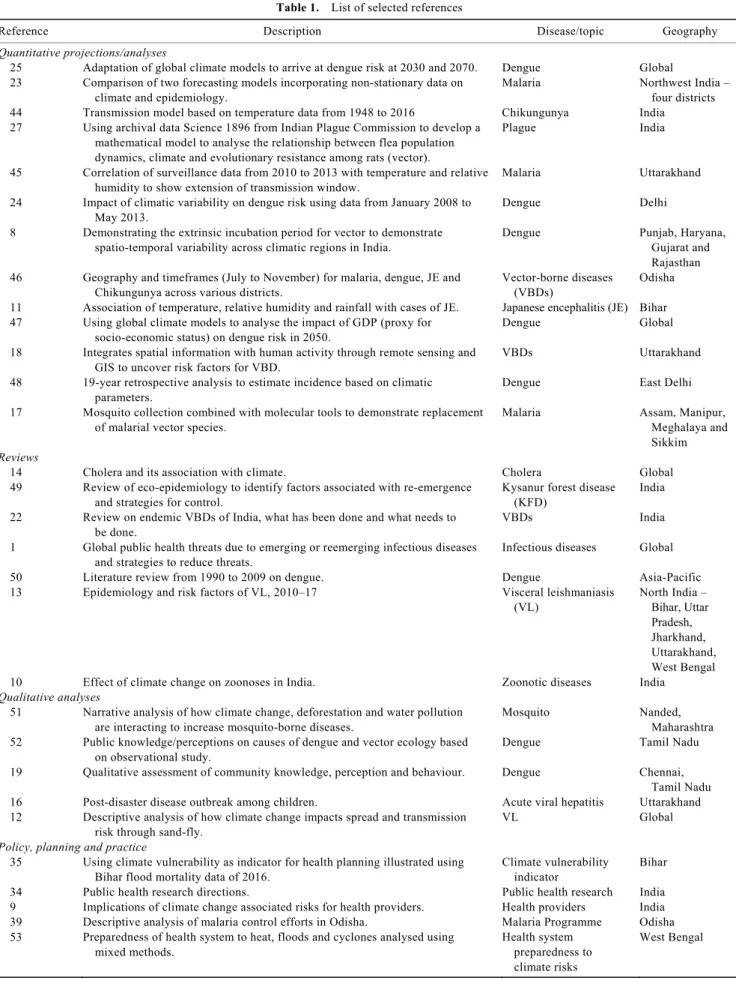
After removing duplicates, and screening titles and ab-stracts, the full text, of 84 articles was reviewed for inclu-sion. Among these, 30 articles were considered relevant using the criteria specified earlier in the text and included in this analysis (Table 1). The articles highlighted various aspects related to climate-associated risk of epidemics in India that are discussed below. Based on this analysis, it is difficult to distinguish the specific additional disease risk attributable to climate change versus risks associated with general climatic variability or changes in weather. Indeed, it has been argued that climate change may not be the principal determinant of increasing infectious disease risk5. This article also reflects the complexity by
Table 1. List of selected references
Reference Description Disease/topic Geography
Quantitative projections/analyses
25 Adaptation of global climate models to arrive at dengue risk at 2030 and 2070. Dengue Global 23 Comparison of two forecasting models incorporating non-stationary data on
climate and epidemiology.
Malaria Northwest India –
four districts 44 Transmission model based on temperature data from 1948 to 2016 Chikungunya India
27 Using archival data Science 1896 from Indian Plague Commission to develop a mathematical model to analyse the relationship between flea population dynamics, climate and evolutionary resistance among rats (vector).
Plague India
45 Correlation of surveillance data from 2010 to 2013 with temperature and relative humidity to show extension of transmission window.
Malaria Uttarakhand 24 Impact of climatic variability on dengue risk using data from January 2008 to
May 2013.
Dengue Delhi 8 Demonstrating the extrinsic incubation period for vector to demonstrate
spatio-temporal variability across climatic regions in India.
Dengue Punjab, Haryana,
Gujarat and Rajasthan 46 Geography and timeframes (July to November) for malaria, dengue, JE and
Chikungunya across various districts.
Vector-borne diseases (VBDs)
Odisha 11 Association of temperature, relative humidity and rainfall with cases of JE. Japanese encephalitis (JE) Bihar 47 Using global climate models to analyse the impact of GDP (proxy for
socio-economic status) on dengue risk in 2050.
Dengue Global 18 Integrates spatial information with human activity through remote sensing and
GIS to uncover risk factors for VBD.
VBDs Uttarakhand 48 19-year retrospective analysis to estimate incidence based on climatic
parameters.
Dengue East Delhi
17 Mosquito collection combined with molecular tools to demonstrate replacement of malarial vector species.
Malaria Assam, Manipur,
Meghalaya and Sikkim
Reviews
14 Cholera and its association with climate. Cholera Global
49 Review of eco-epidemiology to identify factors associated with re-emergence and strategies for control.
Kysanur forest disease (KFD)
India 22 Review on endemic VBDs of India, what has been done and what needs to
be done.
VBDs India 1 Global public health threats due to emerging or reemerging infectious diseases
and strategies to reduce threats.
Infectious diseases Global
50 Literature review from 1990 to 2009 on dengue. Dengue Asia-Pacific
13 Epidemiology and risk factors of VL, 2010–17 Visceral leishmaniasis (VL) North India – Bihar, Uttar Pradesh, Jharkhand, Uttarakhand, West Bengal
10 Effect of climate change on zoonoses in India. Zoonotic diseases India
Qualitative analyses
51 Narrative analysis of how climate change, deforestation and water pollution are interacting to increase mosquito-borne diseases.
Mosquito Nanded,
Maharashtra 52 Public knowledge/perceptions on causes of dengue and vector ecology based
on observational study.
Dengue Tamil Nadu
19 Qualitative assessment of community knowledge, perception and behaviour. Dengue Chennai, Tamil Nadu
16 Post-disaster disease outbreak among children. Acute viral hepatitis Uttarakhand
12 Descriptive analysis of how climate change impacts spread and transmission risk through sand-fly.
VL Global
Policy, planning and practice
35 Using climate vulnerability as indicator for health planning illustrated using Bihar flood mortality data of 2016.
Climate vulnerability indicator
Bihar
34 Public health research directions. Public health research India
9 Implications of climate change associated risks for health providers. Health providers India 39 Descriptive analysis of malaria control efforts in Odisha. Malaria Programme Odisha 53 Preparedness of health system to heat, floods and cyclones analysed using
mixed methods.
Health system preparedness to climate risks
highlighting the role of socio-economic, ecological and health system factors that influence epidemic risk asso-ciated with climatic parameters.
We first examine the nature of the risks posed by climate change, and how climatic parameters and varia-bility might lead to infectious disease outbreaks. As we next discuss, the literature clearly demonstrates that socio-economic factors are key modulators of climate-associated risks. We then summarize the available projec-tions of infectious disease incidence and progression based on models of climatic variability in India, and re-flect on their utility for health policymaking and health system preparedness.
Climate influences the spread of infectious diseases
Climate directly influences infectious diseases by affect-ing the geographic spread and transmission dynamics of disease vectors. Additionally, climate change can lead to epidemics indirectly, by increasing the frequency of extreme natural events or through interaction with other structural factors.
Temperature, rainfall and humidity are climatic factors known to considerably affect vector populations and associated disease transmission dynamics6. Temperature influences developmental rates, mortality and reproduc-tive behaviour of mosquitoes. Precipitation provides the habitat for its larvae and pupae. Thus, all mosquito-borne diseases will be impacted by climate change. The 2007 assessment of IPCC cautioned that up to 1.5–2.5 billion additional people will be exposed to dengue infection worldwide during the 2080s, due to climate change7. Temperature is known to affect the survival of Aedes
mosquitoes that transmit dengue and chikungunya. Epi-demics of dengue have become increasingly more frequent in India. The number of dengue cases during 2010–14 was more than 2.5 times that reported during 1998–2009 (ref. 8).
Temperature and humidity also influence populations of rodents, fleas and ticks, which are involved in the transmission of diseases like plague, Lyme disease, Crimean–Congo haemorrhagic fever and typhus9,10. Rain-fall and relative humidity were found to be positively cor-related with the incidence of Japanese encephalitis in Bihar11. Temperature can influence the biting rate of sandflies affecting the spread of leishmaniasis, which is a protozoan disease transmitted by these insects10,12,13. The causative agent of cholera – Vibrio cholera has been shown to be sensitive to fluctuations in rainfall and temperature, influencing the transmission of this disease in countries like India, where a large section of this popu-lation relies on untreated water14.
The probability of extreme weather events such as flash floods, extreme heat waves, cyclones, etc. is also greatly increased due to climate change. In addition to
causing deaths and diseases directly, these events are often followed by outbreaks of infectious diseases. The 26 July 2005 floods claimed over 1000 lives in Mumbai. In addition it triggered outbreaks of diseases like dengue, leptospirosis and cerebral malaria15. After the 2013 floods in Uttarakhand, high prevalence of hepatitis A among children due to contaminated water was reported16. Climate change can also interact with other ecological or human factors to increase risk of epidemics. Indirect effects can include human migration and land-use changes that result in fragmentation or destruction of nat-ural habitats. At least 60% of the emerging infectious diseases has been zoonotic; in other words, transferred from animals to humans3. As climate change and human activity interact to cause biodiversity loss, pathogens that are most resilient to ecosystem disturbances dominate. A study from four North East states of India demonstrated the replacement of one species of Anopheles as the pre-dominant malarial vector with another due to deforesta-tion and land-use change17. This vector replacement is likely influencing the success of the malaria control pro-gramme and further reduction in disease prevalence in these regions may depend on modified vector control strategies.
Socio-economic factors resulting in epidemics
In addition to climate-related factors, the distribution and severity of infectious diseases are influenced by social and demographic factors18. Population density, urbaniza-tion, housing type, water supply, sewage and waste man-agement systems, land use and irrigation systems, access and utilization of public health services are all important factors in the spread and resurgence of infectious diseases9. For example, the Aedes mosquito which transmits dengue and chikungunya, breeds in stagnant water. Poor urban areas with lack of dependable piped water tend to store water in unprotected container that serves as a breeding grounds for mosquitoes.
Socio-economic factors can also lead to the dispersion or loss of local knowledge among indigenous communi-ties, that helps prevent the escalation of outbreaks into epidemics. The recovery of communities from epidemics and disasters as well as preparedness for future outbreaks are greatly influenced by their socio-economic safety nets19,20.
Internal migration of populations and urbanization may lead to movement of vector reservoirs from endemic to newer areas. Chikungunya had disappeared from India till it reappeared in 2005 and has spread to epidemic propor-tions due to the movement of people21. Similarly, kala azar which is transmitted by sandfly was largely restricted to Bihar and West Bengal, but has recently begun flaring up in Himachal Pradesh and Uttarakhand due to increased deforestation13,22.
Using longitudinal data for projections of epidemic patterns
The move from drawing health linkages due to climate variability to being able to predict future scenarios requires high-quality data on health-related parameters, in addition to meteorological parameters6. Further, any fore-casting models need to be specific to climatic zones with-in India with-instead of a standard country-wide model, swith-ince the incidence and severity of diseases may vary across states or regions8.
Long-term data on disease incidence have been com-bined with climate information to project changes in the patterns of infectious diseases such as malaria, dengue, chikungunya and plague6,23–27.
Based on longitudinal data, malaria epidemics are pre-dicted to shift from traditionally endemic regions of cen-tral India to the southwestern states. Transmission windows are also likely to expand in the northern states, making them more prone to malaria epidemics than before. Thus malaria will spread to new regions with increased virulence even as public health efforts to con-tain the disease have been successful in traditionally endemic states22.
Mean temperature data from 1948 to 2016 have been similarly used to show that the regions of environmental suitability for chikungunya have been expanding to parts of North and NE India, which typically have low temper-atures26.
Discussion
India’s National Action Plan on Climate Change (NAPCC) recognizes the risk to human health due to cli-mate change with a mission on health. Among the key in-terventions proposed under this mission is a disease-specific database to aid in the development of effective prevention strategies, improved epidemiological under-standing and prediction. Proposed strategies include the creation of risk maps for climate-sensitive vector-borne diseases, and the use of technology to expand health access and disease surveillance. Synergies with other sec-tors of climate action, including water, agriculture and energy are especially emphasized with a view to address-ing the ecological determinants of health.
An Environmental Health Cell within the Health Departments along with an Inter-Departmental Task Force are the institutional mechanisms to carry out the actions envisaged under the National Action Plan for Climate Change and Human Health (NAPCCH). How-ever, the NAPCCH is yet to be formally adopted or sup-ported with dedicated budgetary allocations, raising questions on its implementation. A new National Mission on Biodiversity and Human Health has been approved by the Prime Minister’s Science, Technology and Innovation
Advisory Council, that aims to bring together experts in human health, animal health and the environment to prevent and manage zoonotic diseases28. Successful implementation of such a programme will undoubtedly be critical in preventing the next COVID-like epidemic. State governments have also drafted climate change adaptation plans for their health sector, either as separate documents (e.g. Chhattisgarh) or more commonly as a part of their overall climate change action plans (e.g. Bihar, Madhya Pradesh, Kerala, etc.). In the absence of climate-specific financial resources, most states have sought to leverage existing infrastructure and programmes of surveillance and research to manage climate – associated health risks.
Thus, the results of this scoping literature review need to be examined in the context of the existing public health programme for infectious diseases in India. This analysis has revealed significant gaps in research, policy and practice in the face of the climate challenge. Past epidemics may offer important lessons on improving our preparedness to the increased risk of epidemics.
Gaps in research on climate-associated epidemic risk
Research on understanding the role of climate variability in the prevalence and severity of infectious diseases is still at relatively early stages in India. Despite several methodological approaches used in analysing climatic associations with infectious diseases, the relative contri-bution of climate and therefore the centrality of climate change in increasing risk of epidemics in India are still unclear.
Despite repeated references to socio-economic factors influencing community behaviour and vulnerability1, the literature is relatively sparse on research examining the effects of socio-economic parameters in climate resi-lience. There are no studies that empirically capture the feedback loops between climatic factors and the social, economic and political aspects associated with epidemics in India.
Progress has been made on developing early warning systems, but only for a few diseases such as malaria – even these are subject to updation based on availability of new data. This is not surprising, since modelling studies tend to require long temporal records of diseases, and therefore can only project changes in the burden of known diseases rather than predicting emergence of new ones.
The level of complexity arising out of population dynamics interacting with climate variations affects the accuracy and timeliness of any predictions. Regardless, there are important lessons to be drawn from the availa-ble projections of diseases like malaria, dengue and chi-kungunya26,29,30. The most important lesson is clearly that
the range and severity of infectious diseases has already been affected by climate variability, to the extent that old assumptions about endemic regions within India no longer apply.
Policymakers need to account for the relatively short timescales and large magnitude of projected health impacts in their priority-setting processes. Long-term longitudinal surveillance of pathogens and hosts are required in conjunction, to mount an effective public health response. In addition, modifiable behaviours or risk factors in humans need to be identified to design risk reduction practices and behaviour change communica-tion. Data and information should be made available in public registries of diseases for research and awareness. In addition to surveillance of vector dynamics and transmission patterns, more qualitative and applied health systems research needs to be supported on the implemen-tation of interventions, their cost-effectiveness, vulnera-bility assessments of communities, policy evaluations and decision-support systems, especially at sub-national levels. Expansion of the research base and institutionaliz-ing mechanisms to incorporate evidence in policymakinstitutionaliz-ing is urgent, and essential to anticipate risks and proactively manage them.
Public health response and its lacunae
India’s public health system has long emphasized surveil-lance and control of epidemic outbreaks. However, there are clear weaknesses in the public health system even under normal conditions that are especially egregious during epidemics.
The current programme for vector-borne diseases is the National Vector Borne Disease Control Programme (NVBDCP), which focuses on malaria, dengue, chikun-gunya, lymphatic leishmaniasis, Japanese encephalitis and kala azar. Surveillance data along with information of outbreaks in each district are collected and maintained under the Integrated Disease Surveillance Project (IDSP), which is coordinated with a rapid response team to man-age these outbreaks. A network of epidemiologists, microbiologists and entomologists in referral laboratories has also been established up under the IDSP. The Nation-al Centre for Disease Control (NCDC) houses the IDSP, and is tasked with consistently enhancing the capabilities for surveillance and rapid response for communicable diseases. Further, the International Health Regulations (IHR) provide an instrument for the exchange of informa-tion and expertise on public health risks across interna-tional borders.
Research institutions led by the Indian Council of Med-ical Research (ICMR), Department of Biotechnology, Council of Scientific and Industrial Research and Department of Science and Technology assist in the development of protocols for surveillance, diagnostic
development and testing, drug development, clinical trials, etc. to augment our long-term capabilities in epi-demic control. However, for a country the size of India, budgetary allocations for health research as well as health services remain inadequate.
Despite many successes, responses to communicable disease spread have traditionally been through vertical disease control efforts. Diseases that are not covered by control programmes are completely neglected. For exam-ple, while disease surveillance has improved for childhood diarrhoea, there is no systematic surveillance for water-borne diseases in general. Similarly, there are much less data and poor preparedness for emerging zoonotic diseases outside of traditionally endemic regions.
Even for diseases covered by vertical programmes, there are emerging barriers to continued success. The National Malaria Eradication Programme of the Govern-ment of India was launched in the 1950s, and has brought down disease incidence in large parts of the country through effective surveillance and improved access to artemisinin-based combination therapy31. However, the pest-control methods used to deal with vector, such as spraying of insecticides are themselves health risks by virtue of their toxicity and non-specificity of targets. In addition, long-term use of these pest-control strategies has led to the development of insecticide resistance, limiting their usefulness in the future. There is already a visible need for higher dosages and more frequent appli-cations of insecticides, increasing the risk to human health from these synthetic chemicals. Current public health programmes thus face difficult challenges of drug resistance, financial sustainability and availability of trained human resources.
Further, India’s health system is uneven, presenting weaknesses in dealing with climate-related public health challenges. Different states are highly varied in their health system capacity and effectiveness in the control of infectious diseases. While the National Rural Health Mission (now National Health Mission) made substantial progress in strengthening public health in rural areas, urban areas were relatively neglected, and depend more on private hospitals that are almost entirely focused on curative treatment. There is much less public health infra-structure and investment in surveillance and monitoring in urban areas that has proved to be a liability in the COVID-19 response as well. Despite existing evidence for the links between urbanization and zoonosis32, urban health policy and planning in India have not moved to mitigate the socio-environmental accumulation of health risks in urban areas.
Health policy and planning for climate adaptation
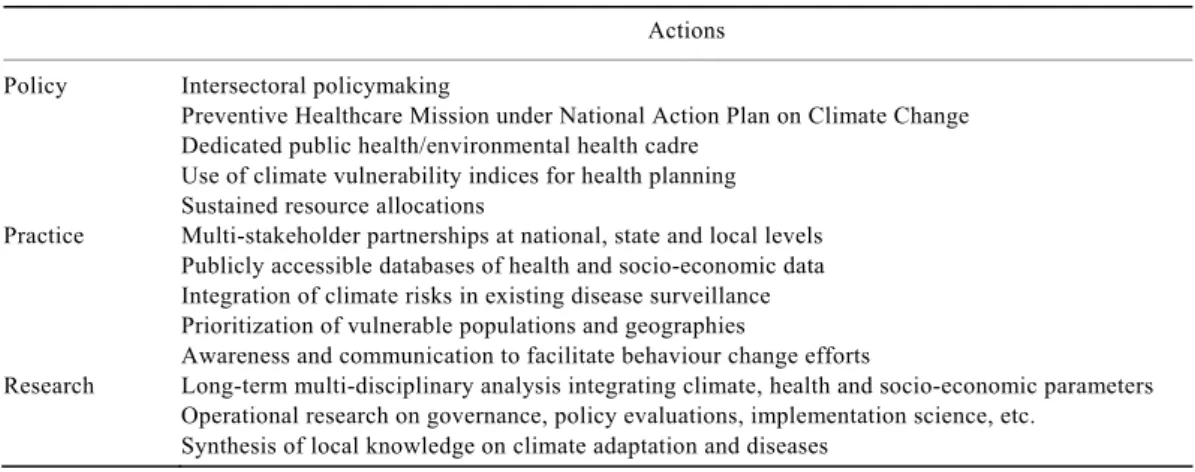
Roy et al.33 recommend a National Preventive Health
Table 2. Recommendations for health policy, practice and research to improve resilience to climate-associated risk
of infectious diseases
Actions Policy Intersectoral policymaking
Preventive Healthcare Mission under National Action Plan on Climate Change Dedicated public health/environmental health cadre
Use of climate vulnerability indices for health planning Sustained resource allocations
Practice Multi-stakeholder partnerships at national, state and local levels Publicly accessible databases of health and socio-economic data Integration of climate risks in existing disease surveillance Prioritization of vulnerable populations and geographies
Awareness and communication to facilitate behaviour change efforts
Research Long-term multi-disciplinary analysis integrating climate, health and socio-economic parameters Operational research on governance, policy evaluations, implementation science, etc.
Synthesis of local knowledge on climate adaptation and diseases
that prevention is the most cost-effective way to minim-ize climate vulnerability.
Research to create a baseline understanding of region-specific demographic, social, and ecological determinants of health is required to support policy development34. Health sector planning has traditionally relied on disease prevalence to determine its priorities, whereas reporting by the public health system is highly uneven across the country. Using a vulnerability index can help get around this challenge while also incorporating parameters on climate adaptation encompassing socio-economic, health and disaster vulnerabilities35. Additional sources of data such as emergency medical services are needed to augment disease surveillance36.
An analysis of Odisha’s malaria policy additionally reinforces the need for an intersectoral approach. The comprehensive case management programme initiated by ICMR along with the Health Department, specifically addressed issues of remoteness and shortage of health workers by involving non-health workers in malaria con-trol. Intersectoral coordination at the community and block levels for active surveillance, diagnosis and treat-ment enabled significant decline in cases37–39.
Conclusion
This analysis based on the existing literature on linkages between climate variability and infectious diseases in India provides specific lessons for health policy, research and practice (Table 2). The concept of health-system resi-lience is especially useful as a yardstick to ensure that the Indian health system can absorb shocks, respond to changing disease patterns and adapt to the instability brought about by climate change. Health system resi-lience is made up of the following components – the con-stant collection of data for surveillance and preparedness, effective financial allocation with protection of public health funding, availability of resources, including trained
workforce, medicines, vaccines and supplies, and most importantly, polycentric leadership and governance40. Existing resources are inadequate to meet the rising pressures of climate variability on India’s public health infrastructure. Given the rising number and frequency of potential epidemic risks and the ultimate objective of epidemic response, undertaking disease- specific res-ponses is neither cost-effective nor practical. Instead, scarce public resources should be directed towards sys-temic efforts to augment public health surveillance and response across the board.
Socio-economic factors also exacerbate the risk among vulnerable populations, with implications for equity and corresponding policy. For example, the acute encephalitis syndrome outbreak in 2019 which led to the deaths of over 160 children in Bihar was underpinned by undernu-trition and poverty41. Over the long term action needs to be oriented towards sustained efforts for improving sani-tation, public investments in innovations for sewage and waste management, improved urban planning and enhancing health equity.
Poor inter-departmental coordination can lead to poli-cies of different departments working at cross-purposes with each other. For example, stubble burning in the neighbouring agricultural states that is blamed for high levels of air pollution in Delhi, is in fact the result of water policies that have minimized the gaps between farming seasons to manage the water table42. This also reinforces the need for inter-sectoral coordination across this Departments of Environment, Health, Disaster Man-agement, Urban Development, etc. pointing to a health-in-all-policies approach to policymaking.
Beyond governmental policy, climate adaptation also requires multi-stakeholder partnerships at all levels39. The private sector, philanthropists, researchers and activists all need to be engaged to improve knowledge and action on climate change and its associated risks for human health. Communities and civil society can be recruited to monitor outbreaks and facilitate behaviour change efforts
that minimize transmission of infectious diseases. Manag-ing water use and lifestyles for example, could substan-tially reduce risks from dengue and chikungunya despite suitable climatic conditions by preventing man–mosquito contact.
The 2015 Lancet Commission on Health and Climate Change described tackling climate change as the greatest global health opportunity of the 21st century43. Building climate resilience of health is really a subset of broader strengthening of the health system. Whether or not dis-eases are attributable to climate change, the ultimate objective must be sustained progress towards improving human health. The good news is that the same steps that need to be taken to improve climate resilience and public health preparedness will additionally further the country’s economic and social goals. Thus, investments in health systems for climate resilience should go beyond health sector budgets and encompass all aspects of public policy and discourse.
1. Kundu, M. K., Mandal, T. K. and Bhattacharya, M., Study on global public health threats due to emerging or re-emerging infec-tious diseases and the strategies to reduce threats. Indian J. Public Health Res. Develop., 2018, 9, 38–43.
2. Freed, J. S., Kwon, S. Y., El, H. J., Gottlieb, M. and Roth, R., Which country is truly developed? COVID-19 has answered the question. Ann. Global Health, 2020, 86.
3. Dikid, T., Jain, S. K., Sharma, A., Kumar, A. and Narain, J. P., Emerging and re-emerging infections in India: an overview.
Indian J. Med. Res., 2013, 138, 19–31.
4. Ghosal, A., Going viral: Congo fever is back in India and here’s why you should be worried. News18, 13 September 2019. 5. Reiter, P., Climate change and mosquito-borne disease. Environ.
Health Perspect., 2001, 109(Suppl), 141–161.
6. Lopez, D. and Sekaran, G., Climate change and disease dynam-ics – a big data perspective. Int. J. Infect. Dis., 2016, 45, 23–24. 7. Confalonieri, U. et al., Human health. climate change 2007:
Impacts, adaptation and vulnerability. In Contribution of Working Group II to the Fourth Assessment Report of the Inter-governmental Panel on Climate Change (eds Parry, M. L. et al.), Cambride University Press, Cambridge, UK, 2007, pp. 391–431. 8. Mutheneni, S. R., Morse, A. P., Caminade, C. and Upadhyayula,
S. M., Dengue burden in India: recent trends and importance of climatic parameters. Emerg. Micro. Infect., 2017, 6, e70.
9. Dhara, V. R., Schramm, P. J. and Luber, G., Climate change and infectious diseases in India: implications for health care providers.
Indian J. Med. Res., 2013, 138, 847.
10. Singh, B. B., Sharma, R., Gill, J. P. S., Aulakh, R. S. and Banga, H. S., Climate change, zoonoses and India. Rev. Sci. Tech. OIE, 2011, 30, 779.
11. Pisudde, P. M., Kumar, P., Sarthi, P. P. and Deshmukh, P. R., Climatic determinants of Japanese encephalitis in Bihar state of India: a time-series poisson regression analysis. J. Commun. Dis., 2017, 49, 13–18.
12. Rajesh, K. and Sanjay, K., Change in global climate and preva-lence of visceral leishmaniasis. Int. J. Sci. Res. Publ., 2013, 3, 1–2.
13. Samuel Singh, N., A review on major risk factors and current status of visceral leishmaniasis in North India. Am. J. Entomol., 2019, 3, 6.
14. Chowdhury, F. R., Nur, Z., Hassan, N., von Seidlein, L. and Dunachie, S., Pandemics, pathogenicity and changing molecular
epidemiology of cholera in the era of global warming. Ann. Clin. Microbiol. Antimicrob., 2017, 16, 10.
15. Singh, V. and Bhupta, M., Deluge of maladies, 29 August 2005.
India Today, 2005.
16. Pal, S., Juyal, D., Sharma, M., Kotian, S., Negi, V. and Sharma, N., An outbreak of hepatitis A virus among children in a flood rescue camp: a post-disaster catastrophe. Indian J. Med. Micro-biol., 2016, 34, 233–236.
17. Akhtar, N., Nagpal, B. N., Kapoor, N., Srivastava, A. and Vale-cha, N., Role of An. culicifacies as a vector of malaria in changing ecological scenario of northeastern states of India. J. Vector Borne Dis., 2016, 53, 264–271.
18. Mondal, R., Jauhari, R. K., Devi, N. P., Saran, S. and Kumar, A. S., A reappraisal on factors for vector-borne diseases (VBDs) in Uttarakhand, India. In Remote Sensing of Northwest Himalayan Ecosystems,Springer, 2019, pp. 455–467.
19. Ashok Kumar, V. et al., Studies on community knowledge and behavior following a dengue epidemic in Chennai city, Tamil Nadu, India. Trop. Biomed., 2010, 27, 330–336.
20. Angeline, A., Suguna, Surekha, A., Joseph, S. and Kiran, P. R., Health impact of Chennai floods 2015: observations in a medical relief camp. Int. J. Health Syst. Disaster Manage., 2017,
5, 46.
21. Mohan, A., Kiran, D., Manohar, C. and Kumar, P., Epidemiology, clinical manifestations, and diagnosis of chikungunya fever: les-sons learned from the reemerging epidemic. Indian J. Dermatol., 2010, 55, 54.
22. Dhiman, R. C., Pahwa, S., Dhillon, G. P. S. and Dash, A. P., Climate change and threat of vector-borne diseases in India: are we prepared? Parasitol. Res., 2010, 106, 763–773.
23. Roy, M., Bouma, M., Dhiman, R. C. and Pascual, M., Predictabili-ty of epidemic malaria under non-stationary conditions with process-based models combining epidemiological updates and climate variability. Malaria J., 2015, 14, 419.
24. Sahay, S., Climatic variability and dengue risk in urban environ-ment of Delhi (India). Urban Climate, 2018, 24, 863–874. 25. Khormi, H. M. and Kumar, L., Climate change and the potential
global distribution of Aedes aegypti: spatial modelling using geographical information system and CLIMEX. Geospatial Health, 2014, 405–415.
26. Kakarla, S. G. et al., Temperature dependent transmission poten-tial model for chikungunya in India. Sci. Total Environ., 2019,
647, 66–74.
27. Lewnard, J. A. and Townsend, J. P., Climatic and evolutionary drivers of phase shifts in the plague epidemics of colonial India.
Proc. Natl. Acad. Sci. USA, 2016, 113, 14601–14608.
28. Pardhikar, R. and Tripathii, B., COVID19-like animal-to-human diseases set to grow, say experts. Here’s what can be done about it. IndiaSpend, March 2020.
29. Laneri, K. et al., Forcing versus feedback: epidemic malaria and monsoon rains in northwest India. PLoS Comput. Biol., 2010, 6, e1000898.
30. Verma, P., Sarkar, S., Singh, P. and Dhiman, R., Devising a method towards development of early warning tool for detection of malaria outbreak. Indian J. Med. Res., 2017, 146, 612– 621.
31. Narain, J. and Nath, L., Eliminating malaria in India by 2027: the countdown begins. Indian J. Med. Res., 2018, 148, 123.
32. Ahmed, S., Dávila, J. D., Allen, A., Haklay, M. (MUKI), Tacoli, C. and Fèvre, E. M., Does urbanization make emergence of zoonosis more likely? Evidence, myths and gaps. Environ. Urbani., 2019, 31, 443–460.
33. Roy, J., Ghosh, D., Mukhopadhyay, K. and Ghosh, A., Exacerbat-ing health risks in India due to climate change: rethinkExacerbat-ing approach to health service provision. In Handbook of Research on Climate Change Impact on Health and Environmental Sustainabi-lity,IGI Global, 2016, ch. 1, pp. 1–25.
34. Bush, K. F. et al., Impacts of climate change on public health in India: future research directions. Environ. Health Perspect., 2011,
119, 765–770.
35. Dogra, N., Kakde, V. and Taneja, P., Decision tool for climate disasters and infectious disease at sub-national level in India: ensuring a paradigm shift in health planning from prevalence to vulnerability. Acta Trop., 2019, 191, 60–68.
36. Pilot, E., Roa, R., Jena, B., Kauhl, B., Krafft, T. and Murthy, G., Towards sustainable public health surveillance in India: using rou-tinely collected electronic emergency medical service data for early warning of infectious diseases. Sustainability, 2017, 9, 604. 37. Porecha, M., How Odisha fought the malaria battle, and won it.
TheHindu Business Line, 2 January 2019.
38. Yadavar, S., World Malaria Report 2018: led by Odisha, India reduces cases by 3 million. Business Standard News, 23 Novem-ber 2018.
39. Pradhan, M. and Meherda, P., Malaria elimination drive in Odi-sha: hope for halting the transmission. J. Vector Borne Dis., 2019,
56, 53–55.
40. Fridell, M., Edwin, S., von Schreeb, J. and Saulnier, D. D., Health system resilience: what are we talking about? A scoping review mapping characteristics and keywords. Int. J. Health Policy Manage., 2020, 9, 6–16.
41. PTI, At AES epicentre, experts count reasons, families rue: ‘poverty, malnutrition and lack of awareness’. The Economic Times, Muzaffarpur, 23 June 2019.
42. Aggarwal, M., Laws meant to save water unexpectedly led to more air pollution: study. The Wire, 2 September 2019.
43. Watts, N. et al., Health and climate change: policy responses to protect public health. Lancet, 2015, 386, 1861–1914.
44. Kakarla, S. G. et al., Lag effect of climatic variables on dengue burden in India. Epidemiol. Infect., 2019, 147.
45. Dhiman, R. et al., Preparedness for malaria elimination in the wake of climate change in the State of Uttarakhand (India). J. Vector Borne Dis., 2019, 56, 46–52.
46. Karmakar, M. and Pradhan, M. M., Climate change and public health: a study of vector-borne diseases in Odisha, India. Nat. Haz., 2019.
47. Åström, C., Rocklöv, J., Hales, S., Béguin, A., Louis, V. and Sauerborn, R., Potential distribution of dengue fever under scenarios of climate change and economic development.
Ecohealth, 2012, 9, 448–454.
48. Ramachandran, V. G., Roy, P., Das, S., Mogha, N. S. and Bansal, A. K., Empirical model for estimating dengue incidence using temperature, rainfall, and relative humidity: a 19-year retrospective analysis in East Delhi. Epidemiol. Health, 2016, 38, e2016052.
49. Ajesh, K., Nagaraja, B. K. and Sreejith, K., Kyasanur forest disease virus breaking the endemic barrier: an investigation into ecological effects on disease emergence and future outlook.
Zoonoses Public Health, 2017, 64, e73–e80.
50. Banu, S., Hu, W., Hurst, C. and Tong, S., Dengue transmission in the Asia‐Pacific region: impact of climate change and socio‐environmental factors. Trop. Med. Int. Health, 2011, 16, 598–607.
51. Vinod, S., Deforestation and water pollution impact on mosquitoes related epidemic diseases in nanded region. Biosci. Discov., 2011,
2, 309–316.
52. Chandran, R. and Azeez, P. A., Outbreak of dengue in Tamil Nadu, India. Curr. Sci., 2015, 00, 171–176.
53. Dasgupta, P., Ebi, K., and Sachdeva, I., Health sector preparedness for adaptation planning in India. Climatic Change, 2016, 138, 551–566.
ACKNOWLEDGEMENT. We thank Azim Premji University, Benga-luru for research funding.
Received 13 August 2020; revised accepted 24 September 2020 doi: 10.18520/cs/v119/i12/1919-1926