St. John Fisher College
Fisher Digital Publications
Education Doctoral Ralph C. Wilson, Jr. School of Education
8-2016
Triadic Interaction between Social Cognitive
Theory, Social Presence Theory, and Community
of Inquiry: An Online Course Instructional Design
Assessment Model Evaluating Students’
Perceptions of Social Presence, Collaborative
Learning, Social Interaction, and Satisfaction with
their Learning Experience
Jamie L. Cuda
St. John Fisher College, [email protected]
How has open access to Fisher Digital Publications benefited you?
Follow this and additional works at:http://fisherpub.sjfc.edu/education_etd Part of theEducation Commons
Recommended Citation
Cuda, Jamie L., "Triadic Interaction between Social Cognitive Theory, Social Presence Theory, and Community of Inquiry: An Online Course Instructional Design Assessment Model Evaluating Students’ Perceptions of Social Presence, Collaborative Learning, Social Interaction, and Satisfaction with their Learning Experience" (2016).Education Doctoral.Paper 265.
Please note that the Recommended Citation provides general citation information and may not be appropriate for your discipline. To receive help in creating a citation based on your discipline, please visithttp://libguides.sjfc.edu/citations.
Triadic Interaction between Social Cognitive Theory, Social Presence
Theory, and Community of Inquiry: An Online Course Instructional
Design Assessment Model Evaluating Students’ Perceptions of Social
Presence, Collaborative Learning, Social Interaction, and Satisfaction with
their Learning Experience
Abstract
Community colleges have a mission of affording students open access to higher education. Student attrition in online courses at community colleges directly reduces student access to higher education and successful course and program completion and negatively impacts student success and institutional outcomes. From a social cognitive theory, social presence theory, and community of inquiry perspective, students’ perceptions of social presence, collaborative learning, social interaction, and satisfaction with their learning experience are critical components of student learning. This quasi-experimental study examines the impact of an
instructional strategy, team-based learning, on students’ perceptions of social presence, collaborative learning, social interaction, and satisfaction with their learning experience in an online medical terminology course at a community college in Upstate New York. An online course instructional design assessment model emerged to assess students’ perceptions of social presence, collaborative learning, social interaction, and satisfaction with their learning environment through the intersection of social cognitive theory, social presence theory, and community of inquiry. Students’ perceptions of social presence, collaborative learning, social interaction, and satisfaction with their learning experience in an online course increased as a result of the student team-based instructional course design strategy. Recommendations support preparation of course designers, instructors, and implementation and evaluation of online courses. A circle of responsibility and success emerged in which student success is contingent on institutional commitment to research and best practices, course designer and instructor professional development, and student orientation and resources. Increasing higher education access and successful course and program completion is significant as a pathway out of poverty to improve social justice and equality. Recommendations include direct practice application, policy development, and future research..
Degree Type
Dissertation
Degree Name
Doctor of Education (EdD)
Department
Executive Leadership
First Supervisor
Subject Categories
Triadic Interaction between Social Cognitive Theory, Social Presence Theory, and Community of Inquiry: An Online Course Instructional Design Assessment Model Evaluating Students’ Perceptions of Social Presence, Collaborative Learning, Social
Interaction, and Satisfaction with their Learning Experience
By
Jamie L. Cuda
Submitted in partial fulfillment of the requirements for the degree
Ed.D. in Executive Leadership
Supervised by
C. Michael Robinson, Ed.D.
Committee Member Kim VanDerLinden, Ph.D.
Ralph C. Wilson, Jr. School of Education St. John Fisher College
Copyright by Jamie L. Cuda
Dedication
I dedicate my research to my family who have provided me with unconditional love and support. I would like to express my sincere appreciation and gratitude to my husband, Vinny, and my children, Kasper, Vincent, and Karissa, for their unwavering support and understanding throughout the dissertation process. I am especially grateful for your assistance with getting me packed, car loaded, and out the door for my weekend commutes to class. A special thank you to my personal assistants who provided me with a hot tea in hand for the road trips. Without your assistance I never would have had what I needed each weekend but more importantly without your willingness and
sacrifices in my absence this would not have been possible. I love you all dearly and am grateful to have been blessed with you in my life.
To my mother and father who raised me with a strong moral compass and the confidence and strength to stand up to injustices. You have instilled the value of life-long learning and that an investment in education is time well spent. Thank you for your love and guidance. I am eternally grateful and blessed to have such wonderful parents and exemplary role models. If I can instill in others a fraction of the good you have in your lifetime I will be extremely fortunate. I thank my siblings for their support and thank God for the gift of my family.
I would like to express my deepest admiration and a very special thank you to Lynn Kattato. I greatly appreciate your support, encouragement, and friendship
and am a better person because of our interactions. I am lucky to have experienced this program with you.
To Syracuse Cohort 2, I could not have asked for a better cohort. Each member of our cohort brought value to the experience and I have learned from each of you. I especially would like to thank my group, C4, Rob DiFlorio, Denise DiRienzo, and Matt LaLonde. I enjoyed learning with you. Our team exemplified effective collaboration, focused on our strengths, and celebrated our successes as a cohesive team!
Last but not least, I would like to express my sincere appreciation to
C. Michael Robinson, Syracuse Site Director and my Committee Chair. Thank you for your instruction and guidance. I deeply value and appreciate your direction. I would also like to thank Dr. Esther Bankert who served as my Executive Mentor, colleague, and friend. Your guidance and direction were invaluable. Thank you for all the time and dedication to ensure a scholarly dissertation. In closing, I would like to thank Nancy Caputo, Professor Emerita, for her exemplary leadership, friendship, and support.
Biographical Sketch
Jamie Cuda is currently an Assistant Professor in the Center for Health and Life Sciences at Mohawk Valley Community College. She has served as program coordinator overseeing six Allied Health Professions programs and assumed all administrative
operations thereof. Mrs. Cuda has secured approximately half a million dollars in grant funding for curriculum development and high needs programs. She has successfully developed curriculum and transitioned hospital-based programs to college-based
programs. She has over twenty-five years of experience as a higher education instructor specializing in online course design and instruction. She also specializes in program and curriculum development. Mrs. Cuda earned her Master’s of Science in Education from the State University of New York College at Oswego, Bachelor’s of Science in Business Public Management from the State University of New York Institute of Technology at Utica/Rome, and an Associate in Applied Science in Accounting from Mohawk Valley Community College. Mrs. Cuda began her studies at St. John Fisher College in Summer 2014 in the Education Doctorate in Executive Leadership program. She pursued her research in Triadic Interaction between Social Cognitive Theory, Social Presence Theory, and Community of Inquiry: An Online Course Instructional Design Assessment Model Evaluating Students’ Perceptions of Social Presence, Collaborative Learning, Social Interaction, and Satisfaction with their Online Learning Experience under the direction of Dr. C. Michael Robinson and Dr. Kim VanDerLinden and received the Ed. D. Degree in
Abstract
Community colleges have a mission of affording students open access to higher education. Student attrition in online courses at community colleges directly reduces student access to higher education and successful course and program completion and negatively impacts student success and institutional outcomes. From a social cognitive theory, social presence theory, and community of inquiry perspective, students’
perceptions of social presence, collaborative learning, social interaction, and satisfaction with their learning experience are critical components of student learning. This quasi-experimental study examines the impact of an instructional strategy, team-based learning, on students’ perceptions of social presence, collaborative learning, social interaction, and satisfaction with their learning experience in an online medical terminology course at a community college in Upstate New York. An online course instructional design assessment model emerged to assess students’ perceptions of social presence,
collaborative learning, social interaction, and satisfaction with their learning environment through the intersection of social cognitive theory, social presence theory, and
community of inquiry. Students’ perceptions of social presence, collaborative learning, social interaction, and satisfaction with their learning experience in an online course increased as a result of the student team-based instructional course design strategy. Recommendations support preparation of course designers, instructors, and
and best practices, course designer and instructor professional development, and student orientation and resources. Increasing higher education access and successful course and program completion is significant as a pathway out of poverty to improve social justice and equality. Recommendations include direct practice application, policy development, and future research.
Table of Contents
Dedication ... iii
Biographical Sketch ...v
Abstract ... vi
Table of Contents ... viii
List of Tables ... xi
List of Figures ... xii
Chapter 1: Introduction ...1
Problem Statement ...3
Theoretical Rationale ...4
Statement of Purpose ...7
Research Questions ...8
Significance of the Study ...9
Definitions of Terms ...11
Chapter Summary ...12
Chapter 2: Review of the Literature ...15
Introduction and Purpose ...15
Reviews of the Literature ...16
Chapter Summary ...38
Research Context ...42
Research Participants ...43
Instruments Used in Data Collection ...44
Procedures for Data Collection and Analysis ...47
Team-based Instructional Design Strategy ...48
Summary ...53
Chapter 4: Results ...55
Introduction ...55
Research Questions ...55
Data Analysis and Findings ...56
Summary of Results ...79 Chapter 5: Discussion ...84 Introduction ...84 Implications of Findings ...86 Limitations ...90 Recommendations ...90 Conclusion ...102 References ...107 Appendix A ...117 Appendix B ...119 Appendix C ...121 Appendix D ...123 Appendix E ...125
Appendix F...133 Appendix G ...134 Appendix H ...135 Appendix I ...136 Appendix J ...137 Appendix K ...138 Appendix L ...139 Appendix M ...141
List of Tables
Item Title Page
Table 2.1 History of online education 23
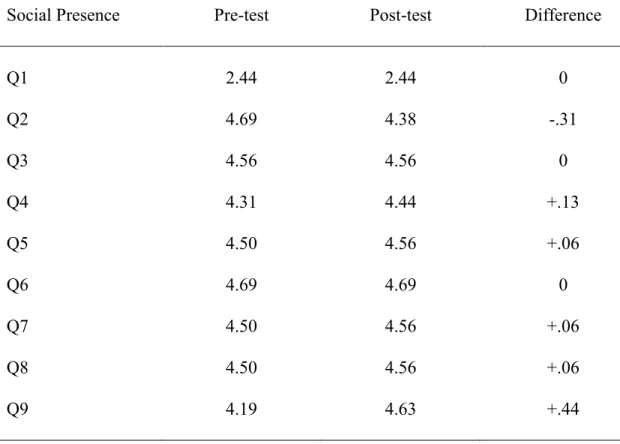
Table 4.1 Demographic information participants’ gender 58 Table 4.2 Demographic information participants’ age 58 Table 4.3 Pre-test information, participants’ perception of social presence 60 Table 4.4 Post-test information, participants’ perception of social presence 62 Table 4.5 Social presence comparison of the means 63 Table 4.6 Pre-test information, participants’ perception of collaborative
learning 65
Table 4.7 Post-test information, participants’ perception of collaborative
learning 67
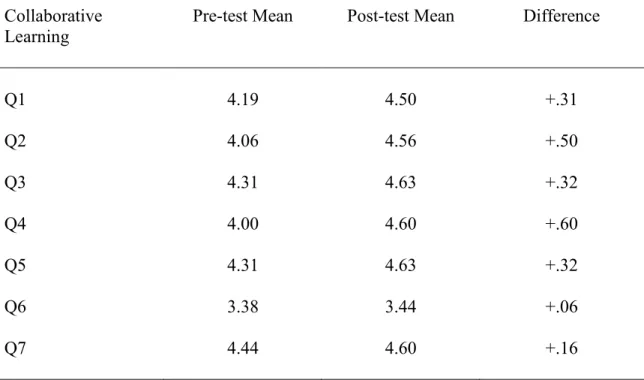
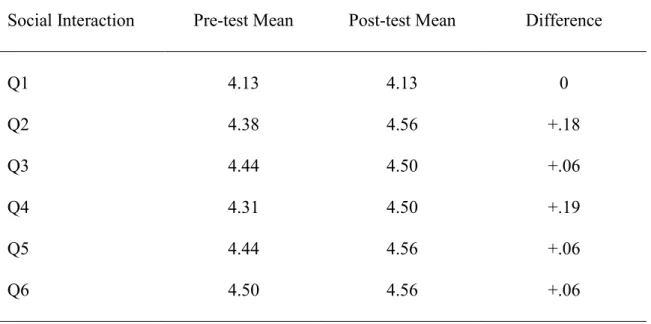
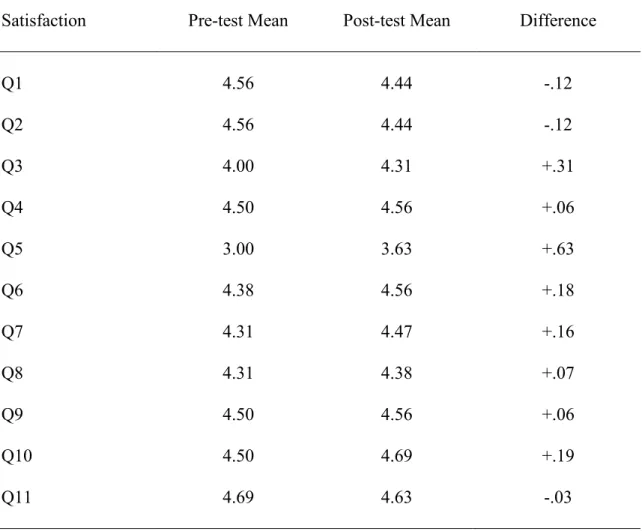
Table 4.8 Collaborative learning comparison of the means 68 Table 4.9 Pre-test information, participants’ perception of social interaction 70 Table 4.10 Post-test information participants’ perception of social interaction 72 Table 4.11 Social interaction comparison of the means 73 Table 4.12 Pre-test information, participants’ perception of satisfaction 75 Table 4.13 Post-test information, participants’ perception of satisfaction 77
Table 4.14 Satisfaction comparison of the means 78
Table 4.15 Participants’ cumulative perception of social presence, collaborative learning, social interaction, and satisfaction,
List of Figures
Item Title Page
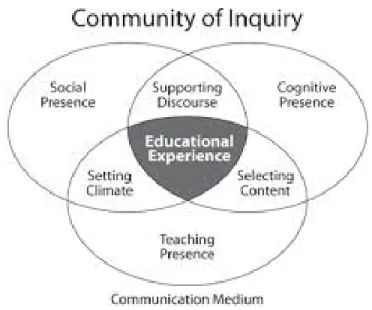
Figure 2.1 The community of inquiry model 34
Figure 5.1 Circle of responsibility and success 93
Chapter 1: Introduction
The popularity and number of online course offerings continue to increase in order to meet the demands of society (Moore, 2014). Alternate means of instructional delivery are necessary to meet the needs of students and colleges (Carr, 2000, 2014). More students are enrolling in college courses wishing to further their education to enhance their career and many wish to do so without interfering with their family and work commitments. Therefore, more students are choosing online courses at community colleges because they are flexible and can accommodate their work and family schedules.
In the fall of 2002, 1.6 million students enrolled in at least one online course (Allen & Seaman, 2011). By 2010, the number of students enrolled in at least one online course grew to over 6.1 million. Online enrollment growth rate has been significantly higher than the growth rate of enrollment in higher education overall. In a comparison from 2009 to 2010, online course enrollment increased 10% while overall higher education enrollment increased less than 1%. In 2010, 31% of all higher education students were enrolled in at least one online course. It is predicted that online course growth will continue to grow at a fast rate (Allen & Seaman, 2011), with an estimated 50% of all learning achieved online by the year 2050 (Draves, 2002).
Challenges in education. Colleges compete for enrollment and have limited physical resources such as building space (Carr, 2014). Online courses have become a solution for colleges to increase student enrollment and limit physical space issues.
undergraduate students are more likely to drop out of an online course in comparison to a traditional face-to-face course (Carr, 2000; Moody, 2004; Patterson & McFaddan, 2009; Xu & Jaggars, 2013). Online course attrition rates can be up to 7 times higher than traditional face-to-face courses (Xu & Jaggars, 2013). A major challenge with online education in undergraduate courses is creating a social presence between students and instructor (Dow, 2008), and thus, students may feel disconnected and less engaged in online courses. Empirical research studies define social presence in many ways. For the purpose of this study, social presence is defined as the students’ ability to project
themselves socially and effectively in an online course leading to connectedness to their instructor and classmates.
The main difference of online instruction from traditional face-to-face instruction is student and instructor separation. Student and instructor separation creates a challenge to design and instruct a course where students feel connected to their instructor and classmates. The absence of social presence and student connectedness may contribute to high attrition rates in online courses (Moore, 2014). Therefore, creating a social presence in an online classroom is important.
Enhancing educational environment. Social presence may directly relate to student satisfaction, success, and course completion (Moore, 2014). Students are more likely to complete a course when they feel connected to their instructor and classmates (Seiver & Troja, 2014). Empirical research studies found a positive correlation between students’ perceptions of social presence and student satisfaction (Coaplen, Hollis, & Bailey, 2013; Richardson & Swan, 2003; Seiver & Troja, 2014; Swan & Shih, 2003). Likewise, a positive correlation was found between students’ perceptions of social
presence and academic success (Garrison, Cleveland-Innes, & Fung, 2010; Hege, 2011; Liu, Gomez, & Yen, 2009; Wei, Chen, & Kinshuk, 2012; Yen & Tu, 2011).
Furthermore, increasing social presence in an online course decreases student attrition (Carr, 2000; Liu et al., 2009).
Colleges are adding more online courses to accommodate the growth in online enrollment; however, there is limited research addressing the relationship between course design, instruction, social presence, and student attrition. Creating social presence in online courses may result in enhanced student satisfaction, decreased student attrition, and increased student success. Therefore, a model to assess these components is imperative to student success.
Problem Statement
High attrition in online courses directly impacts many aspects of higher education. Colleges lose money on online course development, instruction, and assessment as well as tuition revenue (Moody, 2004). Revenue loss has a negative impact on colleges’ economic survival (Liu et al., 2009; Moody, 2004; Summers, 2003). Limited public resources increase the call for community college accountability for the use of funds (Allen & Seaman, 2011; Summers, 2003). Accountability is most frequently measured through the lens of institutional effectiveness, financial, enrollment management, and student learning metrics. Regardless of how it is measured, attrition is a significant challenge for community colleges (Summers, 2003). Attrition rates differ between online and campus courses (Carr, 2000; Moody, 2004; Patterson & McFadden, 2009; Xu & Jaggars, 2013). Online course attrition rates may be up to 7 times higher than campus-based courses (Xu & Jaggars, 2013). Therefore, there is a need for the consideration of
an assessment model to promote attention to social presence in online course development, delivery, and evaluation.
There is high student attrition at community colleges; therefore, it limits
community colleges’ ability to meet President Barack Obama’s (2009) call for increased higher education of Americans. Likewise, high student attrition presents challenges for community colleges to meet the 21st Century Initiative to increase student completion
rates 50% by 2020 (American Association of Community Colleges [AACC], 2010). Students enrolled in online courses are more likely to drop out than students enrolled in traditional face-to-face courses (Patterson & McFadden, 2009). Forty-three percent of students enrolled in online courses drop out compared to 11% of students enrolled in traditional face-to-face courses. Therefore, high student attrition reduces potential level of student access to higher education and successful course and program completion. Further research is needed to investigate the high rate of attrition in online higher education courses at community colleges which negatively impacts student success and institutional outcomes. Students who do not receive the necessary education and degree(s) are not prepared to meet the demands of the labor force. Failing to meet the economic demand will result in a shortfall of educated and skilled laborers, which may negatively affect the social and economic state of Americans and the American economy. Theoretical Rationale
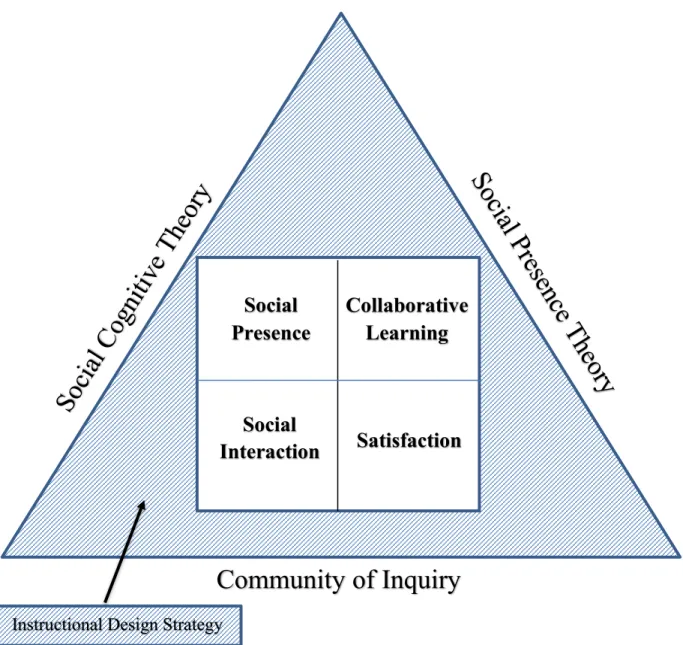
Social cognitive theory (SCT), social presence theory (SPT), and the community of inquiry (CoI) speak to the importance of social presence, collaborative learning, social interaction, and student satisfaction with their learning experience. The concept and importance of social presence originates with SCT. SPT focuses on the importance of
social presence and communication. CoI focuses on three tenets of presence in an online course: teaching presence; social presence; and cognitive presence. SCT, SPT, and CoI all play a fundamental role in human interaction and learning of behavior and individual perceptions. The three perspectives further understanding of the formation of student perceptions and their impact on learning and success in a virtual learning environment.
History of social cognitive theory. Bandura (1986) states that social cognitive theory (SCT) suggests human behavior is a result of an individual’s continuous reciprocal interaction between personal thoughts, behaviors, and environmental events. Through this continuous interaction between personal, behavioral, and environmental influences, individuals are able to grow and develop as well as adapt and change. Individuals are thought to produce their environment and are not merely a result of their environment. Individual thoughts and feelings have a significant impact on one’s own behavior as well as his or her environment (Bandura, 1989, 1998). Individuals learn behavior through interacting with other individuals and that behavior influences the way an individual interacts with him or her (Bandura, 1977b, 1978). This interaction is dynamic, each impacting how the other will act and then react.
Social cognitive theory (SCT) of human behavior theorizes how children learn behavior in a social context through modeling and observing another’s behavior. Bandura (1986) notes that individuals have a great capacity to learn through observational learning. SCT includes six concepts regarding how an individual’s personal and social behaviors develop: reciprocal determination; behavioral capability; modeling and observational learning; reinforcements; expectations; and self-efficacy.
Through an SCT perspective individuals learn through human interaction and connections in social contexts (Bandura, 2001).
How social cognitive theory applies to online learning. Social cognitive theory (SCT) focuses on how individuals learn in various social settings. SCT has significant implications for teaching procedures (Bigge & Shermis, 1992). SCT provides a foundation for online course design to enhance students’ learning. The instructional implications of SCT are that students benefit when provided with frequent opportunities to connect, interact, collaborate, and learn through observation and modeling of desired behaviors. Online instructors should take steps to model the behaviors and cognitive processes they want students to learn (Denier, Wolters, & Benzon, 2014). Instructors need to demonstrate to students that learning the content leads to personal valued
outcomes leading to increased self-efficacy. Students will be more active learners when their perceived self-efficacy for learning is high. Instruction needs to be designed to help develop student self-efficacy for learning. Also, instructors need to assist students in becoming self-aware of their observations, judgments, and reactions (Zimmerman, Bonner, & Kovach, 1996; Zimmerman & Schunk, 2001). SCT contends that individuals have the ability to influence their own behavior and the environment with purpose and direction to achieve their goals (Bandura, 2001). Online instructional design strategies based on SCT and creating a social presence may increase student satisfaction and success. This, in turn, may result in lower student attrition in online courses.
Best practices in traditional learning. In an effort to improve undergraduate education, Chickering and Gamson (1987) researched best practices in teaching and learning in colleges and universities throughout the United States. Their efforts resulted
in widely acclaimed seven principles of good practice in education. The principles are intended to be used as a guideline to good practice for administration, educators, and students alike. Additionally, when the recommended practices are used simultaneously, they have a greater impact on learning. Good practice “encourages student-faculty contact; encourages cooperation among students; encourages active learning; gives prompt feedback; emphasizes time on task; communicates high expectations; and respects diverse talents and ways of learning” (p. 6). In this study, focus is on applying these principles as seen in collaborative learning and active participation.
Successful online learning environments incorporate Chickering and Gamson’s (1987) good practice to encourage connectedness and cooperation among students and active engagement in learning through frequent student and student-to-instructor interactions. They also include incorporating opportunities for students to actively participate in learning (Knowles, 1972, 1992; Knowles, Holton, & Swanson, 2015). Additionally, a successful online course incorporates Bandura’s (2001) social cognitive theory to create a social environment conducive to the way students learn through triadic reciprocal determination, modeling and observational learning,
reinforcements, and self-efficacy (Bandura, 1986). Therefore, online course designers can facilitate student learning through intentionally creating a virtual environment that utilizes these principles of social learning. Through intentional instructional design and instructor presence, student learning is enhanced (Garrison & Cleveland-Innes, 2005). Statement of Purpose
The intent of the study is to examine to what extent, if any, does the level of students’ perceptions of social presence, collaborative learning, social interaction, and
satisfaction with their learning experience change as a result of the utilization of a student team-based instructional course design strategy in an online undergraduate course. There is limited research addressing course design, specifically the utilization of a student team-based instructional course design strategy, within an online course and students’
perceptions of social presence, collaborative learning, social interaction, and satisfaction with their personal learning experience. Additionally, the study examines the need for the assessment of instructional design strategies and delivery of instruction in an online course. There is a need for assessment of instructional design strategies and the
effectiveness of assessing students’ perceptions of social presence, collaborative learning, social interaction, and satisfaction with their learning experience in an online course. The purpose of the study is to collect data to demonstrate application of an online course instructional design assessment model to determine if the online course development, delivery, and evaluation tends to the promotion of social presence.
Research Questions
The study proposed to answer the following questions:
1. To what extent, if any, does the level of students’ perceptions of social presence change as a result of the utilization of a student team-based instructional course design strategy for 5 weeks in an online undergraduate course?
2. To what extent, if any, does the level of students’ perceptions of collaborative learning change as a result of the utilization of a student team-based
instructional course design strategy for 5 weeks in an online undergraduate course?
3. To what extent, if any, does the level of students’ perceptions of social interaction change as a result of the utilization of a student team-based instructional course design strategy for 5 weeks in an online undergraduate course?
4. To what extent, if any, does student satisfaction with their learning experience change as a result of the utilization of a student team-based instructional course design strategy for 5 weeks in an online undergraduate course? 5. After implementing instructional course design strategies to enhance student
learning in an online course, how can social cognitive theory, social presence theory, and community of inquiry provide the foundation for better assessing the online learning environment?
Significance of the Study
As the number of students enrolling in online courses continues to increase, higher education leaders, online instructional course designers, and online course instructors are concerned with the high cost of student attrition (Liu, Gomez, Khan, & Yen, 2007). The significance of the study is to inform online course designers of the importance of the utilization of a student team-based instructional course design strategy on increasing students’ perceptions of social presence, collaborative learning, social interaction, and satisfaction with their learning experience in an online course in an effort to decrease student attrition.
Furthermore, this research informs higher education leaders of the importance of online instructional design strategies and creating a social presence in an online course to aid in student satisfaction and success. Approximately 66% of public, private nonprofit,
and private for-profit education leaders believe online education is critical to the success of their organization (Allen & Seaman, 2011). This rate reflects a steady increase from 63% in 2010. Additionally, the rate of higher education executive leaders in public education institutions who believe online education is critical to the success of their organization continued to steadily increase. In comparison of 2009, 2010, and 2011, the percentage of public higher education leaders who reported online education as being critical to the long-term strategy of their institution increased respectively from
approximately 76%, 77%, and 79%. Three surveys with presidents and chancellors for the Association of Public and Land-Grant Universities Sloan National Commission on Online Learning revealed approximately two-thirds of responding educational leaders reported their institution believes online programs are strategically important.
Therefore, informing higher education leaders, online course designers, and online instructors of the importance of creating a social presence in an online course is significant. Instructional design strategies that create or increase students’ perceptions of social presence will enhance students’ perceptions of their overall satisfaction with their learning experience. Online learning environments that encompass the components of collaborative learning and student-to-instructor and student-to-student interaction increase student satisfaction with their learning experience. Assessment of instructional design strategies and their effect on students’ perceptions of social presence,
collaborative learning, student interaction, and satisfaction with their learning experience is important to decreasing high student attrition in online courses. Instructional design strategies play a significant role in creating social presence in a virtual environment and,
therefore, have the potential to increase student satisfaction and success in the online learning environment.
Definitions of Terms
The following are definitions of terms that are used throughout this study:
Access – gaining entry and receiving the benefit of the entrance.
Attrition - a decrease in the number of students enrolled in a course from the beginning to the end of the course.
Blended or hybrid course - a combination of traditional campus face-to-face and an online course with between 30% to 80% of the course held in an online environment (Allen & Seaman, 2011). Thus, 20% to 70% of a blended or hybrid course is held on campus.
Collaborative learning -working and solving problems with others to increase individual and group understanding through interaction with others with varied
upbringings and experiences to facilitate learning.
Community colleges - regionally accredited public 2-year colleges that primarily award associate degrees (AACC, 2015a).
Connectedness - having social relationships, involvement, and interactions between students.
Instructional design - systematic presentation of instructional strategies and activities based on theory to ensure the quality of instruction and enhance the learning environment.
Online course - a course that has a minimum of 80% of the course held in an online environment (Allen & Seaman, 2011). In this context, 100% of the course is held in an online environment.
Social interaction - a student’s actions and reactions to his or her instructor and classmates; this includes communication, exchanging information, cooperative learning, and competition.
Social presence - a student’s ability to project himself or herself socially and effectively in an online course leading to connectedness to his or her instructor and classmates.
Student satisfaction – a student’s perception towards his or her college experience and perceived significance of the education that he or she receives from the college (Astin, 1993). In this context student satisfaction also refers to a student’s perceived perception of self-worth, fulfillment, gratification, and contentment with the benefit of the learning experience.
Traditional face-to-face course - a course scheduled to meet in a classroom with an instructor at specific dates and times with a minimum of 30% to 70% of the course held on campus (Allen & Seaman, 2011).
Chapter Summary
The popularity and number of online course offerings at community colleges continue to increase in order to meet the demands of society (Moore, 2014). There is a significant increase in the number of students enrolled in at least one online course in higher education (Allen & Seaman, 2011). Colleges are adding more online courses to accommodate the growth in online enrollment; however, attrition rates are higher in
online courses than in campus courses (Carr, 2000; Patterson & McFadden, 2009; Moody, 2004; Xu & Jaggars, 2013). Therefore, high attrition reduces the potential level of student access to higher education and successful course and program completion. There is limited research addressing course design and instruction and students’
perceptions of social presence, collaborative learning, social interaction, and satisfaction in an online undergraduate course. Creating social presence in online courses may result in enhanced student satisfaction, decreased student attrition, and increased student success.
The study explores the utilization of a student team-based instructional course design strategy and students’ perceptions of social presence, collaborative learning, social interaction, and satisfaction with their learning experience in an online undergraduate course. The assessment of an instructional course design strategy and its effect on students’ perception of social presence, collaborative learning, social interaction, and satisfaction with their learning experience is important for the development of an online course instructional design assessment model. Assessing students’ perceptions of social presence, collaborative learning, social interaction, and satisfaction with their learning experience perceived in an instructional course design strategy will aid in identifying instructional design strategies where students’ perceptions of social presence are high. Utilizing instructional design strategies that foster social presence will aid in increasing student success in an online course and thus decrease student attrition.
The following is a brief summary of the remaining chapters. Chapter 2 provides a review of research to aid in understanding the dissertation topic and problem of attrition in online undergraduate courses at community colleges. After review of community
colleges and online instruction, the literature review examines social presence, collaborative learning, social interaction, and satisfaction in online courses. The theoretical framework and evolution of social cognitive theory, social presence theory, and community of inquiry, and social presence measures are examined. The impact social presence plays on student attrition in online courses is discussed. The chapter concludes with a review of instructional course design. Chapter 3 includes detailed information on the research methodology, context, participants, instruments used in data collection, and the procedures used for data collection and analysis. The chapter
concludes with a detailed description of the intervention, student team-based instructional design strategy. Chapter 4 includes a detailed description of the research results.
Descriptive statistics are used to describe and summarize the study data. Data analysis and findings are presented. Lastly, chapter 5 includes implications of the findings, a new model of assessment, and limitations. Several recommendations for improving practice, informing policy, and future research are included.
Chapter 2: Review of the Literature Introduction and Purpose
The review of the literature contains empirical research aiding in increased
understanding of the dissertation topic and problem of attrition in higher education online undergraduate courses at community colleges. A major challenge in online education is creating a social presence between students and instructor (Dow, 2008) to facilitate student satisfaction and success. As online course offerings continue to expand meeting the demands of society, there is a greater focus on designing and instructing online courses that promote student satisfaction and success. The research literature suggests that creating a social presence in an online course may increase student connectedness and satisfaction, hence reducing online course attrition. There are a number of studies examining attrition rates in online courses; however, there is limited research addressing the use of online course instructional design elements to make a concerted effort to increase collaborative learning and form student-to-student and student-to-instructor connections in an online course to facilitate social presence and student satisfaction.
After a review of community colleges and online instruction, the literature review frames the dissertation topic by examining social presence, collaborative learning, social interaction, and satisfaction in online courses. The theoretical framework and evolution of social cognitive theory, social presence theory, and community of inquiry, and social presence measures are examined. Differences between online courses and traditional
attrition in online courses is discussed. The chapter concludes with a review of instructional course design.
Reviews of the Literature
Quality higher education in America has been on a steady decline. America, once number one in the world, leading the world in economic and social advancements, has decreased in higher education attainment for individuals ages 25-34 to its current state of number 14 (Organisation for Economic Co-operation and Development [OECD], 2012). In 1995, America was ranked 2nd in the world for higher education degree attainment. By
2010, America had dropped to 13th. The American people and economy have seen a
significant decrease in the middle class (Autor & Dorn, 2013; Autor, Katz, & Kearney, 2006) throughout this educational decrease. The top 1% of Americans take home approximately one quarter of the nation’s income, tripling their growth rate since 1976 (Shaw & Stone, 2012). The middle class has decreased over the past decade (Autor & Dorn, 2013; Autor et al., 2006).
While this current state of educational decline (The National Center for Public Policy and Higher Education, 2011) is a national concern, American leaders have strived to improve the education system (Spring, 2016). The creation of community colleges resulted from President Harry S. Truman’s United States President’s Commission on Higher Education, which joined technology and junior colleges (United States & Zook, 1947). The Commission’s charge was to examine the current state of American higher education and increase access for all those who were able and seeking education. The community college focus was on access to higher education that would lead to equal access to employment and opportunities to improve standard of living. The American
education system has made an effort to supersede and advance social justice in the face of the American social and economic state. Pathways to education, as well as degree
attainment, have become paramount and the primary focus of American leaders, organizations, and philanthropists in an effort to improve social equality and the American economy overall (AACC, 2010; “Who We Are,” n.d; Obama, 2009).
Communitycolleges. Since its inception in the early 1900s, community colleges in the United States have attracted many students (Beach, 2010). Traditionally,
community colleges have appealed to students seeking technical or vocational education, students who may not have excelled in high school, those entering or re-entering the workforce, and students wishing to save money on undergraduate coursework before entering a Bachelor’s program (CollegeView, 2015). Community colleges have traditionally provided open access to education. Their mission is to serve society by providing an open admission policy (Vaughn, 2000). Community colleges provide access to higher education to all students regardless of race, gender, and social economic status. Community colleges offer students a more affordable alternative to private higher education. The average annual tuition cost of college for a 2-year community college is $3,347.00 per year, one-third less than public 4-year colleges and one-tenth the cost of private 4-year colleges (College Board, 2015a). Thus, community colleges are accessible and an affordable avenue to higher education for many students.
Community colleges’ commitment to accessible, affordable higher education affords many students postsecondary education. Since the early 1960s, community colleges have increased in the United States by 150% and community college enrollment increased by 15% (Cohen, Brawer, & Kisker, 2014), affording access to education for
many underserved populations (Vaughn, 2000). More than 40% of first-year
undergraduate students enrolled in community colleges (United States Department of Education, 2015). Despite increasing community college enrollment, community college completion rates are low (College Board, 2008; Hilliard & Spaic, 2013; United States Department of Education, 2015).
Traditionally, community colleges offered courses only on college campuses. In the last decade, many community colleges have expanded their course offerings to include virtual platforms as well to support the growing demand for online courses. Courses offered on a virtual platform provide students with an additional avenue to access higher education. The increased opportunities for students to enroll in online courses supports community colleges’ mission of open access. Due to increasing demands on students many students choose the convenience and flexibility of online courses. More than half of all students enrolled in online courses are enrolled in online courses at community colleges (Mitchell, 2010).
Approximately 18 million students were enrolled in higher education in fall 2013 (United States Department of Education, 2015). The United States Department of Education National Center for Education Statistics predicts the number of undergraduate students will increase to 19.6 million by the year 2024. Furthermore, approximately seven million students were enrolled in community colleges in fall 2013. Approximately 10% were exclusively enrolled in online courses. The anticipated growth in community college enrollment solidifies the importance for community colleges to continue to expand online course offerings to maintain accessible and affordable education to students for years to come.
President Obama (2009) stressed the need for more Americans to have a postsecondary education to meet the labor demands of the 21st century. “In a global
economy, where the most valuable skill you can sell is your knowledge, a good education is no longer just a pathway to opportunity, it is a prerequisite.” Community colleges are a viable option to provide affordable and equal access to postsecondary education,
especially for low-income students (College Board, 2015a; CollegeView, 2015; Vaughn, 2000). President Obama made the push for free community college to all who maintain minimum performance guidelines furthering access to higher education.
United States Secretary of Education, Margaret Spelling (2006), reported the need for increasing student community college completion in the United States. Today
community colleges offer accessible, affordable education with an increased focus on successful completion (Obama, 2009). In response to President Obama’s call for increased higher education of Americans, an agreement was made between six national community college organizations (American Association of Community Colleges, Association of Community College Trustees, Center for Community College Student Engagement, League for Innovation in the Community College, National Institute for Staff and Organizational Development, and Phi Theta Kappa) to increase student completion rates by 50% by 2020 (AACC, 2010). These organizations serve 1,200 community colleges in the United States. Additionally, the American Association of Community Colleges (AACC) created the 21st Century Initiative (AACC, 2015b). The
21st Century Commission on the Future of Community College’s final report also called
Community college has undergone several changes since its inception in the early 1900s. Holistic education is incumbent in community colleges (Cohen et al., 2014), as is community colleges’ goal of developing civic-minded democratic citizens (Cohen et al, 2014; Ronan, 2012). Community colleges seek to aid students in the development of societal values and respect for cultural diversity through education. Through education individuals are able to obtain the necessary knowledge to become responsible members of society. The initial purpose of community colleges was to develop civic-minded citizens. Although still a part of community college’s breadth, a notable change is the shift to accountability and documentation of student and institutional outcomes which began approximately 25 years ago and has gained more focus in recent years (Cohen et al., 2014). Over this time American leaders began to require documentation of access to education as well as community college, program, and student goals and outcomes. Documentation on student completion rates and contributions to social and economic responsibilities are now included. Graduation rates are now a measure of community college effectiveness. Focus on increasing the number of individuals who complete college is at the forefront of American educational leaders, yet college completion rates remain low (College Board, 2008; Kraemer, 2013; United States Department of
Education, 2013). Less than 30% of students enrolled in community colleges earned a degree in four years of starting college. Only 13% of students earned a degree in two years and only 22% earned a community college degree within three years (Kraemer, 2013; United States Department of Education, 2013).
The American higher education sector is concerned with outcomes assessment. In addition to President Obama’s (2009) call for increased education of all Americans,
private sector organizations and philanthropists joined the quest and have made substantial investments to the assessment and improvement of the American higher education sector. The Lumina Foundation supports education and has called for the increase to 60% of individuals in America with a higher education degree by 2025 (Lumina, 2012). The Bill and Melinda Gates Foundation also supports increased
education and degree attainment of Americans (www.gatesfoundation.org, n.d.). Access to education provides the pathway out of poverty. The Bill and Melinda Gates
Foundation’s goal is to ensure that Americans with the fewest resources have access to education and life skills to succeed in life. The Foundation believes that “by giving people the tools to lead healthy, productive lives, we can help them lift themselves out of poverty” (www.gatesfoundation.org/home, n.d.).
Society benefits with increased education of its citizens (Bloom, Hartley, & Rosovsky, 2007; Cunningham, 2006; Gutman & Ben Porath, 2014; Hout, 2012; Spring, 2016). Benefits include increased tax revenue, decreased need for social programs, decreased number of individuals incarcerated, increased civic engagement, (Cunningham, 2016), increased economic success, improved health (Cunningham, 2016; Hout, 2012), and increased skilled labor force (Gutman & Ben-Porath, 2014; Hout, 2012; Spring, 2016). The Campaign for College Opportunity (2012) estimates that for every dollar the state invests supporting higher education the net return on investment is $4.50.
Furthermore, individuals who receive a college education have an economic advantage (Cunningham, 2016; Hout, 2012). College students under 25 years old who were
employed during their last year of college doubled their earning three years after program completion (Sanchez & Laanan, 1998). The median salary for an individual who
completes a community college associate’s degree program is $7,500 higher than an individual with a high school diploma (United States Department of Education, 2015). The earnings ratio between a community college graduate and an individual who did not graduate from high school is 3 to 1 (College Board, 2015c). It is estimated that a college-educated individual will earn $400,000 more in his or her lifetime than an individual without a college education. Therefore, community college education is a viable pathway out of poverty. Community colleges improve the social and economic status of America (Cunningham, 2006).
Online education. The World Wide Web emerged in 1992 setting the way for a new paradigm in learning. During this time there was much innovation and growth in online education. Colleges, universities, instructors, and students eagerly embraced this new paradigm. Table 2.1 provides a timeline of online education history. While many believe online education recently emerged, it actually began with the invention of e-mail communication and computer conferencing some time ago. Additionally, computer networking systems created a connected platform providing a social and cognitive environment (Hafner & Lyon, 1996).
In 1984, de la Sola Pool expressed computer networking was one of four major inventions to date that changed the way human beings communicate, therefore altering society. He compared the invention of communicating via computer networks to significant advancements in society such as the invention of writing, printing, and telegraphy (de la Sola Pool, 1984). E-mail and computer conferencing provided a collaborative learning environment for online education. Both created a venue for communicating and exchanging information (Hiltz & Turoff, 1978). During the 1980s
computer conferencing in higher education courses aided in the development of collaborative learning in the new online education paradigm (Bradsher, 1996; Hiltz & Wellman, 1997; Khan, 1997). These early developments led to the first online course in 1981.
Table 2.1
Timeline of Online Education
1971 Invention of e-mail.
1972 Invention of computer conferencing. 1981 First online course in adult education. 1982 First online program in executive education. 1984 First online undergraduate course.
1986 First online degree program in higher education. 1989 Internet is underway.
1992 Invention of the World Wide Web.
There are many studies comparing online courses to traditional face-to-face courses (Dutton, Dutton, & Perry, 2001; Moore, 2014; Zhan & Mei, 2013). Two-thirds of academic leaders reported that online course learning outcomes are comparable or better than in traditional face-to-face courses (Allen & Seaman, 2011). This proportion of online learning outcomes compared to face-to-face outcomes has been fairly consistent over the past decade. Additionally, academic leaders reported they believed the level of student satisfaction is the same or higher in an online course as opposed to a traditional
Zhan and Mei (2013) note that data collected from the Academic Self-Concept Scale, Social Presence Inventory, and the Course Interest Scale reveal students in online courses perceived greater social presence in traditional face-to-face courses than the online courses. Moore (2014) reports that there is a great urgency for social presence in an online course in order to avoid students’ feelings of isolation. Moore notes that when students feel isolated it will negatively impact students’ ability to learn. Similarly,
Dutton, Dutton, and Perry (2001) report that social presence and instructor-to-student and student-to-student interaction, support, and encouragement is less in online courses as opposed to traditional face-to-face courses. Higher education leaders surveyed indicated they believe that traditional face-to-face courses provide a better platform for student-to-student communication than online courses (Allen & Seaman, 2011). Dutton et al. note that, although the online students outperformed the traditional face-to-face students, online course attrition rates were higher than the traditional face-to-face course.
Another difference in modes of instruction is the flexibility. Carr (2000) notes that online courses offered more institution, instructor, and student flexibility than traditional face-to-face courses. In addition, scheduling flexibility was reported to be significantly greater in online courses as opposed to traditional face-to-face courses.
A critical issue facing community colleges is student attrition (Aragon & Johnson, 2008; Liu et al., 2009; Patterson & McFadden; 2009; Xu & Jaggers, 2013). Attrition rates are higher in online courses than traditional face-to-face courses (Patterson & McFadden, 2009; Xu & Jaggers, 2013). In some courses, attrition rates were 6 to 7 times higher in online courses than in traditional face-to-face sections (Xu & Jaggers, 2013). Patterson and McFadden (2009) note differences in attrition between online and campus
courses. In a study consisting of 640 students there was an 11% dropout rate in face-to-face courses versus a 43% dropout rate in the online course section of the same course.
Social presence is defined numerous ways throughout empirical research studies. Bandura’s social cognitive theory (SCT) theorizes that individuals learn in the context of their social environment. Picciano (2002) defines social presence as a “student’s sense of being in and belonging to a course” (p. 22). Garrison, Anderson, and Archer (2000) describe social presence as the ability to project oneself socially and emotionally in an online course. Short, Williams, and Christie (1976) state social presence is the “degree of salience of the other person in a mediated communication and the consequent salience of their interpersonal interactions” (p. 65). Likewise, Tu and McIsaac (2002) define social presence as “the degree of feeling, perception, and reaction to another intellectual entity in the computer-mediated communication environment” (p. 146). For the purpose of this study, social presence is defined as a student’s ability to project himself or herself
socially and effectively in an online course leading to connectedness to the course instructor and classmates.
Social presence is a student’s ability to project himself or herself socially and effectively in an online course leading to connectedness to his or her instructor and classmates. Liu et al. (2009) state that social presence is a significant factor impacting student attrition in an online course. Students with a positive perception of social presence were more likely to complete an online college course. Xu and Jaggars (2013) suggest that the absence of social presence in an online course contributes to high attrition. Students expressed a lack of social presence and feelings of isolation in online courses compared to traditional face-to-face courses (Carr, 2014; Moore, 2014). Tu and
McIsaac (2002) note that students’ perceptions of social presence had a direct positive influence on student-to-student and student-to-instructor interaction in an online course. Garrison et al. (2010), using the Community of Inquiry Survey, found social presence was expressed as an atmosphere of trust, open communication, and cohesiveness between the students and instructor.
Social presence plays an integral part in successful online courses (Carr, 2014; Garrison et al., 2010; Tu & McIsaac, 2002) but creating a social presence in an online course is a major challenge (Dow, 2008). Social presence is noted through student-to-instructor and student-to-student interaction and student connectedness. Carr suggests social presence in an online course can be enhanced by providing frequent opportunities for student-to-instructor and student-to-student interactions and student engagement. Similarly, Tu and McIsaac (2002) suggest that promoting informal relationships using emoticons, greetings, and praise in an online course provides avenues for student-to-student and student-to-student-to-instructor interaction which may lead to increased interactions and a student’s perception of social presence in an online course. Likewise, Garrison et al. (2010) note that students’ perceptions of social presence is important to provide an environment for learning in order to increase integration within the course. Additionally, social presence helps students develop learning strategies similar to face-to-face courses and, in turn, will promote success in an online course (Mackey & Freyberg, 2010).
The theory of social presence is continually evolving. Researchers began studying social presence in telecommunication and computer-mediated communication research in the 1970s and 80s and continued in online instruction in the 1990s through present day. Despite the agreed-upon importance of social presence in learning,
definitions of social presence vary. Social presence researchers do not agree on the definition of social presence (Tu, 2002) nor its measure (Lowenthal, 2009). Furthermore, although researchers credit Short, Williams, and Christie as the initial investigators of social presence, there are various views where social presence theory derived. Tu (2000) credits social presence theory as a transition for social learning theory, whereas Short et al. credit the transition from communication theory.
Theoretical framework. Social cognitive theory, social presence theory, and the community of inquiry speak to the importance of social presence, collaborative learning, social interaction, and student satisfaction with their learning experience in an online course. The following section discusses each perspective and its influences on learning.
Social cognitive theory. Canadian-American Psychologist Albert Bandura is a prominent researcher and proponent of social cognitive theory (SCT). SCT theorizes human behavior is a result of an individual’s continuous reciprocal interaction between personal thoughts, behaviors, and environmental events (Bandura, 1986). The
continuous, multi-directional interaction between these three areas influences how an individual behaves. Through this continuous interaction between personal, behavioral, and environmental influences, individuals are able to grow and develop as well as adapt and change. In this theory, individuals are thought to produce their environment and are not merely a result of their environment.
Social cognitive theory (SCT) came to fruition in the mid-1980s, although it originates from social learning theory (SLT) in the 1960s. SLT is one of the most well-known, comprehensive, and influential models for understanding human behavior (Roeckelein, 1998). SLT origin is in the works of behaviorists B. F. Skinner, Ivan
Pavlov, and J. B. Watson and closely relates to Skinner’s principles of operant
conditioning. Skinner’s operant conditioning theorizes that behavior is a direct result of environmental events. The major difference between Bandura’s SCT and SLT is that SCT postulates individual thoughts and feelings have a significant impact on their behavior as well as their environment.
Social learning theory (SLT) explains how children learn behavior in a social context through modeling and observing another’s behavior. The theory evolved to the social cognitive theory (SCT) of human behavior. Originally SLT consisted of five concepts regarding how an individual’s personal and social behaviors develop: Reciprocal determination; behavioral capability; modeling and observational learning; reinforcements; and expectations. As the theory evolved to the SCT a sixth concept was added: self-efficacy (Bandura, 1986).
Reciprocal determination is the concept that an individual’s behavior causes a social reaction which then may cause the individual to change his or her own behavior (Bandura, 1977b, 1978). Individuals learn behavior through interacting with other individuals and that behavior influences the way an individual interacts with them. This interaction is dynamic, each impacting how the other will act and then react. This leads to the continuous reciprocal interaction between the personal, behavioral, and
environmental influences that social cognitive theory identifies as triadic reciprocal causation.
Bandura notes that individuals have a great capacity to learn through
observational learning. Social cognitive theory (SCT) states there are four procedures that must take place in observational learning. An individual has to notice and observe
the modeled behavior, translate the modeled behavior to remember it, note the
consequences of the modeled behavior, and understand and determine the appropriate course of action, to imitate the behavior or not. When the modeled behavior results in punishment the likelihood of the observer imitating the behavior decreases, vicarious punishment. When the modeled behavior results in positive reinforcements the likelihood of observer imitating the behavior increases, vicarious reinforcement (Bandura, 1965, 1969, 1973).
Bandura (1977a, 1982) notes self-efficacy is an individual’s belief that they are able to achieve desired results from their own actions and hence control the course of their own lives. Self-efficacy motivates people, which leads them to accomplish desired results. If people do not believe they can achieve their desired results they will not be motivated to try or succeed in difficult situations. Individuals who are successful have high self-efficacy (Bandura, 1986).
Individuals self-regulate their behaviors through their thoughts (Bandura, 1977b, 1989). Self-regulation involves the process where an individual cognitively punishes and reinforces his or her own behavior based on whether desired results are met. Individuals create goals and follow behavior that will help achieve desired outcomes while avoiding undesirable outcomes. Individuals grow and accomplish desired outcomes while acting morally. Individuals avoid behaviors that violate their values and standards.
Although there are many supporters of social cognitive theory there are a few criticisms of the theory. Cahill (1987) contends that Bandura’s social cognitive theory (SCT) contains extensive research on human behavior but focus is placed on individuals who are thought to be self-reflective and self-regulating. Cahill states this is not an
automatic response to social and environmental events. Cahill also notes that Bandura’s SCT triadic reciprocal causation has not been thoroughly analyzed. The theory does not clarify the extent to which each area influences behavior or if one area has more of an influence than another. Until this is done it is a preliminary finding and hypothesis.
Another main criticism of social cognitive theory (SCT) is many aspects of the theory do not connect to create an interconnected theory of behavior. For example, a connection between observational learning and self-efficacy has not been identified. SCT is very broad and many of its components are not fully understood (Kazdin, 2000).
Another concern is that social cognitive theory does not consider an individual’s age and developmental stage. It also does not explain how changes in an individual’s motivation and personality affect his or her behavior (Kazdin, 2000).
Additionally, social cognitive theory (SCT) assumes changes in the environment lead to changes in the person, which may not be the case. Lastly, a significant criticism of SCT is emphasis is on the process of learning in social contexts and biological influences are ignored (“Evaluating the Social,” 2014).
Social presence theory. Short, Williams, and Christie (1976) initially
investigated social presence in telecommunications in 1976. Short et al. state that social presence is the “degree of salience of the other person in a mediated communication and the consequent salience of their interpersonal interactions” (p. 65). The principle behind social presence theory is that the communication medium social effect is based on the degree of social presence the user experiences with that medium. Therefore, social presence is subjective, the result of the communication medium and the communicator’s attitude, comfort, and ease of use of the medium. A person experiences a high level of
social presence when he or she has a greater sense of awareness of the person with whom he or she is communicating. Furthermore, the quality of the communication medium affects the communicator’s perception of social presence. There is a communication continuum where media such as video and synchronous communication result in a communicator’s feeling a high sense of social presence. Media such as audio and asynchronous communication result in a communicator’s perception of low social presence. The communication medium’s ability to project verbal and nonverbal cues directly contributes to the degree of social presence the communicator perceives. Communicators describe communication mediums perceived to have a high level of social presence as warm and personal compared to cold and impersonal when perceived to have a low level of social presence.
Short et al. (1976) further based their research on social presence on the concept of teacher immediacy behaviors and communication. Communication consists of intimacy (Argyle & Dean, 1965) and immediacy (Wiener & Mehrabian, 1968). The feeling of intimacy in communication relies upon verbal and nonverbal communication features in face-to-face communication such as communication topics and eye contact, facial features, and expressions (Argyle & Dean, 1965). Immediacy is the psychological distance a communicator places between him or herself and the person with whom he or she is communicating (Weiner & Mehrabian, 1968).
Gunawardena and Zittle (1997) research social presence and agree with the findings of Short et al. that the quality of the communication medium affects the
communicator’s perception of social presence. Gunawardena and Zittle state that social presence refers to “the degree to which a person is perceived as real in mediated
communication” (p. 9). This differs from Short et al. (1976) in that Gunawardena and Zittle believe that social presence is perceived through not only the communication medium but the interactions between the communicators. The communicator’s presence in a sequence of interaction fosters increased social presence. The sequence of
interaction is similar to Bandura’s social cognitive theory triadic reciprocation concept. Therefore, Gunawardena and Zittle suggest students who engage in asynchronous communication with instructors and classmates utilize immediacy behaviors such as storytelling and emoticons (icons of facial expressions or textual descriptions depicting the writer’s mode), which fosters social presence in an online course.
Likewise, Tu and McIsaac (2002) define social presence as “the degree of feeling, perception, and reaction to another intellectual entity in the computer-mediated
communication environment” (p. 146). Tu (2001) postulates that there is a transition from social cognitive theory in online learning to social presence theory. Social presence is a critical element to promote interaction in an online course (Tu, 2000). There are three elements of social presence: Social context; online communication; and interactivity (Tu, 2000, 2001). Social presence is formed through interaction and communication in the social context of an online course. Through this ongoing interaction and communication learning takes place.
An important factor in student satisfaction in an online course is social presence. Swan and Shih(2003) note a positive correlation between students’ perceptions of social presence and student satisfaction. Richardson and Swan (2003) echo these findings and report that social presence is a significant predictor of student satisfaction in an online course. Additionally, students who perceived a greater sense of social presence felt