DSS for selection and evaluation of information system in SMEs
Miklós HERDON1, Tünde RÓZSA2
University of Debrecen, Hungary E-mail1: [email protected] E-mail2: [email protected]
Abstract
In the agri-food sector the SMEs demand more efficiences in marketing, logistics, production planning and controlling, bookkeeping and information services. For these tasks they need correct information in any time and anywhere. The best solution can be an integrated information system, an ERP system. The tendency is that these types of organization introduce ERP system successfully. It can give a flexible solution, enabling us to meet and exceed our business requirements. The introduction of a computerized information system, similarly to any other investment requires pre- and post calculations for the economic efficiency, repayment and efficacy of the fixed assets and if possible for its profitability as well. In small enterprises human resources are restricted. For this reason project analyse are neglected in most of the cases. The SMEs and ERP dealer need tools for selecting the right system and evaluate the investment.
Key words
ERP, SME, agri-food, DSS, evaluation.
Introduction
As regards information system investments two big groups can be distinguished. In the first case the computerised information system itself is the means of production or provision (Herdon et al., 2007), whereas in the second one it contributes to the production process indirectly. Part of the computerised information systems applied by SME ventures belong to the first class mentioned above. However, it must be stated that the computerised information systems belonging to this class are applied by big companies or in special cases by medium-sized ventures. We can mention the food-processing industry as an example. In this case the assessment of the information system employed can be more easily performed because in such a case the income, profit growth as well as expenses, input decrease can be measured, assessed and checked up well. In the case when the computerised information system serves the venture’s activity only indirectly the evaluating procedure can be applied at such points, which can be linked to countable and assessable factors (Lau, 2005). In evaluating an ERP project it is not enough to apply traditional investment evaluation methods without changes. We have collected a few financial pointers and have developed decision support tools to evaluate ERP investments in SMSs.
Surveying the use of ERP in SMEs
At the beginning of 2007 a web-based survey was carried out in order to assess the use of ERP by small- and medium-sized enterprises. The request to fill in a form reached about 900 enterprises through the help, first of all, of Nemzeti Fejlesztési Ügynökség (National Development Agency), secondly of Hajdú-Bihar Megyei Iparkamara (Chamber of Commerce and Industry of Hajdú-Bihar County) and thirdly as a result of our own activities. The
National Development Agency assisted us in forwarding our request to the applicants that were awarded funds as a result of the GVOP application round. The County Chamber of Industry sent our request to fill in the form to its own members. 46% of the respondents said they had ERP systems or that the installation of such a system was underway, while 44% reported that they used independent pieces of software in their everyday activities.
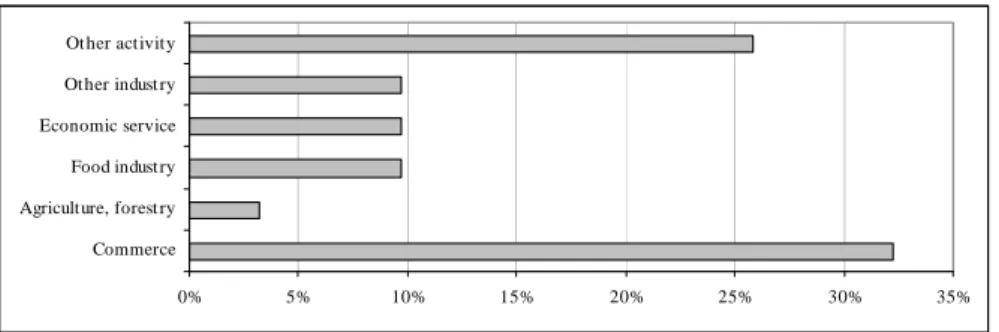
Considering their main activities (Fig. 1.) it becomes clear that the majority of the respondents are active in wholesaling. Considering the experience gained, it is not surprising - though has a tremendous influence on economic efficiency - that in their choices of the ERP system mot of the respondents obtained their systems on the basis of some recommendation.
0% 5% 10% 15% 20% 25% 30% 35% Commerce Agriculture, forest ry Food industry Economic service Other indust ry Ot her activity
Fig. 1: Distribution of responders by scope of business
Among the small- and medium-sized enterprises there was only one that spoke of purchasing its ERP system by way of a tendering procedure. 71.5% of the small- and medium-sized enterprises that responded had not applied an economic or financial evaluation linked to the introduction of the system. Apart from other facts this finding indicates that when implementing a system small- and medium-sized companies are unable to provide labour or financial resources to carry out the evaluation. It has remained a task for applied research or the ones dealing in the ERP system to provide easy-to-use evaluation procedures for managers of small- and medium-sized enterprises that can be adapted to and suitable for preparing for making their decisions and verifying them in the course of implementing the ERP system.
The data from our survey revealed that recommendations, especially recommendations from people interested in the operation of the business, greatly influence the opinions of those wishing to implement ERP systems. In many cases it is these recommendations that mean the first selection. In our opinion the first selection should be done on the basis of the functionality of the different ERP systems. For this task we developed the ERPSelect service.
Services assisting pre-selection (ERP
Select)
As part of our research a plan for an application supporting pre-selection was prepared for small- and medium sized enterprises.
At present the system stores the necessary data in four databases: - Databases storing user data
- Data of people making enquiries (people looking for something) - Data of those offering ERP solutions (suppliers)
- Databases linked to ERP systems
- The database storing the system requirements of those looking for ERP systems - The database storing the data of the ERP systems on offer
The basis for the selection process is consists of a well-defined system of different criteria. As regards the ERPSelect processes there are three different functions to be identified:
- Providing user data, registration (both supply and demand sides)
- Providing the considerations for the system (both supply and demand sides) - Doing the selection, information on the results
From the point of view of the interested person, the person trying to find ERP solutions, the ERPSelect operates in the following way:
- Registration and entry
- Giving the criteria in ten steps
After the data have been given the ERPSelect selects the solutions that are the most favourable
for the enquirer from the ERP database.
The involvement of ERP distributors is considered to be important in order that our database containing ERP systems and businesses selling ERP systems have as current information as possible and so be able to help small- and medium sized businesses with more up-to-date information with making their choices as regards selecting systems for themselves.
A decision supporting tool capable of evaluating ERP (ERP
Compare)
The basis for the multifactor evaluating system is the creation of some multidimensional system of considerations or criteria, which in turn will give the basis for evaluating the system. the advantage of the system is that factors that are hard to quantify can also be included in the selection process or the evaluation, while its disadvantage is that there are no standards available for creating the system of criteria, these may change individually and the expertise of several specialists is necessary for comparing them.
It is practical to include the considerations into several groups. - Exclusive considerations: basic requirements - Listing considerations: desirable characteristics
When compiling the system of considerations one can rely on well-known methodologies like Euromethod ISO/IEC 9126. In conformity with the system of considerations the quantifiable weight of each consideration also has to be defined. With the help of the preference matrices established by comparing pairs or groups of the evaluation considerations individual weighed systems of considerations can be given, with the help of which the satisfactory decision regarding the investment can be made. The method is remarkably useful in analysing implemented investments as well.
When the model was developed the evaluation considerations were arranged according to hierarchical subordination. On this basis the model includes main considerations, considerations and sub-considerations. Within the model itself there are three main considerations differentiated, namely:
- User main consideration - Economic main consideration
- Main consideration related to the evaluation of suppliers
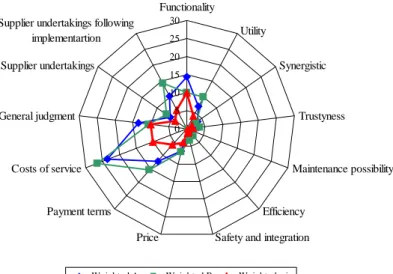
The evaluation remains simple as long as either one of the two projects is dominant. Looking at considerations “Supplier undertakings following system implementation” and “Functionality” in Fig. 2 the question as to which consideration is worth more can be asked. The evaluation according to sub-considerations may be helpful in making this decision.
0 5 10 15 20 25 30 Functionality Utility Synergistic Trustyness Maintenance possibility Efficiency Safety and integration Price
Payment terms Costs of service General judgment
Supplier undertakings Supplier undertakings following
implementartion
Weighted A Weighted B Weighted min
Fig. 2: Evaluation according to user main considerations in the ERPCompare model
The decision supporting tool (ERP
Eco) developed for the evaluation
One of the simplest indicator and at the same time the one that influences business executives to a great extent is what is called TCO (Total Cost of Ownership). Total cost ownership means the total ownership costs of an informatics investment. The TCO indicator includes all the costs that were incurred by investing in and maintaining the equipment during its useful lifetime at the business beginning from the ones related to preparing the decision.
The TCO model used for calculation the total ownership cost is shown in Fig 3.
Fig 3: Calculation of the TCO indicator
The Public ROI (Public Return on Investment)methodology was developed by the Center for Technology in Government at the University of New York with the assistance of SAP. Making efforts at integrating economic processes is one of the primary efforts a business will make. Arranging the economic processes into a system may be one of the consequences of an IT supported investment. The ROI indicator, which is suitable for measuring effectiveness and economic efficiency, is considered by business executives to be one of the most important elements in decision-making even in our days. The ROI i.e. the indicator of the return on investment is the most frequently used indicator in IT investments. It shows what percentage of the invested capital is constituted by the “profit” resulting from the investment. The integration of processes is a complex issue for the evaluation of which a number of factors are
to be taken into consideration in founding a decision. Investments can be evaluated by making use of different ROI indicators. We can also speak of general ROI (ROI), arithmetic ROI (ROIarit) and logarithmic ROI (ROIlog).
Calculating the ROI for [0,k] period:
k k k I H ROI = , where
ROIk –is the general ROI for the period [0,k]
Hk - is the profit accumulated over period [0,k] as a result of the investment
Ik – is the capital invested over period [0,k] for the implementation of the investment
The Net Present Value (NPV) analysis and evaluates an investment. It is calculated as follows:
∑
= + + − = n i i i r C C NPV 1 0 ) 1 ( , whereC0- means the capital invested in order to realise the investment
Ci- means the net cash flow for period i as a result of the investment
r - means the discount rate
n - means the analysed service life of the investment
The cash flow for a given period can be calculated as follows:
i i i B K C = − , where
Bi – is the total of the incomes over period i
Ki – is the total of the expenses for period i
In calculating the NPV the incomes realised and the expenses incurred can be taken into account. The registration of an event in the accounting system can be used in calculating the NVP only after the correction has been made.
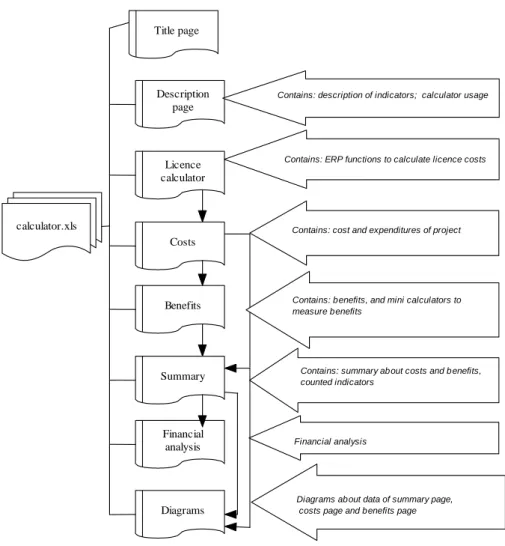
The structure ERPEco represented in Fig 4. The system counts financial pointers, like ROI
(return on investment), TCO (total cost of ownership), NPV (net present value), payback period and some others metrics. The ROI - Return on Investment is the most important and frequent metric to use for evaluating an information technology investment. ROI can be used for prioritizing projects within SME companies too (NucleusResearch, 2005). With ROI, it is possible to get an in-depth look at how much a unit of money spent will yield in returns (Greenbaum, 2005). The Payback Period determines the time needed for benefits returned to equal the initial cost of a project, thereby quantifying the project's risk. Technology solutions with a payback period of less than a year are considered optimal to a risk-averse investor (Internet 1, 2007). The NPV - Net Present Value: quantifies the value of the ongoing benefits discounted back to the present year. This traditional textbook metric takes into account the time value of money when assessing benefits but does not examine the ratio of costs to benefits (Brealey, 1991). The TCO - Total Cost of Ownership (Wouters, 2004) is useful for budgeting concerns because it provides a holistic sense of the long-term financial resources required to undertake an investment.
calculator.xls Title page Description page Licence calculator Costs Benefits Summary Diagrams Financial analysis
Contains: description of indicators; calculator usage
Contains: ERP functions to calculate licence costs
Contains: cost and expenditures of project
Contains: benefits, and mini calculators to measure benefits
Contains: summary about costs and benefits, counted indicators
Financial analysis
Diagrams about data of summary page, costs page and benefits page
Fig. 4: The architecture of ERPEco
The licence module contains the most important functions included in a module system. If the proposals are made according to these modules, the calculator can be easily used to make decisions concerning implementations or even to evaluate the effects of later extensions. The ERPEco operates by using certain basic financial data, such as:
- Expected returns - Discount rate - Average tax bracket
An important step in the evaluation of ERP systems is the thematic collection of the data necessary to calculate the indicators. Two important groups were defined in this respect:
- Expense - Earnings
Expenses mean all the economic activities linked to paying out any sums of money that may be related to the ERP investment.
The definition of the earnings is a little bit more complex. Any incomes and savings directly or indirectly related to the introduction of the ERP system are listed here. After the Expenses and earning have been quantified the necessary values are totalled in the module “sum total” and the preset calculable indicator figures are computed.
Conclusions
Investment, which is the basis for choosing the ERP and the investment decision itself. As regard evaluation models and methods we can say that the calculations based on the two methods do not provide adequate and safe bases for decisions. In order to make right decisions it is necessary to use ERP evaluation analysis methods that provide adequate indicators for deciding the problem on hand.
Literature
[1] Brealey R.- Myers S. (1991) Principles of Corporate Finance. International Edition, McGraw-Hill, Inc
[2] Greenbaum J. (2005) Beyond ROI: Enterprice Payback. EAC Report
[3] Herdon M.-Eckert B. (2007) E-work and IT for developing rural areas in Hungary. Information Systems in Agriculture and Forestry XII European Conference.15th and 16th May 2007, Prague. CD-ROM Proceeding
[4] Internet 1: Rate of return. http://en.wikipedia.org/wiki/Return_on_Investment
[5] Lau L. (2005) Managing Business with SAP: Planning Implementation and Evaluation. Idea Group Publishing, London
[6] NucleusResearch (2005) ROI Evaluation Report. http://www.nucleusresearch.com/ [7] Wouters M., Anderson J. C., Wynstra Finn (2004) The adoption of total cost of
ownership for sourcing decisions––a structural equations analysis. Accounting, Organizations and Society. www.elsevier.com/locate/aos