Sveriges Riksbank Working Paper Series
Interoperability and
Network Externalities in
Electronic Payments
Gabriela Guibourg
September
2001
No.
126
Interoperability and Network Externalities in
Electronic Payments
Gabriela Guibourg
∗Sveriges Riksbank Working Paper Series
No. 126
September 2001
Abstract
The causes of and extent of network externalities in payment systems such as the ATM and the ACH-market have been analysed and tested in earlier studies. In this paper a similar study is made for the market for electronic card payments, i.e. the EFTPOS-market. A panel data set of variables relevant to the evolution of the EFTPOS market in the G-10 countries, Australia and the Nordic countries for the period 1988—1999 is gathered and used in a statistical description of the evolution of the market. Also the hypothesis regarding the positive effects of standardi-sation for the evolution of the market is tested. The results are highly significant and the coefficients have the expected signs. A model that de-scribes the banks’ adoption decision of EFTPOS technology is developed. It is assumed that if network externalities are present, the larger the use of common standards, the larger will be the transaction demand for this par-ticular instrument. Within the specific context of the EFTPOS market, the model illustrates the trade offbetween network effects and competi-tion effects often described in the literature. Existence of pure strategy equilibria requires that banks are not exceedingly asymmetric in terms of their relative sizes in the acquiring market. The full adoption with com-mon standards outcome is more likely to result the smaller benefits banks derive from differentiation.
∗I am greatly indebted to Jonas Häckner, my supervisor at Stockholm University for
help-ful comments and support. I also want to thank my colleagues Jonas Björnerstedt, James McAndrews, Felice Marlor, Björn Segendorff, Anders Warne, Anders Vredin, Staffan Viotti and Göran Zettergren. The views expressed in this paper are solely the responsibility of the author and should not be interpreted as reflecting the views of the Executive Board of Sveriges Riksbank.
1
Introduction
Positive network externalities or network effects are often claimed to be present in payment instruments and payment systems. Network effects are at work when an increase in the number of individuals consuming a certain product en-hances the quality of the product for all consumers. Thus the consumers’ utility and thereby their aggregate willingness to pay for the product increases directly with the size of the market. The telephone is a classical example of this type of externality as are other communication intensive industries such as the telefax or the internet. In some cases referred to in the literature as indirect network externalities, the beneficial size effects can also arise because of complementari-ties between markets. The larger size of a certain market benefits consumers in a complementary market through lower prices, an increased availability of prod-ucts and technical service or even through an overall increase in “know-how” that facilitates the use of the product. The information technology sector is of-ten characterised by these type of externalities. For example, when considering the purchase of a computer the consumer takes into account the market share of the specific hardware brand. This is because the supply of compatible software and technical support will be larger. Also, more users will know how to use the software.
However interesting this distinction may be, it may obscure the underlying source of network externalities. In both cases it is the existence of complemen-tarities that gives rise to externalities. For indirect network externalities, the complementarities exist between products or services in different markets, e.g. hardware and software products. For direct externalities, the complementari-ties arise between different users of the same product or service, for example different users of a payment system. A user of a giro system derives no utility from participation in the system, if there is no other individual or enterprise participating and thus willing to accept payments through the system.
Complementarities between products or users may exist and give rise to network externalities, but for these complementarities to be exploited it is cru-cially important that the products or the users can interact. This is usually expressed in terms of products being compatible1 with each other or sharing a common standard. For a payment card to be accepted by a retailer, it is nec-essary that the retailer’s terminal can process the information imbedded in the card. Thus complementarities and compatibility together give rise to positive
1Compatibility may be achieved by the use of common technical standards and business
standards. Technical standards establish rules for features of payment instruments or sys-tems, for example rules for communication protocols. Business standards are agreements that stipulate procedures, legal interpretation and/or technical standards to be adopted in the pro-cessing of interbank payment transactions, for example requirements for security management in EFTPOS systems. (See BIS (2000).)
network externalities. Complementarity without compatibility creates an un-exploited potential for network externalities. Payment systems such as ATMs, EFTPOS or ACHs2 often require certain infrastructure, such as information
routing switches and telecommunication lines. In this context, system compati-bility is based largely on the adherence to common rules, operational standards, and formats. In this economically more relevant sense, a network is thus made up of the sum of all systems and/or individuals that through adherence to com-mon standards can interact with each other, or in other words are compatible with each other.3
Several studies have examined the extent of and the effects of network ex-ternalities in payment systems such as the ATMs and the ACHs. This paper attempts a similar study of how the existence of network externalities and the extent to which these are exploited influence the evolution of the EFTPOS market. I use a modified version of the model developed by Gowrisankaran and Stavins (1999) to illustrate the crucial role played by standardisation and interoperability agreements between providers in the decisions to adopt and use the EFTPOS technology. In my model, adoption and usage decrease with the number of systems that are not compatible with each other. The conditions for equilibria associated with common and proprietary standards and for full, par-tial and non-adoption of the EFTPOS technology are derived. It is shown that the existence of pure strategy equilibria requires that banks are not exceedingly asymmetric in terms of merchant customers, that is in the number of locations where they can install acceptance terminals. Furthermore, equilibria with full adoption in common standards require that the benefits of differentiation are not too large. Firms’ benefits of differentiation are modeled here as higher mark ups associated with the establishment of different standards. The less intensely banks compete with each other for customers the larger the parameter range for which the interoperability outcome results.
In Gowrisankaran and Stavins’ paper it was shown that the degree of mar-ket concentration was positively correlated with the adoption and usage of the
2Automated teller machine (ATM) is an electro-mechanical device, that permits users,
typically using machine-readable plastic cards, to withdraw cash from their accounts and/or access other services, such as balance inquiries, transfer of funds or acceptance of deposits (BIS, “Statistics on payment systems in the Group of Ten countries”). The ATM-system is the network of terminals interlinked by communication lines, switches and other data processing equipment that is required for the provision of these services.
Electronic funds transfer at the point of sale (EFTPOS) refer to the use of payment cards at a retail location where the payment information is captured and transmitted by electronic terminals.
Automated Clearing Houses (ACH) are electronic clearing systems in which payment orders are exchanged amongfinancial institutions, primarily via magnetic media or telecommunica-tion networks, and handled by a data processing centre. (BIS, “Statistics on payment systems in the Group of Ten countries”)
ACH-technology and thus to the extent to which network effects in this market were exploited. In contrast, the hypothesis in this study is that regardless of the fragmentation of the market in different proprietary systems, network external-ities will be exploited if these systems are linked together through compatibility agreements. Compatibility is defined as the capacity of different proprietary systems to interact with each other through the use of common technical and business standards. In the specific EFTPOS market, compatibility means that the merchant’s terminal can accept the card and process the payment regardless of what system the card issuer belongs to.
As an illustration of the importance of standardisation for the development of the EFTPOS-market, statistical evidence on the growth of the market in the G-10 countries, Australia and the Nordic countries was gathered for the period 1988—1999. The development of the EFTPOS-market itself, in particular all the aspects that are relevant in explaining the presence of network effects, is de-scribed and analysed. The data is also used in a test for the existence of network externalities, according to the hypothesis that–if externalities are present–the fewer the number of networks in the compatibility sense the larger the growth of EFTPOS-transactions that will be observed. Different functional forms are used in the regressions. The exponential form for the independent variable is shown to be a better specification of the relationship between the variables than the logarithmic form. The more concave the specification is the stronger these effects are. All coefficients are found to have the expected signs and the results are highly significant. I gather and analyse other data relevant to parameters in this as well as in Gowrisankaran and Stavins’ (1999) model, such as the number of terminals installed and the degree of market concentration in the bank mar-ket. The degree of market concentration measured by the Herfindahl-Hirschman Index (HHI) data is also regressed on the growth of EFTPOS transactions as a separate test of the Gowrisankaran-Stavins hypothesis in this specific market. The results are highly significant and the sign of the coefficient consistent with their hypothesis. Furthermore, there is evidence of a strong positive correlation between the degree of market concentration and the use of common standards. As in Gowrisankaran and Stavins (1999), the policy perspective is important for the study. If the efficiency of the payment system is the policy objective, one must ask how the existence of network externalities affects this goal. In Gowrisankaran and Stavins (1999) the focus is in the market failure aspect. They test for the existence and extent of network externalities in the ACH-market. If network effects exist and are large enough, the market outcome will result in underprovision of the technology. Under the assumption that the ACH system is a more efficient payment system than other paper based alternatives, one policy conclusion they point to is that the technology might need to be
subsidised. The issue of which market structure leads to the best exploitation of network externalities is further investigated. This study compares different market outcomes without taking into account the problem of underprovision. As regards the exploitation of network externalities, standardisation instead of market concentration is singled out as the crucial variable. The conclusion is that the best strategy for policy makers interested in the efficiency of the payment market is to promote the use of common standards and to facilitate the co-ordination efforts of market players to this effect. Also the conditions for the interoperability outcome gives guidance on the issue of when more active standardisation efforts are required from policy makers. Everything else equal, the more decentralised and competitive the market is, the less likely it is that the market will achieve the interoperability outcome.
The model used is in line with the literature on network externalities. When network effects are large, it is necessary to achieve a certain level of expected market size to get the market established. The combination of economies of scale that are also present on the production side and the existence of network effects thus creates strong incentives towards market concentration at the in-frastructure level through the creation of broad based payment networks, shared by otherwise competing providers.4 Co-operative arrangements however also
in-tensify competition among providers within the same network as their products become less distinguishable for consumers. These opposite effects have been described in the literature as the trade off between “competition effects” and “network effects”.5 The model illustrates how the trade off works in this
spe-cific market and describes how these opposite effects affect the conditions for the different outcomes.
Regarding the efficiency discussion, there is no formal analysis in this paper of the relative effects of different combinations of market structure and degrees of standardisation. Clearly, if one common technical standard in a network market is delivered through the market being completely monopolised, this outcome will give a less efficient result than if the market was divided by a large number of
firms sharing the same standard. Mainly due to lack of relevant data, other factors relevant to market growth as for example pricing are not taken into account either. The price faced by users, both cardholders and merchants is naturally a very important factor in explaining market developments.6
In the next Section I present a review of related empirical research. In Section 3, I describe the main characteristics of the EFTPOS market, in particular those aspects that point to the existence of network effects. I also describe the
4See for example McAndrews (1991).
5See for example Economides (1996) and Katz and Shapiro (1985). 6See for example Humphrey, Kim and Vale (1998).
evolution of the market in the studied sample and give some statistical evidence of the importance of standardisation in the market. In Section 4, the model is developed. Section 5 presents the empirical results.
2
Related research
From a theoretical point of view, if network externalities are present in a cer-tain market, then cercer-tain effects should be observable in terms of prices, market shares, standardisation incentives and technology adoption decisions. Empir-ical tests of network externalities in different markets are often based on the observation of these effects.
Regardingprices, the theory leads us to expect that if network externalities are present, the larger the network producing the network good, the larger willingness to pay it will elicit from consumers and thus the higher prices the network will be able to extract.
On the ATM market, McAndrews (1996) measures the effects of network size on prices. Incorporating network externalities in the retail demand for ATM services and assuming the fulfilled expectations Cournot outcome where banks compete in output, equilibrium output and prices are derived. The comparative statics show that the derivative of the equilibrium price with respect to network size is not clear cut. The sign depends on the relative strength of economies of scale in consumption, i.e. network externalities, and economies of scale in the production of these services. If network effects predominate, the effects of network size on prices are positive, reflecting the fact that larger networks give rise to higher aggregate utility. On the other hand if the effect of economies of scale in production is stronger, then larger networks will lead to lower prices. These hypotheses are tested by McAndrews (1996) against bank, network and price data. The results show that demand side effects are significant up to a certain network size, up to which prices charged are higher when the network becomes larger. This is explained by the fact that, up to a certain point, larger network sizes lead to better exploitation of network effects and thus to increasing willingness to pay for the service that the network provides. Beyond this size, the effects of network externalities are outweighed by the negative effects on prices from supply side economies of scale. In addition the effects of intersystem competition on prices are also tested by McAndrews (1996). The hypothesis tested is that competition between systems does not have the expected negative effect on prices. More competition does not automatically lead to lower prices, because of the existence of considerable costs to consumers of changing networks. Using an ATM-system instead of another competing system may for example imply that the customer has to change banks. The results give support to this
hypothesis and suggest that competitive pressure between systems do not have any significant effect on prices.
Carlton and Frankel (1995) have also studied empirically the similar issue of the effects on ATM costs and volumes of mergers between competing systems. Their purpose was to look for evidence regarding the beneficial effects of network mergers against traditional anti-trust considerations. Their hypothesis is that intersystem competition does not have the expected efficiency gains in terms of costs and prices, but that those gains are more likely to be achieved by intra-system competition instead, i.e. by increasing the number of firms within the same network. The specific case studied is the effect of the merger in 1987 of the two by then competing shared ATM-networks in Chicago–Cash Station and Money Station. They show how after the merger, transaction volumes and the number of machines soared and how the costs per transaction declined in comparison with the corresponding total figures for the United States. These results can be interpreted in the light of the analysis done by Katz and Shapiro (1985) or more recently by Economides and Flyer (1997). The merger of the two systems is equivalent to a move towards full compatibility. The increase of the size of the network resulting from the merger leads to an increase in industry wide output and thereby to an increase in consumer surplus.
The theory of network externalities also predicts that the larger these effects are the stronger are alsofirms’ incentives to adopt the technology that exhibits these effects. Saloner and Shepard (1995) tested for the existence and magni-tude of network externalities in therate of adoption of ATM technology. They modelledfirst the conditions for adoption of this technology in each period un-der the assumption of network externalities. Unun-der this assumption, consumers’ utility and willingness to pay for the ATM-services increase with the size of the network which in turn increases banks’ revenues from the adoption of the tech-nology. Also, the costs of adopting the technology decrease with time because of technological advances. As the McAndrews study, Saloner and Shepard take into account the effect of economies of scale in supply as well. In this context the signs of the effects of economies of scale in supply and in demand coincide. The larger the network of installed ATMs the larger is also the probability that more banks will adopt it. These are the demand side effects. Also, the larger the number of adopting banks, the lower are unit costs for the operation of the system. These are the supply side effects. Their empirical results give strong support to the theory. Theyfind that increasing the expected network size by adding one more branch to the number of potential ATM-locations, increases the probability of a bank adopting the technology in thefirst nine years ATMs were available by between 5, 7 and 10 percent. Even though economies of scale in production also have a significant effect on adoption decisions, network effects
appear to be stronger.
The issue of how the presence of network externalities influence firms’ in-centives towards the use of common standards has been the object of many studies after the seminal paper by Katz and Shapiro (1985). Economides and Flyer (1997) analysefirms’ incentives to adhere to a certain standard consider-ing the trade-offbetween the advantages of conforming to a technical platform, i.e. the increase in consumer surplus that results from the increase of the net-work size, against the advantages of product differentiation through the choice of non-compatibility. Using a two-stage model of Cournot competition–in the
first stagefirms choose the technical standard, in the second the firms play a Cournot game in quantities–they confirm the early results by Katz and Shapiro that showed that the highest welfare was achieved by full compatibility, i.e. all
firms adopting the same standard. However they also showed that because of the opposing incentives present in network goods, such an equilibrium is not likely to arise. Instead the market will be dominated by a few firms showing large asymmetries in output and prices. These asymmetries are larger the stronger the network externalities are. Similarly to the analysis of Carlton and Frankel (1995) that shows that intersystem competition does not have the usual effects when network externalities are present, Economides and Flyer also show that these asymmetries do not diminish and that total welfare actually decreases with new entry under non-compatibility. The reason is that increasing the number offirms within one coalition, which would be equivalent to increasing the size of that particular network, increases consumer and total surplus. However allowing new entrants that do not–or are not allowed to–adhere to existing standards, results in standard fragmentation. This implies more networks of smaller size. When network externalities are very strong, that is for pure network goods, the total surplus is largest with a monopoly standard.
Gowrisankaran and Stavins (1999) model and test for network externalities in the ACH market. They also analyse the effects of market concentration on the adoption and use of this technology. Their model is a two-stage game that describes banks’ decision to adopt the ACH technology and customers’ decision to use the same technology. In the first stage banks make the adoption deci-sion. In the second stage the customers of the banks that have adopted the technology decide whether or not to make use of the system. Assuming that network externalities are present, each customer’s usage is an increasing func-tion of other customers’ usage. By construcfunc-tion, banks have captive markets, that is each bank has its own set of customers at the beginning of the game and they do not compete among themselves for customers. The issue of market power is disregarded and banks price ACH-transactions at cost. As in Saloner and Shepard (1995), it is shown that the profitability of adoption increases in
other banks adoption, that is network effects apply even at the bank level. It is also shown that in terms of the internalisation of the network externalities, the more concentrated the banking market is, the more banks internalise the value of network effects. Both results have significant empirical support. In accor-dance with the literature on network externalities, this model has multiple Nash equilibria but one that is Pareto dominant. Comparing different possible equi-libria with each other, it is shown that consumer usage and thereby consumer surplus are higher for strategies associated with higher level of adoption.
The conclusions regarding welfare effects appear to be counterintuitive. The more oligopolised the banking market is, the larger are the efficiency gains in terms of more adoption and usage. This is a result of the assumption that
firms do make use of their market power and act as perfect agents for their customers. Without this assumption the welfare effects of market concentra-tion would be the usual ones. In more concentrated markets firms will have larger market power. Profit maximising decisions will leadfirms to reduce pro-duction and extract a larger share of consumer surplus through higher prices. The assumption used in this model contributes however to separate this effect from the positive effect that market concentration has on the internalisation of network effects. Furthermore, the testable implications of the model are robust to the assumption of market power. If market power was present and positive correlations could be observed between firms’ adoption decisions on one hand and between usage and the degree of market power on the other, then these positive correlations could only be due to the existence of network externalities. Absent network externalities, the sign of the correlations would be reversed. If consumers decide simultaneously which bank to use and whether or not to use the ACH-system, the fact that onefirm adopts the system reduces the residual demand for some otherfirm which would in turn reduce this otherfirm’s incen-tives to adopt the system. Also, the smaller the number of firms the smaller would be the equilibrium quantity of ACH-usage. Thus even when firms en-joy market power, the fact that positive correlations are observed can only be attributed to the existence of network externalities.
The main results of the model were then tested against American data with two regression equations. One regressed the number of other banks that have adopted ACH and volume of usage on the individual banks adoption decision. The other test was based on an index of banking market concentration, a mea-sure that is regressed on the fraction of customers at banks that have adopted the technology. The conclusion derived from the model is that the more oligopolised the market is, the larger is the adoption probability and thus the share of cus-tomers using the technology. All variables intended to test for network exter-nalities showed strong and significant coefficient values.
3
A description of the market for electronic card
payments
The market for electronic card payments (EFTPOS) has emerged in the ma-jority of the industrialised countries in the last ten to fifteen years. It has evolved from paper based versions of the same type of payment instrument, the debit- or credit card7 payment with vouchers for authorisation and verfication
of payment.
EFTPOS are mostly used for face-to-face non-recurring transactions between a vendor and a cardholder and as such they are mostly substitutes for cash or cheques, the two other payment instruments used at point of sale transactions. They are however a more efficient means of payment than paper based non-cash payment instruments. The reason is that they lower both costs and risks associated with these payments. Because of the on-line authorisation procedure, the card issuing bank can avoid situations where payers’ do not have enough funds and default on the payment. Also the costs associated with electronic payments lie usually between a third and a half of the costs posed by cheques or other paper based transactions.8
As compared to cash, consumers benefit by the use of card payment as the higher risks associated with cash are avoided. The major risk associated with cash isfinancial loss as a result of theft or loss and is equal to the total value of the banknotes involved. If a payment card is involved instead, thefinancial loss can be completely neutralised by the card holder complying with the rule that the loss of the card is communicated to the issuing bank immediately. Also, there are “shoe-leather” costs for cash users in accessing to cash through ATMs or bank branches that do not arise with the use of cards. However, cash benefits in most countries by a legal tender status. As such it is accepted as a means of payment everywhere, whereas the use of EFTPOS requires that the merchant has installed a terminal that accepts the instrument. Thus complementarities exist between the two ends of the transaction–the cardholder and the merchant. For these complementarities to be exploited, i.e. for the card payment to be ac-cepted by the terminal there must exist compatible infrastructure arrangements described in next subsection.
For these reasons, the EFTPOS is a market that requires widespread ac-ceptance and thus is a market where network externalities can be assumed to exist. Cardholders’ benefit increases in the number of installed terminals–the larger the installed base the broader is the acceptance of the card as a means of
7The difference between debit and credit card transactions is that in the first case the
transaction results in an immediate debit to the cardholder’s account while in the second case the transaction amount is charged to the cardholder’s credit line.
payment.
3.1
Infrastructure arrangements
Compared to cash payments that only require the exchange of banknotes be-tween payer and payee for the payment to befinally settled, non-cash payment transactions are more complex. Settlement of non-cash transactions involves other parties than the direct counterparts to the transaction and requires dif-ferent procedures and infrastructures for the exchange of payment information between all the parties involved.
There are a number of different non-cash payments and this diversity is also reflected in the details of how the payment transaction is processed and the type of infrastructure needed. In general in some way or another, all types of non-cash payments are based on the transfer of funds between accounts held at
financial intermediaries. Thefinal transfer of funds is preceded by an exchange of information between counterparts in the different steps of the payment process. When the payment instrument is delivered to the payee, the payment is usually authenticated and authorised. Authentication entails a control of the validity of the instrument used as well as of the identity of the counterparts involved. Authorisation of the transfer of funds by both the payer and the payer’sfinancial institution requires the verification of the ability to pay. If the payer and the payee have accounts at differentfinancial institutions, there is a need of further exchange of information for the clearing process between the two. The clearing process itself involves the exchange of relevant payment information and the calculation of claims for settlement between the financial intermediaries. In the settlement process, the funds are transferred between the parties through accounts held with a common third party, usually the central bank.
For EFTPOS the authorisation and authentication of payment is done at the moment of the transaction. The payee has a terminal that permits real time communication with the bank holding the payers transaction or credit account. The bank verifies that the cardholder has enough funds in his/her account to cover the transaction and authorises the payment. In most cases the cardholder is identified by the use of a unique digit string or Personal Identification Code (PIN). This type of payment system requires an infrastructure of telecommuni-cations and computer routing or “switches” linking the merchant terminal with the card issuing bank and the merchant’s bank, i.e. the acquirer. In some coun-tries this switch infrastructure was already in place as it was first developed for the ATM-system, i.e. for the purpose of providing bank customers with the possibility of making cash withdrawals at automated teller machines. Switch-ing services are often outsourced to third party providers that are notfinancial
One network
Many non-interoperable
issuer
issuer issuerissuer issuerissuer
merchant
merchant merchantmerchant merchantmerchant
switch switch switch switch switch switch issuer
issuer issuerissuer issuerissuer
merchant
merchant merchantmerchant merchantmerchant
switch
switch
Figure 1: Different network arrangements
institutions.9
The way this network infrastructure is organised reflects the extent to which network externalities are exploited. It is possible for all card issuing banks to construct a shared switch network, as shown in the left hand side of Figure 1 illustrating the case of a completely centralised network. In this type of arrangement, all merchants are linked to the card issuing–and the merchant banks through a central switch. A cardholder can thus use the card as means of payment at all points of sale. Participating banks may be shareholders to the joint network or not. If not, the banks buy switching services from the network owners.
At the other extreme, the EFTPOS infrastructure may be organised in a completely decentralised way. Each card issuing bank has its own switch and communication links to its merchant customers, as illustrated in the right hand side of Figure 1. In this case customer utility derived by the use of a bank card diminishes considerably as the customer can only make card payments at a reduced number of points of sale.
In between these two extremes a number of hybrid solutions may arise. A number of banks, for example, may co-operate in the EFTPOS market through shared networks while others develop proprietary systems. As regards the ex-ploitation of network externalities, what matters is the interoperability aspect and not the ownership aspect or the number of systems. From a customer
spective, the example illustrated in Figure 1 can also be seen as one centralised network if links are established between the systems. In that case, all partici-pants in the system are interconnected and all merchants are able to accept all cards regardless of the identity of the issuing bank.
3.2
Market evolution in the studied sample
The sample covers the period between 1988 and 1999 in the Group of Ten countries,10 Australia, Denmark, Finland and Norway. The data set is to a
large extent provided by the Blue Book and the Red Book, i.e. the annual payment statistics published by the European Central Bank and the Bank of International Settlements respectively.11 For Norway, the data are provided by
the Bank of Norway’s statistical publications.12
Some data, as for example information on the number of networks, was collected by direct contact with representatives of the payment systems depart-ments of the central banks in the studied countries. This is because there is no common understanding regarding whatfigure should be reported as “number of EFTPOS networks” in the statistical publications mentioned. Some countries have reported the number of proprietary networks. Others, as is the case for Australia, report the number of networks from the consumer perspective. This is also the interpretation used in this paper: a network is defined as the sum of all systems that through linkages and interoperability agreements work together as one. The data on the number of networks according to this definition is nat-urally more difficult to obtain, especially if the number of networks is relatively large. It is thus a safe assumption that the information received is accurate when one or two networks were reported. The larger the number of networks reported, however, the less reliable this information becomes. The distinction between one, a few or many networks is thus more important than the exact number for the conclusions of the analysis. The Herfindahl-Hirschman Index on market concentration (HHI) was also provided directly by the central banks involved.
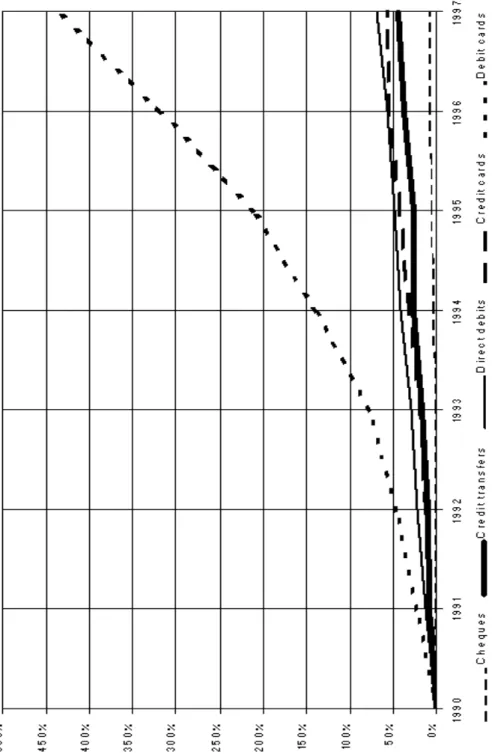
As can be seen in Figure 2, at the aggregate level, the growth rate of debit card payments–most of which are EFTPOS payments–surpasses by far the growth rate of the other non-cash payment instruments in the studied period. The Bank of International Settlements published a study of the retail payment market in the G-10 countries in 1999.13 This report emphasised the rapid growth
1 0The G-10 countries are: Belgium, Canada, France, Italy, Japan, Netherlands, Sweden,
Switzerland, United Kingdom and United States.
1 1ECB, “Payment Systems in the European Union”; BIS, “Statistics on payment systems
in the Group of Ten countries”.
1 2Norges Bank (2000). 1 3BIS (1999b).
Figure 2: Aggregate growth of non-cash payment volume. G-10 and Australia. Source: BIS (1999b).
rate for card payments as one of the salient features of the recent evolution of the retail payment market. Both demand and supply factors are forces driving this development. From the demand side, there is a clear trend toward the substitution of card payments for both cheques and cash. From the supply side, this report also points to the development of interoperability standards among different card networks as one of the main driving forces for the rapid growth. This development has occurred through mergers and alliances among different systems. Most remarkable regarding the level of global acceptance achieved are the alliances between the large card associations such as Visa and MasterCard and the different local networks. As regards retail payments in general, there is no other payment instrument that has been nearly as successful as card payments in achieving global acceptance.
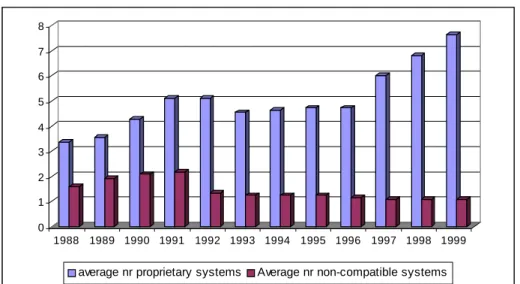
This trend of mergers and alliances between different proprietary systems is in itself a clear indication of the existence of network externalities in the market. The larger the number of acceptance points the more convenient is the use of payment cards and thus the larger is the number of consumers that will substi-tute card payments for cash and cheques. Merchants are interested in investing in the necessary equipment only if there is sufficient demand for this particular payment instrument. This demand increases in turn with the number of accep-tance points. Card issuers, typicallyfinancial institutions, although competing with each other for customers, are aware of the fact that total utility–for both merchants and cardholders–is strongly correlated with the level of acceptance and thus co-operate with each other in enlarging the size of the network. This is clearly the case for the sample studied, where the average number of pro-prietary systems is much larger than the average number of networks from the interoperability perspective, as can be seen in Figure 3.
Figure 3 also shows that the driving forces for co-operation between systems have remained strong. While the average number of proprietary systems has increased, the average number of non-compatible systems has decreased. The latter category’s share of the average number of proprietary systems decreased from 50 percent to 14 percent over the studied period. At the beginning of the period half of the countries in the sample started out with more than one network in the non-compatibility sense while only two countries had more than one network in 1999. This gives also some indications on the relative importance of network externalities and of economies of scale. The latter are also present in this type of payment system as the infrastructure used often involves largefixed costs of adoption and relative low variable costs. Thus, economies of scale can be exploited through consolidation at the infrastructure level and through the establishment of shared networks. According to Figure 3, economies of scale in production does not appear to be as strong as network effects are, as we observe
0 1 2 3 4 5 6 7 8 1988 1989 1990 1991 1992 1993 1994 1995 1996 1997 1998 1999
average nr proprietary systems Average nr non-compatible systems
Figure 3: Proprietary versus non-compatible systems
more concentration on the “interoperability” side than on the ownership side. As expected and shown in Figure 4 with values for 1999, there is also a posi-tive correlation between the number of acceptance terminals and the volumes of card payments, this latter variable expressed as the number of EFTPOS trans-actions per capita. The correlation amounts to .79 and is strongly significant.
Although the aggregate growth rate for the EFTPOS market in the sam-ple studied has been very rapid, there are large differences between countries. Institutional factors such as the degree of market concentration and different regulatory approaches may explain some of these differences. The regulatory policies in some countries have been tolerant of single nationwide network ar-rangements for EFTPOS or shared ATM systems in combination with close monitoring and consultation to preserve effective competition. Some have been less inclined to accept network alliances that could result in dominant systems.14
In some countries such as France, the UK , Belgium and some of the Nordic countries the development of the EFTPOS market was already under way in the beginning of the studied period. In others the market began to develop some years later. Norway and Canada have the steepest growth rates in transactions, other countries as the US, Germany or Italy show very modest development. In the case of Japan, the EFTPOS market did not pick up at all during the studied period.
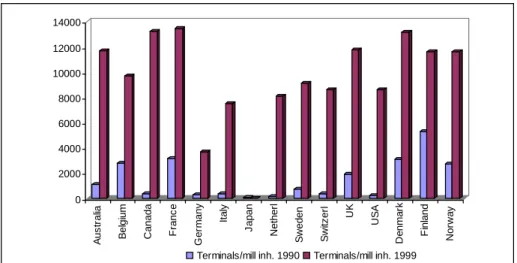
As expected and seen by comparison of Figures 5 and 6 there is a positive correlation between the number of terminals per million inhabitants and the
Jap De US Ita Sch Swe Aus Bel Neth Fra Can Nor Fin UK Dk 0 2000 4000 6000 8000 10000 12000 14000 16000 0 20 40 60 80 transactions/capita te rmin a ls/ millio n in h .
Figure 4: Terminals per million inhabitants and transactions per capita 1999.
0 10 20 30 40 50 60 70 A u s tr a lia B e lg iu m C anada Franc e G e rm any Ital y J apan N e ther l S w e den Sw itz e rl UK US A D enm ar k F inl and No rw a y EFTPOS/cap 1990 EFTPOS/cap 1999
0 2000 4000 6000 8000 10000 12000 14000 Au s tr a lia B e lg iu m C anada Franc e G e rm any Ita ly J apan N e ther l S w ed en Sw itz e rl UK US A De n m a rk F inl and No rw a y
Terminals/mill inh. 1990 Terminals/mill inh. 1999
Figure 6: Terminals per million inhabitants, 1990 and 1999.
number of transactions per capita. However, this correlation although high and strongly significant in both years, decreased from .93 in 1990 to .79 in 1999. This may be an indication of a gradual wearing offof network effects, that is that the market could be moving towards a saturation point as regards the installed base of terminals.
The number of networks seen from the compatibility perspective, not the proprietorship aspect, appears however to have been pivotal for development of the EFTPOS markets. As shown in Figure 7, the average growth rate of transactions for countries with more than one network has been just a small share of the corresponding growth rate in countries with only one network. At the end of the period the number of transactions per capita in countries with only one network was on average tenfold larger than in the other group.15 Lack of
interoperability between systems may also contribute to explain the somewhat lower correlation observed at the end of the period between the number of transactions per capita and the number of terminals. The US and Germany are among the countries that experienced a larger growth in number of terminals than in number of transactions and these two are at the same time countries with more than one network.
The importance of interoperability for the growth of the market can also be seen at the country level. There are only three countries in the group of countries with several networks over the whole period–the US, Germany and Japan. However, as can be seen in Figure 8, the US has experienced a clear
ten-1 5Some countries with large growth in per capita transactions had two networks, and in the
case of Canada more than two, during thefirst years of the studied sample. This is the case of Canada and Netherlands until 1992, of Norway until 1995 and Switzerland until 1996.
0,00 5,00 10,00 15,00 20,00 25,00 30,00 35,00 40,00 45,00 1988 1989 1990 1991 1992 1993 1994 1995 1996 1997 1998 1999 Transactions/capita
One network Several networks
Figure 7: Transactions per capita. Average for countries having one or several networks.
dency toward network consolidation and the number of transactions per capita increases towards the end of the period.
Canada is one of the countries with the most rapid increase in EFTPOS transactions. In the first years of the studied period, however a number of dif-ferent proprietary systems were in place and there was no growth in transactions per capita. It was first after 1992, when the different systems merged into one nationwide network, that the number of transactions per capita began to soar. Japan is a clear example of a market in which large fragmentation hin-dered market development completely. While the number of networks oscillated around two hundred, the number of transactions per capita stayed around zero for the whole period. In the case of Japan, the lack of interoperability was the result of the regulatory environment. When EFTPOS were introduced the Ministry of Finance imposed several restrictions on, for example, the number of locations where terminals could be installed. Also users were required to make a separate deposit contract with each bank to use debit cards. These regulations were abolished in 1997 and this has created incentives to develop the EFTPOS system. In particular, a nationwide service, sharing a network of compatible terminals and a common clearing center was launched.16 The effect as regards
volume of transactions appears to have been almost immediate. Compared to 1999, the number of transactions increased eight times in 2000.17
1 6Direct information from Mr. Januchi Iwabuchi from the Bank of Japan. 1 7Electronic Payments International(2001).
USA 0 10 20 30 40 50 1988 1989 1990 1991 1992 1993 1994 1995 1996 1997 1998 1999
EFT/cap # netw ork
Figure 8: Transactions per capita in the US and number of networks. 1988— 1999. Canada 0 10 20 30 40 50 60 1988 1989 1990 1991 1992 1993 1994 1995 1996 1997 1998 1999 EFT/cap # network
In the case of Germany, the number of networks in the interoperability sense is not clear. There are two systems, one on-line and one off-line, although both offer full interoperability. The off-line feature of the system implies that no control of availability of funds is done when the transaction is completed. Furthermore, in Germany the banks behind the off-line system do not guarantee payment, i.e. payment risk is borne solely by the retailer. This feature has had negative effects on merchant acceptance. Furthermore, there are a number of non-interoperable proprietary systems that offer debit card service to those customers that do not qualify for the Eurocard system which is the largest card system in Germany. However there is no data on neither the number of systems nor the transactions volumes through those. These systems are believed to comprise very small shares of the market. In order to solve the data problem, two networks are reported for Germany. This is not the realfigure, but it serves the purpose of distinguishing Germany from the group of countries with only one network.
Although the issue of interoperability, as shown in Figure 7, is clearly cru-cial for the development of the EFTPOS market, other factors may also have influenced the differences in growth rates between countries. Pricing is a nat-ural candidate for such a factor. Unfortunately, no conclusions can be drawn on the importance of different price structures as detailed information on each country’s pricing policy could not be gathered. Regarding fees towards mer-chants, these should influence their willingness to install the equipment and accept EFTPOS payments. No data on merchant fees was available. In general
fixed transaction fees apply for debit card transactions and turnover fees for credit cards. It can be inferred from the information received that there are at present two main pricing strategies towards cardholders. EFTPOS transactions are either completely free of charges or cardholders pay a fixed annual (or in some cases monthly) fee for the use of the card.
The degree of market concentration is also a variable influencing the growth of the market. In Gowrisankaran and Stavins (1999), the internalisation of network externalities and thus the growth of the ACH-market are positively correlated with the degree of market concentration. In terms of the exploita-tion of network externalities, the same effect is achieved through interoperabil-ity agreements between different firms as through having one firm monopo-lising the market. Naturally, both explanations of how network externalities are best exploited–the degree of standardisation and the degree of market concentration–might be related to each other. For example, it is possible that it is easier for market players to agree on the use of common standards and links between systems the more concentrated the market is.
Finland Denmark FranceUK Norway Belgium Australia Canada Sweden Switzerland USA Germany 0 5 10 15 20 25 30 35 40 0 500 1000 1500 2000 2500 3000 3500
HHI bank sektor
Ef tp o s /ca p it a
Figure 10: Transactions per capita and concentration in the bank market.
other channels than the exploitation of network effects. The more concentrated the market is the more exploited are economies of scale often present in payment systems. This has a positive effect in market growth through lower prices to users. As shown in the overview of related empirical research, both effects– network effects and economies of scale–and the relative strength of these effects are relevant to the study of the efficiency of payment systems.
Comparison of Herfindahl-Hirschman Index18 of market concentration (HHI)
in the deposit market withfigures on average EFTPOS-transactions per capita as shown in Figure 10 supports the existence of such a correlation in a subset of the studied sample.19 The correlation between these variables is .65 and highly
significant.
4
The model
An important difference between the ACH-market analysed by Gowrisankaran and Stavins and the EFTPOS market is that in the former, users’ utility of the system increases directly in the usage of the system by other users. The larger the number of individuals to whom the potential consumer can effectuate payments through the ACH-system, the more the consumer would benefit by
1 8The Herfindahl-Hirschman Index is calculated as the sum of banks’ squared market shares
in the deposit market.
1 9Data used in the construction of HHI was not available for three of the countries in the
using the system–a case similar to the telephone. For card payments, however, the potential user does not directly benefit by the number of other cardholders. In this case, the cardholder benefits by the spread of acceptance of the card as means of payment, that is by the size of the installed base of terminals. Naturally, the number of terminals installed increases in the number of card users as the gains of adoption to banks and merchants increase in this number. Thus, indirectly users benefit by other users adopting the technology. There is a snow ball effect that is typical of network goods.
There are three types of players in the EFTPOS market described in this model: banks, merchants and consumers. Consumers have identical preferences and banks have perfect information on their willingness to pay for card payment services. The alternative to electronic card payments is cash, accepted as means of payment by all merchants. Cash has thus the advantage of fully exploiting the positive externalities present in payment instruments. Nevertheless, everything else equal, in the choice between cash and card payments, consumers prefer cards because cash involves “shoe-leather” costs–the time and effort devoted to withdraw cash from the bank account–that vanishes with the use of payment cards. Also there is the benefit of the risk reduction that results from carrying smaller amounts of cash. Thus, given that banks have chosen to adopt the technology and offer card payment services to their customers, card payments are preferred to cash. However in the introductory stage of the technology, card payments will not be as widely accepted by merchants as cash. The utility of using card payments increases in the degree of acceptance, that is in the number of terminals installed that can process electronic card payments.
Merchants need a certain technology in order to be able to accept card payments. They need also an agreement with their acquiring bank, i.e. the bank that installs the terminal at the merchant’s point of sale and that holds the merchant’s account. Merchants benefit from the adoption of the technology as it makes it possible to offer alternative means of payment which potentially can increase sales. Merchants bear the fixed costs of adoption associated with the installation of terminals. However, it is assumed that these costs are lower than the benefits that merchants derive from the adoption of the technology. Thus, if the merchant’s bank decides to adopt, the merchant will install the technology, as it implies positive profits. The marginal costs of transactions are assumed to be zero. By these assumptions, both the merchant’s and the consumers’ decisions can be ignored in this model.
There are two variations to the basic model. In thefirst case, banks have completely captive markets in relation to merchants and private customers. The rationale for this is that there are very large switching costs for both groups. Once they have chosen a bank, they stick to their choice. Also, as
in Gowrisankaran and Stavins’ model, banks act as perfect agents for their pri-vate customers and want to maximise their customers’ consumer surplus. This is explained by the assumption that banks do not exploit their market power in the payment market. Instead they take their mark-ups in the complementary deposit–and saving markets by offering lower interest rates for these accounts, i.e. a kind of two-part tariffarrangement. In this sense, the larger their cus-tomers’ valuation of the service is, the larger the share of surplus that banks can extract in the complementary market. In the other version of the model, switch-ing costs are high but not infinite. If the quality of payment services offered to bank customers is widely inferior to that offered by other banks, customers might choose to incur these switching costs. In this sense, the model describes a situation of “almost” captive markets, where the potential of loosing customers does not completely vanish.
There are two stages in the model. In thefirst stage banks make their tech-nology adoption decision. They decide both on adoption and on the choice of technology standard. If they adopt, they install acceptance terminals at all their merchant customers’ points of sale. In the second stage, customers decide on us-age. The utility that customers derive from card payments determines the level of usage. However, the set up of the model is such that both the merchants’ and the private customers’ usage and acceptance decisions are given by the banks’ adoption decision. Regarding the decision on technology standard, there are two choices. Banks can either adopt a common standard or a proprietary stan-dard. It follows from the basic assumption regarding the existence of network externalities that usage and consumer surplus is lower with fragmentation in different standards.
In real life, given that banks offer their customers card payments services, customers usually acquire cards. Card holders are usually not explicitly charged for the use of the card, or are charged low annual fees. Thus, the fact that in the model, consumer usage decision is given by the bank decision is not a problem. However, modelling merchants’ adoption decision as given by banks adoption is a simplification of the real world. Merchants incur the costs of adoption and pay either turnover or transactions fees. The higher the costs for merchants, the lower the incentives for adoption. The case of relatively slower terminal adoption in Germany is a good example of this. Merchants participating in the off-line system incur higher payment risks which is equivalent to say that they have higher costs. Despite the fact that merchant costs are important in merchant adoption decision, these are not taken into account in this model. Data on charges to merchants were not available and the benefits of adoption to merchants are difficult to estimate. Moreover, the primary focus of this study is the interoperability aspect and the effect that the choice of standards may have
on usage decisions.
4.1
The second stage: consumers’ choices
There are two banks in the market and each bank has afixed number of cus-tomers equal toC/2,where C is the total number of customers in the market that is divided equally between banks. Customers may be private customers or merchant customers and the relative importance of these two categories in the composition of a bank’s customer base differs. However, it is assumed that the share of merchant customers of the total number of bank customers is very small. Thus, the effect of differences in number of merchant customers between the two banks on the total number of customers can be disregarded and the assumption of symmetry still holds.
Each customer decides whether or not to use payment cards as an alternative to cash. The use of payment cards is thus a 0—1 choice. Each customer decides simultaneously on usage conditional on his or her bank’s adoption decision. There are two technology standards for terminals availableA andB which are equivalent to each other in terms of quality.Thus a bank may decide to adopt or not to adopt, and if adoption is decided there is also a choice between two technologies.
Network externalities appear indirectly at the users’ level. The more termi-nals installed–expressed bytj–the larger the benefit from the use of card
pay-ments. Thus, consumers benefit directly from the number of terminals installed with the technology standard chosen by the customer’s bank. The subindex j denotes the technology in question. Each bank has Nb merchants, i.e. points
of sale where terminals can be installed. The subindex b denotes the bank in question. Banks are completely symmetric in the number of private customers but they may differ in the number of merchant customers, that is in Nb. If
differences in the number of merchant customer exist, then it is assumed that bank 2 is larger than bank 1, that is N2 ≥N1. If a bank decides on adoption,
then terminals are installed at all Nb possible places. N =N1+N2 is the
to-tal number of merchant customers in the market and is thus non-negative, i.e. N1, N2 ≥0. The number of terminals installed in each standard is a function
of the adoption decisions, namely:
tj = N1+N2 if same standard, (1)
tj = Nb if partial adoption or different standards, (2)
tj = 0if non-adoption. (3)
market, i.e. all customers derive the same utility from the adoption of the technology. The price of the card payment service does not enter the utility function. Card payments are priced through annual fees which cover banks’
fixed costs of adoption. These are fees taken for the package of bank services associated with the provision of bank accounts. From the consumer perspective, the cost of acquiring and using a payment card is thus equal to zero. Then a customer belonging to bankbderives the following utility from the usage of card payments:
ub =γtj ≥0. (4)
Withtj ≥0,the assumption of network externalities is given by the marginal
utility of adoption γ being non-negative. As tj is a function of the adoption
decision of both banks, this means that if the consumer belongs to a bank that has adopted a certain technology, then his or her utility of card payments increases if the other bank adopts the same technology. If the banks choose different standards, the consumer benefits in the bank size in the merchant market, i.e. Nb.The transaction demand for card payments for the customers
of each bank is a function of the utility derived by the use of payment cards. For simplicity, the transaction demand function is assumed to be equal to expression (4), i.e. db=ub:
db=
(
γtj if adoption,
0 otherwise, (5)
wheredbdenotes bankb’s representative customer’s transaction demand for card
payments, i.e. how much any customer will use EFTPOS as means of payment. As the use of payment cards is not priced then individual utility equals consumer surplus of usage for a customer of bankband can be expressed as
CSi,b=γtj. (6)
Given the choice of standard and that each bank hasC/2customers, bank b’s aggregate consumer surplus is given by
CSb = (C/2)γtj. (7)
Formally in the second stage of the game consumers make their choices, however as expression (5) shows, the equilibrium is already determined at the
consumer surplus. However, both aggregate demand and consumer surplus will be divided between the two technologies as will bank customers:
CSb = (C/2)γN if same standard⇒CS=D= (8)
CSb = (C/2)γNb if partial adoption/different standards
⇒ CS=D= (C/2)γN. (9)
It follows directly that as consumer surplus and demand are additive, aggregate consumer surplus and demand will be larger if both banks adopt the same standard.
4.2
The
fi
rst stage: banks’ choices
Banks maximise their share of customers’ consumer surplus, as given by expres-sion (7), net of afixed cost of technology installationK that is common to the whole branch and to the two technology standards. Fixed costs of installation are related to each bank’s share of the acquiring market, i.e. toNb and thus the
larger the number of terminals that each bank can potentially install, the larger these costs are. However, these costs have been absorbed by the merchants and can thus be disregarded.
4.3
Nash equilibria with captive markets
By the assumption of captive markets, mark ups are constant for all banks and equal to α = 1. Assuming first completely captive markets, and given the assumption of identical customers, this means that banks can extract all consumer surplus. Thus,
α = 1⇒
CSi,b = γtj−αγtj = 0.
Banks pay offfunctions can be expressed by
πb=
(
γ(C/2)tj−K for adoption,
0 otherwise. (10)
It will be assumed that whenever banks are indifferent between adoption and non-adoption, i.e. when the pay off function (10) is not strictly greater than zero, adoption will result. By the same token, for outcomes in which banks are indifferent between adoption in common standards or adoption with different standards, the banks will choose common standards. Letting Sb express bank
b’s technology choice of standard A or B or 0 for non-adoption and defining θ=γC/2,the possible strategy combinations and related pay-offfunctions can be described in the following matrix:
S2=A S2=B S2= 0
S1=A θN−K,θN−K θN1−K,θN2−K θN1−K,0
S1=B θN1−K,θN2−K θN−K,θN−K θN1−K,0
S1= 0 0,θN2−K 0,θN2−K 0,0
Banks are assumed to have perfect information on each others’ pay-off func-tions. Although nine strategy combinations are possible, only three of these– (A, A),(B, B) and(0,0) on one diagonal of the matrix–represent equilibrium outcomes.
Partial adoption is not possible with this set up. Outcomes where bank 1 adopts when bank 2 abstains, i.e. (A,0)or(B,0), are not equilibrium outcomes as the conditions for these outcomes–θN−K <0andθN1−K≥0–contradict
the assumptions of the model. Given the assumptions of the relative sizes of each bank’s terminals, if the larger bank has negative profits of adoption, the loss of adoption is even larger for the smaller bank and it will also abstain from adoption. Nor is partial adoption by the largest bank possible. Outcomes(0, A) and (0, B) are not equilibria as these outcomes would require that conditions θN1−K < 0and θN2−K ≥0 are both satisfied. However θN−K ≥0 is
then also satisfied and bank 1 would choose adoption using the same standard as bank 2.
Full adoption with different standards, i.e. (A, B),or(B, A),are not equilib-rium outcomes either. The conditions for these outcomes areθNb−K≥θN−K
andθNb−K≥0forb= 1,2. This would requireNb≥N which is impossible
sinceN1 andN2are non-negative numbers.
Full adoption with common standards, i.e. (A, A)or (B, B) are equilibria. The conditions for these outcomes are:
bank 1: θN−K≥θN1−K;θN ≥K, (11)
bank 2: θN−K≥θN2−K;θN ≥K.
The first line of this condition can be expressed as N ≥ N1 which is always
satisfied as N2 is non negative. This means that full adoption with common
standards will always result if θN ≥ K and thus adoption is an equilibrium outcome. However, even if this condition is satisfied, non-adoption may result ifθN2< K, that is for certain parameter values, multiplicity of equilibria exists.
adopts, but negative if the smaller bank abstains. For small enough values ofK only the full adoption with common standards type of equilibrium is possible. The multiplicity of equilibria vanishes as does the trivialnon-adoption outcome when the condition θN < K is satisfied.
4.4
Non-captive markets: network e
ff
ects versus
compe-tition e
ff
ects
Within the previous set up, whenever “adoption” is the preferred strategy, both banks will choose the same standard in equilibrium. This result follows from the assumption of captive markets according to which banks do not compete with each other for customers. Both banks have the same customer base and symmet-ric mark ups. Assuming instead that banks have “almost” captive markets for private customers, different results may arise. The assumption of “almost” cap-tive markets reflects a situation in which banks face a risk of losing customers to other banks. Banks that adopt the common standards increase their customers’ surplus. However, as a consequence, bank services become less distinguishable from each other and switching costs are reduced. As a result of this, the risk of losing customers to other banks in the same network reduces mark-ups. Banks must then choose between belonging to a larger network where consumer surplus is high, but mark-ups are low or differentiating their card technology from other banks through proprietary standards which increases mark-ups at the cost of lower consumer surplus. In this way the trade offbetween “competition effects” and “network effects” described in the literature are introduced.
The choice of a proprietary standard is a strategy that banks follow to in-crease switching costs. Here, the choice of a proprietary standard is modelled as the choice of a technology different than the one chosen by the other bank and can be interpreted as a decision not to enter into interoperability agreements with the other bank. When considering whether to change banks, customers to a bank that has chosen a proprietary standard have to take into account the cost of losing the possibility of making card payments at all points of sale belonging to this bank’s merchants. The larger the bank’s merchant base is, the larger are also these costs for private customers.
However, the larger the other banks’ shares of the total merchant base are, the larger are the bank’s costs for adopting a proprietary standard in terms of forgone consumer surplus. Alternatively, the mark-up can be seen as the non-explicit price private customers pay for payment services. Proprietary standards make the customer base more captive, the market less competitive and the demand for each bank’s card payments system more inelastic. Thus, proprietary standards are associated with higher mark-ups (ˆα),than open standards (αˇ).
Actually, different switching costs for customers of each bank and thus different mark upsαˆcould also be assumed to exist. Differences in sizes in the acquiring market–that is in the relation between N1 and N2–should be reflected in
differences in mark ups across banks. The same argument applies for situations where a bank is the only one adopting the technology which should give it more market power. However, as a simplifying assumption, switching costs will be assumed to be determined mostly by factors other than these and only one αˆ will exist. A bank would prefer to be alone in its choice of standard if
ˆ
αθNb−K≥αθNˇ −K,αˆ≥α.ˇ (12)
The condition (12) is satisfied for small ratios of N/Nb. Thus proprietary
standards and the corresponding higher mark-ups αˆ are the preferred choices for banks having a large share of the total installed base of terminals. Those are also the banks for which the incentives towards differentiation are stronger as they have the capacity to impose large switching costs on their customers. In the terms used in the network literature, these are the banks for which competition effects outweigh network effects.
How does the existence of a trade offbetween network effects and competi-tion effects affect the strategy space and the equilibrium outcomes? As before, there are nine strategy combinations and two technology choices if adoption is chosen. The profit functions are
πb=
θαNˇ −K if the same standard,
θαNˆ b−K if different standards or partial adoption,
0 if non adoption.
(13)
The possible strategy combinations and corresponding pay-offfunctions are described in the following matrix:
S2=A S2=B S2= 0
S1=A θαNˇ −K,θαNˇ −K θαNˆ 1−K,θαNˆ 2−K θαNˆ 1−K,0
S1=B θαNˆ 1−K,θαNˆ 2−K θαNˇ −K,θαNˇ −K θαNˆ 1−K,0
S1= 0 0,θαNˆ 2−K 0,θαNˆ 2−K 0,0
Given the assumptions of banks’ relative market shares, outcomes where bank 1 adopts when bank 2 abstains are not equilibrium outcomes.Thus, nei-ther (A,0) nor(B,0) are equilibria. All the other strategy combinations are however equilibrium outcomes. Depending on parameter values the equilibrium outcomes are:
described in the first column, first row and second column, second row. For this to be an equilibrium outcome, the following conditions have to be satisfied:
θαNˇ −K≥ˆαN2−K;θαNˇ −K≥0. (14)
From expression (14) we get that:
N2≤N1
ˇ α ˆ α−αˇ.
Given the assumption thatN2≥N1, this condition can only be satisfied if
ˆ
α≤2α.ˇ Small differences betweenαˆandαˇimply that competition effects are small relative to network effects, and thus banks have stronger incen-tives to exploit these through the choice of common standards. Given the differences between mark ups, the outcome with full adoption in common standards results if market shares in the acquiring marketN1 andN2 are
not exceedingly asymmetric, as represented by the shaded area in Fig-ure 11. The more symmetric the market is in this sense, the more likely it is that the both banks will choose adoption with the same standard. If instead N2 is large relative to N1, this means that differentiation is
the better option for the largest bank. The number of terminals that the smaller bank can add to the network is not large enough and thus network effects are outweighed by competition effects. Given each bank’s size in the acquiring market, the full adoption outcome with common standards would arise for small differences between mark ups. In terms of Figure 11, small differences betweenαˆ2andαˇimply a larger slope for theN1αˆ−αˇαˇ line
which, for larger asymmetries between banks, increases the area for which the interoperability outcome results. The situation of completely captive markets with the same mark up regardless of the choice of technology can be described as a special case for which αˆ = αˇ applies. In that case, as long as adoption yields positive profits for the largest bank, full adoption with common standards is the only equilibrium outcome regardless of the extent of asymmetries between banks. Also considering the assumptions of the model regarding the number of terminals for each bank, outcomes below the 45-degree line are not possible. Below this line the relative sizes of banks in the merchant market is reversed, which is ruled out by assumption. See Figure 1120:
2. Full adoption with different standards (A, B)or (B, A)are the outcomes
2 0In Figure 11, it has been assumed thatθαˆ
1N1 ≥ K,which means that outcomes with partial adoption are not described.