Some pages of this thesis may have been removed for copyright restrictions.
If you have discovered material in Aston Research Explorer which is unlawful e.g. breaches
copyright, (either yours or that of a third party) or any other law, including but not limited to
those relating to patent, trademark, confidentiality, data protection, obscenity, defamation,
libel, then please read our Takedown policy and contact the service immediately
Implicit Emotion Detection in Text
Orizu Udochukwu
Doctor of Philosophy
Aston University August 2018
Orizu Udochukwu, 2018 asserts his moral right to be identified as the author of this thesis
This copy of the thesis has been supplied on condition that anyone who consults it is understood to recognise that its copyright rests with its author and that no quotation from
the thesis and no information derived from it may be published without appropriate permission or acknowledgement
Aston University
Title: Implicit Emotion Detection in Text and Application Areas
Student: Orizu Udochukwu
Degree: PhD
Year: 2018
Summary
In text, emotion can be expressed explicitly, using emotion-bearing words (e.g. happy, guilty) or implicitly without emotion-bearing words. Existing approaches focus on the detection of explicitly expressed emotion in text. However, there are various ways to express and convey emotions without the use of these emotion-bearing words. For example, given two sentences: “The outcome of my exam makes me happy” and “I passed my exam”, both sentences express happiness, with the first expressing it explicitly and the other implying it.
In this thesis, we investigate implicit emotion detection in text. We propose a rule-based ap-proach for implicit emotion detection, which can be used without labeled corpora for training. Our results show that our approach outperforms the lexicon matching method consistently and gives competitive performance in comparison to supervised classifiers. Given that emotions such as guilt and admiration which often require the identification of blameworthiness and praiseworthiness, we also propose an approach for the detection of blame and praise in text, using an adapted psychology model, Path model to blame. Lack of benchmarking dataset led us to construct a corpus containing comments of individuals’ emotional experiences annotated as blame, praise or others.
Since implicit emotion detection might be useful for conflict-of-interest (CoI) detection in Wikipedia articles, we built a CoI corpus and explored various features including linguistic and stylometric, presentation, bias and emotion features. Our results show that emotion features are important when using Nave Bayes, but the best performance is obtained with SVM on linguistic and stylometric features only.
Overall, we show that a rule-based approach can be used to detect implicit emotion in the ab-sence of labelled data; it is feasible to adopt the psychology path model to blame for blame/praise detection from text, and implicit emotion detection is beneficial for CoI detection in Wikipedia articles.
Keywords: Implicit emotion detection, OCC model, Blame and praise detection, Conflict-of-Interest detection, Rule-based approaches.
This thesis is dedicated to
Miss Ifiok Akpan, My Family, My Friends for their love and support during this past 4 years
Acknowledgements
I would like to thank my supervisors Dr. Yulan He for her amazing patience and support in overcoming numerous obstacles I faced during my research and Dr. David Lowe for his kind suggestions and ideas.
I would like to thank my fellow doctoral students for their feedback, cooperation and of course friendship. Especially, all the members of my reading group for the numerous suggestions and feedback.
I would like to thank my friends for accepting nothing less than excellence from me. Last but not the least; I would like to thank my family: my parents, brother, and sisters for supporting me spiritually throughout writing this thesis and my life in general.
Contents
1 Introduction 12
1.1 Overview . . . 12
1.2 Challenges . . . 14
1.3 The Research question, hypotheses, and contributions . . . 16
1.4 Overview of Thesis . . . 18
2 Literature Review 19 2.1 Emotion Analysis . . . 19
2.1.1 Theories of Emotion . . . 19
2.1.2 Classification of Emotion . . . 20
2.1.3 Computational Models for Emotion . . . 22
2.1.3.1 The OCC Model . . . 22
2.1.4 Emotion Detection Approaches . . . 31
2.1.4.1 Lexicon-based Approaches . . . 31 2.1.4.2 Learning-based Approaches . . . 32 2.1.4.3 Supervised Learning . . . 34 2.1.4.4 Semi-supervised Learning . . . 36 2.1.4.5 Unsupervised Learning . . . 36 2.1.4.6 Discussion . . . 37 2.1.4.7 Hybrid Approaches . . . 38
2.1.4.8 Other Detection Approaches . . . 38
2.1.5 Implicit Emotion Detection . . . 39
2.1.6 Summary on Emotion Detection . . . 40
2.2 Blame and Praise Detection . . . 41
2.2.1 Theories of Blame . . . 42
2.2.1.1 Cognitive Theories of Blame . . . 43
2.2.1.2 Emotional Theories of Blame . . . 43
2.2.1.3 Functional Theories of Blame . . . 44
2.2.2 Blameworthiness . . . 44
2.2.3 Path Model of Blame . . . 45
2.2.4 Summary on Blame and Praise Detection . . . 47
2.3 Conflict of Interest Detection . . . 47
2.3.1 Bias . . . 50
2.3.2 Vandalism . . . 51
2.3.3 Summary on Conflict of Interest Detection . . . 52
2.4 Summary . . . 52
3 A Rule-Based Approach to Implicit Emotion Detection in Text 53 3.1 Introduction . . . 53 3.2 Our Approach . . . 54 3.2.1 Overall Steps . . . 54 3.2.2 Polarity Detection . . . 58 3.2.2.1 Keyword Detection . . . 58 3.2.2.2 Negation Handling . . . 58
3.2.2.3 Polarity/Sentiment Detection based on Majority Voting . . . 61
3.2.3 Assigning Values to the OCC Variables . . . 66
3.3 Experiments . . . 70
3.3.1 Results and Analysis . . . 72
3.3.2 Error Analysis . . . 74
3.3.3 Discussion . . . 78
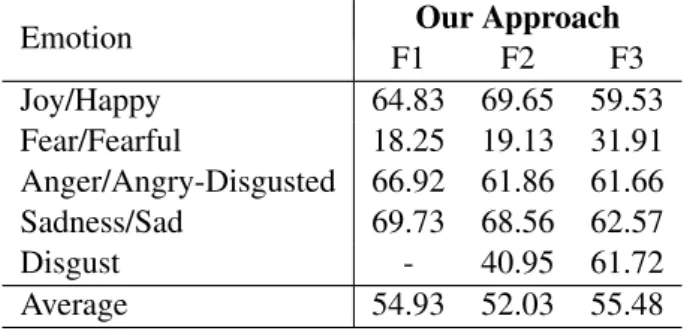
3.4 Improving Rule-Based Approach to Implicit Emotion Detection in Text . . . 79
3.4.1 Tense Detection . . . 79
3.4.1.1 Present Tense . . . 81
3.4.1.2 Past Tense . . . 81
3.4.1.3 Future Tense . . . 83
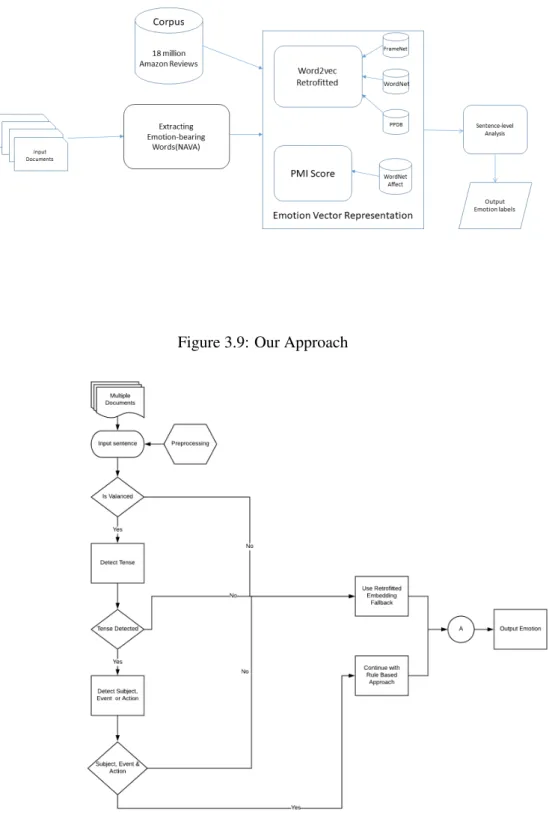
3.4.2 Using Word Relatedness Measure to Improve Implicit Emotion Detection . 85 3.4.2.1 Extracting Emotion-bearing Words . . . 85
3.4.2.2 Emotion Vector Representation . . . 87
3.4.2.3 Sentence Level Analysis . . . 89
4 Detection of Expressions of Blame and Praise in Text 92 4.1 Introduction . . . 92 4.2 Our Approach . . . 93 4.2.1 Event Detection . . . 95 4.2.2 Agent Causality . . . 96 4.2.3 Foreseeability . . . 97 4.2.4 Coercion . . . 99 4.3 Corpus Creation . . . 100
4.4 Experiments and Analysis . . . 102
4.4.1 Error Analysis . . . 103
5 Content-Based Conflict of Interest Detection for Articles in Wikipedia 107 5.1 Introduction . . . 107 5.2 Our Approach . . . 110 5.2.1 Stylometric Features . . . 110 5.2.2 Bias Features . . . 111 5.2.3 Presentational Features . . . 111 5.2.4 Emotion Features . . . 112 5.3 Experiments . . . 113 5.3.1 Data . . . 113 5.3.2 Preprocessing . . . 114 5.3.3 Feature Selection . . . 115
5.3.4 Binary Classification Results . . . 116
5.3.5 One-Class Classification . . . 118
5.3.6 Comparison with an Existing Approach to Vandalism Detection . . . 119
5.3.7 Discussion . . . 120
6 Conclusion and Future Work 122 6.1 Analysis and Evaluation . . . 123
6.2 Contributions . . . 124
6.3 Future work . . . 125
A List of Publications 127
B Annotation Sample and Guidelines 128
List of Figures
2.1 Plutchiks Wheel of Emotions [263]. . . 21
2.2 The original OCC model [191]. . . 24
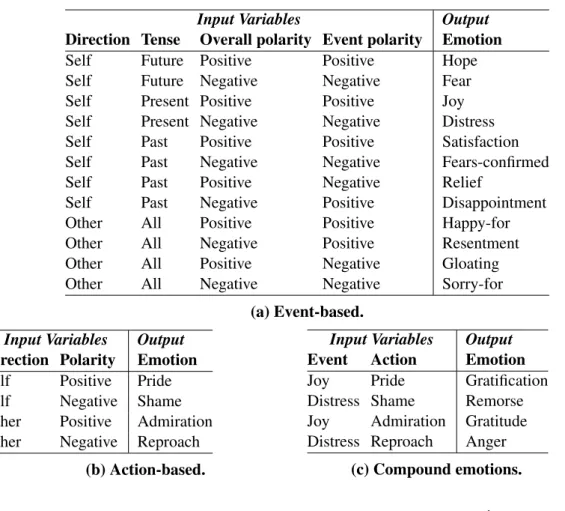
2.3 Combination for Compound emotions [191]. . . 26
2.4 The revised OCC model [246]. . . 28
2.5 The PAD model [127]. . . 30
2.6 The Path Model of Blame [145]. . . 46
3.1 Dependency parser output sample. . . 57
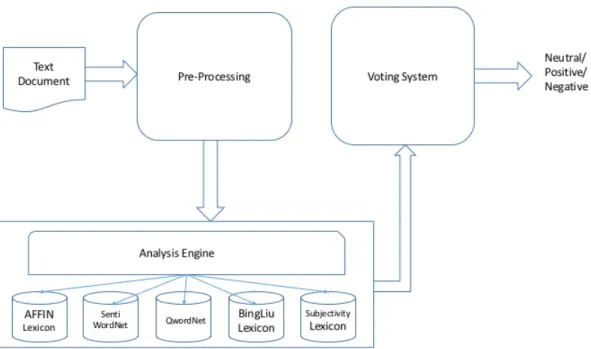
3.2 Polarity/Sentiment Detection based on Majority Voting . . . 63
3.3 Multi-emotion detection distribution using SemEval dataset . . . 73
3.4 List of auxiliary verbs and their base forms [274] . . . 80
3.5 List of modal auxiliaries [274] . . . 80
3.6 Present tense auxiliary examples [36] . . . 82
3.7 Past tense auxiliary examples [36] . . . 83
3.8 Future tense auxiliary examples [36] . . . 83
3.9 Our Approach . . . 86
3.10 Fallback Flow chart . . . 86
4.1 Revised Path Model of Blame. . . 94
4.2 An example dependency parse result. . . 96
4.3 List of lexicographer files with file numbers and a brief description of file’s contents. 98 4.4 Annotation User Interface. . . 101
5.1 Two sample documents with features identified by our approach. Words/phrases un-derlined in text are those which be found in an emotion or sentiment lexicon. Due to space constraint, we only show some key features here such as the emotion/sen-timent label, bias score, praise/blame indicator, and sentence type. . . 109
5.2 The overall work flow of our proposed approach. . . 111
List of Tables
2.1 OCC Model emotions and definitions [191] . . . 25
3.1 Rules for emotion detection. . . 55
3.2 Tense Patterns . . . 58
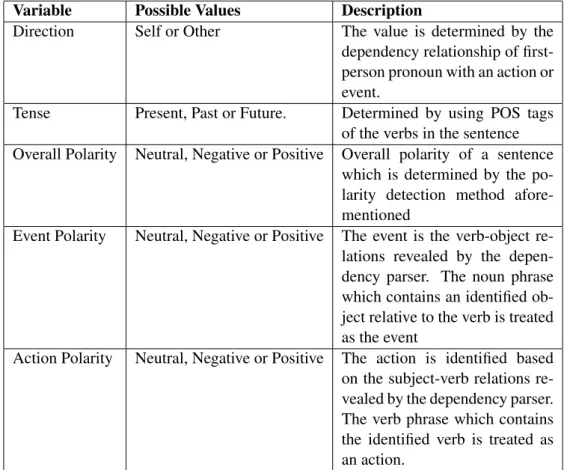
3.3 Variable assignment and possible values. . . 69
3.4 Statistics of the three datasets used in our experiments. “Total” denotes the original number of sentences in each emotion category while “Implicit” denotes the number of sentences which do not contain any emotion words according to WordNet-Affect. 72 3.5 Performance comparison of F-measure (F) results on the 3 datasets. Alm dataset(F1), ISEAR(F2) and SemEval(F3). . . 73
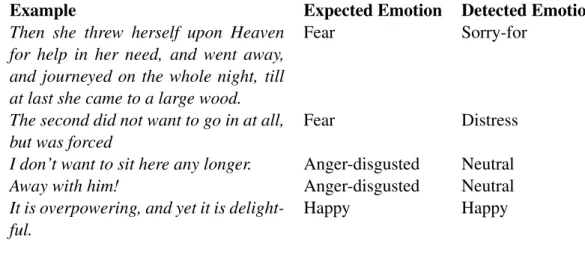
3.6 Detection examples of correct and failed detection using our approach on SemEval dataset . . . 75
3.7 Detection examples of correct and failed detection using our approach on ISEAR dataset . . . 75
3.8 Detection examples of correct and failed detection using our approach on Alm dataset 78 3.9 Present tense Rules . . . 82
3.10 Past Tense Rules . . . 82
3.11 Future Tense Rules . . . 84
3.12 Performance comparison of F-measure (F) results on the 3 datasets. Alm dataset(F1), ISEAR(F2) and SemEval(F3). . . 85
3.13 Top 5 related words returned forshopliftingbefore and after retrofitting . . . 89
3.14 Tables showing results of the ALM data set . . . 90
3.15 Tables showing results of the ISEAR data set . . . 90
4.1 Annotation agreement matrix. . . 101
4.2 Classification results ofblame,praiseorothers. . . 102
4.3 Classification results ofself-blame,self-praise,blame-others,praise-othersorothers. 103 4.4 Detection examples of correct and failed detection using our approach on the dataset 104 5.1 Stylometric features. . . 112
5.2 Bias features and subtypes. . . 113 5.3 Definitions of 10 presentational relations used (N stands for nucleus, R for reader
and W for writer). . . 113 5.4 Individual feature ranking results from Correlation-based Feature Subset Selection
(CFS) and Information Gain Ratio (IGR). . . 116 5.5 Merged features from the feature selection results from Correlation-based Feature
Subset Selection (CFS) and Information Gain Ratio (IGR). . . 116 5.6 Conflict-of-Interest (CoI) detection results in Precision, Recall and F-measure using
SVM, MaxEnt and NB with various feature sets. . . 117 5.7 CoI detection results using one-class classification. . . 118 5.8 Comparison with an existing approach to vandalism detection. . . 119
Chapter 1
Introduction
1.1 Overview
The internet holds huge document collections which can provide various types of information [180, 289]. Studies in various areas such as Natural Language Processing (NLP), Affective Computing and Computational Linguistics have begun to conduct various researches on these text document collections [180, 63]. This text not only contains information that describes facts and events, they can in most cases hold information about the writer’s attitudes or stances towards the subject matter [75, 135, 62, 199].
The emergence of the web, combined with various social media platforms have changed the way people live, with a constantly growing number of people sharing thoughts, opinions, and emotions in these environments. Analyzing these contents from all kinds of platforms can provide both public and private sectors with opportunities to grow and understand the general public. Private sectors can use sentiment analysis results to track the view of the public on their services/products, as well as the overall image of their organizations, as opinions published and shared on these online platforms can have an effect on the reputation of the organization [295, 282]. These organizations have realized that understanding public opinions from these platforms can help build good relationships with their customers and respond appropriately to market and socio-economic changes. For the public sector, various studies have shown the close relationship between events on social media platforms and various issues in politics, for example, the role social media platforms played during civil uprising in various Arab countries (known as Arab Spring). There was a ten-fold increase in the number of tweets talking about a need for Egypt to have a political change, resulting in the resignation of the
Egyptian president [35, 104].
There is evidence that human emotions influence the design of software products, evidence of how products also can influence human feelings and evidence of how those feelings can make people buy or not. The points above show how important it is to detect and identify sentiments and emotions in text. Key influences of our behavior as humans are our beliefs, view of reality and the choices we make. It is constantly becoming difficult even in journalism to find objective information because these beliefs make one write more subjective sentences than objective ones [122, 101]. Subjective sentences are sentences which express personal views, beliefs, and feelings while objective sentences present some factual information [140].
The concept of emotion is a complex one and the term is often used in various ways. An emotion is considered a short-lived episode of coordinated brain activity, which creates specific changes in response to both external and internal events [75, 135]. The subjective experience of these emotions is often referred to as feelings (to feel fear, joy, or guilt). Feelings are subjective and best described as the way an individual experiences an emotion [75]. Moods are a more spread out affective state, with smaller intensity when compared to emotion but are of a more prolonged in duration than emotion [75]. For example: receiving an “A” in one’s exam might put one in a good mood all day, however, the emotion of happiness is short-lived and very intense [75].
Natural Language Processing (NLP) areas such as subjectivity and sentiment analysis have more developed foundational methodologies which are beneficial to emotion analysis [112, 116, 166]. Emotion analysis in text aims at identifying and extracting emotions towards a specific subject mat-ter. Given its importance, much research in the area of emotion recognition in text has been ongoing in recent years and the attention the area is getting is constantly growing. Previous research on emo-tion analysis of text focused on text content from web-blogs, stories, news, text messages, spoken dialogs, etc [140, 235, 112, 199]. Emotion has been studied in depth in the field of psychology and behavioural sciences, mainly as a result of its importance to the human nature and this has led to the growth in this area of computing [251, 33, 52, 82, 93, 233].
Emotions play a big role in human intelligence, decision making, creativity, social interaction and more [135, 75, 62, 61]. The study of emotions is very broad and includes areas such as emo-tional responses to physiological reactions, gestures, and postures based on subjective experiences, facial expressions and emotion intensities. There is a strong relationship between emotions and
sentiments. The intensity of an emotion can typically be linked to the strength of a sentiment or opinion it produces.
Emotion is subjective and expressed with the use of subjective language, a language used mainly for expressing opinions and/or evaluations [140, 135]. It can hence be said that emotion analysis in text benefits from the ability to detect and distinguish objective from subjective language. Clues on the attitude/position of the writer on a subject matter, are often provided in the lexical choices of the writer, also in the structure of the text. These clues can be as a result of emotions, their writing style or the presentation relations used in the text. These clues can be identified using a combination of various NLP techniques and research from areas such as emotion and sentiment analysis in text, detection of bias and many more. As previously mentioned, distinguishing objective from subjective language is important and recent studies have shown that both languages when combined is effective for accurate results when compared to methods that rely solely on subjective language as shown in the area of subjectivity analysis [140].
In this thesis, we investigate emotion analysis, aiming mainly at the implicit emotion detec-tion problem, which deals with classifying text documents into emodetec-tion categories in the absence of words considered as emotion bearing words. In particular, we research several methods for extracting emotion and sentiment in text. Our research in implicit emotion detection leads us to identify that certain emotion categories such as ”Pride”, ”Shame”, ”Gratitude”, ”Admiration”, ”Remorse”, and many more require one to identify when the subject of the emotion is praiseworthy or blameworthy. This leads us to study and investigate the detection of expressions of blame and praise in text documents. Therefore, we propose adopting the psychology”Path Model for Blame” into a model that can be applied to text documents. We use various datasets in the experimen-tal work and annotate a new dataset for the detection of blame. We study various applications of implicit emotion analysis, looking at document types that should have less explicit expressions of emotions as in reference sites like Wikipedia.
1.2 Challenges
As previously stated, emotion is subjective and with subjectivity, only the bearer (writer) truly knows the underlining motivation. Hence, there are a few challenges to be tackled in emotion detection from text such as:
• Natural language is ambiguous, that is; words and sentences can have different meanings [106] “The meaning of a word is its use in the language”. For example, “Pride” by definition: “is a feeling that one respects oneself and deserving of respect by other people” or “a feeling that you are more important or better than other people”. In both cases, the word is spelt the same way but these are clearly different [106, 259]. A sentence can also be ambiguous even if the words which make up the sentence are not. One type of such ambiguity is structural ambiguity. For example: “Stolen rifle found by tree”.
• The lack of labeled data required for classifiers training [112, 199].
• Identify emotions in text when no emotion keywords or phrases have been used. This presents the problem of trying to identify opinionated views in a document when the writers are avoid-ing the use of explicit opinionated words [235, 199].
• Detecting emotion based on only the text content of the article without additional context. For example in the sentence “When I was so sure I failed an exam but I did not fail” expresses joy but none of the words are positive words. Additional context (“passing an exam”) is needed to correctly detect the emotion from the aforementioned example correctly [140, 112, 199]. • A single compound/complex sentence can contain multiple subjects and objects, hence it can
express multiple emotions and views, which can be directed towards various subjects/objects within a single sentence [140, 235, 112, 199].
Above are some of the major challenges when working on emotion detection in text. However, due to time constraints, we would not be able to focus completely on all 5 points. In this thesis, we try to address the following 3 challenges.
1. Identify emotions in text when no emotion keywords or phrases have been used: This is
the primary focus of our work and we propose a rule-based emotion detection approach for implicit emotion detection.
2. The lack of labeled data required for classifiers training: To help mitigate this challenge, we propose an approach that is independent of labeled data for emotion detection. We also
provide an annotated dataset for the detection of blame and praise, which are useful variables for the detection of emotions like guilt, admiration and many more.
3. Natural language word level ambiguity: We try to address this challenge by incorporating
contextual valence detection and context level word sense disambiguation. These techniques help us to understand the context meaning of the words within the sentences they appear in. Identifying when an entity in an article subject matter is overly praised/blamed, the style of writings found in the text can help shed more light on the intentions of the writer.
We also touch briefly the detection of multiple emotions in a sentence but will not go into an in-dept analysis of what these may entail.
In the rest of this chapter, we present our research questions which we will be addressing and the hypotheses for our research. Next, we outline our contributions and a layout for the overall thesis.
1.3 The Research question, hypotheses, and contributions
The main research question investigated in this thesis is:
How can we detect and correctly classify text documents into emotion categories in the ab-sence of emotion bearing words and labeled corpora?
The primary focus of this research is to detect implicit emotion in text. We hypothesize that by adapting existing psychology models for use in text analysis, we are able to detect implicit emotions from text without the use of labeled corpora.
To solve/answer the main question, the following sub-questions need to be addressed:
1. Can we identify implicit expressions of emotion in text without the use of labeled data ? There is evidence which shows that an author’s emotions towards a subject matter can affect his/her writing on the subject. Emotion detection in text is an area that much work has been done in recent years. However, most existing studies either rely on keyword matching based on emotion lexicons or supervised classifier training from labeled data. We instead propose a rule-based approach for implicit emotion detection, using a model proposed by Ortony, Clore and Collins in their book “The Cognitive Structure of Emotions” often referred to as
the OCC-Model (OCC is taken from the names of the book authors) [191].
2. Can we detect praise and blame in text, elements necessary for the detection of emotions such as guilt, remorse and many more ?
Emotions such as guilt require one to first establish oneself as “blameworthy” before the emotion can be said to exist. We propose an approach for blame/praise detection based on the “Path Model of Blame” presented by Malle et al [145].
3. Can the intelligent combination of emotion features help with conflict-of-interest detection in Wikipedia articles ?
The conflict-of-interest problem is a complex one and we believe that emotions features as well as other types of features such as linguistic, stylometric and bias features can aid in the classification of such documents. We create a dataset from Wikipedia, investigate various types of features and various feature combinations for the classification of conflict-of-interest articles.
Our contributions from this research can be summarised as follows:
• We propose a new rule-based approach for implicit emotion detection using the OCC model, which detects expressions of emotion in sentences and investigate the existence of multiple expressions of emotions within a single sentence, which is largely ignored in existing work. • We extend and annotate a dataset of over 7000 comments for blame and praise detection. We
propose an approach adapted from Path Model of Blame for detecting expressions of blame and praise in text
• We conduct experiments and take into account the direction of emotions and blame (to see if they are directed towards self or others), something we believe most existing work did not take into consideration.
• We investigate the application of implicit emotion detection on conflict-of-interest (CoI) de-tection in Wikipedia articles. In specific, we create a dataset and explore various features apart from emotions for this task.
We believe that our work in this thesis is the first to introduce and investigate implicit emotion detection using the OCC model in text documents, blame and praise detection in text and conflict of interest detection in Wikipedia articles based solely on content.
1.4 Overview of Thesis
The structure of the rest of this thesis is as follows:
In Chapter 2, we conduct a literature review of the emotion detection task and popular
ap-proaches. We also review recent work on the related tasks such as vandalism detection and bias detection.
InChapter 3, we propose a rule-based approach for implicit emotion detection. We also explore multiple emotion detection from a single sentence and evaluate our work on three different datasets. This chapter addresses the first research sub-question.
InChapter 4, we describe our work on detecting expressions of blame in text, presenting a
model for blame detection in text. This chapter addresses the second research sub-question. InChapter 5, we present our work on conflict of interest detection using emotion, presentation, stylometric and linguistic features. Our third research sub-question is addressed in this chapter.
Chapter 2
Literature Review
Overview
In this chapter, an overview of the emotion analysis literature is provided. In particular, the emotion analysis problem is first introduced in Section 2.1. A literature review of the emotion analysis research including a discussion of various approaches, their main strengths, limitations, and gaps are provided in Section 2.2. Recent work on implicit emotion detection is discussed in Section 2.3. Finally, a review of bias and vandalism detection is given in Section 2.4.
2.1 Emotion Analysis
There has been much research in sentiment analysis and emotion analysis of text [81, 76, 285]. This section presents the literature of the previous work in emotion analysis, identifies their strengths and weaknesses, and finally gives an overall comparison.
2.1.1 Theories of Emotion
Since early studies on emotion in the field of psychology, there have been controversies on what actually causes emotions. There are many theories of emotion. Here are the three most frequently mentioned in research from which all other theories originate.
In the James-Lange theory, the event which causes arousal and physical changes is interpreted as the emotion [75]. For example: if you are taking a walk in the city at night and a man jumps in front of you holding what appears to be a gun, according to James-Langes view, seeing the man would cause an increase in your heart rate; you become aware of your heart beating faster and you experience fear.
theory states that the arousal caused by an event is not necessary for emotion. Thus, an event creates both the emotion and physiological changes, without a dependency on one another. The cognitive theory of emotion is similar to James-Langs theory, it states that emotions have more to do with the interpretation process. Thus, it is the complete scenario and not just the arousal and physical changes that determine emotion [75, 135].
Hot cognition is basically cognition coloured by feeling [39]. There are theories that state that almost all human activities tend to implicate emotions in one manner or the other. This means that day to day events are in some way controlled by our feelings and the expression options available to us [62]. Our choice of words will tend to communicate information about our opinions, beliefs, and judgments [76, 135, 62]. According to Brand, using a stage model one can show how cognition and affect interact: “before, during, and after” writing. The “Before” affects are enthusiastic [39]. The “During” affects enables the continuation of writing towards its closure. The “After” affects are the outcome emotions that lead to the next writing episode [39]. Emotions influence both what and how we write, emotions also influence our writing process and our thinking process. Human personal experience tells us that when one is feeling angry and when one is feeling happy lead to different emotional outcomes and actions. A similar thing happens in writing, feeling angry and feeling happy lead to different writing events [39].
Alice in her work [39] stated that the writing psychology must include cognitive as well as affective attributes, because writing which requires thinking and analysis. This representation of the human thought process employs both inductive and deductive reasoning. During writing, the act of thinking deals with words and the sense of the word meaning in context. This sense is a collection of associated psychological events that relate to the word. These word senses are filled with affect [40].
2.1.2 Classification of Emotion
In the study of human emotions, there are various classifications which have been presented over the years. Various researchers have postulated different sets of human emotions, Aristotle maintained that there were 15 basic emotions; Descartes listed 6 emotions [135, 263].
In the Book “Emotions In Social Psychology” [198], the author classified emotions and placed Love, Joy, Anger, Sadness, Fear, and Surpriseon the primary level and explained the emotion
sys-tem. Ekman made a case for these basic emotions, stating that each emotion has unique and shared characteristics that distinguish them [68].
Figure 2.1: Plutchiks Wheel of Emotions [263].
Robert Plutchik created the “wheel of emotions” shown in Figure 2.1. He showed how various emotions can combine with each other to create new emotions. Starting with 8 primary emotions: trust versus disgust; surprise versus anticipation; anger versus fear and joy versus sadness, more advanced emotions were identified based on differences in intensity [263]. Parrot presented a theory, where he identified over 100+ emotions. He then used a tree structure to conceptualize them [198].
In computational linguistics, it is becoming important to be able to detect human emotions and this has led to various computational models of emotion [199].
2.1.3 Computational Models for Emotion
In this section, we look at the various computational models for emotion and try to reveal their uses, techniques, and assumptions. Emotions are a big part of our day to day life as humans, and as a result, there are commonsense interpretations to emotion research terminologies (appraisal, emotion, feeling), which can differ from the technical definition of the said terms within a given computational model for emotion [154].
Appraisal Theories
Appraisal theory is a predominant theory on emotion and a good source for parties interested in AI systems. Appraisal theory explains the link between cognition and emotion [154]. According to this theory, emotions stem from the types of judgment one makes about an event and one’s beliefs, intentions as well as desires. These patterns are called the person-environment relationship [129]. These judgments, are technically referred to as appraisal variables [154]. They characterize parts of the significance of an event to an individual. This theory presents appraisal as central to emo-tion process. However, various appraisal theorists view “emoemo-tion” as an unattached component, while others refer to appraisal configurations such as physical changes and subjective experience as emotion. There is research work that focuses on the interdependence between appraisal vari-ables and emotion labels [191]. In the Book “The Cognitive Structure of Emotion” Ortony, Clore, and Collins defined emotions as valenced reactions, stating that how an individual understands the eliciting conditions determines the emotion.
2.1.3.1 The OCC Model
The OCC model is a model under the appraisal theory of emotion. The model starts off by providing a few assumptions on three major focus points when dealing with emotion types which include: Eventswhich people focus on when they are interested in the consequence of an event. Agents which one focuses on because of their actions and Objects which one focuses on when one is interested in the properties or aspects. The OCC Model provides a clear and convincing structure of the eliciting conditions of emotions and the variables that affect emotional intensities [191]. It
describes a hierarchy that classifies 22 emotion types. The hierarchy contains three branches. The first branch is the “consequences of events” branch. The emotions on this branch express pleasure or displeasure with event consequences. The second branch contains emotions in relation to “actions of agents”. An agent can be self or other and these are the attribution type of emotions. When well-being and attribution type emotions are mixed, we get the compound emotions such as anger and remorse. The third branch contains emotions relating to liking or disliking in regards to “aspects of objects”. The authors explain how focusing on events, agents, and objects can lead to various emotion. Take an individual finding out that his neighbor is a child-beater. If one focuses on the neighbor as an agent of beating, one will judge it as blameworthy as it violates standards. The resulting emotional reaction towards the neighbor will be one of attribution such as reproach. If one focuses on the undesirable child-beating event, it will cause him/her distress. If one focuses on the children, one will feel pity for them. Thus by focusing on different parts of the same situation, one can experience various emotions.
Table 2.1: OCC Model emotions and definitions [191]
Emotion OCC Model Definition
Well Being Emotions
Joy pleased about a desirable event Distress displeased about an undesirable event
Prospect Emotions
Hope pleased about the prospect of a desirable event Fear displeased about the prospect of an undesirable event
Satisfaction pleased about the confirmation of the prospect of a desirable event Fear confirmed displeased about the confirmation of the prospect of an undesirable event Relief pleased about the disconfirmation of the prospect of an undesirable event Disappointment displeased about the disconfirmation of the prospect of a desirable event
Fortune of Others
Happy-for pleased about an event desirable to someone else Resentment displeased about an event desirable to someone else Gloating pleased about an event undesirable to someone else Sorry-for displeased about an event undesirable to someone else
Attribution Emotions
Pride approving of one’s own praiseworthy action Shame disapproving of one’s own blameworthy action Admiration approving of someone else’s praiseworthy action Reproach disapproving of someone else’s blameworthy action
Compound Emotions
Gratitude approving of someone’s praiseworthy action and pleased about the related desirable event Anger disapproving of someone’s blameworthy action and displeased about the related undesirable event Remorse disapproving of someone’s blameworthy action and displeased about the related undesirable event Gratification approving of someone’s praiseworthy action and pleased about the related desirable event
Attraction Emotions
Love liking an appealing object Hate disliking an unappealing object
Looking at the branch which reached from CONSEQUENCES OF EVENTS this branch con-nects to being pleased and displeased. Here, being pleased or displeased refers to unspecific emotion state that are valenced reactions to an event. This branch continues to reflect if the person experi-encing the emotion is reacting to an event focusing on himself or to an event focusing on another person. This gives the two branches CONSEQUENCES FOR SELF and CONSEQUENCES FOR OTHER. Events can be in the past, future or concurrent(present) and can in turn, lead to different types of emotion. The CONSEQUENCES FOR SELF the first group of emotions to consider here are emotions which deal with the well being of self. These emotions do not take the prospect of an events consequence into consideration but are simply what it is like to be pleased or displeased with an event that affects one directly. Joy and distress are two emotions that correspond to one focusing only on the desirability and undesirability of an event. Continuing under the CONSEQUENCES FOR SELF branch we look at the prospect of emotions, these emotions are reactions to the prospect of an event. It involves looking at events that are yet to occur, already occurred or failed to occur.
With prospect-emotions, they are separated by thestatusof the event in question. First, emotions where the experiencer of the emotion is unaware of if the event has occurred or has not occurred, is referred to as anunconfirmedstatus. Second, the individual is aware that the event has occurred, this is aconfirmed status. Finally, the individual is aware that the event failed to occur, this is a disconfirmed status. Looking at the CONSEQUENCES FOR OTHER branch, the event emotions here are in relation to what happens to other people. For example, if one is pleased for someone who is having a good fortune, the basis of this could just be that they like the person and wish them well. The branch with ACTIONS OF AGENTS are for attribution emotions, as they deal with emotions of responsibility for actions. A central part of this is our ability to find a person blameworthy/praise-worthy for an action. With attribution emotion, the primary focus is the agent and his/her causal role rather than the outcome. The model also discusses compound emotions, which are derived by conditions of two different emotions. These emotions generally result from the combination of well-being emotions and attribution emotions as presented in figure 2.3.
Figure 2.3: Combination for Compound emotions [191].
The model also looks at attraction emotions, which are object-based emotions. The appeal-ingness of an object connected to how one associates/categorises objects and one’s disposition to objects in said categories and said object’s attributes. The model also makes it clear that familiarity has a correlation with liking or not liking an object. According to the model, a one’s evaluation of a given emotion-inducing event is based on three variablesdesirability, praiseworthiness and
ap-pealingness, which respectively apply toevent-based, agent-based, andobject-based emotions. It then goes into detail to identify what it calledglobalandlocalvariables which affect the intensity of the emotion. The global variables are variables that affect all emotions, while local variables are those that affect only specific groups of emotions. The model is dependent on its variables and the rules for implementing/identifying emotion. The variables are grouped intoemotion-inducing variableandemotion intensity variables. For a full list of the emotions and variables, see [191]. Depending on what is expressed, some of the variables may or may not have assigned values. Emo-tion recogniEmo-tion aims to infer emoEmo-tions from text by applying a set of pre-defined rules. Multiple emotions can be inferred from a given situation.
The OCC model is rather complex and full of ambiguity. Steunebrink et al [246], outlined a number of issues of the original OCC model and proposed changes to remove duplications and ambiguities in the original OCC model. The result of these resolutions is evident as shown in the revisited OCC model in Figure 2.4. In our work, we use the revisited OCC model [246] for emotion detection in text.
Figure 2.4: The revised OCC model [246].
Computational appraisal models create complex mechanisms for detecting and extracting ap-praisal variables. Emotion in these models is not modeled as elaborately as the apap-praisal variables, mostly treated as a label and in most cases without reference to intensity levels [154]. The modeling of appraisal is such that it is the trigger that results in emotion, derived via rules placed on appraisal variables [154].
The Appraisal theories of emotion are the most dominant emotion theories primarily because it explains and emphasises the connection in relation to the process of emotion appraisal. Appraisal theories have been used with great success in Artificial Intelligence systems and other machine learning systems. The values of this theory to the understanding of emotion is one of the major
reasons we choose to work with a model from the Appraisal theories.
Dimensional Theories
Dimensional theories state that emotions are not unattached entities, but points in a measurable space [154]. Most computational dimensional models stem from the three-dimensional “PAD” model presented by Mehrabian et al [154], which includes a measure of valence calledpleasure, affective activation known asarousal, and a measure of control calleddominance. Dimensional theory focuses on different emotion components and their relationships in comparison to appraisal theories [154]. The model focuses more on core affect/moods and less on emotions. To the di-mensional model, core affect is a non-rational construct of a non-intensional state, which provides a summarized state of the individual [127]. Core affect is presented as a continuous time varying process that is represented at a given period in time by a 3D space controlled by events. Computa-tional models which stem from these theories, dwell on the processes that are related to affect as it is affected by surrounding events [154].
Figure 2.5: The PAD model [127].
Anatomic Approaches
These try to re-create an organism’s neural links for emotional reaction. They focus on sub-symbolic processes and view emotions as discrete neural circuits. They then focus on the processes which are associated with these discrete neural circuits. Thus, models inspired by these theories often rely on process assumptions, and not as comprehensive as appraisal or dimensional theories [154]. Researchers who work with such models often focus on a specific emotion. Anatomic models often present a dual perspective of emotion, “a fast, automatic, undifferentiated emotional response” and “a slower, differentiated response that relies on higher-level reasoning processes” [154].
Rational Approaches
These approaches view emotion for its adaptive function, and this function is abstracted and in-corporated into a model of intelligence [154]. Models that stem from these theories are directed towards improving theories of machine intelligence [154]. They focus more on the processes and constraints but tend to overlook emotion.
Communicative Approaches
Communicative theories see emotion as a communicative system which is used for communicating with other persons, one’s mental state and as a way of asking for changes in others behavior [154].
2.1.4 Emotion Detection Approaches
Emotion detection approaches are classified into four categories, lexicon-based, learning-based, a hybrid of both and other approaches not falling into the aforementioned three categories. Here, we look at these approaches and various researches conducted using these approaches
2.1.4.1 Lexicon-based Approaches
Here, emotion detection is approached as a keyword pattern matching problem. It is typically a problem of finding predefined keywords in a text document. These words have been grouped into various emotion categories such as happy, angry etc. The method typically consists of five steps where the input is a text document and the output is the emotion class. These five steps include tok-enization, identification of emotion keywords, identification of intensity of emotion words, negation check, and then finally emotion classification [199, 235, 112]. Thelwall et al [265] in their work proposed SentiStrength, an unsupervised system for emotion and sentiment analysis which utilizes snippet- based and word-matching rules for detection, and handles intensifiers and negation. Vari-ous works have been done using this method with different algorithms. Lexicons like NRC [172] and Wordnet-Affect [248] are frequently used, either alone or in collaboration with other lexicons.
Discussion: This type of approach seems to have high accuracy rate as shown in various related
publications but as was observed in various works that lexicon-based emotion detection methods have a few limitations [288, 235, 199] such as:
to identify associated emotions. However, the meanings of words can be diverse, ambiguous and most often differ in meaning based on usage. In sentences such as ironic, sarcastic or cynical sentences [199, 112, 235], these words could have a different meaning and thus have a different emotion classifications.
• Failure of detecting emotion/sentiment of text without emotion-bearing words:Most of the techniques rely heavily on the emotion keywords. Thus, sentences which do not have any of the predefined keywords are assumed to be without emotion or neutral, and this is not always true[199, 112, 235]. For instance, “I passed my qualifying exam today” and “Hooray! I passed my qualifying exam today” should be categorised with the same emotion. However, the absence of “hooray”in the first example makes it impossible to detect the underlying emotion using lexicon-based approaches.
• Ignorance of linguistic information: The expression of emotion is influenced by syntactic structures and semantics. For example, “I laughed at him” and “He laughed at me” should have different emotions based on the speakers perspectives. Not considering linguistic infor-mation raises a problem in most lexicon-based systems [199, 112, 235].
An extension of keyword spotting approach is to assign a probabilistic affinity for specific emo-tion to words. These word probabilities can be derived from linguistic corpora and are often biased toward the genre of texts in that specific corpus. However, such an approach only considers emo-tional content at the word-level [199, 235, 112].
2.1.4.2 Learning-based Approaches
This type of approaches looks at the problem differently. It casts the emotion detection problem as one of text classification. That is, a classifier is trained to determine if a text document falls in any of the predefined emotion categories. This is different from the lexicon-based approach, as it tries to detect emotions using a classifier which is trained with labeled or unlabeled data to determine the emotion category of an input text [199, 292, 262, 235, 112, 292, 262]. More recent work on emotion detection using learning based approach can be further classified into unsupervised, semi-supervised and semi-supervised learning approaches. These approaches often utilize one of the following machine learning techniques:
• Naive Bayes Algorithm(NB) : This is kind of classifier that uses Bayes Theorem [133]. Bayes Theorem works on conditional probability, which is the probability that an event will occur, given that another event has already occurred. Thus, the probability of an event can be cal-culated based on prior knowledge [133]. It assumes that all the features are unrelated/inde-pendent to each other. Naive Bayes is a fast, scalable and useful for binary and multi-class classification. Its biggest drawback is that it considers all the features to be unrelated/in-dependent, this results in an inability to learn the important relationships between features [133].
• Support Vector Machines(SVM): In SVM, the training data is plotted in given dimensional space [110]. A binary SVM predicts a straight hyperplane dividing these 2 classes. The hyperplane is drawn by maximizing the distance between hyperplane and the nearest data point of each class [110]. This is called the maximum-margin hyperplane. The subset of the training data instances which are used to determine the hyperplane in SVM are known as the support vectors. The dimensionality of feature/attribute space does not have an effect on the performance of SVM classifiers [110].
• Logistic Regression Method: This uses a black box (Softmax function) function to
under-stand the relation between the categorical dependent variable and the independent variables [164]. A dependent variable is the class to be predicted, while independent variables are the features/attributes used for predicting the target class. A Softmax function output values are always in the range of (0, 1) and their sum will always be equal to 1 [164].
• Neural Networks: Neural networks (NN) can be viewed as a complex function with numeric
inputs and outputs [98]. The output values are determined by a combination of the input values, the hidden and output activation functions, and the weights/bias. A neural network withiinputs,hhidden nodes, andooutputs has(i * h) + h + (h * o) + oweights and biases. Neural networks are often trained using back propagation [98]. The aim of training a neural network is to find weights/ biases values, in other for the computed network outputs to closely match the training sets known outputs [98].
2.1.4.3 Supervised Learning
Supervised learning put simply, is basically learning from examples. Here, two sets of data are provided to the algorithm, training, and a testing set. The learner has to “learn” from the examples in the training set which are labeled, to enable it to identify unlabeled test set examples with high accuracy where possible [97]. Mohammad [166] conducted emotion detection experiments with Logistic Regression and Support Vector Machines (SVM). They used binary features which repre-sented the presence/absence of unigrams and bigrams identified in the dataset. Alm et al [6] worked on fairy tales dataset and used Sparse Network of Winnows (SNoW) learning architecture which is tailored for large-scale learning for the multi-class classifier. They experimented with different feature combinations and achieved an average accuracy of 0.63. Strapparava et al [251], carried out experiments focused on news headlines taken from news media websites and blog posts using Nave Bayes classifier and Latent Semantic Analysis (LSA). Gliozzo et al [84] used a type of Latent Semantic Analysis (LSA) which took into account the weighting schema oftf-idf. They carried out corpus-based experiments of posts from LiveJournal.com. The posts were mapped using mood to six emotion categories. Alm et al [6] used a manually annotated data set and explored automatic classification of children’s fairy tales sentences into basic emotions as defined by Ekman [68].
Gupta et al [87], performed emotion detections on customer service emails. A total of 620 email messages were used for training and 457 emails as test samples selected at random from a two million email corpus. They identified 8 reaction categories in the dataset such as business threats, report threats, legal threats etc. They experimented with Boosting [224] and Support Vector Machines (SVM). They used BoosTexter [225], a variation of AdaBoost which takes words and n-grams as features used for emotion classification. AdaBoost is a meta-learning algorithm which takes the outputs from many weak learners as a weighted sum to produce the final classification output. They archived an F-measure of 0.746, having used unigram features and orthographical features [87].
In Mohammad et al [167], worked with tweets. Each tweet had a hashtag corresponding to Ekmans six emotions: disgust, anger, happy, fear, sadness, and surprise. They ignored tweets that have a hashtag in the middle, do not contain a hashtag and all retweets. The experiments carried out with supervised Support Vector Machine (SVM) algorithm was especially informative since
it showed that when the hashtags are compared to human judge results, they correspond to the annotations [167]. They found that the results were improved by combining labeled data in other domains with the Twitter corpus.
Vo et al [277], compared support vector machine(SVM) and Naive Bayes algorithms on a Twit-ter dataset containing tracking and updates on four earthquakes. They used hashtags to detect tweets that were about the earthquakes. They collected and annotated the tweet data for calm, unpleasant-ness, sadunpleasant-ness, anxiety, fear, and relief emotions. Using supervised Multinomial Naive Bayes and Sequential Minimal Optimization (SMO), they created models for detecting the annotated emotions, with the best results produced by Naive Bayes [277].
In Li et al [137], their work was based on the theory that emotions triggering event are important. A crucial step in their approach is the extraction of emotion cause. They examined the dataset and constructed an automatic rule-based system to extract the emotion causes in the posts. They used a corpus of Chinese micro-blogs labeled by human annotators of 16485 posts classified into 6 emotions and neutral. Using 75% of the dataset as training set and 25% for the test set, they made use of a version of SVM proposed by Drucker et al (SVR) support vector regression [67], which uses SVM principles but returns a real number [67]. The classifier is trained based on extracted cause events to classify emotions in micro-blog posts.
Roberts et al [221] worked on experiments to detect emotions from suicide notes. These suicide notes were annotated by the authors and used for the experiments. They used for their baseline method for emotion detection an approach proposed by Robert and Harabagiu [220]. First, they use independent binary SVM classifiers, with each classifier working on individual emotion categories, they then create a single multi-label classifier by combining the individual SVM classifiers. This allowed the tweets to be classified into multiple emotion categories. They used the implementation of SVM found in WEKA [90, 221].
In Kunneman et al [124], their approach was training a classifier that will result in a balanced bi-nary classifier with an equal amount of tweets with emotion hashtags and random counter-examples. They used Balanced Winnow algorithm [139] and found that 12 of the 24 hashtags tested had an AUC score of about 0.80 or higher and a precision score of 0.70 on two of the 24 hashtags [124].
2.1.4.4 Semi-supervised Learning
This type of learning uses the techniques of supervised learning for training but with a combination of labeled data and unlabeled data. This usually consists of a large quantity of unlabeled data and a small quantity of labeled data [97].
Tsur et al [269] worked on a product review dataset and used a semi-supervised approach using a strategy similar to the concept of k-nearest neighbors (kNN), to detect the presence of sarcasm in products reviews. They used features such as content words, frequent words or punctuation marks, to represent sarcastic texts, with results of high precision and recall scores.
Haggag used a semantic frame approach for detecting emotions in text [89]. By using a knowl-edge base, they stored semantic and syntactic information. Learning is provided by training a Knowledge-Based Artificial Neural Network (KBANN) to aid classification decision of detecting emotions in text. Emotion detection is done by matching against the entries in the knowledge base. The dataset had the following emotion categories: sad, happy, anger, joy, disgust, fear, astonish-ment and natural, also comprised of short paragraphs of about 3 sentences with 600 labeled with positive emotion and 400 negative emotion. Their model had higher accuracy when compared to the linguistic, pragmatic and keyword models.
In Bann et al [30], they collected Twitter data of tweets that contain emotion keywords related to Ekmans six basic emotions [68]. They used Document-Emotion Latent Semantic Algorithmic Reducer (DELSAR) which uses emotion set and clusters documents emotion clusters. They also make use of the Emotion Profile concept and conduct analysis of compound emotions [30].
2.1.4.5 Unsupervised Learning
In unsupervised learning, a type of machine learning that draw inferences from a datasets input data in the absence of labeled responses, basically learning without a teacher.
Calvo et al [46] introduced a way of using normative databases for processing text and compare it with categorical approaches. For their experiments, they utilized a lexicon and a bag-of-words approach to build/create sentence vectors. They then applied Latent Semantic Analysis (LSA), Probabilistic Latent Semantic Analysis (PLSA) and Non-negative Matrix Factorization (NMF) to their dataset. Their experiments show that the categorical model with NMF performed best along with the dimensional model [46].
Tang et al [257] combined emotion lexicon, emoticons and emotion-shifting rules to detect emotion in tweets. They use an unsupervised method to balance the effectiveness and the scalability. They manually annotated data on earthquakes and conducted experiments whose results show that the precision reaches 80% [257].
Agrawal et al [5] presented a context-based unsupervised approach for sentence level emotion detection. Their approach does not depend directly on emotion lexicons such as WordNet-Affect, rather refer to emotion-bearing words as NAVA (Noun, Adjective, Verb, Adverb) words. First, they extract words considered as emotion bearing words. Using part-of-speech tagging, they extract all words in an input sentence that fall into the NAVA words tagging by first assuming that all emotion-bearing are NAVA words. They use a set of affiliated emotion words in order to calculate the emotion vector of a given emotion bearing word. This is done by calculating the semantic relatedness score of the word and the emotion concept score generated from the Point-wise Mutual Information (PMI) score of the co-occurrence of the NAVA word and the affiliate emotion word [5].
2.1.4.6 Discussion
The algorithms in this category have very good performance and accuracy levels as shown in various related publications. However, it has a few pitfalls such as:
• Identifying Emotion Indicators:Learning-based methods tend to inherit the problems of lex-icon approach as they generate probabilities based on words in the input text. The classifiers require features such as words and emoticons to assist in the detection of an authors emotion [199, 112, 235].
• Dependence of labelled data for training: This type of approach require large training data, and this data has to be manually labeled. It is both time consuming and labour intensive to label data manually, and this labeling has to be done for each application domain. Do-main specific data results in classifiers performing well in their trained doDo-main and poorly on different domains [112, 113, 257, 199].
• Most of the algorithms studied also show a lack of use of linguistic information to aid in emotion identification, problems in detecting emotion cues, and sometimes biased toward the corpus-specific genre of texts [199, 112].
• The algorithms in this approach tend to stick to Ekmans 6 basic emotions [68] resulting in over-simplified emotion categories and emotions outside these categories classified as neutral (which they are not) or ignored completely.
2.1.4.7 Hybrid Approaches
Given the flaws of keyword-based and learning-based methods, some researchers adopt a hybrid approach. This is most often the combination of keyword-based and learning-based methods. This combination helps to improve the level of accuracy generated. In Wu et al [288], they use a rule-based method to extract semantics of various emotions in text as well as lexicon ontology features. These features are used in the training of their learning module. This method though with limited emotion categories outperforms previous approaches [199, 235, 112].
Aman et al [10] used an annotated dataset of blog post sentence corpus, which contained infor-mation about emotion category, intensity, and emotion indicators. They found that instances of fear and happiness had high annotator agreement, as well as sentences with high emotional intensity. They used General Inquirer [247], WordNet-Affect [248], and a combination of both with Support Vector Machines (SVM) and Naive Bayes. The best performance was a significantly high accuracy of 73.89%.
Discussion Hybrid approaches perform with a reasonable level of accuracy. However, it appears
to inherit both the pros and cons of learning and keyword-based approaches.
2.1.4.8 Other Detection Approaches
Neviarouskaya et al [182] used a rule-based method for detecting Ekmans primary emotions [40] in data set of blog post sentences. Liu et al in their work used real-world knowledge from a common-sense knowledge base for sentence level emotion detection. First, they extract from the knowl-edge base sentences with emotion, which are then used for building emotion models for labeling sentences with the corresponding emotions [68].
Singh et al [237] described sentence level emotion detection using supervised learning approach and tagged dictionary and unsupervised learning approach using ISEAR database. They use a PCFG parser, which is a probabilistic version of a CFG (context-free grammar) where each production has a probability and is an important part in training machine. The algorithm used is Probabilistic Latent
Semantic Analysis (pLSA), which is a technique mostly used in topic modeling. It discovers un-derlying semantic structure in data by modeling the co-occurrence information under a probabilistic framework. The algorithm views data in terms of documents, words, and topics these are its main variables.
Das et al [64] used preprocessed WordNet Affect lists for semi-automatic word level emotion annotation process. Using Conditional Random Field (CRF) for word level based emotion detection, they produced an overall accuracy score of 87.65% with a dataset of 250 sentences. Gill et al [81] used a Latent Semantic Analysis (LSA) and Linguistic Inquiry and Word Count (LIWC) method for determining basic emotions [68] in data set of sentences taken from blog posts [81].
2.1.5 Implicit Emotion Detection
The expression of emotion in written text is through the use of words and most often emotion-bearing words such as “happy”. However, emotions can be adequately expressed without the use
of emotion-bearing words. For example, given two sentences “The outcome of my exam
makes me happy.” and “I passed my exam.” , both sentences express the emotion of
happiness, with the first expressing it explicitly and the second implying it. Most research in the area of emotion detection focuses on explicit emotion detection [235, 154]. Implicit emotion detection is a much more difficult task and the approaches which rely on emotion lexicons are inapplicable here. Although it is possible to train supervised classifiers from annotated data, acquiring sufficient annotated data for training requires heavy manual effort. Implicit emotion detection in text refers to identifying and classifying text into emotion categories in the absence of emotion-bearing words.
Liu et al [142] argued that real-world knowledge of everyday emotional situations (e.g., “get-ting into a car accident”) can be used to detect implicit emotions. They made use of the Open Mind Common Sense Corpus (OMCS) [238] which holds 400,000 facts about the everyday world. From OMCS, they extracted sentences which contain affect based on Ortony’s Affect Lexicon [191]. Those affect keywords from the lexicon were pre-classified into Ekman’s basic emotions and acted as “emotion grounds” which propagated their value to concepts related to commonsense relations. Based on the syntactic parse results obtained from text, they created four linguistic models coupled with some hand-crafted rules to classify sentences into one or more of Ekmans basic emotion cat-egories. Their approach is restricted by the knowledge source and the affect lexicon used. Also,
the approach largely depends on the subject-verb-object-object structure of sentences which is not always present.
Balahur et al [24] constructed the EmotiNet ontology which started with three knowledge cores including kinship relations, emotions, and actions. The EmotiNet ontology was then extended and populated using the situations found in International Survey On Emotion Antecedents And Re-actions (ISEAR) dataset1, and was further expanded using existing resources and other common-sense knowledge bases. EmotiNet holds real-world situations and emotional reactions in which commonsense is key to the interpretation of affect. In subsequent work, EmotiNet was extended to enable implicit emotion detection [25]. The problem with the EmotiNet approach is that it is domain-dependent, since the approach would fail if the knowledge on certain actions is not defined in EmotiNet.
There are also some other approaches not relying on commonsense knowledge, but can still be used for implicit emotion detection. For example, Agrawal and An [5] already discussed above, although this approach did not directly target at implicit emotion detection, it occasionally identi-fied emotions of sentences without emotion-bearing words. Nevertheless, their approach depends on the external knowledge sources such as Wikipedia for the calculation of PMI values which is computationally expensive.
Discussion: Most of the approaches we encountered for implicit emotion detection in text rely
on some external knowledge sources. However, the use of knowledge sources is not robust enough to be applicable in any real-world context as it is impossible to cover all possible entity specifica-tions. Another limitation is that it does not give consideration to semantic relationships of linguistic components in the given sentence and the contextual meanings of words in the sentence.
2.1.6 Summary on Emotion Detection
Given the progress and challenges in this field of study as presented above, the research work re-ported in this thesis aims to address the following limitations of existing approaches to emotion detection from text.
• The lack of labeled data: We propose an approach for implicit emotion detection which will
be able to classify text into emotion categories without the need for labeled data.
• Dependence on emotion lexicons: We propose an approach for implicit emotion detection, which will not have a dependency on emotion lexicons.
• Feature engineering perspective: Our proposed approach presents a set of rules used to
allocate values to the model variables and reduces the amount of feature engineering required.
• Over-simplified emotion categories: Our proposed solution utilizes the OCC model which
has 22 emotions, with emotions such as sorry-for and happy-for which indicate the direction of the emotion, rather than classifying all emotions under the same category regardless of the direction (towards self or towards others) of said emotion.
Our approach for the detection of blame and praise is discussed in detail in chapter 3 of this thesis.
2.2 Blame and Praise Detection
With the prevalence of social networking sites, the continual growth of social computing, there is a need for more and more systems which utilise human insight for computer-related tasks [196]. In recent years, social computing is becoming key in many research areas and technological systems such as learning, human-computer interaction, entertainment and many more. A major aspect of social computing is the ability of an entity to infer the social behaviour of not just itself but of other entities as well [196, 151]. This inference includes the ability to pass judgment and determine if an entity is blameworthy or praiseworthy and allocate blame or praise where appropriate [267]. Blame and praise are closely related, to blame an entity is to hold that entity morally responsible for doing something of a negative outcome while praise is to hold that entity morally responsible for doing something of a positive outcome [69] . The volume of text data in recent years is continuously growing, so is the need to understand the content of the data. 90 percent of today’s online commu-nications is in text format [58]. Detection of blames can be used in a variety of applications such as identifying entities holding moral responsibilities in multi-agent systems, in emotion detection from text in helping with the identification of emotions such as guilt, remorse, admiration, shame [191], in forensic linguistics for legal cases, and in automatic identification of relief efforts by crawling the web during a disaster and many more.
2.2.1 Theories of Blame
Blame is in the family of “moral judgments”. It deals with evaluating agents for their involvement in events to determine if the agent is blameworthy or praiseworthy. As discussed in [145], in the family of moral judgments one needs to distinguish at least three types :
1. Setting and attesting to norms for example, avowing one norm as overriding another or stating an imperative.
2. Evaluating events, the outcome of events and behaviors in relation to norms, e.g. judging an event as bad or good.
3. Performing agent evaluations to see their involvement in norm-related events, for example judging someone as blameworthy or morally responsible.
The key difference between the three types of judgment includes the following:Type 1is directly involved with norms, while Types 2 and3 are judgments through evaluation in relation to those norms. Furthermore,Type 2 focuses on events, whileType 3focuses on agents. Blame falls into the category ofType 2and3[145]. To find an entity as blameworthy, one is holding that said entity morally responsible for doing something wrong. Blame is cognitive in relation to the process that leads to the judgment of blame; blame is also social in relation to the act of showing a judgment of blame to a different entity.
There is a variety of theories of blame, these theories could be organised in different dimensions depending on the purpose. We consider here just two dimensions:
• First, we could categorise blame theories based on its blaming content [145]. This dimension covers theories that believe that blame is found in judgments of ill will and the theories that state that blame can be said to be a response to ill will which is emotional [145, 267]. • We could categorise blame theories based on psychological states which are in line with
blame. These would include: Cognitivetheories where blame is viewed as an evaluation or judgement an entity makes about an agent in relation to attitudes or actions;Conativetheories where blame is viewed with focus on aspect considered essential to blame the motivational aspects such as intention; Emotional theories see blame as an emotional expression; and
Functionalaccounts identify blame by its functional role and can be more flexible than other three categories [267].
2.2.1.1 Cognitive Theories of Blame
These theories view blame as a judgment one makes about an agent based on their action. According to Smart [240], it is a form of grading which is no different from how one decides if an orange is better than another orange. He states that there is more to blame than mere evaluation of an agent’s actions, blame implies responsibility of a negative evaluative judgment. The work of Gary Watson [283] suggests that blaming someone is to say that the person is responsible for their actions and have failed to meet a given criteria. In these theories, there is no need for the one passing judgement to be conatively or emotionally exercised. These two theories are closely related but have differences such as Smart theory believes blame requires moral responsibility, while Watson’s theory sees moral responsibility as a virtue of blame and one of many by which we can blame others for their actions. Pamela Hieronymi [99] articulates cognitive accounts of blame, an evaluation of the ill will shown by a person. Our view or rating of other people’s judgments about our will ill or not, can carry a level of blame. A potential problem of cognitive theories of blame is that there is risk conflating blaming with judging blameworthy. According to Hieronymi [99], the fact that said judgment could elicit such different responses means that the judgment alone cannot constitute blame.
2.2.1.2 Emotional Theories of Blame
Our attitudes and emotions are closely linked with our ability to function as morally responsible agents, which is needed for day to day relationships with others. This theory views others as morally responsible agents is an emotional response and not one of judgement [252].
According to Wallace [278] we hold people mora
![Figure 2.1: Plutchiks Wheel of Emotions [263].](https://thumb-us.123doks.com/thumbv2/123dok_us/369882.2540727/22.892.160.762.253.868/figure-plutchiks-wheel-of-emotions.webp)
![Table 2.1: OCC Model emotions and definitions [191]](https://thumb-us.123doks.com/thumbv2/123dok_us/369882.2540727/26.892.143.797.197.671/table-occ-model-emotions-and-definitions.webp)

![Figure 3.4: List of auxiliary verbs and their base forms [274]](https://thumb-us.123doks.com/thumbv2/123dok_us/369882.2540727/81.892.175.774.371.592/figure-list-auxiliary-verbs-base-forms.webp)