Research Journal
Volume 8, No. 22, June 2014, pp. 19–25
DOI: 10.12913/22998624.1105146 Research Article
Received: 2014.03.17 Accepted: 2014.05.20 Published: 2014.06.05
COMPARISON AODV AND DSDV ROUTING PROTOCOLS
WITH USING FUZZY LOGIC IN THE MANET
Hamed Jelodar1, Javad Aramideh2
1 Department of Computer, Science and Research, Islamic Azad University, Bushehr, Iran, e-mail: JelodarH@
Gmail.com
2 Department of Computer Engineering, Sari Branch, Islamic Azad University, Sari, Iran, e-mail: Javad_
ABSTRACT
Mobile ad hoc networks have consisted of the nodes which are freely displaced. In other words, this network has dynamic topology. Routing protocols find route of for -warding data packets from the source node to the destination node. A routing protocol plays important role in finding the shortest time and the route path. In this paper, considering significance of the subject, attempt has been made to present a model us -ing fuzzy logic approach to evaluate and compare two rout-ing protocols i.e. AODV DSDV using effective factor of the number of nodes based on 2 outputs of delay and throughput rate (totally fuzzy system with four outputs) in order to select one of these two routing protocols properly under different conditions and based on need and goal. To show efficiency and truth of fuzzy system, two protocols have been evaluated com -pletely equally using NS-2 simulator and attempt has been made to prove efficiency of the designed fuzzy system by comparing results of simulation of fuzzy system and NS-2 software.
Keywords: AODV routing protocol, DSDV routing protocol, fuzzy expert system, MANET.
INTRODUCTION
Mobile ad hoc network is a type of ad hoc wireless networks which has become highly important in wireless communication. This net-work has composed of a set of wireless nodes and mobile phones and computer can play role of these nodes. Routing in these networks is
complex and difficult because there is no fixed
topology and nodes are freely displaced. In these networks, each node plays role of a router. Mili-tary networks, crime management networks etc. can be among the examples of mobile ad hoc network. One of the most important issues in ad hoc networks is routing. There are different types of routing protocols such as AODV and DSDV routing protocols. This paper analyzes and eval-uates these two protocols with fuzzy logic and NS-2 simulator. This paper is organized as fol-lows: previous works, relates to concepts
men-tioned in this paper, the designed fuzzy system, results of simulation are mentioned with NS-2 software and at the end, result of the research is mentioned.
PREVIOUS WORKS
AODV. Criterion for their comparison was data packet size. They found that DSR protocol had
better function for packet of below 7 bytes [3]. Boukerche et al. studied and compared AODV, PAODV, CBRP, DSR, DSDV protocols and found that DSR and CBRP routers had higher
power compared with other protocols [4].
STATEMENT OF CONCEPTS
In this Section, we introduce two AODN and DSDV routing protocols in this paper.
A. Routing in mobile ad hoc network
Ad hoc networks are classified into two
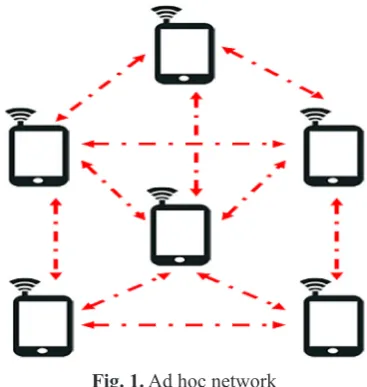
groups including mobile ad hoc network and in-telligent sensor network. Mobile ad hoc network has composed of wireless nodes. Nodes are freely displaced. In other words, this network has dy-namic topology. Figure 1 shows an mobile ad hoc
network. Routing is difficult in this network. In
order to send data soundly and with low delay to destination, routing protocols should be used. DSDV and AODV protocols are of the popular protocols which are evaluated and compared with different nodes size.
Fig. 1. Ad hoc network
The above figure shows an ad- hoc network
and each one of these nodes can be regarded as a router or can have a middle node for routing to send data from the source to the destination.
B. DSDV routing protocol
This protocol performs routing with Bell -man–Ford algorithm. Each node has a routing
table which is updated continually and periodi-cally. The inputs which are located in routing table include the number of nodes for reaching destination, sequence numbers for reaching des-tination which is generated by the desdes-tination node and is the destination address [2, 5]. Data packets are transferred to nodes with routing table. Preventing creation of loop is one of the features of this protocol.
C. AODV routing protocol
This protocol discovers route with request
ap-proach. In other words, this protocol finds routes
with RREQ, RREP and RERR messages. When the source node wants to send data to
destina-tion, source node first broadcasts messages called
RREQ to its neighbor nodes. When the RREQ message reaches destination node, the destination node will send its response to the source node from the same previous path with RREP message and it means that the route has been found from source to destination and the source node can send its data. One of the features of this protocol is that it performs routing action only if neces-sary. ADOV protocol uses a routing method and acts similarly to DSR [6, 7, 8].
As mentioned above, the source node first
broadcasts its route request among neighbors and the node forwards its response message into the source node. Figure 2 shows message
broadcasting procedure. This figure has 8 nodes
in which node A has role of source and H has role of destination. Node A broadcasts route request among the neighboring nodes and also neighboring nodes route request source node to another node.
When request message reaches node H or destination node is found, the destination node forwards the response message to node A and the
source can send its data. Figure 3 shows response
of destination node to the source node.
FUZZY SYSTEM CONSTRUCTION
In this Section, we introduce the proposed fuzzy system for evaluation of two AODV and
DSDV and stages of fuzzy system construction are described as follows:
A. Fuzzy system
Fuzzy systems are able to make decision and control a system with expert systems so that the most applicable case for using them is to model relations in complex medium or anywhere which there is no clear model in the system such that it makes conclusion and decision for the system by relying on some inputs and their results. It is
very complex to recognize reasons for efficiency
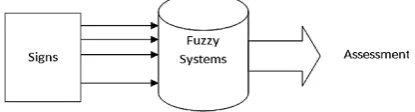
of a test technique. The following Figure shows general diagram of MANET model with fuzzy system. The most important idea in use of fuzzy system which has been shown in Figure 4 is that verbal words are transferred to fuzzy system and
the fuzzy system expresses efficiency of the pro -tocols under different conditions considering the signs which have been shown with verbal words.
Fig. 4. Function of Fuzzy system
In the fuzzy system, we have used rules as Relation 1 to model the concepts [9].
(1)
,..., 1 1
1 1
1isA x isA theny B
ifx m m = (1)
Utilized membership functions are triangular, yet they have different number of variables. This difference roots in natural quiddity of parameters such as degree of anemia.
The most paramount reasons justifying use of fuzzy systems are Annabelle Mercier [2005],
Kim-Hui Yap [2005]:
• The sophistication of natural world which leads to an approximate description or a fuzzy system for modeling.
• Necessity of providing a pattern to formulate mankindknowledge and applying it to actual systems.
Thus, the following procedure is considered
to define expert fuzzy system:
• Defining input-output sets which accept nor -malized input-output pairs.
• Generating if-else fuzzy rules based on input-output pairs.
• Creating fuzzy rule base.
• Implementing fuzzy system based on fuzzy rules. In this artical we utilize product inference
engine, singleton fuzzifier and center average defuzzifier in order to build fuzzy system. In our
inference engine we also used Mamdani product implication and individual-rule based inference combined with algebraic summation and mulit-plication for t-norms and max for s-norms. Thus, product inference engine can be written as denot-ed by equation (2) [9]:
(2) ))] ( ) ( ) ( [sup( max ) ( 1 1
ki A i B
A n
l
B y x l x y
i = ′ ′ = ′ = µ µ µ
µ (2)
In this fuzzy system, singleton fuzzifier and average defuzzifier are utilized. Singleton fuzzi
-fier is widely applied as it simplifies calculation
of inference engine. Moreover, center averages
defuzzifier is the most popular defuzzifier used
in fuzzy systems and fuzzy control systems
ow-ing to its simplicity, justifiability and continuity. Center average defuzzifier is calculated as shown in equation (3) [10]:
∑
∈ = ⇒ Classh x p j p j A x m Classh As( ) 1 µ ( ) (3)
B. Input–output parameters of the fuzzy systems
As mentioned before, 1 factor of the number of nodes has been used in this system for evalu-ation of two AODV, DSDV routing protocols as input parameter and based on this input factor, effect of the factor on two AODV, DSDV rout-ing protocols is studied but as mentioned above, other factors such as nodes searching speed, num-ber of packets etc. are also effective on evaluation of two AODV and DSDV routing protocols. As a
result, it is not possible to determine efficiency of
two AODV and DSDV routing protocols under different conditions but attempt has been made
to calculate efficiency of two AODV and DSDV
routing protocols with a fuzzy system using this single factor for taking suitable measures. There-fore, the above fuzzy system has four outputs
which show efficiency of two AODV and DSDV
routing protocols based on different input states. In this research, FIS tools were used in Matlab
software to determine efficiency of test technique
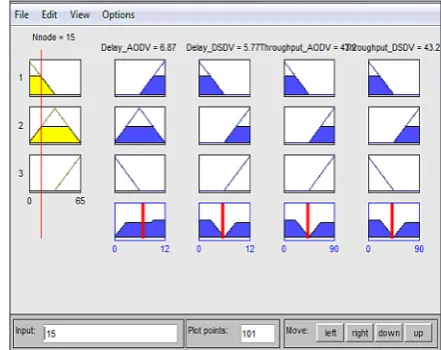
and its general diagram is shown in Figure 5.
This system has 1 input field which relates
to factor affecting evaluation of two AODV and DSDV routing protocols and three classes i.e. low, normal and high verbal words have been
as-signed to each factor and 4 output fields which show efficiency of two AODV and DSDV rout
-ing protocols and the output has been classified
into three groups and low, normal and high verbal words have been assigned to each factor. In Fig-ures 6 and 7, one of the membership functions of input and output parameters is shown.
C. Construction of rules database
A simple method for generation of fuzzy rules
is clustering of input features with specified num -ber of fuzzy mem-bership functions (for example, triangular membership function and assignment of verbal words to each cluster). With the
classi-fied space for each model, one way for generation
of fuzzy rules is to consider all possible combi-nations of antecedents (input features) and this method has been also used in this research.
D. Fuzzy if–then rules
With the mentioned facts, we write if-them rules as follows:
1. If (Nnode is normal) then (Delay_AODV is middle) (Delay_DSDV is max) (Throughput_ AODV is max) (Throughput_DSDV is max). 2. If (Nnode is max) then (Delay_ AODV is min)
(Delay_DSDV is max) (Throughput_AODV is max) (Throughput_DSDV is min).
3. If (Nnode is min) then (Delay_AODV is max)
(Delay_DSDV is min) (Throughput_AODV is min) (Throughput_DSDV is min).
E. Simulations and statement of results of fuzzy system
As mentioned above, MATLAB software
which is a suitable medium for simulation of such systems has been used. Simulation of two
cases of tests with 15 and 35 nodes is given in Figures 8A and 8B we then showed results ob
-Fig .6. Membership function relating to input of the number of node
Fig .7. Membership function relating to delay of AODV routing protocol
Fig. 5. General model of fuzzy expert system for evaluation of two AODV and DSDV
routing protocols
tained from effect of the number of node on out-put as 2D which has been obtained in the simula-tion model.
F. Results
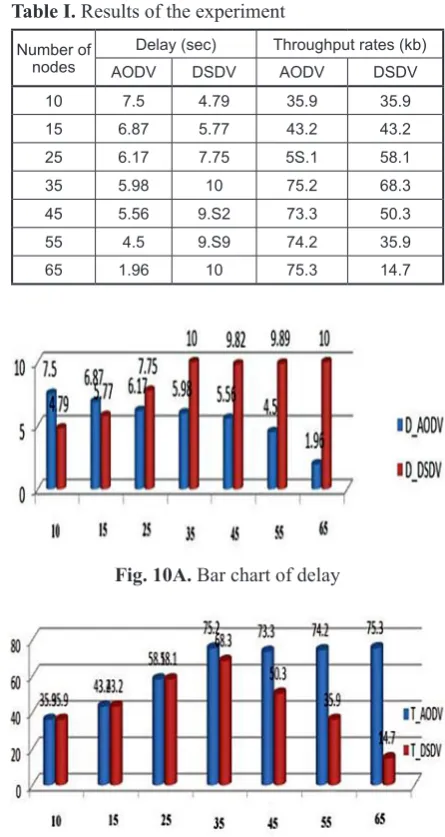
Results of fuzzy expert system for two out-puts of delay and throughput are given in Table 1. The results for two protocols which have been
tested with nodes 10, 15, 25, 35, 45, 55 and 65 are shown in Figure 10A and 10B. The obtained
results show that AODV protocol has lower delay
rate and higher throughput than DSDV protocol with increasing the number of nodes.
Results obtained from execution of the de-signed fuzzy system for the number of different nodes are exactly mentioned in Table 1. Now, we have evaluated and simulated two AODV and DSDV routing protocols for the number of sim-ilar nodes with NS-2 software in order to show performance and reliability of the proposed fuzzy system by comparing results of executing fuzzy system and NS-2 software with each other.
SIMULATION AND STATEMENT OF
RESULTS WITH NS-2 SOFTWARE
In this Section, we compare two AODV and DSDV routing protocols by performing test and NS-2 software has been used to simulate the
pro-Fig. 8B. Results of simulation with 35 nodes
Fig. 9A. Effect of number of node on output of delay in AODV protocol
Fig. 9B. Effect of number of node on output of delay in DSDV protocol
Table I. Results of the experiment
Number of nodes
Delay (sec) Throughput rates (kb)
AODV DSDV AODV DSDV
10 7.5 4.79 35.9 35.9
15 6.87 5.77 43.2 43.2
25 6.17 7.75 5S.1 58.1
35 5.98 10 75.2 68.3
45 5.56 9.S2 73.3 50.3
55 4.5 9.S9 74.2 35.9
65 1.96 10 75.3 14.7
Fig. 10A. Bar chart of delay
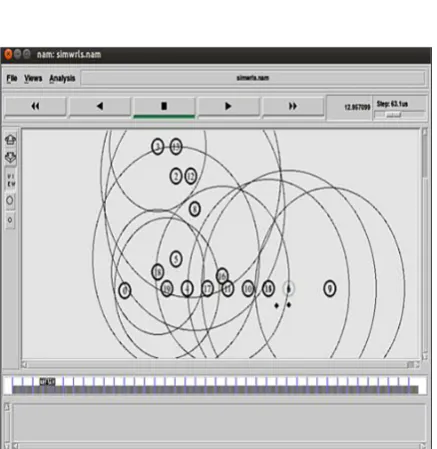
tocols and NS2 Visual Trace Analyzer software has been used to analyze the results. Our evalua-tion criterion is condievalua-tion of the sent packets, the maximum delay and maximum forwarded data per second. Each one of them is discussed here. The settings which have been done for analysis of this test are shown in Table 2. Figure 11 shows simulation medium and Figure 12 shows layout of nodes in which number zero is source node and node number 1 is destination node.
Table 2. Parameters used for simulation
Parameter Values
Channel type Channel/Wireless channel Number of nodes 10, 15, 20, 25, 30, 35, 40, 45, 50, 55, 60, 65
Simulation time 150 sec Area of simulation 500x500 Routing Protocol AODV, DSDV
Mac Type 802.11
Data Type TCP/FTP
Interface queue type QueuelDrop Tail
Fig. 11. Simulation medium with NS2 software
A. The forwarded packets
In this Section, condition of the packets which have been generated, dropped and transferred are shown with different nodes with both protocols.
Figure 13 shows the generated packets,
drop-ped packets and transferred packets for AODV protocol with different nodes. For example, a test has been done on 10 nodes in this Figure. There
are 4038 TCP packets and 13 packets have been
Fig. 12. Layout of nodes with 20 nodes in which node number zero is source and node number 1 is destination
Fig. 13.The forwarded packets with AODV protocol
dropped. The number of packet which has been transferred from source to destination is 4025. Considering this Figure, it can be said that with in-creasing the number of nodes, the number of pack-ets forwarded from source to destination increases.
Figure 14 shows the generated packets, the dropped packets and transferred packets for DSDV protocol with different nodes. For example, there are 4726 TCP packets in the test which has been performed on 10 nodes and the number of the dropped packet is 41 and also the number of trans-ferred packet from source to destination is 4685.
B. Maximum delay of both protocols
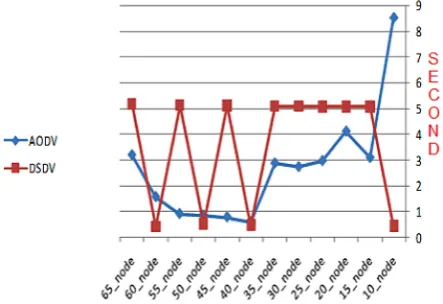
CONCLUSION
In this paper, fuzzy system has been designed to evaluate two DSDV and AODV protocols in mobile ad hoc network and to prove truth of the fuzzy system, we compare results of comparing two protocols with NS-2 software and the results show that the designed fuzzy system has
suit-able efficiency for proposing and selecting one
of these two routing protocols principally and logically under different conditions and based on different applications. It can be generally said that AODV protocol has better performance than the DSDV protocol in terms of the data transfer rate per second and delay rate with increasing the number of node in the network. Generally, we can say that goal of designing the fuzzy system in this paper is to help ordinary user select type
of the routing protocol only based on information of ordinary user (even if the user has no accurate information about routing protocols of Manet net-works) and only based on personal discernment of the user regarding the number of nodes based on application of network as verbal words (high-low-medium).
REFERENCES
1. Morshed Md Monzur, Franz Is Ko, Dongwook Lim, Md Habibur Rahman, Md Rezaur Rahman Mazumder, and Jyotirmoy Ghosh. Performance evaluation of DSDV and AODV routing protocols in mobile ad-hoc networks. In: New Trends in In-formation Science and Service Science (NISS), 4th IEEE International Conference on, 2010, 399-403. 2. Mohapatra S. and Kanungo. Performance analysis
of AODV, DSR, OLSR and DSDV Routing Proto-cols using NS2 Simulator. Procedia Engineering, 30, 2012, 69-76.
3. Odeh A., Eman A.F. and Muneer A. Performance Evaluation of AODV and DSR Routing Protocols in MANET Networks. International Journal of Dis-tributed and Parallel Systems (IJDPS) Vol. 3, 2012. 4. Boukerche A. Performance evaluation of routing
protocols for ad hoc wireless networks. Mobile Networks and Applications 9(4), 2004, 333-342. 5. Ramesh V., Subbaiah P., Koteswar Rao N. and
Ja-nardhana Raju M. Performance Comparison and Analysis of DSDV and AODV for MANET. Inter-national Journal on Computer Science and Engi-neering 2(2), 2010, 183-188.
6. Gupta S.K. and Saket R.K. Performance metric comparison of AODV and DSDV routing pro-tocols in manets using ns-2. IJRRAS, Vol. 7(3), 2011, 339-350.
7. Bhosle A.A. and Tushar P.T. International Journal of Computer Science, Engineering and Applica-tions (IJCSEA). Black-Hole and Wormhole At -tack in Routing Protocol AODV in MANET, 2(1), 2012, 45-54.
8. Rahman Abdul Hadi Abd, and Zuriati Ahmad Zukarnain. Performance comparison of AODV, DSDV and I-DSDV routing protocols in mobile ad hoc networks. European Journal of Scientific Re -search.
9. Zadeh LA., Fuzzy Logic, Neural Networks and Soft Computing, Com. of the ACM, vol. 37, 1994, 77-84.
10. Ishibuchi H., Nozaki K., Yamamoto N., Tanaka H., Construction of fuzzy classification systems with rectangular fuzzy rules using genetic algorithm, Fuzzy Sets and Systems, Vol. 65, 1994, 237-253.
Fig. 14. Number of the forwarded packets with num-ber of different nodes for DSDV protocol