Emanpreet Kaur et al, International Journal of Computer Science and Mobile Applications,
Vol.3 Issue. 7, July- 2015, pg. 44-54 ISSN: 2321-8363
TO COMPARE THE PERFORMANCE OF TORA AND
DSR BASED ON THE SIZE OF THE NETWORK
Emanpreet Kaur
1, Abhinash Singla
21
Assistant Professor, Department of computer and science, BMSCE, MUKTSARSAHIB, Punjab 2
Assistant Professor, Department of Computer Science, BGIET, Sangrur, Punjab
___________________________________________________________________________
Abstract
The Temporally Ordered Routing Algorithm (TORA) is an adaptive distributed routing algorithm for multihop ad hoc networks. It was intentionally build for fast changing network topologies. The protocol is based on the link reversal concept. TORA uses destination oriented routing information that is already available at each node. Nodes only need to know their one-hop neighbourhood. Based on the neighbour information TORA creates independently local routing information for each destination node. The destination oriented routing principle allows reactive, proactive and combined concepts. Furthermore TORA was drafted to be able using multiple routes and absence of loops[1]. In this paper OPNET simulation tool is used for analysing the performance of TORA routing protocol .In this simulation scenario different networks are used to measure the performance of TORA routing protocol. The experimental study has delay and throughput parameters. The simulation results of the research have practical reference value for further study.
Keywords
- MANET; routing protocols; TORA
____________________________________________________________________________
1.
Introduction
Mobile Ad- hoc Network (MANET)
A mobile ad hoc network (MANETs) consists of mobile hosts prepared with wireless communication
devices. Each node participating in the network acts both as host and a router and are able to forward
packets for other nodes. It is a self-configuring network of mobile nodes connected by wireless links with
no access point [2,3 ]. In other words, ad hoc network do not rely on any fixed infrastructure. The
Communication in MANET takes place by using multi-hop paths. The density of nodes and the number
of nodes are depends on the applications in which it is being used. Nodes in the MANET share the
wireless medium and the topology of the network changes irregularly and dynamically. The transmission
of a mobile host is received by all hosts within its transmission range due to the broadcast nature of
Emanpreet Kaur et al, International Journal of Computer Science and Mobile Applications,
Vol.3 Issue. 7, July- 2015, pg. 44-54 ISSN: 2321-8363 free to move to anywhere. The mobile hosts can move randomly and can be turned on or off without
notifying
other hosts.
If two wireless hosts are out of their transmission ranges in the ad hoc networks,
other mobile hosts placed between them can forward their messages, which effectively build connected
networks among the mobile hosts in the deployed area
.
Features of MANET
A Mobile Ad hoc Network has the following features [4]:
Autonomous terminal: In MANET, each mobile terminal is an autonomous node, which may function
as both a host and a router. In other words, working as a host, the mobile nodes can also perform
switching functions as a router. So usually endpoints and switches are the same in MANET.
Distributed operation: In MANETs there is no control of the network operations, the control and
management of the network is distributed among the terminals. The nodes involved in a MANET should
collaborate amongst themselves and each node acts as a receiver and transmitter as needed, to implement
functions e.g. security and routing.
Multihop routing: Basic types of ad hoc routing algorithms can be single-hop and multihop, based on
different link layer attributes and routing protocols. Single-hop MANET is simpler than multihop in terms
of structure and implementation, with the cost of lesser functionality. When delivering data packets from
a source to its destination out of the direct wireless transmission range, the packets should be forwarded
via one or more intermediate nodes.
Dynamic network topology: Since the nodes are mobile, the network topology may change rapidly andrandomly and the connectivity among the terminals may vary with time. MANET should adapt to the
traffic and propagation conditions as well as the mobility patterns of the mobile network nodes. The
mobile nodes in the network dynamically establish routing between themselves as they move and,
forming their own network. Moreover, a user in the MANET may not only operate within the ad hoc
network, but may require access to a public fixed network (e.g. Internet).
Light-weight terminals: In most cases, the MANET nodes are mobile devices with less CPU
processing capability, small memory size, and low power storage. Such devices need optimized
Emanpreet Kaur et al, International Journal of Computer Science and Mobile Applications,
Vol.3 Issue. 7, July- 2015, pg. 44-54 ISSN: 2321-8363
Routing in Ad Hoc Networks
The lack of a backbone infrastructure [5,6] coupled with the fact that mobile Ad Hoc networks change
their topology frequently and without prior notice makes packet routing in ad-hoc networks a challenging
task. The suggested approaches for routing can be divided into topology-based and position-based
routing
.
Topology-based routing protocols use the information about the links that exist in the network to perform
packet forwarding. They can be further divided into proactive, reactive, and hybrid approaches
.
Dynamic Source Routing Protocol (DSR)
The Dynamic Source Routing protocol (DSR)[7,8] is a simple and efficient routing protocol designed specifically for use in multi-hop wireless ad hoc networks of mobile nodes. DSR allows the network to be completely self-organizing and self-configuring, without the need for any existing network infrastructure or administration. As nodes in the network move or join or leave the network , and as wireless transmission conditions such as sources of interference change, all routing is automatically determined and maintained by the DSR routing protocol. Since the number or sequence of intermediate hops needed to reach any destination may change at any time, the resulting network topology may be quite rich and rapidly changing. The protocol is composed of the two main mechanisms of "Route Discovery" and "Route Maintenance", which work together to allow nodes to discover and maintain routes to arbitrary destinations in the ad hoc network.
Important Properties of the Protocol
The DSR protocol [8]is composed of two mechanisms that work together to allow the discovery and maintenance of source routes in the ad hoc network:
DSR Route Discovery
Emanpreet Kaur et al, International Journal of Computer Science and Mobile Applications,
Vol.3 Issue. 7, July- 2015, pg. 44-54 ISSN: 2321-8363
DSR Route Maintenance
When the transmission of data started, it is the responsibility of the node that is transmitting data to confirm the next hop received the data along with source route. The node generates a route error message, if it does not receive any confirmation to the originator node. The originator node again performs new route discovery Process [7]
Temporally Ordered Routing Algorithm (TORA)
Temporally-Ordered Routing Algorithm (TORA) is a distributed protocol designed to be highly adaptive so it can oper-ate in a dynamic network. For a given destination, TORA uses a somewhat arbitrary ‚height‛ parameter to determine the direction of a link between any two nodes. As a consequence of this multiple routes are often present for a given destination, but none of them are necessarily shortest route The TO-RA routing protocol is based on the LMR protocol. It uses similar link reversal and route repair procedure as in LMR and also the creation of a DAGs, which is similar to the query/reply process used in LMR. Therefore, it also has the same benefits as LMR. The advantage of TORA is that it has reduced the far-reaching control messages to a set of neighboring nodes, where the topology change has occurred. An other advantage of TORA is that it also supports multicasting; how-ever this is not incorporated into its basic operation. TORA can be used in conjunction with Lightweight Adaptive Multicast Algorithm (LAM) to provide multicasting. The disadvantage of TORA is that the algorithm may also produce temporary invalid routes as in LMR.[9]
2.
SIMULATION
In this paper the DSR and TORA routing protocol is analysed with the help of OPNET MODELER 14.0.The OPNET SIMULATOR is used to analyse the parameters like delay, throughput on 50 and 100 nodes.
SIMULATION ON DIFFERENT NETWORKS
Emanpreet Kaur et al, International Journal of Computer Science and Mobile Applications,
Vol.3 Issue. 7, July- 2015, pg. 44-54 ISSN: 2321-8363
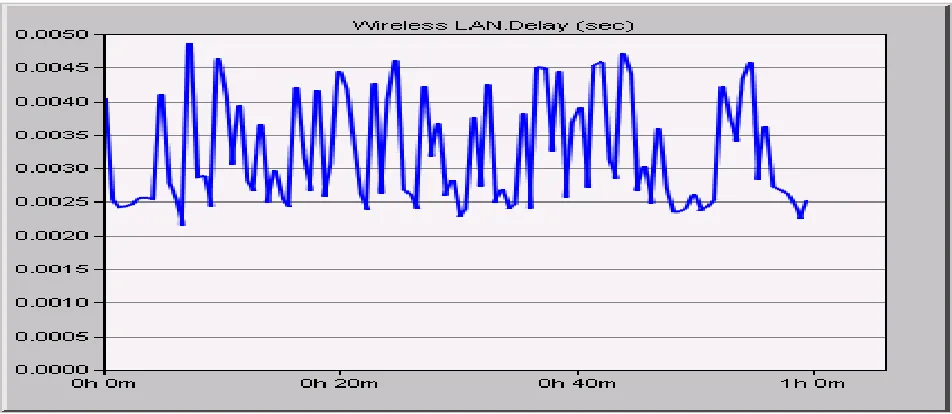
Figure Variation of Delay for DSR Protocol
Fig shows variation of data packet delay for DSR protocol .the variation in data packet delay is
around 0.0063 seconds for 50 nodes.
Figure Variation of Delay for TORA Protocol
Emanpreet Kaur et al, International Journal of Computer Science and Mobile Applications,
Vol.3 Issue. 7, July- 2015, pg. 44-54 ISSN: 2321-8363
DELAY
:-
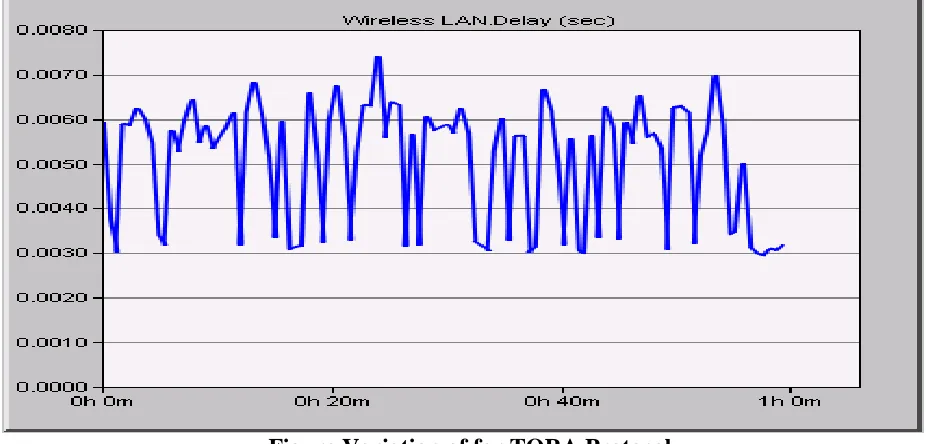
in this we have created a scenario of 100 nodes for both DSR and TORA routing protocol . their results are shown and discussed below :-Figure Variation of Delay for DSR Protocol
Fig shows variation of data packet delay for DSR protocol .the variation in data packet delay is
around 0.0062 seconds for 100 nodes.
Figure Variation of for TORA Protocol
Emanpreet Kaur et al, International Journal of Computer Science and Mobile Applications,
Vol.3 Issue. 7, July- 2015, pg. 44-54 ISSN: 2321-8363
Throughput
: -
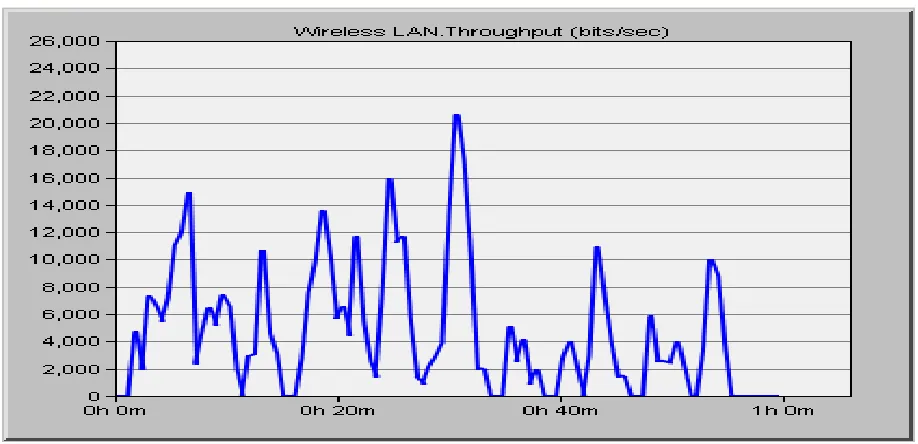
first we have created a scenario of 50 nodes for both DSR and TORA routing protocol, their results are shown and discussed below :-Fig:
throughput for DSR Protocol in MANET network
Fig shows throughput in bits per second and packets per second for DSR protocol. Its maximum
value is around 21000 bits per second for 50 nodes.
Emanpreet Kaur et al, International Journal of Computer Science and Mobile Applications,
Vol.3 Issue. 7, July- 2015, pg. 44-54 ISSN: 2321-8363
Fig shows throughput in bits per second and packets per second for TORA protocol. its
maximum value is around 25,000 bits per second for 50 nodes .
Throughput
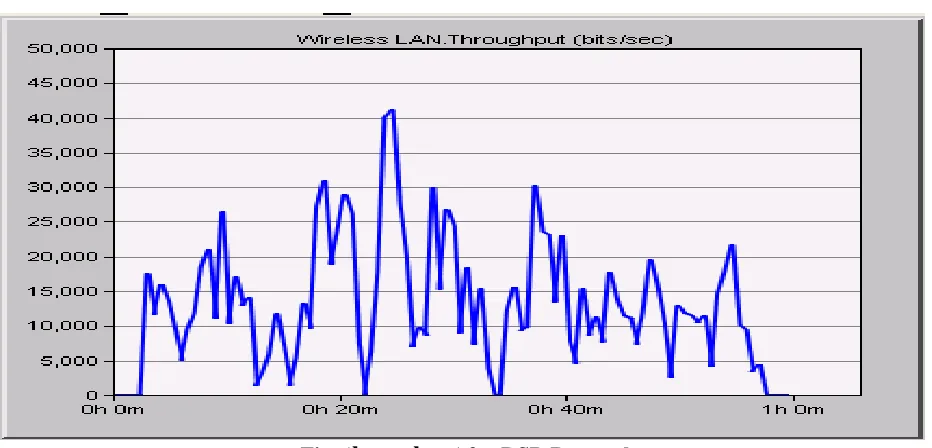
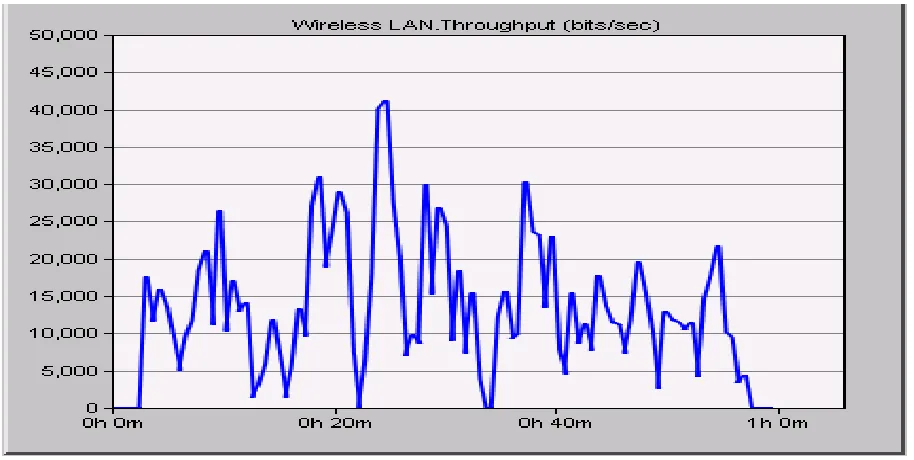
:- in this we have created a scenario of 100 nodes for both DSR and TORA
routing protocol . their results are shown and discussed below :-
Fig:
throughput
for DSR Protocol.Emanpreet Kaur et al, International Journal of Computer Science and Mobile Applications,
Vol.3 Issue. 7, July- 2015, pg. 44-54 ISSN: 2321-8363
Fig:
throughput
for TORA Protocol in WLAN network
Fig shows throughput in bits per second and packets per second for DSR protocol. Its maximum
value is around 41000 bits per second
for 100 nodes .
CONCLUSION
In this paper, performance of TORA and DSR is analysed using OPNET modeler 14.0
In thispaper i have analysed DSR and TORA protocol on 50 and 100 nodes using delay and throughput as
parameters . as it is clearly shown from the above results that for 50 nodes TORA has less delay as
compared to DSR protocol whereas for 100 nodes DSR has less delay than TORA protocol . but when we
take throughput for 50 nodes then i have noticed that TORA has higher throughput than DSR protocol
whereas for 100 nodes i have seen that both DSR and TORA has same throughput .so in the end i ll
conclude that on 50 nodes TORA has less delay and higher throughput as compared to DSR protocol .
whereas on 100 nodes TORA has higher delay and equal throughput as compared to DSR protocol .
. As
a result, ad hoc networking has been receiving much attention from the wireless research
community. With regards to overall performance TORA performed good in respect to DSR
Emanpreet Kaur et al, International Journal of Computer Science and Mobile Applications,
Vol.3 Issue. 7, July- 2015, pg. 44-54 ISSN: 2321-8363
REFERENCES
[1]
Erik Weiss*, Guido R. Hiertz*, Bangnan Xu(2005)
“
Performance Analysis of Temporally
Ordered Routing Algorithm based on IEEE 802.11a “
0-78038887-9/05/$20.00(c)2005IEEE.
[2]
Amith Khandakar(2012)
” Step by Step Procedural Comparison of DSR, AODV and DSDV
Routing protocol”,
4th International Conference on Computer Engineering and Technology
(ICCET 2012)IPCSIT vol.40, 2012.
[3]
Kumar Prateek, Nimish Arvind and Satish Kumar Alaria(2013)
“
MANET-Evaluation of
DSDV, AODV and DSR Routing Protocol”
, International Journal of Innovations in Engineering
and Technology, Vol. 2 Issue 1 February 2013.
[4]
Amer O. Abu Salem, Ghassan Samara and Tareq Alhmiedat,(2014
)
“ Performance
Analysis of Dynamic Source Routing Protocol”
, Journal of Emerging Trends in Computing and
Information Sciences, Vol. 5, No. 2 February 2014.
[5]
A. Shastri, R. Dadhich and Ramesh C. Poonia
(
2011),
“PERFORMANCE ANALYSIS OF
ON-DEMAND ROUTING PROTOCOLS FOR VEHICULAR AD-HOC NETWORKS
”,
International Journal of Wireless & Mobile Networks (IJWMN) Vol. 3, No. 4, August 2011
[6
] Mrs. Amninder Kaur Gill and Yog Kunwar(2014)
,
“Performance Analysis and
Comparison of MANET Routing Protocols under Black Hole Attack”
, International Journal of
Emerging Trends in Science and Technology, Volume 0, Issue 07, Pages 1029-1035, September
2014.
[7]
Rajput, Monika. and ,Khatri, Pallavi (2010),
“
Comparison of Ad-hoc Reactive Routing
Protocols using OPNET Modeler
”, IACSIT International Journalof Engineering and
Emanpreet Kaur et al, International Journal of Computer Science and Mobile Applications,
Vol.3 Issue. 7, July- 2015, pg. 44-54 ISSN: 2321-8363