Vol -3, Issue-1, April-June 2014
ISSN: 2278-7496
AJPER April - June 2014, Vol 3, Issue 2 (20-37)
RESEARCH ARTICLE
FORMULATION AND EVALUATION OF GESTRORETENTIVE
FLOATING TABLET OF PERINDOPRIL
Sanju Singh1, Abhishek Dwivedi1, Shubendu Mishra2, Avalani Gunjan3
1. Department of Pharmaceutics, RKDF University, Bhopal, M.P.
2. Department of Pharmaceutics, Radharaman College of Pharmacy, Bhopal, M.P.
3. Department of Quality, Bajaj Health Care, Baroda. Gujarat
Abstract:
Oral delivery of drugs is by far the most preferable route of drug delivery due to the ease of administration, patient compliance and flexibility in formulation etc. From immediate release to site specific delivery, oral dosage forms have really progressed. Gastro retentive dosage forms significantly extend the period of time, over which drug may be released and thus prolong dosing intervals and increase patient compliance. Perindopril Eribumineis an angiotensin converting enzyme inhibitor and is used in the treatment of hypertensive and congestive cardiac failure. The bioavailability of Perindopril following oral administration is very low. Perindopril is absorbed rapidly on oral administration. When administered orally, frequent dosing is needed due to its short biological half life (0.8-1hr).Secondly drug undergoes high hepatic first pass metabolism. The present study focus on the development of floating tablets of perindopril hydrochloride using different polymer grades to achieve a sustained release for 24 hrs.
Keywords: Gastro retention, Angiotensin System,
Gastroretnial tract system
Article Received on
17 Feb 2014.
Revised on 22 Feb 2014,
Accepted on 03 Mar 2014
*Correspondence for
Author:
Sanju Singh
Department of
Pharmaceutics, RKDF
University, Bhopal, M.P
Email:
AJPER April - June 2014, Vol 3, Issue 2 (20-37) INTRODUCTION:
Oral delivery of drugs is by far the most preferable route of drug delivery due to the ease of
administration, patient compliance and flexibility in formulation etc. From immediate release to
site specific delivery, oral dosage forms have really progressed. Gastro retentive dosage forms
significantly extend the period of time, over which drug may be released and thus prolong dosing
intervals and increase patient compliance.1 Such retention systems are important for those drug that are degraded in the 0intestine like antacids or certain antibiotics, enzymes that act locally in
the stomach. This system can be retained in the stomach and assist in improving the oral
sustained delivery of drugs that have an absorption window in a particular region of the
gastrointestinal tract, thus ensuring optimal bioavailability. 2,3 Various gastro retentive techniques were used, including floating, swelling, high density, and bioadhesive system, have been
explored to increase the gastro retention of dosage forms. 4,5 Floating systems having low density systems that have sufficient buoyancy to float over the gastric contents and remain in the
stomach without affecting the gastric emptying rate for a prolonged period. While the system
floats over the gastric contents, the drug is released slowly at the desired rate, which results in
increased gastric retentive time and reduces fluctuation in plasma drug concentration. 6,7 Perindopril Eribumine8-11 is an angiotensin converting enzyme inhibitor and is used in the treatment of hypertensive and congestive cardiac failure. The bioavailability of Perindopril
following oral administration is very low. Perindopril is absorbed rapidly on oral administration.
When administered orally, frequent dosing is needed due to its short biological half life
(0.8-1hr).Secondly drug undergoes high hepatic first pass metabolism. The present study focus on the
development of floating tablets of perindopril hydrochloride using different polymer grades to
achieve a sustained release for 24 hrs.
Materials:
Perindopril was obtained as gift sample from Glenmark Pvt. Ltd., Mumbai. HPMC K14M was
obtained from Suvidhanath Lab. Baroda. Carbopol was obtained from High Purity Chemicals
Lab., Mumbai, Sodium Carbonate, Lactose, Talc and Magnesium stearate were obtained from
S.D. Fine Chemicals. Pvt Ltd, Mumbai, India. All chemicals and solvents used were of analytical
grade.
Experimental:
AJPER April - June 2014, Vol 3, Issue 2 (20-37)
Description: The sample of Perindipril was analyzed for its nature, color and taste.
Table 1. Physical Evaliuyation
Sr. No. Property Observation
1. Colour White
2. Odour Odourless
3. State Solid
4. Nature Amorphous
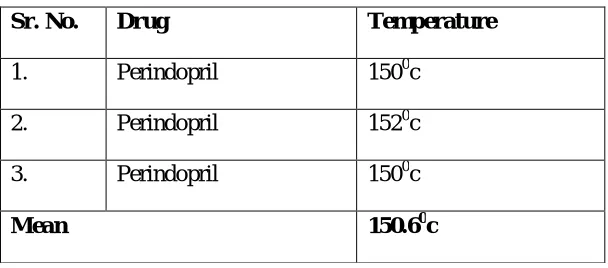
Melting Point: The melting point was taken by open capillary method.
Table 2. Melting Point-Determination
Sr. No. Drug Temperature
1. Perindopril 1500c
2. Perindopril 1520c
3. Perindopril 1500c
Mean 150.60c
Standard Curve of Perindopril: Perindipril has been quantitatively analyzed by various
techniques. In present studies, Perindipril was estimated by UV Spectrophotometry method.
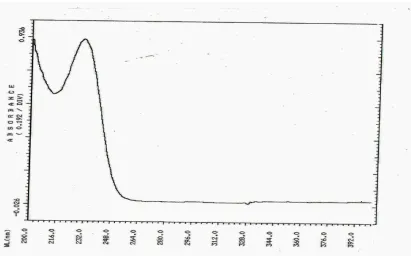
Table 3. Observation of Drug by UV
Sr. No. Concentration Wavelength Absorbence
AJPER April - June 2014, Vol 3, Issue 2 (20-37) Figure 1. Plotted in UV of Perindopril
Table 4.Standard Calibration Curve of Perindopril
Sr. No. Concentration
(µg/ml)
Absorbance
Equation of line-
y = 0.016x + 0.006
R² = 0.998
1. 2 0.038
2. 4 0.073
3. 6 0.108
4. 8 0.137
AJPER April - June 2014, Vol 3, Issue 2 (20-37) Fig-2. Calibration Curve of Perindopril
Infrared spectra analysis: Infrared spectrum of Perindipril was determined on Fourier
Transform Infrared Spectrophotometer (FTIR-4100s) using KBr dispersion method. The base
line correction was done using dried potassium bromide. Then the spectrum of dried mixture of
AJPER April - June 2014, Vol 3, Issue 2 (20-37) Figure 3. drug interaction study of Perindopril
Preparation of Floating Tablet of Perindopril :
Each floating tablets containing Perindipril were prepared by a conventional wet granulation
method, employing sodium bicarbonate, citric acid as gas generating agent and water-soluble
polymer (HPMC K15M) as hydrophilic matrix in each formulation.(Table No.1) The
concentration of gas generating agent (sodium bicarbonate) was developed as optimal
concentration under experimental formulae and condition of preparation. All the ingredients
were mixed thoroughly except magnesium stearate and talc. Granules were prepared manually
with a solution of the Polyvinyl pyrrolidone (PVP K30) in sufficient isopropyl alcohol as binder.
The wet mass was passed through a 16 mesh sieve no. and the wet granules produced were dried
in hot air oven for 30 min at 50°C. The dried granules mixed with magnesium stearate as
lubricant, talc as glidant and compressed into tablet on single punch machine (Khera made).
AJPER April - June 2014, Vol 3, Issue 2 (20-37)
characteristics.12-15
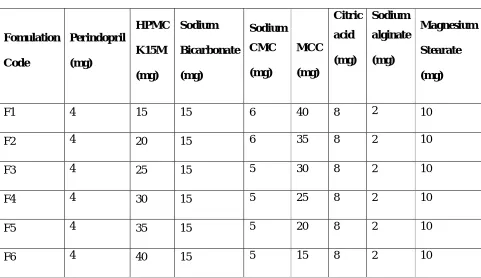
Table 5. Formulation of tablet
Fomulation Code Perindopril (mg) HPMC K15M (mg) Sodium Bicarbonate (mg) Sodium CMC (mg) MCC (mg) Citric acid (mg) Sodium alginate (mg) Magnesium Stearate (mg)
F1 4 15 15 6 40 8 2 10
F2 4 20 15 6 35 8 2 10
F3 4 25 15 5 30 8 2 10
F4 4 30 15 5 25 8 2 10
F5 4 35 15 5 20 8 2 10
F6 4 40 15 5 15 8 2 10
Evaluations of Granules Properties:
The flow properties of granules were characterized in terms of angle of repose, Carr index and
Hausner's ratio. The bulk density and tapped density were determined and from this data Carr's
index and Hausner's ratio were calculated.
Evaluation of Tablet Properties:
Weight variation test: 10 tablets were selected at a random and average weight was determined.
Then individual tablets were weighed and was compared with average weight.
Weight uniformity test16 :
If the drug forms greater part of the tablet, any variation in the tablet weight obviously indicates
a variation in the active ingredient this test resembles weight uniformity test.20 Tablets were selected at random and average weights were determined. Then individual tablets weighed and
the individual weight was compared with the average.
AJPER April - June 2014, Vol 3, Issue 2 (20-37)
The hardness of prepared formulation was measured by using Pfizer hardness tester. Five
floating tablets were used for hardness uniformity studies. The hardness data used to calculate
mean and standard deviation.
Thickness uniformity studies:
The thickness uniformity studies were carried out by using Vernier callipers. Five tablets were
used for thickness uniformity studies and denoted in millimeter. The data obtained was used to
calculate mean and standard deviation.
Drug estimation: 10 tablets were powdered and the blend equivalent to 25 mg of drug was
weighed and dissolved in suitable quantity of methanoil. The solution was filtered, diluted and
the drug content was analyzed spectrophotometrically at 243nm.17 Percentage of drug content is calculated by Y/X* 100
Where Y = Actual drug content (mg)
X = Labeled amount of drug (mg)
Friability: Friability of the tablets was determined using Roche friabilator. This device subjects
the tablets to the combined effect of abrasions and shock in plastic chamber revolving at 25 rpm
and dropping the tablets at height of 6 inches in each revolution. Preweighed sample of tablets.
was placed in the friabilator and were subjected to 100 revolutions. Tablets were de dusted using
a soft muslin cloth and reweighed.The friability (f) is given by the formula:
F = (W0 /W) × 100
Where, W0 is weight of the tablets before the test and W is the weight of the tablet after the test.
(Liberman HA et al,1989)
Disintegration: The time required for the tablets to disintegrate in mouth cavity was determined
by holding the tablets in mouth. The tablet should disintegrate with in one minute when examine
by the disintegration test for fast dissolving tablet by using artificial saliva or water by
disintegration test apparatus.
Table 6. Evaluation of Tablet:
Formulatio n code Thickness (mm) Hardness (kg/cm2) Weight variation (mg) Friability (%)
Drug content
(%)
Total
floating
AJPER April - June 2014, Vol 3, Issue 2 (20-37)
(h)
F1 3.73±0.05 5.5 150.19± 0.24 0.98 ± 0.10 97.33± 0.92 8.23 ±0.03
F2 3.84± 0.08 5.4 150.18 ± 0.20 0.96 ± 0.08 98.20 ± 0.34 8.75±0.05
F3 3.96± 0.05 5.5 140.33 ± 0.28 0.99 ± 0.12 98.60 ± 1.39 9.05±0.06
F4 3.95± 0.05 5.7 160.10 ± 0.45 0.83 ± 0.04 98.14 ± 1.69 8.35±0.01
F5 3.93± 0.10 5.4 150.13 ± 0.83 0.87 ± 0.07 99.21 ± 1.07 6.40±0.06
F6 4.03± 0.06 5.8 156.16 ± 0.33 0.98 ± 0.05 98.50± 1.81 6.30±0.02
F7 4.05± 0.05 5.8 150.18 ± 0.11 0.99 ± 0.08 98.34 ± 0.37 6.40±0.05
F8 3.98± 0.05 5.5 140.04 ± 0.56 0.96 ± 0.12 98.31± 0.91 8.19±0.02
Dissolution rate study:
In vitro dissolution studies for all the fabricated tablets and the pure drug was carried out USP
paddle method at 50 rpm in 900 ml of Phosphate Buffer pH 5.8, maintained at 37 + 0.5 °C. 5 ml
of aliquots withdrawn at specified intervals filtered through whatmann filter paper and analyzed
at 243 nm using UV- Visible spectrophotometer. The dissolution media was then replaced by 5
ml of each fresh dissolution fluid to maintain a constant volume .(Jwuagwuma et al, 2002).
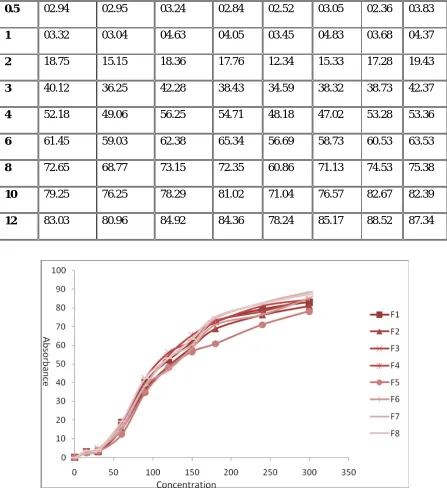
Table 7. Dissolution Profile of Perindopril Foating tablet
Time Cumulative % of Drug Release
AJPER April - June 2014, Vol 3, Issue 2 (20-37)
0.5 02.94 02.95 03.24 02.84 02.52 03.05 02.36 03.83
1 03.32 03.04 04.63 04.05 03.45 04.83 03.68 04.37
2 18.75 15.15 18.36 17.76 12.34 15.33 17.28 19.43
3 40.12 36.25 42.28 38.43 34.59 38.32 38.73 42.37
4 52.18 49.06 56.25 54.71 48.18 47.02 53.28 53.36
6 61.45 59.03 62.38 65.34 56.69 58.73 60.53 63.53
8 72.65 68.77 73.15 72.35 60.86 71.13 74.53 75.38
10 79.25 76.25 78.29 81.02 71.04 76.57 82.67 82.39
12 83.03 80.96 84.92 84.36 78.24 85.17 88.52 87.34
Figure 4. Dissolution curve of Perindopril Foating tablet
CONCLUSION:
Perindopril, can be successfully formulated as sustained release floating tablets which has the
advantage to retain the dosage form in the effective site of absorption for long period of time and
release the drug in sustained manner, ultimately achieving desired steady state concentration
AJPER April - June 2014, Vol 3, Issue 2 (20-37)
hydrophobic drug can be designed as modified release dosage form with desired qualities, using
a hydrophilic polymer HPMC K15M and calcium carbonate as a buoyancy initiator.
Additionally, ease of manufacturing process by direct compression implies that it ensures the
capability of commercial utility by large scale production with satisfactory industrial feasibility.
Reference:
1. Shinde AJ, Patil MS and More HN. Formulation and Evaluation of an Oral Floating
Tablet of Cephalexin, Indian J.Pharm. Educ. Res. 2010; 44(3), 41-50.
2. Rouge N, Buri P, Deolkar E, Drug absorption sites in the gastrointestinal tract and dosage
forms for site specific drug delivery system, Int. J. Pharm., 1996; 136: 117- 139.
3. Alexander S, Juergen S. Gastroretentive drug delivery systems. Expert Opin. Drug Deliv.
2006; 3:217–233.
4. Deshpande AA, Rhodes CT, Shah NH, et al. Controlled release drug delivery system for
prolonged gastric residence: An Review. Drug Dev Ind Pharm.1996; 22:531-539.
5. Singh B, Kim HN. Floating drug delivery system: an approach to oral controlled drug via
gastric retention. J Control Rel. 2000; 63: 235-259.
6. Khatri S, Girdhani D, Pahwa R. Recent advances in floating drug delivery system. The
Indian Pharmacist. 2007; 17–20.
7. Arora S, Ali J, Ahuja A, et al. Floating Drug Delivery Systems: A Review. AAPS
PharmSciTech. 2005;06:372-390.
8. The Merck Index; Thirteenth edition; p; 1286.
9. Todd PA and Fitton A. Perindopril: a review of its pharmacological properties and
therapeutic use in cardiovascular disorders. Drugs. 1991;42:90-114.
10. Doyle AE. Angiotensin-converting enzyme (ACE) inhibition: benefits beyond blood
pressure control. Am J Med. 1992;92(4b):IS-107S.
11. Hurst M and Jarvis B. Perindopril; an updated review of its use in hypertension. Drugs.
2001;61:867-896.
12. Patel VF, Patel NM. Intragastric floating drug delivery system of cefuroxime axetil: in
vitro evaluation. AAPS PharmSciTech. 2006; 7:118-124.
13. Jaimini M, Rana AC, Tanwar YS. Formulation and evaluation of famotidine floating
tablets. Curr Drug Deliv 2007; 4:51-55.
14. Dave BS, Amin AF, Patel MM. Gastroretentive drug delivery system of ranitidine
AJPER April - June 2014, Vol 3, Issue 2 (20-37)
15. Basak SC, Rao N. Development and in vitro evaluation of an oral floating matrix tablet
formulation of ciprofloxacin. Indian J Pharm Sci. 2004; 66:313-316.
16. Gupta R and Pathak K. “Optimisation studies on floating multiparticulate gastro retentiva
drug delivery system of famotidine”, Drug development and industrial pharmacy, 2008;
1201-1208.
17. Brahmankar DM, Jaiswal SB. Controlled Release Medication. In Brahmankar DM.
EDITORS. Biopharmaceutics and pharmacokinetics A Treatise. 1st Ed. Vallabh