N. Sunitha et al/JGTPS/ JGTPS/Volume-5, Issue - 2, April – June 2014 Address for correspondence
DEVELOPMENT AND VALIDATION OF AN RP-HPLC METHOD FOR SIMULTANEOUS ESTIMATION OF CITICOLINE AND METHYLCOBALAMIN
1. INTRODUCTION:
Citicoline1is chemically 5'-O-[hydroxy({hydroxyl [2-(trimethylammonio) ethoxy] phosphoryl}oxy) phosphoryl] cytidine. It is also known as cytidine diphosphate-choline (CDP-Choline) & cytidine 5'-diphosphocholine is a psychostimulant / nootropic. It is an intermediate in the generation of phosphatidyl choline from choline. It is used as neuroprotective and memory disorders. Methylcobalmin2 is a form of vitamin B12. It features octahedral cobalt (III) at centre. It used in the treatment of peripheral neuropathy, diabetic neuropathy, and as a preliminary treatment for amyotrophic lateral sclerosis. The review of literature revealed that various analytical methods involving spectrophotometry, HPLC have been reported for citicoline in single form and in combination with other drugs 3-8.
Fig.1: The molecular structure of Citicoline
Fig.2: The molecular structure of methylcobalmine
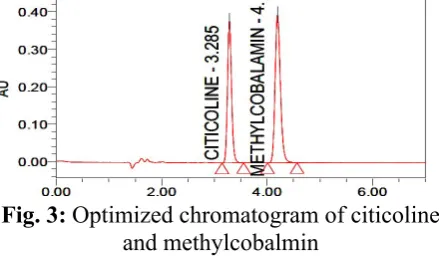
A simple, accurate, precise and stability-indicating method was developed and validated for the quantitative determination of citicoline and methylcobalmin in pharmaceutical dosage form. The method was based on RP-HPLC. Chromatographic separation was performed on HPLC system (Waters with Empower2 Software) containing C18 (YMC, 250 x 4.6mm, 5µ) column with UV- PDA detection using a mobile phase consisting of a mixture of the mobile phase consisted of potassium dihydrogen phosphate: acetonitrile (adjusted to pH 3.0 using orthophosphoric acid) in the ratio of 50:50 v/v. The following system conditions were maintained throughout development and validation i.e., flow rate 0.8 mL/min, column was maintained at ambient temperature and the detected by a PDA detector at wave length 295nm. The citicoline and methylcobalmin was well resolved on the stationary phase and the retention time was 3.2 min and 4.1min. The linearity of the method was found to be within the concentration range of 500-1500 μg/ml solutions of citicoline and 0.75-2.25μg/ml solutions of methylcobalmin , the correlation coefficient (r2) for the drug was 0.999. The precision, accuracy, specificity, ruggedness, robustness and forced degradation studies were determined to validate the method.
Keywords:Citicoline, methylcobalmin, RP-HPLC, chromatography. ABSTRACT
N. Sunitha1* Subash C Marihal 2
1SIMS College of Pharmacy,
Guntur - 522001, Andhra Pradesh, India
2HLT College of Pharmacy,
Channapatna, Bengaluru, Karnataka, India
Journal of Global Trends in Pharmaceutical Sciences
Available online at www.JGTPS.com
N. Sunitha et al/JGTPS/ JGTPS/Volume-5, Issue - 2, April – June 2014 Several analytical methods have been
reported for methylcobalmine in single form and in combination with other drugs including spectrophotometry, HPLC 9-11.
There is no research work carried on simultaneous estimation of citicoline and methylcobalmin by HPLC in bulk drug and in pharmaceutical dosage forms. In this present investigation developed and validated HPLC method for the estimation of citicoline and methylcobalmin in bulk drug and pharmaceutical dosage forms. The proposed method is validated as per ICH guidelines.
2. EXPERIMENTAL:
2.1 Materials and reagents:
Analytically pure citicoline and methylcobalmin were obtained from Lara Laboratory, Hyderabad as gift samples. HPLC grade acetonitrile was purchased from Merck & Co. Triple distilled water is used for all purpose.
2.2 Instrumentation:
HPLC system (Waters with Empower2 Software) containing C18(YMC, 250 x 4.6mm, 5µ) column with UV- PDA detection.
3. Method development:
3.1 Optimization of the chromatographic conditions:
The mobile phase consisted of potassium dihydrogen phosphate: acetonitrile (adjusted to pH 3.0 using orthophosphoric acid) in the ratio of 50:50 v/v. The contents of the mobile phase were filtered before use through a
0.45μ membrane and degassed for 10 min. The mobile phase was pumped from the solvent reservoir to the column at a flow rate of 0.8
ml/min and the injection volume was 20μL. The
column temperature was maintained at ambient temperature. The eluents were monitored at 295 nm.
3.2 Preparation of standard stock solutions: Accurately weighed 500mg of citicoline and 0.75mg methylcobalmine standard were transferred to separate 100 ml volumetric flask and dissolved in 10 ml methanol. The flasks were shaken and volume was made up to the mark with distilled water to give solutions containing 5000 μg/ml citicoline and 7.5 μg/ml
methylcobalmine. From this solution 5ml was transferred to volumetric flask of 25 ml
capacity. Volume was made up to the mark to
give a solution containing 1000μg/ml of citicoline and 1.5μg/ml methylcobalmine.
3.3 Calibration of standards:
The standard calibration curve was constructed for citicoline and methylcobalmin. Different volumes of stock solutions of each were accurately Transferred in to 10mL volumetric flasks and diluted to mark to yield a concentration range of 500-1500 μg/ml
solutions of citicoline and 0.75-2.25μg/ml
solutions of methylcobalmin. The calibration line was obtained by plotting the peak area against concentration of drug.
3.4 Determination of citicoline and methylcobalmin in their combined Dosage:
Sample preparation:
A powder quantity equivalent to 500 mg citicoline and 0.75 mg methylcobalmin was accurately weighed and transferred to volumetric flask of 100 ml capacity. 50ml of distilled water was transferred to this volumetric flask and sonicated for 15 min. The flask was shaken and volume was made up to the mark with distilled water. The above solution was filtered through whatmann filter paper (0.45μ).
From this solution 5ml was transferred to volumetric flask of 25ml capacity. Volume was made up to the mark to give a solution
containing 1000μg/ml of citicoline and 1.5μg/ml of methylcobalmin. The resulting
solution was analyzed by proposed method. The quantification was carried out by keeping these values to the straight line equation of calibration curve.
4. RESULTS AND DISCUSSION: 4.1 Method validation:
The proposed method has been extensively validated in terms of specificity, linearity, accuracy, precision, limits of detection (LOD) and quantification (LOQ), robustness and reproducibility. After validation, the developed methods have been applied to pharmaceutical dosage form.
System suitability criteria:
The system suitability was assessed by five replicate analyses of the drugs at
N. Sunitha et al/JGTPS/ JGTPS/Volume-5, Issue - 2, April – June 2014
1.5μg mL−1 of methylcobalmin and for this, parameters like plate number (n), tailing factor, retention time, resolution, similarity of samples were measured.
4.2 Validation parameters:
Method was validated as per ICH (Q2B) guidelines with respect to linearity, accuracy, precision, specificity, and robustness, limit of detection (LOD) and limit of quantification (LOQ).
4.2.1 Specificity:
Commonly used excipients (starch, microcrystalline cellulose and magnesium stearate) were spiked into a pre weighed quantity of drugs. Specificity of the method was shown by quantifying the analyte of interest in the presence of matrix and other components. Blank injections have shown no peaks at retention time of 3.2 min and 4.1min, the proposed method was specific for the detection of citicoline and methylcobalmin respectively.
4.2.2 Linearity:
Linearity found to be 500-1500μg/ml for
citicoline and 0.75-2.25μg/ml for
methylcobalmin.
4.2.3 Accuracy:
Accuracy was assessed by determination of the recovery of the method by addition of standard drug to the prequantified placebo preparation at 3 different concentration levels 50, 100 and 150 %, taking into consideration percentage purity of added bulk drug samples. Each concentration was analyzed 3 times and average recoveries were measured
4.2.4 Precision:
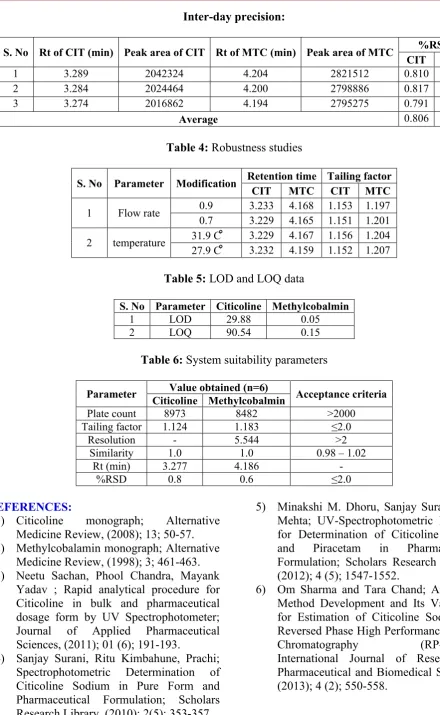
The repeatability was evaluated by assaying 6 times of sample solution prepared for assay determination. The intra and inter-day precision study of citicoline and methylcobalmin was carried out at 100% concentrations of citicoline and methylcobalmin, 3 times on the same day and on 3 different days (first, second, third).
4.2.5 Robustness:
The robustness of the method was evaluated by analyzing the system suitability standards and evaluating system suitability
parameter data after varying the HPLC pump flow rate (±0.1ml) and temperature (±1oC). None of the alterations caused a significant change in peak area, retention time, USP tailing factor.
4.2.6 LOD and LOQ:
LOD and LOQ were 29.88, 90.54 for citicoline LOD and LOQ were 0-05, 0.15 for methylcobalmin
5. CONCLUSION:
The present study represents an accurate, precise and specific HPLC method for routine analysis of citicoline and methylcobalmin combination in tablet dosage form. In addition to assay it may be used to detect related substance or other impurities which are formed during storage conditions and the analyte of interest could be estimated without any interferences. The use of C18 column in the present work has shown better elution of analytes with good resolution, improved plate count, capacity factor, and reduced tailing. So the C18 column can be used to achieve high specificity in shorter time of analysis of citicoline to methylcobalmin in tablet as per ICH Q2B guidelines.
The developed RP-HPLC method for simultaneous determination of citicoline and methylcobalmin in combined pharmaceutical dosage form is simple and reliable. From the study of validation parameters namely accuracy, precision (SD and RSD), (inter-day, intraday), specificity, linearity and range, it was observed that the method is specific, accurate, precise and reproducible. Hence the method can be employed for routine analysis of dosage form.
N. Sunitha et al/JGTPS/ JGTPS/Volume-5, Issue - 2, April – June 2014 Fig.4:Assay chromatogram for citicoline and
methylcobalamin in combined tablet dosage form.
Fig.5:Linearity for citicoline
Fig.6:Linearity for methylcobalmin
Table 1: Optimized chromatographic conditions of citicoline and methylcobalamin S.
No Parameters Specification
1 Mobile phase KH2PO4: acetonitrile (50:50 v/v)
2 Flow rate (mL/min) 0.8 ml/min
3 Run time (min) 10min
4 Column
Temperature ( ̊C) ambient 5 Volume of injection (µL) 20 µl
6 wavelength (nm)Detection 295 nm
Table 2: Recovery report of citicoline and methylcobalamin
Drug Amount taken (µg/ml) Recovery level (%) Amount of drug added Amount of drug found RSD% Recovery%
CIT 1000
50 500 1507.65 1.1 100.51
100 1000 1978.33 1.0 98.91
150 2500 2523.78 0.7 100.95
MTC 1.5
50 0.75 2.27 1.3 100.88
100 1.5 2.97 0.8 99
150 2.25 3.80 0.7 101.33
Table 3: Precision (intraday and inter-day Precision) Intraday precision:
S. No Rt of CIT (min) Peak area of CIT Rt of MTC (min) Peak area of MTC %RSD
CIT MTC
1 3.288 2038642 4.203 2803798 0.809 0.598
2 3.292 2067066 4.207 2835554 0.804 0.600
3 3.290 2035515 4.207 2802533 0.801 0.608
N. Sunitha et al/JGTPS/ JGTPS/Volume-5, Issue - 2, April – June 2014 Inter-day precision:
S. No Rt of CIT (min) Peak area of CIT Rt of MTC (min) Peak area of MTC %RSD
CIT MTC
1 3.289 2042324 4.204 2821512 0.810 0.600
2 3.284 2024464 4.200 2798886 0.817 0.594
3 3.274 2016862 4.194 2795275 0.791 0.597
Average 0.806 0.597
Table 4: Robustness studies
S. No Parameter Modification Retention time Tailing factor
CIT MTC CIT MTC
1 Flow rate 0.9 3.233 4.168 1.153 1.197
0.7 3.229 4.165 1.151 1.201
2 temperature 31.9 C̊ 3.229 4.167 1.156 1.204
27.9 C̊ 3.232 4.159 1.152 1.207
Table 5: LOD and LOQ data
S. No Parameter Citicoline Methylcobalmin
1 LOD 29.88 0.05
2 LOQ 90.54 0.15
Table 6: System suitability parameters
Parameter Value obtained (n=6) Acceptance criteria
Citicoline Methylcobalmin
Plate count 8973 8482 >2000
Tailing factor 1.124 1.183 ≤2.0
Resolution - 5.544 >2
Similarity 1.0 1.0 0.98 – 1.02
Rt (min) 3.277 4.186
-%RSD 0.8 0.6 ≤2.0
REFERENCES:
1) Citicoline monograph; Alternative Medicine Review, (2008); 13; 50-57. 2) Methylcobalamin monograph; Alternative
Medicine Review, (1998); 3; 461-463. 3) Neetu Sachan, Phool Chandra, Mayank
Yadav ; Rapid analytical procedure for Citicoline in bulk and pharmaceutical dosage form by UV Spectrophotometer; Journal of Applied Pharmaceutical Sciences, (2011); 01 (6); 191-193.
4) Sanjay Surani, Ritu Kimbahune, Prachi; Spectrophotometric Determination of Citicoline Sodium in Pure Form and Pharmaceutical Formulation; Scholars Research Library, (2010); 2(5); 353-357.
5) Minakshi M. Dhoru, Sanjay Surani, Priti Mehta; UV-Spectrophotometric Methods for Determination of Citicoline sodium and Piracetam in Pharmaceutical Formulation; Scholars Research Library, (2012); 4 (5); 1547-1552.
N. Sunitha et al/JGTPS/ JGTPS/Volume-5, Issue - 2, April – June 2014 7) Raga Pravallika E, Prashanthi D and
ISMAIL Y; Method Development and Validation of RP-HPLC for Simultaneous Estimation of Citicoline and Piracetam in Tablet Dosage Form; International Journal of Chemical and Pharmaceutical Sciences, (2012); 3 (2); 76-80
8) Sonali O. Uttarwar, R.T. Jadhav, C.G. Bonde; Stability Indicating LC Method of Citicoline Sustained Release Tablets; International Journal of PharmTech Research, (2010); 2 (4); 2482-2486.
9) Varsha R.Galande, K.G. Baheti, M. H. Dehghan; UV-Vis Spectrophotometric Method For Estimation of Gabapentin and Methylcobalamin In Bulk And Tablet;
International Journal of ChemTech Research, (2010); 2 (1); 695-699
10) Ganesan.M, Solairaj .P, Rajesh S.C., Senthilkumar. T, Thangathirupathi; A Simple Spectrophotometric Method for the Estimation of Mecobalamin in Injections; International Journal of Pharmacy and Pharmaceutical Sciences, (2012); 4 (3); 559-562.