The Effect of Electroless Ni Coating of SiC Particles on the
Corrosion Behavior of A356 Based Squeeze Cast Composite
Dikici, B. - Tekmen, C. - Gavgali, M. - Cocen, U.
Burak Dikici1,* - Cagri Tekmen2- Mehmet Gavgali3 - Umit Cocen2
1 Yuzuncu Yil University, Ercis Technical Vocational School of Higher Education, Turkey 2 Dokuz Eylul University, Metallurgical and Materials Engineering, Turkey
3 Ataturk University, Department of Mechanical Engineering, Turkey
The corrosion behavior of electroless Ni coated SiC particle reinforced squeeze cast aluminum based composite was investigated by potentiodynamic scanning (PDS) and electrochemical impedance spectroscopy (EIS) techniques in aerated and deaerated chloride solutions. Microstructural and interfacial characterization of the composite was carried out by using an optical microscope, scanning electron microscope (SEM), energy dispersion spectroscopy (EDS) and X-ray diffractometer (XRD). It has been observed that electroless Ni coating of SiC particles is not an effective method to improve its corrosion resistance in structural applications containing halide solution.
©2011 Journal of Mechanical Engineering. All rights reserved.
Keywords: electroless nickel, metal matrix composite, corrosion, EIS
0 INTRODUCTION
Properties of metal matrix composites (MMCs) strongly depend on the interfacial phenomena between the metal matrix and ceramic reinforcement [1] to [4]. The wettability of reinforcement by liquid metal is the key factor to achieve high interface bonding strength [5] to [7]. Unfortunately, the wettability of SiC particle reinforcement with molten aluminum matrix is generally poor. However, several methods including the modification of the matrix composition, coating of the reinforcement and control of process parameters have been widely used to improve the interfacial properties [8] to [11]. Among these methods, electroless nickel (EN) coating of the reinforcement, which is a simple, low-cost and an easy to use process, has been successfully applied to prevent undesired interfacial reactions and promote the wettability through increasing the overall surface energy of the reinforcement [12] to [14].
The corrosion properties of aluminum based metal matrix composites reinforced with coated ceramic particles is still in the investigation stage. In addition, the published literature on the corrosion behavior of aluminum based composites is rather limited and often contradictory [15] and [16]. The reason is generally related to the quantity of alloying elements in the Al matrix, reinforcement shape, size and volume fraction and
In this study, corrosion behavior of Al–7%Si–0.7%Mg (A356) based metal matrix composite reinforced with electroless nickel (EN) coated SiC particles produced by squeeze casting technique has been investigated. Another purpose of this study was to increase wettability between matrix/reinforcing phase and preventing undesirable interface reactions. The coating morphology, microstructural and interfacial properties of the composite, and the effect of EN coating of SiC reinforcement on the corrosion properties has been examined and discussed in detail.
1 EXPERIMENTAL PROCEDURE
1.1 Electroless Nickel (EN) Coating
Electroless nickel coating of SiC particles was carried out as follows: cleaning of SiC particles in acetone for 15 min. After cleaning, particles were sensitized for another 15 minutes in a solution containing 10 g/L SnCl2 and 30 mL HCl. The sensitized particles were immersed in a solution containing 0.25 g/L PdCl2 and 3 ml/L HCl for 15 min in order to activate the nonmetal SiC particle surface. Rinsed and dried SiC particles were gently dispersed in an electroless nickel bath containing 45 g NiCl2, 8 g NaH2PO2. H20, 100 g Na3C6H5O7 and 50 g NH4Cl dissolved in 1 L distilled water. Deposition was carried out at 80 to 90 °C and 8 to 9 pH.
1.2 Composite Manufacturing
A composite reinforced with 20 vol. % electroless nickel coated SiC particles with an average size of 15 µm was produced by a squeeze casting technique. Al–7%Si–0.7%Mg matrix alloy was melted in a ceramic crucible and then SiC particles were added by stirring continuously. The mixture was superheated up to 750 °C and then poured into a preheated (400 °C) die and finally solidified under a pressure of 100 MPa.
1.3 Characterization
Characterization studies were carried out by using optical microscope, scanning electron microscope (SEM), energy dispersion
spectrometer (EDS) and X-ray diffractometer (XRD).
1.4 Corrosion Tests
Electrochemical investigation of the composite was performed with potentiodynamic polarization (PDS) and electrochemical impedance spectroscopy (EIS). All experiments were carried out with a computer-controlled potentiostat (PCI4/750, GAMRY Instruments, Inc., Warminster, PA) in aerated and deaerated 3.5% NaCl solution at room temperature. Ag/ AgCl and platinum (Pt) electrodes were used as a reference and auxiliary electrode, respectively. The solution was deaerated in order to remove the oxygen with nitrogen (N2) gas. Deaerated process was started 60 minutes prior the measurement and continued until the end of the experiment. Specimens were immersed into the solution until obtaining a steady open circuit potential (OCP). After reaching equilibrium, polarization test started at the cathodic overpotential and the scan was stopped when the specimens reached the anodic corrosion current density of 10 mA.cm-2. All potentiodynamic scanning (PDS) tests were carried out according to the ASTM standard [31]. EIS measurements were carried out using AC signals of amplitude 10 mV at the open circuit potential (OCP) in the frequency range of 100000 to 0.01 Hz. The exposed area of the test specimens was about 5 x 5 mm (±0.01), and all data have been normalized according to the surface area. Impedance parameters were calculated by fitting the experimental results to an equivalent circuit model by using the Echem Analyst software.
2 RESULTS
2.1 Characterization
dendrites and eutectic silicon with no evidence of macro-pores. The amount of micro-pores was measured as 0.54% (in vol.).
Fig. 1. a)SEM image and b) X-ray map of Ni on the SiC particle surface
Fig. 2. Optical micrograph of squeeze cast composite
Fig. 3. SEM micrograph showing the SiC/matrix interface
Higher magnification micrograph of the composite demonstrates a good SiC/matrix interface in terms of porosity (Fig. 3). In addition, XRD pattern of the composite indicates that Al4C3 reaction product does not occur (Fig. 4).
Fig. 4. XRD pattern of squeeze cast composite
2.2 Corrosion Tests
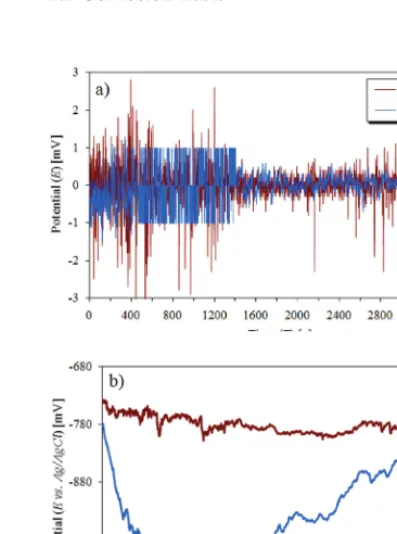
Fig. 5. a) open circuit potential‒time (Eocp‒T)
curves, b) electrochemical potential noise measurements in aerated and deaerated 3.5%
Open circuit potential (OCP) and electrochemical noise measurements of the composite in aerated and deaerated 3.5% NaCl solutions measured against time are given in Fig. 5. Noise values were calculated from the variation between two potential values obtained from OCP.
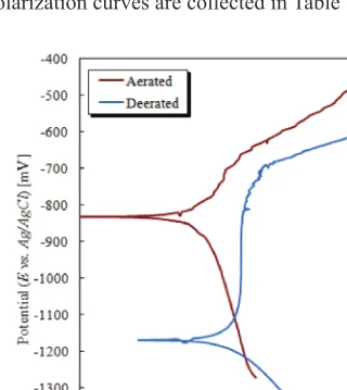
It is well known that a corrosion reaction may be masked by the heavily reduction reactions in aerated solution. Thus, especially aluminum alloys, pitting onset, passive areas and subtle polarization effects can not be seen completely. Therefore, the solution was deaerated to remove the oxygen by introducing nitrogen into the system. Fig. 6 shows a typical potentiodynamic polarization curve of the composite obtained in aerated and deaerated 3.5% NaCl solutions. Corrosion parameters obtained from these polarization curves are collected in Table 1.
Fig. 6. Potentiodynamic polarization curves in aerated and deaerated 3.5% NaCl solutions
Fig. 7 shows the impedance response of the composite in a Nyquist representation. In addition, the corrosion behavior of the composite is further illustrated by Bode plots in Fig. 8.
In order to obtain accurate results, complex plane plots were analyzed by fitting the experimental results to the equivalent circuit as given in Fig. 9. It is obvious from Fig. 7 that fitted results present a similar shape with experimental results. Also, impedance parameters derived from complex plane plots are given in Table 2.
Fig. 7. Nyquist diagram of the sample exposed to aerated 3.5% NaCl
Fig. 8. Bode plots of the sample exposed to aerated 3.5% NaCl: a) magnitude, b) phase angle
2.3 Corrosion Morphology
Fig. 10 is a typical SEM micrograph of a squeeze cast composite exposed to 3.5% NaCl solution, where the presence of preferentially localized corrosion can be seen at SiC/matrix interface.
Fig. 10. SEM micrographs showing the corroded surfaces of the sample
Fig. 11 shows the corrosion progress paths on the corroded surface of squeeze cast composite at the initial and intensive corrosion stages. At extensive corrosion levels, the presence of pits
at the SiC/matrix interface can be considered as regions where SiC particles are partially or completely detached (Fig. 12).
Fig. 11. Initial and intensive stages of corrosion: a) fresh pit, b) grown pit (arrow directions present
corrosion paths)
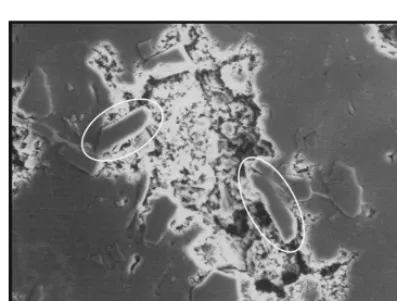
Fig. 13 reveals the preferential removal of the matrix material around EN coated SiC particles. This figure illustrates that SiC particles are not greatly affected by the corrosion process. The corrosion progress on aluminum rich matrix, causes an intense porous structure, without any Table 1. Corrosion parameters obtained from polarization curves of the composite in aerated and deaerated 3.5% NaCl solutions (E vs. Ag/AgCl)
Test condition Eocp [mV] Ecorr [mV] Epit [mV] Epass [mV] Ipass [μA/cm2] Icorr [μA/cm2]
Aerated solution -776 -833 -696 - - 1.25
Deaerated solution -904 -1169 -718 -1135 6.15 2.50
Table 2. Impedance parameters derived from complex plane plot in aerated 3.5% NaCl solution
R1 [W.cm2] R2 [W.cm2] C1(x10-6) [F.cm-2] C2(x10-3) [F.cm-2] W(x10-6) [S.s½.cm-2]
corrosion product on SiC particle surface. In addition, it was observed that corrosion did not cause any damage in the EN coating, as illustrated by small, light spheres in Fig. 13.
Fig. 12. Detachment of SiC particles from the structure due to intensive matrix corrosion
Fig. 13. High magnification SEM micrograph of EN coated SiC particles after the corrosion test
3 DISCUSSION
In the literature, it has been attributed that the following parameters significantly affect the corrosion behavior of metal matrix composites in macro scale; (i) reinforcement volume fraction [26] and [33], (ii) composition of the matrix alloy [28] and [34], (iii) reinforcement coating [15] and [18], (iv) composite manufacturing method [33], and (v) thermal or thermo-mechanical post treatment [33] and [35]. In addition, the corrosion principle of aluminum alloys under passive
conditions establishes the pitting [19]. Therefore, for these alloys, the pitting potential value is directly related to the corrosion susceptibility, and it can provide more realistic results related to the electrochemical behavior of the composites. In spite of using the same matrix alloy and reinforcement volume fraction in this study, the corrosion and pitting results are relatively more noble (Table 1) compared to our previous study [18] and [26]. Also, since no post treatment was applied in this study, the difference in potential values cannot be explained by parameters (i), (ii) and (v) given before. Therefore, the main reason of the difference can be attributed to the manufacturing method (iv) and/or reinforcement coating (iii).
From the point of manufacturing method, in both liquid infiltration and squeeze casting methods, a composite material solidifies under pressure, therefore, its effect on microstructure, in terms of porosity and interfacial properties, is insignificant. As reported in our previous studies, the porosity ratio of 20% volume fraction SiC reinforced composite manufactured by liquid infiltration [18], stir casting and extrusion [20] and squeeze casting [32] is the same and approximately 1%. Porosity, which acts as preferential sites for corrosion, is one of the key parameters in the corrosion behavior of composite materials. Therefore, it can be concluded that, the most effective parameter that differentiates the corrosion results obtained in each study is the type of reinforcement coating (iii).
deaerated condition. This can be explained by the affinity of the present and dissolved oxygen in aerated condition. The reason is that in deaerated condition, the oxygen reduction reaction given by reaction (1) will not occur, thus the growth of the surface oxide layer will be prevented. Consequently, dissolution of the metal became more dominant and the protective oxide layer became gradually thinner.
½O2 + H2O +2e- → 2OH- (1) In order to evaluate localized interactions, the electrochemical potential noise magnitudes of each sample were compared (Fig. 5b). 25 minutes after the sample was immersed into the electrolyte it was observed that localized corrosion is hindered due to passivation, and this inhibition is relatively stronger in deaerated solution. This can be easily seen in the magnitued graph of the noise amplitude (Fig. 5b). This result verifies that the difference in potential values observed in both studies arise from the composite structure rather than the oxidation in dilute solution.
In our previous study [18], corrosion was preferentially started and continued at the interface between the Al matrix and alloying elements rather than reinforcement. Also, since SiC particles were coated with SiO2 and TiO2, no detrimental galvanic corrosion was observed between SiC particles and matrix alloy. In addition, up to date, no galvanic effect has been reported between Al and SiC [28] and [33]. However, in this study, SiC particles were coated with nickel which is a relatively good conductive metal, and a metallic bond is expected to occur where Al and Ni are in direct contact. An interface with a metallic bond is more ductile than other bonds, and is desirable in metal matrix composites [8]. However, as a metallic bond has a relatively high electrical conductivity, electrons in the matrix alloy can be easily drained through the conductive EN coating in a corrosive environment,. Also, it has been demonstrated that Ni can react with Al matrix and intermetallic phases such as NiAl3 and Al3Ni2 can occur preferentially at the Al/SiC interface [14]. These intermetallic phases frequently have solution potentials differing from that of the matrix alloy in which they occur, therefore, localized galvanic cells may be formed between these phases and the matrix. Thus, these
phases are cathodic to the Al matrix and decrease the corrosion resistance in aqueous saline media [19] and [28].
active. Consequently, these regions will become localized regions where the oxide film layer has a relatively high solubility and surface conductivity. Therefore, after corrosion propagates in-dept for a while, it will interact with these localized regions and will propagate around these regions, and will consequently spread out (Fig. 11). This progress will occur in a very short time and will continue until the reinforcement detach from the matrix (Figs. 12 and 13). This approach is well in agreement with the observation of Modi et al. [30]. As a result, this kind of constitutions may affect the normal corrosion behavior of the material.
The corrosion potential and polarization resistance during the immersion of a system in a corrosive medium can provide information regarding the ongoing corrosion reaction process. This information, as well as additional information about the solution/protection layer/composite surface interfaces can be obtained from EIS. Figs. 7 and 8 demonstrate the Nyquist and bode plots of the composite after the EIS scanning. At low frequency, the region of the Nyquist plot shows an approxinately straight line with a slope of 45° (Fig. 7). In addition, the phase angle approaches 45° at low frequency (Fig. 8b). In this case, it can be said that the corrosion rate is controlled by the diffusion of electrochemical active species (EAS) to the composite surface and is referred as Warburg diffusion [39]. The result confirms the Nyquist plot because Warburg Impedance appears as a straight line with a slope of 45° in a Nyquist plot. Diffusion is observed at relatively low frequencies and corrosion is observed at higher frequencies (Fig. 8). This behavior demonstrates that the electron exchange between the composite and EAS is very fast. This can be attributed to a relatively high surface electrical conductivity of the Al/SiC interface because of EN coating, which supports the above discussions. As a result, the EN surface coating method significantly affects the corrosion characteristics and the morphology of the composite.
4 CONCLUSIONS
In this study, it has been observed that Al/ SiC interfaces are active sites where corrosion preferentially starts in-depth at the early stages, and later, as a result of excessive polarization,
expanses to the surface, which indicates that the corrosion type is 'pitting'. Such corrosion behavior has been attributed to the conductivity of the coating material, eutectic silicon phase and dislocations accumulated around Al dendrites, by forming preferential sites for corrosion. In addition, the high pressure applied in squeeze casting might have an indirect effect on the corrosion resistance of the composite. It can be concluded that despite improving the wettability, electroless nickel coating is not an effective method to improve the corrosion resistance in structural applications containing halide solution.
ACkNOWLEDGEMENTS
This work was financially supported by Yuzuncu Yil University (2009-MYO-B031).
5 REFERENCES
[1] Lee, J.C., Ahn, J.P., Shim, J.H., Shi, Z., Lee, H.I. (1999). Control of the interface in SiC/ Al composites. Scripta Mater, vol. 41, p. 895-900.
[2] Shi, Z., Yang, J.M., Fan, T., Zhang, D., Wu, R. (2000). The melt structural characteristics concerning the interfacial reaction in SiC(p)/ Al composites. Appl Phys A, vol. 71, p. 203-209.
[3] Thakur, S.k., Dhindaw, B.k. (2001). The influence of interfacial characteristics between SiCp and Mg/Al metal matrix on wear, coefficient of friction and microhardness. Wear, vol. 247, p. 191-201. [4] Wang, R.M., Surappa, M.k., Tao, C.H., Li,
C.Z., Yan, M.G. (1998). Microstructure and interface structure studies of SiCp-reinforced Al (6061) metal-matrix composites. Mater Sci and Eng A, vol. 254, p. 219-226.
[5] Hashim, J., Looney, L., Hashmi, M.S.J. (2001). The wettability of SiC particles by molten aluminium alloy. J of Mater Proc Tech, vol. 119, p. 324-328.
[7] Feng, A., McCoy, B.J., Munir, Z.A., Cagliostro, D. (1998). Wettability of transition metal oxide surfaces. Mater Sci and Eng A, vol. 252, p. 50-56.
[8] Rajan, T.P.D., Pillai, R.M., Pai, B.C. (1998). Review reinforcement coatings and interfaces in aluminum metal matrix composites. J of Mater Sci, vol. 33, p. 3491-3503.
[9] Rams, J., Urena, A., Campo, J. (2004). Sol-gel coatings as active barriers to protect ceramic reinforcement in aluminum matrix composites. Adv Eng Mater, vol. 6, p. 57-61. [10] Wen, T., Gao, J., Shen, J., Zhou, Z. (2001).
Preparation and characterization of TiO2 thin films by the sol-gel process. J of Mater Sci, vol. 36, p. 5923-5926.
[11] Yang, G., Fan, T., Zhang, D. (2004). Chemical reaction in Al matrix composite reinforced with SiCp coated by SnO2. J Mater Sci, vol. 39, p. 3689-3694.
[12] Libo, L., Maozhong, A., Gaohui, W. (2004). A new electroless nickel deposition technique to metallise SiCp/Al composites.
Surf and Coat Tech, vol. 200, p. 5102-5112. [13] Ip, S.W., Sridhar, R., Toguri, J.M.,
Stephenson, T.F., Warner, A.E.M. (1998). Wettability of nickel coated graphite by aluminium. Mater Sci and Eng A, vol. 244, p. 31-38.
[14] Leon, C.A., Drew, R.A.L. (2002). The influence of nickel coating on the wettability of aluminum on ceramics. Compos A, vol. 33, p. 1429-1432.
[15] Pardo, A., Merino, M.C., Ureña, A., Merino, S., Viejo, F., Campo, M. (2004). Effect of reinforcement coating on corrosion behavior of AA6061/SiC/20p composite in high relative humidity environments. Corrosion, vol. 60, p. 945-953.
[16] Davidson, A.M., Regener, D. (2000). A comparison of aluminium-based metal-matrix composites reinforced with coated and uncoated particulate silicon carbide.
Compos Sci Technol, vol. 60, p. 865-869. [17] kiourtsidis, G., Skolianos, S.M. (1998).
Corrosion behavior of squeeze-cast silicon carbide-2024 composites in aerated 3.5 wt.% sodium chloride. Mater Sci and Eng A, vol. 248, p. 165-172.
[18] Dikici, B., Tekmen, C., Yigit, O., Gavgali, M., Cocen, U. (2009). Detrimental effect of particle sol-gel coating on the corrosion behavior of A380-SiC composite. Corros Sci, vol. 51, p. 469-476.
[19] Aylor, D.M., Taylor, D. (1987). Corrosion of metal matrix composites. ASM Handbook. ASM international Materials Park, vol. 13. [20] Dikici, B., Gavgali, M., Tekmen, C. (2006).
Corrosion behavior of an artificially aged (T6) Al-Si-Mg based metal matrix composite. J of Comp Mater, vol. 40, p. 1259-1269.
[21] Aylor, D.M., Moran, P.J. (1985). Effect of reinforcement on the pitting behavior of aluminum-base metal matrix composites. J Electrochem Soc, vol. 132, p. 1277-1281. [22] Yaghmaee, M.S., kaptay, G. (2001). On the
stability range of SiC in ternary liquid Al-Si-Mg alloy. In Materials Worlds: Proceeding of Hungarian Materials Science Society, vol. 2, no. 3, e-journal from http://materialworld. fw.hu.
[23] Trowsdale, A.J., Noble, B., Haris, S.J., Gibbins, I.S.R., Thompson, G.E., Wood, G.C. (1996). The influence of silicon carbide reinforcement on the pitting behaviour of aluminium. Corrosion Sci, vol. 38, p. 77-191.
[24] Suery, M., Salvo, L. (1995). Matrix-reinforcement interactions during fabrication and thermal treatment of cast Al-matrix composites. Metall New Mater, vol. 111, p. 119-137.
[25] Urena, A., Escalera, M.D., Rodrigo, P., Baldonedo, J.L., Gil, L. (2001). Active coatings for SiC particles to reduce the degradation by liquid aluminium during processing of aluminium matrix composites: study of interfacial reactions. J Microsc, vol. 201, p. 122-136.
[26] Gavgali, M., Dikici, B., Tekmen, C. (2006). The effect of SiCp reinforcement on the corrosion behaviour of Al based metal matrix composites. Corrosion Reviews, vol. 24, p. 27-37.
evaluation. Kovove Mater, vol. 47, p. 317-323.
[28] Lucas, k.A., Clarke, H. (1993). Corrosion of aluminium-based metal matrix composites. Research Studies Pres Ltd.
[29] Shackelford, J.F., Alexander, W. (2001).
Thermal properties of materials. Materials Science and Engineering Handbook, vol. 5. CRC press.
[30] Modi, O.P., Prasad, B.k., Dasgupta, R., Jha, A.k., Mondal, D.P. (1999). Errosion-corrosion characteristics of squeeze cast aluminium alloy/SiC composites in water and sodium chloride solutions containing sand. Mater Sci Technol, vol. 15, p. 933-938. [31] ASTM G5, Standard reference test
method for making potentiostatic and potentiodynamic anodic polarization measurements, Annual Book of ASTM Standards. ASTM International.
[32] Tekmen, C., Cocen, U. (2008). Squeeze casting of Ni coated SiC particle reinforced Al based composite. J Comp Mater, vol. 42, p. 1271-1279.
[33] Turnbull, A. (1992). Review of corrosion studies on aluminium metal matrix composites. Br Corros J, vol. 27, no. 27-35.
[34] Bhat, M.S.N., Surappa, M.k. (1991). Corrosion behaviour of silicon carbide particle reinforced 6061/Al alloy composites.
J Mater Sci, vol. 26, p. 4991-4996.
[35] McIntyre, J.F., Conrad, R.k., Golledge, S.L. (1990). The effect of heat treatment on the pitting behaviour of SiCw/AA2124. Corros, vol. 46, p. 902-905.
[36] Trzaskoma, P.P., McCafferty, E., Crowe, C.R. (1983). Corrosion behavior of SiC/Al metal matrix composites. Electrochem Soc J, vol. 130, p. 1804-1809.
[37] Ahmed, Z., Abdul Aleem, B.J. (2002). Degradation of aluminum metal matrix composites in salt water and its control.
Mater Des, vol. 23, p. 173-180.
[38] Trzaskoma, P.P. (1990). Pit morphology of aluminum alloy and silicon carbide/ aluminum alloy metal matrix composites.
Corrosion, vol. 46, p. 402-409.