ISSN 2319-8133 (Online (An International Research Journal), www.physics-journal.org
An Evaluation of Super Fluid Density as a Function of Reduced
Temperature (T/T
C) for Multi Gap Superconductors
Pankaj Kumar Sinha1 and L. K. Mishra2
129, Lala Babu Road, New Godown, Gaya-823001 (Bihar), INDIA. 2Department of Physics,
Magadh University, Bodh Gaya-824234 (Bihar), INDIA.
(Received on: February 2, Accepted: February 5, 2017)
ABSTRACT
Using the theoretical formalism of G. Eilenberger (Z. Phys. 214, 195 (1968)), we have theoretically evaluated super fluid density
1 and
2 along with totaldensity
for two superconducting gap parameters
1 and
2 as a function of (T/TC) for multi gap superconductors MgB2 and V3Si. In this evaluation, we havetaken various parameters
11,
12,
22, ,
n n
1 2,
. Our theoretically evaluated
1,
2 and total density
decreases with (T/TC) for both MgB2 and V3 Si. Our theoreticallyevaluated temperature dependent superconducting parameters
1,
2 and single gap-s wave indicate that these parameters decrease with (T/TC) as per BCS theory.Our theoretically evaluated results are in good agreement with other theoretical workers.
Keywords: Two superconducting gap parameters, Temperature dependent penetration depth, Super fluid density, Reduced temperature, Complex Fermi surfaces, Unconventional order parameters, Weak inter band coupling, Renormalized BCS model, Eilenberger quasi classical formulation of superconductivity, Matsubara frequencies.
INTRODUCTION
Magnesium diboride is a binary intermetallic compound known to the materials science community since early 1950. Jones et al.1 and Russel et al.2 reported the formation of MgB2 phase with the interaction of Mg and amorphous B in hydrogen and argon atmospheres. Till today, there are more than 50 boride compounds with different structures were reported to be superconductors3. Among these diborides, MgB
high critical temperature of any non-cuprate superconductors. The basic feature of MgB2 that makes it so special5 is the following: (i) Relatively high T
C (ii) Weak link free grain boundaries (iii) Lower anisotropy than HTS (iv) Larger Coherence length (v) Remarkable low normal state resistivity (vi) presence of two superconducting gaps (vii) High upper critical field Hc2 etc. The superconducting properties of MgB2 resemble those of conventional superconductors rather than HTS. These properties6 include isotope effect, a linear T-dependence of the upper critical field, temperature dependent resistivity etc. Regarding theoretical understanding is concerned, these materials may be well described by a model that takes account into multiple gaps and the associated scattering processes. These models have been widely used to explain specific heat7 and penetration depth data8 for alleged multi gap superconductors. Later on, it was observed that these models take a short cut by assigning the BCS temperature to both gaps
1,2
in order to ft the total super fluid density
x
1
(1
x
)
2. Here
1,2 are evaluatedby using BCS using 1,2
(
1,2)
( )
1.76
BCST
. Here x is the contribution from one of the bands.Although the α model9 played an important role for providing convincing evidence for two-gap superconductivity in MgB2, it is inconsistent for describing the actual temperature dependence of the specific heat and super fluid density. The major problem is that this model cannot assume temperature dependence for the gaps in the presence of arbitrary weak inter band coupling which imposes the same TC for both bands.
The full blown microscopic approach based on the Eilenberger theory10 is too cumbersome for analysing actual experimental data hence the need for a relatively simple self consistent theory accessible to experimental data is obvious. The weak coupling model provides the framework for such a starting point which over the years has proven to be very successful for describing superconductivity related phenomena. This is known as the ‘renormalized BCS model’ which incorporates the Eilenberger corrections into the effective coupling constants of the weak coupling theory. The following approach has been referred to as the weak coupling two-band scheme and the applicability of the model of the super density and specific heat data is broader than the traditional weak coupling theory11.
In this paper, we have theoretically evaluated super fluid density
1 and
2 for two superconducting gap
1 and
2 with total super fluid density
as a function of (T/TC) by fitting parameters of Eilenberger theory12. We have computed the results for different value of parameters
11,
12,
22,n
1,n
2 and
for two multi gap superconductors MgB2 and V3Si.MATHEMATICAL FORMULAE USED IN THE EVALUATION
2 2 0 g f
1(a) 2 21
g
f
1(b)' 0
( )
2
(0)
( , ') ( ', )
D
k
k
TN
V k k f k
1(c)Here, k is the Fermi momentum, is the gap function, N(0) is the density of states at the Fermi level per one spin,
D is the Debye frequency and Matsubara frequencies are definedby
T(2n1). The quantity in the brackets represents an average taken over theFermi surface.
Now consider a model material with the gap given by
1,2 1,2
( )k ,k F
2(a)
Where F1,2 are two separate sheets of the Fermi surface. Assuming the gaps are constant on each band, the density of states on the two sheets is given by N1,2 the average over the Fermi surface for the quantity X is given by
1 1 2 2
1 1 2 2
(
)
(0)
X N
X N
x
n X
n X
N
2(b)Now equations 1(a) and 2(b) are easily solved within the two-band model and the results are the following
2 2 2 2
, ,
f g
2(c)
The self-consistency equation 1(c) takes the form
1,2 0
2
DT
n
2(d)where
N(0) ( , )V
is the dimensionless effective interaction constants. Now for givenmatrix
the relative densityn
and known
Ddetermines TC and 1,2. AsT
T
c,1,2 0
and
, the sum over
is readily evaluated1,2
2
2
2
ln
ln
1.76
D D D e c cT
S
T
T
(3a)with
being the Euler constant. The above relation can also be written as1.76Tc 2
DeS 3(b)The system has linear self-consistent relation
1
S n
(
1 11
1n
2 12
2)
2
S n
(
1 12
1n
2
22 2)
3(d)It has nontrivial solution 1,2, if its determinant is zero 2
1 2 ( 1 11 2 22) 1 0
S n n
S n
n
(4a)where
11 22
212. The roots of this equation are 12 2
1 11 2 22 1 11 2 22 1 2 1 2
[(
)
4
]
2
n
n
n
n
n n
S
n n
4(b)which can be written as
1
2 2
1 11 2 22 1 11 2 22 1 2 1 2
[(
)
4
]
2
n
n
n
n
n n
S
n n
4(c)Denoting the properly chosen root as S 1'
. One has
'
1
1.76TC 2
Dexp( )
4(d)
One can easily check that for all values of
, this yields the standard BCS result.. Since the determinant of the system is zero, the two gap equations are equivalent and give near TC' 2 1 11 1 2 22
n
n
4(e)Now, we have
1
2
ln
'
D CT
T
T
5(a)Now add and subtract the last sum
2 2 2
[ ( ) ]
D T T D T
n
5(b)which can be expressed as
2 2 1
[ ( ) ln ]
' D
C
T T T
n T
5(c)The last sum over
is fast-converging and one can replace
D with . Numerically, the upper limit of the summation can be set to include some few terms even at low temperature.Now, introducing the dimensionless quantity 1
,
2 2 C C
T t
T T T T
With the help of this quantity, equation 5(c) can be written as
' 1,2
1
( ln )
C T n A T
6(b)With
2 2
0
1 1
[ ]
1/ 2 ( 1/ 2)
n A n n
6(c)For a given coupling constant
and densities of staten
, one can obtain the gaps2
T
( )
t
. In order to evaluate ( )T , one turns to the London penetration depth given for a general Fermi surface2 2 2
2 1 3
2
16 ( )
( ) o
L ik k
i
e N o T c
(7)where
i is the Fermi velocity. One considers here only the case of currents in the ab-plane of uniaxial or cubic material having two separate Fermi surfaces sheets, for which a simple algebra gives for the super fluid density2
( i
2 2 23 2 2 2 232 2
0
[ i ( 1 / 2) ] [ ( 1 / 2) ] ) / (1 )
n
n a n a
(8)With an2
2a2/n1
2a1The equation (8) can be written in the form of α-model as
1
(1
)
2
(9)3
2 2 2 2
2 0
[ ( 1/ 2) ]
n
n
(10)And
2 1 1
2 2
1 1 2 2
F F F
n
n
n
(11)The formal similarity of the first line here to the α-model promotes the name
model for these results. Note, however
determines the partial contributions for each band and is not just a partial densities of states n1 from the α-model, which instead involves the band’s Fermi velocities.Now these results are used to fit the data for the super fluid density obtained in MgB2 crystals from penetration depth measurements.
RESULTS AND DISCUSSION
In this paper, using the theoretical formalism of Eilenberger10 and self-consistent equations (9), (10) and (11), we have theoretically evaluated the super fluid density
1,
2 and
total along with
1 and
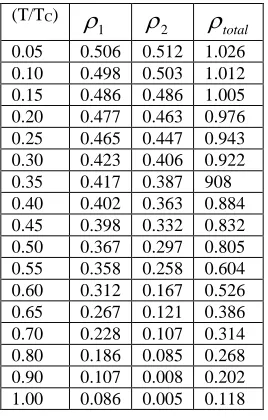
2 as a function of reduced temperature (T/TC) for two multi gap superconductors MgB2and V3Si. The results are shown in table T1 to T6. In Table T1, we have shown an evaluated results of super fluid density as a function of reduced temperature (T/TC) for zero inter band coupling
12
0,
11
0.50,
22
0.45
and
n
1
n
2
0.50,
0.50
.Our theoretical results indicate that both
1 for superconducting gap
1 and
2 for superconducting gap
2 decreases as a function of (T/TC). Similar is the finding for
total. In Table T2, we repeated the calculation for other fitting parameters
12
0.01
,11
0.5,
220.45
,n
1
n
2
0.5,
0.5
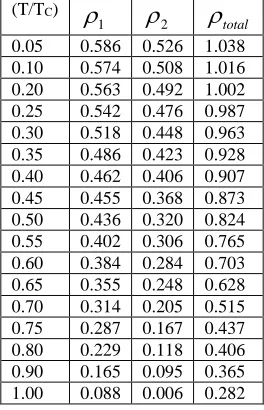
. In this case also similar trend were observed. In Table T3, we repeated the calculation for MgB2 single crystal by taking the fitting parameters12
0.06
,
11
0.23,
22
0.08
andn
1
n
2
0.44,
0.56
. Here again both1
,
2,
total
decrease with (T/TC). In table T3, we have repeated the calculation for MgB2 single crystal by keeping the fitting parameters11
0.23,
220.08,
120.06,
n
1n
20.44,
0.56
.Here also
1, 2, decreases with (T/TC). In table T4, we have repeated the calculations fortemperature dependent energy gap parameters
1and
2 along with the single gap s-wave.The fitting parameters are the same as table T3. Here again both
1 and
2 and single s-wavedecrease with (T/TC). However the value of
1 is larger than
2 and the value of
1is even larger than single gap s-wave. In table T5, we repeated the calculation for multi gap superconductor V3Si. Here we have kept the parameters5
11 0.10, 22 0.10, 12 1 10 ,x n1 n2 0.47, 0.4
.Here, again
1,
2,and
decrease with (T/TC). In table T6, we have repeated the calculationsfor temperature dependent energy gap parameters
1,
2 and BCS . We have used the samefitting parameters as given in table T5. Here also both
1,
2 and BCS decrease withTable T1
An evaluated results of super fluid density as a function of reduced temperature (T/TC) for zero
inter band coupling
12
0,
11
0.50,
22
0.45
andn
1
n
2
0.50,
0.50
.(T/TC) 1
2 Total
0.05 0.516 0.507 1.032 0.10 0.508 0.486 1.002 0.15 0.497 0.462 0.987 0.20 0.488 0.433 0.825 0.30 0.480 0.405 0.786 0.35 0.478 0.384 0.622 0.40 0.465 0.325 0.538 0.45 0.422 0.213 0.486 0.50 0.406 0.164 0.402 0.55 0.383 0.105 0.367 0.60 0.354 0.086 0.295 0.70 0.304 0.050 0.186 0.80 0.276 0.012 0.102 0.90 0.152 0.006 0.076 0.95 0.148 0.003 0.024Table T2
An evaluated results of super fluid density as a function of reduced temperature (T/TC). The fitting
parameters are
12
0.01
,
11
0.50
,
22
0.45
andn
1
n
2
0.5,
0.5
(T/TC) 1
2
totalTable T3
An evaluated results of super fluid density for MgB2 single crystal as a function of reduced
temperature (T/TC) keeping
12
0.06
,
11
0.23
,
22
0.08
and n1 =n2 =0.44 and
0.56(T/TC) 1
2
total0.05 0.586 0.526 1.038 0.10 0.574 0.508 1.016 0.20 0.563 0.492 1.002 0.25 0.542 0.476 0.987 0.30 0.518 0.448 0.963 0.35 0.486 0.423 0.928 0.40 0.462 0.406 0.907 0.45 0.455 0.368 0.873 0.50 0.436 0.320 0.824 0.55 0.402 0.306 0.765 0.60 0.384 0.284 0.703 0.65 0.355 0.248 0.628 0.70 0.314 0.205 0.515 0.75 0.287 0.167 0.437 0.80 0.229 0.118 0.406 0.90 0.165 0.095 0.365 1.00 0.088 0.006 0.282
Table T4
An evaluated results of temperature dependent gaps
1 and
2 for MgB2 as a function ofreduced temperature (T/TC). The fitting parameters are
12
0.06
,
11
0.23
,
22
0.08
and n1 =n2 =0.44 and
0.56.(T/TC) 1
Table T5
An evaluated results of super fluid density for V3Si single crystal as a function of reduced
temperature (T/TC) The fitting parameters are
121 10x 5,
11
0.10
,
22
0.10
, n1=n2=0.47 and
0.4.(T/TC) 1
2
total0.05 0.586 0.492 1.026 0.10 0.522 0.480 1.006 0.20 0.507 0.462 0.935 0.25 0.468 0.432 0.826 0.30 0.415 0.374 0.745 0.40 0.368 0.263 0.634 0.50 0.322 0.214 0.516 0.60 0.265 0.167 0.422 0.70 0.208 0.108 0.538 0.80 0.158 0.053 0.232 0.90 0.109 0.007 0.136 1.00 0.086 0.000 0.005
Table T6
An evaluated result of temperature dependent energy gaps
1 and
2 for single crystal V3Si asa function of reduced temperature (T/TC). The fitting parameters are
11
0.10
22,5 12 1 10x
,
n
1
n
2
0.47,
0.4
.(T/TC) 1
2 BCS 0.05 1.326 1.768 1.546 0.10 1.302 1.702 1.423 0.20 1.284 1.622 1.329 0.30 1.126 1.543 1.108 0.40 0.987 1.428 0.956 0.50 0.904 1.357 0.818 0.60 0.808 1.274 0.706 0.70 0.675 0.859 0.617 0.80 0.432 0.743 0.508 0.90 0.328 0.526 0.422 1.00 0.125 0.208 0.246 1.10 0.007 0.008 0.006CONCLUSION
From above theoretical investigations and analysis, we have come across the following conclusions;
(2) Our theoretical results indicate that both
1 for
1 and
2 for
2 along with
decrease with (T/TC) for both the superconductors.(3) We repeated the calculations of
1,
2 and
for single crystal MgB2 and V3Si superconductors for taking different parameters and in this case also all
1,
2,
decrease with (T/TC)(4) We repeated the calculation for temperature dependent energy gap parameters
1 for
1,2
for
2 and single gap s-wave parameters for both the superconductors. Our theoretical results indicate that
1,
2,
and s-wave gap decrease with (T/TC). These theoretical results are in accordance with The BCS theory.(5) Our theoretical results for super fluid density and temperature dependent energy gap parameters are based on the penetration depth measurements. This calculation also reflects that G. Eilenberger theoretical formulation which is quite old (1968) works quite well in the study of physical properties of multi- gap superconductors.
REFERENCES
1. M. E. Jones and R. E. Marsh, ‘Formation of MgB2 phase with interaction of Mg and amorphous B’ J. Am. Chem. Soc. 76, 870 (1953).
2. V. Russell, R. Hirst, F. A. Kanada and A. J. King, “Review of the superconducting properties of MgB2” Appl. Phys. Lett. 23, 480 (1973).
3. C. Buzea and T. Yamashita, “ Superconducting critical fields around anisotropy of a MgB2 single crystal” Supercond. Sci. Technol. 14, R115 (2001).
4. M. I. Eremets, V. V. Struzhkin, H. K. Mao and R. J. Hemely, “Superconductivity of Boron” Science 293, 272 (2001).
5. J. Nagamatsu, N. Nakagawa, T.Muranaka and J. Akimitsu, ‘Superconductivity at 39K magnesium diboride” Nature 410, 63 (2001).
6. R Zeyer and G. Zwicknagi, ‘Strongly correlated electron system and high TC superconductivity’ Z. Phys. B78, 175 (1990).
7. F. Bouquet, Y, Wang, R. A. Fischer, D.G. Hinks and N. E. Phillips, ‘Phenomenological two gap model for specific heat of MgB2.
8. E. J. Nical and J.P. Carbotte, ‘Properties of the superconducting state in a two-band model’
Phys. Rev. B71, 054501 (2005).
9. V. G. Kogan, C. Martin and R. Prozorov, ‘Superfluid density and specific heat within a self consistent scheme for two-band model’ Phys. Rev. B 80, 014507 (2009).
10. G. Eilenberger, ‘Transformation of Gorkov’s equation for type II superconductor’ Z. Phys. A214, 195 (1968).
12. L. Fang, H. Luo, P.cheng and Z. Wang, ‘Momentum resolved superconducting behaviour of iron based superconductors.’ Phys. Rev. B80, 140508 (2009).
13. H. Kim, R. T. Gordon, J. Hua and R. Prozorov, ‘Role of multiband effects and electron-hole symmetry in the two-band superconductivity.’ Phys. Rev. B82, 060518(R) (2010). 14. C. Martin, H. Kim, R. T. Gordon and R. Prozorov, ‘Local measurement of the penetration
depth in the pnictide high TC superconductors.’ Supercond. Sci. Technol. 23, 065022 (2010).
15. E. Babaev, J. Carlstrom and M. Speight, ‘ Multigap superconductors can lead to qualitative change in the superconducting state’ Phys. Rev. Lett. (PRL) 105, 067003 (2010).
16. J. Carlstrom, J. Garaud and E. Babaev, ‘Type 1.5 superconductivity in multiband system: Effect of interband transition’ Phys. Rev.B84, 134515 (2011).
17. G. Guard, J. Carlstrom and E. Babaev, ‘Topological solitons in three band superconductors with broken symmetry, Phys. Rev. Lett; (PRL) 107, 197001 (2011).
18. Multigap and anisotropic superconductors beyond MgB2’ https;//www.rep-publishing company, May `18 (2012).
19. Cryomagnetic Scanning tunnelling spectroscopy study of multigap superconductors’ https://archjev.org/details (arxiv-1110.644) sept 23 (2013).
20. H. Asia, ‘Two-dimensional microscopic quantum tunnelling in nultigap superconductor’ (2014).
21. Isotopic multigap superconductivity in BaFe1,9Pf0.1As2 from thermal transport and spectroscopic measurement’ Supercond. Sci Technol 28, 014004 (2015).