Volume 2, Issue 4, 2015
98 Available online at www.ijiere.com
International Journal of Innovative and Emerging
Research in Engineering
e-ISSN: 2394 - 3343 p-ISSN: 2394 - 5494
Studies on Development of Refining process for Biodiesel
(FAME) using Membrane
Prof. M.K.Ahire
a, Dr.V.S.Sapkal
a, Dr.R.S.Sapkal
aa U.D.C.T. Amravati ,Maharashtra,India.
ABSTRACT:
In this study Ultrafiltration polyethersulphone spiral wound membrane module were used separately to refine crude biodiesel containing glycerol and unreacted oil. The membrane module were operated at permissible range of pressure . The permeate is collected and analyzed for composition and physical parameters such as density and kinematic viscosity, calorific value and flash point are investigated .The quality of biodiesel obtained through ultrafiltration membrane module is compatible with diesel and meet all requirements as compared to commercial grade biodiesel available in market.
Keywords: Biodiesel , transesterification , membrane.
I. INTRODUCTION
Biodiesel is a renewable fuel that consists of fatty acid methyl ester currently produced by transesterification of triglycerides with methanol. After biodiesel synthesis the downstream processing steps involve the purification of crude biodiesel, as well as separation of excess methanol (recyclable), glycerol as by product. The separation of ternary mixture methanol-water-glycerol is carried out in a conventional direct sequence that requires two distillation column[2,7]. For refining a biodiesel of production capacity 20 Litre/hr the energy cost is 15 Rs/hr, whereas in present work refining using membrane technology such as ultra filtration, the cost of same production is reduce to 2/3rd of the conventional process with enhanced refinement and saving in the energy and water for water washing and decreasing NOx removal as our process removes the unreacted oil, glycerol and soap.
A. Biodiesel
Biodiesel, which usually refers to fatty acid methyl esters, is notable environmentally friendly alternative fuel for diesel engines. It is commonly produced at commercial scale by alkali-catalyzed transesterification of vegetable oil and animal fats with methanol. Once produced, the mixture of fatty acid methyl esters (crude biodiesel) should be purified to comply with the specifications prescribed by the corresponding biodiesel standard such as EN 14214 or ASTM D6751[5]. The downstream purification steps are needed to remove various impurities (unconverted triacylglycerols, monoacylglycerols, diacylglycerols, free fatty acids, glycerol, water, catalyst, soaps and others) from crude biodiesel to prevent a significant damage of diesel engines. Therefore, these processing steps are among the most important ones for commercial biodiesel production. In the present work, the methods for purification of crude biodiesel produced by alkali-transesterification is processed for purification and quality improvement through various membrane operations such as ultrafiltration and are compared with the support of G.C. analysis.
B. General Biodiesel production process
Volume 2, Issue 4, 2015
99 (MG) as intermediate products. Biodiesel is being used increasingly in public transportation in Europe, Japan and North America.
Due to diminishing petroleum reserves and the environmental consequences of exhaust gases from petroleum derived fuels, such as gasoline and diesel, biodiesel has attracted attention during the past two decade as a renewable and environmentally friendly fuel. Because biodiesel is made entirely from vegetable oil or animal fats, it is renewable, environmentally benign (biodegradable), and does not contain any sulphur, aromatic hydrocarbons, metals or crude oil residues. Like petroleum diesel, biodiesel operates in compression– ignition engines such as those used in farm equipment, and private and commercial vehicles. Essentially no engine modifications are required, and biodiesel maintains the payload capacity and range of diesel. Because biodiesel is oxygenated, it is a better lubricant than diesel fuel, increasing the life of engines, and is combusted more completely[3]. Indeed, many countries are introducing biodiesel blends to replace the lubricating effect of sulfur compounds in low-sulfur diesel fuels the higher flash point of biodiesel makes it a safer fuel to use, handle and store. With its relatively low emission profile, it is an ideal fuel for use.
C. Advantages and Disadvantages of biodiesel [3] Advantages of biodiesel fuel
Biodiesel fuel is a renewable energy source unlike petroleum-based diesel.
An excessive production of soybeans in the world makes it an economic way to utilize this surplus for manufacturing the Biodiesel fuel.
One of the main biodiesel fuel advantages is that it is less polluting than petroleum diesel.
The lack of sulfur in 100% biodiesel extends the life of catalytic converters.
Another of the advantages of biodiesel fuel is that it can also be blended with other energy resources.
Biodiesel fuel can also be used in existing oil heating systems and diesel engines without making any alterations.
It can also be distributed through existing diesel fuel pumps, which is another biodiesel fuel advantage over other alternative fuels.
The lubricating property of the biodiesel may lengthen the lifetime of engines.
Disadvantages of biodiesel fuel
At present, Biodiesel fuel is more expensive than petroleum diesel fuel.
It requires energy to produce biodiesel fuel from soya crops, plus there is the energy of sowing, fertilizing and harvesting.
Another biodiesel fuel disadvantage is that it can harm rubber hoses in some engines.
As Biodiesel cleans the dirt from the engine, this dirt can then get collected in the fuel filter, thus clogging it. So, filters have to be changed after the first several hours of biodiesel use.
Biodiesel fuel distribution infrastructure needs improvement, which is another of the biodiesel fuel disadvantages.
Biodiesel requires further refining to stabilize and use as a fuel in motor vehicles.
D. Comparison between biodiesel and diesel
Table : 1 Comparison between Biodiesel and diesel
Parameters Diesel Biodiesel
Cetane number 45 60
Carbon residue 0.35% 0.002%
Flash point(°C ) 60 145
Sulphur 05 Nil
Biodegradable No Yes
O2 Nil 10%
Aromatics 5% Nil
Lubricity 2000-5000 7000
II. OBJECTIVE OF RESEARCH WORK
Volume 2, Issue 4, 2015
100 A. Crude biodiesel
The crude biodiesel about 80 liter at the cost of 50 Rs for refining purpose was purchased from KMT AGRO processing LTD, village Hingane ,district Satara , Maharashtra. The process of making biodiesel is summarized as follows. Company purchase non edible type of oil from open market. The proportion of oil to methanol to acid is calculated on the basis of initial acid value. Normally the acid value of oil is around 150. 8000 liter oil is taken in C.S.T.R. and it is heated at 100- 102 °C to remove moisture . Then on cooling up to 60 °C 15-25 liter H2SO4 is added to keep pH at 4 to 4.5 . During addition stirring is allowed and temperature is maintain at 57°C to add 1400 liter of methanol is added with stirring at 1500 rpm. The reaction last for 6 to 7 Hr. During reaction methanol is recycled by total condenser as it is more volatile and simultaneously acid value and density of reaction mixture is checked to understand completion of reaction. When acid value and density reach to 5-10 and 880 kg / m3 respectly the stirring is stopped and reaction mixture is allowed to cool . Then reaction mixture is transferred to settaling tank for another 6 Hr for separating glycerol from biodiesel.
Figure 1. Site photo KMT Agro processing
B. Conventional refining technology and challenges
Density difference between biodiesel and glycerol allow us to take out glycerol from bottom of settaling tank. The biodiesel so obtain till contain unreacted oil, catalyst , methanol , glycerol , soap if formed .It means there is a margin to refine such biodiesel .As biodiesel is immiscible in water so warm water washing of biodiesel is done to remove catalyst[4] . Then biodiesel is either processed through thin film evaporator or distillation to refine it and obtain pure biodiesel. Such refining is accomplishing with the help of energy input and requires about 15 Rs per hour as energy cost. The major challenge in such refining is energy input for energy output and demand for huge investment for infrastructure.
C. Proposed membrane technology
The major problem in refining of biodiesel is energy used in thin film evaporator and distillation, whereas membrane module work at lower energy input.
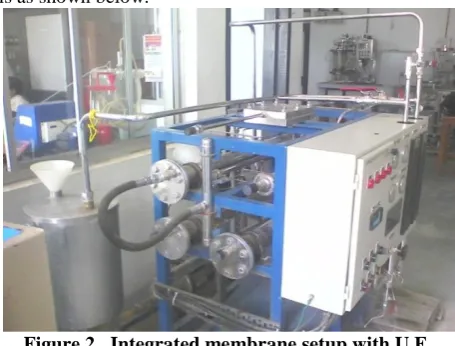
The setup for biodiesel refining is as shown below.
Figure 2. Integrated membrane setup with U.F.
D. Refining using ultrafiltration process
Volume 2, Issue 4, 2015
101 Table 2. Analysis of feed biodiesel
Unreacted oil
Glycerol Biodiesel Density kg/m3
Kinematic viscosity mm2/sec 9.4426 26.3476 64.2098 0.87694 8.18
The crude biodiesel is passed through ultrafiltration polyethersulphone spiral wound membrane module with surface area 1.75cm2 with transmembrane pressure of 100psi and Feed rate of 10LPM. Permeate and reject are collected in separate container and permeate is analyzed using Gas chromatography. The results are as shown .
Table 3. Observation Table Sr
No.
Run Batch
Volume
Pi Po Pt QP Qr Vp Vr
Ultra Filtration Litre Kg/cm2 Kg/cm2 Kg/cm2 LPM LPM Litre Litre
1 UF1 15 7 1 4 2 10 9 6
2 UF2 12 5 0.5 2.75 0.5 11 5 7
3 UF3 12 6 0.5 3.25 0.5 11 5.5 6.5
Table 4. Calculation table no.1 Sr
No.
Unreacted Oil V %
Glycerol V%
Biodiesel V %
Density of Permeate
(Kg/L)
Redwood Viscometer
No.1(sec)
Kinematic Viscosity (mm2/sec)
UF1 2.6296 0.8614 96.509 0.8621 42.1 6.6942
UF2 3.3172 1.0389 95.6439 0.8634 42.5 6.8382
UF3 2.9546 1.0654 95.9800 0.8634 42.2 6.7302
All the composition are analysed by G.C at 200°C
Table 5. Calculation table no.2 Sr
No.
Oil Rejected % Glycerol Rejected% Biodiesel Rejected % Biodiesel Processed %
UF1 83.29 85.78 39.31 60.68
UF2 86 90.34 53.7 46.30
UF3 85.65 86.87 50.65 49.34
E. Results and discussion
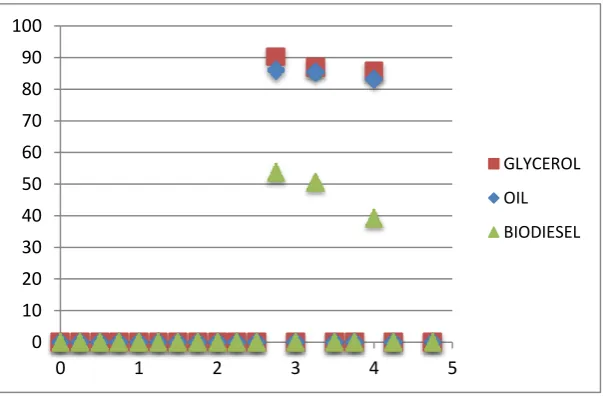
The permeate coming out of ultrafiltration module are collected and analyzed for the purity and performance analysis. The results are as follows :
% Reject Vs Transmembrane Pressure 0
10 20 30 40 50 60 70 80 90 100
0 1 2 3 4 5
GLYCEROL
OIL
Volume 2, Issue 4, 2015
102 Above results clearly tells us the effectiveness of membrane technology where glycerol and unreacted oil are successfully removed through crude biodiesel .Effectiveness of ultrafiltration is addressed. Refining efficiency of ultrafiltration is high. There is a tremendous decrease in kinematic viscosity [8]and density of a biodiesel as shown in table no : 2,3,4.
CONCLUSIONS
The purification of biodiesel (FAME ) from non edible oil – methanol – catalyst reaction mixture poses some important challenges in production of biodiesel . This work has demonstrated that membrane technology can be effective path for refining of crude biodiesel with removal of one major step in conventional process of removing glycerol by allowing it for settling. In present work the study of ultrafiltration was performed with a rigid conclusion to recommend ultrafiltration as a technique to refine crude biodiesel at minimum operating pressure and minimum cost of operation. Moreover biodiesel obtain from such setup has compatible kinematic viscosity and density as compared to diesel. Thus ultrafiltration of crude biodiesel using polyethersulphone spiral wound membrane module is recommended to obtain higher grade refined biodiesel with minimum cost of refining.
ACKNOWLEDGMENT
I first author sincerely thanks to Dr. V.S.Sapkal (Head , U.D.C.T. Amravati ) and Dr. R.S.Sapkal (U.D.C.T. Amravati ) for their support and continuous guidance and also thanks to all supporting staff for their guidance and assistance.
REFERENCES
[1] I.M.Atadashi , M.K. Aroua , A.R. Abdul Aziz , N.M.N. Sulaiman , “ High quality biodiesel obtained through membrane technology”, Journal of membrane science: pg 154-64 , 24 July 2012 .
[2] Anton A. Kiss , Radu M. Ignat , “Enhanced methanol recovery and glycerol separation in biodiesel production – DWC make it happen”, Elsevier applied energy vol.99 pg. 146-153 , 2012.
[3] G.B.Shinde,Dr.V.S.Sapkal, Dr.V.S.Sapkal,Dr.N.B.Raut, “Transesterification by reactive distillation for characterization and synthesis of biodiesel”,NTSI-Nanotech 2009,vol-3,2009.
[4] J.M.Marchetti , V.U. Miguel , A.F.Errazu , “ Possible methods for biodiesel production” , Elsevier , rser 11 , pg 1300-1311 , 2007.
[5] M.A.Dube , A.Y.Tremblay, J.Liu , “Biodiesel production using a membrane reactor” , Bioresource technology Vol (98) pg 639-647, 2007.
[6] Wall J, Van Gerpen J, Thompson J. “Soap and glycerin removal from biodiesel using waterless processes”. Trans ASABE 2011;54:535–41
[7] Ivan J. Stojkovic, Olivera S. Stamenkovic, Dragan S. Povrenovic, Vlada B. Veljkovic, “purification technologies for crude biodisesl obtained by alkali – catalysed transesterification”, Renewable and Sustainable Energy Reviews 32 ,pg 1-15,2014.
[8] Babagana Gutti, Shittu S. Bamidele and Idris M. Bugaje , “Biodiesel Kinematics Viscosity Analysis of Balanite Aegyptiaca seed oil” ARPN Journal of Engineering and Applied Sciences ( April 2012 )