Changing the Climate of Beliefs:
A Conceptual Model of Learning Design Elements to Promote
Climate Change Literacy
Katrina Leona Marzetta, PhD
University of Colorado Denver [email protected] [email protected]
Abstract
Climate change is a difficult subject to teach because it requires complex scientific
understandings and is connected to personal beliefs (Spence, Poortinga & Pidgeon, 2012). It is important to teach students the science of climate change and impact their personal beliefs to produce behavior that will mitigate climate change. In this study pre and post surveys focusing on climate change understanding, belief, and behavior were administered. Interviews were also conducted. The quantitative and qualitative data were conflicting, but through triangulated data analysis learning design elements promoting Climate Change Literacy in higher education were identified. A conceptual model was developed with the learning design elements to improve the teaching of Climate Change Literacy. Findings depicted three design elements that increase students’ Climate Change Literacy: 1) Decreasing students’ psychological distance from climate change, 2) Utilizing students’ sense of place, and 3) Student investigation of their own research questions. Increasing students’ Climate Change Literacy is the critical first step in making sustainable societal transformations required for mitigating climate change, our most pressing environmental issue that impacts all people and the natural environment (Spence, Poortinga, & Pidgeon, 2012).
Introduction and Literature Review
The purpose of this study is to develop a conceptual model that depicts learning design elements that promote Climate Change Literacy in higher education that will help support sustainability in all its aspects (environmental, social/cultural, and economic). The question that guides this pilot study is: What learning design elements are suited for the promotion of Climate Change Literacy in higher education and do these design elements inform the development of a conceptual model to improve the teaching of Climate Change Literacy?
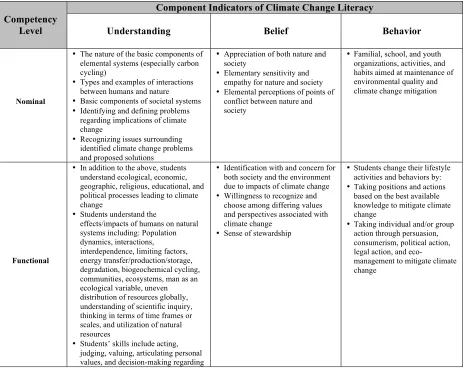
This study proposes that Climate Change Literacy is part of Environmental Literacy, which includes the key components of climate change understanding, beliefs, and behavior to mitigate climate change. It is imperative for students to be Climate Change Literate to make important decisions that stem from or impact climate change and sustainability. Table 1 summarizes the indicators of each competency level for the three components of Climate Change Literacy (understanding, belief, and behavior) adapted from Roth (1992).
Table 1. Competency level indicators for the three components of Climate Change Literacy (modified from Roth, 1992, p. 27-34).
Competency Level
Component Indicators of Climate Change Literacy
Understanding Belief Behavior
Nominal
• The nature of the basic components of
elemental systems (especially carbon cycling)
• Types and examples of interactions
between humans and nature
• Basic components of societal systems
• Identifying and defining problems
regarding implications of climate change
• Recognizing issues surrounding
identified climate change problems and proposed solutions
• Appreciation of both nature and
society
• Elementary sensitivity and
empathy for nature and society
• Elemental perceptions of points of
conflict between nature and society
• Familial, school, and youth
organizations, activities, and habits aimed at maintenance of environmental quality and climate change mitigation
Functional
• In addition to the above, students
understand ecological, economic, geographic, religious, educational, and political processes leading to climate change
• Students understand the
effects/impacts of humans on natural systems including: Population dynamics, interactions, interdependence, limiting factors, energy transfer/production/storage, degradation, biogeochemical cycling, communities, ecosystems, man as an ecological variable, uneven distribution of resources globally, understanding of scientific inquiry, thinking in terms of time frames or scales, and utilization of natural resources
• Students’ skills include acting,
judging, valuing, articulating personal values, and decision-making regarding
• Identification with and concern for
both society and the environment due to impacts of climate change
• Willingness to recognize and
choose among differing values and perspectives associated with climate change
• Sense of stewardship
• Students change their lifestyle
activities and behaviors by:
• Taking positions and actions
based on the best available knowledge to mitigate climate change
• Taking individual and/or group
action through persuasion, consumerism, political action, legal action, and
climate change influences and impacts
Competency Level
Component Indicators of Climate Change Literacy Understanding (continued) Belief (continued) Behavior (continued) Operational
• In addition to the above, students are
involved with evaluating issues on the basis of available evidence and personal values/skills used in planning, implementing, and evaluating solutions for climate change including:
• Using the process skills of scientific
inquiry, using the ability to forecast, to think ahead, and plan
• Imagining, connecting, valuing, and
analyzing
• Using primary and secondary sources
of information
• Using the ability to separate fact from
opinion
• Determining the roles played by
differing human beliefs and values in climate change
• Students show affects, attitudes,
values that esteem nature and
society
• Students demonstrate a sense of
investment and responsibility for the resolution of climate change
• Motivation to actively participate
in environmental improvement and protection
• Take into account historical
perspectives while focusing on current and future climate change causes and consequences
• Taking personal responsibility:
recognizes impacts of personal behavior and accepts personal responsibility for climate change impacts
• Willingness to help correct or
avoid the negative impacts of climate change
• Balancing love of nature with love
of humanity
• Willingness to curtail some
individual short-term privileges for long range public and environmental good
• Perceptual movement from:
present to future, society to humanity, isolated phenomena to interacting systems
• Personal environmental ethics
• Respects diversity of human
perceptions, learning styles, and value systems
• Students’ action demonstrate
leadership in working toward resolution of climate change problems including:
• Evaluating their impact on
quality of life and environment
• Actively reducing their carbon
footprint and helping those around them to do the same
• Working to maintain biological
and social diversity
• Continually examining and
reexamining the values of culture
• Making decisions based on
beneficence, justice, stewardship, prudence, cooperation, and compassion to mitigate climate change
Significance
Students entering higher education institutions will be required to make complex decisions about climate change mitigation and will need to do so from an informed perspective. “Erroneous” understandings regarding climate change issues are a real concern due to the significant impacts of climate change on sustainability (Wachholz, Artz, & Chene, 2012). Thus, “higher education needs to expand its efforts to ensure all university graduates understand the scientific consensus about climate change and are actively engaged as part of the solution in their public and private roles” (Wachholz, Artz, & Chene, 2012, p. 138). Simply, university graduates need to be Climate Change Literate, no matter their vocational pursuits, to promote sustainability. Yet this is not occurring.
Wachholz, Arts, and Chene (2012) surveyed 375 students representing a cross-section of
disciplines at a mid-sized university in New England, and their results were disconcerting. Most students held misinformation about the basic causes and consequences of climate change, especially surrounding the ozone hole. In fact, the majority of students surveyed were not aware Earth is already experiencing the consequences of climate change: One in three students
occurring (Wachholz, Arts, & Chene, 2012). These findings most likely represent students’ exposure to manufactured controversies produced by media, interest groups, and politicians who are funded by the fossil fuel industry (Wachholz, Arts, & Chene, 2012). Most concerning was students’ lack of personal action to reduce gas emissions—only 15 percent were attempting to reduce their carbon footprint (Wachholz, Arts, & Chene, 2012). These results tie into Crona, Wutich, Brewis, and Gartin’s (2013) research, which correlates higher education with higher income and lower involvement in rural economies and/or direct extraction of natural resources. Those with higher education tend to have a lower sense of personal risk towards the effects of climate change due to their lack of direct experience with it. Another possible reason for
students’ lack of action to mitigate climate change is their belief that it is not an ethical problem (Markowitz, 2012). This may stem from students’ conviction that current climate change is not human induced.
As indicated by these studies, climate change is a difficult subject to teach—especially if understanding and initiation of mitigation behavior are learning outcomes. Understanding climate change requires the comprehension of complex scientific concepts like the carbon cycle, atmospheric circulation, as well as regional and temporal variations in weather versus climate. It is also difficult to teach climate change because personal beliefs enter the scientific conversation (Li, Johnson, & Zaval, 2011; Markowitz, 2012; Spence, Poortinga, & Pidgeon, 2012; Wachholz, Arts, & Chene, 2012). Additionally, students may have psychological distance to climate change, which can be explained by Construal Level Theory (CLT) developed by Liberman and Trope (2008). CLT outlines four key dimensions of psychological distance: spatial or geographical distance; temporal distance; distance between the perceiver and others; as well as uncertainty that an event will occur. Psychologically distant events are abstract, high-level constructs composed of general decontextualized features (Spence, Poortinga, & Pidgeon, 2012). Students often perceive climate change as distant in all CLT dimensions.
Science educators must also understand the strong link between understanding and belief. It is possible to understand something, but not believe in it. This leads students to understand the science behind climate change, but not “believe” in climate change. Thus, students do not change their behaviors to mitigate climate change even though they may score well on a climate change concept test. This is seen in the research of Nam and Ito (2011) as well as Rule and Meyer (2009). In fact, students may develop their “belief” in climate change before their scientific understanding. This may make it difficult for students to comprehend or accept the science of climate change, as it does not support what students think they already know. Kahan (2015, p. 12) confirms: “To say there is “no relationship” between science comprehension and belief in climate change would definitely be incorrect. There is a very large one. But the nature of it depends on the [individuals’] identities”.
conceptual ecology, will influence the selection of a new central concept” and the behavior that accompanies it (Posner, Strike, Hewson, & Gertzog, 1982, p. 215). Conceptual ecology was defined by Posner, Strike, Hewson, & Gertzog (1982, p. 214) as “an individual’s current
concepts”. In this study I extended the term conceptual ecology to represent students’ knowledge and experiences that lead to their current science understanding, beliefs, and behavior. Therefore, ecology represents not only students’ mental conceptions, but also the physical space where educative experiences take place.
Literature on students’ climate change understanding, beliefs, and behavior (i.e., Climate Change Literacy) has focused on primary and secondary education (Wachholz, Artz, & Chene, 2012). The research on post-secondary students tends to be over a decade old, narrowly focused on climate change facts, and does not examine the impact of different teaching methods on students’ climate change understanding, beliefs, or behavior. Therefore, there is a pressing need for
science education research that examines students’ beliefs and behaviors along with their understanding due to the severity of climate change as a human induced environmental risk. Students must understand the scientific consensus around climate change and be actively engaged in an answer to promote sustainability. Consequently, science educators must understand what learning design elements are suited for the promotion of Climate Change Literacy.
Teaching Climate Change Literacy
The hypothesis of this study is based on the assertion that, when students are taught controversial and confusing science concepts (such as climate change) where accommodation (Piaget, 1968) is required, their conceptual ecology is not often utilized. As a result, students do not fully
accommodate the information. Thus, students’ beliefs are frequently unchanged, so their behavior does not reflect the new science concepts they are taught and their Climate Change Literacy does not increase. This study design asserts that accommodation is more likely to occur when students generate their own questions created from their conceptual ecology and research the answers. Accommodation is more likely to occur in these circumstances because such research experiences create the cognitive dissonance (Festinger, 1962) required for students to find dissatisfaction with their existing science conceptions as discussed by Posner, Strike, Hewson, & Gertzog (1982). Lastly, when students learn by generating their own questions and answers created from their conceptual ecology, they decrease the psychological distance between them and the concept as suggested by Construal Level Theory. Therefore, students are more likely to change their beliefs and behavior to align with their new conceptual accommodation. This would promote the development of students’ Climate Change Literacy, which is
psychologically distant for many students.
Experiential and Place-based Education are both philosophies and methods that teach through action directly tied to students’ understanding and beliefs through experiences (their conceptual ecology). Consequently, they may inform the specific learning design elements that promote Climate Change Literacy. Experiential Education (ExEd) is defined as “education … that makes conscious application of the students' experiences by integrating them into the curriculum where experience involves any combination of senses, emotions…, physical condition…, and
connections to places where place refers not only to a physical location, but the relationships and meanings that learners attach to places (Gruenewald, 2003; Sobel, 2004). Learners use these different place attachments, their sense of place, to comprehend concepts. PbEd validates different ways of knowing the world through inclusive curriculum and instruction. Due to ExEd and PbEd’s cultivation of students’ emotions and experiences to impact their beliefs, behavior, and understanding these teaching methods hold promise for evoking true transformation in students.
Methods
This mixed methods study is the pilot research to investigate what design elements promote Climate Change Literacy to inform the design of a conceptual model for a future course. The research took place in a sustainable urban agriculture field course at a public, urban Western university. As such, the students enrolled in the course were from urban and rural backgrounds (62% and 38%, respectively). The field course was conducted at an urban farm and included guest speakers with related hands-on activities. The course culminated with each student
completing an independent research project to evaluate and improve current planning at the farm. A complex sequence of ExEd/PbEd activities was designed with the intended outcome of
changing students’ understanding and dispositions.
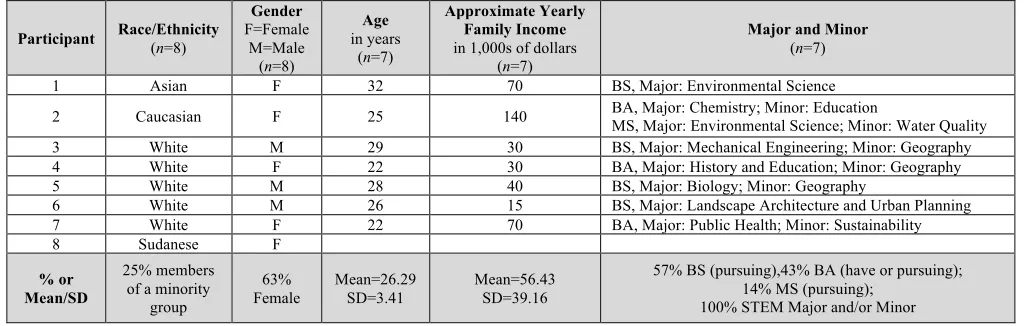
This study examined the research question by measuring the growth (if any) of students’ Climate Change Literacy as well as examining why shifts do or do not occur in students’ climate change beliefs and/or behavior. This course was selected because it was a primarily undergraduate course (Table 2) that employed true ExEd/PbEd and involved the causes and consequences of climate change.
Table 2. Participants’ self-reported demographics and descriptive statistics.
Participant Race/Ethnicity (n=8)
Gender F=Female
M=Male (n=8)
Age in years
(n=7)
Approximate Yearly Family Income in 1,000s of dollars
(n=7)
Major and Minor (n=7)
1 Asian F 32 70 BS, Major: Environmental Science
2 Caucasian F 25 140 BA, Major: Chemistry; Minor: Education MS, Major: Environmental Science; Minor: Water Quality
3 White M 29 30 BS, Major: Mechanical Engineering; Minor: Geography
4 White F 22 30 BA, Major: History and Education; Minor: Geography
5 White M 28 40 BS, Major: Biology; Minor: Geography
6 White M 26 15 BS, Major: Landscape Architecture and Urban Planning
7 White F 22 70 BA, Major: Public Health; Minor: Sustainability
8 Sudanese F
% or Mean/SD
25% members of a minority
group
63% Female
Mean=26.29 SD=3.41
Mean=56.43 SD=39.16
57% BS (pursuing),43% BA (have or pursuing); 14% MS (pursuing);
100% STEM Major and/or Minor
Quantitative Data Instruments and Collection
A pre and post Climate Change Beliefs and Behavior Survey (CCBBS) was administered at the beginning and end of the course. The pre/post CCBBS determined any change in students’ perception of their climate change understanding as well as their beliefs and behavior
10 open items. The surveys compiled for the CCBBS included the climate change understanding, beliefs, and behavior student survey by Wachholz, Artz, and Chene (2012) as well as climate change causes, ethics, and beliefs survey by Markowitz (2012). The CCBBS took approximately 15 minutes to complete.
To determine if ExEd/PbEd impacted students’ climate change understanding, a pre and post climate change concept test (CCCT) was administered. The CCCT was a combination of the 2011 carbon cycle concept inventory (Hartley et al., 2011), climate change cultural conceptual questions by Crona, Wutich, Brewis, and Gartin (2013), as well as the climate change causes, ethics, and beliefs survey by Markowitz (2012). Information from the National Science Teachers Association (NSTA) and Carnegie Mellon University (Hassol, 2002) were also utilized to
develop questions. Questions were selected or created that would demonstrate students’ climate change understanding, especially focusing on common alternative conceptions based on
misinformation. These resources have been found reliable and valid to demonstrate student climate change understanding by their respective authors.
Qualitative Data Instruments/Collection
Qualitative data included the open response CCBBS items and in-person participant interviews. This helped construct case studies to examine possible reasons why (or why not) students shifted their beliefs and/or behavior. The interviews lasted ~30 minutes and were conducted with two consenting participants. Interview topics included the participants’ course experiences, their climate change understanding, and their belief/behavior surrounding climate change mitigation.
Pilot Study Results
CCBBS and CCCT Closed Items
When the CCBBS was analyzed, the Wilcoxon signed-rank test indicated there was not a
statistically significant difference between pre and post responses on the closed-response survey questions where p < 0.05. This quantitative analysis, therefore, did not support use of the design elements facilitated by ExEd and PbEd to promote students’ Climate Change Literacy. However, the qualitative analyses of the CCBBS’ open-ended responses told a very different story thus illustrating the importance of utilizing a mixed methods approach.
No statistically significant increase was found in participants’ overall score between pre and post CCCT where p < 0.05. However, after taking the course, participants were more aware of local flooding and its connection to climate change, reflected in the post survey responses and
CCBBS Open Items
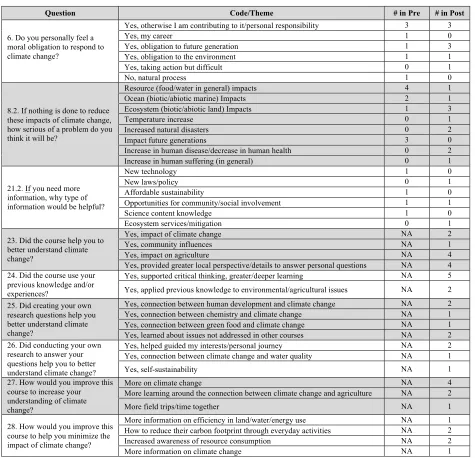
Open response survey items were analyzed using coding in relation to the research question, as described in Table 3. First, priori codes based on the research question were used for the deductive comparison. The second round of constant comparison analysis was performed using inductive techniques where themes and patterns relating to the research purposes were allowed to emerge (Patton, 2002). Summary of key findings are listed below.
• Q. 6: In the post survey, four participants acknowledged taking action to mitigate climate change is a difficult endeavor, but felt obligated to do so for future generations. This realization reflected an increase from functional to operational Climate Change Literacy.
• Q. 8.2: Students’ understanding and beliefs surrounding the consequences of global climate change shifted from isolated ecosystem impacts (i.e., water shortage) to how systems work together (i.e., how water shortage leads to disease). This illustrates a functional to operational shift in Climate Change Literacy.
• Q. 21.2: Participants demonstrated a shift from self-preservation to environmental preservation/sustainability.
• Q. 23: All participants that responded to this question (n=6) agreed the course assisted them in deepening their climate change understanding.
• Q. 24: For seven participants, their understandings and beliefs shifted to a higher level of Climate Change Literacy, but radical accommodation was not seen as participants were already expressing functional Climate Change Literacy. Yet, one participant did experience a radical accommodation shifting from believing climate change was a natural process to understanding it is an anthropomorphically induced issue. (This is discussed in the Case Studies section).
• Q. 25/26: When participants created their own research question and investigated the answer, participants’ spatial, temporal, and social distance to climate change
decreased. This assisted participants in reaching higher levels of Climate Change Literacy, which is in agreement with CLT (Liberman & Trope, 2008).
Table 3. Coding of pre/post CCBBS open responses. (Not all students responded; some responses contained multiple codes; “NA” represents questions not posed in the pre survey because they were not applicable and/or relevant.)
Case Studies
The pre/post CCBBS and CCCT gave a snap shot into the participants’ understanding, beliefs, and behavior, but did not capture why. This was where the interviews were utilized to triangulate the findings. Participant Three was interviewed to further examine why he dramatically shifted his understanding/beliefs regarding human induced climate change and his moral obligation to respond to it. Participant One was interviewed to further examine why she did not shift her understand/beliefs regarding human induced climate change and her moral obligation to respond to it.
Question Code/Theme # in Pre # in Post
6. Do you personally feel a moral obligation to respond to climate change?
Yes, otherwise I am contributing to it/personal responsibility 3 3
Yes, my career 1 0
Yes, obligation to future generation 1 3
Yes, obligation to the environment 1 1
Yes, taking action but difficult 0 1
No, natural process 1 0
8.2. If nothing is done to reduce these impacts of climate change, how serious of a problem do you think it will be?
Resource (food/water in general) impacts 4 1
Ocean (biotic/abiotic marine) Impacts 2 1
Ecosystem (biotic/abiotic land) Impacts 1 3
Temperature increase 0 1
Increased natural disasters 0 2
Impact future generations 3 0
Increase in human disease/decrease in human health 0 2
Increase in human suffering (in general) 0 1
21.2. If you need more information, why type of information would be helpful?
New technology 1 0
New laws/policy 0 1
Affordable sustainability 1 0
Opportunities for community/social involvement 1 1
Science content knowledge 1 0
Ecosystem services/mitigation 0 1
23. Did the course help you to better understand climate change?
Yes, impact of climate change NA 2
Yes, community influences NA 1
Yes, impact on agriculture NA 4
Yes, provided greater local perspective/details to answer personal questions NA 4
24. Did the course use your previous knowledge and/or experiences?
Yes, supported critical thinking, greater/deeper learning NA 5
Yes, applied previous knowledge to environmental/agricultural issues NA 2
25. Did creating your own research questions help you better understand climate change?
Yes, connection between human development and climate change NA 2
Yes, connection between chemistry and climate change NA 1
Yes, connection between green food and climate change NA 1
Yes, learned about issues not addressed in other courses NA 2
26. Did conducting your own research to answer your questions help you to better understand climate change?
Yes, helped guided my interests/personal journey NA 2
Yes, connection between climate change and water quality NA 1
Yes, self-sustainability NA 1
27. How would you improve this course to increase your understanding of climate change?
More on climate change NA 4
More learning around the connection between climate change and agriculture NA 2
More field trips/time together NA 1
28. How would you improve this course to help you minimize the impact of climate change?
More information on efficiency in land/water/energy use NA 1
How to reduce their carbon footprint through everyday activities NA 2
Increased awareness of resource consumption NA 2
Case Study One
Participant Three grew up on a chicken farm and later enlisted in the armed forces where he served as a meteorologist. He acknowledged his ideas about climate change were shaped by his work in meteorology and the policies of the military:
…in a lot of [those] meteorologists’ minds climate change is make believe. We’re just going through a natural warming cycle on the Earth and eventually we will go through a cooling phase…
Yet, why did Participant Three’s ideas about climate change shift? The participant was adamant it was first-hand evidence that changed his mind regarding human’s role in climate change because he could see it:
There is actually something going on that’s not Earth related—it’s caused by humans… In class you see it first-hand. You get
experiences and actually talk to professionals… whether it be conservation easements to being a state engineer or seeing how our water ways have changed in the past twenty years—especially since our population has increased… For me, at least, hands-on being outside [is important]. I’m a very visual learner. If I can see it, I can learn it. If I’m in a classroom with a white board I go to sleep mentally. You don’t get to have the same types of
conversations—you don’t know the questions to ask ‘till you see it. It’s more “I tell you what you need to know and write it down” and then you’re going to be tested on it. Some people just don’t learn that way…To see the trash in the water, the fertilizer [runoff]… You can see how bad that water is.
For Participant Three, seeing was believing. Yet, did believing impact his behaviors? For this participant the answer was, “yes”—first starting small, then higher sustainability goals:
I don’t use aerosols any more, which is a good thing. I try to use as little electricity as possible. We leave our lights off when we’re not in the room. Try to only run the wash machine one time a week … I talk with my wife about what we want to do in five years to reduce our carbon footprint. ... What do we want our grandkids’ world to be? We point out observations [to our children] — “see all the trash that’s here? We need to do our part to keep the
environment as pristine as possible. Either recycle it or compost it” ... [Eventually] we want to take mass transport … or … community vehicles … [which] reduces a lot of our carbon footprint.
both can be together… So [I] will keep talking and maybe they will hear me”. This demonstrates Participant Three’s increased Climate Change Literacy as he is “taking individual action through persuasion, political action, and eco-management to mitigate climate change.” Indeed,
Participant Three’s dramatic shift in climate change understanding and behavior precipitated a shift in behavior to mitigating climate change and promoting sustainability.
Participant Three was then asked if PbEd was essential for learning about difficult and
controversial subjects. He first responded negatively but went on to talk about the importance of a sense of place and application of knowledge:
The closer you are to where you learn, the more you care about it… But if you can uproot what you learned to anywhere you live, it [the learning] goes with you there to that place. You have to be able to apply it [the learning]. If you can’t apply it, then that would be a negative—for you and where you live.
According to Participant Three, the more connected to where you learn, the more you care about the learning. If you can apply your learning to where you live, the learning keeps living and growing, which is beneficial for the participant and community. This is connected to the participant’s sense of place, which is essential to PbEd.
Case Study Two
While Participant One did not share a great deal of personal background, she did give insights into her thinking and behavior surrounding climate change:
I’ve always loved the environment and knew we needed to protect it. That hasn’t changed. I’ve always known about climate change and knew it was real and caused by us. I’ve tried to help the environment too … Now I know a lot more ways I can help, so I do more.
Other than having a deeper understanding of climate change and doing more to mitigate it, Participant One was questioned on what else transformed within her climate change
understanding and/or beliefs. Her answer was indicative of operational Climate Change Literacy: “Student shows affects, attitudes, and values that indicate a valuation of both nature and society”.
The health of the environment will only get worse because there will be less and less clean water, food, and air. Because of that there will be more chronic and acute human diseases. This course made all the environmental information more connected to people—it started me thinking about the connection between climate change and human development. I use to be all negative about people—you know—they’re all bad, make bad choices. But now I understand people more. I care about people and the
Even though Participant One did not have a dramatic increase from pre to post CCBBS or CCCT scores, she discussed significant shifts in her Climate Change Literacy by valuing both humans and the environment. Participant One also increased her behavior in climate change mitigation activities, but was much more critical of herself so this was not reflected in her post CCBBS:
I garden organically now and teach my friends about it. I watch what I buy even more carefully. But I feel bad about driving so much—there’s no good public transportation in a lot of areas. I could do better though.
Lastly, Participant One made certain to credit the “field” nature of the course for her increased climate change awareness: “The course put to work my previous knowledge and applied it to issues around land, water, agriculture and the environment at the farm. I could see the plants growing and the goats eating the weeds. I helped do that!” Participant One ended with a lament about the course not counting as a science credit:
The course isn’t counted as a science credit for me—I think it’s an elective. I don’t know why. I learned so much in that class that I didn’t learn in my lecture classes. We need more courses like the one at the farm.
This reinforces participants’ desire for experiential courses and the conflict that ExEd and PbEd often experiences within the science discipline.
Discussion/Conclusions
Limitations
Due to the very low course enrollment and consequential use of non-parametric tests, the results of this study are not generalizable. Additionally, there may have been other factors such as a ceiling effect due to high pre scores that masked any changes in Climate Change Literacy with the selected instruments. Since participants elected to enroll in this course, they may have already had an interest in environmental sustainability, increasing the probability of a ceiling effect. Furthermore, participants’ demographics for this study were very similar as all were either STEM major or minors and all were between 22 to 32 years of age. Only 25 percent of
participants were members of a minority group and 63 percent identified as female. These
demographics were not representative of the university as a whole. The participant demographics may have impacted the outcome of this study by predisposing participants to certain
Connecting Literature to the Pilot Study
Crona, Wutich, Brewis, and Gartin’s (2013) research correlates higher education with a lower sense of personal risk towards the effects of climate change due to students’ lack of direct
experience with it. When students have a direct experience with the impacts of climate change, it increases their sense of personal risk and thus increases their Climate Change Literacy.
Essentially students are decreasing their psychological distance (Liberman & Trope, 2008) to climate change. Therefore, students are acknowledging climate change has a direct and
immediate impact on them. It appears first-hand experience that ties to students’ sense of place is even more impactful than accessing their conceptual ecology. This was observed when this study was compared to the findings of Rule and Meyer (2009) as well as Nam and Ito (2011).
Furthermore, when participants researched their own questions they increased their Climate Change Literacy though accessing their sense of place. These questions stemmed from their cognitive dissonance the course planted in participants through learning design elements initiated and supported by ExEd and PbEd. An example of participants’ research questions was
investigating if organic produce is truly better for human health as well as why organics are priced much higher than non-organics that need more pesticides and fertilizers.
Experiential and Place-based Education are both excellent teaching methods for promoting learning design elements that help students accommodate difficult and often controversial science concepts. However, students’ conceptual ecology is also important to address through each approach. Thus, students’ conceptual ecology can positively impact their understanding, beliefs, and behavior surrounding climate change and its mitigation to promote sustainability. This can be seen in the conceptual shift of Participant Three documented in his interview.
Conceptual Model
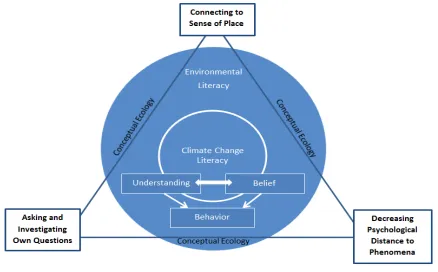
Through Experiential and Place-based Education, three vital design elements were fostered to help students accommodate new climate change understanding, beliefs, and mitigation behavior. By utilizing these design elements, this pilot study suggests students can increase their Climate Change Literacy. As the learning design elements that support Climate Change Literacy emerged from the results, a conceptual model formed (Figure 1). Since there are no existing models that discuss learning design elements to increase students’ Climate Change Literacy, the importance of this pilot study’s conceptual model is substantial. The design elements have been discussed by other researchers, but not linked to each another or in relation to Climate Change Literacy.
Figure 1. Learning Design Elements for Promoting Climate Change Literacy (Marzetta, 2016).
This conceptual model could be further operationalized for the course in this study by students utilizing their research to create/implement a plan in their community to reduce its carbon footprint. This would connect to students’ sense of place and decrease their psychological distance to climate change, as they would be acknowledging its existence where they live. Students would also exercise their conceptual ecology to access previous experiences in their community. Additionally, this project would help students become agents of ecological change as it promotes sustainability in students’ lives and communities. Yet this educational model does require guidance from the instructor to prevent students from being distracted or overwhelmed.
Developing students’ Climate Change Literacy is the critical first step in societal transformations required for mitigating climate change, our most pressing environmental issue that impacts all people and the natural environment (Spence, Poortinga, & Pidgeon, 2012). However, this study’s conceptual model has potential beyond course design for teaching Climate Change Literacy or Environmental Literacy. This study’s conceptual model is a new teaching model for science educators who must instruct students on topics that are conceptually difficult and controversial (like climate change). This is due to the model’s learning design elements that can be applied to any topic. Furthermore, there is potential for this conceptual model to be generalized across different disciplines (e.g. geography, life science, social studies, history, etc.), just as ExEd and PbEd can be used as teaching methods in any academic field. The conceptual model is so diverse because its learning design elements are successful at inducing students’ conceptual and
elements attach to what students already know and feel (their conceptual ecology and sense of place) as well as connect students to new understandings presented in a course. This makes attachments for students in both their head and heart.
Next Steps
Due to this pilot study’s preliminary evidence (as observed with Participant One), further investigation is warranted to determine if the learning design elements illustrated in the
conceptual model can truly increase students’ Climate Change Literacy and sustainability efforts. Thus, studies involving larger enrollment courses where climate change is an objective should be conducted to provide a stronger empirical test of my conceptual model. Results could be further generalized if participants are representative of a diverse student population, including those outside of STEM majors and minors representing a mix of undergraduate and graduate students. Such a study could also measure students’ climate change learning gains and increases in
Climate Change Literacy to help determine the accuracy of the conceptual model. Additionally, the impact of students’ Climate Change Literacy on their vocational goals (especially in
agriculture and the fossil fuel industry) could be studied to provide further insight into the conceptual model’s effectiveness. Secondly, it is important to note this study demonstrated the need for mixed methods and how qualitative data can inform the quantitative results through triangulation and thus lead to more accurate findings. Thus, any follow-up study should also be conducted through mixed methods.
Moreover, a conversation needs to be initiated in post-secondary education about the benefits of utilizing Experiential and Place-based Science Education. ExEd and PbEd promote
Environmental Literacy by supporting specific learning design elements that increase students’ cognitive gains and affective growth. By developing students’ emotionality and cognitive
growth, ExEd and PbEd opens science to all students. Climate Change Literacy is imperative for every student because science holds a uniquely powerful place in our society.
Understanding science that impacts our present and future is imperative for making critical life choices that promote sustainability. Thus, it is essential that educators teach Climate Change Literacy and Environmental Literacy through educational experiences that are accessible—both conceptually and emotionally—to all students.
Acknowledgements
References
Barton, A. C. (2008). Urban science education: A commitment to equity, social justice, and a sense of place. Studies in Science Education, 38(1), 1-37.
Campbell, D. T., & Stanley, J. C. (1963). Experimental and quasi-experimental designs for research on teaching. In N. L. Gage (Ed.), Handbook of research on teaching (pp. 171– 246). Chicago, IL: Rand McNally.
Carver, R. (2008). Theory of practice: a framework for thinking about experiential education. Journal of Experiential Education, 19(1), 8-13.
Crona, Wutich, Brewis, & Gartin. (2013). Perceptions of climate change: Linking local and global perceptions through a cultural knowledge approach. Climatic Change, 119(2), 519-531.
Festinger, L. (1962). Cognitive dissonance. Scientific American, 207(4), 93-107.
Gruenewald, D. (2003). Foundations of place: a multidisciplinary framework for place-conscious education. American Educational Research Journal, 40(3), 619-654.
Hartley, L., Wilke, B., Schramm, J., D’Avanzo, C. & Anderson, C. (2011). College students’ understanding of the carbon cycle: Contrasting principle-based and informal reasoning. Bioscience, 61(1), 65-75.
Hassol, S. J. (2002). Teachers Guide to High Quality Educational Materials on Climate Change and Global Warming: Top 10 Things You Need to Know About Global Warming. Center for Integrated Study of the Human Dimensions of Global Change, Department of
Engineering and Public Policy Carnegie Mellon University & the National Science Teachers Association. Retrieved from
http://hdgc.epp.cmu.edu/teachersguide/teachersguide.htm
Kahan, D. M. (2015) Climate-Science Communication and the Measurement Problem. Advances in Political Psychology, 36, 1-43.
Liberman N, Trope Y. (2008). The psychology of transcending the here and now. Science, 21(322),1201–1205.
Li, Y., Johnson, E. J., & Zaval, L. (2011). Local warming: Daily temperature change influences belief in global warming. Psychological Science, 22(4), 454-459.
Markowitz, E. M. (2012). Is climate change an ethical issue? Examining young adults’ beliefs about climate and morality. Climatic Change, 114(3), 479-495.
Nam, Y. & Ito, E. (2011). A climate change course for undergraduate students. Journal of Geoscience Education, 59, 229-241.
Patton, M. Q. (2002). Qualitative Research & Evaluation Methods, 3rd ed. Thousand Oaks, CA: Sage.
Piaget, J. (1968). Six Psychological Studies. Anita Tenzer (trans.). New York, NY: Vintage Books
Posner, G., Strike, K., Hewson, P., & Gertzog, W. (1982). Accommodation of a scientific conception: Toward a theory of conceptual change. Science Education, 66(2), 211-227. Roth, C. E. (1992). Environmental literacy: Its roots, evolution, and directions in the 1990s.
Columbus, OH: ERIC Clearinghouse for Science, Mathematics, and Environmental Education.
Shen, W., Yuan, Y., Liu, C., & Luo, J. (2015). In search of the “aha!” experience: Elucidating the emotionality of insight problem-solving. British Journal of Psychology, 107(2), 281-298.
Sobel, D. (2004). Place-based education: Connecting classrooms & communities. Great Barrington, MA: The Orion Society.
Spence, A., Poortinga, W. and Pidgeon, N. (2012). The psychological distance of climate change. Risk Analysis, 32, 957–972.
Wachholz, S., Artz, N., & Chene, D., (2012). Warming to the idea: university students'
Katrina Leona Marzetta, PhD