Iranian Chemical Society
Anal. Bioanal. Chem. Res., Vol. 6, No. 2, 253-269, December 2019.
Recent Advances in Microextraction Methods for Sampling and Analysis of Volatile
Organic Compounds in Air: A Review
Ali Poormohammadi
a, Abdolrahman Bahramy
b,* and Balendu Shekher Giri
b aCenter of Excellence for Occupational Health, Research Center for Health Sciences, School of Public Health, Hamadan University of Medical Sciences, Hamadan, Iran
b
Department of Chemical Engineering & Technology, Indian Institute of Technology (BHU), Varanasi 221005, India (Received 18 November 2018 Accepted 26 January 2019)
Human exposures to volatile organic compounds (VOCs) are associated with a wide range of health problems. Due to the adverse effects of VOCs on the human health, determination of trace levels of VOCs is very important for accurate assessment of indoor and
outdoor exposure. Solid phase microextraction (SPME), needle trap device (NTD), and hollow fiber-liquid phase microextraction (HF-LPME) are increasingly used for accurate determination of VOCs in air. In this paper, authors have reviewed new developed forms of
SPME, NTD and LPME techniques for the sampling and analysis of VOCs in air with a main focus on SPME coating fibers and NTD
sorbents. The effects of some environmental and device parameters on SPME and NTD samplers are also reviewed. Moreover, several analytical parameters such as carryover effect, storage time, limit of detection (LOD) and limit of quantitation (LOQ) of these new technologies are discussed. Finally, the applicability, limitations and future trends of these methods are reviewed.
Keywords: Volatile organic compounds (VOC), Solid phase microextraction (SPME), Needle trap device (NTD), Air
INTRODUCTION
Volatile organic compounds (VOCs) are among the major indoor and outdoor pollutants. VOCs and their degradative products are considered as important agents in the epidemiology of respiratory disorders and various types of cancers [1,2]. Nowadays, the presence of these compounds at workplaces has become as a major concern for many scientists worldwide. VOCs are globally used in many products, such as solvents, cleaning and degreasing agents, polymerization, blowing agents, and disinfecting agents. The products containing VOCs can release them into the air when they are used and stored [3,4]. Because of their high vapor pressure, they can be easily released into the environment and workplace. Previous studies have defined several definitions for VOCs [5,6]. Generally, VOCs can be defined by two following definitions: in the
*Corresponding author. E-mail: [email protected]
knowledge, there is no review focusing on the new advances of microextraction methods for sampling and analysis of VOCs in air. Therefore, with respect to the previous reviews on the SPME applications for detecting VOCs in air, the main objective of this article is to review
all of the new developed technologies for the sampling and analysis of VOCs in air [9,11]. Main literature sources in this study consist of published articles on developed technologies for the sampling and analysis of VOCs in air.
AIR SAMPLING AND ANALYSIS OF VOCS
Sampling and analysis of analyte are the most important steps for detecting analyte of interest in the matrix samples. In recent years, several studies have been conducted to develop new technologies for measuring VOCs from air in trace analysis [7,12-14]. Sampling of VOCs can be carried out by active or passive methods. The passive methods are used for sampling the indoor and outdoor air pollutants in trace analysis. Due to the fact that the passive methods are easy to use and handle and require cheap instruments, there has been growing interest in the use of them for the assessment of occupational exposures at low concentrations [14]. It should be noted that these methods are only suitable for long-term sampling periods and they are less commonly used to quantify indoor pollutants [15,16]. While active sampling methods can be used for short-term periods. Passive badges, canisters, sorbent traps, active samplers and diffusive samplers are commonly used for sampling the
VOCs in air [16,17]. According to the NIOSH 1501 method, adsorbent tube and GC-FID have been recommended for the sampling and analysis of VOCs in workplaces [18]. Moreover, the use of containers and GC-MS has been also recommended by the USEPA for outdoor determination of VOCs [19]. Most of the previous conventional methods are based on drawing air through a sorbent or impinger trap followed by a solvent desorption process and injecting the solvent into the detective device to detect the extracted analytes. These sampling methods have many disadvantages such as low sensitivity, costly, non-reusable and solvent requirements [20]. In this regard, the development of new technologies is necessary to overcome the disadvantages of previous methods.
NEW DEVELOPED TECHNOLOGIES FOR
SAMPLING AND ANALYSIS OF VOCS
Solid-phase Microextraction (SPME)
important for selecting an appropriate fiber in SPME method, such as porosity, thickness, and polarity [31]. SPME sampling can be performed by attaining equilibrium of analyte between the matrix and a stationary phase, and it is not based on the complete extraction. After equilibrium, by increasing the contact time, further extraction does not occur. SPME sampling can also be performed under non-equilibrium conditions, which is classified into two exposed and retracted modes for sampling. In the retracted mode, the SPME technique is applied as a Time Weighted Average (TWA) sampler [15].
In recent years, different types of SPME have been developed such as fiber introduction mass spectrometry
(FIMS) in which a portable mass spectrometer is used along with SMPE for detecting trace levels of VOCs in air [9], and derivatization techniques occurring in the coating SPME fiber or in the injector port of analyzer for increasing the extraction efficiency and limit of detection (LOD) [32]. Moreover, Mangani et al., introduced a new technique of SPME for the determination of HVOCs in air after sampling by steel containers. In this method, the output of the sampler is connected to the GC inlet with a packed column. The SPME fiber is inserted into the GC injection port [33].
Needle Trap Device (NTD)
Needle trap device (NTD) is also one of the novel
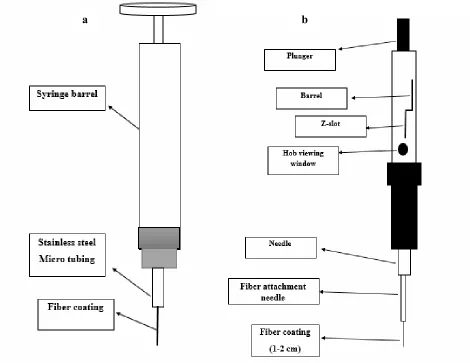
Fig. 1. Schematic diagram of SPME device: (a) Customized SPME device (the first form of SPME based on Hamilton syringe), (b) Conventional or commercial SPME device.
extraction methods that its first principal was introduced by Qin et al., [34]. In the NTD method, a syringe needle packed with charcoal adsorbent was used for sampling and analysis of methanol, ethanol, acetone and pentane in breath air (Fig. 2). Then, the needle was placed in the gas chromatograph injector to desorb the adsorbed analytes [34]. This technique was also introduced by Koziel et al., in 2001 as a simple, environmental friendly, user friendly, small, inexpensive and solvent-less method. In the mentioned study, both NTD and SPME were used for measuring air born particulate matter and aerosol. They combined the concept of both active and passive methods with newly created microextraction methods [29]. NTD is a combination of the concepts of liquid phase microextraction
(LPME), SPME and sorbent tube. In NTD, sorbent particles are protected inside a steel needle, which makes it more robust technique than SPME. This technique is based on the microextraction of analytes using a small gauge needle packed with sorbents demonstrating a high sensitivity compared to the conventional extraction methods. Its high sensitivity is attributed to high enrichment into small volume of solid extraction phase [35]. In this method, direct desorption occurs by inserting the needle inside the GC/GC-MS port. NTD has very important advantages over SPME, such as lack of fragile fiber, inexpensive device and high sorption capacity [36,37]. Also, in SPME method, a tiny volume of analyte is extracted in comparison to the matrix volume, which requires complex calibration and careful
Fig. 2. Schematic diagram of NTD(* in recent studies on NTD applications glass wool is successfully used to keep the sorbent fixed).
development [38]. NTD can be applied for both active and passive sampling and its capacity increases with the increase of sorbent quantity [37]. Its high capability for using as an active sampler can reduce the sampling time compared to SPME. A NTD packed with an appropriate and strong sorbent can also be used as a passive TWA sampler. Recent studies have reported that NTD coupled with GC-MS device acts as a sensitive technology for quantitative on-site analysis of VOCs [39]. It has also been reported that the relatively low amount of sorbent inside needle can cause the breakthrough volume in the air volume range 10-100 ml. For this reason, the design parameters of NTD must be carefully optimized to prevent occurring breakthrough and analyte loss during sampling [40]. Within research activities on NTD application, different methods have been suggested for packing sorbent inside the NTD. Most of the packing methods are based on a general rule that involves placing a 1.5 cm sorbent from the tip of the steel needle and fixing the sorbent using a holder such as glass wool (as can be seen in Fig. 2) [7,12,37]. In passive sampling, diffusion is the only mechanism for transporting analyte to the extraction phase [41]. In addition, NTD can act as a filter for trapping particulate material in the matrix [42]. Four mechanisms have a major role in the collection of particles from air streams including interception, inertial impaction, diffusion and gravitational settling. However, the effect of gravitational settling is negligible in comparison with other mentioned mechanisms [43]. Previous studies have investigated the effects of some fundamental parameters on the performance of NTD, such as packing density, sorbent type, sorbent size, air temperature, air velocity, air relative humidity, storage time, carryover effect, and desorption time [7,37,44]. In a fundamental study conducted by Lord et al., it was found that the effects of sorbent type and high retention time are more important on NTD performance than those of the particle size, sorbent amount and sorbent density [38]. In the present review, the effects of some environmental and device parameters on the performance of SPME and NTD are discussed.
Hollow Fiber-liquid Phase Microextraction
(HF-LPME)
Liquid-liquid extraction (LLE) as a solvent extraction method is commonly used as a classical and common
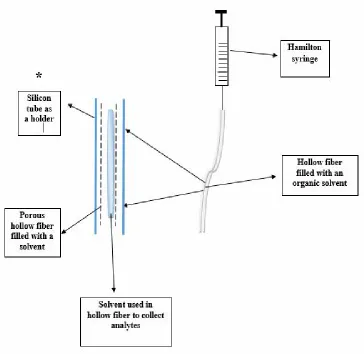
only for aqueous samples, and to our knowledge, no previous studies have been undertaken to use the application of these techniques for sampling the analytes from air. HF-LPME as one of the LPME techniques is used as a miniature and novel method for simultaneous sampling and pre-concentration of organic pollutants from various matrices [51]. The HF-LPME was first introduced by Pedersen-Bjergaard and Rasmussen [52]. In this method, a suitable organic solvent fills the HF pores to allow the HF to absorb the analytes from air. Polypropylene is usually used as HF membrane in the HF-LPME technique. Meanwhile, various solvents can be applied in this method to develop its application for sampling the different compounds [53]. Overall structure and schematics of HF-LPME is shown in Fig. 3. There have been few studies on
the use of LPME for the sampling and analysis of VOCs in air. Most of the previous studies have focused on the use of LPME for sampling and pre-concentration of analytes from aqueous samples [54,55]. In some previous studies, HF-LPME has been successfully applied for the sampling and analysis of various VOCs from water samples [53-55]. A recent study reported that HF-LPME with hydrochloric acid (0.1%) as the solvent could efficiently be used for TWA determination of 1,1-dimethylhydrazine (UDMH) in air followed by spectrophotometric analysis [56].
FIBER/SORBENT TYPE
Various fibers and sorbents are used in SPME and NTD for sampling and analysis of different analytes from air
Fig. 3. Schematic diagram of HP-LPME (*A recent study has used silicon tube as a holder).
samples. A variety of materials have been used in SPME and NTD as fibers and sorbents, respectively. PDMS belongs to a group of polymeric organ silicon compounds widely used as the solid phase in SPME method. The efficiency of PDMS along with other materials for the determination of VOCs has been extensively investigated [29,57]. Nowadays, several types of coating fibers are commercially available, such as PDMS, Carboxen/PDMS and PDMS/Divinylbenzene (PDMS/DVB) [13-15]. Despite all benefits of these coating fibers, they suffer from several drawbacks such as instability at high temperature and high cost. For example, thermal stability of PDMS is lower than 300 °C. In addition to these commercial coatings fibers, different synthesized fibers have been studied in SPME such as nano-tubes of carbon and graphene [58,59], cobalt and zinc oxide nano-particles [60], and molecular imprinted polymers [61]. In this case, the nano-tubes of carbon and graphene revealed many inherent advantages like high surface area, high thermal stability and long lifetime [59]. Earlier studies revealed that PDMS/DVB coatings are more efficient in the sampling of VOCs over other common fibers [62]. The use of tetra-quinoxaline cavitand functionalized with methylenoxy bridges at the upper rim as solid phase in SPME method showed very low LOD (0.4-1.2 ng m-3) for sampling and analysis of BTEX compounds from air samples [63]. This new proposed coating fiber in SPME method also showed a good repeatability and sensitively for the sampling and analysis of BTEX compounds in air. Also, SPME coated with CAR/PDMS in the retracted mode can successfully be applied as a TWA sampler for occupational exposure assessments [64]. Under the retracted mode, SPME coated with CAR-PDMS is also suited for TWA determination of epichlorohydrin from air [15]. In this mode, SPME can be used as a passive sampler and the analyte concentration on the SPME samples are calculated according to the fallowing equation:
C t
L A D
N g
where, N indicates the amount of analyte adsorbed on the SPME fiber (ng), Dg is diffusion coefficient of gas phase or sampling rate, which could be obtained theatrically based on Fuller et al., study, cm2 s-1, A is diffusion area (cm2), L is
diffusion path length (cm), and C and t are analyte concentration (ng cm-3) and sampling time (min),
respectively [15,65].
In recent uses of SPME, nano-materials were used as the coating fibers for the sampling and analysis of various compounds in air [14,66]. Due to the high surface area of carbon nanotube, SPME coated with single and multi-walled carbon nanotubes might be a good option for sampling and analysis of a wide range of VOCs. Single and multi-walled carbon nanotube/silica composite fiber synthesized by sol-gel technology could increase the performance of SPME method for the determination of VOCs [66].
The use of sol-gel method as a new technique is used for synthesizing new sorbents with a high surface area [67]. In recent years, this technique has been also examined for the preparation of new and various types of fibers in SPME [68, 69]. Several operational parameters should be considered in the synthesis of new SPME fibers through sol-gel technique, such as thickness, surface area, solvability, stability, polarity, absorption capacity, and absorption rate [14]. Single and multi-walled carbon nanotube/silica composite fiber synthesized by sol-gel technologies are suited for measuring HVOCs compounds in air with a high extraction efficiency and sensitive analysis. The application of these new advanced fibers allows the quantification of the trace level of HVOCs in air (with LOD range of 0.09-0.2) [14,66].
Table 1. A Summary of New Developed Techniques for Sampling and Analysis of VOCs in Air
Microextraction
device
Analyte Fiber/sorbent
Detection
device
LOD* LOQ* Precision LDR* Ref.*
1 SPME
BTEX in indoor air at
environmental levels
CAR HRGC-FID 0.4-2 mg m-3 -
6.6-12.8%
- [72]
2 SPME
aldehydes in exhaled
breath of patients with
lung cancer
PDMS/DVB GC-MS 1 × 10-12 M
3 × 10-12
M
7.2-15.1%
3.3-333.3
× 10-12 M [73]
3 SPME
volatile and
semi-volatile pollutants
PDMS GC-MS
1.3-273.9
ng l-1
4.3-913
ng ml-1
5.6-15.2
ng ml-1
1-100
ng ml-1
[74]
4 SPME
Airborne Particulate
Matter and Aerosols in
diesel exhaust air
PDMS GC/MS - - - - [29]
5 SPME
PAHS in atmospheric
particulate matter
PDMS GC-MS 5-20 pg - - - [57]
6 SPME
aldehydes in human
breath
PDMS/DVB GC-MS 0.01-0.03 nM
0.02-0.10
nM
9-24%
0.002-20
nM
[75]
7 SPME Sinus mucus volatiles
DVB/CAR/P
DMS
Stableflex
GC-MS
- - - - [76]
9 SPME Epichlorohydrin CAR/PDMS GC-MS 0.8 ng - 6.9% - [15]
10 SPME
Halothane, isoflurane,
and sevoflurane in
operating room air.
CAR/PDMS GC-MS 4.2-5.1 ppb 2.2-7.4% - [64]
11 SPME
perchlorethylene
in dry cleaning
CAR/PDMS GC–MS 0.08 ng 8.9% [77]
12 SPME
VOCs (Benzene,
ketones and aldehydes)
in human exhaled breath
vapor
NPAA fiber GC-MS
0.7 and 3.4
ng l-1 1.8-14% 0.005-40
ng ml-1
[78]
13 SPME BTEX
Cavitand-coated
GC-MS 0.4-1.2
ng m-3
1.1-2.9
ng m-3
0.4-1.2
Table 1. Continued
14 SPME
Carbontetrachloride,
Benzotrichloride,
Chloromethyl methyl ether
and Trichloroethylene in
air
CAR/PDMS GC-MS
0.09-0.2
ng ml-1 0.25-0.7
ng ml-1
0.1-100
ng ml-1 [14]
15 SPME
Perchloroethylene,
benzotrichloride,
chloromethyl methyl ether
and trichloroethylene
Single-walled carbon
nanotube/silica
composite fiber based
on sol-gel technology
GC-MS
0.11-0.2
ng ml-1
0.34 and 0.7
ng ml-1
1-100
ng ml-1
[79]
16 SPME carbon tetrachloride
Synthesized
multi-walled carbon
nanotube based on
sol-gel method
0.09
ng ml-1
0.21
ng ml-1
4-4.3%
1-100
ng ml-1
[66]
17 NTD
Methanol,
ethanol, acetone and
pentane in human breath
and in the
ambient air
Charcoal adsorbent
(trade name CNH
charcoal)
GC
< 0.1
nmol-1 [34]
18 NTD
C1–C10 aldehydes,
2-propenal and 2-butenal,
formaldehyde,
acetaldehyde, methanol,
ethanol,
methyl-1,3-butadiene, acetone,
propenal, acetonitrile,
butanone, benzene,
2-butenal, toluene,
chlorobenzene,
1,2-dimethylbenzene,
4,7,7-
trimethylbicyclohept-3-ene, 1,2-dichlorobenzene
and 1,2,4-trichlorobenzene
PDMS, DVB and
Carbopack X and
Carboxen 1000 and
single layer organic
polymer of
methacrylic acid
and ethylene glycol
dimethacrylate
GC-MS
In the range
of some
ng l-1
In the range
of some
ng l-1
0.27-961.5
ng l-1
In a recent NTD study, graphene and its nano-platelet silica composite prepared by sol-gel technique were used in NTD for the sampling and analysis of organo halogen compounds in air [37,71]. The NTD packed with graphene
nano-platelets and its silica composite showed a high sensitivity for determination of VOCs and HVOCs in air [70]. Also, single and multi-wall carbon nanotubes/silica composites prepared by sol-gel technique have been applied
Table 1. Continued
19 NTD
Carbon tetrachloride,
trichloroethylene, bis
(chloromethyl) ether
and chloromethyl methyl
ether in air
Single wall carbon
nanotubes sol-gel
sorbent
GC-MS
0.001-0.01
ng ml-1
0.007-0.03
ng ml-1
0.01-100
ng ml-1
[7]
20 NTD
Carbon tetrachloride,
trichloroethylene,bis
(chloromethyl) ether
and chloromethyl methyl
ether in air
Sol-gel derived, multi-walled carbon nanotubes/silica composite GC-MS 0.01-0.05
ng ml-1
0.039-
0.173
ng ml-1
0.01-100
ng ml-1 [12]
21 NTD
Perchloroethylene
in the air
Graphene GC-MS
0.023 and
0.25 ng ml-1
0.08
ng ml-1
0.01-70
ng ml-1
[37]
22 NTD Carbon tetrachloride in air
Graphene nanoplatelets silica composite, prepared by sol-gel GC-MS 0.021-0.25
ng ml-1
0.08-0.75
ng ml-1
0.01-80
ng ml-1 [71]
23 NTD BTEX compounds Carbotrap B GC-MS
0.03-0.04
ng ml-1
0.1-0.13
ng ml-1
4.3-13.3%
0.01-50
ng ml-1
[80]
24 NTD
vapor mercury in ambient
air
Gold wire GC-MS 0.23 ng ml-1 1.9-7.1% [81]
25 NTD Aromatic amines
Amberlite/silica
composite
GC-FID
0.01-0.02
ng ml-1
0.05-0.08
ng ml-1
0.60-12.15%
0.01-20
ng ml-1
[82] HF-LPME 1,1-dimethylhydrazine (UDMH) hydrochloric acid
(0.1 N) as solvent
Spectrophot
ometry
0.002
ng ml-1
0.006
ng ml-1
0.082-0.12
ng ml-1
- [56]
as efficient sorbents in NTD. In this case, the NTD packed with single and multi-wall carbon nanotubes/silica composites showed a higher efficiency over SPME CAR-PDMS fiber for sampling and analysis of HVOCs in air [7, 12].
EFFECT
OF
ENVIRONMENTAL
PARAMETERS
Environmental Temperature
The ambient temperature at the time of sampling is one of the important parameters affecting the absorption rate of the analyte on the fiber/adsorbent. In Koziel and Pawliszyn study, it was found that the change in sampling temperature is a main reason for obvious errors during sampling with SPME [83]. According to the Wang et al., theory (2009), the sampling rate of nonpolar VOC is correlated to T1.085. In this theory, any change in the ambient temperature at the sampling time from 25 °C and in the range ±10˚ can cause about 4% error in the final measured concentration [84,85]. In the use of HS-SPME method, temperature changes in the range 25-65 °C showed a dramatic effect on the area obtained by GC-MS device, and the strongest response was at 50 °C. The effect of environmental temperature on SPME coated with CAR/PDMS fiber in 0.5 retracted mode showed that there is no relationship between temperature changes (under 5 °C) and analyte adsorption rate. While, temperature changes more than 10 °C demonstrated a dramatic effect on the SPME performance [15,77,78]. Increasing sampling temperature from 30 to 50 °C showed an increase in the sampling efficiency of NPAA coated fibers in SPME. However, an obvious reduction was observed with increasing temperature over 50 °C [78]. The use of synthesized multi-walled carbon nanotube coating prepared by sol-gel method showed that the peak response decreased with increasing temperature sampling [14,64,66]. This decrease is attributed to the influence of temperature on the adsorption of analytes onto the coating fiber. Indeed, the vapor pressure of the analyte increases with increasing sampling temperature, and thereby its volatility increases. As a result, it has a negative effect on the analyte extraction efficiency. Similarly, in NTD sampling, an increase in the sampling temperature can cause an obvious decrease in the sampler efficiency [7,12,80]. In
the use of NTD packed with graphene/silica composite for the determination of perchloroethylene, the efficiency of the proposed sampler decreased with increasing sampling temperature. Comparison of the effect of sampling temperature between the SPME and NTD methods revealed that the increase in the sampling temperature reduces the efficiency of the both samplers, which this reduction in SPME is greater than that of NTD [37,71]. This may be attributed to the effect of the sampling temperature on the distribution equilibrium in SPME sampler.
Relative Humidity
particles. As a result, decreasing free sites on the sorbent surface and sticking of sorbent particles can clog the needle and, thereby, causes a pressure drop into the needle. The clogging causes a decrease in the amount of extracted analyte, subsequently reduces the peak area responses [7, 12,71].
Velocity
Air velocity is another environmental factor that can be effective on the sampling rate. The changes of air velocity in sampling sites can affect the sampling efficiency, especially in passive samplers such as SPME. Isetun et al., (2004) reported that in exposed mode of SPME, linear velocities higher than 7 cm s-1 do not have significant influence on the sampling efficiency [89]. In SPME coated with CAR/PDMS, the effect of air velocity in the range 0-0.5 m s-1 showed a significant influence on the sampler efficiency [15]. In another application of SPME, it was found that the air velocities higher than 0.1 m s-1 have no significant effect on the sampling efficiency [64]. This may be attributed to the inclinable role of boundary layer on mass transfer. In addition, in this process, passive diffusion is the limiting step. In retracted SPME, the effect of air velocity can be less than other passive samplers, due to its structure and aspect ratio of the fiber. In NTD, the effect of air velocity has not been studied yet.
EFFECT OF DEVICE PARAMETERS
Desorption Temperature
Desorption temperature has a key role in the sensitivity and reproducibility of the SPME and NTD methods. Desorption temperature should be selected based on the type of fiber/sorbent used and target analyte [37], because high desorption temperature has adverse effects on the fiber/sorbent and target analytes [15]. In the use of Cavitand-coated SPME, it was found that the desorption of aliphatic hydrocarbons occurs in the temperature range 50-100 °C, while the desorption of BTEX compounds occurs at 200 °C and the desorption operation can be completed at 250 °C [63]. This contradiction in the optimal desorption temperature concerns to the analyte type. In the development of SPME coated with Anodic alumina for the determination of VOCs in human exhaled breath vapor,
265 °C was determined as the best thermal desorption temperature [78]. The study of thermal desorption temperature ranging from 230-275 °C on the application of SPME coated with N-phenylanthranilic acid (NPAA) for sampling and analysis of VOCs in human exhaled breath vapor showed that the sampler efficiency increased with increasing desorption temperature until 265 °C, and the best area response was obtained at 265 °C. After that, the peak area decreased obviously [78]. In the use of NTD packed with PDMS as a sorbent, the largest peak areas were observed at a desorption temperature of 290 °C [70]. This result is in agreement with other applications of NTD packed with graphene [37], graphene Nano-platelets silica composite sol-gel [71], single and multi-walled carbon nanotubes sol-gel [7,12].
NTD packed with double bed containing PDMS showed a better efficiency at desorption temperature of 290 °C compared to 250 °C for the sampling and analysis of a wide range of volatile compounds, such as aromatic compounds, pentane, hexane, isoprene, propanal, E-2butenal, and aldehydes [70]. In addition, in the use of NTD packed with DVB/Carboxen, peak area responses of the target analytes increased with increasing desorption temperature from 180 to 250 °C [70].
Desorption Time
disposable ionic liquid coating [90]. In sampling and analysis of HVOCs using SPME coated with SWCNTs/ silica composite, the influence of desorption time in the range 1-5 min was investigated on the SPME performance, and its results implied that the maximum performance of SWCNTs/silica composite coated SPME was observed at 5 min of desorption time. In another research, the effect of thermal desorption time (in the range 1-7 min) was evaluated on the efficiency of nano-porous as coating fiber in SPME method. In this study, after 6 min of desorption time, the tapped analytes were well desorbed from the used fiber [83].
In some of NTD studies, the desorption time has been considered to be 30 s without further optimization [70]. In another study, the effect of desorption time in the range 1-5 min was investigated on the NTD packed with graphene Nano-platelets silica composite prepared by sol-gel method, and the maximum peak area response of the target analyte was observed at 3 min, and then the increase of the desorption time did not increase the peak area response of the analyte indicating that further increase in the desorption time did not affect the sampling efficiency [71]. A similar result has been also reported by other studies on the use of NTD packed with various sorbents for the sampling and analysis of VOCs in air.
CARRY OVER
SPME and NTD methods could be reused several times (20-150 times), and this is one of the most important advantages of these technologies over the conventional methods. Since carryover effect can affect the reusability of these methods, it should be carefully inspected [9]. Carry over varies between different type of NTDs. In general, increasing the desorption temperature and desorption time could lead to the complete desorption of analytes from the sorbent bed. PDMS as a commercial sorbent that can be packed inside NTD has shown a large amount of carry over even at high levels of desorption time and temperature [70]. In previous studies, the effect of carryover has been investigated with changing desorption time or desorption temperature [70,89,90]. The sampling and analysis of BTEX from polluted air using Cavitand-coated fiber showed that the carryover effect was not observed after
thermal desorption at 250 °C [63]. In the extraction of VOCs in human breath vapor using SPME coated with anodic alumina, it was reported that no carryover effect was observed at 265 °C and 6 min of desorption temperature and time, respectively [78] In another application of simple SPME in TWA mode, temperatures above 260 °C were used to remove carryover effect for future applications [86]. The use of SPME coated with CAR/PDMS for sampling perchlorethylene from dry cleaning shops, desorption temperature of 280 °C for 2 min was applied to remove the carryover effect for consecutive sampling [77]. In NTD packed with PDMS, desorption temperature of 290 °C was recommended to remove the carryover effect [70]. In NTD packed with graphene, at 3 min of desorption time and 290 °C of desorption temperature, no peak was observed for studied analytes [37,91]. A similar trend was also observed for NTD packed with Carbotrap for the sampling and analysis of BTEX from air [80].
STORAGE TIME
even up to 7 days after sampling indicating a good storage stability [12,37].
ANALYTICAL PARAMETERS
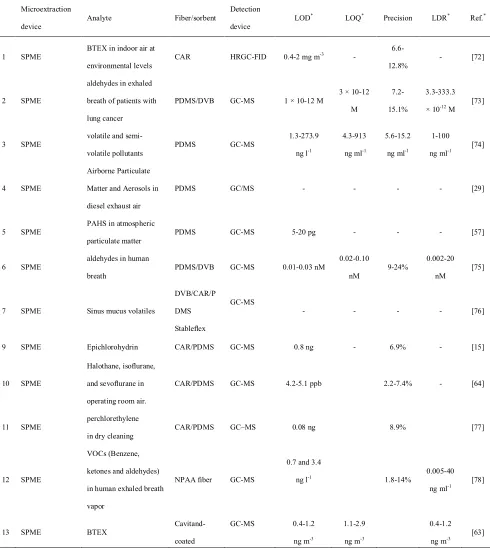
In analytical chemistry, LOD is the lowest level of analytes that can be determined and distinguished from the absence of the analytes .[92] In analytical methods coupled with chromatography, the value of LOD is estimated as the lowest concentration of target analyte corresponding to the peak area responses with signal to noise ratio of 3 [80,93]. Moreover, limit of quantitation (LOQ) is the lowest concentration of target analyte that can be reliably determined. In chromatography coupled methods, LOQ is estimated based on the lowest concentration of target analyte corresponding to the peak area responses with signal to noise ratio of 10 [80,94]. As shown in Table 1, NTD can detect lower concentrations of HVOCs in air compared to SPME. According to the table, 0.001 ng ml-1 and 0.007 ng ml-1 of HVOCs have been reported as LOD and LOQ values of the NTD packed with single wall carbon nanotubes sol-gel sorbent, respectively. While the LOD and LOQ values of SPME methods are obviously higher than those of NTD methods. This finding implied that NTD offers a higher sensitivity than SPME for the detection of VOCs in air.
LIMITATIONS AND FUTURE TRENDS
Despite all the developments in the microextraction methods including SPME, NTD and HF-LPME for the determination of VOCs in air, there are still some limitations for applying them as TWA samplers. For example, the fragility of SPME fiber coatings in exposed mode has not yet been overcome in the recent advances of SPME. In NTD, the low flow of air passing through the sorbent packed in NTD is the main limitation of this method as a TWA sampler. The larger needle diameter in this method compared to the standard Hamilton syringes, which causes the leakage of the carrier gas in the injection port of GC system, is another limitation of this method. These limitations have been addressed in some of the latest studies on NTD development [80,82]. The low capacity of the liquid absorbent and possibility of damage to the HF
body have been reported as the main drawbacks of HF-LPME method for applying as TWA sampler [56]. Hence, future studies must be specifically focused on these strategies to overcome their limitations and improve their performance as the field samplers.
CONCLUSIONS
storage time among the new proposed technologies showed that the NTD has better storage stability.
ACKNOWLEDGMENTS
The authors would like to express their gratitude to the Excellence Centre of Occupational Health, Hamadan University of Medical Sciences, Hamadan, Iran.
REFERENCES
[1] A.K. Mathur, C, Majumder, S, Chatterjee, J. Hazard. Mater. 148 (2007) 64.
[2] A. Kumar, I. Víden, Environ. Monit. Assess. 131 (2007) 301.
[3] S. Hazrati, R. Rostami, M. Fazlzadeh, Sci. Total Environ. 524 (2015) 347.
[4] M.R. Samarghandi, S.A. Babaee, M. Ahmadian, G. Asgari, F. Ghorbani Shahna, A. Poormohammadi, J. Res. Health Sci. 14 (2014) 227.
[5] S. Hazrati, R. Rostami, M. Farjaminezhad, M. Fazlzadeh, Atmos. Environ. 132 (2016) 91.
[6] S.K. Brown, Indoor Air. 12 (2002) 55-63.
[7] M. Heidari, A. Bahrami, A.R. Ghiasvand, F.G. Shahna, A.R. Soltanian, Talanta. 101 (2012) 314. [8] L.K. Wang, N.C.P Ereira, Y.-T. Hung, Springer Vol.
1, 2004.
[9] K. Demeestere, J. Dewulf, B. De Witte, H. Van Langenhove,. J. Chromatogr. A 1153 (2007) 130. [10] S. Hellweg, E. Demou, M. Scheringer, T.E. McKone,
K. Hungerbühler, Environ. Sci. Technol. 39 (2005) 7741.
[11] D.A. Lambropoulou, I.K. Konstantinou, T.A. Albanis, J. Chromatogr. A 1152 (2007) 70.
[12] M. Heidari, A. Bahrami, A.R. Ghiasvand, F.G. Shahna, A.R. Soltanian, Anal. Chim. Acta 785 (2013) 67.
[13] M.J.Z. Sakhvidi, A. Bahrami, A. Ghiasvand, H. Mahjub, L. Tuduri, Environ. Monit. Assess 184 (2012) 6483.
[14] S.G. Attari, A. Bahrami, F.G. Shahna, M. Heidari, J. Environ. Health. Sci. Eng. 1 (2014) 12.
[15] M.J. Zare Sakhvidi, A. Bahrami, A. Afkhami, A. Rafiei. Int. J. Environ. Anal. Chem. 92 (2012) 1365.
[16] B. Zabiegała, A. Kot-Wasik, M. Urbanowicz, J. Namieśnik, Anal. Bioanal. Chem. 396 (2010) 273. [17] X.L. Cao, C.N. Hewitt, Environ. Technol. 12 (1991)
1055.
[18] NIOSH Manual of Analytical Methods (NMAM), Fourth Edition. 3 (2003) 1.
[19] S.C. Lee, M.Y. Chiu, K.F. Ho, S.C. Zou, X. Wang, Chemosphere 48 (2002) 375.
[20] Z. Zhang, M.J. Yang, J. Pawliszyn, Anal. Chem. 66 (1994) 844A.
[21] J. Pawliszyn, John Wiley & Sons, 1997.
[22] C.L. Arthur, J. Pawliszyn. Anal. Chem. 62 (1990) 2145.
[23] J. Pawliszyn, Royal Soc. Chem. 5 (1999).
[24] S. Balasubramanian, S. Panigrahi, Food Bioprocess Tech. 4 (2011) 1.
[25] W. Wardencki, P. Sowiński, J. Curyło, J. Chromatogragh A 984 (2003) 89.
[26] C.C. Camarasu, J. Pharmaceut. Biomed. 23 (2000) 197.
[27] F. Augusto, A.L.P. Valente, Trends Analyt. Chem. 21 (2002) 428.
[28] C. Dietz, J. Sanz, C. Cámara. J. Chromatogr. A 1103 (2006) 183.
[29] J.A Koziel, M. Odziemkowski, J. Pawliszyn. Anal. Chem. 73 (2001) 47.
[30] J. Pawliszyn, Handbook of Solid Phase Microextraction. 1st Ed., Elsevier, 2011.
[31] L. Tuduri, V. Desauziers, J. L. Fanlo, J. Chromatogr. Sci. 39 (2001) 521.
[32] E.E. Stashenko, J.R. Martı́nez, Trends Analyt. Chem. 23 (2004) 553.
[33] F. Mangani, R. Cenciarini, Chromatographia 41 (1995) 678.
[34] T. Qin, X. Xu, T. Polak, V. Pacakova, K. Stulik, L. Jech, Talanta 44 (1997) 1683.
[35] M.R. Ras, R.M. Marcé, F. Borrull, Environ. Monit. Assess. 161 (2010) 389.
[36] V.H. Niri, I.-Y. Eom, F.R. Kermani, J. Pawliszyn, J. Sep. Sci. 32 (2009) 1075.
[37] M. Heidari, A. Bahrami, A.R. Ghiasvand, M.R. Emam, F.G. Shahna, A.R. Soltanian, Talanta 131 (2015) 142.
677 (2010) 3.
[39] N. Reyes-Garcés, G.A. Gómez-Ríos, É.A. Silva, J. Pawliszyn, J. Chromatogr. A 1300 (2013) 193. [40] J.M. Sanchez, J. Chromatogr. A 1369 (2014) 18. [41] M. Chai, J. Pawliszyn, Environ. Sci. Technol. 29
(1995) 693.
[42] R. Jiang, J. Pawliszyn, Trends Analyt. Chem. 39 (2012) 245.
[43] W.C. Hinds, John Wiley & Sons, 2012.
[44] A. Wang, F. Fang, J. Pawliszyn, J. Chromatogr. A 1072 (2005) 127.
[45] M.Á. Bello-López, M. Ramos-Payán, J.A. Ocaña-González, R. Fernández-Torres, M. Callejón-Mochón, Anal. Lett. 45 (2012) 804.
[46] J. Ee, H.K. Lee, K.E. Rasmussen, S. Pedersen-Bjergaard, Anal. Chim. Acta 624 (2008) 253.
[47] A. Sarafraz-Yazdi, A. Amiri, Trends Analyt. Chem. 29 (2010) 1.
[48] F. Ghamari, A. Bahrami, Y. Yamini, F.G. Shahna, A. Moghimbeigi, Anal. Chem. Insights 11 (2016) ACI. [49] A. Bahrami, F. Ghamari, Y. Yamini, F. Ghorbani
Shahna, A. Moghimbeigi, Membranes 12 (2017) 8. [50] M. Rezaee, Y. Assadi, M.R. Millani, E. Aghaee, F.
Ahmadi, S. Berijani, J. Chromatogr. A 1116 (2006) 1. [51] H. Prosen, Molecules 19 (2014) 6776.
[52] S. Pedersen-Bjergaard, K.E. Rasmussen, Anal. Chem. 71 (1999) 2650.
[53] A. Sarafraz-Yazdi, A.H. Amiri, Z. Es’haghi, Chemosphere 71.4 (2008) 671.
[54] M.R. Payán, M.Á.B. López, R. Fernández-Torres, M. V. Navarro, M.C. Mochón, Talanta 79 (2009) 911. [55] X. Ma, M. Huang, Z. Li, J. Wu, J. Hazard. Mater. 194
(2011) 24.
[56] E. Taheri, A. Bahrami, F.G. Shahna, M. Farhadian, Environ. Monit. Assess. 190 (2018) 479.
[57] J.M. Vaz, Talanta 60 (2003) 687.
[58] A. Sarafraz-Yazdi, A. Amiri, G. Rounaghi, H.E. Hosseini, J. Chromatogr. A 1218 (2011) 5757. [59] M. Wu, L. Wang, B. Zeng, F. Zhao, J. Chromatogr. A
1364 (2014) 45.
[60] M.B. Gholivand, M. Shamsipur, M. Shamizadeh, R. Moradian, B. Astinchap, Anal. Chim. Acta 822 (2014) 30.
[61] M. Azenha, E. Schillinger, E. Sanmartin, M.T.
Regueiras, F. Silva, B. Sellergren, Anal. Chim. Acta 802 (2013) 40.
[62] J.A. Koziel, M. Jia, A. Khaled, J. Noah, J. Pawliszyn, Anal. Chim. Acta 400 (1999) 153.
[63] N. Riboni, J.W. Trzcinski, F. Bianchi, C. Massera, R. Pinalli, L. Sidisky, E. Dalcanale, M. Careri, Anal. Chim. Acta 905 (2016) 79.
[64] M.J.Z. Sakhvidi, A. Bahrami, A. Ghiasvand, H. Mahjub, L. Tuduri, Anal. Lett. 45 (2012) 375.
[65] E.N. Fuller, P.D. Schettler, J.C. Giddings, Ind. Eng. Chem. 58 (1966) 18.
[66] S.G. Attari, A. Bahrami, F.G. Shahna, M. Heidari, J. Analyt. Chem. 70 (2015) 1192.
[67] S.L. Chong, D. Wang, J.D. Hayes, B.W. Wilhite, A. Malik, J. Analyt. Chem. 69 (1997) 3889.
[68] J. Pawliszyn, Trends Analyt. Chem. 14 (1995) 113. [69] Y.L. Fu, Y.L. Hu, Y.J. Zheng, G.K. Li., J. Sep. Sci.
29 (2006) 2684.
[70] P. Trefz, S. Kischkel, D. Hein, E.S. James, J.K. Schubert, W. Miekisch, J. Chromatogr. A 1219 (2012) 29.
[71] M. Heidari, A. Bahrami, A.R. Ghiasvand, F.G. Shahna, A.R. Soltanian, M. Rafieiemam, J. Sep. Sci. 38 (2015) 4225.
[72] K. Elke, E. Jermann, J. Begerow, L. Dunemann, J. Chromatogr. A 826 (1998) 191.
[73] D. Poli, M. Goldoni, M. Corradi, O. Acampa, P. Carbognani, E. Internullo, A. Casalini, A. Mutti, J. Chromatogr. B 878 (2010) 2643.
[74] M. Llompart, K. Li, M. Fingas, J. Chromatogr. A 824 (1998) 53.
[75] S. Svensson, M. Lärstad, K. Broo, A.C. Olin, J. Chromatogr. B 860 (2007) 86.
[76] G. Preti, E. Thaler, C.W. Hanson, M. Troy, J. Eades, A. Gelperin, J. Chromatogr. B 877 (2009) 2011. [77] M.J. Zare Sakhvidi, A.R. Bahrami, A. Ghiasvand, H.
Mahjub, L. Tuduri, Environ. Monit. Assess 185 (2013) 4933.
[78] G. Zhang, L. Zou, H. Xu, Talanta 132 (2015) 528. [79] G. Attari, A. Bahrami, F. Ghorbani Shahna, M.
Heidari, J. Occup. Health 13 (2016) 78.
[81] J. Cai, G. Ouyang, Y. Gong, J. Pawliszyn, J. Chromatogr. A 1213 (2008) 19.
[82] A. Poormohammadi, A. Bahrami, A. Ghiasvand, F.G. Shahna, M. Farhadian, Microchem. J. 143 (2018) 127. [83] J.A. Koziel, J. Pawliszyn, J. Air Waste Manag Assoc.
51 (2001) 173.
[84] J. Wang, L. Tuduri, M. Mercury, M. Millet, O. Briand, M. Montury. Environ. Pollut. 157 (2009) 365.
[85] Y. Chen, J. Pawliszyn, Anal. Chem. 75 (2003) 2004. [86] E. Gallego, F.J. Roca, J.F. Perales, X. Guardino,
Talanta 81 (2010) 916.
[87] D. Djozan, Y. Assadi, S.H. Haddadi, Anal. Chem. 73 (2001) 4054.
[88] J. Namieśnik, A. Jastrzebska, B. Zygmunt, J.
Chromatogr. A 1016 (2003) 1.
[89] S. Isetun, U. Nilsson, A. Colmsjö, R. Johansson. Anal. Bioanal. Chem. 378 (2004) 1847.
[90] J.-F. Liu, N. Li, G.-B. Jiang, J.-M. Liu, J.Å. Jönsson, M.-J. Wen, J. Chromatogr. A 1066 (2005) 27.
[91] M. Heidari, A. Bahrami, A. Ghiasvand, F. Ghorbani Shahna, A. Soltanian, M. Rafieiemam, J. Occup. Health. 11 (2014) 45.
[92] B. Magnusson, Eurachem. (2014) 34.
[93] L. Tajik, A. Bahrami, A. Ghiasvand, F.G. Shahna, Pol. J. Chem. Technol. 19 (2017) 9.