http://www.ijnaa.semnan.ac.ir
Weights in block iterative methods
Touraj Nikazada,∗, Mokhtar Abbasia
aDepartment of Mathematics, Iran University of Science and Technology, Tehran 16846-13114, Iran.
(Communicated by M. Eshaghi Gordji)
Abstract
In this paper we introduce a sequential block iterative method and its simultaneous version with op-timal combination of weights (instead of convex combination) for solving convex feasibility problems. When the intersection of the given family of convex sets is nonempty, it is shown that any sequence generated by the given algorithms converges to a feasible point. Additionally for linear feasibility problems, we give equivalency of our algorithms with sequential and simultaneous block Kaczmarz methods explaining the optimal weights have been inherently used in Kaczmarz methods. In addi-tion, a convergence result is presented for simultaneous block Kaczmarz for the case of inconsistent linear system of equations.
Keywords: block iterative methods, convex feasibility problem, Kaczmarz's method. 2010 MSC: Primary 65J22, 65J15; Secondary 65F10.
1. Introduction
A common problem in dierent areas of mathematics and physical sciences comprises of nding a point in the intersection of convex sets. This problem is referred to as the convex feasibility problem (CFP), see [2] for a general denition. We are interested to nd a point in the nonempty intersection of a nite family of closed convex sets in the Euclidean spaceRn.Of special interest is the case with
linear equations and/or inequalities, often referred to as the linear feasibility problem (LFP). Such linear systems may arise from discretization of an ill-posed problem such as the Radon transform used in modeling of several reconstruction problems, see, e.g., [18, 23]. Work related to the CFP are wide-ranging and numerous iterative methods for the CFP has been studied, see, e.g., [2, 5, 12] and references in [26]. Some problems that are modeled into CFP could be listed as discretized models of image reconstruction from projections, the fully discretized model of radiation-therapy
∗Corresponding author
Email addresses: [email protected] (Touraj Nikazad ), [email protected] (Mokhtar Abbasi)
treatment planning, and problems of image restoration. However, from such real-world applications, the resulting convex feasibility problem is often huge. Since direct factorization methods are inecient for such a large-scale problem we employ iterative methods. Projection algorithms are successful iterative methods in the area of constructive solution of such problems see [5] and references therein. These kind of methods are formed by doing some projections onto the individual sets. Then, usually convex combination of projected results were used to produce the next iteration, see, e.g., [1]. The main result of our work allows, in some sense, to have the best combination instead of convex combination of projections. Also we observe that the simultaneous and sequential block Kaczmarz methods intrinsically employ the optimal weights resulted in faster convergence respect to other methods. In case of LFP, an extension of Kaczmarz method is recently achieved in [24].
In a simple way, one may classify projection methods as either sequential or simultaneous. The block iterative methods (in the image reconstruction literature is named ordered subsets methods [4, 11, 19]), which lie between sequential and simultaneous cases, have been studied in several works with dierent applications, see, e.g., [1, 4, 6, 7, 8, 13, 14, 15, 16, 25, 27, 29]. Simultaneous block iterative methods have also been used to increase computational eciency using parallel processors [3, 8, 21]. For an overview in a more general framework, see [9]. In the case of LFP, we recall the simultaneous version of block Kaczmarz (it is same as row-Jacobi method [15]) which is suitable for parallel computing. In addition, we obtain that our algorithms and (sequential and simultaneous) block Kaczmarz methods are equivalent.
We now present a short summary of the contents of the paper. In Section 2 we introduce a sequential block iterative method and its parallel version, i.e., Algorithms 2.1 and 2.2. All convergence theorems are given in Section 3. Precisely, we demonstrate (from theoretical point of view) in Theorems 3.2 and 3.3, that the whole produced sequence by Algorithms 2.1 and 2.2 converge to a feasible point. In Section 4, we describe how the Algorithms 2.1 and 2.2 can be eciently implemented for the LFP. Indeed the assumed solution pointx∗is disappeared from the computation step. Also we remind sequential block Kaczmarz (for an excellent presentation see [23]) and its simultaneous version (row-Jacobi method, see [15]). Furthermore, it is shown that the generated cycles by Algorithms 2.1 and sequential block Kaczmarz (i.e., Algorithm 4.2 whenλ= 1) and their parallel versions which are
Algorithm 2.2 (with equal exterior weights wk,s) and simultaneous block Kaczmarz (i.e., Algorithm 4.3 whenλ = 1) are equivalent. For the inconsistent case, we conclude from above equivalency and
[14] that the cycles of Algorithm 2.1 converge to a point which satises a certain linear system. Also it is shown the Algorithms 2.2 and 4.3 converge to a weighted least squares solution.
2. Preliminaries and algorithms
LetB ={1,2,· · · , m}, the index set, and letCi∈B be a nite family of closed convex sets in Rn. The intersection C =T
i∈BCi is assumed to be nonempty. A block iterative method may be formed by partitioning of index set B into q subset Bt such that B = Sqt=1Bt. The orthogonal projection of x ∈ Rn onto C
i is denoted by Pi(x) which satises Pi(x) = argminy∈Cikx−yk. Here hx, yi is
the Euclidean inner product and kxk the corresponding norm. A well-known property of projection operators is their non-expansivity, i.e.,kPi(x)−Pi(y)k ≤ kx−ykfor any x and y in Rn.
Also we use the standard terms sequential block iterative (SeqBI) and simultaneous block iterative (SimBI) from [9, 20]. Indeed, an iterative step sequentially moves from one block to the next one in SeqBI methods whereas SimBI methods use simultaneously a given starting point for each block and an iteration is produced by combination of all outcomes which are made by each block. Obviously, SimBI methods are more suitable than SeqBI methods for parallel computation, see [8, 9, 21].
Algorithm 2.1. SeqBI
Initialization: x0 ∈Rn is arbitrary. Iterative Step: Given xk compute,
xk,0 =xk,
xk,s =xk,s−1+X
i∈Bs
wik,s Pi(xk,s−1)−xk,s−1
, s= 1, . . . , q,
s.t. xk,s =argminx∈Ψk,skx∗−xk,
xk+1 =xk,q,
where wk,si are weights and Ψk,s =xk,s−1+span{Pi(xk,s−1)−xk,s−1}i∈Bs.
In Algorithm 2.1, the step fromk tok+1is called a cycle and it consists of a sequence of sub-iterative
steps (referred to as atomic steps). Each atomic step moves from xk,s−1 toxk,s. The following algorithm is appropriately designed for parallel computations. Algorithm 2.2. SimBI
Initialization: y0 ∈Rn is arbitrary. Iterative Step: Given yk compute,
yk,0 =yk, yk,s =yk+X
i∈Bs
wk,si Pi(yk)−yk
, s= 1, . . . , q,
s.t. yk,s =argminy∈Ωk,sky∗−yk,
yk+1 =
q
X
s=1
wk,syk,s,
s.t. yk+1 =argminy∈Ωkky∗ −yk,
where wk,si , wk,s are weights, and Ωk,s =yk+span{P
i(yk)−yk}i∈Bs,Ω
k =span{yk,s}q s=1.
As seen, the starting point is used for each block in parallel. Then each block has its own result and the combination of such results makes the next iteration. Both Algorithms 2.1-2.2 encounter with an optimization problem and needs a solution point x∗ in each step. Although this problem is resolved for the LFP, but the applicability of these methods to the nonlinear case is, however, unclear due to the nature of the error-measure.
The following theorem (see, e.g., [22]) and Lemma 2.4 guarantee the existence and uniqueness of the atomic step xk,s (of Algorithm 2.1) such that kx∗−xk,sk becomes minimum over Ψk,s whereas x∗ ∈T
i∈BCi.
Theorem 2.3. Consider nite dimensional subspace Y of normed linear space X and an arbitrary point x ∈ X. Then there exists a point in Y which is the best approximation to x. Also to have a unique point in Y it is enough to consider X a Hilbert space.
Lemma 2.4. For any xed x∗ ∈T
i∈BCi there exists a unique element x
Figure 1: optimal weights versus convex combination of weights
Proof . Let x ∈ Rn be an arbitrary point. Using Theorem 2.3, there exists a unique point
e
z =
P
i∈Bswei(Pi(x)−x)∈ span{Pi(x)−x}i∈Bs which minimizes k(x
∗−x)−zk over z ∈span{P i(x)− x}i∈Bs. Now we assert ey=ez+xis unique minimizer of kx
∗−yk overy ∈x+span{P
i(x)−x}i∈Bs.
Let by =x+ P
i∈Bswbi(Pi(x)−x) =: x+zbsuch that kx
∗−
b
yk ≤ kx∗−
e
yk. From the last inequality we have k(x∗−x)−bzk ≤ k(x∗−x)−ezk which gives the desired result in the lemma.
Similarly, one easily gets the same results for the Algorithm 2.2.
Remark 2.5. Since, for the case of convex combination of weights, the convergence results of Al-gorithms 2.1 and 2.2 are known one may imagine that our convergence results with the optimal weights are not so surprising. But the gure 1 demonstrates reverse results. Indeed, it results kx∗ −xopt,1k ≤ kx∗ −x1k whereas kx∗ − xopt,2k ≥ kx∗ − x2k here B
1 = {1,2}, B2 = {3}. Also
x1, x2 and xopt,1, xopt,2 are computed using convex combination of weights and optimal weights re-spectively.
3. Convergence of the block iterative methods
In the this section we derive convergence theorems for our algorithms. First we begin with a lemma which is used in our further proofs.
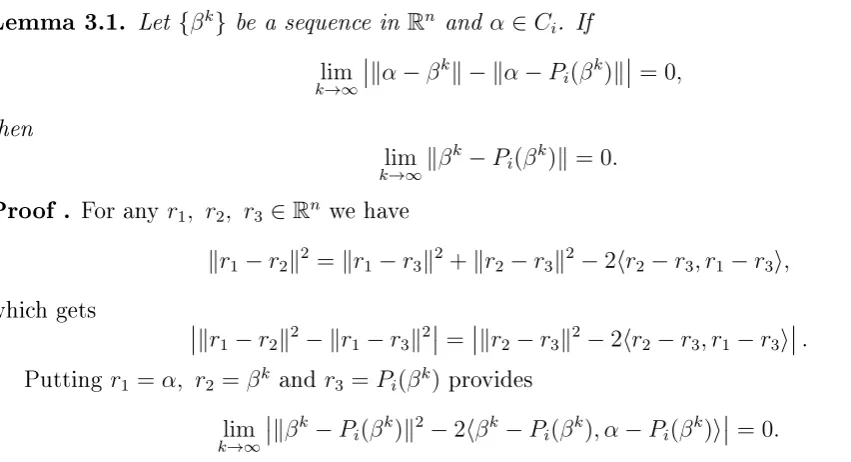
Lemma 3.1. Let {βk} be a sequence in
Rn and α∈Ci. If
lim
k→∞
kα−βkk − kα−Pi(βk)k
= 0,
then
lim
k→∞kβ k−
Pi(βk)k= 0. Proof . For anyr1, r2, r3 ∈Rn we have
kr1−r2k2 =kr1−r3k2+kr2−r3k2−2hr2 −r3, r1−r3i,
which gets
kr1−r2k2− kr1−r3k2
=
kr2 −r3k2 −2hr2−r3, r1−r3i .
Putting r1 =α, r2 =βk and r3 =Pi(βk) provides
lim
k→∞
kβk−Pi(βk)k2−2hβk−Pi(βk), α−Pi(βk)i
= 0.
Using metric projection characterization properties, see [2, FACTS 1.5] and [17, Section 3], one gets
−2hβk−P
i(βk), α−Pi(βk)i ≥0, which shows
lim
k→∞kβ k−
Pi(βk)k= 0.
Proof .
Since xk,s =argmin
x∈Ψk,skx∗−xk, for every i∈Bs we have
kx∗−xk,sk=kx∗−xk,s−1−X
i∈Bs
wik,s Pi(xk,s−1)−xk,s−1
k
≤ kx∗−xk,s−1 − P
i(xk,s−1)−xk,s−1
k
=kx∗−Pi(xk,s−1)k, which oers
kx∗−xk,sk ≤min
i∈Bs
kx∗−Pi(xk,s−1)k. (3.1) Non-expansivity of projection operator and (3.1) guarantee that for any i∈Bsthere exist scalars
0≤γik,s ≤1such that
kx∗−xk,sk ≤ kx∗−Pi(xk,s−1)k
=kPi(x∗)−Pi(xk,s−1)k=γ k,s i kx
∗−
xk,s−1k. (3.2) Let
δk,s = min
i∈Bs
γk,si , s= 1,· · · , q. (3.3) From (3.2) and (3.3) one gets
kx∗−xk,sk ≤δk,skx∗−xk,s−1k, s= 1,· · · , q. (3.4) Repeating (3.4) gives
kx∗−xk+1k=kx∗−xk,qk ≤δk,qδk,q−1· · ·δk,1kx∗−xk,0k
=δk,qδk,q−1· · ·δk,1kx∗ −xkk. (3.5) Let k= min
s∈{1,···,q}δk,s, therefore (3.5) provides
kx∗−xk+1k ≤kkx∗ −xkk, (3.6) which shows
lim
k→∞kx ∗−
xkk=d. (3.7)
Using (3.6) recursively gives
kx∗−xkk ≤k−1k−2· · ·0kx∗−x0k. (3.8) Now we consider two cases: rst let the sequence {k} have a subsequence {kr} such that
limkr→∞
kr = α < 1. Therefore Q∞
r=1
kr = 0 which means Q∞
k=1
k = 0. Using (3.8) we get
limk→∞kxk−x∗k= 0.The second case, the complimentary case of the rst one, results inlimk→∞k=
1.By the denition of k and δk,s one obtains
lim
k→∞γ k,s
i = 1, for i∈Bs. (3.9)
Using (3.2) and (3.9) we get
lim
k→∞
kx∗−xk,s−1k2− kx∗−Pi(xk,s−1)k2
Lemma 3.1 and (3.10) show that
lim
k→∞kx
k,s−1−P
i(xk,s−1)k= 0 for i∈Bs. (3.11) Now we claim
lim
k→∞kx k−P
i(xk)k= 0 for i∈B. (3.12) Putζk,s−1 =P
j∈Bsw
k,s
j Pj(xk,s−1)−xk,s−1
, then fori∈Bs (no matter if i∈B` for 1≤` ≤q)
lim
k→∞kx k,s−P
i(xk,s)k= lim k→∞kx
k,s−1+ζk,s−1−P
i(xk,s−1 +ζk,s−1)k (3.13) ≤ lim
k→∞
kxk,s−1−P
i(xk,s−1+ζk,s−1)k+kζk,s−1k . The equality (3.11) and boundedness of weights {wk,si }result
lim
k→∞kζ
k,s−1k ≤
lim
k→∞
X
j∈Bs
|wjk,s| kPj(xk,s−1)−xk,s−1k= 0. (3.14)
Since a projection operator is nonexpansive, we have
kPi(xk,s−1+ζk,s−1)−Pi(xk,s−1)k ≤ kζk,s−1)k. (3.15) Using (3.11), (3.14) and (3.15), one concludes
lim
k→∞kx
k,s−1−P
i(xk,s−1 +ζk,s−1)k=
= lim
k→∞kx
k,s−1−
Pi(xk,s−1) +Pi(xk,s−1)−Pi(xk,s−1+ζk,s−1)k, ≤ lim
k→∞
kxk,s−1−P
i(xk,s−1)k+kPi(xk,s−1)−Pi(xk,s−1+ζk,s−1)k , ≤ lim
k→∞
kxk,s−1−P
i(xk,s−1)k+kζk,s−1)k = 0, (3.16) for i∈Bs.
Therefore using (3.13) we get
lim
k→∞kx k,s−P
i(xk,s)k= 0 for i∈Bs. (3.17) From (3.11) and (3.17) one nds (by induction)
lim
k→∞kx k,r−P
i(xk,r)k= 0, for i∈Bs and s−1≤r ≤q. (3.18) Since the set Bs is arbitrary, one easily gets the desired result in (3.12). Concerning (3.7), there exists the subsequence {xkt} of {xk} that converges to a point x¯. Using (3.12) we nd
0 = lim
t→∞kx kt −P
i(xkt)k=kx¯−Pi(¯x)k for i= 1,2, . . . , m (3.19) which means x¯ ∈ C. Now, if we use x¯ instead of x∗, one concludes d = 0 which shows that xk converges to a feasible point x¯. It is easy, using (3.5), to show that the whole sequence of the
algorithm converges to x¯.
Theorem 3.3. If C 6= ∅ then the sequence of atomic steps {yk,s} in Algorithm 2.2 converges to a point x∗ ∈C.
Proof .
The denition of yk,s in Algorithm 2.2 yields kx∗−yk,sk ≤min
i∈Bs
kx∗−Pi(yk)k for s= 1,· · · , q. (3.20)
Since a projection is nonexpansive mapping, there exist 0≤γik,s ≤1such that
kx∗−Pi(yk)k=γik,skx ∗−
ykk. (3.21)
Letδk,s = mini∈Bsγ
k,s
i . Using (3.20) and (3.21) we havekx∗−yk,sk ≤δk,skx∗−ykkfors= 1,· · · , q. Therefore
kx∗−yk+1k=kx∗ − q
X
s=1
wk,syk,sk ≤ 1 q
q
X
s=1
kx∗−yk,sk
≤ 1 q
q
X
s=1
δk,skx∗−ykk=kkx∗−ykk, (3.22)
where0≤k = 1
q
Pq
s=1δk,s ≤1. Obviously, we get the following two results from (3.22)
lim
k→∞kx ∗−
ykk=d, (3.23)
and
kx∗ −yk+1k ≤k· · ·0kx∗−y0k. (3.24) Similar to proof of Theorem 3.2 two cases occur: First let the sequence {k} have a subsequence {kr} such that lim
kr→∞
kr =α <1. ThereforeQ∞
r=1
kr = 0which means Q∞
k=1
k= 0.Using (3.24) we get limk→∞kxk−x∗k= 0. The second case, the complimentary case of the rst one, necessitates
limk→∞k = 1. This equality causes
lim
k→∞δ
k,s = 1, lim k→∞γ
k,s
i = 1 for s= 1,· · ·, q, i∈Bs. (3.25) Using (3.21) and (3.25) we get
lim
k→∞
kx∗−ykk2− kx∗−Pi(yk)k2
= 0, fori∈Bs (3.26) Thus, the Lemma 3.1 and (3.26) give
lim
k→∞ky k−P
i(yk)k= 0 fori∈Bs, s= 1,· · · , q. (3.27) Regarding (3.23), there exists the subsequence {ykt} of {yk} that converges to a point x¯. The
equality (3.27) implies kykt−P
i(ykt)k → 0 which results kx¯−Pi(¯x)k= 0 for s= 1,· · · , q, i ∈Bs. It means that x¯ is a feasible point. Now using x¯ instead of x∗ in (3.23) gets d= 0 which completes
4. Implementations and new results for LFP
Here we discuss how to eciently implement Algorithms 2.1-2.2 for the following linear system of equations. Indeed the assumed solution point x∗ is not needed, i.e., it disappears from the weight computation step. Let us consider the linear system of equations (which may be inconsistent)
Ax=b, (4.1)
where A ∈Rm×n and b ∈
Rm. Let Hi∈B = {x∈ Rn, hx, aii =bi} here ai and bi indicate ith row of A and brespectively. Respect to partitioning of the index setB, the matricesA,bbe partitioned into q (not necessarily disjoint) row blocks {At},{bt} respectively. Obviously, the orthogonal projection of a pointx∈Rn onto H
i can be calculated by Pi(x) = x+
bi− hx, aii kaik2 a
i. (4.2)
Both Algorithms 2.1-2.2 contain a norm minimization in each step. To minimize a convex function f(x) = kx∗−xk over a proper subspace of
Rn, its gradient is used . Recall that a subgradient of a
convex function f aty is any vector g that satises the inequality f(x)−f(y)≥ hg, x−yifor all x. Iff is dierentiable at y then its gradient∇f(y)is the unique subgradient of f aty. Therefore, any y that satises ∇f(y) = 0 is a global minimizer of f.
Remark 4.1. In our algorithms, the linear system of equations∇f(y) = 0 may have many solutions.
But any solution (weights) results in a unique iteration (atomic step/cycle), see Theorem 2.3 and Lemma 2.4.
Since an optimization problem, in fact a small linear system of equations comparing with (4.1), must be solved in each step of Algorithms 2.1-2.2, we remind the block Kaczmarz method which is comparable with our methods from that point of view. The sequential block Kaczmarz method (also called block iterative ART) can be formulated as:
Algorithm 4.2. Seq. Block Kaczmarz Initialization: u0 ∈Rn is arbitrary.
Iterative Step: Given uk compute, uk,0 =uk,
uk,s =uk,s−1+λATs(AsATs) †
(bs−Asuk,s−1), s= 1, . . . , q, uk+1 =uk,q,
where 0< λ <2 is relaxation parameter and B† shows pseudoinverse of B.
This algorithm is a special case of [14, Algorithm 1.10]. The subsequences of cycles{uk,s}, k≥0 with xed s will actually converge. Indeed, if b ∈ R(A) then {uk} converges toward a solution of Ax = b. If in addition u0 ∈ R(AT), then {uk} converges to a point, see [14, Theorem 1.3]. Indeed this point satises a certain linear system of equations, see [16, Proposition 4]. For the special case λ= 1, we explain in Section 4.1 (Remark 4.4) why this algorithm and Algorithm 2.1 are equivalent.
Algorithm 4.3. Sim. Block Kaczmarz (Row-Jacobi) Initialization: v0 ∈Rn is arbitrary.
Iterative Step: Given vk compute, vk,0 =vk,
vk,s =vk+λATs(AsATs) †
(bs−Asvk), s= 1, . . . , q, vk+1= 1
q q
X
s=1
vk,s,
where 0< λ <2 is relaxation parameter.
Indeed, if b ∈R(A) and v0 ∈R(AT) then the generated cycles of row-jacobi method (Algorithm 4.3) converges towards the solution of (4.1) with minimum norm, see [15, Theorem 1]. Similar to Algorithm 4.2, we obtain that this algorithm gives the same iterates as in Algorithm 2.2 whenλ = 1
and the exterior weights (i.e., wk,s) are equal, see Section 4.2, Remark 4.6. Both Algorithms 2.1 and 2.2 can be written as the following matrix forms:
xk,0 =xk,
xk,s =xk,s−1+ATsMk,s(bs−Asxk,s−1), s= 1, . . . , q, s.t. xk,s =argminx∈Ψk,skx∗−xk,
xk+1 =xk,q, and
yk,0 =yk,
yk,s =yk+ATsMk,s(bs−Asyk), s= 1, . . . , q, s.t. yk,s =argminy∈Ωk,sky∗−yk,
yk+1 =
q
X
s=1
wk,syk,s,
s.t. yk+1 =argminy∈Ωkky∗ −yk,
whereMk,s =diag( wk,si
kaik2) and {w k,s
i }i∈Bs are related weights of each algorithm.
4.1. Algorithm 2.1
Let x∗ be a solution of (4.1) and zi(x) = bi −hai,xi
kaik2 . To nd the weights in Algorithm 2.1, forming partial derivative of kx∗−xk,sk2 with respect to{wk,s
j }and setting them to zero result the following linear system of equations
hxk,s−1+X
i∈Bs
wik,s Pi(xk,s−1)−xk,s−1
, zjaji=zjbj, for j ∈Bs, (4.3)
thus, the equality (4.2) gives
X
i∈Bs
wik,szihai, aji= bj − haj, xk,s−1i
wherezi :=zi(xk,s−1)for i∈Bs.
Next, by a simple calculation we demonstrate that Algorithms 2.1 and 4.2 become identical when λ= 1. In each step of Algorithm 4.2, the following linear system of equations should be solved
(AsATs)x= (bs−Asuk,s−1), (4.5) whereuk,s−1 is computed in previous iteration. Also the weights in Algorithm 2.1 satisfy (4.4) which
can be rewritten as the following matrix form
(AsATs)Dw = (bs−Asyk,s−1), (4.6) whereD=diag(zi)and w=
n
wik,so i∈Bs
. Note that we assumedzi 6= 0, otherwise we do not need to compute xk,s since b
i − hai, xk,s−1i = 0. Therefore (4.5) and (4.6) show x = Dw. To compute next iteration in Algorithms 4.2 and 2.1 we have to calculateuk,s−1+AT
sx and xk,s−1+X
i∈Bs
wik,s Pi(xk,s−1)−xk,s−1
=xk,s−1+X
i∈Bs
wik,sziai
=xk,s−1+ATsDw, (4.7) respectively. Now we can conclude
Remark 4.4. Algorithms 2.1 and 4.2 (with λ = 1) are equivalent.
Remark 4.5. Using Remark 4.4 and [14, Theorem 1.3], the generated cycle in Algorithm 2.1 con-verges to a solution of (4.1) (Also, from Theorem 3.2, we can see that the whole generated sequence by this algorithm converges to a solution of (4.1)). And for inconsistent case, it converges to a point. Indeed this point satises a certain linear system of equations, see [16, Proposition 4], which do not correspond to a gradient mapping.
4.2. Algorithm 2.2
In Algorithm 2.2, the weights wik,s and wk,s are called interior and exterior weights respec-tively. The complexity of nding the weights in Algorithms 2.1 and 2.2 are quite similar. Indeed, see (4.4), the interior weights{wk,si } satisfy the following equations for Algorithm 2.2
X
i∈Bs
wk,si zihai, aji= bj− haj, yki
, for j ∈Bs, s= 1,· · · , q. (4.8)
Also exterior weights wk,s satisfy q
X
s=1
wk,shyk,s, yk,ti=hx∗, yki+X
i∈Bt
wk,ti bizi, fort = 1,· · · , q. (4.9)
Let k = 0. If y0 ∈ R(AT) then we can compute {w0,s}q
s=1 (x∗ is disappeared from (4.9)) and
y1 =Pq
s=1w
0,sy0,s. In the next iteration, k = 1, after computing w1,s
(4.9) to calculatew1,s. But
hx∗, y1i=hx∗, q
X
s=1
w0,sy0,si
=
q
X
s=1
w0,shx∗, y0,si
=
q
X
s=1
w0,s
*
x∗, y0+X
i∈Bs
wi0,s Pi(y0)−y0
+ = q X s=1
w0,s
x∗, y0
+X
i∈Bs
wi0,szi(y0)bi
!
, (4.10)
which meanshx∗, y1ican be computed without using x∗. By this way the whole generated sequence can be calculated devoid of the solution.
Similar conclusions as in Remark 4.4 can be drawn for Algorithms 2.2 and 4.3.
Remark 4.6. The Algorithms 4.3 (for λ = 1) and 2.2 with equal exterior weights are equivalent.
The following proposition provides a convergence proof for Algorithm 2.2 when the linear system (4.1) is inconsistent.
Proposition 4.7. The sequence of atomic steps in Algorithm 2.2 converges to a solution of (4.1). In the inconsistent case, the generated cycle in Algorithm 2.2, with equal exterior weights, converges to a solution of a certain weighted least-squares problem.
Proof .
The proof of the rst part of the statement can be deduced from Theorem 3.3 (it was proven that the generated cycle converges to a solution of (4.1), see [15, Theorem 1] ). For the inconsistence case, we use Remark 4.6 and rewrite Algorithm 4.3 as a fully simultaneous method. In Algorithm 4.3, the summation of xk,s overs furnishes
q
X
s=1
xk,s =qxk+λ q
X
s=1
ATs(AsATs) †
(bs−Asxk)
=qxk+λ
A1 ... Aq T
(A1AT1)
† O
...
O (AqATq) †
b1−A1xk
... bq−Aqxk
=qxk+λATM(b−Axk) (4.11)
where M = diag((AiATi )
†) is a symmetric positive semidenite matrix. Therefore the cycle of this algorithm can be written as
xk+1 =xk+λ
qA T
M(b−Axk). (4.12)
Using classical theorems for full simultaneous iteration methods like (4.12), see, e.g., [28], one nds that the cycles {xk} converge to a solution ofminkAx−bk
Remark 4.8. The Remark 4.6 and Proposition 4.7 show that the sequence of atomic steps in Al-gorithm 4.3 (with λ = 1) converges to a solution of (4.1). For the inconsistent case, the generated
cycle converges to a solution of a certain weighted least-squares problem when 0< ≤λ/q≤2−.
5. Conclusions
The sequential and simultaneous block iterative methods with optimal weights are proposed for solving convex feasibility problems. The whole sequences generated by both methods converge to a point in the feasible set. In the case of LFP, it is observed that the simultaneous and sequential block Kaczmarz methods inherently use the optimal weights. Additionally, it is demonstrated that the generated sequence by the simultaneous block Kaczmarz method converges to a weighted least squares solution.
Acknowledgements
The authors thank Professor Tommy Elfving for his valuable advices and discussions.
References
[1] R. Aharoni and Y. Censor, Block-iterative projection methods for parallel computation of solutions to convex feasibility problems, Linear Algebr. Appl., 120 (1989) 165175.
[2] H. H. Bauschke and J. M. Borwein, On projection algorithms for solving convex feasibility problems, SIAM Rev., 38 (1996) 367426.
[3] D. Butnariu, Y. Censor and S. Reich,(eds): Inherently Parallel Algorithms in Feasibility and Optimization and Their Applications. Elsevier Science, Amsterdam, The Netherlands, 2001.
[4] C. Byrne, Block-iterative interior point optimization methods for image reconstruction from limited data, Inverse Problems, 16 (2000) 14051419.
[5] Y. Censor, W. Chen, P. L. Combettes, R. Davidi and G. T. Herman, On the eectiveness of projection methods for convex feasibility problems with linear inequality constraints, Comput. Optim. Appl., 51 (2012) 10651088. [6] Y. Censor and T. Elfving, Block-iterative algorithms with diagonally scaled oblique projections for the linear
feasibility problem, SIAM J. Matrix Anal. Appl., 24 (2002) 4058.
[7] Y. Censor, T. Elfving, G. T. Herman and T. Nikazad, On diagonally-relaxed orthogonal projection methods, SIAM J. Sci. Comput., 30 (2007/08) 473504.
[8] Y. Censor, D. Gordon and R. Gordon, BICAV: an inherently parallel algorithm for sparse systems with pixel-dependent weighting, IEEE Trans. Med. Imaging, 20 (2001) 10501060.
[9] Y. Censora and S. A. Zenios, Parallel Optimization: Theory, Algorithms and Applications, Oxford: Oxford University Press, 1997.
[10] G. Cimmino, Calcolo approssimato per le soluzioni dei sistemi di equazioni lineari, La Ricerca Scientica. XVI, Series II, Anno IX, 1 (1938) 326333.
[11] P. L. Combettes and J. C. Pesquet, Image restoration subject to a total variation constraint, IEEE Trans. Image Process. 13 (2004) 12131222.
[12] P. L. Combettes, Convex set theoretic image recovery by extrapolated iterations of parallel subgradient projections, IEEE Trans. Image Process., 6 (1997) 493506.
[13] R. Davidi, G. T. Herman and Y. Censor, Perturbation-resilient block-iterative projection methods with application to image reconstruction from projections, Int. Trans. Oper. Res., 16 (2009) 505524.
[14] P. P. B. Eggermont, G. T. Herman and A. Lent, Iterative algorithms for large partitioned linear systems, with applications to image reconstruction, Linear Algebra Appl., 40 (1981) 3767.
[15] T. Elfving, it Block-iterative methods for consistent and inconsistent linear equations, Numer. Math., 35 (1980) 112.
[16] T. Elfving and T. Nikazad, Properties of a class of block-iterative methods, Inverse Problems, 25 (2009) 115011. [17] K. Goebel and S. Reich, Uniform Convexity, Hyperbolic Geometry, and Nonexpansive Mappings, Marcel Dekker,
New York and Basel, 1984.
[19] H. Hudson and R. S. Mand Larkin, Accelerated image reconstruction using ordered subsets projection data, IEEE Trans. Med. Imaging, 13 (1994) 601609.
[20] M. Jiang and G. Wang, Convergence studies on iterative algorithms for image reconstruction, IEEE Transactions on Medical Imaging, 22 (2003) 569579.
[21] C. Kamath and A. Sameh, A projection method for solving nonsymmetric linear systems on multiprocessors, Parallel Comput., 9 (1989) 291312.
[22] E. Kreyszig, Introductory functional analysis with applications, Wiley Classics Library. John Wiley & Sons, Inc., New York, 1989.
[23] F. Natterer, The Mathematics of Computerized Tomography, New York: Wiley 2001.
[24] D. Needell and R. Ward, Two-Subspace Projection Method for Coherent Overdetermined Systems, Journal of Fourier Analysis and Applications, 19 (2)(2013) 256-269.
[25] T. Nikazad, R. Davidi and G. T. Herman, Accelerated perturbation-resilient block-iterative projection methods with application to image reconstruction, Inverse Problems, 28 (2012) 035005.
[26] T. Nikazad and M. Abbasi, An acceleration scheme for cyclic subgradient projections method, Computational Optimization and Applications. (2012) DOI: 10.1007/s10589-012-9490-y .
[27] S. N. Penfold, R. W. Schulte, Y. Censor, V. Bashkirov, S. McAllister, K. E. Schubert and A. B. Rosenfeld, Blockiterative and string-averaging projection algorithms in proton computed tomography image reconstruction of Biomedical Mathematics: Promising Directions in Imaging, Therapy Planning and Inverse Problems eds. Y. Censor, M. Jiang and G. Wang, Madison, WI: Medical Physics Publishing, 2009.
[28] G. Qu, C. Wang and M. Jiang, Necessary and sucient convergence conditions for algebraic image reconstruction algorithms, IEEE Trans. Image Process., 18 (2009) 435440.