A Survey for the Selection of Control Structure for Distillation
Columns Based on Steady State Controllability Indexes
K. Razzaghi, F. Shahraki∗
Department of Chemical Engineering, University of Sistan and Baluchestan, Zahedan, Iran
Abstract
One of the important aspects of distillation control design is the choice of a good control structure since improper choice of manipulated/controlled variable pairing can lead to poor control performance. In this paper, comparison and selection of structures is mainly based on the plant condition number. Columns with reflux ratios less than unity or greater than five show large condition numbers. For the ratio structures, the results show that double-ratio structures such as the (D/(L+D))(V/B)-structure have smaller values of the relative gain array element (λ11) compared with single-ratio structures, such as the (D/(L+D))V-structure. In addition, the relative values of λ11 corresponding to the values of minimized condition number (γmin), instead of condition number (γ), provides a better basis for comparison. It has also been shown that the maximum singular value (σmax) of the relative gain array (RGA) is a good criteria between ratio and non-ratio structures, and also between various ratio structures selection. At a constant reflux ratio, columns with smaller values of σmax show small values of γmin. Finally, a frequency-based analysis is performed for the selection of the appropriate structure. The analyses show that although the DV-structure has a relatively small value of condition number with respect to other structures, the value of λ11 is far from unity. In contrast, ratio structures have λ11 values near unity. Frequency-based behavior of ratio structures show small oscillations at higher frequencies (> 1 rad/min), while the conventional LV-structures show large oscillations for smaller values of λ11 at higher frequencies.
Keywords: Distillation, Control configuration, Condition number, Singular value, Frequency response
∗ Corresponding author: [email protected] Introduction
Control configuration selection has been considered by some authors [1-4], but there is no general agreement among the authors in the best control configuration selection. A complete review in this field is performed by Skogestad et al. [5] which verifies this. The
30 Iranian Journal of Chemical Engineering, Vol. 6, No. 2
The main works for selection of manipulated/controlled variable pairings have focused upon using controllability measures, such as relative gain array [9] and structured singular value μ [10]. In particular, the field of control structures often use singular values and the condition number as measures when comparing or designing different control structures [11-14]. The basis for directionality analysis usually used a stem from the singular value decomposition (SVD) of a matrix. Indeed, there is an intuitive appeal in using SVD when analyzing a multivariable system [15]. This is because it can be argued that the concept of SISO gain in this way can be extended to MIMO systems [16].
Due to the wide range of different applications based on the directionality concept, this defficult is not thorough enough. One main motivation for studying directionality stems from the common belief that plants with a large condition number (plants with high directionality) are potentially different to control [5,17-19]. However, no conclusive proof of this connection has yet been presented [14]. A process model with a large span in the possible gain of the model is said to show high directionality, and a process model with the smallest singular value equal to the largest singular value is said to show no directionality [18].
Waller et al. [15] suggest reinforced definition of process directionality. The definition divides the concept of process directionality into two parts. The minimized condition number is connected to stability aspects, whereas the condition number of a process model scaled according to the weight of the variables is connected to performance aspects. However, measuring process gain directionality may in some cases be problematic [20].
This paper considers the selection of control structures based on the comparison between the condition number and the reflux ratio of the columns. Thereafter, a frequency analysis
is performed to show the properness of these selections.
Theory
The relative gain array (RGA)
Let × denote element-by-element multi-plication. The RGA of the matrix G [9] is defined as
. ) ( )
( = × −1 T
ΛG G G (1)
For 2 × 2 systems
(
)
11 12 11 11
21 22 11 11
11
12 21 11 22 1 RGA
1 1 and
1 g g g g
λ λ λ − λ ⎛ ⎞ ⎛ ⎞ =⎜ ⎟ ⎜= ⎟ λ λ − λ λ ⎝ ⎠ ⎝ ⎠ λ = − (2)
where gijs are open-loop gain from the jth input to the ith output of the process. The RGA has been considered as important MIMO system information for feedback control. Controllers with large RGA elements should generally be avoided, otherwise the closed-loop system will be very sensitive to input uncertainty [21].
Ill-Conditioning
The common definition of an ill-conditioned plant is that it has a model with a large condition number (γ). The condition number is defined as the ratio between the largest and smallest singular values (σmax/σmin) of a process model. However, the condition number depends on the scaling of the process model. This problem arises from the scaling dependency of the SVD which means that the result of the decomposition depends on the units used when defining the process model, i.e. the units of the physical variables used to express the process model have an impact on the analysis. Although this scaling dependency is well-known in the literature [22,5,19,14], its consequences do not seem to be generally recognized.
minimized condition number (γmin) is defined as the smallest possible condition number that can be achieved by varying the scaling. Close relationship between γmin and RGA is proposed by Grosdidier et al. [23]. For 2 × 2 systems 1 ) ( ) ( )
( 1 12
min = Λ + Λ −
γ G G G (3)
where the 1-norm of the RGA is defined as
∑
= λ = Λ m i ij j 1 1 max )(G . (4)
According to the above relationship, a 2 × 2 system with small RGA elements always has a small γmin. In particular, if 0 ≤ λ11 ≤ 1 the minimized condition number is always equal to unity.
For 2 × 2 plants, Λ(G)1 and γmin are always close in magnitude as seen from the following inequalities [23,24]:
1 min
min
1 ( ) ( ) ( )
1 )
( G G
G
G ≤γ ≤ Λ
γ −
Λ (5)
Thus, the difference between Λ(G)1and
γmin(G) is at most one (since γmin(G) ≥ 1) and goes to zero as γmin(G) →∞.
For larger systems the following conjecture was presented [15]
(
Λ Λ ∞)
≤
γmin(G) 2max (G)1, (G) (6)
The definition that a plant is ill-conditioned when it is described by a model with a large condition number is questionable. If the ill-conditionedness is a consequence of the choice of units only, it can hardly be considered as a characteristic feature of the plant itself.
Both the minimized condition number and the condition number of a model have a physical relevance. The minimized condition number is connected to stability aspects,
whereas the condition number provides information concerning performance aspects, Control problems in terms of low robust stability can thus be shown to be connected to a large minimized condition number [15]. Results and discussion
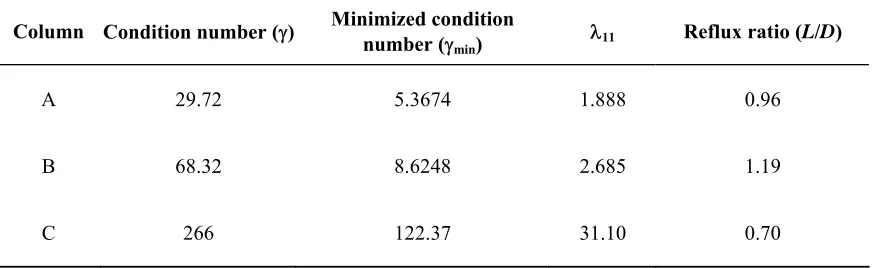
Table 1 shows the values of λ11 and γ for three different columns [25] using the LV -configuration. These values are also obtained for seven different columns [26] using the LV-configuration (Table 2). It can be seen that columns with reflux ratios less than unity have large condition numbers (e.g., column C with reflux ratio 0.70 in Table 1 and column F with reflux ratio 0.45 in Table 2). In Table 3, values of λ11 and γ for different structures are shown. In this case the column with a DV-structure has a small value of λ11 compared with the other three structures. For the ratio structures, the double-ratio (D/(L+D))(V/B)-structure shows a smaller value of λ11 compared with the single-ratio (D/(L+D))V-structure. Now comparing the conventional LV-structure and the single-ratio (D/(L+D)) V-structure, although the value of λ11 for the single-ratio structure is less than the LV-structure, the value of the condition number for the single-ratio structure is much greater than the LV -structure, but this is not true for the minimized condition number. Therefore, γmin provides a better basis for comparison with respect to γ.
32 Iranian Journal of Chemical Engineering, Vol. 6, No. 2
equal to unity. This is obvious, since λ11 for this column is less than unity.
Frequency analysis
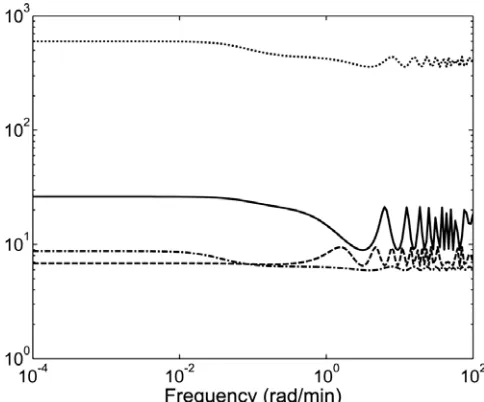
Fig. 1 shows the frequency behavior of the condition number of the four structures presented in Table 3. Among these structures, the DV-structure has a small oscillation over a wide range of frequencies (10–4–102); then, (D/(L+D))(V/B)-, (D/(L+D))V-, and LV-structure, respectively. This is in agreement with the observations for γmin of the structures. Again, in Fig. 2, the
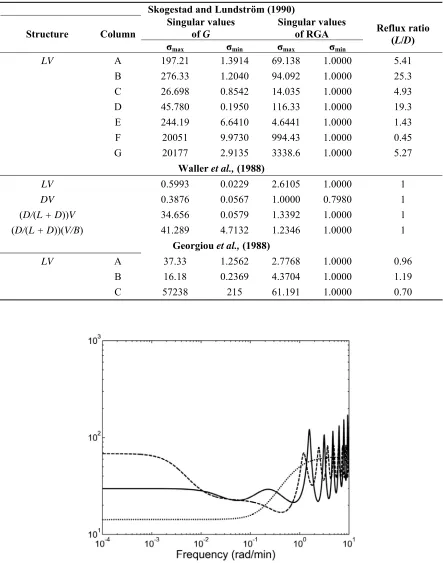
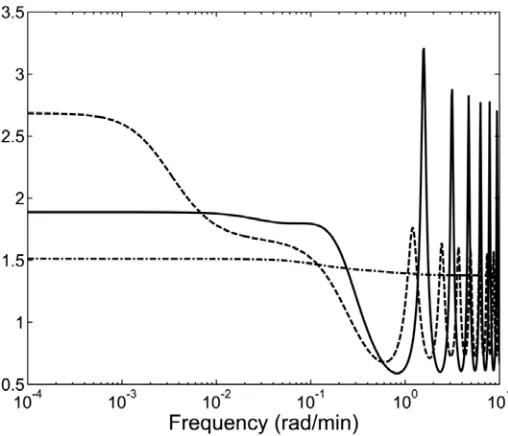
DV-structure has a small oscillation for λ11 over a wide range of frequencies and then, (D/(L+D))(V/B)-, (D/(L+D))V-, and LV -structure, respectively. Fig. 3 shows the frequency-dependent behavior of the condition number for columns A, B, and C [25] that use the LV-structure. Columns that have reflux ratio near unity have large oscillations at higher frequencies (A and B), while column C which has a reflux ratio of 0.7 shows small oscillation at higher frequencies. This is also true for 1,1-element of RGA (Fig. 4).
Table 1. Values of γ, γmin and λ11 for the column under study using the LV-structure (Georgiou et al., 1988).
Column Condition number (γ) Minimized condition number (γ
min) λ11 Reflux ratio (L/D)
A 29.72 5.3674 1.888 0.96
B 68.32 8.6248 2.685 1.19
C 266 122.37 31.10 0.70
Table 2. Values of γ, γmin and λ11 for the column under study using the LV-structure (Skogestad and Lundström, 1990).
Column number (γ) Condition Minimized condition number (γ
min) λ11 Reflux ratio (L/D)
A 141.7 138.3 35.1 5.41
B 229.5 188.2 47.5 25.3
C 31.26 28.04 7.52 4.93
D 234.8 232.7 58.7 19.3
E 36.74 9.179 2.82 1.43
F 2011 1989 498 0.45
Figure 1. Frequency-dependent behavior of condition number (γ) for the selected structures (Waller et al., 1988).
––LV; --- DV; ⋅⋅⋅⋅ (D/(L+D))V; -⋅-⋅- (D/(L+D))(V/B).
Table 3. Values of γ, γmin and λ11 of four different structures (Waller et al., 1988).
Structure Condition number (γ) Minimized condition number (γ
min) λ11
Reflux ratio (L/D)
LV 26.2 5.022 1.8053 1 DV 6.84 1.000 0.1010 1
(D/(L + D))V 599 2.230 1.1696 1
(D/(L + D))(V/B) 8.76 1.964 1.1182 1
34 Iranian Journal of Chemical Engineering, Vol. 6, No. 2 Table 4. SVD analysis of the columns under study
Skogestad and Lundström (1990) Singular values
of G
Singular values of RGA Structure Column
σmax σmin σmax σmin
Reflux ratio (L/D)
LV A 197.21 1.3914 69.138 1.0000 5.41
B 276.33 1.2040 94.092 1.0000 25.3
C 26.698 0.8542 14.035 1.0000 4.93
D 45.780 0.1950 116.33 1.0000 19.3
E 244.19 6.6410 4.6441 1.0000 1.43
F 20051 9.9730 994.43 1.0000 0.45
G 20177 2.9135 3338.6 1.0000 5.27
Waller et al., (1988)
LV 0.5993 0.0229 2.6105 1.0000 1
DV 0.3876 0.0567 1.0000 0.7980 1
(D/(L + D))V 34.656 0.0579 1.3392 1.0000 1
(D/(L + D))(V/B) 41.289 4.7132 1.2346 1.0000 1
Georgiou et al., (1988)
LV A 37.33 1.2562 2.7768 1.0000 0.96
B 16.18 0.2369 4.3704 1.0000 1.19
C 57238 215 61.191 1.0000 0.70
Figure 3. Frequency-dependent behavior of condition number (γ) for three different columns using the LV-structure (Georgiou et al., 1988). –– Column A (L/D = 0.96); --- Column B (L/D = 1.19); ⋅⋅⋅⋅ Column
Figure 4. Frequency-dependent behavior of 1,1-element of RGA (λ11) for three different columns using the LV-structure (Georgiou et al., 1988). –– Column A (L/D = 0.96); --- Column B (L/D = 1.19); -⋅-⋅- Column C
(L/D = 0.70).
Concluding remarks
A survey is performed for the selection of appropriate distillation control structure based on the analysis of the properties of the plant transfer function, namely condition number and singular values. Although this survey was done for a limited number of columns, the results can be extended to a large number of columns, since these findings are based on some theoretical measurements of the plant transfer function. The concluded results can be summarized as follows:
1. Columns that have reflux ratio much smaller than unity or much greater than five show large (minimized) condition number.
2. Double-ratio structures are superior to the single ratio structure, although in practice, ratio structure are merely used (because of difficulties in the tuning of such controllers).
3. Minimized condition number provides a better basis for comparison of structures if λ11> 1.
Nomenclature
G Plant transfer function
gij Open-loop gain from the jth input to the ith output
γ Condition number
Λ Relative gain array (RGA)
λ Element of RGA
σ Singular value ||⋅||1 1-norm of (⋅) ||⋅||∞ ∞-norm of (⋅) References
1. Shinskey, F.G., Distillation Control. 2nd ed., McGraw-Hill, New York (1984).
2. Skogestad, S., and Morari, M., “Control configuration selection for distillation columns”, AIChE J., 33(10), 1620–1635 (1987a).
3. Finco, M.V., Luyben, W.L., and Polleck, R.E. “Control of distillation columns with low relative volatilities”, Ind. Eng. Chem. Res.,
28(1), 75–83 (1989).
36 Iranian Journal of Chemical Engineering, Vol. 6, No. 2
5. Skogestad, S., Jacobsen, E.W., and Morari, M., “Inadequacy of steady-state analysis for feedback control: Distillate-bottom control of distillation columns”, Ind. Eng. Chem. Res., 29(12), 2339–2346 (1990).
6. Yi, C.K., and Luyben, W.L., “Evaluation of plant-wide control structures by steady-state disturbance sensitivity analysis”, Ind. Eng. Chem. Res., 34(7), 2393–2405 (1995). 7. Bian, S., and Henson, M.A., “Measurement
selection for on-line estimation of nonlinear wave models for high-purity distillation columns”, Chem. Eng. Sci., 61(10), 3210– 3222 (2006).
8. Kariwala, V., “Optimal measurement combination for local self optimizing control”, Ind. Eng. Chem. Res., 46(11), 3629–3634(2007).
9. Bristol, E.H., “On a new measure of interactions for multivariable process control”, IEEE Trans. on Autom. Control,
AC-11, 133–134 (1966).
10. Doyle, J.C., “Analysis of feedback systems with structured uncertainties”, IEE Proce-edings, 129(6), 242–250 (1982).
11. Lau, H., Alvarez, J., and Jensen, K.F., “Synthesis of control structures by singular value analysis: Dynamic measures of sensitivity and interaction”, AIChE J., 31(3), 427–439 (1985).
12. Papastathopoulou, H.S., and Luyben, W.L., “Control of a binary sidestream distillation column”, Ind. Eng. Chem. Res., 30(4), 705– 713 (1991).
13. Hori, E.S., and Skogestad, S., “Selection of control structure and temperature location for two-product distillation columns”, Chem. Eng. Res. Des., 85(A3), 293 (2007).
14. Hori, E.S., and Skogestad, S., “Selection of controlled variables: Maximum gain rule and combination of measurements”, Ind. Eng. Chem. Res., 47(23), 9465–9471 (2008). 15. Waller, J.B., Sågfors, M.F., and Waller, K.E., “Ill-conditionedness and process direc-tionality—The use of condition numbers in process control”, Proceedings of IFAC Symposium, Kyoto, Japan, pp. 465–470 (1994).
16. Doyle, J.C., and Stein, G., “Multivariable feedback design: Concepts for a classical/-modern synthesis”, IEEE Trans. Autom. Control, 26, 4–16 (1981).
17. Freudenberg, J.S., “Analysis and design for ill-conditioned plants. Part 1. Lower bounds
on the structured singular value”, Int. J. Control, 49(3), 851–871 (1988a).
18. Li, W., and Lee, J.H. “Control relevant identification of ill-conditioned systems: Estimation of gain directionality”, Comput. Chem. Eng., 20(8), 1023–1042 (1996). 19. Halvorsen, I.J., Skogestad, S., Morud, J.C.,
and Alstad, V., “Optimal selection of controlled variables”, Ind. Eng. Chem. Res.,
42(14), 3273–3284 (2003).
20. Shahraki, F., and Razzaghi, K., “On a problem regarding process gain direc-tionality error measures”, The 55th Canadian Chemical Engineering Con-ference, Torento, Ontario, December 16–19 (2005).
21. Skogestad, S., and Morari, M., “Implications of large RGA elements on control performance”, Ind. Eng. Chem. Res., 26(11), 2323–2330 (1987b).
22. Skogestad, S., and Morari, M., “Understanding the dynamic behavior of distillation columns”, Ind. Eng. Chem. Res.,
27(10), 1848–1862 (1988).
23. Grosdidier, P., Morari, M., and Holt, B. R. “Closed-loop properties from steady-state gain information”, Ind. Eng. Chem. Fundam., 24(2), 221–235 (1985).
24. Nett, C.N., and Manousiouthakis, V. “Euclidean condition number and block relative gain: Connections, conjectures and clarifications”, IEEE Trans. Autom. Control,
AC-32(5), 405–407 (1987).
25. Georgiou, A., Georgakis, C., and Luyben, W.L., “Nonlinear dynamic matrix control for high-purity distillation columns”, AIChE J., 34(8), 106–115 (1988).
26. Skogestad, S., and Lundström, P., “Mu-optimal LV-control of distillation columns”, Comput. Chem. Eng., 14(4–5), 401–413 (1990).
27. Freudenberg, J.S., “Analysis and design for ill-conditioned plants. Part 2. Directionally uniform weightings and an example”, Int. J. Control, 49(3), 873–903 (1989b).
28. Waller, K., Häggblom, K., Sandelin, P., and Finnerman, D., “Disturbance sensitivity of distillation control structures”, AIChE J.,