Volume 2, 2018, Pages 152–161
SUMO 2018- Simulating Autonomous and Intermodal Transport Systems
A new strategy for synchronizing traffic flow on a
distributed simulation using SUMO
Nicol´
as Arroyo
1, Andr´
es Acosta
1, Jairo Espinosa
1, and Jorge Espinosa
21 Universidad Nacional de Colombia, Medell´ın, Antioquia, Colombia
{jarroyo,afacosta,jespinov}@unal.edu.co
2 Polit´ecnico Colombiano Jaime Isaza Cadavid, Medell´ın, Antioquia, Colombia
Abstract
The Project Modelling and Control of Urban Traffic in the City of Medell´ın (MOY-COT) has produced multiple results in modelling, simulation and control of multimodal urban traffic using the SUMO simulator. As the simulations became more complex the necessity to distribute the computational load rose. Therefore, an approach for network partitioning and border edges management was introduced. In this paper a new border edge management strategy is presented for distributed simulation with SUMO. Unlike the previous approaches, which were developed in Python programming language using the corresponding TraCI client and tools such as sumolib, the strategy presented in this work was developed in C++ using the TraCI client for this language. Additionally, this strategy involves a simplified process for network partitioning since the border edges are preserved in every partition, without the need of splitting them. In this case, neighboring partitions behave in a master-slave fashion, depending on whether the border edge is an incoming edge or an outgoing edge. Concretely, a given partition is a master for its incoming edges and a slave for its outgoing ones. Furthermore, all the vehicles are found in the master and the slave partitions, where the master partition controls its slaves through the TraCI commandsslowDownandmoveTothat correct the position of these vehicles. Simulation results show that this new strategy presents better precision than the previous one. The description of the new procedure for border edge management is detailed. Finally, it is compared with the previous approach and the non-distributed simulation using a free flow scenario and a scenario with queue formation is presented.
1
Introduction
presented, which is based on a master-slave scheme where a given partition acts as a master for incoming traffic and as a slave for outgoing traffic. The strategy works by correcting the posi-tion of each vehicle found in the boundary edges at each time step. This article is organized, as follows: Section2details the implementation of the proposed synchronization strategy. Section
3presents simulation results. Finally, section4concludes the article.
2
Implementation
To parallelize the simulation, partitioning of the scenario and its routes is required, to accom-plish this the method proposed in [1] was used. From this, multiple scenarios were obtained to test their behavior when parallelized. Then, the partitions must be synchronized with each other to guarantee results similar to the centralized simulation.
2.1
Synchronization
A new synchronization method was proposed following a master-slave scheme. From the parti-tioning, the edges that are common to neighboring partitions can be obtained. One of the nodes of these common edges has to be a ”dead-end” node while the other one is connected to the rest of the network of the partition. The strategy works in such a way that vehicles in the these boundary edges are found simultaneously in the partitions connected by them. If the vehicles of an edge travel towards the ”dead-end” node it means that these vehicles will finish their trip in the current partition and are unaware of the state of the next one. In the other partition, the same vehicles travel from the ”dead-end” node and are constrained to the conditions of this new partition, such as traffic lights, queues, accidents, etc. A method to propagate the effects of this new partition to the previous one must be implemented.
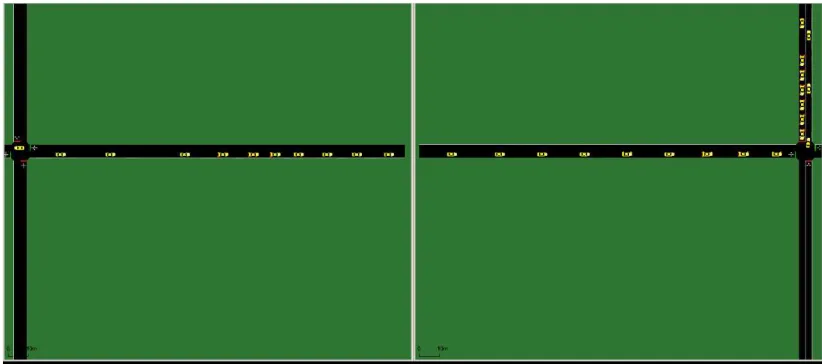
The partition in which the vehicles travel towards the ”dead-end” node acts as a slave par-tition in that edge because the vehicles must follow, blindly, the conditions imposed by their counterpart in the edge of the master partition. This means that position, speed and acceler-ation of the vehicles in the slave partition are determined by those in the edge of the master partition and the edge in the master partition is left as is. Then, the new vehicles that enter the slave edge are entered in the master edge as well. A partition can act as both, master and slave, for the different edges, e.g. a two-way road. Figure 1 is an example in free flow and Figure2is an example in congestion of this method.
Figure 1: Vehicles in free flow, (Slave-left Master-right)
Figure 2: Propagation of queue, both partitions act as master and slave for the two edges
This algorithm was developed with the TraCIAPI in C++, in order to exploit the language’s multi-threading and shared memory features. To manage the partitions, a class to collect the necessary data and send the synchronizing commands to each one of them and a class to syn-chronize all partitions were created. The commands used to synsyn-chronize the vehicles in slave boundary edges wereadd,moveToandslowDownfrom the vehicle scope.
3
Results
3.1
Scenarios
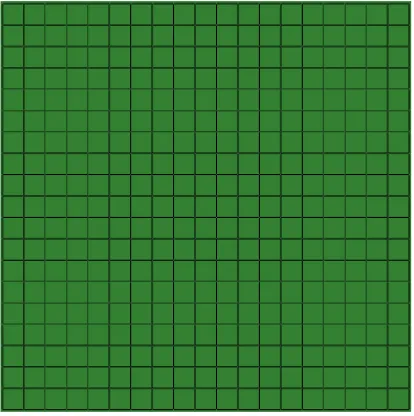
The implemented scenarios are based on a 20x20 square as seen in figure3. Vehicles depart from the left side and the right side and their final destination is the opposite side. For this scenario, the routes of all vehicles are straight lines and the traffic demand was 3300 vehicles per hour. As it is, it can be divided into two partitions with 40 boundaries, 20 bidirectional roads, as shown in figure4. Then, the number of boundaries and partitions were modified to create new scenarios for the analysis.
Figure 3: Base scenario for simulations
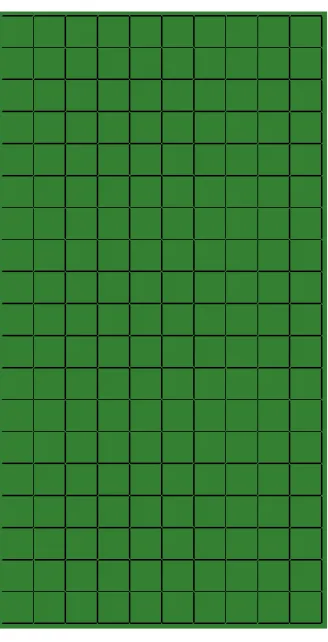
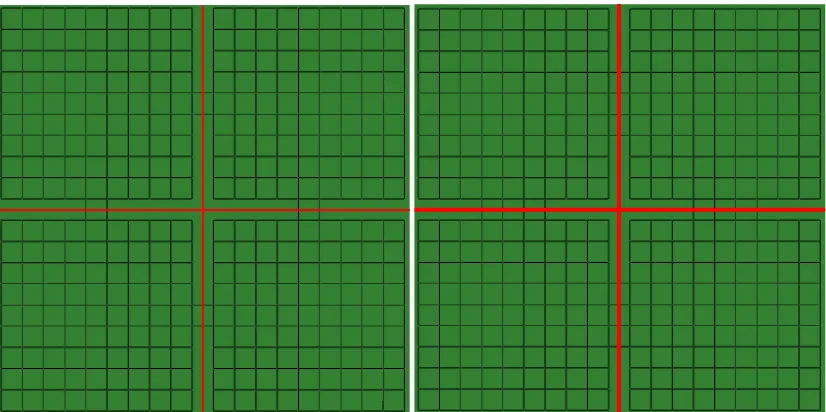
In order to analyze the effect of the number of boundaries, they were reduced. An example of a scenario with 8 boundaries can be seen in figure 5. This scenario can be divided into two partitions and the routes are not straight lines. Furthermore, the base scenario was also partitioned into 4 parts with 4 boundaries and with 8 boundaries as seen in figure6. Finally, the base scenario was divided into 16 partitions (5x5 squares) with 10 common edges for each of the adjacent simulations.
3.2
Performace and precision
For performance, the time of the simulation was used; for precision, the distance between a vehicle in centralized and the same vehicle in parallel at the same time was used. All of the results shown use TraCI with shared memory.
(a) Left side of base scenario (b) Right side of base scenario
Figure 4: Base scenario on two partitions
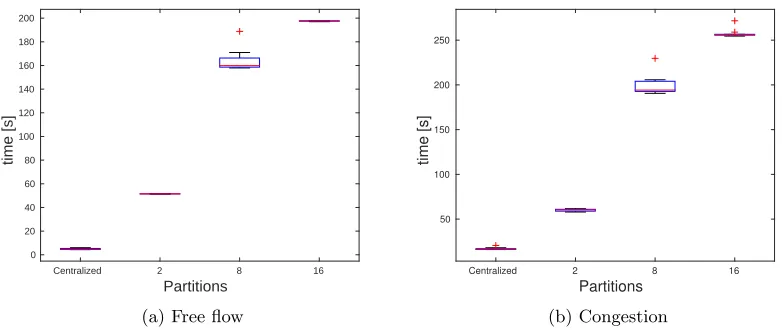
behavior can be explained by the high usage of TraCI to synchronize the partitions which is much slower than the simulation. To prove it, performance of simulations where TraCI was heavily used was also measured. The position and name of all the vehicles were taken on every simulation step, the results are shown in tables1 and2.
Free Flow
Boundaries Centralized Time [s] Parallel Time [s] Fraction [%]
4 238.3 85.2 35.8%
8 228.8 97.3 42.5%
40 196.2 121.8 62.1%
Table 1: Mean simulation times for 4 partitions and communication via TraCI in free flow
Figure 5: Base scenario with 8 boundaries
(a) Base scenario with 4 boundaries and 4 partitions (b) Base scenario with 8 boundaries and 4 partitions
Figure 6: Base scenario with 4 partitions
communication via TraCI. Furthermore, the average utilization of the threads used for the parallel simulation did not exceed 5% of usage.
The precision for the different scenarios is shown in figure 9 The data collected for tables
Partitions
Centralized 2 4
time [s] 5 10 15 20 25 30 35 40
(a) Free flow
Partitions
Centralized 2 4
time [s] 5 10 15 20 25 30 35 (b) Congestion
Figure 7: Simulation time for vehicles using different number of partitions
Partitions
Centralized 2 8 16
time [s] 0 20 40 60 80 100 120 140 160 180 200
(a) Free flow
Partitions
Centralized 2 8 16
time [s] 50 100 150 200 250 (b) Congestion
Figure 8: Simulation time for vehicles using different number of partitions and 40-edge boundary
cases where the mean error is higher. Samples are more than 3000 vehicles per simulation. As expected, the error for free flow condition is almost zero with some few exceptions, only two outliers for both 4 and 8 partitions scenarios. When the simulation encountered congestion, the outliers increased significantly but the average was still around zero and most of the errors were below 10 meters.
Congestion
Boundaries Centralized Time [s] Parallel Time [s] Fraction [%]
4 264.8 93.0 35.1%
8 253.5 100.3 40.0%
40 868.9 318.5 36.7%
Table 2: Mean simulation times for 4 partitions and communication via TraCI in congestion conditions
4Part 4Part-cong 8Part 8Part-cong
Error [m]
0 5 10 15 20 25 30 35 40
Figure 9: Precision using different partitions for a 40 boundary-edge scenario
a vehicle to be delayed or advanced one second can mean to skip or have a red light that was not present in the centralized simulation for the same vehicle. This error will be sustained until the vehicle finishes its trajectory, thus the reason of these outliers in the congestion scenarios.
4
Conclusions
In this paper, a method to parallelize the simulation of a scenario using SUMO was proposed. The results show that in terms of precision the method is acceptable but partitioning in a boundary with a traffic light will increase the error and this error is proportional to the amount of partitions with traffic lights or any other condition that is affected by a traffic light cycle. In terms of performance, a parallel simulation is slower than its centralized counterpart due to the synchronization process that is done via TraCI. When both simulations need a heavily usage of TraCI, parallel simulation is far superior to centralized. From these, it can be concluded that:
1. Although the process of partitioning a network is relatively easy to accomplish, there is not an algorithm to find an optimal partitioning of the network for the different possible configurations of a parallel simulation.
2. To accomplish a general better performance of the parallelized simulation over the cen-tralized, and not only when TraCI is heavily used, it is necessary to synchronize and simulate the different partitions from within SUMO.
5
Acknowledgements
This work was supported by COLCIENCIAS project: Reducci´on de Emisiones Vehiculares Mediante el Modelado y Gesti´on ´Optima de Tr´afico en ´Areas Metropolitanas - Caso Medell´ın - ´Area Metropolitana del Valle de Aburr´a, c´odigo 111874558167, CT 049-2017. Universidad Nacional de Colombia. Proyecto HERMES 25374.
References
[1] A Acosta, J Espinosa, and J Espinosa. Distributed Simulation in SUMO Revisited: Strategies for Network Partitioning and Border Edges Management. InProceedings of the 4th SUMO User Conference, pages 61–71, Berlin, 2016. Deutsches Zentrum f¨ur Luft- und Raumfahrt e.V.
[2] R Blokpoel. Interface between proprietary Controllers and SUMO. InProceedings of the 2nd SUMO User Conference, pages 27–33, Berlin, 2014. Deutsches Zentrum f¨ur Luft- und Raumfahrt e.V. [3] R Blokpoel. Network Conversion for SUMO Integration. InProceedings of the 2nd SUMO User
Conference, pages 35–44, Berlin, 2014. Deutsches Zentrum f¨ur Luft- und Raumfahrt e.V.
[4] Quentin Bragard, Anthony Ventresque, and Liam Murphy. dSUMO: towards a distributed SUMO - Simulation of Urban MObility. 2013.
[5] J Eising, F Fischer, J Flaig, O Florian, C Fritze, K Indych, M Montenegro, S M¨uller, M Schneider, N Vieregg, A Wegge, H D¨obler, F Koller, O Menzel, S Dietzel, and B Scheuermann. PARCOURS: A SUMO-Integrated 3D Driving Simulator for Behavioral Studies. InProceedings of the 4th SUMO User Conference, pages 135–146, Berlin, 2016. Deutsches Zentrum f¨ur Luft - und Raumfahrt e.V. [6] P Heywood, S Maddock, J Casas, D Garcia, M Brackstone, and P Richmond. Data-parallel
agent-based microscopic road network simulation using graphics processing units. Simulation Modelling Practice and Theory, 1(13), 2017.
[7] J Jin and X Ma. Stochastic optimization of signal plan and coordination using parallelized traffic simulation. InProceedings of the 2nd SUMO User Conference, Berlin, 2014. Deutsches Zentrum f¨ur Luft - und Raumfahrt e.V.