Douglas-fir beetle lipid levels in relation
to tree physical characteristics
KEVIN J. DODDS
1, 2and DARRELL W. ROSS
1ABSTRACT
The relationship of Douglas-fir beetle, Dendroctonus pseudotsugae Hopkins, brood adult lipid levels and position of development along infested tree boles was investigated. In addition, the effects of phloem and bark thickness on brood adult lipid levels were also tested. There were no significant differences (P > 0.05) in brood adult lipid levels in relation to bole position, phloem thickness, or bark thickness found in this study. Numbers of attacks, larval mines, brood adults, and parasitoid cocoons did not differ significantly by tree bole position. Results from this study suggest Douglas-fir beetle does not benefit, in the form of increased lipid levels, from oviposition at different bole positions.
Key Words:Dendroctonus pseudotsugae, lipids, phloem thickness, optimal habitat
INTRODUCTION
Bark beetles are economicallyimpor-tant insects and knowledge of factors that affect their flight and dispersal behavior could be useful for improving existing management techniques or developing new ones. Within a population beetles display varying degrees of flight capabilities from extended flight periods to those incapable of flight (Atkins 1966; Jactel 1993). This variation in flight capability can be related to a beetle’s physiological state.
Lipids are a source of energy for insect flight (Canavosa et al. 2001) and have been correlated with flight capabilities in bark beetles (Atkins 1966; Slansky and Haack 1986; Jactel 1993). Atkins (1966) found that Douglas-fir beetle (DFB), Den-droctonus pseudotsugae Hopkins, with high lipid levels were least likely to re-spond to pheromones and hence disperse, while beetles with low lipid levels re-sponded immediately to pheromones. Bennett and Borden (1971) found that a 90 minute flight was required before DFB responded to pheromones, suggesting the need to metabolize lipids before phero-mone arrestment occurred (Atkins 1969).
Relationships between lipid levels and responsiveness to host chemicals, phero-mone arrestment, or dispersal behavior have been found in other bark beetle spe-cies as well (Hagen and Atkins 1975; Hed-den and Billings 1977; Wallin and Raffa 2000). Because of their association with bark beetle dispersal potential, a better understanding of factors that influence lipid levels is important for understanding population movements.
Bark beetle lipid levels are influenced by temperature (Atkins 1967), attack den-sity (Atkins 1975; Botterweg 1983; Ander-brandt et al. 1985), mycangial fungi (Coppedge et al. 1995) and phloem thick-ness (Slansky and Haack 1986). However, with the exception of Ips calligraphus
(Germar) (Slansky and Haack 1986), it is unknown whether host tree characteristics affect lipid levels in bark beetle brood adults. Nutrient levels (N, P, Mg, Fe, Zn) vary by bole height on Douglas-fir, Pseu-dotsuga menziesii (Mirb.) Franco, tree boles and could influence patterns of insect colonization (Schowalter and Morrell 2002). In several Dendroctonus species,
1 Department of Forest Science, Oregon State University, Corvallis, OR 97331
initial attacks occur at or near mid-bole (Miller and Keen 1960; Fargo et al. 1978; Safranyik et al. 1992) possibly due to phloem nutrients at these heights. Conse-quently, brood developing at mid-bole could have higher lipid levels than brood developing elsewhere along the tree bole.
Other factors, such as parasitism or predation rates, could influence coloniza-tion behavior. Studies investigating the relationship between parasitoid density and tree height have produced mixed results.
Several studies found relationships be-tween parasitoid density and height on tree boles (Ryan and Rudinsky 1962; Mills 1986; Wermelinger 2002), while others have not (Gargiullo and Berisford 1981).
Our objectives were to determine if DFB brood development position along the length of tree boles and bark and phloem thickness affected lipid levels in brood adults and to determine the influence of bole position on attack density, larval mines, brood adults, and parasitoids.
MATERIALS AND METHODS
Tree Sampling. On 27 to 29 April,2002, prior to the DFB flight period, nine Douglas-fir trees infested the previous year were felled and sampled from a small stand (< 1 ha) of pure Douglas-fir in the Rock Creek Area (N 46° 34.619’ W 113° 40.067’), 60 km southeast of Missoula, MT. The sample trees ranged in diameter from 40.2 to 71.6 cm. An additional six trees were felled and sampled from one Douglas-fir stand on the Flathead National Forest (N 46° 25.316; W 114° 37.995) near Whitefish, MT on 6 April, 2003. How-ever, because DFB attacks were only suc-cessful on small portions of the tree boles, only two of the six additional trees (41.1 and 53.3 cm diameter breast height) were suitable for use in this study. Pheromone baiting live trees prior to DFB flight was considered, but concerns over initiating large infestations on federal lands and the unnatural selection of host trees necessi-tated avoidance of this method. All sample trees in this study were naturally selected and colonized by DFB.
The portion of each tree bole infested by DFB was distinguished by the presence of successful egg galleries and brood adults. Total length of infested tree boles and dbh were recorded. Infested tree bole lengths ranged from 6.7 to 14.6 m ( = 9.7 m, SE ± 0.8). Bark samples were collected at three positions along the infested tree bole: 2 m up from the bottom of the infes-tation, the mid-point of the infested tree bole, and 2 m down from the top of the
infestation.
Four bark samples were collected from each bole position. Bark samples were taken randomly around the circumference of each tree. A 100-cm2 hole saw attached to a power drill was used to remove bark samples from the infested tree. Bark sam-ples were removed and placed individually in labeled plastic bags. Samples were transported to the laboratory on ice and stored in a freezer at -10 °C until proc-essed. Phloem thickness was measured on a subsample of bark samples before and after freezing. No differences in the aver-age phloem thicknesses before and after freezing were found (KJD, unpublished data).
Bark Analysis. Brood adults were re-moved from bark samples and placed indi-vidually in numbered 7 ml glass vials with caps attached. Numbers of DFB entrance holes, larval mines, parasitoid cocoons, and bark and phloem thickness were re-corded for each bark sample. Bark thick-ness was measured on four locations around each bark sample, while phloem thickness was measured in two locations. To account for bark thickness variability, the minimum and maximum thicknesses on each sample were recorded along with two random measurements.
Lipid Analysis. Beetles (n = 283 from 2002, 73 from 2003) removed from bark samples were placed in an oven to dry at 70 °C for 48 h then weighed. To deter-mine the lipid levels of individual beetles,
petroleum ether was used to remove lipids with methods modified from Langor et al.
(1990). Briefly, 5 ml of petroleum ether was added to each vial, the vial was capped, and then placed in a drying oven at 50 °C for 24 h. Petroleum ether was re-moved and replaced with fresh solvent every 24 h for a total of 72 h. After the extraction was complete, beetles were oven dried for 48 h and reweighed. To ensure all lipids were extracted, dried beetles were again placed in petroleum ether for 24 h, oven dried for 48 h, and reweighed. Be-cause there was no change in their ex-tracted weights, it was assumed all extract-able lipids were removed from the beetles during the initial 72-h process. Lipid lev-els were calculated as percent loss in dry weight. Beetles that had 0% lipid levels were assumed dead at the time of sampling and discarded from the study.
Gender of each DFB brood adult was determined (Jantz and Johnsey 1964). In addition, pronotal width of each beetle was measured using microcalipers and a dis-secting microscope.
Statistical Analysis. Analyses of vari-ance (PROC MIXED, SAS 8.0) were
con-ducted with trees as blocks and bark and beetle samples grouped by bole position to test for differences in bark and phloem thickness, numbers of entrance holes, brood adults, parasitoid cocoons, and lar-val galleries by height. Residual and nor-mality plots were visually interpreted for homogenous variances and normality. Where necessary, data were log trans-formed to meet ANOVA assumptions of normality or variability. Means were com-pared and separated using Tukey pairwise comparisons. Regression analysis was used to determine if there was a relation-ship between the average lipid levels and number of brood adults found in each bark sample. In addition, relationships between bark and phloem thickness, and lipid levels and pronotal widths were analyzed using analysis of covariance. Analysis of covari-ance was also used to investigate the rela-tionship between parasitoid abundance and bark thickness. Differences in lipid levels and pronotal width by gender were as-sessed using ANOVA. All reported means and confidence limits were backtrans-formed from data used in the statistical analyses.
RESULTS
There were no significant differences between brood adult lipid levels and bole position (F2, 20 = 0.75, P = 0.48). Overall lipid levels ranged from 3.12% to 43.08% and averaged 21.3 (95% CL = 17.8-25.5), 23.6 (19.5-28.2), and 21.8 (18.0-26.3) for the bottom, middle, and top position re-spectively. Less than 26% of beetles from both sample years had ≤ 15% lipid levels (Figure 1). The largest number of beetles from all three bole positions had between 25-35% lipids, while very few had ≤ 5% lipids (Figure 2). Analysis of covariance indicated there was no significant relation-ship between phloem thickness (F2, 20= 0.87, P = 0.43) or bark thickness (F2, 20= 0.73, P = 0.49) and lipid levels. Phloem thickness ranged from 1.5 mm to 4.9 mm, while bark thickness ranged from 7.5 mm to 32.6 mm. There were no significantrelationships between pronotal width and bole position (F2, 20= 2.02, P = 0.16), phloem thickness (F2, 20= 1.89, P = 0.18), or bark thickness (F2, 20= 0.34, P = 0.72).
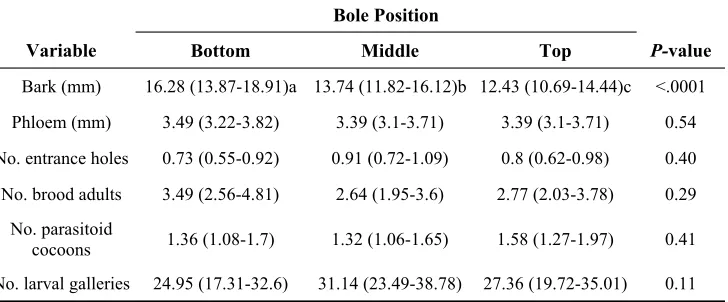
Phloem thickness, numbers of entrance holes, larval mines, brood adults, and para-sitoid cocoons were not significantly dif-ferent among the three bole positions (Table 1). However, bark thickness was significantly different among the three heights (F2, 20= 32.74, P < 0.0001). Bark at the bottom was thicker than the middle (t20 = 4.95, P = 0.0002) and top (t20 = 8.02, P < 0.0001) of tree boles, while the middle was also thicker than the top (t20 = 3.07, P = 0.02). There was no significant relation-ship between lipid levels and number of brood adults in bark samples (F1,105= 1.44,
number of parasitoids and bark thickness (F2, 20= 0.92, P = 0.42).
Overall, the gender of brood adults was 55% female and 45% male. Average brood adult lipid levels were significantly higher in female (25.3%, CL = 22.4%,
28.2%) than in male (23.0%, CL = 20.1%, 26.0%) DFB (F1, 322 = 6.88, P = 0.009). There was no difference in pronotal width between male and female DFB (F1, 318 = 0.16, P = 0.70).
0-5 5-10 10-15 15-20 20-25 25-30 30-35 35-40 40-45 0
5 10 15 20 25 30 35
# of
Be
et
le
s
Lipid Levels (%)
Bottom
Middle
Top
Figure 2. Frequency distribution of Douglas-fir beetle brood adult lipid levels (%) by bole position. n = 356.
Figure 1. Frequency distribution of the proportion of Douglas-fir beetle brood adults by lipid levels (%) in 2002 (n = 283) and 2003 (n = 73).
0-5 5-10 10-15 15-20 20-25 25-30 30-35 35-40 40-45
0 5 10 15 20 25
Pr
opor
tion
of b
eetl
es
Lipid Levels (%)
2002
DISCUSSION
Intraspecific competition has beencor-related with lipid levels in DFB and other bark beetle species, (Atkins 1975; Botter-weg 1983; Anderbrant et al. 1985), and must be considered when evaluating fac-tors that influence brood adult lipid levels. Because entrance holes, larval mines, and brood adult densities were equal at the three bole positions, it was assumed devel-oping brood encountered similar intras-pecific competition levels at each position. Therefore, intraspecific competition should not have influenced lipid levels in this study.
Lipid level was not influenced by bole position or phloem thickness in this study. However, unmeasured factors such as phloem quality (e.g., nutrient level), gut flora, genetics, or length of feeding could also influence lipid levels. Ayres et al.
(2000) found a positive relationship be-t w e e n D e n d r o c t o n u s f r o n t a l i s
Zimmermann size and phloem nitrogen levels of infested trees, demonstrating that phloem qualitative characters determine fitness attributes of phloem-feeding in-sects. Phloem nutritional levels at the three bole positions were not sampled in this study because sampled trees were already
colonized and extensively fed upon by bark beetle brood and associated insects (e.g., Cerambycidae and Buprestidae) at the time of sampling.
There was no relationship between bark thickness and lipid content of DFB. Bark thickness imparts some level of insulation on host tree phloem (Graham 1924; Beal 1934; Powell 1967) and influences bark beetle brood survival during cold periods (Miller and Keen 1960). Consequently, bark thickness may have influenced lipid levels in this study, but differences may have been undetected due to the sampling procedure. Bark samples were not parti-tioned by cardinal direction, thus aspect-related differences in lipid levels could not be analyzed.
Female brood adults had higher lipid levels than males in sample trees, while pronotal widths were equal between the sexes. In Dendroctonus species, females locate and initiate colonization of host trees. This supports the hypothesis that higher energy levels benefit dispersing females that must locate, colonize, and release aggregation pheromones that attract conspecifics to overwhelm host tree de-fenses. Similarly, Anderbrant et al. (1985)
Table 1.
Mean (95% CL) bark and phloem thickness and Douglas-fir beetle and parasitoid population parameters from 100-cm2 bark samples taken at three bole positions. Means followed by the same letter are non-significant as determined by Tukey’s pairwise comparisons (α = 0.05). Eleven trees were sampled, with a total of n = 44 bark samples taken from each of the three bole position.
Bole Position
Variable Bottom Middle Top P-value
Bark (mm) 16.28 (13.87-18.91)a 13.74 (11.82-16.12)b 12.43 (10.69-14.44)c <.0001
Phloem (mm) 3.49 (3.22-3.82) 3.39 (3.1-3.71) 3.39 (3.1-3.71) 0.54
No. entrance holes 0.73 (0.55-0.92) 0.91 (0.72-1.09) 0.8 (0.62-0.98) 0.40
No. brood adults 3.49 (2.56-4.81) 2.64 (1.95-3.6) 2.77 (2.03-3.78) 0.29
No. parasitoid
cocoons 1.36 (1.08-1.7) 1.32 (1.06-1.65) 1.58 (1.27-1.97) 0.41
found higher lipid levels in male Ips typog-raphus (L.) and attributed this to males being the colonizing sex, and therefore benefiting from increased energy reserves.
Atkins (1966) determined that DFB adults with lipid levels of less than 10% were unlikely to fly, those with 11-20% lipid content can fly and respond to phero-mones, and brood adults with over 20% lipid content disperse but are less likely to respond to pheromones. In the current study, the majority of beetles from both sample years had > 20% lipids (Figure 1). Based on Atkins (1966) data for potential to disperse, 67.7% of beetles sampled in this study, regardless of the bole position where they developed, would be capable of long distance dispersal.
There were no differences between parasitoid densities at each bole position. Although bark was significantly thinner at the upper bole position, an attribute com-monly associated with higher parasitism levels, there was not a higher level of sitoid abundance found there. Likely, para-sitoids are exploiting thin bark portions or bark crevices at all positions.
Bark beetles colonizing host trees are affected by natural predators (Reeve 1997; Aukema and Raffa 2002), competitors (Schroeder and Weslien 1994; Dodds et al.
2001), and host tree defenses (Raffa and Berryman 1983). In addition to minimiz-ing interactions with these mortality fac-tors, bark beetles must also locate areas that are suitable for brood development and reproductive success. If lipid levels
are viewed as a relative fitness measure, there seems to be no benefit to oviposition on different bole positions for developing DFB brood. Consequently, it is unlikely that the colonization behavior of attacking the mid-bole first, is a fitness response to seeking out and exploiting optimal habitat for developing brood. While no relation-ship between lipids and bole position were found, other factors (e.g., avoidance of predators or host tree defenses) might make oviposition at the mid-bole benefi-cial.
Results from this study suggest DFB brood adult lipid levels are not influenced by tree phloem or bark thickness. How-ever, due to low DFB populations in the study area, the number of infested trees available to sample was lower than antici-pated. Consequently, several of the re-sponse variables measured had wide 95% CL ranges that may have been smaller had more trees been available to sample. If the number of sample trees had been in-creased,differences in lipid levels between the three bole positions may have been detected.
Beetles emerging from different host trees within or between forest stands could explain the population level variations in brood adult lipid levels and subsequent flight behaviors found in wild populations. Further studies into the direct relationship of phloem characteristics and lipid levels may help explain landscape level dispersal behaviors of DFB and mortality patterns attributed to this beetle.
ACKNOWLEDGEMENTS
The authors would like to thank Ken Gibson (USDA Forest Service, Forest Health Protection, Missoula, MT) and Ed Lieser (USDA Forest Service, Flathead National Forest, Tally Lake Ranger Dis-trict) for help locating Douglas-fir beetle infested trees. Mike Armstrong, Missoula, MT generously allowed access to his land
and cutting of infested trees. Rick Kelsey (USDA Forest Service, Pacific Northwest Research Station) provided access to lab equipment. Laëtitia Plewinski provided lab assistance. Kimberly F. Wallin (Oregon State University) provided comments on an earlier draft of this work.
REFERENCES
Atkins, M.D. 1966. Laboratory studies on the behaviour of the Douglas-fir beetle, Dendroctonus pseu-dotsugae Hopk. The Canadian Entomologist. 98: 953-991.
Atkins, M.D. 1967. The effect of rearing temperature on the size and fat content of the Douglas-fir bee-tle. The Canadian Entomologist. 99: 181-187.
Atkins, M. D. 1969. Lipid loss with flight in the Douglas-fir beetle. The Canadian Entomologist 101: 164-165.
Atkins, M.D. 1975. On factors affecting the size, fat content and behavior of a scolytid. The Canadian Entomologist. 78: 209-218.
Aukema, B.H. and K.F. Raffa. 2002. Relative effects of exophytic predation, endophytic predation, and intraspecific competition on a subcortical herbivore: consequences to the reproduction of Ips pini and Thanasimus dubius. Oecologia. 133: 483-491.
Ayres, M.P., R.T. Wilkens, J.J. Ruel, M.J. Lombardero, and E. Vallery. 2000. Nitrogen budgets of phloem-feeding bark beetles with and without symbiotic fungi. Ecology. 81: 2198-2210.
Beal, J.A. 1934. Relation of air and bark temperatures of infested ponderosa pines during subzero weather. Journal of Economic Entomology. 27:1132-1139.
Bennett, R.B. and J.H. Borden. 1971. Flight arrestment of tethered Dendroctonus pseutotsugae and Try-podendron lineatum (Coleoptera: Scolytidae) in response to olfactory stimuli. Annals of the Entomo-logical Society of America. 64: 1273-1286.
Botterweg, P.F. 1983. The effect of attack density on size, fat content and emergence of the spruce bark beetle Ips typographus L. Journal of Applied Entomology. 96: 47-55.
Canavoso, L.E., Z.E. Jouni, K.J. Karnas, J.E. Pennington, and M.E. Wells. 2001. Fat metabolism in in-sects. Annual Review of Nutrition. 21: 23-46.
Coppedge, B.R., F.M. Stephen, and G.W. Felton. 1995. Variation in female southern pine beetle size and lipid content in relation to fungal associates. The Canadian Entomologist. 127: 145-154.
Dodds, K.J., C. Graber, and F.M. Stephen. 2001. Facultative intraguild predation by larval Cerambycidae (Coleoptera) on bark beetle larvae (Coleoptera: Scolytidae). Environmental Entomology. 30: 17-22. Fargo, W.S., R.N. Coulson, P.E. Pulley, D.N. Pope, and C.L. Kelley. 1978. Spatial and temporal patterns
of within-tree colonization by Dendroctonus frontalis (Coleoptera: Scolytidae). The Canadian Ento-mologist. 110: 1213-1232.
Gargiullo, P.M. and C.W. Berisford. 1981. Effects of host density and bark thickness on the densities of parasites of the southern pine beetle. Environmental Entomology. 10: 392-399.
Graham, S.A. 1924. Temperature as a limiting factor in the life of subcortical insects. Journal of Eco-nomic Entomology. 17: 377-383.
Hagen, B. W. and M. D. Atkins 1975. Between generation variability in the fat content and behavior of Ips paraconfusus Lanier. Zeitschrift für angewandte Entomologie. 79: 169-172.
Hedden, R.L. and R.F. Billings. 1977. Seasonal variation in fat content and size of the southern pine beetle in east Texas. Annals of the Entomological Society of America. 70: 876-880.
Jactel, H. 1993. Individual variability of the flight potential of Ips sexdentatus Boern. (Coleoptera: Scoly-tidae) in relation to day of emergence, sex, size, and lipid content. The Canadian Entomologist. 125: 919-930.
Jantz, O.K. and R.L. Johnsey. 1964. Determination of sex of the Douglas-fir beetle Dendroctonus pseu-dotsugae Hopkins (Coleoptera: Scolytidae). The Canadian Entomologist. 96: 1327-1329.
Langor, D.W., J.R. Spence, and G.R. Pohl. 1990. Host effects on fertility and reproductive success of Dendroctonus ponderosae Hopkins (Coleoptera: Scolytidae). Evolution. 44: 609-618.
Miller, J.M. and F.P. Keen, 1960. Biology and control of the western pine beetle. USDA Forest Service Miscellaneous Publication 800. 381 pp.
Mills, N.J. 1986. A preliminary analysis of the dynamics of within tree populations of Ips typographus (L.) (Coleoptera: Scolytidae). Journal of Applied Entomology. 102: 402-416.
Powell, J.M. 1967. A study of habitat temperatures of bark beetle Dendroctonus ponderosae Hopkins in lodgepole pine. Agricultural Meteorology. 4: 189-201.
Raffa, K.F. and A.A. Berryman. 1983. The role of host plant resistance in the colonization behavior and ecology of bark beetles (Coleoptera: Scolytidae). Ecological Monographs. 53: 27-49.
Reeve, J.D. 1997. Predation and bark beetle dynamics. Oecologia. 112: 48-54.
Ryan, R.B. and J.A. Rudinsky. 1962. Biology and habits of the Douglas-fir beetle parasite, Coeloides brunneri Viereck (Hymenoptera: Braconidae), in western Oregon. The Canadian Entomologist. 94:
748-763.
Safranyik, L., D.A. Linton, R. Silversides, and L.H. McMullen. 1992. Dispersal of released mountain pine beetles under the canopy of a mature lodgepole pine stand. Journal of Applied Entomology. 113: 441-450.
content of Ips calligraphus reared in slash pine bolts with thick or thin inner bark (phloem). Ento-mologia Experimentalis et Applicata. 40: 197-207.
Schowalter, T.D. and J.J. Morrell. 2002. Nutritional quality of Douglas-fir wood: effect of vertical and horizontal position on nutrient levels. Wood and Fiber Science. 34: 158-164.
Schroeder, L.M. and J. Weslien. 1994. Interactions between the phloem-feeding Tomicus piniperda (Col.: Scolytidae) and Acanthocinus aedilis (Col.: Cerambycidae), and the predator Thanasimus for-micarius (Col.: Cleridae) with special reference to brood production. Entomophaga. 39: 149-157. Wallin, K. F. and K. F. Raffa. 2000. Influences of host chemicals and internal physiology on the multiple
steps of postlanding host acceptance behavior of Ips pini (Coleoptera: Scolytidae). Environmental Entomology 29: 442-453.