Journal of Applied Linguistics and Language Research Volume 4, Issue 4, 2017, pp. 13-28
Available online at www.jallr.com ISSN: 2376-760X
* Correspondence: Mohsen Shahrokhi, Email: shahrokhi1651 yahoo.com © 2017 Journal of Applied Linguistics and Language Research
Impact of Collaborative Writing on the Complexity,
Accuracy, and Fluency of Iranian EFL Learners’ L2 Writing
Mehrnoosh Haji Jalili
English Department, Shahreza Branch, Islamic Azad University, Isfahan, Iran
Mohsen Shahrokhi *
English Department, Shahreza Branch, Islamic Azad University, Isfahan, Iran
Abstract
The study aimed at investigating the effects of Individual and collaborative writing on the complexity, accuracy and fluency of Iranian intermediate EFL learners L2 written productions. To this end, sixty EFL learners were divided into two groups. The participants in both groups were asked to compose a story based on the provided picture sheet. One group worked individually, and the other group worked in pairs. T-test results indicated no significant differences in the complexity of the texts produced by the pairs and the individuals. Moreover, the findings demonstrated that collaborative writing fostered more accurate L2 written productions while individual writing promoted more fluent compositions. The results disclosed some pedagogical implications with special relevance to teaching the skill of writing.
Keywords: individual and collaborative writing, complexity, accuracy, fluency
INTRODUCTION
Writing has usually been considered a solitary task because it states the writer’s individual opinions and feelings. But in reality collaborative writing is far from unusual specifically in higher education contexts where students use group work to discuss ideas, peer edit, complete joint assignments, or even proofread. They are frequently asked to work in pairs or groups to complete written assignments and this allows them to pool their linguistic resources (Wigglesworth & Storch, 2012).
pair work, there has been relatively little empirical research comparing collaborative and individual writing.
All in all, as discussed above, even though a substantial amount of empirical research focuses on individual writing, little research examines the effect of collaborative wiring on the quality of the written productions. It was, therefore, decided to undertake further exploration and to collect additional evidence individual and collaborative in L2 written output
LITERATURE REVIEW
Several issues associated with collaborative writing which were raised from the findings of previous studies are worthy of exploration in the present study. It is well documented that the use of group and pair work can foster L2 development (Ellis, 2003; Wu, 2015). However, compared to research that examined the benefits of collaborative work for the spoken discourse, research investigating the benefits of collaborative writing is scant (Storch, 2005; Storch & Wigglesworth, 2009, Shehadeh, 2011). Consequently, comparing compositions produced collaboratively with compositions produced individually can enhance our understanding of the interactive nature of collaboration in the writing modality.
resulted in negative consequences for the measures of accuracy, fluency, and complexity of written products in comparison to the planning conditions.
Another study (Dellerman et al., 1996) specifically examined the effects of planning in argumentative writing. These authors hypothesized that the quality of an argumentative text is dependent on prior planning of the argumentative relationships (logical, thematic, and directional) and the writer’s writing proficiency. The participants were asked to complete a constrained argumentative composition based on 13 arguments that were provided in 30 minutes. Although there was no global effect of planning on the quality of written texts, the results showed that planning focused on logical relationships had a significant effect on the argumentative texts produced. As Dellerman et al. expected, planning was most effective for non-proficient writers.
The two studies documented above (Dellerman et al., 1996; Ellis & Yuan, 2004) have supported hypotheses that the presence of planned conditions results in improved written performance. These results are in line with earlier investigations of the effects of planning on L2 oral performance. As stated in Foster and Skehan (1999) this approach (i.e., individual planning) has some drawbacks. First, individual planning is not the only way that learners in classrooms utilize when they involve in planning. In the real classroom setting, it is natural that fellow students engage in the planning activity. Moreover, the use of small group and pair work is supported by the communicative approach to L2 instruction. Individual planning seems to be contrary to the central quality of communicative language teaching, i.e., the need for interaction. Second, the act of collaboration can be productive and the students who work in teams may achieve a higher order of thinking. Solitary planning may, on this basis, not be as efficient as other group-based methods of the planning phase.
Franken and Haslett (2002) conducted an experiment exploring the effects of interaction on the rhetorical features of summary writing and argument writing. The participants were required to finish their composition in two modes: by means of speaking with a peer and without speaking with a peer. The results showed that working individually resulted in significantly higher mean scores for linguistic accuracy and complexity in a summary writing task. But interaction with a peer did not enhance the quality of the written texts and had positive effects on the quantity of the argumentative texts. Franken and Haslett’s results implied that interaction with a peer is effective only in argumentative writing that requires writers to have more specific domain knowledge to generate ideas and support their claim than is found in summary writing. However, that interaction did not enhance the quality of the written text.
did not affect fluency and complexity. More recently, Shehadeh (2011) revealed that collaboration had positive effects on content, organization, and vocabulary, but not on grammar and mechanics. Considering previous studies as a whole (e.g., Johnson, et. al., 1991; Stroch, 2005; Storch & Wigglesworth, 2009; Shehadeh, 2011), comparison between the writing conditions need to be tested when study designs include potentially mediating variables.
THIS STUDY
One important rationale behind the present study is that it may respond to increased calls for extension of L2 writing research in foreign language (FL) contexts by exploring the issue of pre-task planning in the domain of FL writing. Although many features of FL writing contexts are distinct from SL settings, many aspects of FL writing have been ignored in L2 writing scholarship (Manchón, 2009b). Due to the comprehensive importance of FL writing studies to theory, research and learning, L2 writing scholars emphasize the extension of L2 writing research from SL to FL contexts to broaden the perspective of L2 writing scholarship (Manchón, 2009a, 2009b; Ortega, 2009; Polio & Williams, 2009). Consequently, in an attempt to fill in these gaps in the existing literature, the current research sought to examine the influence of collaborative and individual writing on students’ L2 writings in an EFL context.
Research questions and hypotheses
The following research questions were investigated in the current study.
RQ1. Does collaborative writing have any effect on the complexity of Iranian intermediate EFL learners L2 written productions?
RQ2. Does collaborative writing have any effect on the accuracy of Iranian intermediate EFL learners L2 written productions?
RQ3. Does collaborative writing have any effect on the fluency of Iranian intermediate EFL learners L2 written productions?
Based on the aforementioned issues, the following hypotheses were formulated.
H01. Collaborative writing does not have any effect on the complexity of Iranian
intermediate EFL learners L2 written productions.
H02. Collaborative writing does not have any effect on the accuracy of Iranian
intermediate EFL learners L2 written productions.
H03. Collaborative writing does not have any effect on the fluency of Iranian
intermediate EFL learners L2 written productions. METHOD
Research Design
collaborative writing conditions). The dependent variables include the three measures of complexity, accuracy, and fluency.
Sixty female intermediate EFL learners with the age ranges from 16 to 28, were selected in the current research based on the results of an Oxford Placement Test (OPT) administered before carrying out the treatment. One class was selected as the collaborative group (N = 29) and one class was chosen as the individual group (N = 31). Participants
At the beginning of the study Eighty-nine female intermediate EFL learners with the age ranges from 16 to 28, participated in the current research. To confirm the proficiency level of the participants (i.e., intermediate level) an Oxford Placement Test (OPT) was administered before carrying out the treatment. Based on the results of the OPT, one class was selected as the experimental group (N = 29) and one class was chosen as the control group (N = 31) from among the participants whose proficiency fell at intermediate level. Consequently, there remains 29 texts produced by the experimental group and 31 texts by the control group for analysis (total number of compositions = 60).
Instruments
Oxford Placement Test (OPT)
As an indicator to identify intermediate level learners, the results of an OPT was used. The test contained 60 multiple choice items of grammar (20 items), vocabulary (20 items), reading comprehension (20 items). A multiple-choice test format was considered to be appropriate for Iranian learners who had much experience taking tests in a similar format during formal schooling. To determine the participants' level of proficiency, the OPT was administered and intermediate-level learners were selected according to their scores (30-47) on this test. According to the OPT manual the students who can obtain the score range of 30-47 can be considered as intermediate-level.
Essay Writing Task
The writing task which was selected for this study was a narrative writing task. A picture composition task was used to elicit stories from the students. The picture sheet consisted of six pictures that described a short story. Participants were required to compose a story in the given time. The picture-cued narrative activities have been used frequently in previous studies (e.g., Bitchener & Knotch, 2010, Li, 2013; Shintani & Ellis, 2015). These tasks are designed to afford a potential measure to assess the complexity, accuracy, and fluency of L2 written productions.
Measures of task performance (CAF)
1996), a further measure which was used is the percentage of dependent clauses to all clauses, which measures the degree of embedding in a text (Wiglesworth & Storch, 2009). In addition, two general measures of accuracy were used as percentages: the proportion of error-free T-units to all T-units and the proportion of error-free clauses to all clauses (Wiglesworth & Storch, 2009). Errors were either errors of syntax such as errors in word order and missing elements or errors of morphology such as errors in use of articles and prepositions, verb tense, subject-verb agreement and errors in word forms. In addition, following Caruso (2014), Tavakoli and Rezazadeh (2014) and Wigglesworth and Storch (2009), fluency was assessed with regards to the average number of words, T-units and clauses per text. Besides, to ensure the internal reliability of the data, inter-rater reliability was obtained by using two raters. The analysis of 30 written texts was carried out by the researchers and a research assistant and the inter-rater reliability coefficient was .82.
Procedure
All the data was collected over a 2-week period in two classes at Donya e Zaban language institute in Isfahan, Iran, during the spring semester of 2016. Before the experiment participants were informed that all details of the procedures would be confidential and their essays would not be graded as part of their academic achievement. A classes was selected as the experimental (collaborative) group (N = 29) and one class was chosen as the control (Individual) group (N = 31). In the first week, to determine the participants' level of proficiency, an OPT was administered to 85 available students and intermediate-level learners were selected.. In the second week, the participants were asked to perform the wiring tasks in a normal classroom setting over the scheduled class periods.
In the individual writing condition, a picture sheet was given to the students and then they were asked to write an essay based on the six pictures on the sheet. In the collaborative writing condition, the pairs were asked to work with each other and then co-write an essay based on the picture sheet given to them. As a result of previous research which has shown that pairs take longer to complete tasks than individuals (Storch, 2005), the pairs and individuals were allocated a different amount of time. The pairs were given 45 minutes to complete the essay and the individuals were given 30 minutes.
Data analysis
RESULTS
The effect of collaborative writing on complexity
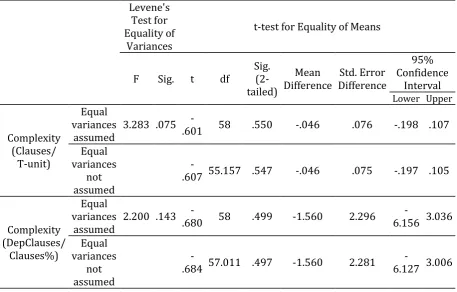
The first research question tried to investigate if collaborative writing had any effect on the complexity of Iranian intermediate EFL learners L2 written productions. Independent samples t-tests were conducted between the two groups. The mean scores and standard deviations of the two groups with respect to the two complexity measures are presented in Table 1. Additionally, t-tests results are demonstrated in Table 2.
Table 1. Descriptive statistics of the complexity measures
Group N Mean Std. Deviation Std. Error
Mean Complexity
(Clauses/T-unit)
Individual 31 1.86 .334 .060
Collaborative 29 1.90 .247 .046
Complexity (DepClauses/Clauses%)
Individual 31 39.34 9.696 1.741
Collaborative 29 40.90 7.930 1.473
Two measures were utilized to measure complex language used in participants' written products. As shown in Table 1, the mean scores of the collaborative group are slightly higher than that of the individual group. Although the complexity mean scores are slightly different, it is not clear whether this difference is statistically significant or not. Therefore, independent samples t-tests were carried out across the two group (see Table 2).
Table 2. Independent samples t-tests of the complexity measures Levene's
Test for Equality of
Variances
t-test for Equality of Means
F Sig. t df
Sig. (2-tailed) Mean Difference Std. Error Difference 95% Confidence Interval Lower Upper
Complexity (Clauses/ T-unit) Equal variances assumed
3.283 .075
-.601 58 .550 -.046 .076 -.198 .107
Equal variances
not assumed
-.607 55.157 .547 -.046 .075 -.197 .105
Complexity (DepClauses/ Clauses%) Equal variances assumed
2.200 .143
-.680 58 .499 -1.560 2.296
-6.156 3.036
Equal variances
not assumed
-.684 57.011 .497 -1.560 2.281
T-test results, reported in Table 2, reveal that there is not any statistically significant difference between the individual and collaborative writers with regards to the two complexity measures (ratio of clauses to T-units: t (58) = - .601, p = .550; percentage of dependent clauses: t (58) = - .680, p = .499). This finding suggested that collaborative writing did not have any effect on the complexity of Iranian intermediate EFL learners L2 written productions.
Based on the obtained results, therefore, no significant differences were found in the way in which the individuals performed the tasks compared to the pairs. Therefore, the first null hypothesis stating collaborative writing does not have any effect on the complexity of Iranian intermediate EFL learners
The effect of collaborative writing on accuracy
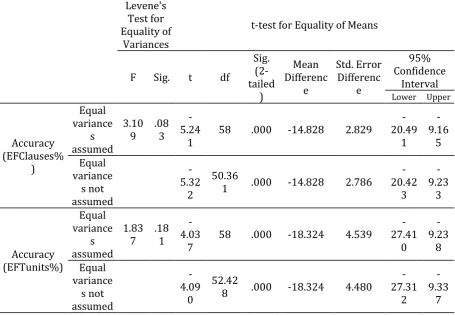
The second research question addressed the difference between individual and collaborative writing with respect to the accuracy measures. As in the previous section, between-group analyses were performed in order to investigate the second research hypothesis. That is, two independent samples t-tests were conducted on the scores of the two accuracy measures. Table 3 presents the descriptive statistics for the accuracy scores across the two groups of individual and collaborative writing.
Table 3. Descriptive statistics of the accuracy measures
Group N Mean Std. Deviation Std. Error Mean
Accuracy(EFClauses%) Individual 31 66.07 13.089 2.351
Collaborative 29 80.90 8.054 1.496
Accuracy(EFTunits%) Individual 31 47.02 20.570 3.694
Collaborative 29 65.35 13.644 2.534
Table 4. Independent samples t-tests of the accuracy measures Levene's
Test for Equality of
Variances
t-test for Equality of Means
F Sig. t df
Sig. (2-tailed ) Mean Differenc e Std. Error Differenc e 95% Confidence Interval
Lower Upper
Accuracy (EFClauses% ) Equal variance s assumed 3.10 9 .08 3 -5.24 1
58 .000 -14.828 2.829
-20.49 1 -9.16 5 Equal variance s not assumed -5.32 2 50.36
1 .000 -14.828 2.786
-20.42 3 -9.23 3 Accuracy (EFTunits%) Equal variance s assumed 1.83 7 .18 1 -4.03 7
58 .000 -18.324 4.539
-27.41 0 -9.23 8 Equal variance s not assumed -4.09 0 52.42
8 .000 -18.324 4.480
-27.31 2 -9.33 7
The results of the t-tests, illustrated in Table 4, shows that there are statistically significant differences between the two group regarding both accuracy measures of error free clauses (t (58) = -5.241, p = .000) and error free T-unit (t (58) = -4.037, p = .000). Therefore, the mean score of both accuracy measures were statistically higher for the collaborative writers than for the individual ones.
Therefore, regarding the effect of collaboration on the accuracy of the composed texts, t-test results indicated that collaborative writers produced significantly more accurate compositions in comparison to the individual writers. Thus, the second null hypothesis predicting that collaborative writing does not have any effect on the accuracy of Iranian intermediate EFL learners L2 written productions was rejected.
The effect of collaborative writing on fluency
Table 5. Descriptive statistics of the fluency measures
Group N Mean Std. Deviation Std. Error Mean
Fluency(Words) Individual 31 171.32 22.903 4.114
Collaborative 29 155.76 34.828 6.467
Fluency(T-units) Individual 31 15.26 3.924 .705
Collaborative 29 11.90 2.335 .434
Fluency(Clauses) Individual 31 27.65 5.636 1.012
Collaborative 29 22.48 4.695 .872
As reported in Table 5, the mean scores of the collaborative group were smaller than that of the individual group as far as the three measures of fluency are concerned. That is, collaboration did not lead to more fluent written productions. However, the significance of this difference needs to be checked using the results of the independent samples t-tests presented in Table 6.
Table 6. Independent samples t-tests of the fluency measures Levene's
Test for Equality of
Variances
t-test for Equality of Means
F Sig. t df
Sig. (2-tailed)
Mean Difference
Std. Error Difference
95% Confidence Interval of the
Difference Lower Upper
Fluency (Words)
Equal variances
assumed
4.182 .045 2.058 58 .044 15.564 7.562 .426 30.702
Equal variances
not assumed
2.031 47.918 .048 15.564 7.665 .152 30.976
Fluency (T-units)
Equal variances
assumed
5.931 .018 3.997 58 .000 3.362 .841 1.678 5.045
Equal variances
not assumed
4.062 49.425 .000 3.362 .827 1.699 5.024
Fluency (Clauses)
Equal variances
assumed
2.178 .145 3.840 58 .000 5.162 1.344 2.472 7.853
Equal variances
not assumed
3.864 57.258 .000 5.162 1.336 2.487 7.838
(58) = 3.840, p = .000). Therefore, the fluency of written texts was statistically lower for the pairs than for the individuals.
The results obtained from the fluency measures suggested that the texts written collaboratively were significantly less fluent than the texts written individually. Consequently, hypothesis three stating that collaborative writing does not have any effect on the fluency of Iranian intermediate EFL learners L2 written productions was rejected.
DISCUSSION
Results of the complexity measures indicated no significant differences in the way in which the individuals performed the tasks compared to the pairs. Therefore, the first null hypothesis was confirmed. The results for complexity are somewhat in agreement with the findings of by Storch and Wigglesworth (2007) and Wigglesworth and Storch (2009). Wigglesworth and Storch (2009) found that collaboration had no impact on grammatical complexity and there were no statistically significant differences between the texts produced by the pairs and those produced by the individuals. However, they noted that the two measures used here reflect the same construct. It is possible that other measures of complexity such might elicit different results.
The results for complexity measures failed to show a significant effect for collaborative writing. This finding contradicts the results of the studies which found that collaboration leads to more complex language use (e.g., Storch, 2001, 2005; Tuan & Storch, 2007). For example, in Storch (2005) pairs tended to write more complex sentences, as measured by the length of the units in words, the ratio of clauses to T-units, and the percentage of dependent clauses. It seems that the discussion with regard to the results of the complexity measures demonstrated inconclusive findings in the literature. Therefore, future research needs to be done with regard to this point.
and Ansari (2012) stated that the improved accuracy in collaborative writing groups may be due to the increased motivation to focus on grammatical accuracy and the engagement in revision process which led to more accurate texts.
On the contrary, the fact that the collaborative writers in the present study produced significantly better texts than did the individuals conflicts with earlier research by Dobao (2012). He found no statistically significant differences in accuracy between collaboratively written texts and independently written ones, although pairs received better scores on most of the accuracy measures than did individual learners. One issue which can account for our findings with regard to accuracy is that collaborative planning afforded students the opportunity to provide and get immediate feedback on language, an opportunity which is absent when learners write individually. This may justify the reason that learners in the collaborative group wrote better texts in term of accuracy. Moreover, according to Wigglesworth and Storch (2009), Another reason might be that, when working in pairs, learners are able to pool their resources, and on the whole, to come up with the correct outcome.
The findings with regard to fluency indicated that the texts written collaboratively were significantly less fluent than the texts written individually. The findings of the present study are in congruence with other research findings such as: Watanabe (2014), Foster and Skehan (1999) and Storch (2005) who used the three measures of average number of words, T units, and clauses to assess the fluency of learners’ productions. On the contrary, the results run counters to Storch (2001), Storch and Wigglesworth (2007) and Wigglesworth and Storch, (2009) who reported the similarity rates of fluency across the individual and collaborative writers.
Watanabe (2014) found that the learners produced a statistically significant greater number of words when writing independently than collaboratively, suggesting that independent writing may be more conducive for producing more written text. Additionally, in Storch (2005) the results of the comparison of individually and jointly written texts showed that pairs tended to compose much shorter texts than students who composed individually. Foster and Skehan (1999) found that group-based planning proved to be a relatively unsuccessful condition and provoked less fluency than solitary planning. One explanation is that collaborative writing provided the students with the opportunity to give and receive immediate feedback on language while writing. Therefore, they might lead to having less time to spend writing the text and as a result producing a less fluent composition with regard to the length of production i.e., average number of words, T units, and clauses.
CONCLUSION
measures demonstrated inconclusive findings in the literature. Therefore, future research needs to be done with regard to this point.
Second, with respect to accuracy, deductions can be made that collaborative writers produced significantly more accurate compositions in comparison with the individual writers. That is, collaborative writing had a positive effect on the accuracy of the written texts. In fact, collaboration gave students the opportunity to provide and get immediate feedback on language, an opportunity which is absent when learners write individually. Moreover, when working in pairs, learners are able to pool their resources, and on the whole, to come up with the correct outcome. Third, the findings obtained from the fluency measures suggested that the texts written collaboratively were significantly less fluent than the texts written individually. Therefore, it can be inferred that individual writing may be more advantageous for producing more fluent written text.
All in all, from the obtained findings regarding the CAF measures, it can be concluded that collaborative writing is an effective and suitable technique to be used for EFL students to write more accurate compositions. CW can be used as a pedagogical tool to encourage student collaboration and create a positive social atmosphere in the classroom. Writing does not need to be a solitary act.
REFERENCES
Ahmadian, M. J., & Tavakoli, M. (2011). The effects of simultaneous use of careful online planning and task repetition on accuracy, complexity, and fluency in EFL learners‟ oral production. Language Teaching Research, 15(1), 35-59.
Atay, D., & Kurt, G. (2006). Prospective teachers and L2 writing anxiety. Asian EFL Journal, 8(4), 100-118.
Beseler, L. M., & Qi, L. (2014). A Study in Collaborative Writing. International Journal of Bilingual & Multilingual Teachers of English, 2(1), 15-29.
Bitchener, J., & Knoch, U. (2010). Raising the linguistic accuracy level of advanced L2 writers with written corrective feedback. Journal of Second Language Writing, 19(4), 207-217.
Cheng, Y. S. (2004). A measure of second language writing anxiety: Scale development and preliminary validation. Journal of second language writing, 13(4), 313-335. Dellerman, P., Coirier, P., & Marchand, E. (1996). Planning and expertise in
argumentative composition. Theories, models and methodology in writing research, 182-195.
Dobao, A. F. (2012). Collaborative writing tasks in the L2 classroom: Comparing group, pair, and individual work. Journal of Second Language Writing, 21(1), 40-58.
Donahoe, T. (2010). Language anxiety in the online environment: An exploratory study of a secondary online Spanish class. (Unpublished Doctoral Dissertation). Pepperdine University, Malibu.
Ellis, R. (2003). Task-based language learning and teaching. New York: Oxford University Press.
Ellis, R. (2009). The Differential Effects of Three Types of Task Planning on the Fluency, Complexity, and Accuracy in L2 Oral Production. Applied Linguistics, 30(4), 474-509.
Ellis, R., & Yuan, F. (2004). The effects of planning on fluency, complexity, and accuracy in second language narrative writing. Studies in second Language acquisition, 26(01), 59-84.
Foster, P. & Skehan, P. (1999). The influence of source of planning and focus of planning on task-based performance. Language Teaching Research, 3(3), 215-247.
Foster, P., & Skehan, P. (1996). The influence of planning and task type on second language performance. Studies in Second language acquisition, 18(03), 299-323. Franken, M., & Haslett, S. (2002). When and why talking can make writing harder. In
New directions for research in L2 writing (pp. 209-229). Springer Netherlands. Hyde, M. (1993). Pair work - a blessing or a curse? An analysis of pair work from
pedagogical, cultural, social and psychological perspectives. System, 2(3), 343–348. Jafari, N., & Ansari, N. A. (2012). The effect of collaboration on Iranian EFL learners'
writing accuracy. International Education Studies, 5(2), 125-131.
Johnson, D., R. Johnson, & K. Smith. (1991). Active Learning: Cooperation in the College Classroom. Edina, MN: Interaction Book Company.
Kinsella, K. (1996). Designing group work that supports and enhances diverse classroom work style. TESOL Journal, 6(1), 24–30.
Kormos, J. (2012). The role of individual differences in L2 writing. Journal of Second Language Writing, 21(4), 390-403.
Kurt, G., & Atay, D. (2007). The Effects of Peer Feedback on the Writing Anxiety of Prospective Turkish Teachers of EFL. Online Submission, 3(1), 12-23.
Leki, I. (1999). Pretty much I screwed up: Ill-served needs of a permanent resident. In L. Harklau, K. Losey, & M. Siegal (Eds.), Generation 1.5 meets college composition: Issues in the teaching of writing to U.S.-educated learners of English as a second language (pp. 17–43). Mahwah, NJ: Erlbaum.
Li, S. (2013). The interactions between the effects of implicit and explicit feedback and individual differences in language analytic ability and working memory. The Modern Language Journal, 97(3), 634-654.
Li, X., Chu, S. K. W., Ki, W. W., & Woo, M. (2010). Students and teacher’s attitudes and perceptions toward collaborative writing with Wiki in a primary four Chinese classroom. In 3rd International Conference on ICT for Language Learning 2010. Manchón, R. (Ed.). (2009b). Writing in foreign language contexts: Learning, teaching,
and research (Vol. 43). Multilingual Matters.
Manchón, R. M. (2009a). Broadening the perspective of L2 writing scholarship: The contribution of research on foreign language writing. In R. M. Manchón (Ed.), Writing in foreign language contexts. Learning, teaching and research (pp. 1-19). Bristol: Multilingual Matters.
Manchón, R. M., & Roca de Larios, J. (2007). On the temporal nature of planning in L1 and L2 composing. Language learning, 57(4), 549-593.
Mehnert, U. (1998). The effects of different lengths of time for planning on second language performance. Studies in second language acquisition, 20(01), 83-108. Mishra, S., & Oliver, R. (1998). Secondary school ESL learners' perceptions of pair work
in Australian classrooms. TESOL in Context, 8(2), 19.
Nixon, R., & McClay, J. K. (2007). Collaborative writing assessment: Sowing seeds for transformational adult learning. Assessing Writing, 12(2), 149-166.
Nystrand, M., & Brandt, D. (1989). Response to writing as a context for learning to write. In Anson, C.M., (Ed.), Writing and response: Theory, practice, and research (pp. 209-230). Illinois: NCTE.
Ortega, L. (1999). Planning and focus on form in L2 oral performance. Studies in Second language acquisition, 21(01), 109-148.
Polio, C., & Williams, J. (2009). Teaching and testing writing. The handbook of language teaching, 486-517.
Sangarun, J. (2005). The effects of focusing on meaning and form in strategic planning. In R. Ellis (Ed.), Planning and task performance in a second language (pp. 111-142). Amsterdam, Philadelphia: John Benjamins.
Shehadeh, A. (2011). Effects and student perceptions of collaborative writing in L2. Journal of Second Language Writing, 20(4), 286-305.
Shintani, N., & Ellis, R. (2015). Does language analytical ability mediate the effect of written feedback on grammatical accuracy in second language writing? System, 49, 110-119.
Skehan, P. (1996). A framework for the implementation of task-based instruction. Applied Linguistics, 17, 38–62.
Skehan, P. (2009). Modeling second language performance: Integrating complexity, accuracy, fluency, and lexis. Applied Linguistics, 30(4), 510-532.
Skehan, P., & Foster, P. (1999). The influence of task structure and processing conditions on narrative retellings. Language learning, 49(1), 93-120.
Storch, N. (2001). How collaborative is pair work? ESL tertiary students composing in pairs. Language Teaching Research, 5(1), 29-53.
Storch, N. (2005). Collaborative writing: Product, process, and students’ reflections. Journal of Second Language Writing, 14(3), 153-173.
Storch, N., & Wigglesworth, G. (2007). Writing tasks: The effects of collaboration. Investigating tasks in formal language learning, 157-177.
Tavakoli, M., & Rezazadeh, M. (2014). Individual and Collaborative Planning Conditions: Effects on Fluency, Complexity and Accuracy in L2 Argumentative Writing. Journal of Teaching Language Skills, 5(4), 85-110.
Tuan, T. A., & Storch, N. (2007). Investigating group planning in preparation for oral presentations in an EFL class in Vietnam. RELC journal, 38(1), 104-124.
Watanabe, Y. (2014). Collaborative and independent writing: Japanese university English learners’ processes, texts and opinions. (Unpublished doctoral dissertation). University of Toronto, Canada.
Wigglesworth, G., & Storch, N. (2009). Pair versus individual writing: Effects on fluency, complexity and accuracy. Language Testing, 26(3), 445-466.
Wigglesworth, G., & Storch, N. (2012). What role for collaboration in writing and writing feedback. Journal of Second Language Writing, 21(4), 364-374.
Wu, H. J. (2015). The Effects of Blog-supported Collaborative Writing on Writing Performance, Writing Anxiety and Perceptions of EFL College Students in Taiwan. (PhD Dissertation). University of South Florida.