Review
Spatial considerations for captive snakes
Clifford Warwick
a,*, Phillip Arena
b, Catrina Steedman
c aEmergent Disease Foundation, Tonbridge, Kent TN9 1EP, UKbPro-Vice Chancellor (Education) Department, Murdoch University, Mandurah Campus, Mandurah WA 6210, Australia cEmergent Disease Foundation, Tonbridge, Kent TN9 1EP, UK
a r t i c l e i n f o
Article history:
Received 9 September 2018 Received in revised form 29 October 2018 Accepted 7 December 2018 Available online 13 December 2018
Keywords: snake space stress enclosure captive husbandry
a b s t r a c t
Captive environments for snakes commonly involve small enclosures with dimensions that prevent occupants from adopting straight line body postures. In particular, the commercial, hobby, and pet sectors routinely utilize small vivaria and racking systems, although zoos and other facilities also commonly maintain at least some snakes under broadly similar conditions. Captive snakes may be the only vertebrates where management policy commonly involves deprivation of the ability and probable welfare need to freely extend the body to its natural full length. In this report, we present background information concerning some relevant physical and behavioral characteristics of snakes, discuss pervading beliefs or folklore husbandry and its implications for animal welfare as well as factors con-cerning stress, its manifestations and measurement, and provide criteria for the assessment of captive snake welfare. As part of this review, we also conducted an observational component involving captive snakes and report that during 60-minute observation periods of 65 snakes, 24 (37%) adopted rectilinear or near rectilinear postures (stationary 42%; mobile 37%). Of the 31 snake species observed, 14 (45%) adopted rectilinear or near rectilinear postures. Ectomorphological associations, normal behavior, and innate drive states infer that snakes, even so-called sedentary species, utilize significant space as part of their normal lifestyles. We conclude that future policies for snake husbandry require a paradigm shift away from an erroneous belief system and toward recognizing the greater spatial needs of these reptiles.
Ó2018 The Authors. Published by Elsevier Inc. This is an open access article under the CC BY-NC-ND license (http://creativecommons.org/licenses/by-nc-nd/4.0/).
Introduction
Snakes are commonly kept in captivity in various situations and conditions, including as pets, zoological exhibits, and research an-imals. Data on numbers of snakes kept across these sectors are not fully available. However, figures indicate that, for example, approximately 200,000 snakes are kept as pets in private homes in the United Kingdom (PFMA, 2018) and 1,150,000 in the United States (AVMA, 2012), and approximately 8,000 snakes are kept in American Zoological Association collections (AZA, 2018).
Historical and current information and beliefs regarding spatial considerations and needs for snakes in captivity vary widely. The commercial, hobby, and pet sectors frequently recommend and utilize vivaria and racking systems for snakes that involve small and
highly restrictive enclosures with dimensions that prevent occu-pants from adopting straight line body postures, that is, extending their bodies to full and unrestricted natural length (for example,
McCurley, 2005; Mader, 2006; Gartersnake info, 2013; Hollander, 2018), and many zoos (Nash, 2016; Mendyk, 2018) and other fa-cilities also maintain at least some snakes under similar conditions. Some nonscientific governmental guidance also broadly claims that enclosures less than the total length of the snake are consistent with their welfare (for example,NSW, 2013; Defra, 2018). Other guidance suggests that certain "active" snakes require enclosures longer than their full body length, whereas more "sedentary" spe-cies do not (for example,Kaplan, 2014; Divers, 2018).
In contrast, there exist numerous behavioral research in-vestigations and several scientific and other guidance reports that emphasize that snakes demand as much space as possible as they actively seek and require the ability to fully straighten their bodies as an essential requirement to satisfy the need for behavioral normality, exercise, avoidance of stress and disease, alleviation of physical discomfort, and achievement of physical comfort, among others, and these factors are significant contributors to welfare in
*Address for reprint requests and correspondence: Emergent Disease Founda-tion, Riverside House, River Lawn Road, Tonbridge, Kent TN9 1EP, United Kingdom. Tel:þ44 (0) 7757267369.
E-mail address:[email protected](C. Warwick).
Contents lists available atScienceDirect
Journal of Veterinary Behavior
j o u r n a l h o m e p a g e : w w w . j o u rn a l v e t b e h a v i o r . c o m
https://doi.org/10.1016/j.jveb.2018.12.006
captivity (Astley & Jayne, 2007; BVZS, 2014; Cannon & Johnson, 2012; Hedley, 2014; Hu et al., 2009; Jepson, 2015; RSPCA, 2018; RVC, 2018a,b; Scott, 2016; Warwick, 1990a,b, 1995; Warwick et al., 2013; Wilkinson, 2015; Warwick, et al., 2018a).
In this report, we present background information concerning some relevant physical and behavioral characteristics of snakes, discuss pervading beliefs or folklore husbandry and its implications for animal welfare as well as factors concerning stress, its manifestations and measurement, provide criteria for the assessment of captive snake welfare, report results of an observational component involving recti-linear or near-rectirecti-linear posturing in captive snakes, and make rec-ommendations regarding minimum housing standards for snakes.
Background
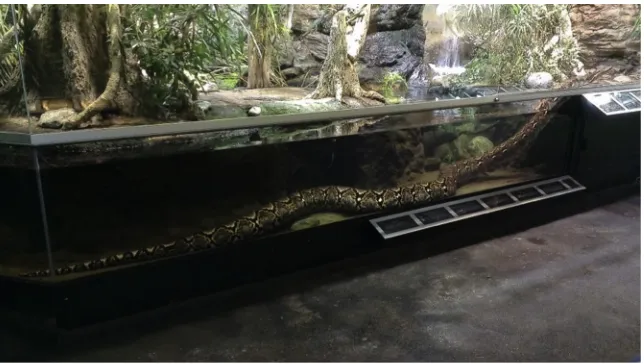
Snakes are universally identifiable elongate-bodied animals that are often observed adopting coiled and straight line or near straight line postures, both during locomotion and at rest (Warwick, 1995). Several types of locomotion have been described in snakes, for example,rectilinear motionorcreeping motionis a caterpillar-like lo-comotor style commonly adopted by snakes when moving close to straight objects such as fallen trees and rock faces, when stealthily hunting, or where there exists little environmental purchase (Hu et al., 2009; Newman & Jayne, 2017); concertina locomotion is a snake locomotor style commonly associated with movement in arboreal habitats where animals are challenged by cylindrical branches or other narrow items or in tunnels where lateral movement is highly limited (Astley & Jayne, 2007; Hu et al., 2009);sliding behavioris also used by snakes in arboreal habitats where they must negotiate sharp descents (Astley & Jayne, 2007);serpentine lateral undulationis a locomotor style typically adopted by snakes when moving through most habitats (for example, grasslands or bush) that offers good purchase or contact irregularities or when swimming (Shine & Shetty, 2001);sidewindingcharacteristically involves snakes that move diagonally and quickly, usually on hot desert surfaces (Secor et al.,1992). During all of these locomotor styles, the body of the snake commonly approaches a significantly or entirely straightened form, and with respect to rectilinear/creeping motion, concertina motion and sliding behavior, straight line posturing is particularly common.Figures 1-4provide examples of rectilinear or near recti-linear posturing (n/RLP) (straight line or near straight line/stretched out positioning) as well as attempted n/RLP in captive snakes.
Home range studies demonstrate that while some snakes exhibit relatively sedentary behavior at times, activity levels even in
such species may, for example, manifest a four-fold increase at other times (Brito, 2003). As such, even the more sedentary snakes manifestly use significant amounts space when there are appro-priate opportunities to do so. Although snake home ranges may be dynamic and are often measured using differentfield techniques,
Table 1provides examples of the extensive areas occupied by these reptiles.
It is inarguable that both free-living and captive snakes utilize large areas of space and diverse habitat where available and also adopt straight line, rectilinear, stretched-out posturing at will in sufficiently spacious environments, and this may be performed regularly.
Discussion
Folklore husbandry and mythology
Folklore husbandry is a phenomenon referring to a belief system based on typically unscientific, often anecdotal, information communicated via keeper-to-keeper, hobbyist forums and maga-zines, trade and amateur herpetological groups, and "care sheets" developed by vested interests (Arbuckle, 2010, 2013; Mendyk, 2018; Warwick, 1995; Warwick, et al., 2013). Furthermore, prac-tices that are reported as successful may represent results of indi-vidualized husbander goals and not be generally applicable (Mendyk, 2018). Particularly problematic is the issue that scientific evidence and high-level objective data and opinion are frequently overlooked, disfavored, or disregarded by commercial and private snake keepers where it is inconsistent with folklore husbandry (Arbuckle, 2010, 2013; Mendyk, 2018). Although challenging to eradicate, there are current efforts by the scientific herpetological community aimed at replacing folklore husbandry with evidence-based practice (Arbuckle, 2010, 2013; Mendyk, 2018).
Common justifications for spatially minimalistic enclosures and husbandry practices involving snakes in general are based on a number of beliefs, including that snakes are sedentary, insecure in large environments, do not use space, suffer from agoraphobia (anxiety related to open spaces) and anorexia, and further that snakes thrive in small spaces, and feed, grow, and reproduce well (for example,Bartlett & Bartlett, 1999; Engler, 2010; Iherp, 2011; McCurley, 2005; Pets4Homes, 2018; Reddit, 2015; TBC, 2018). However, these views are not universal among herpetologists, herpetoculturalists, and other snake keepers (for example,Mendyk, 2018; Rose et al., 2014; Silvestre, 2014).
Claims regarding sedentarism and spatial insecurity are poorly considered by many keepers. For example, in highly exposed areas, many species will naturally utilize local cover during locomotion or seclude themselves in small or tight refuges at rest, but such behavior constitutes only part of overall activity budgets (Gillinghan, 1995; Mendyk, 2018). Agoraphobia is a human anxiety condition and not recognized in snakes (Warwick, et al., 2013). Extensive natural home ranges, as outlined previously, dismiss notions that snakes do not use space. Indeed, were snakes truly both sedentary and agora-phobic then keepers would require no vivaria frontage or lids and could open all enclosures confident that snakes would not leave the proposed security of their cages. However, snakes
will freely leave their enclosures when permitted to do so and they are known for their abilities to escape captive environments.
Established captivity-stresserelated behaviors are also
commonly associated with snakes in small enclosures (Warwick, 1990a,b, 1995; Warwick et al., 2013); thus claims that these ani-mals are thriving lack balance. In contrast, snakes are known to function more successfully in larger, naturalistic environments (Warwick, et al., 1995; Wilkinson, 2015).
Regular feeding and breeding is frequently also reported in as-sociation with captivity-stress where energy may be redirected toward basic biological functions (Warwick, 1990a,b, 1995; Broom & Johnson, 1993; Moore & Jessop, 2003), which may result in Figure 2.Terrestrial near rectilinear motion: milk snake (Lampropeltissp.) in hobbyist/private conditions. (Image credit: C. Warwick).
reproductive exhaustion or obesity, and thus these factors are not reliable indicators of good welfare.
It is arguable that highly restrictive enclosures in some respects may offer limited prevention against certain potentially welfare-negative situations. For example, ease of cleaning associated with the minimalistic conditions of racking systems (McCormack, 2015; Warwick, 2015) may prevent accumulation of particular potentially pathogenic wastes and microbes. In addition, nontransparent opa-que plastic or wood boundaries prevent the highly problematic behavior known as interaction with transparent boundaries (Warwick, 1990a), and thermal burns are avoided where no direct heating sources are used (Mendyk, 2018). However, diminutive en-closures and racking systems are also known to be associated with their own suite of particular management, observation, and hygiene problems, as well as stressors and diseases (McCormack, 2015; Warwick, 1990a,b, 1995; Warwick et al., 2013; Warwick, 2015) (see alsoTables 2 and 3). Therefore, it is also arguable that the potential benefits of minimal housing are artificial and ingenuine.
The scientific community generally accepts that snakes require the provision of enriched captive environments (Burghardt, 2013;
Funk, 2006; Vosjoli, 1999; Warwick, 1990a,b, 1995; Warwick & Steedman, 1995; Warwick et al., 2013; Wilkinson, 2015). In contrast, the minimalistic enclosures, as used by numerous com-mercial snake breeders and some private collectors, impose no or extremely limited enrichment on their occupants, resulting in controlled deprivation (Burghardt, 2013) and negative health im-plications (Mendyk, 2015, 2018; Morgan and Tromberg, 2007; Warwick et al., 2013). The accepted scientific and rational view that snakes require enriched lives and the view that those kept without enrichment also experience good welfare, constitute mutually exclusive perspectives.
Evolutionary considerations
As with all organisms, the principle of form follows function through the process of evolution explains the elongate morphology of snakesdthey are the way they are because it is necessary.
Ectomorphological associations (i.e., morphology and behavior in the environment) are also inextricably linked, thus the evolutionary biology of snakes requires that their bodies are able to do what is normal. Furthermore, because snakes, like all reptiles, are greatly governed by innateness, behaviors and needs are substantially hard wired or preset, regardless of whether an animal is free-living or captive-bred (Arbuckle, 2013; Burghardt 2013; Warwick, 1990, 1995; Warwick et al., 2013). In addition, being ectothermic, envi-ronmental temperatures and behaviors are fundamentally linked, and where imposed thermal regimes and gradients are insuffi -ciently complex or fail to satisfy basic thermoregulatory needs, behavioral expression, including activity patterns, is constrained (Rose et al., 2014; Wilms et al., 2011) (for example, providing a false indicator of sedentarism).
It is valid to argue that normal behavior includes offensive and defensive activities, and that these are not necessarily desirable, and indeed often disfavored, in captivity because of their associa-tion with stressors and injuries among co-occupants (Homer, 2006; Warwick, 1990a,b, 1995; Warwick et al., 2013; Wilkinson, 2015). Relatedly, some may consider that straight line posturing is also unnecessary in captivity, despite being normal behavior.
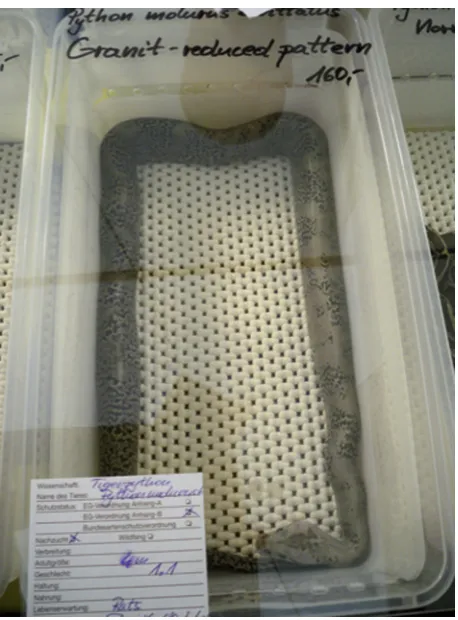
However, in nature, offensive and defensive behaviors are fundamental survival and reproduction features (including prey acquisition, predator avoidance, courtship, territorial, or group hi-erarchies), involving extreme elevated physiological and physical responses consistent with occasional acute challenges or stress (Gillinghan, 1995), whereas straight-line posturing is typically part of a quiescent behavioral repertoire as experienced by snakes in a regular daily context (Warwick, 1990a, 1995). Importantly, in na-ture, almost limitless space allows opportunities for withdrawal or escape in many situations (Gillinghan, 1995; Silvestre, 2014). In captivity, major spatial limitations dramatically alter the encounter-avoidance possibilities thereby effectively intensifying the dynamic of potentially harmful consequences and raising the undesirability of offensive and defensive behaviors, making otherwise natural Figure 4.Attempted rectilinear motion: python (Pythonsp.) in pet‘fair’,‘expo’ ‘market’
conditions. (Image credit: ProWildlife/Animal Protection Agency).
Table 1
Example home range occupations for snakes
Species Home range Source
Lataste’s viper (Vipera latastei) 0.24 ha-1.52 ha Brito (2003)
Northern pine snake (Pituophis melanoleucus melanoleucus) 59.9 ha with core areas averaging 7.9 ha, snakes traveled 273 m per move Gerald et al. (2006) Great Plains rat snake (Elaphe guttata emoryi) 3.98 ha-26.95 ha (average of 10.17 ha) Sperry & Taylor (2008) Black pine snake (Pituophis melanoleucus lodingi) 92-396 ha, with single movement events of 338m Baxley and Qualis (2009)
Timber rattlesnake (Crotalus horridus) 21.1 ha-39 ha Hamilton (2009)
behavior a problem in captivity, caused by captivity (Howell & Bennett, 2017; Silvestre, 2014; Warwick, 1990; Warwick et al., 2013). Nevertheless, some captive snakes deprived of live food have been reported to redirect aggression toward co-occupants and human keepers, indicating that pursuit of prey may in some situ-ations be an ethological need (Burghardt & Denny, 1983; Warwick, 1990a,b, 1995).
Nocturnality is an important issue associated with welfare assessment (Warwick et al., 2018a). Being commonly nocturnal, snakes are typically at rest and relatively inactive when observed by
their keepers. Nocturnality in species raises important welfare concerns in that the contrasting activity patterns with humans may have negative influences on rest cycles and also implies that normal monitoring for problematic behavioral signs are, as a consequence, regularly confounded (Warwick, et al., 2018a).
Behavioral versus physiological assessments of captivity stress
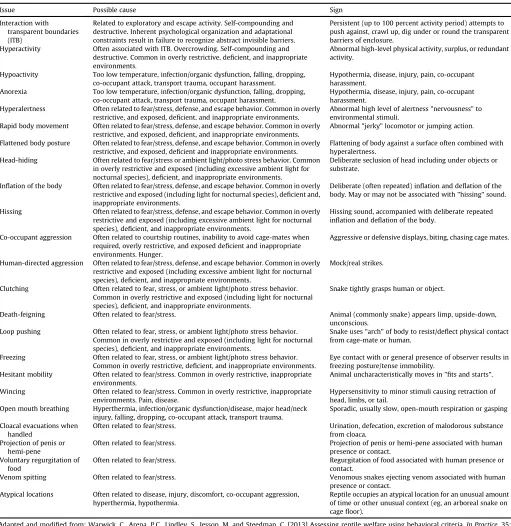
Behavioral observation of snakes monitors normal or abnormal activities and their contexts. Numerous behavioral signs are Table 2
Behavioral signs of captivity-stress associated with confinement of snakes in overly restrictive enclosures
Issue Possible cause Sign
Interaction with transparent boundaries (ITB)
Related to exploratory and escape activity. Self-compounding and destructive. Inherent psychological organization and adaptational constraints result in failure to recognize abstract invisible barriers.
Persistent (up to 100 percent activity period) attempts to push against, crawl up, dig under or round the transparent barriers of enclosure.
Hyperactivity Often associated with ITB. Overcrowding. Self-compounding and destructive. Common in overly restrictive, deficient, and inappropriate environments.
Abnormal high-level physical activity, surplus, or redundant activity.
Hypoactivity Too low temperature, infection/organic dysfunction, falling, dropping, co-occupant attack, transport trauma, occupant harassment.
Hypothermia, disease, injury, pain, co-occupant harassment.
Anorexia Too low temperature, infection/organic dysfunction, falling, dropping, co-occupant attack, transport trauma, occupant harassment.
Hypothermia, disease, injury, pain, co-occupant harassment.
Hyperalertness Often related to fear/stress, defense, and escape behavior. Common in overly restrictive, and exposed, deficient, and inappropriate environments.
Abnormal high level of alertness "nervousness" to environmental stimuli.
Rapid body movement Often related to fear/stress, defense, and escape behavior. Common in overly restrictive, and exposed, deficient, and inappropriate environments.
Abnormal "jerky" locomotor or jumping action.
Flattened body posture Often related to fear/stress, defense, and escape behavior. Common in overly restrictive, and exposed, deficient and inappropriate environments.
Flattening of body against a surface often combined with hyperalertness.
Head-hiding Often related to fear/stress or ambient light/photo stress behavior. Common in overly restrictive and exposed (including excessive ambient light for nocturnal species), deficient, and inappropriate environments.
Deliberate seclusion of head including under objects or substrate.
Inflation of the body Often related to fear/stress, defense, and escape behavior. Common in overly restrictive and exposed (including light for nocturnal species), deficient and, inappropriate environments.
Deliberate (often repeated) inflation and deflation of the body. May or may not be associated with "hissing" sound.
Hissing Often related to fear/stress, defense, and escape behavior. Common in overly restrictive and exposed (including excessive ambient light for nocturnal species), deficient, and inappropriate environments.
Hissing sound, accompanied with deliberate repeated inflation and deflation of the body.
Co-occupant aggression Often related to courtship routines, inability to avoid cage-mates when required, overly restrictive, and exposed deficient and inappropriate environments. Hunger.
Aggressive or defensive displays, biting, chasing cage mates.
Human-directed aggression Often related to fear/stress, defense, and escape behavior. Common in overly restrictive and exposed (including excessive ambient light for nocturnal species), deficient, and inappropriate environments.
Mock/real strikes.
Clutching Often related to fear, stress, or ambient light/photo stress behavior. Common in overly restrictive and exposed (including light for nocturnal species), deficient, and inappropriate environments.
Snake tightly grasps human or object.
Death-feigning Often related to fear/stress. Animal (commonly snake) appears limp, upside-down, unconscious.
Loop pushing Often related to fear, stress, or ambient light/photo stress behavior. Common in overly restrictive and exposed (including light for nocturnal species), deficient, and inappropriate environments.
Snake uses "arch" of body to resist/deflect physical contact from cage-mate or human.
Freezing Often related to fear, stress, or ambient light/photo stress behavior. Common in overly restrictive, deficient, and inappropriate environments.
Eye contact with or general presence of observer results in freezing posture/tense immobility.
Hesitant mobility Often related to fear/stress. Common in overly restrictive, inappropriate environments.
Animal uncharacteristically moves in "fits and starts".
Wincing Often related to fear/stress. Common in overly restrictive, inappropriate environments. Pain, disease.
Hypersensitivity to minor stimuli causing retraction of head, limbs, or tail.
Open mouth breathing Hyperthermia, infection/organic dysfunction/disease, major head/neck injury, falling, dropping, co-occupant attack, transport trauma.
Sporadic, usually slow, open-mouth respiration or gasping
Cloacal evacuations when handled
Often related to fear/stress. Urination, defecation, excretion of malodorous substance from cloaca.
Projection of penis or hemi-pene
Often related to fear/stress. Projection of penis or hemi-pene associated with human presence or contact.
Voluntary regurgitation of food
Often related to fear/stress. Regurgitation of food associated with human presence or contact.
Venom spitting Often related to fear/stress. Venomous snakes ejecting venom associated with human presence or contact.
Atypical locations Often related to disease, injury, discomfort, co-occupant aggression, hyperthermia, hypothermia.
Reptile occupies an atypical location for an unusual amount of time or other unusual context (eg, an arboreal snake on cagefloor).
commonly associated with negative acute and chronic states, including injury, disease, disturbance, co-occupant aggression, as well as those defined by attempts to avoid or escape captive con-ditions (Arena et al., 2012; Chiszar et al., 1995; Gillinghan, 1995; Greenberg, 1995; Guillette et al., 1995; Mancera et al., 2017a; Warwick, 1990a,b, 1995; Warwick et al., 2013; Warwick et al., 2018a) (see also Tables 2 and 3). As discussed elsewhere in this report, fundamental underlying causes of stress are highly variable and present accordingly, whether due to factors including malnu-trition, poor thermal regimes, or spatially overly restrictive envi-ronments. Behavioral indicators of captivity stress typically and significantly resolve with alteration of captive provisions to include more naturalistic environments and greater space, confirming the importance of behavioral indicators as stress markers (Warwick, 1990a,b, 1995). In addition, behavioral observations, rather than physiological assessments, of stress are typically noninvasive and allow for more objective investigation.
Physiological monitoring involves obtaining blood, fecal, and other physical samples to test for stress-related levels of relevant hormones, notably corticosterone (Guillette et al., 1995; Moore & Jessop, 2003; Silvestre, 2014; Warwick et al., 2013). Under controlled experimental conditions as well as targeted clinical vet-erinary assessment, physiological parameters can provide important indicators of certain stressors and particular health states in reptiles (Dupoué et al., 2018; Frye, 1991; Mancera et al., 2017a).
It has been suggested that physiological measurements are a useful alternative to behavioral observation for assessing stress in
snakes, while also recognizing significant interpretational limita-tions with the physiological approach (van Waeyenberge et al., 2018). Impacts from physiological monitoring on snakes vary, for example, blood sampling is invasive because of handling and nee-dle extraction and may itself elevate blood corticosterone values, whereas fecal sampling is noninvasive because of collection of organic detritus (Moore & Jessop, 2003; Silvestre, 2014; van Waeyenberge et al., 2018; Warwick et al., 2013).
Sampling physiological parameters under natural conditions may occur against a background of noncontext-specific scenarios and multifactorial or nondetermined histories (Silvestre, 2014). For example, all physical sampling may be affected by seasonality, age, sex, body condition, or reproductive state (among other factors), fecal values may be affected by diet, and ecdysis samples may reflect medium- and not recent-term histories (Angelier and Wingfield, 2013; Moore & Jessop, 2003; Silvestre, 2014; van Waeyenberge et al., 2018; Warwick et al., 2013). Thus, these various sampling factors may potentially impact on normally important scientific controls and affect relevance for extrapolation to snakes under abnormal and artificial situations.
Comparing acute or chronic stress under natural versus artificial conditions may be mutually incongruent for important contextual reasons. In nature, stressors manifest transiently within evolved frameworks, and thus occur against a background of generalized normality (Gentsch et al., 2018; Warwick, 1995). In captivity, stressors are often consistent with maladaptation and inconsistent with evolved coping mechanisms as well as a lack of normalizing recovery opportunities (Warwick, 1995).
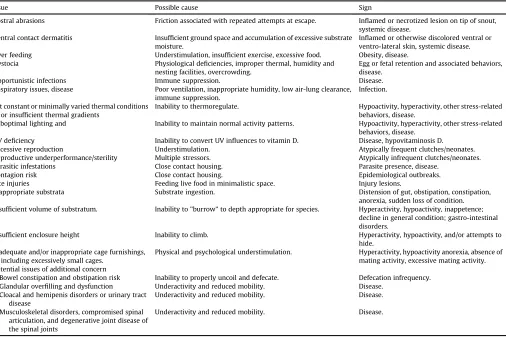
Table 3
Reported clinical and physical problematic issues and signs associated with confinement of snakes in overly restrictive enclosures (in particular¼less than 1 x snake straight line length and "racking" systems)
Issue Possible cause Sign
Rostral abrasions Friction associated with repeated attempts at escape. Inflamed or necrotized lesion on tip of snout, systemic disease.
Ventral contact dermatitis Insufficient ground space and accumulation of excessive substrate moisture.
Inflamed or otherwise discolored ventral or ventro-lateral skin, systemic disease. Over feeding Understimulation, insufficient exercise, excessive food. Obesity, disease.
Dystocia Physiological deficiencies, improper thermal, humidity and nesting facilities, overcrowding.
Egg or fetal retention and associated behaviors, disease.
Opportunistic infections Immune suppression. Disease.
Respiratory issues, disease Poor ventilation, inappropriate humidity, low air-lung clearance, immune suppression.
Infection.
Set constant or minimally varied thermal conditions or insufficient thermal gradients
Inability to thermoregulate. Hypoactivity, hyperactivity, other stress-related behaviors, disease.
Suboptimal lighting and Inability to maintain normal activity patterns. Hypoactivity, hyperactivity, other stress-related behaviors, disease.
UV deficiency Inability to convert UV influences to vitamin D. Disease, hypovitaminosis D. Excessive reproduction Understimulation. Atypically frequent clutches/neonates. Reproductive underperformance/sterility Multiple stressors. Atypically infrequent clutches/neonates. Parasitic infestations Close contact housing. Parasite presence, disease.
Contagion risk Close contact housing. Epidemiological outbreaks.
Bite injuries Feeding live food in minimalistic space. Injury lesions.
Inappropriate substrata Substrate ingestion. Distension of gut, obstipation, constipation, anorexia, sudden loss of condition. Insufficient volume of substratum. Inability to "burrow" to depth appropriate for species. Hyperactivity, hypoactivity, inappetence;
decline in general condition; gastro-intestinal disorders.
Insufficient enclosure height Inability to climb. Hyperactivity, hypoactivity, and/or attempts to hide.
Inadequate and/or inappropriate cage furnishings, including excessively small cages.
Physical and psychological understimulation. Hyperactivity, hypoactivity anorexia, absence of mating activity, excessive mating activity. Potential issues of additional concern
Bowel constipation and obstipation risk Inability to properly uncoil and defecate. Defecation infrequency. Glandular overfilling and dysfunction Underactivity and reduced mobility. Disease.
Cloacal and hemipenis disorders or urinary tract disease
Underactivity and reduced mobility. Disease.
Musculoskeletal disorders, compromised spinal articulation, and degenerative joint disease of the spinal joints
Underactivity and reduced mobility. Disease.
Relatedly, there exists a dearth of baseline physiological data, especially for the large diversity of species involved, implying that meaningful normal and abnormal physiological values can be difficult to ascertain or apply (Moore & Jessop, 2003; Silvestre, 2014; van Waeyenberge et al., 2018; Warwick et al., 2013). In humans, for example, where vast data are known for physiological states, studies reveal that although cortisol may be mediated by factors including agitation-related stimuli, other states including generalized stress, anxiety, and depression may not increase cortisol (van Eck et al., 1996). Studies concerning the effects of noise on mice found that stress resulted in reduced corticosterone, while behavioral stereotypes increased indicating that stress had already created a behavioral "coping mechanism" to reduce physiological activation (Mancera et al., 2017b).
In our view, physiological complexity, impracticality as a regular means of assessment, baseline data reference deficiencies, evolu-tionary relevance, problematic contextualization and interpreta-tion, invasiveness for some procedures, and situation- and temporal-specific sampling biases undermine generalized physio-logical monitoring of stress in snakes. In contrast, behavioral assessment constitutes the primary objective method for
evaluation of stress and welfare of snakes in captivity and may help to avoid underascertainment of captivity stress (Moore & Jessop, 2003; Silvestre, 2014; Warwick et al., 2013).
Confinement, captivity-stress, injury, and disease
Snakes are known to manifest a wide range of behavioral and morbidity problems related to their captive conditions and hus-bandry, many of which are very common and persistent (Frye, 1991, 2016; Homer, 2006; Mader, 2006; Oonincx & van Leeuwen, 2017; Pilny, 2015; Warwick, et al., 1995; Whitehead, 2018; Wilkinson, 2015). Objective scientific studies reveal high mortality rates among captive reptiles (including snakes), for example, 41% at 10 days relating to the commercial sector (Ashley et al., 2014) and 75% annually in the private home (Toland et al., 2012). Prevalence and specificity of behavioral and physical problems, morbidities, and mortalities related to overly restrictive enclosures are generally unavailable in documented form. For many if not most commercial and other breeders or producers of snakes, documentation of serious welfare issues or captivity-related disease, injury or death may both equate to an admission of management failure and also
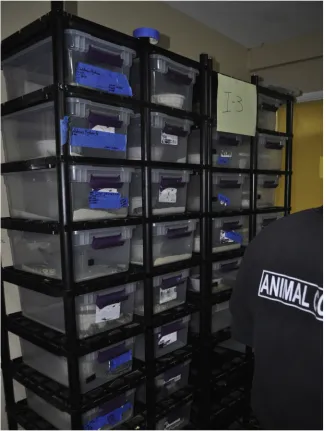
attract legal consequences (Warwick et al., 2017). Therefore, be-tween possible misinterpretation of numerous behavioral and physical signs and particular transparency concerns, it may be appropriate to regard overly positive anecdotal reports relating to snake welfare in diminutive enclosures and racking systems with a degree of circumspection. Accordingly, the lack of reliable infor-mation from the commercial and private sectors may represent serious under-reporting of minor and major problematic issues associated with truth telling surrounding sensitive topics (Moorhouse et al., 2017; Warwick et al., 2017).Figures 5e7provide examples of a racking system.
Behavioral and clinical considerations
Table 2provides a list of primarily behavioral signs of captivity-stress associated with confinement of snakes in overly restrictive environments. Table 3 provides a list of primarily clinical signs associated with confinement of snakes in overly restrictive enclo-sures. Although the problematic issues listed inTable 3manifest in both larger and smaller captive conditions, these issues most likely increase with decreased space (Rose et al., 2014).
Temporary, transient, and permanent conditions
It is generally recognized that snakes, as for many other ani-mals, may be held under temporary conditions that would not be acceptable for longer-term accommodation (Warwick, 1990b; Warwick & Steedman, 1995). Acceptable conditions include clin-ical situations where snakes may be undergoing veterinary observation or treatment, some quarantine protocols, efficient transportation, and in some experimental field and laboratory situations (Warwick, 1990b; Warwick & Steedman, 1995). Reasonably acceptable periods for temporary conditions may be said to involve durations of hours or days. Some exceptional scenarios, such as long-term quarantine for purposes of bio-security, are justifiable transient accommodation, and in such situations, animals should be afforded permanent style environ-ments where feasible (Miller, 1996; NRC, 2011; Pough, 1991; Warwick, et al., 2018a). Examples of unacceptable temporary conditions include days, weeks, or months during storage at commercial wildlife collection, export, import, wholesale and retail sites, and itinerant events known as pet fairs, expos, or markets (Arena et al., 2012).
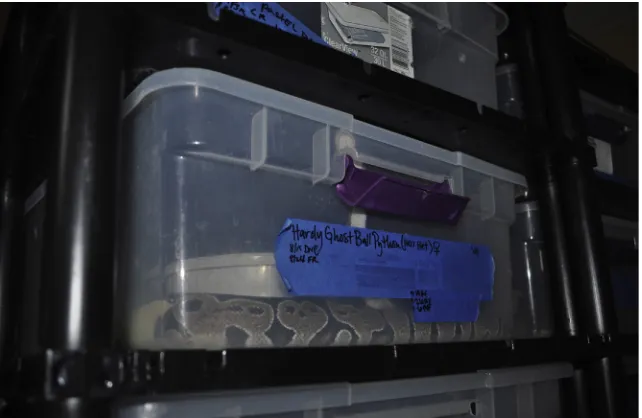
Figure 6.Close view of a racking system enclosure showing a Royal (`ball’) python (Python regius) under minimalistic spatial and other provisions. (Photo credit: PETA).
Observational component
As part of this report, we conducted an observational compo-nent to assess prevalence of rectilinear or near-rectilinear posturing (n/RLP) among captive snakes.
Methods
We conducted observations for approximately 60-minute diurnal periods at eight zoological facilities in the United Kingdom and Canada to estimate the possible prevalence of n/RLP in captive conditions capable of allowing straight line behavior. Three observers used scan sampling that involved each animal being revisited within an approximately 60-second time period. A pilot test-run at two sites (facilities 1 and 2 ofTable 4) was con-ducted to crosscheck and verify note-taking consistency, and still image cameras were used to record relevant postures among
captive snakes. Although circadian observations would have been preferable, access to zoological facilities was limited to diurnal periods. Although rectilinear, concertina, and other snake postures may be categorized as separate and distinct, all can involve straight line or near straight line posturing. Thus our recording of n/RLP includes any displayed behavior resulting in straight line or near straight line posturing. To estimate whether an enclosure possessed at least one dimension capable of allowing a snake to fully extend its body or straight line posture, we assessed the primary length of all snake enclosures, visually located snakes, and then utilized the 10 X coiled body-size diameter rule (Warwick et al., 2018a) to establish an approximate length for each snake. If snakes could not be visualized sufficiently, these enclosures were not further assessed. Snakes displaying n/RLP were also recorded as being either stationary (s) or mobile (m) to acknowledge whether the animals were active or at rest, and where not recorded as (-).
Table 4
Rectilinear or near rectilinear posturing (n/RLP) in captive snakes during approximately 60 minutes diurnal observation periods
Location No. of enclosures capable of accommodating snake rectilinear or near rectilinear posturing
No. of snakes displaying rectilinear or near rectilinear posturing
Snake stationary¼s; snake mobile¼m; not recorded¼
-Facility 1 7 2 s x 2
Facility 2 9 5
-Facility 3 15 8 m x 5/s x 3
Facility 4 14 3 s x 3
Facility 5 7 3 m x 2/s x 1
Facility 6 9 2 m x 2
Facility 7 1 1 s x 1
Facility 8 3 0
Total 8 Total 65 Total 24 (37%) Totals¼10 (42%)
Totalm¼9 (37%) Total -¼5 (21%)
Table 5
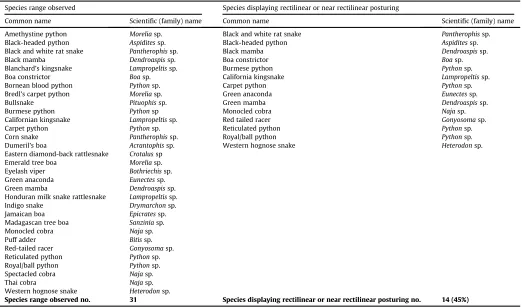
List of all species of captive snakes observed and species displaying rectilinear or near rectilinear posturing (n/RLP)
Species range observed Species displaying rectilinear or near rectilinear posturing
Common name Scientific (family) name Common name Scientific (family) name
Amethystine python Moreliasp. Black and white rat snake Pantherophissp.
Black-headed python Aspiditessp. Black-headed python Aspiditessp.
Black and white rat snake Pantherophissp. Black mamba Dendroaspissp.
Black mamba Dendroaspissp. Boa constrictor Boasp.
Blanchard’s kingsnake Lampropeltissp. Burmese python Pythonsp.
Boa constrictor Boasp. California kingsnake Lampropeltissp.
Bornean blood python Pythonsp. Carpet python Pythonsp.
Bredl’s carpet python Moreliasp. Green anaconda Eunectessp.
Bullsnake Pituophissp. Green mamba Dendroaspissp.
Burmese python Pythonsp Monocled cobra Najasp.
Californian kingsnake Lampropeltissp. Red tailed racer Gonyosomasp.
Carpet python Pythonsp. Reticulated python Pythonsp.
Corn snake Pantherophissp. Royal/ball python Pythonsp.
Dumeril’s boa Acrantophissp. Western hognose snake Heterodonsp.
Eastern diamond-back rattlesnake Crotalussp Emerald tree boa Moreliasp. Eyelash viper Bothriechissp. Green anaconda Eunectessp. Green mamba Dendroaspissp. Honduran milk snake rattlesnake Lampropeltissp. Indigo snake Drymarchonsp. Jamaican boa Epicratessp. Madagascan tree boa Sanziniasp. Monocled cobra Najasp.
Puff adder Bitissp.
Red-tailed racer Gonyosomasp. Reticulated python Pythonsp. Royal/ball python Pythonsp. Spectacled cobra Najasp.
Thai cobra Najasp.
Western hognose snake Heterodonsp.
Results
The total number of snakes that were visualized in enclosures to determine their capability to adopt straight line postures by recti-linear or near rectirecti-linear behavior was 65. The total number of snakes adopting n/RLP was 24(37%). The total number of species observed was 31. The total number of species adopting n/RLP was 14(45%).Table 4provides a breakdown of the observation-based data. Table 5provides a list of all species observed and species displaying rectilinear or near rectilinear posturing (n/RLP).
Given that our observations were of relatively short duration (approximately 60 minutes per location) and conducted during diurnal periods, the finding of 37% prevalence for n/RLP among snakes is significant, and we anticipate that these data are probably minimally representative of actual n/RLP prevalence. We propose that within a 24 hour period, most snakes, regardless of species, would exhibit n/RLP where housed in permissible enclosures. In addition, the presence of significant rectilinear or near rectilinear postures across a wide range of species, including those with reportedly highly sedentary lifestyles, further contradicts anecdotal claims and belief-based husbandry concerning spatial needs of snakes. The variable proportionality of total number of enclosures capable of accommodating snake straight line/rectilinear posturing versus number of snakes displaying rectilinear or near rectilinear posturing among different study locations may be explained by varied husbandry routines such as feeding times and lighting, as well as visitor-related noise and other disturbances. Both stationary and mobile n/RLP (42% and 37%, respectively) in snakes indicated that straight or near straight line posturing is important in both resting and active animals.
Conclusions
We believe that this introductory investigation may be thefirst of its kind to examine near-rectilinear or rectilinear behavior in captive snakes, and that future research involving circadian time budget observations may prove helpful to further evaluate n/RLP prevalence.
Ectomorphological associations, behavior, and innate drive states confirm that snakes utilize and biologically need consider-able space as part of their normal lifestyles. However, captive snakes may be the only vertebrates where management policy commonly involves deprivation of the essential ability and welfare need to voluntarily straighten their bodies. Spatial deprivations routinely imposed on snakes would be unacceptable for any other vertebrate species, and while larger enclosures may represent
significant inconveniences for many snake breeders and keepers, current common approaches to accommodation for many snakes are scientifically and ethically unjustifiable. Other than for short-term confinement such as clinical or essential transportation pur-poses snakes should not be held in enclosures with dimensions that do not permit these animals to fully extend their bodies, including both horizontally and vertically where semi-arboreal or arboreal species are involved.
Erroneous folklore husbandry has long governed snake, and other reptile, keeping practices. Although many of the best zoos and some other facilities and individuals may provideflagship housing for snakes (although these likely still represent a vast reduction in terms of spatial requirements and natural homes ranges), it remains commonplace for others, in particular the commercial, hobby, and private pet keeping sectors, to confine snakes in overly restrictive environments that are substantially inconsistent with their bio-logical needs or the basic provisions of the Five Freedoms (FAWC, 2009; Mellor, 2012) or the Five Welfare Needs (RSPCA, 2005).
Snake-keeping practices typically demonstrate a recurring generalized animal husbandry problem that left uncorrected over time "bad practices become normal" (Silinski et al., 2016). The normalization of numerous misperceptions, beliefs, false-facts, and bad practices in snake keeping constitutes a major obstacle to good welfare. To what extent either scientific ignorance or practical convenience governs many snake-keeping habits is unclear. There is good evidence to show that uptake of objective information by exotic pet sellers and keepers is poor (Howell & Bennett, 2017; Kohler, 2010; Moorhouse et al., 2017; Pees et al., 2014; Warwick et al., 2018b).
Essentially, n/RLP posturing is integral to normal and desirable behavior and should be regarded as being as fundamental for healthy activity as other accepted essential ethological needs as well as avoidance of abnormal behavior and ill-health (Warwick, 1990a,b; Warwick et al., 2013; Scott, 2016). Captive birds are ex-pected to be able to fully extend (stretch) their wings, and whether or not some birds elect to perform this behavior, the requirement is generally accepted, and for instance in the UK, enshrined in law (WCA, 1981). Relatedly, there is no scientific reason for failing to allow all snakes the comparable ability to straighten their bodies whenever they wish to do so, and a zero-tolerance position should be adopted toward enclosures less than the total length of the snake.
Future policies for the care of these animals require a paradigm shift away from folklore husbandry and toward recognition of the behavioral and ecological complexities of these reptiles. Given that folklore husbandry appears to be ingrained in both practice and Table 6
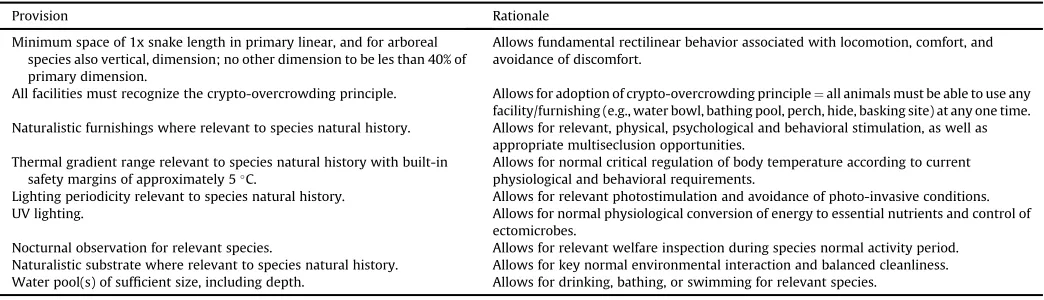
Summary of essential absolute minimum containment conditions for snakes
Provision Rationale
Minimum space of 1x snake length in primary linear, and for arboreal species also vertical, dimension; no other dimension to be les than 40% of primary dimension.
Allows fundamental rectilinear behavior associated with locomotion, comfort, and avoidance of discomfort.
All facilities must recognize the crypto-overcrowding principle. Allows for adoption of crypto-overcrowding principle¼all animals must be able to use any facility/furnishing (e.g., water bowl, bathing pool, perch, hide, basking site) at any one time. Naturalistic furnishings where relevant to species natural history. Allows for relevant, physical, psychological and behavioral stimulation, as well as
appropriate multiseclusion opportunities. Thermal gradient range relevant to species natural history with built-in
safety margins of approximately 5C.
Allows for normal critical regulation of body temperature according to current physiological and behavioral requirements.
Lighting periodicity relevant to species natural history. Allows for relevant photostimulation and avoidance of photo-invasive conditions. UV lighting. Allows for normal physiological conversion of energy to essential nutrients and control of
ectomicrobes.
Nocturnal observation for relevant species. Allows for relevant welfare inspection during species normal activity period. Naturalistic substrate where relevant to species natural history. Allows for key normal environmental interaction and balanced cleanliness. Water pool(s) of sufficient size, including depth. Allows for drinking, bathing, or swimming for relevant species.
attitude among snake keepers, it follows that targeted education of husbanders alone is unlikely to attract relevant changes in snake care. Accordingly, it may be necessary for governmental authorities to stipulate policies for minimum spatial requirements and general husbandry as outlined in this report, as well as formalize obliga-tions within legal frameworks.
Recommendations
The authors do not suggest that snakes can be readily (indeed probably very rarely) provided with environments and lifestyles sufficiently naturalistic to be free from captivity-stress. Regardless, provision of space for snakes should be sufficient to allow them to move around without imposed bodily restriction, be stimulating and accommodate as much natural and desirable behavior as possible, including the ability to fully straighten or stretch out their bodies. Enclosures must also be large enough to accommodate essential provisions and furnishings, including appropriate thermal gradation, heaters, basking zones, lights, humidifiers, seclusion and specific retreats or hides, water vessels or pools, rocks, burrows and plant, or plant-like furnishings, where relevant to the species without cluttering the general environment or posing risk of injury to the occupant.
Table 6provides summary guidance of essential absolute mini-mum containment conditions for snakes (other than for essential temporary or transient conditions, such as clinical treatment and during short-term transportation).
Acknowledgments
The authors thank the Animal Protection Agency UK for funding open access availability for this article and the following people for their expert scientific and veterinary input as well as helpful in-sights and comments: Prof Fredric L Frye BSc MSc DVM CBiol FRSB FRSM (Hon)DiplECZM (Hon)DiplAmBdVetPrac; Dr Mike Jessop BVMS MRCVS; Dr Angelo JL Lambiris NHED MSc PhD CBiol FRSB; Dr Emma Nicholas MA VetMB MRCVS; Dr Anthony Pilny DVM DABVP; Dr Martin Whitehead BSc BVSc CertSAM PhD MRCVS.
Conflict of interest statement
C. Warwick and C. Steedman have acted as professional con-sultants to the Animal Protection Agency (APA), which had no input into design, research, data collection, analysis, or other directional role in this report.
References
Angelier, F., Wingfield, J.C., 2013. Importance of the glucocorticoid stress response in
a changing world: Theory, hypotheses and perspectives. Gen. Comp. Endocrinol.
190, 118e128.
Arbuckle, K., 2010. Suitability of day-old chicks as food for captive snakes. J. Anim.
Physiol. Anim. Nutr. 94 (6), e296ee307.
Arbuckle, K., 2013. Folklore husbandry and a philosophical model for the design of
captive management regimes. Herpetol. Rev. 44, 448e452.
Arena, P.C., Steedman, C., Warwick, C., 2012. Amphibian and reptile pet markets in the EU an investigation and assessment. Animal Protection Agency, Animal Public, International Animal Rescue, Eurogroup for Wildlife and Laboratory Animals, Fundacion para la Adopcion, el Apadrinamiento y la Defensa de los Animales, p. 52. Available online:
https://www.apa.org.uk/pdfs/AmphibianAn-dReptilePetMarketsReport.pdf. Accessed February 9, 2018.
Ashley, S., Brown, S., Ledford, J., Martin, J., Nash, A.E., Terry, A., Tristan, T., Warwick, C., 2014. Morbidity and mortality of invertebrates, amphibians, rep-tiles and mammals at a major exotic companion animal wholesaler. J. Appl.
Anim. Welf. Sci. 17, 1e14.
Astley, H.C., Jayne, B.C., 2007. Effects of perch diameter and incline on the kine-matics, performance and modes of arboreal locomotion of corn snakes (Elaphe
guttata). J. Exp. Biol. 210 (21), 3862e3872.
AVMA, 2012. U.S. Pet Ownership & Demographics Sourcebook (2012 Edition). Available online:
https://www.avma.org/KB/Resources/Statistics/Pages/Market-research-statistics-US-pet-ownership.aspx. Accessed September 1, 2018.
AZA, 2018. American Zoological Association, Personal Communication. . Accessed
August 30, 2018.
Bartlett, R.D., Bartlett, P., 1999. Reptile and Amphibian Keeper’s Guides: Corn
Snakes. Barron’s educational Series, Hauppauge, NY, p. 27.
Baxley, D.L., Qualls, C.P., 2009. Black pine snake (Pituophis melanoleucus lodingi):
spatial ecology and associations between habitat use and prey dynamics.
J. Herp. 43 (2), 284e293.
Breininger, D.R., Bolt, M.R., Legare, M.L., Drese, J.H., Stolen, E.D., 2011. Factors
influencing home-range sizes of eastern indigo snakes in central Florida.
J. Herpetol. 45 (4), 484e490.
Brito, J.C., 2003. Seasonal variation in movements, home range, and habitat use by
male Vipera latastei in northern Portugal. J. Herpetol. 37 (1), 155e160.
Broom, D.M., Johnson, K.G., 1993. Assessing welfare: Short-term responses. In:
Stress and Animal Welfare. Springer, Dordrecht, pp. 87e110.
Burghardt, G.M., 2013. Environmental enrichment and cognitive complexity in reptiles and amphibians: concepts, review, and implications for captive
pop-ulations. J. Appl. Anim. Behav. Sci. 147, 286e298.
Burghardt, G.M., Denny, D., 1983. Effects of prey movement and prey odor on
feeding in garter snakes. Zeitschrift für Tierpsychologie 62 (4), 129e147.
BVZS, 2014. BVZS Pet Shop Inspection Guidance Notes. British Veterinary Zoological
Society, London, UK, p. 2.
Cannon, M., Johnson, R., 2012. Handling and Nursing Reptiles: What’s normal and What’s Not. Australian Veterinary Association. Available online: https://
www.ava.com.au/sites/default/files/Handling%20and%20Nursing%20Reptiles_
MCannon.pdf. Accessed September 1, 2018.
Chiszar, D., Tomlinson, W.T., Smith, H.M., Murphy, J.B., Radcliffe, C.W., 1995. Behavioral consequences of husbandry manipulations: indicators of arousal, quiescence and environmental awareness. In: Warwick, C., Frye, F.L., Murphy, J.B. (Eds.), Health and Welfare of Captive Reptiles. Chapman & Hall/
Kluwer, London and New York, pp. 186e201.
Defra, 2018. The Animal Welfare (Licensing of Activities Involving Animals) (En-gland) Regulations 2018 Guidance notes for conditions. Available online:http://
www.cfsg.org.uk/_layouts/15/start.aspx#/sitepages/legislation%20and%20gui-dance.aspx. Accessed September 1, 2018.
Divers, S.J., 2018. Management of reptiles. MSD Veterinary Manual. Available online:
https://www.msdvetmanual.com/exotic-and-laboratory-animals/reptiles/man-agement-of-reptiles. Accessed September 1, 2018.
Dupoué, A., Rutschmann, A., Le Galliard, J.F., Clobert, J., Blaimont, P., Sinervo, B., Miles, D.B., Haussy, C., Meylan, S., 2018. Reduction in baseline corticosterone secretion correlates with climate warming and drying across wild lizard
pop-ulations. J. Anim. Ecol. 87, 1331e1341.
Engler, B., 2010. Milksnakes. The Herpetological Library, Advanced Vivarium
Sys-tems, Irvine California, p. 127pp.
FAWC, 2009. Five Freedoms. Farm Animal Welfare Council. Available online:http:// webarchive.nationalarchives.gov.uk/20121007104210/http:/www.fawc.org.uk/
freedoms.htm. Accessed August 28, 2018.
Frye, F.L., 1991. Biomedical and Surgical Aspects of Captive Reptile Husbandry, 2nd
Edition. Krieger Publishing, Malabar, p. 712pp.
Frye, F.L., 2016. Reptiles and Amphibians, 2ndEdition. CRC Press, Taylor and Francis
Baton Rouge, p. 240pp.
Funk, R.S., 2006. Snakes. In: Mader, D.R. (Ed.), Reptile Medicine and Surgery.
Saunders, St Louis (MO), pp. 42e58.
Gartersnake.info, 2013. Housing. Available online: http://www.gartersnake.info/
care/housing.php#housing-size. Accessed September 1, 2018.
Gentsch, R.P., Kjellander, P., Röken, B.O., 2018. Cortisol response of wild ungulates to trauma
situations: hunting is not necessarily the worst stressor. Eur. J. Wildl. Res. 64 (1), 11.
Gerald, G.W., Bailey, M.A., Holmes, J.N., 2006. Movements and Activity Range Sizes
of northern pine snakes (Pituophis melanoleucus melanoleucus) in Middle
Ten-nessee. J. Herp. 40 (4), 503e510.
Gillinghan, J.C., 1995. Normal behavior. In: Warwick, C., Frye, F.L., Murphy, J.B. (Eds.), Health and Welfare of Captive Reptiles. Chapman & Hall/Kluwer, London and
New York, pp. 131e153.
Greenberg, N., 1995. Ethologically informed design in husbandry and research. In: Warwick, C., Frye, F.L., Murphy, J.B. (Eds.), Health and Welfare of Captive
Rep-tiles. Chapman & Hall/Kluwer, London and New York, pp. 239e263.
Guillette Jr., L.J., Cree, A., Rooney, A.A., 1995. Biology of stress: interactions with reproduction,immunology and intermediary metabolism. In: Warwick, C., Frye, F.L., Murphy, J.B. (Eds.), Health and Welfare of Captive Reptiles. Chapman &
Hall/Kluwer, London and New York, pp. 32e70.
Hamilton, C.H., 2009. Home range size and habitat selection of timber rattlesnakes (Crotalus horridus) in southwestern Wisconsin, p. 74. A Thesis Submitted in
Partial Fulfillment of the Requirements of the Degree Master of Science in
Natural Resources (Wildlife) college of natural resources University of
Wis-consin Stevens Point, WisWis-consin.
Hart, K., Cherkiss, M.S., Smith, B.J., Mazzotti, F.J., Fujisaki, I., Snow, R.W., Dorcass, M.E., 2015. Home range, habitat use, and movement patterns of non-native Burmese
pythons in Everglades National Park, Florida, USA. Animal Biotelemetry 3 (1), 8.
Hedley, J., 2014. Snakes: husbandry and common health problems. Veterinary
Times, London, UK.
Hollander, P., 2018. Care Sheet for Snakes. Reptile Cage Plans. Available online:
http://www.reptile-cage-plans.com/articles/snakes/snakeintro.html. Accessed
Homer, K., 2006. Reptiles: behavior and stress. Vet. Nurs. J. 21, 17e20.
Howell, T.J., Bennett, C.P., 2017. Despite their best efforts, pet lizard owners in Vic-toria, Australia, are not fully compliant with lizard care guidelines and may not
meet all lizard welfare needs. J. Vet. Behav.: Clin. Appl. Res. 21, 26e37.
Hu, D.L., Nirody, J., Scott, T., Shelley, M.J., 2009. The mechanics of slithering
loco-motion. Proc. Natl. Acad. Sci. U. S. A. 106 (25), 10081e10085.
Hyslop, N.L., Meyers, M., Cooper, R.J., Stevenson, D., 2013. Effects of body size and
sex ofDrymarchon couperi(eastern indigo snake) on habitat use, movements,
and home range size in Georgia. J. Wildl. Mgt. 78 (1), 101e111.
Iherp, 2011. Snake rack questions. Iherp Answers. Available online:
https://www.i-herp.com/Answers/ReptileProblem.aspx?Id¼21486. Accessed September 1,
2018.
Jepson, L., 2015. Inspecting pet shops. Practice 37, 333e346.
Kaplan, M., 2014. Reptile Housing: Size, Dimension and Lifestyle. Herp Care Collection. Available online: http://www.anapsid.org/enclsize.html. Accessed August 31, 2018.
Kohler, R., 2010. Der‘Schildkrötentest’: das neue Gesundheitsprojekt für engagierte
Mitglieder. Elaphe 2, 57e62.
Mader, D.R., 2006. Reptile Medicine and Surgery, 2ndEdition. Elsevier, New York,
p. pp1118.
Mancera, K.F., Murray, P.J., Lisle, A., Dupont, C., Faucheux, F., Phillips, C., 2017a. The effects of acute exposure to mining machinery noise on the behavior of eastern
blue-tongued lizards (Tiliqua scincoides). Anim. Welf. 26 (1), 11e24.
Mancera, K.F., Lisle, A., Allavena, R., Phillips, C.J.C., 2017b. The effects of mining machinery noise of different frequencies on the behavior, faecal corticosterone
and tissue morphology of wild mice (Mus musculus). Appl. Anim. Behav. Sci.
203, 81e89.
McCormack, S., 2015. Respiratory Conditions in Reptiles. The Exotic Pet Blog. Available online:
https://exoticpetvetblog.wordpress.com/2015/12/30/respira-tory-conditions-in-reptiles/. Accessed August 31, 2018.
McCurley, K., 2005. Ball Pythons in Captivity. Herpetological Publishing and Dis-tribution, Rodeo, New Mexico, 101.
Mellor, D.J., 2012. Animal emotions, behavior and the promotion of positive welfare
states. N.Z. Vet. J. 60 (1), 1e8.
Mellor, D.J., 2015. Positive animal welfare states and reference standards for welfare
assessment. N.Z. Vet. J. 63 (1), 17e23.
Mendyk, R.W., 2015. Life expectancy and longevity of varanid lizards (Reptilia:
Squamata: Varanidae) in North American zoos. Zoo Biol. 34 (2), 139e152.
Mendyk, R.W., 2018. Challenging folklore reptile husbandry in zoological parks. In: Berger, M., Corbett, S. (Eds.), Zoo Animals: Husbandry, Welfare and Public
In-teractions. Nova Science Publishers, Hauppauge, pp. 265e292.
Miller, R.E., 1996. Quarantine protocols and preventive medicine procedures for
reptiles, birds and mammals in zoos. Revue Sci. Tech. 15, 183e188.
Miller, G.J., Smith, L.L., Johnson, S.A., Franz, R., 2012. Home Range Size and Habitat
Selection in the Florida Pine Snake (Pituophis melanoleucus mugitus). Copeia (4),
706e713.
Moore, I.T., Jessop, T.S., 2003. Stress, reproduction, and adrenocortical modulation in
amphibians and reptiles. Horm. Behav. 43 (1), 39e47.
Moorhouse, T.P., Balaskas, M., D’Cruze, N.C., Macdonald, D.W., 2017. Information
could reduce consumer demand for exotic pets. Conserv. Lett. 10 (3), 337e345.
Morgan, K.N., Tromberg, C.T., 2007. Sources of stress in captivity. Appl. Anim. Behav.
Sci. 102 (3-4), 262e302.
Nash, S., 2016. Snake enclosure size-collaborative research projects for BIAZA col-lections. In: Tapley, B., Redbond, J. (Eds.), BIAZA Reptile & Amphibian Working
Group Meeting. Crocodiles of the World, Oxfordshire, UK.
Newman, S.J., Jayne, B.C., 2017. Crawling without wiggling: muscular mechanisms and kinematics of rectilinear locomotion in boa constrictors. J. Exp. Biol. jeb166199.https://doi.org/10.1242/jeb.166199.
NRC, 2011. National Research Council. Guide for the Care and Use of Laboratory
Animals, 8thEd. National Academies Press, Washington, D.C.
NSW, 2013. Code of Practice for the Keeping of Reptiles. State of NSW and Office of Environment and Heritage. Available online: https://www.envir-
onment.nsw.gov.au/-/media/OEH/Corporate-Site/Documents/Licences-and-per-mits/keeping-private-reptiles-code-of-practice.pdf. Accessed September 1, 2018.
Oonincx, D., van Leeuwen, J., 2017. Evidence-based reptile housing and nutrition.
Vet. Clin. North Am. Exot. Anim. Pract. 20, 885e898.
Pees, M., Muller, K., Mathes, K., Korbel, R., Seybold, J., Lierz, M., Krautwald-Junghanns, M., 2014. Evaluation of the husbandry conditions of reptile species
commonly kept in Germany. Kleintierpraxis 59, 477e491.
Pets4Homes, 2018. Buying And Bringing Home Your First Snake. Available online:
https://www.pets4homes.co.uk/pet-advice/buying-and-bringing-home-your-fi
rst-snake.html. Accessed September 1, 2018.
PFMA, 2018. UK Pet Population Statistics. Pet Food Manufacturers’ Association. Available online: https://www.pfma.org.uk/pet-population-2018. Accessed September 1, 2018.
Pilny, A.A., 2015. Small exotic companion mammal wellness management and
environmental enrichment. Vet. Clin. North Am. Exot. Anim. Pract. 18, 245e254.
Pough, F.H., 1991. Recommendations for the care of amphibians and reptiles in
academic situations. ILAR J 33 (4), S1eS21.
Reddit, 2015. Why is it considered OK to keep snakes in "racks"? Reddit snakes. Available online:https://www.reddit.com/r/snakes/comments/338pci/why_is_
it_considered_ok_to_keep_snakes_in_racks/. Accessed September 1, 2018.
Rose, P., Evans, C., Coffin, R., Miller, R., Nash, S., 2014. Evidence-basing exhibition of
reptiles and amphibians using student-lead research: three species-specific
case studies. JZAR 2, 25e32.
RSPCA, 2005. The Five Welfare Needs. Royal Society for the Prevention of Cruelty to Animals. Available online: https://www.rspca.org.uk/whatwedo/endcruelty/
changingthelaw/whatwechanged/animalwelfareact. Accessed February 14, 2018.
RSPCA, 2018. Royal python Care. Royal Society for the Prevention of Cruelty to Animals. Available online: https://www.rspca.org.uk/adviceandwelfare/pets/
other/royalpython. Accessed September 1, 2018.
RVC, 2018a. Corn Snake Care. Royal Veterinary College. Available online:https:// www.rvc.ac.uk/Media/Default/Beaumont%20Sainsbury%20Animal%20Hospital/
documents/caring-for-your-corn-snake.pdf. Accessed September 27, 2018.
RVC, 2018b. Royal python Care. Royal Veterinary College. Available online:https:// www.rvc.ac.uk/Media/Default/Beaumont%20Sainsbury%20Animal%20Hospital/
documents/caring-for-your-royal-python.pdf. Accessed September 27, 2018.
Secor, S.M., Jayne, B.C., Bennett, A.F., 1992. Locomotor performance and energetic
cost of sidewinding by the snakeCrotalus cerastes. J. Exp. Biol. 163 (1), 1e14.
Scott, R., 2016. Enclosure useage by giant snakes. In: Tapley, B., Redbond, J. (Eds.), BIAZA Reptile & Amphibian Working Group Meeting. Crocodiles of the World,
Oxfordshire, UK.
Shine, R., Shetty, S., 2001. Moving in two worlds: aquatic and terrestrial locomotion
in sea snakes (Laticauda colubrina, Laticaudidae). J. Evol. Biol. 14 (2), 338e346.
Silinski, S., Grandin, T., Muir, W., 2016. Importance of Genetics in Sow Group Housing and Other Tips for Successful Group Housing. Available online:https://
www.grandin.com/welfare/problems.handling.transporting.newborn.calves.html.
Accessed September 1, 2018.
Silvestre, A.M., 2014. How to assess stress in reptiles. J. Exotic Pet. Med. 23, 240e
243.
Sperry, J.H., Taylor, C.A., 2008. Habitat use and seasonal activity patterns of the Great Plains
ratsnake (Elaphe guttata emoryi) in central Texas. Southwest. Nat 53 (4), 444e449.
TBC, 2018. The Blood Cell. Bloodpythons.Com. Available online: http:// www.bloodpythons.com/index.php/blood-stp-info/husbandry/captive-environ-ment. Accessed September 1, 2018.
Toland, E., Warwick, C., Arena, P.C., 2012. The exotic pet trade: pet hate. Biologist 59
(3), 14e18.
van Eck, M., Berkhof, H., Nicolson, N., Sulon, J., 1996. The effects of perceived stress, traits, mood states, and stressful daily events on salivary cortisol. Psychosom.
Med. 58 (5), 447e458.
van Waeyenberge, J., Aerts, J., Hellebuyck, T., Pasmans, F., Martel, A., 2018. Stress in
wild and captive snakes : quantification, effects and the importance of
man-agement. Vlaams Diergeneeskundig Tijdschrift 87 (2), 59e65.
Vosjoli, P., 1999. Designing environments for captive amphibians and reptiles. Vet.
Clin. North Am. Exot. Anim. Pract. 2 (1), 43e68.
Warwick, C., 1990a. Reptilian ethology in captivity: observations of some problems
and an evaluation of their aetiology. Appl. Anim. Behav. Sci. 26, 1e13.
Warwick, C., 1990b. Important ethological considerations of the study and
main-tenance of reptiles in captivity. Appl. Anim. Behav. Sci. 27, 363e366.
Warwick, C., 1995. Psychological and behavioral principles and problems. In: Warwick, C., Frye, F.L., Murphy, J.B. (Eds.), Health and Welfare of Captive
Rep-tiles. Chapman & Hall/Kluwer, London and New York.
Warwick, C., 2015. Captive breeding-saving wildlife? Or saving the pet trade? The Ecologist (Sept). Available online: http://www.theecologist.org/News/news_ analysis/2985202/captive_breeding_saving_ wildlife_or_saving_the_pet_trade. html. Accessed February 14, 2018.
Warwick, C., Arena, P.C., Lindley, S., Jessop, M., Steedman, C., 2013. Assessing reptile
welfare using behavioral criteria. Practice 35 (3), 123e131.
Warwick, C., Frye, F.L., Murphy, J.B., 1995. Health and Welfare of Captive Reptiles.
Chapman & Hall/Kluwer, London and New York, p. pp300.
Warwick, C., Jessop, M., Arena, P.C., Pilny, A., Nicholas, E., Lambiris, A.J.L., 2017. The future of keeping pet reptiles and amphibians: animal welfare and public health
perspective. Vet. Rec. 181, 454e455.
Warwick, C., Jessop, M., Arena, P., Pilny, A., Steedman, C., 2018a. Guidelines for In-spection of Companion and Commercial Animal Establishments. Front. Vet. Sci.
5 (151), 1e21.
Warwick, C., Steedman, C., 1995. Naturalistic versus unnaturalistic environments in husbandry and research. In: Warwick, C., Frye, F.L., Murphy, J.B. (Eds.), Health and Welfare of Captive Reptiles. Chapman & Hall/Kluwer, London and New York,
1995.
Warwick, C., Steedman, C., Jessop, M., Arena, P., Pilny, A., Nicholas, E., 2018b. Exotic pet suitability: understanding some problems and utilising a labeling system to aid animal welfare, environment, and consumer protection. J. Vet. Behav.: Clin.
Appl. Res. 26, 17e26.
WCA, 1981. Wildlife and Countryside Act 1981. Available online:
https://www.le-gislation.gov.uk/ukpga/1981/69. Accessed September 1, 2018.
Whitehead, M.L., 2018. Factors contributing to poor welfare of pet reptiles. Testudo
8 (No. 5), 47e61.
Wilkinson, S.L., 2015. Reptile Wellness Management. Vet. Clin. North Am. Exot.
Anim. Pract. 18 (2), 281e304.
Wilms, T., Wagner, P., Shobrak, M., Rödder, D., Böhme, W., 2011. Living on the edge? On the thermobiology and activity pattern of the large herbivorous desert liz-ard,Uromastyx aegyptiamicrolepis (Blanford, 1875) at Mahazat as-Sayd