The Thirty-Third AAAI Conference on Artificial Intelligence (AAAI-19)
On Completing Sparse Knowledge
Base with Transitive Relation Embedding
Zili Zhou,
1,2Shaowu Liu,
1Guandong Xu,
*,1Wu Zhang
2 1Advanced Analytics Institute, University of Technology Sydney2School of Computer Engineering and Science, Shanghai University
[email protected], [email protected], [email protected], [email protected]
Abstract
Multi-relation embedding is a popular approach to knowl-edge base completion that learns embedding representations of entities and relations to compute the plausibility of miss-ing triplet. The effectiveness of embeddmiss-ing approach depends on the sparsity of KB and falls for infrequent entities that only appeared a few times. This paper addresses this issue by proposing a new model exploiting the entity-independent transitive relation patterns, namely Transitive Relation Em-bedding (TRE). The TRE model alleviates the sparsity prob-lem for predicting on infrequent entities while enjoys the gen-eralisation power of embedding. Experiments on three public datasets against seven baselines showed the merits of TRE in terms of knowledge base completion accuracy as well as computational complexity.
Introduction
The last few years have seen a growing trend in construct-ing knowledge bases (KB) such as Freebase (Bollacker et al. 2008), WordNet (Fellbaum 2005), DBpedia (Auer et al. 2007) and Google Knowledge Graph (Singhal 2012). KB typically stores knowledge in form of the entity-relation-entity triplet, e.g., “Sydney”-“is in”-“Australia”. Collec-tively, a large number of triplets connect entities into a mas-sive graph structure, which has a wide range of applications, such as recommender systems (Zhang et al. 2016), question answering (Yih et al. 2015) and information extraction (Yao and Van Durme 2014).
Despite its important role played in real-world applica-tions, KB is often incomplete by its nature (Min et al. 2013) which is one of the main barriers to broader adoption. To address this issue, a considerable amount of literature on
knowledge base completionhas been published with an em-phasis on embedding approach (Nickel, Tresp, and Kriegel 2011; Bordes et al. 2013; Wang et al. 2014; Yang et al. 2014; Lin et al. 2015b; Ji et al. 2015; Welbl, Riedel, and Bouchard 2016; Liu, Wu, and Yang 2017). The main idea of this ap-proach is to learn low-dimensional representations of KB entities and relations which can then be used to infer miss-ing triplets. Nevertheless, embeddmiss-ing approach looks at the global structures from the entire KB, thus its effectiveness
Copyright c2019, Association for the Advancement of Artificial Intelligence (www.aaai.org). All rights reserved.
depends on the sparsity of KB and falls for infrequent enti-ties, i.e., reliable embedding representations can’t be learnt for entities that only appeared a few times.
a
b
c
r
1r
2r
3d
e
f
r
1r
2?
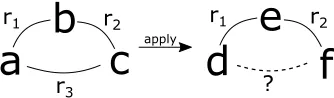
applyFigure 1: Entitiesa,b,care connected through relationsr1,
r2,r3. If these three relations, regardless of which entities
are connected, appeared together frequently, then we may believe there is a pattern. The pattern is then applied to an incomplete triangle to predict the missing relation between entitiesdandf.
We argue that the local structure can be used to alleviate the sparsity problem by improving the completion of infre-quent entities through freinfre-quent relation patterns. A typical local structure is the transitivity among relations as illus-trated in Figure 1. The basic idea is that the missing relation between two entities could be inferred from a path connect-ing them. Although the idea is straightforward, it has several nice properties. Firstly, the relation patterns are independent of entities, thus makes it possible to predict missing rela-tions for infrequent entities, which was a difficult task for embedding approach. Secondly, identifying relation patterns is less computational expensive (Tsourakakis 2008) compar-ing to the embeddcompar-ing approach because it does not require the learning of embedding representations for individual en-tities. Last but not least, relation patterns have great inter-pretability.
miss-ing triplets involvmiss-ing infrequent entities. We summarise the main contributions of this work as follows:
• For the first time, the data sparsity problem in knowledge base completion is tackled by learning relation embed-dings from transitive relation patterns.
• The new TRE model significantly improves completion performance on sparse knowledge bases comparing to state-of-the-art embedding models.
• We conducted extensive experiments on3datasets and7
embedding models to evaluate the proposed TRE model in terms of accuracy and computational complexity.
The rest of the paper is organised as follows: Section “Re-lated Work” introduces the basic concepts of knowledge base and existing embedding approach. Section “Transitive Relation Embedding” describes the proposed TRE model in detail. Section “Experiments” compares our TRE model with several state-of-the-art embedding models followed by a conclusion in Section “Conclusions”.
Related Work
This section briefly summarises necessary background of knowledge base completion and relevant embedding-based and path-basesd models in literature.
Knowledge Base Completion
A knowledge base consists a set of entitiesE and a set of relations R. Knowledge facts are stored as collection of tripletsD = {(h, r, t)} whereh ∈ E is the head entity, t ∈ E is the tail entity andr ∈ Ris the relation connects the two entities. For example, “Sydney (h), is in (r), Aus-tralia (t)”. The triplets setDis often incomplete, which calls for knowledge base completion to infer the missing triplets based on the given set of knowledge fact triplets.
Embedding-based Knowledge Base Completion
Multi-relational embedding is a type of knowledge base completion approach that embeds entities and relations in the same space Rd. To be specific, each entity h ∈ E is represented by a vectorhand each relationr∈ Ris repre-sented by a vectorr. The core idea of multi-relational em-bedding (Bordes et al. 2013) is to learn these vectors such thath+r≈twhen the triplet (h,r,t) holds. For this par-ticular model, the scoring function can be defined as:fr(h, t) =−||h+r−t||1/2 (1)
The latent vectors should be learnt to maximisefr(e1, e2)
if the triplet (h,r,t) is true. There exist other variants of multi-relational embedding models (Wang et al. 2014; Lin et al. 2015b; Ji et al. 2015; Yang et al. 2014; Welbl, Riedel, and Bouchard 2016), nevertheless, latent vectors of entities and relations will be learnt.
Relation-based Knowledge Base Completion
Literature on Relation-based knowledge base completion is limited. A recent work done by Yoon et al. (Yoon et al. 2016)attempted to preserve the logical properties among relations by adding a role-specific mapping matrix for entities. An-other work from Lin et al. (Lin et al. 2015a) considers path between entities, however, only in the form of line segments. Nevertheless, learning latent vectors for entities is required for all of these methods. Other works (Tang et al. 2015; Grover and Leskovec 2016; Dong, Chawla, and Swami 2017) exist to analyse the path or relation embeddings in graph structures, however, not targeting the knowledge base completion.
Limitations of Current Models
As shown in Eq. 1, existing multi-relational embedding models require the learning of both entity and relation repre-sentations. It can be difficult to learn entity representations when an entity has never appeared in the training set or only appeared a few times. This limitation makes it impractical to infer related missing triplets. Besides, learning entity repre-sentations can be costly due to the large number of entities in the KB that further limits large scale applications (Zhang et al. 2016).
Transitive Relation Embedding
To solve the sparse KB completion inaccuracy problem, we proposed an embedding based relation inference model. The proposed model focuses on following issues.
• Instead of training individual knowledge fact, proposed model extracts knowledge information by using co-occurrence statistics of relations. We use these statistics as the input of embedding model to learn inference rules. We highly improve the accuracy in prediction, especially on sparse KG.
• Our proposed model focuses on explicit relation infer-ence. We use the transitivity of Knowledge Base relations (from the relations A-B and B-C we can infer the relation between A and C) to extract inference rules, this makes the result of our model highly interpretable.
• In the proposed model, we only learn the embedding for relations, which makes the number of the parameters ex-tremely small. This makes the training process efficient.
Triangle Pattern
Inspired by previous work on triangle pattern (Tsourakakis 2008), we observed the triangle structure in our dataset and found that triangle pattern also existed in Knowledge Base. We extract 115,939 triangle patterns from FB15K, 1,068 tri-angle patterns from WN18 and 46,327 tritri-angle patterns from DBP.
The triangle patterns in social network user relation graph and web page reference link graph can be used for social community detection and web page semantic structure dis-covery. This makes us assume that Knowledge Base triangle pattern can be helpful for Knowledge Base hidden relation discovery, and go a step further, Knowledge Base automatic completion. However, Knowledge Base is a multi-relational graph, different than social network user relation graph and web page reference link graph. With entities as nodes, the edges in Knowledge Base represent multiple types of rela-tions between entities. Thus, we focus on relation inference based on the triangle pattern of Knowledge Base.
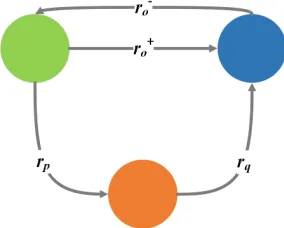
To formulate the triangle patterns, as shown in Fig. 2, we define a restricted triangle structure with three nodes a(green), b(orange), c(blue). We represent the relation fromatobas rp, the relation fromb tocas rq. If the re-lation betweenaandcis fromatoc, we represent it asr+
o, otherwise, we use ro− for the relation fromctoa. In each restricted triangle structure, eitherr+
o orr−o occurs between
aandc. In each triangle structure, if one relation is missed, we can use the other two relations to predicted the missed one.
Conf idence(ro+|rp, rq) =
F reqency(rp, rq, r+o)
F reqency(rp, rq)
Conf idence(rp|r+o, rq) =
F reqency(rp, rq, r+o)
F reqency(r+o, rq)
Conf idence(rq|r+o, rp) =
F reqency(rp, rq, r+o)
F reqency(r+o, rp)
Conf idence(r−o|rp, rq) =
F reqency(rp, rq, r−o)
F reqency(rp, rq)
Conf idence(rp|r−o, rq) =
F reqency(rp, rq, r−o)
F reqency(r−o, rp)
Conf idence(rq|r−o, rp) =
F reqency(rp, rq, r−o)
F reqency(r−o, rq) (2)
If we found a complete triangle structure, “a-r1-b-r2-c, a-r3-c”, we call it triangle pattern. Besides, if we found a tri-angle consisting of three entities with only two edges, such as “a-r1-b-r2-c”, we call it potential triangle pattern. We use existed triangle pattern in KB for model training, and we predict new triangle pattern based on existed potential trian-gle pattern in KG.
Collecting all the triangle patterns in Knowledge Base, we count the co-occurrence frequency of poten-tial triangle patterns as F reqency(r1, r2), r1, r2 can be
replaced by picking two from rp, rq, ro+/r−o. We also count the co-occurrence frequency of r1, r2 and r3
in triangle patterns as F reqency(r1, r2, r3), r1, r2, r3
can be replaced by rp, rq, ro+/r−o, the order can be changed. We can conclude a candidate inference rule, “n1−r1−n2−r2−n3=> n1−r3−n3”. In textual
ex-pression, “Ifr1andr2occur on a specific role in the triangle
pattern consists of three nodesn1, n2, n3, we can measure
how likelyr3occurs by a confidence”. As shown in Eq. 2,
based on occurrence dependency between relations, the confidence can be computed asConf idence(r3|r1, r2) =
F requency(r1, r2, r3)/F requency(r1, r2). The
confi-dence of each candidate inference rule is used in embedding learning process to indicate how likely the rule is tenable.
Transitive Relation Embedding
To measure the probability of candidate inference rules based on the relation transitive inference, we propose the Transitive Relation Embedding model.
If we observer1andr2in a triangle pattern, then we can predict the occurrence probability ofr3 and represent it as P(r3|r1, r2). We have the following probabilities needed to be predicted in our model, P(r+
o|rp, rq),P(ro−|rp, rq),
P(rp|r+
o, rq),P(rp|ro−, rq),P(rq|r+o, rp)andP(rq|r−o, rp).
# »
Vrp,rq =M1r#»p+M2r#»q, # »
Ur+o =M
+ 3r#»o,
# » Ur−
o =M
− 3r#»o
(3)
P(r+o|rp, rq) =
exp(U# »r+oT
# »
Vrp,rq)
PR rk[exp(
# »
Ur+kT
# »
Vrp,rq) +exp(
# »
Ur−kT
# »
Vrp,rq)]
P(r−o|rp, rq) =
exp(U# »r−o
TV# » rp,rq)
PR rk[exp(
# »
Ur+k
TV# » rp,rq) +exp(
# »
Ur−k
TV# » rp,rq)]
P(rp|r+o, rq) =
exp(U# »r+o
TV# » rp,rq)
PR rkexp(
# »
Ur+oT
# »
Vrk,rq)
P(rp|ro−, rq) =
exp(U# »r−oT
# »
Vrp,rq)
PR rkexp(
# »
Ur−oT
# »
Vrk,rq)
P(rq|ro+, rp) =
exp(U# »r+o
TV# » rp,rq)
PR rkexp(
# »
Ur+oT
# »
Vrp,rk)
P(rq|r−o, rp) =
exp(U# »r−oT
# »
Vrp,rq)
PR rkexp(
# »
Ur−oT
# »
Vrp,rk)
(4)
We learn ak-dimensional vector embedding for each re-lation in Knowledge Base, each rere-lation is represented as a point in ak-dimensional space, all relations share the same space. But in each triangle pattern, each relation has differ-ent role,rp,rq,ro+orr−o. As shown in Eq. 3, for two rela-tions occurs on posirela-tions ofrpandrq, we map their embed-dings into one joint role-specific space point asV# »rp,rqby us-ing role-specific matricesM1andM2. We also map the
em-bedding of the relation in positionr+
o /r−o into role-specific space asU# »+
ro / # »
As shown in Eq. 4, we can compute the probabilities of relation occurrence based on mapped vector space points
# » Vrp,rqand
# » Ur+o /
# »
Ur−o. We give the assumption that if the re-lation inference rule is likely to be true, the probability we predict in our model should be high, which means interac-tion ofV# »rp,rqand
# » U+ ro/
# »
Ur−oshould be high. Our probability equation meets the restrictions in Eq. 5.
R
X
rk
[P(rk+|rp, rq) +P(r−k|rp, rq)] = 1,
R
X
rk
P(rk|r+o, rq) = 1, R
X
rk
P(rk|r−o, rq) = 1,
R
X
rk
P(rk|r+o, rp) = 1, R
X
rk
P(rk|r−o, rp) = 1. (5)
An important reason to use embedding model is that the result of embedding model is one vector for each relation, it can not only compute the probabilities for relation triples occurred in training data, it can also generalize to the rela-tion triples never occurred in training data but need to be predicted in test data. For example,(r1, r3, r5+),(r1, r4, r+5)
and(r2, r3, r6+)occurred in training data,r2,r4andr6never
occurred in the same triangle pattern, we can still compute probabilities for inference rule consists ofr2,r4andr6,
be-cause we learn the transitive inference information ofr2,r4
andr6and represent it by embedding vector.
Training
With the above definitions, we can get a training likelihood equation for our detail embedding model. We define two triple sets,S+andS−,S+consists of relation triples with
forward direction third relationr+
o (fromatoc). Conversely, S−consists of relation triples with backward direction third
relationro−(fromctoa). As shown in Eq. 6, in the likelihood equation, we use KL-divergence for distributions of confi-dence and predicted probability. By maximizing the likeli-hood equation, the relation inference rule with higher confi-dence have more chance to result in high probability.
L=
S+
X
rp,rq,r+o
{Conf idence(r+o|rp, rq)log[P(r+o|rp, rq)]
+Conf idence(rp|ro+, rq)log[P(rp|ro+, rq)]
+Conf idence(rq|r+o, rp)log[P(rq|r+o, rp)}
+
S−
X
rp,rq,ro−
{Conf idence(r−o|rp, rq)log[P(r−o|rp, rq)]
+Conf idence(rp|ro−, rq)log[P(rp|ro−, rq)]
+Conf idence(rq|r−o, rp)log[P(rq|r−o, rp)]} (6)
Joint Prediction Strategy
We also observed a limitation of the proposed model. It can’t predict links between a pair of entities if there is no existing potential triangle pattern in training data between them. We use a strategy to combine the prediction results of the pro-posed model and baseline models including TransE, TransH, TransR, RESCAL, TransD, DistMult, ComplEx. The final result of the combined model is improved.
In entity link prediction and relation link prediction tasks, we target to predict how likely the given entity-relation-entity triple is true or false. For each triple(a, ro, c),aand
care entities,ris one relation fromatoc, we detect all the potential triangle pattern between entity pairaandc. Specif-ically, we find all the combination ofrp, b, rqwhich can link
aandc,a−rp−b−rq−c,rpandrqare relations,bis an en-tity. If there is any potential triangle pattern between entity pairaandc, we can compute the probability based on the tri-angle pattern inference embedding vectors ofrp,rq andro, we predict the triple authenticity with computed probabil-ity, we can achieve more accurate prediction than baselines because of the advantages of triangle pattern inference em-bedding. Otherwise, if there is no potential triangle pattern betweenaandc, we can’t compute the probability. In this condition, we predict a new triple based on score function value of baselines. In brief, our proposed method uses the same prediction result for entity pairs with no potential tri-angle pattern, it uses embedding based tritri-angle pattern infer-ence to achieve better prediction result for entity pairs with the potential triangle pattern.
Advantages of Proposed Model
Outperform on sparse KG. In sparse KG, some entities occur infrequently, traditional embedding models can’t do accurate prediction for these entities, while our proposed method focuses on relation inference, as long as there is valid triangle pattern between two entities, we can give accu-rate prediction, the entity occurrence frequency is irrelevant. High interpretability. Our proposed model can achieve high interpretability because the probability of each can-didate relation inference rule can be explicitly computed. Given two entitiesa, c, and a potential triangle patterna−
r1−b−r2−cbetween them, we can explicitly compute the
probability of relationr3betweenaandc,P(r3|r1, r2). We
can conclude an interpretable rule, ”Ifr1betweenaandb,r2
betweenbandc, then the probability of there isr3between
a, c isP(r3|r1, r2)”. In Tab. 1, we list some interpretable
relation inference rule example computed by our proposed model on dataset FB15K.
iter-Table 1: Relation Inference Example
Potential triangle pattern Inferred relation Probability rp: film release region,rq: languages spoken r+o: language 0.9916
rp: actor,rq: languages r+o: language 0.9578
rp: film release region,rq: currency r+o: currency 0.9433
rp: spouse,rq: place lived location r+o: location of ceremony 0.9969
rp: sibling,r+o: ethnicity rq: ethnicity 0.9664
rp: computer videogame/sequel,rq: computer videogame/developer r−o: games developed 0.9987
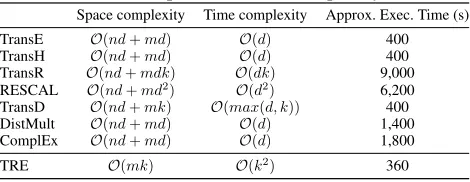
Table 2: Space and Time Complexity
Space complexity Time complexity Approx. Exec. Time (s)
TransE O(nd+md) O(d) 400
TransH O(nd+md) O(d) 400
TransR O(nd+mdk) O(dk) 9,000
RESCAL O(nd+md2) O(d2) 6,200 TransD O(nd+mk) O(max(d, k)) 400
DistMult O(nd+md) O(d) 1,400
ComplEx O(nd+md) O(d) 1,800
TRE O(mk) O(k2) 360
ations than other methods, we find that the execution time of TRE is shorter than others.
Why we focus on triangle pattern rule inference?By observing KB structure, we find that transitivity existed in most of existed KG, and it is a key factor for KB comple-tion because it can reliably infer new relacomple-tions between a pair of entities. To model the KB transitivity, we need a sim-ple but reasonable representation, triangle pattern. We use triangle pattern to represent the transitive relation inference, and conclude interpretable relation inference rule based on triangle pattern.
Why we use relation transitivity statistics? Compare with baselines, especially TransX KB completion methods, we use a totally different training framework to solve KB sparsity problem. We focus on KB relations only and aban-don entity embedding learning, we also use relation transi-tivity statistics, The occurrence of triangle pattern, as input of our learning process. As long as the relation triangle pat-tern related to an entity is proved by large number of samples in entire KG, the infrequent occurrence of this entity doesn’t influence the KB completion accuracy.
Why we use embedding model? We use embedding model in this paper for learning result generalization. If a tri-angle pattern in the testing set has never occurred in training data, we can’t determine whether it is true with traditional methods, such as rule-based model, however, the embed-ding model generalizes the learning result. By embedembed-ding model, we can learn embedding for the relations consisting the triangle pattern, which enables us to determine the prob-ability of that the triangle pattern is tenable. Through the generalization of embedding model, as long as the relations occurred in training data, we can do prediction for triangle patterns which has ever occurred in training data.
Experiments
We use several entity embedding required knowledge base embedding models, which are popular KB Embed-ding models used in previous works, as our baselines in-cluding TransE(Bordes et al. 2013), TransH(Wang et al. 2014), TransR(Lin et al. 2015b), RESCAL(Nickel, Tresp, and Kriegel 2011), TransD(Ji et al. 2015), DistMult(Yang et al. 2014), and ComplEx(Welbl, Riedel, and Bouchard 2016). We test the performance of these methods on several widely used KB datasets, including FB15K and WN18. We also construct an extremely sparse dataset by extracting subset from entire DBpedia project, we call this dataset “DBP” in experiment. The sizes of datasets are listed in Tab. 3, we also list average and median time of entities occur in train-ing dataset in last two column of table. We can see that DBP is far more sparse than other two datasets.
Entity Link Prediction
To compare the performance of proposed model with base-lines direct, we do an experiments for entity link prediction under the framework of previous works, predicting tail en-tity(h, r,?)and predicting head entity(?, r, t). Given a pair
(h, r)or (r, t),his head entity of triple,r is relation,t is tail entity, our task is to predict the missing part of triple, to predicttfor(h, r)and to predicthfor(r, t). For tail entity prediction, (h, r,?), we fill tail entity with any entity ein KG, and rank the entities with the probability that the triple
(h, r, e)is true, the triple with the higher rank is more likely to be true. Similarly, for head entity prediction,(?, r, t), we rank the triples(e, r, t)and determine which triples are more likely to be true.
For triple ranking, we need to compute the score of each triple. In baselines, we compute the score of triple with the score function of baselines, we rank the triples in ascend-ing order, low score indicates high rank. In the proposed model, we first detect all potential triangle pattern between pair(h, e)/(e, t), then we sum up all the probability thatr occurs between(h, e)/(e, t)as score of triple, we rank the triples in descending order, high score indicates high rank. With ranking result, we use three evaluation methods, Mean Rank (MR), Mean Reciprocal Rank (MRR) and Hit@10. The target of prediction task is to achieve low MR, high MRR and high Hit@10.
re-Table 3: Dataset Size
Entity count Relation count Triple count Triangle pattern count Avg. entity occurrence Med. entity occurrence FB15K 14,951 1,346 483,142 115,939 64.63 41
WN18 40,943 18 141,442 1,068 6.91 4
DBP 376,941 566 432,760 46,327 2.27 1
Table 4: Result of FB15K Entity Prediction
(h, r,?) (?, r, t)
Baseline Baseline+TRE Baseline Baseline+TRE MRR MR Hit@10 MRR MR Hit@10 MRR MR Hit@10 MRR MR Hit@10 TransE .2371 222.22 .4355 .5444 60.17 .7974 .1786 346.65 .3536 .4789 83.51 .7184
TransH .2317 234.33 .4222 .5442 60.54 .7965 .1733 364.00 .3428 .4784 85.57 .7176
TransR .2428 209.27 .4422 .5451 55.74 .7986 .1822 347.35 .3627 .4794 82.67 .7201
RESCAL .1519 523.31 .2615 .5392 114.90 .7825 .1015 806.08 .1879 .4741 163.55 .7054
TransD .2307 244.57 .4193 .5441 62.56 .7967 .1735 375.40 .3404 .4785 86.25 .7173
DistMult .1904 231.57 .3603 .5425 58.32 .7909 .1370 334.54 .2852 .4768 84.14 .7130
ComplEx .2430 207.30 .4671 .5467∗ 52.05∗ .8043∗ .1871 296.30 .3899 .4811∗ 71.82∗ .7257∗
Table 5: Result of WN18 Entity Prediction
(h, r,?) (?, r, t)
Baseline Baseline+TRE Baseline Baseline+TRE MRR MR Hit@10 MRR MR Hit@10 MRR MR Hit@10 MRR MR Hit@10 TransE .2424 625.15 .4564 .3649 582.83 .5422 .2184 614.51 .4202 .3400 555.27 .5072
TransH .0378 2974.43 .073 .1922 2572.43 .229 .0400 2948.18 .0716 .1933 2500.31 .2262
TransR .2776 469.16 .5268 .3924 443.12∗ .5954 .2537 482.39 .5114 .3698 441.37∗ .581
RESCAL .0408 7172.78 .0722 .1962 6167.40 .2278 .0584 6677.36 .0984 .2101 5777.30 .252
TransD .2208 769.21 .3986 .3471 706.03 .4946 .2042 850.86 .3752 .3323 747.70 .4782
DistMult .3226 761.08 .5866 .4333 703.62 .655 .2966 767.61 .5602 .4091 709.83 .634
ComplEx .5627 819.72 .8012 .6351∗ 719.08 .8328∗ .5399 839.39 .781 .6177∗ 730.66 .818∗
Table 6: Result of FB15K, WN18 and DBP Relation Prediction(h,?, t)
FB15K WN18 DBP
Baseline Baseline+TRE Baseline Baseline+TRE Baseline Baseline+TRE
MRR MR Hit@10 MRR MR Hit@10 MRR MR Hit@10 MRR MR Hit@10 MRR MR Hit@10 MRR MR Hit@10
TransE .5049 63.99 .7256 .6730 19.54 .8882 .5833 3.61 .9398 .6100 3.34 .9466 .0121 258.56 .0150 .1827∗ 192.50∗ .2265 TransH .5281 55.47 .7494 .6780∗ 20.37 .8891 .1568 10.68 .3764 .2372 9.52 .4666 .0124 273.02 .0169 .1824 201.92 .2263 TransR .4169 194.95 .5998 .6550 37.72 .8638 .4582 4.33 .9628 .4976 4.04 .9618 .0119 267.27 .0159 .1821 198.93 .2260 RESCAL .4314 11.47 .7969 .6629 8.47∗ .9035∗ .6417 3.52 .9046 .6486 3.43 .9136 .0112 284.79 .0144 .1820 210.73 .2254
TransD .5115 67.04 .7304 .6743 22.19 .8856 .6891 3.52 .8404 .7060 3.23 .8716 .0120 258.92 .0165 .1824 192.57 .2270 DistMult .0855 44.77 .2120 .5959 15.68 .7972 .7669 1.84 .9764∗ .7489 2.04 .9728 .0124 275.04 .0194 .1823 204.69 .2278∗
sult of tail entity prediction,(h, r,?), the right part of tables contain result of head entity prediction,(?, r, t). By compar-ing prediction result of baselines and joint prediction result of baselines and TRE, we find that joint prediction result out-perform the baselines on both two datasets. For each base-line, we compare the results for baseline and TRE+basebase-line, the bold font results means the better one between baseline and TRE+baseline, the results with star represent the best re-sult among all 14 methods including 7 baseline methods and 7 TRE+baseline methods. As we can see, in entity link pre-diction, joint prediction (TRE+baseline) result outperforms the baselines on both two datasets.
Relation Link Prediction
We also test relation link prediction, predicting (h, ?, t), to show the proposed model is capable to predict new relations between entities. Given an entity pair(h, t), the task is to predict the relationrbetweenhandt. For each pair(h, t), we fill triple (h, ?, t) with any relationr, the score of triple (h, r, t) is computed as same as in entity link prediction. We rank the triples to determine which triples are more likely to be true, we also use MR, MRR and Hit@10 for result evaluation.
We can see on FB15K and DBP, the TRE+baseline meth-ods outperform the baseline methmeth-ods, however, on WN18, we observe that some result baseline methods are slightly better than TRE+baseline methods, this is because there are only 18 relations in WN18 dataset, we can extract a lim-ited number of triangle pattern for training. As shown in Tab. 3, the entity size and triple size of WN18 is close to other two datasets, but the relation size is extremely small, which causes the triangle pattern extracted is extremely less than other two datasets. The meaning of bold font and star is as same as in entity link prediction task.
Table 7: Result of Sparse FB15K Relation Prediction
MRR MR Hit@10
TransE .3632 204.63 .5295
TransH .3867 174.89 .5810
TransR .3322 287.74 .4668
RESCAL .3713 27.88 .6438
TransD .3663 199.49 .2659
DistMult .0414 78.20 .1128
ComplEx .4488 42.01 .8088
TRE .6429 14.84 .8723
Accurate Prediction on Extremely Sparse KG
We do the relation link prediction on this sparse dataset DBP. The result shows that the proposed model has a clear advan-tage than other baselines when they deal with sparse dataset. From Tab. 3, we can see that the average occurrence of each entity in DBP is far less than other two datasets, which makes the dataset DBP extremely sparse. We test the base-line methods and TRE+basebase-line methods, the result shows that our proposed model has large advantage, the baseline methods perform poorly, however, the predictions of pro-posed model are still accurate.For further testify our assumption, we also extract a sparse subset of FB15K to show the capability of the proposed method on sparse KB data through leveraging transitive re-lation inference. We extract a sparse subset of FB15K by extracting the triples meeting following conditions, at least one entity occurred less than 5 times in training dataset, at least one triangle pattern existed between two entities. Com-paring result in Tab. 7 with the FB15K result in Tab. 6, we can find that the results of baseline methods fall largely on at least one evaluations, however, the TRE results is barely influenced by sparsity.
Conclusions
In This paper, we proposed TRE, a new embedding model using the transitivity of Knowledge Base relations to effi-ciently solve KB sparsity problem. To take advantages of Knowledge Base relation transitivity, we extract relation tri-angle pattern from large-scale Knowledge Bases. We mea-sure the reliability of Knowledge Base relation inference rule with confidences of relation triangle patterns, which are used as input to train TRE model. We evaluate our pro-posed model with two tasks, entity prediction and relation prediction, the proposed model outperforms baselines. We specially test our model on sparse dataset, the advantage of proposed model is greater. Because of using relation trian-gle pattern statistics as training data, the entity occurrence frequency is irrelevant, proposed model can achieve good result on sparse data. The possibility of each given triangle pattern relation inference rule can be explicitly computed, which makes the prediction result of TRE interpretable. By learning embedding of relations only instead of both entities and relations, TRE can achieve efficient training. The above advantages of TRE are evaluated in our experiments.
References
Auer, S.; Bizer, C.; Kobilarov, G.; Lehmann, J.; Cyganiak, R.; and Ives, Z. 2007. Dbpedia: A nucleus for a web of open data. InThe semantic web. Springer. 722–735.
Bollacker, K.; Evans, C.; Paritosh, P.; Sturge, T.; and Taylor, J. 2008. Freebase: a collaboratively created graph database for structuring human knowledge. In Proceedings of the 2008 ACM SIGMOD international conference on Manage-ment of data, 1247–1250. AcM.
Bordes, A.; Usunier, N.; Garcia-Duran, A.; Weston, J.; and Yakhnenko, O. 2013. Translating embeddings for modeling multi-relational data. InInternational Conference on Neural Information Processing Systems, 2787–2795.
Dong, Y.; Chawla, N. V.; and Swami, A. 2017. metap-ath2vec: Scalable representation learning for heterogeneous networks. In Proceedings of the 23rd ACM SIGKDD In-ternational Conference on Knowledge Discovery and Data Mining, 135–144. ACM.
Fellbaum, C. 2005. Wordnet and wordnets.
Conference on Knowledge Discovery & Data Mining, 855– 864.
Ji, G.; He, S.; Xu, L.; Liu, K.; and Zhao, J. 2015. Knowledge graph embedding via dynamic mapping matrix. InMeeting of the Association for Computational Linguistics and the In-ternational Joint Conference on Natural Language Process-ing, 687–696.
Lin, Y.; Liu, Z.; Luan, H.; Sun, M.; Rao, S.; and Liu, S. 2015a. Modeling relation paths for representation learning of knowledge bases. In Proceedings of the 2015 Confer-ence on Empirical Methods in Natural Language Process-ing, 705–714.
Lin, Y.; Liu, Z.; Zhu, X.; Zhu, X.; and Zhu, X. 2015b. Learn-ing entity and relation embeddLearn-ings for knowledge graph completion. InTwenty-Ninth AAAI Conference on Artificial Intelligence, 2181–2187.
Liu, H.; Wu, Y.; and Yang, Y. 2017. Analogical inference for multi-relational embeddings. In International Conference on Machine Learning, 2168–2178.
Min, B.; Grishman, R.; Wan, L.; Wang, C.; and Gondek, D. 2013. Distant supervision for relation extraction with an in-complete knowledge base. InProceedings of the 2013 Con-ference of the North American Chapter of the Association for Computational Linguistics: Human Language Technolo-gies, 777–782.
Nickel, M.; Tresp, V.; and Kriegel, H. P. 2011. A three-way model for collective learning on multi-relational data. InInternational Conference on International Conference on Machine Learning, 809–816.
Singhal, A. 2012. Introducing the knowledge graph: things, not strings. Official google blog5.
Tang, J.; Qu, M.; Wang, M.; Zhang, M.; Yan, J.; and Mei, Q. 2015. Line:large-scale information network embedding. 2(2):1067–1077.
Tsourakakis, C. E. 2008. Fast counting of triangles in large real networks without counting: Algorithms and laws. InEighth IEEE International Conference on Data Mining, 608–617.
Wang, Z.; Zhang, J.; Feng, J.; and Chen, Z. 2014. Knowl-edge graph embedding by translating on hyperplanes. In
Twenty-Eighth AAAI Conference on Artificial Intelligence, 1112–1119.
Welbl, J.; Riedel, S.; and Bouchard, G. 2016. Complex em-beddings for simple link prediction. InInternational Con-ference on Machine Learning, 2071–2080.
Yang, B.; Yih, W.; He, X.; Gao, J.; and Deng, L. 2014. Em-bedding entities and relations for learning and inference in knowledge bases.
Yao, X., and Van Durme, B. 2014. Information extrac-tion over structured data: Quesextrac-tion answering with freebase. InProceedings of the 52nd Annual Meeting of the Associa-tion for ComputaAssocia-tional Linguistics (Volume 1: Long Papers), volume 1, 956–966.
Yih, S. W.-t.; Chang, M.-W.; He, X.; and Gao, J. 2015. Se-mantic parsing via staged query graph generation: Question answering with knowledge base.
Yoon, H.-G.; Song, H.-J.; Park, S.-B.; and Park, S.-Y. 2016. A translation-based knowledge graph embedding preserving logical property of relations. In Proceedings of the 2016 Conference of the North American Chapter of the Associa-tion for ComputaAssocia-tional Linguistics: Human Language Tech-nologies, 907–916.