65
Copyright © 2018. IJEMR. All Rights Reserved.
Volume-8, Issue-1 February 2018
International Journal of Engineering and Management Research
Page Number: 65-72
Experimental Investigation of the Effects of Electrode Shape on ECSM
Performance during Machining of Alumina Ceramics
Mukesh Verma1 and Alakesh Manna2 1
Associate Professor, Department of Mechanical Engineering, Sri Sukhmani Institute of Engineering & Technology, Dera Bassi, INDIA
2Professor, Department of Mechanical Engineering, PEC University of Technology, Chandigarh, INDIA
2
Corresponding Author: [email protected]
ABSTRACT
Advanced ceramic material like alumina ceramic is continuously gaining the industrial acceptance in various applications such as cutting tools, electrical and thermal insulators, turbine blades, electronic devices etc. due to the superior properties of such ceramic. The alumina ceramic has different superior qualities such as high hardness, refractoriness, wear and corrosion resistance, high temperature withstands capability, low thermal coefficient of expansion etc. But machining of alumina ceramics is very difficult because of its brittleness and electrically nonconductive. Keeping in view, the present research work undertakes the machining study through design and fabrication of electrochemical spark machining (ECSM) set-up. Experiments were carried out with three different shapes of electrodes such as (i) solid circular shape of 0.8mm diameter (ii) hollow circular shape of 0.8mm external and 0.6mm internal diameter (iii) 0.8mm diameter solid circular tool with flutes i.e. drill type electrodes. The experimental results and SEM images of the machined holes revealed that the solid circular drill electrode is better electrode as compared to the others electrodes used for experiments for machining of hole on alumina ceramic workpiece specimens. The working range of different machining parameters was also identified on the basis of experimental results and analyzed the effects of ECSM set-up parameters on response characteristics.
Keywords-- ECSM, Electrode shape, Alumina, SEM images
I.
INTRODUCTION
The electrically non-conducting advanced ceramic materials such as alumina are becoming increasingly popular in technologically advance industries such as aeronautics, automotive and nuclear industries
because of their inert nature, high hardness, refractoriness, wear and corrosion resistance and high temperature strength [1]. But machining of such advanced ceramics by well known conventional and some of non conventional machining processes are difficult because of cutting tool wear, low material removal rate (MRR), relatively poor surface quality and micro cracks developed on the machined surface, it is due to high brittleness and electrically nonconductive of these materials. Advanced machining methods like electrochemical machining (ECM) and electric discharge machining (EDM) provides good surface finish and machining tolerances but suffers from the drawback that these processes can’t be used for machining of these advance materials because they are electrically non-conductive [2, 3]. To meet the challenges in micro-machining domain and overcome the limitations of machining of nonconductive ceramics, different researchers have been attracted toward developing hybrid machining processes (HMPs), in which two or more processes are combined together for machining to enhance the advantages of constituent processes and hybrid machining processes can be effectively applied for machining of electrically nonconductive materials.
66
Copyright © 2018. IJEMR. All Rights Reserved.
explored the capabilities of ECSM by conducting theexperimental investigation on the micro machining of electrically nonconductive e-glass–fibre–epoxy composite during electrochemical spark machining using specially designed square cross section with centrally micro hole brass tool and different diameter round-shaped micro tools made of IS-3748 steel. The influence of the fabricated ECSM parameters on the material removal rate and overcut on generated hole radius were investigated. The shape of the tool has a strong influence on the geometry of the machined hole. Flat side wall shaped tool performed better as compared to cylindrical tools while machining the holes as reported by Eunice et al. [9]. Yang et al. [10] used spherical end shape tool i.e. electrode and claimed that the curved surface of the spherical tool reduces the contact area between the electrode and the workpiece, thus facilitating the flow of electrolyte to the electrode end and enables rapid formation of gas film, resulting generates better micro-hole. Wei et al. [11] presented the technique of electrochemical discharge machining (ECDM) gravity-feed drilling using micro-drills. They claimed that the
(MRR) and radial overcut during machining of alumina ceramic on developed ECSM set-up.
II. PLANNING AND EXPERIMENTATION
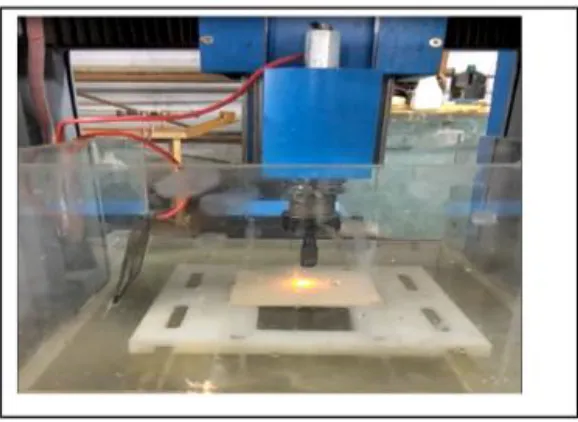
The experiments were carried out based on one factor at a time approach. The selection of parameters and their range (Table 1), and plan for experimentation were done based on the feasibility tests conducted on fabricated ECSM set-up. The three different shapes of stainless steel electrodes i.e. (i) solid circular shape of 0.8 mm diameter tool, (ii) hollow cylindrical shape of 0.8 mm external and 0.6 mm internal diameter tool and (iii) 0.8 mm diameter solid circular with flutes i.e. drill type electrode were selected for the experiments is shown in Fig. 1. The non conductive alumina ceramic and NaOH selected as workpiece specimens and electrolyte respectively. Fig. 2 shows the developed ECSM set-up used for machining of alumina ceramic.
Table1. ECSM machine parameters and their ranges selected for experiments
S. No. Symbol Machining parameters Ranges Units
1 A DC supply voltage 40 to 110 V
2 B Electrolyte concentration 40 to 280 g/l
3 C Pulse-on-time ,Ton 50 to 500 ms
4 D Pulse-off-time ,Toff 50 to 300 ms
67
Copyright © 2018. IJEMR. All Rights Reserved.
Fig. 2 Experiments carried out on developed ECSM set upIII.
RESULTS AND DISCUSSION
As discussed earlier, experiments were carried out with the objective to study the effect of developed ECSM set-up parameters on machining response characteristic as well as to identify the best tool i.e. electrode shape for effective machining of alumina ceramic. The effect of various parameters on MRR and overcut during machining of alumina ceramic specimens with different shapes of electrodes were analyzed through various graphs, SEM images.
3.1 Effect of electrode shape and machining parameters on MRR
68
Copyright © 2018. IJEMR. All Rights Reserved.
Fig. 3 Variation of MRR with DC supply voltage for different shapes of electrodesFrom Fig. 3, it is clear that at lower values of DC supply voltages, the material removal rate was very low and almost same for three different shapes of tool electrodes used. But as the DC supply voltage was increased further, the MRR was also increased. This may be due to increase of DC supply voltage, the bubble formation increases which leads to increase the intensity of spark generation in the machining zone. It is also clear that the material removal rate is high for solid circular with flutes i.e. drill type electrode. The hollow circular electrode gives almost same MRR as solid circular electrode gives at low supply voltage.
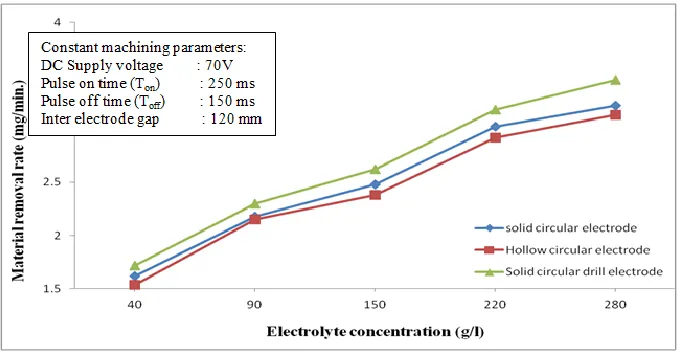
Fig. 4 shows the variation of MRR with electrolyte concentration. From Fig 4, it is identified that the material removal rate increases with increase in electrolyte concentration. It is may be due to more ionic current generation in the machining zone at high value of electrolyte concentration. The same increasing trend was observed for all three shapes of electrodes, but material removal rate for the solid circular drill electrode was more as compared to other two shapes of electrodes. It is due to the availability and circulation of more electrolytes in the machining zone.
Fig. 4 Variation of MRR with electrolyte concentration for different shapes of electrodes
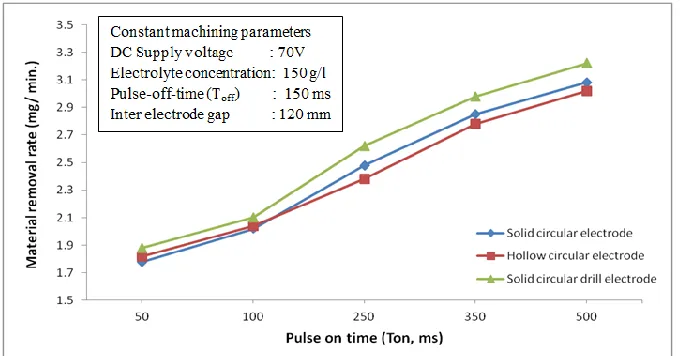
Fig. 5 shows variation of MRR with pulse-on-time (Ton, ms). From Fig 5, it is found that the material removal rate increases with increase in pulse-on-time (Ton, ms). When the small duration pulse was used for machining of alumina ceramic specimens, the spark was generated for the smaller period of time resulting into low material removal rate. As the pulse-on-time increases which increase the pulse duration time thereby spark generated for longer durations and hence the material
69
Copyright © 2018. IJEMR. All Rights Reserved.
Fig. 5 Variation of MRR with pulse-on-time (Ton, ms) for different shapes of electrodesFig. 6 Variation of MRR with inter electrode gap for different shapes of electrodes
Fig. 6 shows the variation of MRR with inter electrode gap during machining of electrically non conductive alumina (Al2O3) ceramic. From Fig. 6, it is clear that the variation of material removal rate (MRR, mg/min) with variation in inter electrode gap (IEG, mm) follows the similar fashion for all the three types of tool shapes of electrode. With increase of IEG from 30mm to 60mm, an increasing trend for MRR is identified but further increase in IEG i.e. beyond 60 mm IEG, the trend of MRR is declining in nature. As the inter electrode gap increases, it increases the resistance to current flow thereby decreases material removal rate. It is may be due to low electrochemical dissolution of material from the workpiece surface. The material removal rate at 60mm IEG was higher as compared to other setting values of IEG for all shapes of electrodes. However, the tool shape i.e. solid circular drill electrode was identified as best electrode for MRR (Fig.6)
3.2 Effect of electrode shape and machining parameters on overcut
70
Copyright © 2018. IJEMR. All Rights Reserved.
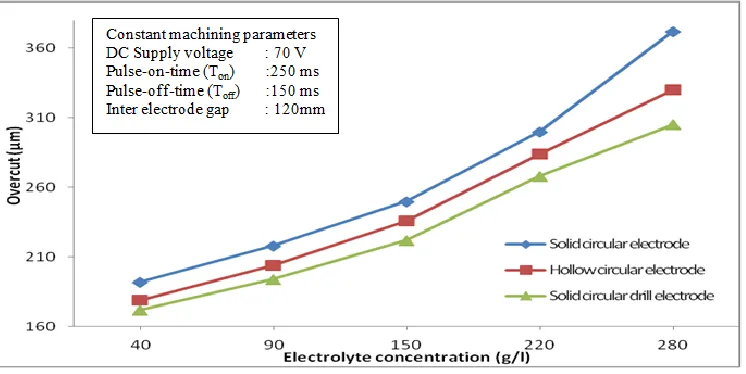
Fig. 7 Variation of overcut with DC supply voltage for different shapes of electrodesIt is clear from Fig.8 that overcut increases with increase in electrolyte concentration. With increase in electrolyte concentration, the charge carrier increases in the machining zone and hence the material also removes from the side walls of the holes already generated as a
result increases overcut. Electrolyte concentration has an important effect for all three shapes of electrodes but overcut was found less in case of solid circular tool with flutes as compared to other shapes of electrodes at all levels of electrolyte concentrations.
Fig. 8 Variation of overcut with electrolyte concentration for different shapes of electrodes
Fig. 9 shows the variation of overcut (µm) with pulse-off-time (Toff) and it is found that the overcut decreases with increase in pulse-off-time (Toff) for all three shapes of electrodes. With the increase of pulse off time,
71
Copyright © 2018. IJEMR. All Rights Reserved.
Fig. 9 Variation of overcut with pulse-off time (Toff) for different shapes of electrodeIV.
ANALYSIS OF SEM IMAGES OF
MACHINED HOLES
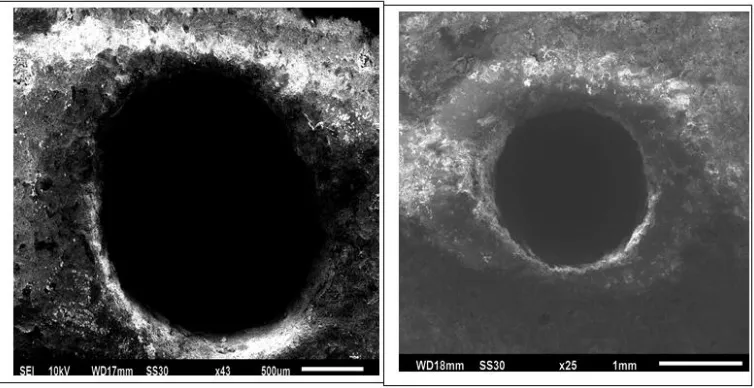
The SEM images of the machined holes were taken during experiments and analyzed for machined surface quality. Fig. 10 shows the SEM images of machined hole machined with solid circular drill electrode
at 70 V DC supply voltage, 150 g/l electrolyte concentration, 250 ms pulse on time (Ton), 150 ms pulse off time (Toff) and 150 mm inter electrode gap. The machining quality was also improved in terms of hole diameter at entry and exit i.e. less overcut when machining was done with solid circular drill electrode over other electrodes.
Fig. 5.10 SEM images of machined hole at 70V with (a) solid circular electrode (b) solid circular drill electrode.
V.
CONCLUSION
The electrochemical spark machining process can be effectively used for machining of nonconductive alumina ceramic material. Based on the experimental results, SEM images and discussions, it is clear that the solid circular drill electrode is the best tool as compared to the other tools (i.e. electrodes used in the experiments) for machining of alumina ceramics. Solid circular drill
72
Copyright © 2018. IJEMR. All Rights Reserved.
phenomenon— An overview. International Journal ofMachine Tools & Manufacture, 45(9), 1095–1108.
[5] Jain V. K. & Adhikary S. (2008) On the mechanism of material removal in electrochemical spark machining of quartz under different polarity conditions. Journal of
Material Processing Technology, 200, (460-470).
[6] C.T. Yang, S.L. Song, B.H. Yan & F.Y. Huang. (2006). Improving machining performance of wire electrochemical discharge machining by adding SiC
Engineering, 14(4), 535-540.
[10] Yang C. K., Wub K. L., Hung J. C., Lee S. M. , Lin J. C., & Yan B. H. (2011). Enhancement of ECDM efficiency and accuracy by spherical tool electrode.
International Journal of Machine Tools & Manufacture, 51, (528–535).
[11] Wei C., Xu K., Ni J., Brzezinski A. J., & Hu D., (2011). A finite element based model for electrochemical discharge machining in discharge regime. The
International Journal of Advanced Manufacturing