Effect of Cowpea Seeding Density on Growth
Parameters and Grain Yield of Maize in a real
Crop Situation in Northern Côte d'Ivoire.
Kouamé Antoine N'GUESSAN *, N'klo OUATTARA, Hermann Désiré
LALLIE, Fanta TOURE and Kouadoueu Alain Jaures WANELO
Peleforo Gon Coulibaly University , Faculty of Biological Sciences, Geosciences Department, BP 1328 Korhogo, Côte d’Ivoire. Corresponding author
Kouamé Antoine N’GUESSAN*. Teacher-researcher, Peleforo Gon Coulibaly University, Faculty of Biological Sciences, Geosciences Department. Cel : (225) 07 42 69 65 / (225) 52 14 82 04 E.mail : [email protected]
Abstract— Soil depletion and degradation as well as climate variability are responsible for the decrease in agricultural yields and the poverty of the rural population in northern Côte d'Ivoire.The present study was conducted in a participatory manner with two (2) food producer group s from the villages of Kolok aha and Sohouo (Korhogo Department) to determine the density of semi cowpea seeding that maximizes the growth and yield of maize.In this perspective, three densities of cowpea tested in this system of association with pure maize culture during two growing seasons with two improved maize varieties and a local variety.This is the T0 treatment: pure corn culture; T1_SNL: corn + cowpea in interbedded line; T2_SNLDI: corn + semi-cowpea in double line; T3_SNQ: corn + semi-semi-cowpea staggered.The results show that improved varieties of maize produce more and grow faster than the local variety. At each of two study sites, there was no mark ed effect of cowpea seeding density on plant height and grain yield per unit area.Although the thre e association modalities are efficient, SNL and SNLDI association models, which are confirmed as the most competitive, can preferably be recommended in a rural environment. However, the study of the use of cowpea with corn could be considered to allow a better use of the soil resources and consequently an improvement of the productivity of the associated crops.
Keywords— Association, cowpea, maize, semi density, soil.
I. INTRODUCTION
Soil depletion and degradation as well as climate variability are responsible for decrease in agricultural yields and worsening poverty in northern Côte d'Ivoire. With the strong land and demographic pressure observed in this zone, farmers are forced to practice continuous cultivation and to make the most of available land (N'guessan et al., 2019, N'goran et al., 2018), as is the case in the cotton zone of Burkina Faso reported by Coulibaly et al., (2012), Barro et al., (2016) and Ouattara et al., (2016). Today, farmers are worried about the fatigue of their soils, say that the land does not produce as before. In the cotton and maize cropping systems that predominate in the dense area of Korhogo Department, the use of mineral fertilizers alone does not maintain soil fertility.In this zone, legumes occupy only a marginal part in cropping systems, whereas they can play a very important role, whether grown in rotation or in association. Several studies conducted on legumes indicate that they can help improve soil fertility through
II. MATERIAL AND METHOD
Study site
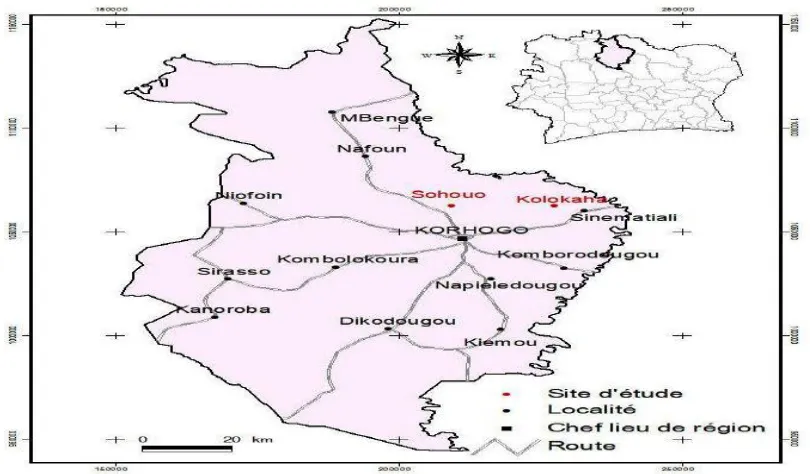
The study was conducted in the villages of Kolokaha and Sohouo located in the sub-prefectures of Sinematiali and Sohouo in the Korhogo department respectively (Figure 1). These two villages are mainly populated by Senoufo natives whose main activity is agriculture and livestock. The general pattern of the region is a tabular set of ferruginous cuirasses with gentle breaks caused by garlands of hills and hillocks with rounded reliefs set on plateaus of medium height (Avenard et al., 1971).According to Beaudou and Sayol, (1980), the geological substratum consists of calc-alkaline granites of the Precambrian. The soil cover of this region is characterized by the very large predominance of ferrallitic soils (Avenard et al., 1971). At the climatic level, the savanna district is bathed in a two-season tropical Sudanian climate, a dry season from November to April and a rainy season from May to October.
Plant material
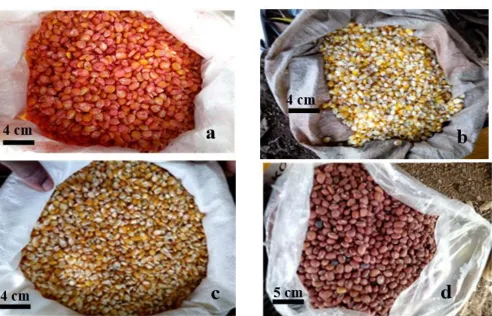
The plant material used consisted of three varieties of maize seed with or without local cowpea seed purchased from the Korhogo market (Figure 2). Corn seeds included two improved varieties, namely the Komsaya and EV 87 varieties and the local variety supplied by the farmers. The seeds of the Komsaya variety are characterized by yellow-orange grains of the dentate horn type. They have a crop cycle that ranges from 85 to 90 days with a potential yield of 8 to 9.5 t / ha for an optimal density of 60 000 plants / ha.This seed is suitable for areas receiving an annual rainfall ranging from 800 to 900 mm / year. The seeds of the selected variety EV 87 are composed of yellow-toothed grains characterized by a crop cycle that ranges from 80 to 95 days with a potential yield of 3 to 5 t / ha and an optimum density of 42. 500 plants / ha. It is suitable for areas receiving an annual rainfall of about 1000 mm.
Fig.2: Morphological aspect of maize and cowpea grain seeds (a: Komsaya maize variety, b: Maize local variety, c: EV87 maize seed, d: cowpea seed)
According to the farmers, the seeds of the local variety can produce between 02 to 03 t / ha. Regarding cowpea, the seed is characterized by a cycle of 75 days. Its potential grain yield is 1.5 t / ha and is suitable for areas with annual rainfall ranging from 400 to 800 mm of water.
Establishment and operation of demonstration plots Out of the nine villages benefiting from the project, the two groups of Kolokaha and Sohouo have a total of 50 direct beneficiaries, distributed among 35 members in Kolokaha (70%), including 03 men (8.42%) and 32 women (91%). , 43%) and 15 people in Sohouo (30%) with 02 men (13.33%) and 13 women (86.67%). In each of these villages, the members of the target groups were volunteers and the choice of the plot dedicated to the project and its location were done by the farmers themselves.They were trained in the proposed new technologies and participated fully in all the phases (semi, weeding, fertilizer spreading, harvesting, etc.) of the field work. In addition to agricultural inputs (improved maize seed, NPK fertilizer, urea, herbicides, insecticide), land
Fig.3: Maize and cowpea semi points in the association system
T0: maize seed in pure culture
T1-SNL: corn-semi-cowpea seed interposed
T2-SNLDI: semi-cowpea corn seed in double interbedded line
T3-SNQ: semi-stale corn seed staggered
There were 16 semi points when cowpea is sown in intercalated line (SNL) and quinconce (SNQ), or 16 cowpea plants per line for a density of 208 plants per elementary plot. In addition, when cowpea is sown in a double interspersed line (SNLDI), there were 32 plants on each line equivalent to a density of 416 plants/30m2. All of these plots benefited from fertilizer inputs and insecticide treatments. The study was conducted during two growing cycles covering the growing seasons of 2017 and 2018. During these two seasons, the semi intervened on the demonstration plots of the two villages in the periods from August 12 to 16, 2017 and July 10-15, 2018. Agronomic data collection
On each of the two demonstration plots, monitoring of the height growth and development of maize plants on the elementary plots was carried out in a participatory manner with the members of the beneficiary groups for 02 months. During this period, observations were made every 15 days from the 30th day after semi (JAS); i.e. at the 30th; 45th and 60th JAS out of 12 plants randomly selected by elementary plot equivalent to 36 plants per treatment.Growth and development parameters described by Mbaye et al. (2014) and Barro et al. (2016) in the case of similar studies, were used to characterize the vegetative behavior of plants from the three maize seeds. During the culture phase, the variables measured were the height of the plants, the number of leaves produced per plant, the circumference of the collar stems at 10 cm from the soil, and the grain yield per unit area.
Statistical analysis
Comparison of the averages of the agronomic parameters tested for seedling density, variety and measurement dates was achieved by variance analysis (ANOVA) at the 5% probability threshold. When a significant difference is noted between the factors considered for a given trait, the test of the smallest significant difference (ppds) HSD of TUKEY was performed. All these statistical tests were carried out using STATISTICA 7.1 software. In addition, the evaluation of association performance was carried out by calculating the Surface Equivalent Rate (TSE) or Land Equivalent Ratio (LER) for each component of the association. When the value of the LER is greater than or equal to 1, the combination is more advantageous than pure cultivation. Otherwise, when the value of the LER is less than 1, the association is less advantageous than pure cultivation (Ghosh, 2004). This method is based on the formula of Mead and Willey (1980) described as following::
LERm= 𝑌𝐿𝑚 𝑌𝑆𝑚
YLm : maize yield in combination, YSm : corn yield in pure culture, LERm : LER of maize.
III. RESULTS
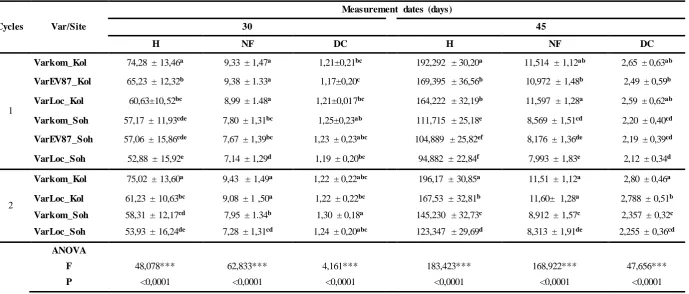
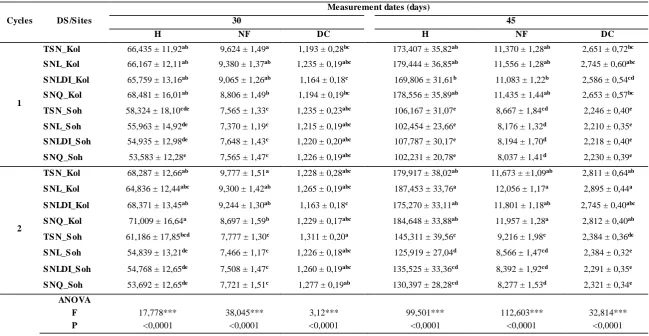
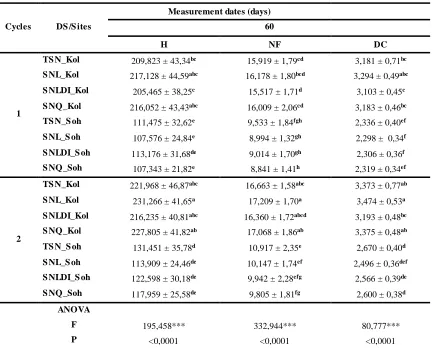
Effects of the corn variety and the study site on plant growth parameters over the two growing seasons. Tables 1 and 2 show, respectively, the average height, number of leaves produced and circumference at the
Poquets of maize
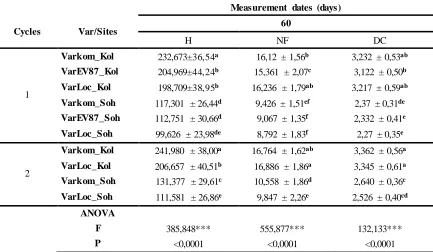
collar during the growth of plants from the three maize varieties during the 2017 and 2018 crop seasons. These tables show that the variety of maize has significantly affected (p -0.0001) all of these parameters 30; 45 and 60 JAS regardless of the growing season.The results also show that the average values of these parameters increase over time and with variety, highlighting significan t differences (P -0.0001) from 30 JAS. At the Kolokaha demonstration site, there was no significant effect of the maize variety on the number of leaves produced and the circumference at the collar of the corn plants 30; 45 and 60 JAS whatever the growing s eason. On the contrary, during the two growing seasons, there was a significant difference in the height of maize plants from 30 JAS. In fact, during this period, plant height is significantly higher in the Komsaya (season 1: 74.28 cm; season 2: 75.02 cm) compared to EV87 (season 1: 65.229 cm) and local (season 1: 60.625 cm; saiso n 2: 61,231 cm) which, moreover, have statistically identical values. However, although there is no significant difference, there is a slight increase in plant height in the EV87 variety compared to the local variety regardless of the growing season. This trend of evolution of plant height is the same after 45 and 60 JAS. In Sohouo, the plants behave in the same way for this variable regardless of the variety and the growing season 30 JAS. On this site, the difference between plant height occurs from 45 JAS up to 60 JAS. On these dates, the height of the plants is higher than the improved Komsaya variety compared to the other two varieties during the 2017 and 2018 growing seasons.The results also reveal that in Sohouo, the variety of maize did not significantly influence the circumference at the collar of corn plants 30; 45 and 60 JAS. In addition, data from Tables 1 and 2 show that maize plants grow faster on the Kolokaha demonstration plot compared to those grown in Sohouo regardless of variety and growing season. Influence of cowpea seeding density and study site on corn plant growth and development parameters during both growing cycles
Tables 3 and 4 show, respectively, the averag e values of the growth and development parameters of maize plants based on seeding density. These tables show that cowpea seeding density had no significant effect on height, number of leaves produced and plant collar circumference regardless of date of measurement, study site and growing season.Nevertheless, on the Kolokaha demonstration plot and during the first growing cycle, there were 30 JAS, a trend of stunting of maize plants of 0.4% and 1.02%, respectively in low (SNL) and high (SNLDI) cowpea compared to a non-significant 3.08% increase in SNQ treatments compared to pure-grown maize plants.From this date, the sNL maize plants begin a slight growth in
Table 1: Corn plant growth and development data 30 and 45 days after semi depending on variety and study site
Cycles Var/Site
Measurement dates (days)
30 45
H NF DC H NF DC
1
Varkom_Kol 74,28 ± 13,46a 9,33 ± 1,47a 1,21±0,21bc
192,292 ± 30,20a 11,514 ± 1,12ab 2,65 ± 0,63ab VarEV87_Kol 65,23 ± 12,32b 9,38 ± 1.33a 1,17±0,20c 169,395 ± 36,56b 10,972 ± 1,48b 2,49 ± 0,59b VarLoc_Kol 60,63±10,52bc 8,99 ± 1.48a 1,21±0,017bc 164,222 ± 32,19b 11,597 ± 1,28a 2,59 ± 0,62ab Varkom_Soh 57,17 ± 11,93cde 7,80 ± 1,31bc 1,25±0,23ab 111,715 ± 25,18e 8,569 ± 1,51cd 2,20 ± 0,40cd VarEV87_Soh 57,06 ± 15,86cde 7,67 ± 1,39bc 1,23 ± 0,23abc 104,889 ± 25,82ef 8,176 ± 1,36de 2,19 ± 0,39cd VarLoc_Soh 52,88 ± 15,92e 7,14 ± 1,29d 1,19 ± 0,20bc
94,882 ± 22,84f 7,993 ± 1,83e 2,12 ± 0,34d
2
Varkom_Kol 75,02 ± 13,60a 9,43 ± 1,49a 1,22 ± 0,22abc
196,17 ± 30,85a 11,51 ± 1,12a 2,80 ± 0,46a VarLoc_Kol 61,23 ± 10,63bc 9,08 ± 1 ,50a 1,22 ± 0,22bc 167,53 ± 32,81b 11,60± 1,28a 2,788 ± 0,51b Varkom_Soh 58,31 ± 12,17cd 7,95 ± 1.34b 1,30 ± 0,18a 145,230 ± 32,73c 8,912 ± 1,57c 2,357 ± 0,32c VarLoc_Soh 53,93 ± 16,24de 7,28 ± 1,31cd 1,24 ± 0,20abc
123,347 ± 29,69d 8,313 ± 1,91de 2,255 ± 0,36cd ANOVA
F 48,078*** 62,833*** 4,161*** 183,423*** 168,922*** 47,656***
P <0,0001 <0,0001 <0,0001 <0,0001 <0,0001 <0,0001
Table 2: Corn plant growth and development data 60 days after semi depending on variety and study site.
Measurement dates (days)
Cycles Var/Sites 60
H NF DC
1
Varkom_Kol 232,673±36,54a 16,12 ± 1,56b 3,232 ± 0,53ab VarEV87_Kol 204,969±44,24b 15,361 ± 2,07c 3,122 ± 0,50b VarLoc_Kol 198,709±38,95b 16,236 ± 1,79ab 3,217 ± 0,59ab Varkom_Soh 117,301 ± 26,44d 9,426 ± 1,51ef 2,37 ± 0,31de VarEV87_Soh 112,751 ± 30,66d 9,067 ± 1,35f 2,332 ± 0,41e VarLoc_Soh 99,626 ± 23,98de 8,792 ± 1,83f 2,27 ± 0,35e
2
Varkom_Kol 241,980 ± 38,00a 16,764 ± 1,62ab 3,362 ± 0,56a VarLoc_Kol 206,657 ± 40,51b 16,886 ± 1,86a 3,345 ± 0,61a Varkom_Soh 131,377 ± 29,61c 10,558 ± 1,86d 2,640 ± 0,36c VarLoc_Soh 111,581 ± 26,86e 9,847 ± 2,26e 2,526 ± 0,40cd
ANOVA
F 385,848*** 555,877*** 132,133***
P <0,0001 <0,0001 <0,0001
Table 3: Corn plant growth and development data based on cowpea seeding density and study site during the two 30 - and 45 JAS growing cycles
Cycles DS /S ites
Measurement dates (days)
30 45
H NF DC H NF DC
1
TS N_Kol 66,435 ± 11,92ab 9,624 ± 1,49a 1,193 ± 0,28bc 173,407 ± 35,82ab 11,370 ± 1,28ab 2,651 ± 0,72bc
S NL_Kol 66,167 ± 12,11ab 9,380 ± 1,37ab 1,235 ± 0,19abc 179,444 ± 36,85ab 11,556 ± 1,28ab 2,745 ± 0,60abc
S NLDI_Kol 65,759 ± 13,16ab 9,065 ± 1,26ab 1,164 ± 0,18c 169,806 ± 31,61b 11,083 ± 1,22b 2,586 ± 0,54cd
S NQ_Kol 68,481 ± 16,01ab 8,806 ± 1,49b 1,194 ± 0,19bc 178,556 ± 35,89ab 11,435 ± 1,44ab 2,653 ± 0,57bc
TS N_S oh 58,324 ± 18,10cde 7,565 ± 1,33c 1,235 ± 0,23abc 106,167 ± 31,07e 8,667 ± 1,84cd 2,246 ± 0,40e
S NL_S oh 55,963 ± 14,92de 7,370 ± 1,19c 1,215 ± 0,19abc 102,454 ± 23,66e 8,176 ± 1,32d 2,210 ± 0,35e
S NLDI_S oh 54,935 ± 12,98de 7,648 ± 1,43c 1,220 ± 0,20abc 107,787 ± 30,17e 8,194 ± 1,70d 2,218 ± 0,40e
S NQ_Soh 53,583 ± 12,28e 7,565 ± 1,47c 1,226 ± 0,19abc 102,231 ± 20,78e 8,037 ± 1,41d 2,230 ± 0,39e
2
TS N_Kol 68,287 ± 12,66ab 9,777 ± 1,51a 1,228 ± 0,28abc
179,917 ± 38,02ab 11,673 ± ±1,09ab 2,811 ± 0,64ab
S NL_Kol 64,836 ± 12,44abc 9,300 ± 1,42ab 1,265 ± 0,19abc 187,453 ± 33,76a 12,056 ± 1,17a 2,895 ± 0,44a
S NLDI_Kol 68,371 ± 13,45ab 9,244 ± 1,30ab 1,163 ± 0,18c 175,270 ± 33,11ab 11,801 ± 1,18ab 2,745 ± 0,40abc
S NQ_Kol 71,009 ± 16,64a 8,697 ± 1,59b 1,229 ± 0,17abc 184,648 ± 33,88ab 11,957 ± 1,28a 2,812 ± 0,40ab
TS N_S oh 61,186 ± 17,85bcd 7,777 ± 1,30c 1,311 ± 0,20a 145,311 ± 39,56c 9,216 ± 1,98c 2,384 ± 0,36de
S NL_S oh 54,839 ± 13,21de 7,466 ± 1,17c 1,226 ± 0,18abc 125,919 ± 27,04d 8,566 ± 1,47cd 2,384 ± 0,32e
S NLDI_S oh 54,768 ± 12,65de 7,508 ± 1,47c 1,260 ± 0,19abc 135,525 ± 33,36cd 8,392 ± 1,92cd 2,291 ± 0,35e
S NQ_Soh 53,692 ± 12,65de 7,721 ± 1,51c 1,277 ± 0,19ab
130,397 ± 28,28cd 8,277 ± 1,53d 2,321 ± 0,34e
ANOVA
F 17,778*** 38,045*** 3,12*** 99,501*** 112,603*** 32,814***
P <0,0001 <0,0001 <0,0001 <0,0001 <0,0001 <0,0001
Table 4: Corn plant growth and development data based on cowpea semi density and study site during the two crop cycles at 60 JAS
Cycles DS /S ites
Measurement dates (days)
60
H NF DC
1
TS N_Kol 209,823 ± 43,34bc 15,919 ± 1,79cd 3,181 ± 0,71bc
S NL_Kol 217,128 ± 44,59abc 16,178 ± 1,80bcd 3,294 ± 0,49abc
S NLDI_Kol 205,465 ± 38,25c 15,517 ± 1,71d 3,103 ± 0,45c
S NQ_Kol 216,052 ± 43,43abc 16,009 ± 2,06cd 3,183 ± 0,46bc
TS N_S oh 111,475 ± 32,62e 9,533 ± 1,84fgh 2,336 ± 0,40ef
S NL_S oh 107,576 ± 24,84e 8,994 ± 1,32gh 2,298 ± 0,34f
S NLDI_S oh 113,176 ± 31,68de 9,014 ± 1,70gh 2,306 ± 0,36f
S NQ_Soh 107,343 ± 21,82e 8,841 ± 1,41h 2,319 ± 0,34ef
2
TS N_Kol 221,968 ± 46,87abc 16,663 ± 1,58abc 3,373 ± 0,77ab
S NL_Kol 231,266 ± 41,65a 17,209 ± 1,70a 3,474 ± 0,53a
S NLDI_Kol 216,235 ± 40,81abc 16,360 ± 1,72abcd 3,193 ± 0,48bc
S NQ_Kol 227,805 ± 41,82ab 17,068 ± 1,86ab 3,375 ± 0,48ab
TS N_S oh 131,451 ± 35,78d 10,917 ± 2,35e 2,670 ± 0,40d
S NL_S oh 113,909 ± 24,46de 10,147 ± 1,74ef 2,496 ± 0,36def
S NLDI_S oh 122,598 ± 30,18de 9,942 ± 2,28efg 2,566 ± 0,39de
S NQ_Soh 117,959 ± 25,58de 9,805 ± 1,81fg 2,600 ± 0,38d
ANOVA
F 195,458*** 332,944*** 80,777***
P <0,0001 <0,0001 <0,0001
In the same column, the averages followed by the same letter are not significantly different to P -0.0001. H : height ;NF : number of leaves produced per plant ; DC : circumference at the collar ; Var: variety; Varkom: Komsaya variety;
VarEV87: variety EV87; VarLoc: Local variety; Kol: Kolok aha, Soh: Sohouo.
On the contrary, during the 2018 growing season, there is a trend of SNL and SNQ corn plants growing faster in heights of 4.19% and 2.63% respectively, and a slight growth delay of 2.58% in high density of cowpea semi (SNLDI) compared to pure-grown corn plants (NSTs).The same is true in Sohouo, where the overall trend in maize plants was recorded on all three measurement dates, respectively of SNL, SNLDI and SNQ treatments compared to pure-grown plants (NSTs) regardless of the growing season and the study site. Analysis of the data in Tables 3 and 4 also reveals a significant inter-site difference between the growth and development of maize plants. These tables show that the corn plants at the Kolokaha demonstration site have significantly, the highest average collar circumference values and move higher up on all measurement dates than those grown at Sohouo whatever the growing season. +
Influence of the variety on corn grain yield during the first growing season.
Moyenne
Moyenne±0,95 Intervalle Conf. Local_KOL
Komsaya_KOL
EV8728_KOL
Local_SOH
Komsaya_SOH
EV8728_SOH
Parameters -1
0 1 2 3 4 5 6 7 8 9
(Kg
/3
0
m2
)
(Kg/30 m2): F(5;84) = 22,7707; p = 0,0000
Fig.6: Evolution of maize grain yield during the first growing season
Influence of cowpea seeding density on corn grain yield during the two growing seasons
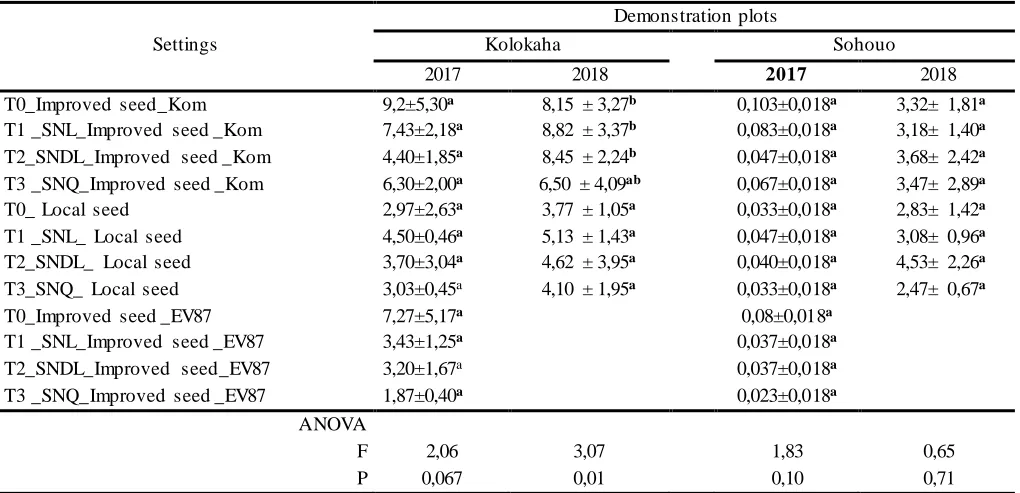
The results of Table 5 reveal that cowpea seeding density had no significant effect on corn grain yield produced per unit area regardless of the study site and growing season. However, in 2017, there was a downward trend in corn grain yield at each of the two demonstration sites with the seeding density of cowpea in elementary plots grown with improved Komsaya and EV87 against an increase in this parameter at the level of those grown with the local variety. In Kolokaha, the yield decline was 19.24%;
52.17% and 31.52%, respectively, in the SNL, SNLDI and SNQ elementary plots of the improved Komsaya variety and 52.82%; 55.98% and 74.28% at the elementary plots of the EV87 variety compared to pure-grown maize plots. On the Sohouo parcel, the trend decline in yield was 19.41%; 54.37% and 34.95%, respectively, in the SNL, SNLDI and SNQ elementary plots of the improved Komsaya variety and 53.75%; 53.75% and 71.25% in corresponding elementary plots grown with EV87.
Table 5: Corn grain yield per unit area based on density and the study site
Settings
Demonstration plots
Kolokaha Sohouo
2017 2018 2017 2018
T0_Improved seed_Kom 9,2±5,30a 8,15 ± 3,27b 0,103±0,018a 3,32± 1,81a T1 _SNL_Improved seed _Kom 7,43±2,18a 8,82 ± 3,37b 0,083±0,018a 3,18± 1,40a T2_SNDL_Improved seed _Kom 4,40±1,85a 8,45 ± 2,24b 0,047±0,018a 3,68± 2,42a T3 _SNQ_Improved seed _Kom 6,30±2,00a 6,50 ± 4,09ab 0,067±0,018a 3,47± 2,89a
T0_ Local seed 2,97±2,63a 3,77 ± 1,05a 0,033±0,018a 2,83± 1,42a
T1 _SNL_ Local seed 4,50±0,46a 5,13 ± 1,43a 0,047±0,018a 3,08± 0,96a T2_SNDL_ Local seed 3,70±3,04a 4,62 ± 3,95a 0,040±0,018a 4,53± 2,26a T3_SNQ_ Local seed 3,03±0,45a 4,10 ± 1,95a 0,033±0,018a 2,47± 0,67a
T0_Improved seed _EV87 7,27±5,17a 0,08±0,018a
T1 _SNL_Improved seed _EV87 3,43±1,25a 0,037±0,018a
T2_SNDL_Improved seed_EV87 3,20±1,67a 0,037±0,018a
T3 _SNQ_Improved seed _EV87 1,87±0,40a 0,023±0,018a
ANOVA
F 2,06 3,07 1,83 0,65
P 0,067 0,01 0,10 0,71
3,21 b
6,67 a
4,02 b
0,32 c
b
0,67 c
b
0,40 c
In the same column, the averages followed by the same letter are not significantly different at P <0.05. F: frequency; P: probability.
On the other hand, during the 2018 crop season, there was a non-significant increase in corn grain yields in elementary plots in cowpea-associated crops in both demonstration plots compared to pure-grown plots for each of the two varieties. In Kolokaha, apart from the SNQ elementary plots of the Komsaya maize variety, where there was a downward trend of 20.24%, yield growth was 8.22% and 3.68% respectively in the SNL and SNLDI elementary plots with improved variety and 36.07%; 22.28% and 8.75%, respectively, in the SNL, SNLDI and SNQ elementary plots corresponding to the local variety compared to pure-grown plots.Thus, on the Kolokaha plot, there was a slight performance of corn grain yield in the SNL elementary plots followed by SNLDI for each maize variety compared to the pure-grown elementary plots. In Sohouo, during the 2018 crop season, there was a trend decline in yield of 3.92% and 13.07% respectively in the elementary SNL plots of the
improved Komsaya and SNQ variety of the local variety in contrast to a non-increase yield of 11.18% and 4.53% at the SNLDI and SNQ elementary plots of the improved Komsaya variety and 8.83% and 60.07% at the SNL and SNDL parcels of the local variety. In Sohouo, the SNLDI association modality was more efficient regardless of the variety of maize, followed by SNL and SNQ treatments respectively with the local and improved varieties.
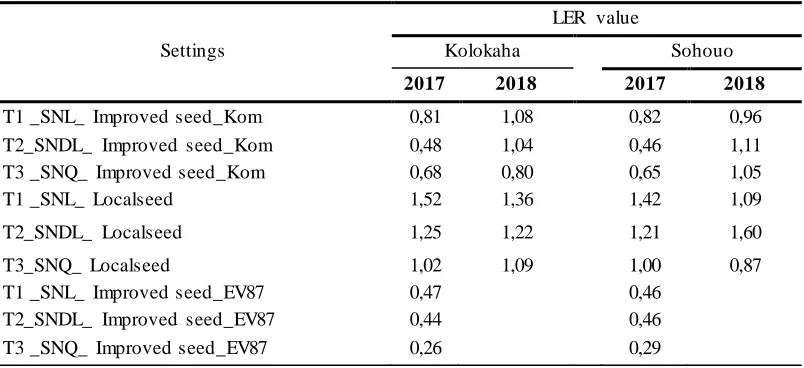
LER values of different cowpea seeding densities Table 6 shows the LER values obtained from the different seeding densities of the cowpea. During the 2017 growing season, LER values are below 1 when corn seeds of improved varieties are associated with cowpea and greater than 1 in this system of association with the local variety regardless of the study site. On the contrary, during the 2018 crop season, it was observed that LER values are above 1 regardless of the seeding density and maize variety except, the SNQ elemental plots of the improved Komsaya variety at the Kolokaha site and SNL and SNQ resp Komsaya and local varieties in Sohouo.
Table 6: LER values obtained from different cowpea seeding densities
Settings
LER value
Kolokaha Sohouo
2017 2018 2017 2018
T1 _SNL_ Improved seed_Kom 0,81 1,08 0,82 0,96
T2_SNDL_ Improved seed_Kom 0,48 1,04 0,46 1,11
T3 _SNQ_ Improved seed_Kom 0,68 0,80 0,65 1,05
T1 _SNL_ Localseed 1,52 1,36 1,42 1,09
T2_SNDL_ Localseed 1,25 1,22 1,21 1,60
T3_SNQ_ Localseed 1,02 1,09 1,00 0,87
T1 _SNL_ Improved seed_EV87 0,47 0,46
T2_SNDL_ Improved seed_EV87 0,44 0,46
T3 _SNQ_ Improved seed_EV87 0,26 0,29
IV. DISCUSSION
Comparison of the three maize varieties according to agronomic parameters
During the two years of testing, the results revealed that corn plants of the improved Komsaya and EV87 varieties grow faster and produce more than local seed plants. This performance of the seeds of the improved varieties is due to the difference between genotype, cultivation techniques and environmental effects (soil quality, temperature, quantity and frequency of rains, relative humidity, etc.). This reflects significant inter-variety variability and is consistent with the work of N'Zué et al., (2004) an d Djinabou et al., (2018) which have achieved similar results on cassava varieties in Côte d'Ivoire and southern Benin. This result is also consistent with those of Moussa
Korhogo area reported by N'guessan et al., ( 2019) and N'goran et al. (2018) compared to Kolokaha, which is very little used. As a result, in Sohouo, there has been a general decline in fertility and soil productivity, the plot of which is characterized today by its high sand wealth (78.17 per cent) particularly coarse sand (61.28%) and clay poverty (10.17 per cent) and organic carbon (0.93%) compared to the ground of the Kolokaha plot as evidenced by the results of the work carried out on this project by Gnagne (2019). This negatively impacts the texture and gives the soil of the sohouo plot, poor water retention between rains and a tendency to dry out very quickly and easily lose the fertilizers brought by leaching and joins the observations of N'guessan et al., (2019). Moreover, the results of Gnagne's work (2019) confirmed the low soil richness of the Sohouo plot in mineral elements including nitrogen, potassium, calcium and magnesium and a deficiency of nitrogen compared to phosphorus. In view of the above, low physical and chemical fertility of the soil would be one of the main causes of the poor yield of corn grains obtained in Sohouo compared to that of Kolokaha. For, according to Barro et al., (2016), maize is very demanding in fertiliser and, it is very difficult to get good yields on soils poor in fertilizer elements (NPK, Urea, ...).
Effect of cowpea seeding density on corn growth and yield parameters
In order to optimize the maize/cowpea combination, the choice of seedling density remains a crucial step (M'BAYE et al., 2014; Barro et al. (2016) that would better manage arable space (M'Baye et al., 2014) and help improve soil fertility by symbiotic nitrogen fixation in the air (N'goran et al., 2011; Coulibaly et al., 2017). Based on field work, the results indicate that cowpea seeding density had no significant effect on corn grain growth and yield parameters per unit of land regardless of study site and season. These results are in line with those of N'guessan et al., (2010) and Foidl et al. (2001) who observed that the increase in seeding or planting density does not affect the individual performance of the plants, since the density remains below the level of occurrence of food competition between plants. As a result, the corn plants in each of the two demonstration plots behaved substantially in the same way regardless of the seeding density of the cowpea and the growing season. Based on our results, it could be said that the three methods of combining cowpea tested are indeed suitable for maize in associated crops. Nevertheless, looking at our data, we note during the 2017 growing season that the increase in the seeding density of cowpea tends to induce a decline in yield per unit of surface and a delay in the growth and development of corn from elementary plots in associated
cultivation compared to pure-grown plants.This result is consistent with those of Coulibaly et al., (2017) and N'goran et al., (2011), which achieved similar results in assessing the performance of food corn-legume swings and yam-legumes in western Burkina Faso and in Central West Côte d'Ivoire. It joins the work of Kouassi et al., (2017) and N'guessan et al., (2010) who have made similar findings with three varieties of cowpea and plants from savannah tea cuttings (Lippia multiflora) tested respectively between three and four seeding and planting
densities in Côte d'Ivoire. They also corroborate the
nutrients from the decomposition of crop residues Previous. According to Coulibaly et al., (2017), the biomass supplement from legumes can increase in a non -significant 10-43% increase in total forage production on the association plots compared to the pure corn plot. This is an asset inthatcoulibaly et al., (2017) advocate for environments where soils are poor due to over-exploitation and where there is a lack of fodder for animals, food crop associations with legumes to ensure forage safety (forage production), food security (food production) and improve soil fertility. Specifically, our data revealed that the performance of corn plants is more pronounced in Kolokaha in the basic Plots SNL followed by SNLDI compared to pure-grown treatment. This justifies the fact that, with a low density of cowpea (SNL), competition between maize and cowpea is reduced while promoting good maize production. On the other hand, the SNLDI association of the high density of cowpea seeding has been more effective in Sohouo, regardless of the variety of maize. It is followed by SNL and SNQ treatments respectively with local and improved varieties. It is thought that the high density of seeding -SNLDI has led to a gain in maize productivity due to the maintenance of sufficient moisture and soil enrichment of the corresponding plots of nutrients, notably organic carbon and nitrogen. Because the functioning and performance of cereal-legume associations depend heavily on the nitrogen availability of the environment (Naudin et al., 2010). Overall, it can be said that maize can be associated with legumes without significantly decreasing its yield. A good control of the density and the semi lag of cowpea can lead to better yields and this would have an advantage in the management of land that is becoming increasingly scarce with population growth.
V. CONCLUSION
The results of this work show that corn plants in the improved Komsaya and EV87 varieties grow faster and produce more than local seed plants. Cowpea seeding density does not significantly affect all growth parameters and corn grain yield per unit area. Nevertheless, during the first year of testing, the increase in cowpea semi density tends to induce a decline in yield per unit of surface and a delay in the growth and development of corn plants in the elementary plots in cultivation compared to pure-grown plants. On the other hand, there was a slight performance of corn grain yield in the associated elementary plots in the second year of the trial. Although the three methods of association are effective, the SNL and SNLDI association models that confirm themselves as the most competitive can, preferably, be recommended to farmers. However, the study of the shift
of cowpea with corn could be considered to allow a better use of the soil resources and consequently, an improvement of the productivity of the associated crops.
ACKNOWLEDGEMENTS
The authors thank the Republic of Korea through the Korea Food and Agriculture Cooperation Initiative (KAFACI) for approval of this program as part of the Youth Scientist Pilot Research Project. My thanks also to Mr. Ernest Chola Bwalya, from Zambia Agriculture Research Institute for Reading and Correcting the English version of the manuscript.
REFERENCES
[1] Avenard JM. 1971.Les sols dans le milieu naturel de la
Côte d’Ivoire. Mémoire ORSTOM, Paris. (50): 269-391. [2] Ayaz S , Mc Kenzie BA, Hill GD, et McNeil DL. 2004.
Variability in yield of four grain legume species in a subhumid temperate environment. II. Yields components. Journal of Agricultural Sciences. 142 (1) : 21–28.
[3] Bambara D., Zoundi J.S ., Tiendrébéogo J-P., 2008. Association céréale/légumineuse et intégration agriculture-élevage en zone soudano-sahélienne. Cahiers
Agricultures, Vol. 17 (3) : 297-301.
[4] BARRO Awa, S ANGARE Mamadou, COULIBALY Kalifa, KOUTOU Mahamoudou et DIALLO Mahamadoun A. 2016. Etude des modalités d’association
maïs/niébé dans les villages de Koumbia et
Gombêlêdougou en zone cotonnière de l’Ouest du Burkina
Faso. Symposium International sur la Science et la
Technologie (SIST 2016). Sciences naturelles et
agronomie. Spécial hors-série n° 2 : 151-163.
[5] Beaudou A. G.et S ayol. R. (1980). Etude pédologique de la région de boundiali-korhogo (Côte d’Ivoire). Edité par
ORSTOM (Paris). 58 p.
[6] COULIBALY Kalifa, GOMGNIMBOU Alain Péoulé Kouhouyiwo, TRAORE Mamadou, NACRO Hassan Bismarck et S EDOGO Michel Papaoba. 2017. Effets des associations maïs-légumineuses sur le rendement du maïs (Zea mays L.) et la fertilité d’un sol ferrugineux tropical à l’Ouest du Burkina Faso. Afrique SCIENCE 13(6) : 226 - 235
[7] Coulibaly K., Vall, E. Autfray P. et S edogo P.M. 2012. Performance technico-économique des associations maïs/niébé et maïs/mucuna en situation réelle de culture au Burkina Faso: potentiels et contraintes.
TROPICULTURA. 30 (3) : 147-154.
[8] Dekoula Sékpa Charles, Brou Kouame, N’goran
Kouadio Emmanuel, Ehounou Jean-Noël, Yao Guy Fernand, KAS S IN Koffi Emmanuel, Julien Brou
KOUAKOU, N’GUESSAN Badou Angelo Evariste, Soro Nagnin. 2018 a. Variabilité des descripteurs pluviométriques intrasaisonniers à impact agricole dans le
bassin cotonnier de Côte d’Ivoire : cas des zones de Boundiali, Korhogo et Ouangolodougou. Journal of
[9] Dekoula S ékpa Charles, Brou Kouame, N’goran Kouadio Emmanuel, Yao Guy Fernand, Ehounou Jean-Noël, Soro Nagnin. 2018 b. Impact de la variabilité pluviométrique sur la saison culturale dans la zone de
production cotonnière en Côte d’Ivoire. European
Scientific Journal, (14) 12 : 143-159.
[10] DJINADOU Adijatu Kouboura Alice, OLODO Nestor Isséré et Adolphe ADJANOHOUN. 2018. Evaluation du comportement de variétés améliorées de manioc riches en bêta-carotène au Sud du Bénin. Int. J. Biol. Chem. Sci.
12(2): 703-715.
[11] Gbakatchetche H., S anogo S ., Camara M., Bouet A., Keli J.Z., 2010. Effet du paillage par des résidus de pois
d’angole (Cajanus cajan L.) sur le rendement du riz paddy
(Oryza sativa) pluvial en zone forestière de Côte d’Ivoire.
Agronomie Africaine, Vol. 22 (2) : 131-137.
[12] Gnagne, 2019.Diagnostic de la fertilité des sols cultivés dans les localités de Kolokaha et Sohouo (Département de
Korhogo) au nord de la Côte d’Ivoire. Mémoire de Master
de Gestion des Ressources Naturelles option Génie pédologie et Développement Durable. Université Peleforo Gon Coulibaly, UFR des Sciences Biologiques, Département Géosciences, 49p.
[13] Kouassi N’dri Jacob, Gore bi Boh Nestor, Ayolié Koutoua. 2016. Influence du calendrier de semis du maïs
(Zea mays L.) et de l’année de culture sur le rendement et
les composantes de rendement du voandzou (Vigna
subterranea (L.) Verdc.) dans la région savanicole de la
Côte d’Ivoire. International Journal of Innovation and
Applied Studies, (15) 3 : 697-703.
[14] KOUASSIN’dri Jacob, KOFFI Ahébé Marie Hélène,
YAH N’Guettia Marie, KOUAKOU Yao Isidor Junior
et YATTY Kouadio Justin. 2017. Influence de la densité de semis sur les paramètres agronomiques de trois variétés de niébé (Vigna unguiculata (L.) Walp, Fabaceae)
cultivées en Côte d’Ivoire. Afrique SCIENCE 13(4) : 327
– 336.
[15] MBAYE M.S ., KANE A., GUEYE M., BAS S ENE C., BA N., DIOP D., S YLLA S .N., NOBA K. 2014. Date et densité optimales de semis du niébé [Vigna unguiculata
(L.) Walp.] enassociation avec le mil [Pennisetum glaucum (L.) R. Br.]. Journal of Applied Biosciences 76 : 6305– 6315.
[16] MOUS S A A.A., S ALAKO V.K., CHARLEMAGNE GBEMAVO D.S .J., ZAMAN-ALLAH M., KAKAÏ R.G. et BAKAS S O Y. 2018. Performances agro-morphologiques des variétés locales et améliorées de maïs au sud-ouest du Niger.African Crop Science Journal, (26) 2 : 157 – 173.
[17] Naudin C., Corre-Hellou G., Pineau S ., Crozat Y., Jeuffroy M. H., 2010. The effect of various dynamics [18] of N availability on winter pea-wheat intercrops: Crop
growth, N partitioning and symbiotic N2 fixation. Field CropsResearch, 119, 2-11.
[19] N’GORAN Kouadio Emmanuel, KAS S IN Koffi
Emmanuel, ZOHOURI Goli Pierre, N’GBESSO Mako
François De Paul, YORO Gballou René. (2011).
Performances agronomiques des associations culturales igname-légumineuses alimentaires dans le Centre-ouest de
la Côte d’Ivoire. Journal of Applied Biosciences (43) : 2915 – 2923.
[20] N’Goran Kouadio Emmanuel, Kassin Koffi
Emmanuel, Kouakou Brou Julien, Gustave Francis
Messoum, Brou Kouamé, Brou N’guessan Dominique.
2018.Diagnostic de l’état de fertilité des sols sous culture cotonnière dans les principaux bassins de production de
Côte d’Ivoire. European Scientific Journal, 14 (33) : 221-238.
[21] N’GUESSAN Kouamé Antoine, KOUAKOU Konan
Elie, ALUI Konan Alphoneet YAO - KOUAME Albert. 2019. Stratégies et pratiques paysannes de gestion durable de la fertilité des sols dans le département de
Korhogo au Nord de la Côte d’Ivoire. Afrique SCIENCE
15(4) : 245 – 258.
[22] N’guessan KA, Yao-Kouamé A, Ballo KC, Alui KA. 2010. Effet de la densité de plantation sur le rendement et les composantes du rendement de Lippia multiflora
(Verbenaceae), cultivée au sud de la Côte d’Ivoire.
Journal of Applied Biosciences. (33) : 2047- 2056.
[23] NOUFE D., KOUADIO Z. A., S ORO G. E., WAYOU T. P., GOULA B. T. A., S AVANE I. 2015. Impact de la variabilité climatique sur la production du maïset de
l’igname en Zones Centre et Nord de la Côte d’Ivoire.
Agronomie Africaine 27 (3) : 241 – 255.
[24] N'ZUE B., ZOHOURI P. G. et S ANGARE A. 2004. Performances agronomiques de quelques variétés de manioc (manihot esculenta crantz) sans trois zones
agroclimatiques de la Côte d’Ivoire. Agronomie africaine
16 (2) : 1 – 7.
[25] OUATTARA Bassiriki, S ANGARE Mamadou et COULIBALY Kalifa. 2016. Options pour une intensification durable de la production agricole et fourragère dans le système de production agropastoral des zones cotonnières du Burkina Faso. Symposium International sur la Science et la Technologie (SIST
2016). Sciences naturelles et agronomie. Spécial
hors-série n° 2 : 133-149.
[26] Pageau D, Lajeunesse J, et Lafond J. 2006. Influence de la densité de semis sur la productivité du pois sec cultivé sous un climat frais. Canadian Journal of Plant Science. 41-48. [27] Zoundi J.S ., Butare I. et Adomefa J.N.K., 2006.