D A T A B A S E
Open Access
Comparison of face-down posturing with
nonsupine posturing after macular hole
surgery: a meta-analysis
Song Xia
1, Xin-yu Zhao
2, Er-qian Wang
2and You-xin Chen
2*Abstract
Background:A few randomized controlled trials (RCTs) have evaluated face-down posturing (FDP) with the far less physically challenging nonsupine posturing (NSP) in the treatment of idiopathic full-thickness macular holes (MHs). The objective of our study was to evaluate the efficacy of postoperative posturing on the anatomical and functional outcomes of MH surgery.
Methods:The PubMed, Embase, and Cochrane Central Register of Controlled Trials databases were searched from their earliest entries through December 2016 to identify the studies that had evaluated the effects of postoperative posturing with FDP or NSP for patients with MH surgery. The PRISMA guidelines were followed. The relevant data were analyzed using StataSE 12.0 software. The weighted mean difference (WMD), relative risk (RR) and their 95% confidence intervals (95% CIs) were used to assess the strength of the association.
Results:Our search yielded 181 records from which 11 studies comprising 726 cases that had examined the effects of postoperative posturing with FDP for patients compared with NSP after MH surgery were included for review and analysis. Our meta-analyses showed that postoperative FDP could generally improve the overall MH closure rate compared to NSP (OR = 1.828, 95% CI: 1.063~3.143,P= 0.029). Subgroup analysis of the size of MH suggested a significant benefit of FDP for large MHs (≥400μm) (OR = 4.361, 95% CI: 1.429~13.305,P= 0.010) while there was no difference in the MH closure rate for small MHs (< 400μm) (OR = 1.731, 95% CI: 0.412~7.270,P= 0.453). Moreover, ILM peeling for large MHs could significantly increase the MH closure rate of the FDP group (OR = 2.489, 95% CI: 1.021~6.069,P= 0.045), while no difference existed for small MHs (OR = 3.572, 95% CI: 0.547~23.331,P= 0.184). Combined cataract surgery might not influence the MH closure rate under any circumstance (OR = 0.513, 95% CI: 0.089~2.944,P= 0.454).
Conclusion:Based on all the available evidence, our study found that FDP after MH surgery could generally
improve the overall MH closure rate compared to NSP. For MHs larger than 400μm, ILM peeling combined with
FDP could significantly increase the MH closure rate. Combined cataract surgery might not influence the MH closure rate.
Keywords:Macular hole, Face-down, Posturing, Meta-analysis
* Correspondence:[email protected]
2Department of Ophthalmology, Peking Union Medical College Hospital,
Chinese Academy of Medical Sciences, Beijing 100730, China Full list of author information is available at the end of the article
© The Author(s). 2019Open AccessThis article is distributed under the terms of the Creative Commons Attribution 4.0
Introduction
Idiopathic full-thickness macular holes (MHs) are one of the most significant causes of visual loss. MHs have an estimated incidence of 7.8 per 1000,000 individuals, and they commonly affect elderly females [1–3]. In 1991, Kelly and Wendel [4] first described the traditional sur-gical intervention for idiopathic MHs, which comprised pars plana vitrectomy, removal of the adherent cortical vitreous, peeling of epiretinal membranes and intraocu-lar tamponade with gas, followed by strict face-down posturing (FDP) for one week. With the significant pro-gress in surgical techniques, such as internal limiting membrane (ILM) peeling and combined cataract sur-gery, hole closure rates have improved from 58 to 100%, as reported in recent studies [4–6].
However, some controversies regarding the postopera-tive position still exist. A few randomized controlled trials (RCTs) have evaluated FDP with the far less physically challenging nonsupine posturing (NSP) in the treatment of idiopathic full-thickness MHs, and some of them sug-gested a significant benefit of FDP, while others sugsug-gested that FDP is unnecessary [6–10]. As there were heteroge-neous study methods and varying surgical techniques, current studies could not provide sufficient data to achieve firm conclusions about the optimal postoperative position, and some authors held the opinion that equiva-lent closure rates could be achieved with NSP [8,11, 12]. Despite NSP receiving favorable reviews, the lack of clear superiority between FDP and NSP has prevented NSP from entering into clinical practice, as demonstrated by a recent survey of American Society of Retina Specialists, which revealed that 95% of retinal surgeons still incorpor-ate FDP in the treatment of MHs [13, 14]. If high hole closure rates can be achieved without FDP, MH surgery can be made available to many patients who were previ-ously unable or unwilling to tolerate the postoperative FDP. Additionally, some severe complications such as ulnar nerve palsies, thrombophlebitis and pulmonary em-bolism could also be avoided [15,16].
A previous meta-analysis [17] was performed to evaluate the efficacy of postoperative posturing on the anatomical and functional outcomes of MH surgery. They made a subgroup analysis of the size of the MH and drew the fol-lowing conclusions: FDP significantly improved the suc-cess rate of the surgery for MH larger than 400μm, while it was unnecessary for MH less than 400μm. Although this was a scientific and rigorous study, some limitations still existed: (1) Only 4 previous RCTs were included and other available and recent data were not pooled; and (2) Other adjunct treatments, such as inner limiting mem-brane (ILM) peeling and combined cataract surgery, were not considered. Hence, we performed this meta-analysis, which included all the available data and took all the influential factors into consideration to
evaluate the superiority of FDP over NSP following MH surgery in order to provide a reference for the decision-making of ophthalmologists.
Methods
This systematic review and meta-analysis was performed strictly according to the guidelines given by the ‘Preferred Reporting Items for Systematic Reviews and Meta-Analysis (the‘PRISMA’statement)’[18].
Search strategy
Two independent researchers (SX and XYZ) searched the PubMed, Embase, and Cochrane Central Register of Controlled Trials databases. Data were last updated in June 2017. The following keywords or corresponding Medical Subject Headings (Mesh) were used: “macular hole”, “position”, “posturing”, “face-down” and “supine”. The references of the included studies were also screened to further identify related articles. No language limitation was imposed.
Inclusion criteria and exclusion criteria
Inclusion criteria were as follows: (1) Participants were people with macular holes that required surgical inter-vention; (2) The intervention was macular hole surgery; (3) FDP was compared with NSP; (4) The MH closure rate, best-corrected visual acuity or more were the out-comes; and (5) The methodology needed to be a pro-spective study, a case-controlled study or a cohort study. Exclusion criteria were as follows: (1) Other differ-ences existed between the case group and control group in addition to the postoperative face position; (2) There was insufficient data to estimate an odds risk (OR) or weighted mean difference (WMD); (3) The study was an animal study or subjects were cadavers; and (4) There were redundant publications.
Data extraction and assessment of methodological quality
disagreements and consensus was achieved by discussion with the corresponding author (YXC).
Statistical methods
StataSE 12.0 software (StataCorp, College Station, TX, USA) was used to perform the meta-analysis. In this meta-analysis, continuous data was described by the weighted mean difference (WMD) and its 95% confi-dence interval (CI), dichotomous data used odds risk (OR) and its 95% CI. The statistical heterogeneity was assessed with a Chi-squared test andI2. If heterogeneity was low (P>0.1,I2
<50%), a fixed-effect model was used; for substantial heterogeneity (P<0.1,I2
>50%), sensitivity analysis and subgroup analyses were conducted to iden-tify the source of the heterogeneity. If the heterogeneity could not be eliminated, a random-effects model was used when the result of the meta-analysis had clinical homo-geneity or a descriptive analysis was used. A stratified sub-group analysis, which evaluated the possible influencing factors, was also conducted.
Publication bias was evaluated with a Begg’s funnel plot. A value ofP< 0.05 was considered to indicate stat-istical significance [20] .
Source of funding
No external funding was received in support of this study.
Results
Study characteristics
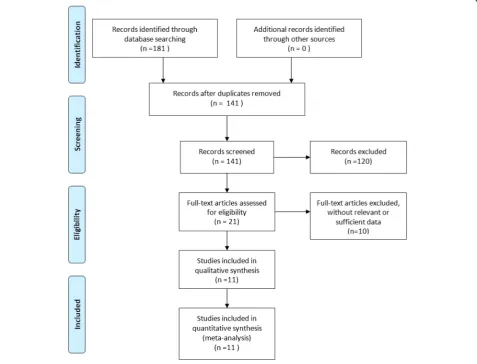
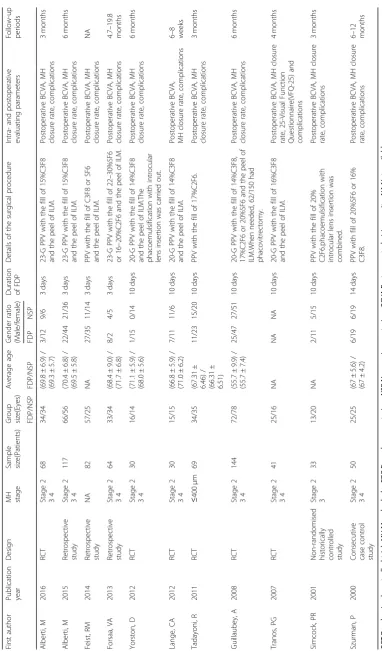
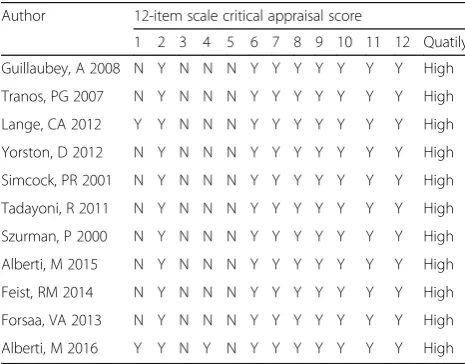
One hundred eighty-one articles were initially identified for this meta-analysis. After removing 40 duplicate stud-ies, screening titles and abstracts, and removing 120 un-related articles, 11 studies [7–12,14,21–24] were finally included in this meta-analysis (Fig. 1). The cumulative sample size of 742 MH surgeries comprised 396 eyes in the FDP group and 346 eyes in the no FDP group. In each study, the demographic characteristics of the two groups were similar. The main characteristics of the included studies are summarized in Table 1 and the literature-exclusion procedures are depicted in Fig. 1. The results of 12-item scale showed that the average
Table 1 Main characteristics of the included studies First author Publication year Design MH stage Sample size(Patients) Group size(Eyes) Average age Gender ratio (Male/female) Duration of FDP Details of the surgical procedure Intra-and postoperative evaluating parameters Follow-up periods FDP/NSP FDP/NSP FDP NSP Alberti, M 2016 RCT Stage 2 34 68 34/34 (69.8 ± 6.9) / (69.3 ± 5.7) 3/12 9/6 3 days 23-G PPV with the fill of 15%C3F8 and the peel of ILM. Postoperative BCVA, MH closure rate, complications 3 months Alberti, M 2015 Retrospective study Stage 2 34 117 66/56 (70.4 ± 6.8) / (69.5 ± 5.8) 22/44 21/36 3 days 23-G PPV with the fill of 15%C3F8 and the peel of ILM. Postoperative BCVA, MH closure rate, complications 6 months Feist, RM 2014 Retrospective study NA 82 57/25 NA 27/35 11/14 3 days PPV with the fill of C3F8 or SF6 and the peel of ILM. Postoperative BCVA, MH closure rate, complications NA Forsaa, VA 2013 Retrospective study Stage 2 34 64 33/34 (68.4 ± 9.0) / (71.7 ± 6.8) 8/2 4/5 3 days 23-G PPV with the fill of 22 – 30%SF6 or 16 – 20%C2F6 and the peel of ILM. Postoperative BCVA, MH closure rate, complications 4.7 – 19.8 months Yorston, D 2012 RCT Stage 2 34 30 16/14 (71.1 ± 5.9) / (68.0 ± 5.6) 1/15 0/14 10 days 20-G PPV with the fill of 14%C3F8 and the peel of ILM.The phacoemulsification with introcular lens insertion was carried out. Postoperative BCVA, MH closure rate, complications 6 months Lange, CA 2012 RCT Stage 2 34 30 15/15 (66.8 ± 5.9) / (71.0 ± 6.2) 7/11 11/6 10 days 20-G PPV with the fill of 14%C3F8 and the peel of ILM. Postoperative BCVA, MH closure rate, complications 6 – 8 weeks Tadayoni, R 2011 RCT ≤ 400 μ m 69 34/35 (67.31 ± 6.46) / (66.31 ± 6.51) 11/23 15/20 10 days PPV with the fill of 17%C2F6. Postoperative BCVA, MH closure rate, complications 3 months Guillaubey, A 2008 RCT Stage 2 34 144 72/78 (55.7 ± 9.9) / (55.7 ± 7.4) 25/47 27/51 10 days 20-G PPV with the fill of 14%C3F8, 17%C2F6 or 20%SF6 and the peel of ILM.When needed, 62/150 had phacovitrectomy. Postoperative BCVA, MH closure rate, complications 6 months Tranos, PG 2007 RCT Stage 2 34 41 25/16 NA NA NA 10 days 20-G PPV with the fill of 16%C3F8 and the peel of ILM. Postoperative BCVA, MH closure rate, 25-Visual Function Questionnaire(VFQ-25) and complications 4 months Simcock, PR 2001
Non-randomised historically controlled study
quality score of the included studies was 8.18 and all of them were of high quality (Table 2). The inter-rater agreement was excellent between the investigators (κ= 0.75).
Macular hole closure rate
Together, eleven studies [7–12, 14, 21–24] comprised 726 cases, including 396 eyes in the FDP group and 346 eyes in the NSP group, which described the MH closure rate, respectively.
For the overall MH closure rate, a fixed-effects model was used as no heterogeneity was detected (P= 0.458, I2= 0%). The pooled results showed that the MH closure rate in the FDP group was significantly higher than that of the NSP group (OR = 1.828, 95% CI: 1.063~3.143,P= 0.029, Fig.2).
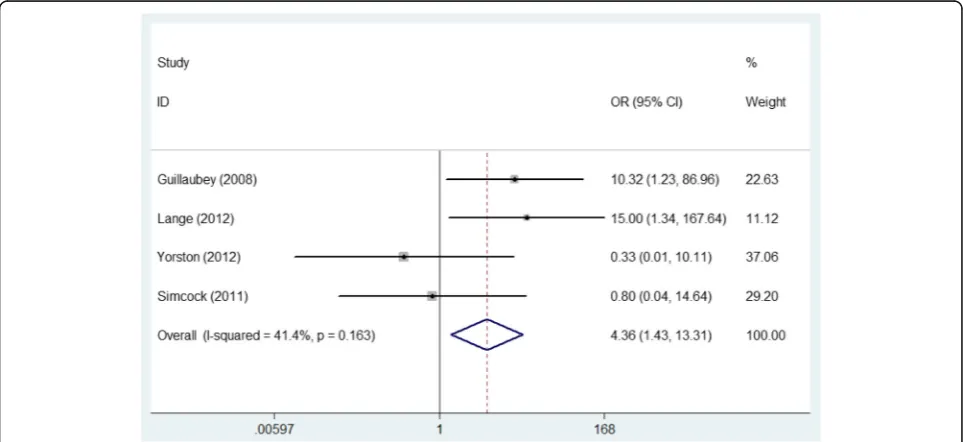
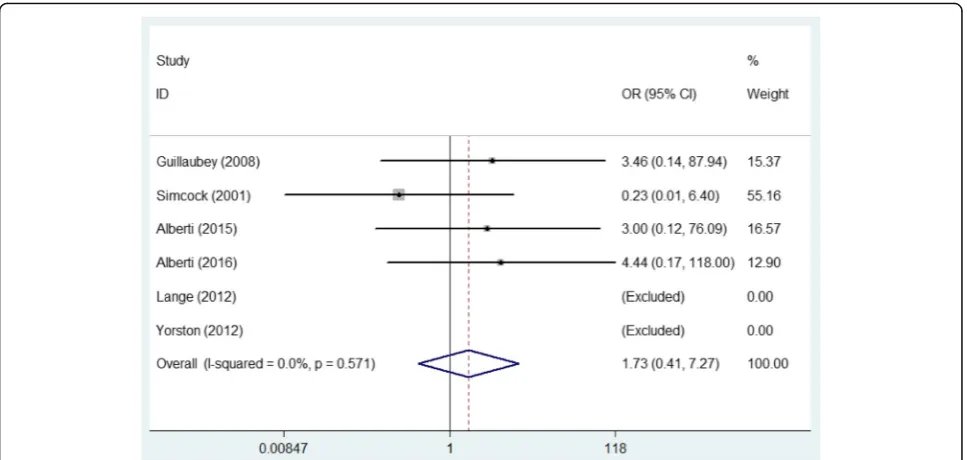
As 400μm (narrowest width at largest aperture of MH) was defined as the cut-off point when classifying MHs [25], we used it to divide the included patients into two subgroups for further analysis. For MHs with a size more than 400μm, the pooled result according to the fixed-effects model (P= 0.163, I2 = 41.4%) manifested that the MH closure rate in the FDP group was signifi-cantly higher than that of the NSP group (OR = 4.361, 95% CI: 1.429~13.305, P= 0.010, Fig. 3). For MHs smaller than 400μm, the meta-analysis pooled results according to the fixed-effects model (P= 0.571, I2= 0%) indicated no significant difference in the MH closure rate between the two groups (OR = 1731, 95% CI: 0.412~7.270,P= 0.453, Fig.4).
As several previous studies have reported that MH surgery might benefit from ILM peeling [26–28], which strengthens the treatment, a comprehensive evaluation of this factor was conducted. Regardless of the size of the MH, the subgroup analysis with the fixed-effects model (Poverall= 0.518, Ioverall2= 0%) showed that ILM peeling might not influence the MH closure rate be-tween the FDP group and the NSP group (Ppeeling= 0.096, Pnone= 0.978, Poverall= 0.130, Table 3). For MHs larger than 400μm, the forest plots created with the fixed-effects model (Poverall= 0.094,Ioverall2= 46.9%) indi-cated that peeling the ILM significantly increased the MH closure rate of the FDP group compared to the NSP group, while no difference between the two groups was found when the surgery was performed without ILM peeling (Ppeeling= 0.045, Pnone= 0.880, Poverall= 0.060, Table 3). However, for MHs smaller than 400μm, the meta-analysis pooled according to the fixed-effects model (P= 0.571, I2 = 0%) indicated that whether there was peeling of the ILM or not, there was no significant difference in the MH closure rate between the two groups (Ppeeling= 0.184, Pnone= 0.390, Poverall= 0.453, Table3).
Additionally, as some authors previously demonstrated the benefit of phacovitrectomy with intraocular lens implants in MH surgery [8, 29], we conducted another subgroup analysis focused on combining MH surgery with or without phacovitrectomy and intraocular lens implants. The overall subgroup analysis (fixed-effects model,Poverall= 0.565,Ioverall2= 0%) showed that phacov-itrectomy and an intraocular lens implant might not in-fluence the MH closure rate between the FDP group and the NSP group (Pcombine= 0.453, Pnone= 0.471, Poverall= 0.737, Table 4). For MHs larger than 400μm, the meta-analysis conducted with a fixed-effects model (Poverall= 0.176, Ioverall2= 36.8%) indicated that phacov-itrectomy and intraocular lens implants did not influ-ence the MH closure rate between the two groups (Pcombine= 0.573, Pnone= 0.370, Poverall= 0.615, Table 4). For MHs smaller than 400μm, the pooling results with a fixed-effects model (Poverall= 0.405, Ioverall2= 0%) also showed that phacovitrectomy and intraocular lens im-plants did not influence the MH closure rate between the two groups (Pcombine= 0.390, Pnone= 0.273, Poverall= 0.674, Table4).
Ideal visual acuity improvement
In total, six studies [7–9,12,14,23], including 144 eyes in the FDP group and 152 eyes in the NSP group, described the rate of ideal postoperative visual acuity improvement.
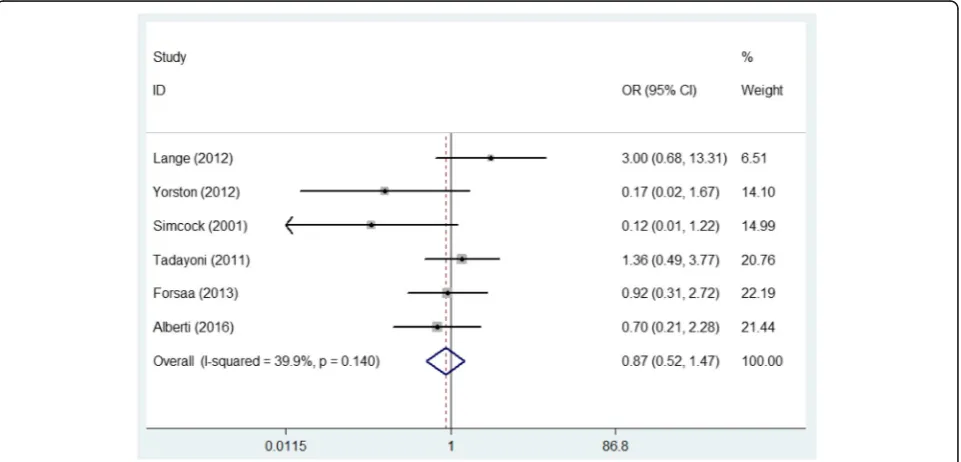
For the overall ideal VA improvement rate, the meta-analysis pooled with a fixed-effect model (P= 0.140,
I2
= 39.9%) indicated no significant difference in the ideal
Table 212-item scale critical appraisal scores
Author 12-item scale critical appraisal score
1 2 3 4 5 6 7 8 9 10 11 12 Quatily
Guillaubey, A 2008 N Y N N N Y Y Y Y Y Y Y High
Tranos, PG 2007 N Y N N N Y Y Y Y Y Y Y High
Lange, CA 2012 Y Y N N N Y Y Y Y Y Y Y High
Yorston, D 2012 N Y N N N Y Y Y Y Y Y Y High
Simcock, PR 2001 N Y N N N Y Y Y Y Y Y Y High
Tadayoni, R 2011 N Y N N N Y Y Y Y Y Y Y High
Szurman, P 2000 N Y N N N Y Y Y Y Y Y Y High
Alberti, M 2015 N Y N N N Y Y Y Y Y Y Y High
Feist, RM 2014 N Y N N N Y Y Y Y Y Y Y High
Forsaa, VA 2013 N Y N N N Y Y Y Y Y Y Y High
Alberti, M 2016 Y Y N Y N Y Y Y Y Y Y Y High
VA improvement rate between the two groups (OR = 0.873, 95% CI: 0.521~1.466,P= 0.609, Fig.5).
For MHs with a size more than 400μm, the meta-analysis using the random-effects model (P= 0.039, I2 = 76.5%) manifested no significant difference in the ideal VA improvement rate between the two groups (OR = 0.727, 95% CI: 0.017~31.794, P= 0.868). For MHs smaller than 400μm, the forest plots resulting
from the fixed-effects model (P= 0.236,I2= 28.9%) also indicated no significant difference in the ideal VA im-provement rate between the two groups (OR = 0.466, 95% CI: 0.076~2.847,P= 0.408).
Publication bias
Begg’s test showed that publication bias did not affect our analysis (P= 0.175, continuity corrected).
Fig. 2Comparison of the macular hole closure rate in the face-down posturing group and nonsupine posturing group
Discussion
Our study showed that postoperative FDP could gener-ally improve the overall MH closure rate compared to the NSP group. Subgroup analysis of the size of the MH suggested a significant benefit of FDP for large MHs (≥400μm), while no difference in the MH closure rate was observed for small MHs (< 400μm). Moreover, ILM peeling for large MHs could significantly increase the MH closure rate of the FDP group, while no differ-ence existed for small MHs. Combined cataract surgery might not influence the MH closure rate under any cir-cumstances. Additionally, the ideal visual improvement rate was not influenced by postoperative positioning.
Postoperative positioning after MH surgery is mostly influenced by intraocular gas tamponade, which has two major properties: surface tension and buoyancy. The surface tension depends on the viscosity of the tamponade product. Buoyancy depends on density, and
it is maximal at the apex of the gas bubble. Buoyancy can remove the subretinal fluid to reattach the retina [10, 30, 31], which is why the postoperative position after retinal detachment is crucial. The actual mechan-ism for how the intraocular gas tamponade facilitates MH closure is still debated [6, 24]. The generally ac-cepted opinion was that the gas bubble could isolate the macula from the vitreous fluid and keep it dry, thereby providing a scaffold to support the formation of a bridging preretinal membrane, rather than exerting up-ward buoyancy forces on the macular hole [31]. If this is correct, a large gas bubble should be sufficient to keep the macula dry in all but the supine position [6,32–35]. How-ever, the results of our meta-analysis suggested that post-operative FDP could generally improve the overall MH closure rate compared to NSP, which might hint that the upward mechanical force of buoyancy is still beneficial, especially for large MHs (≥400μm). These results are Fig. 4Comparison of the macular hole closure rate with the macular hole size smaller than 400μm in the face-down posturing group and nonsupine posturing group
Table 3Comparison of macular hole closure rate between two groups with or without internal limiting membrane peeling
Outcome Type of subgroup
No. of studies
Sample size With ILM Peeling Without ILM Peeling Selected
model
Face-down group
No face-down group
OR 95% CI Pvalue OR 95% CI Pvalue
MH closure rate Overall 10 371 321 1.744 0.906 3.356 0.096 1.020 0.258 4.026 0.978 Fixed-effect model
MH≥400μm 6 107 101 2.489 1.021 6.069 0.045 0.080 0.044 14.643 0.880 Fixed-effect model
MH<400μm 6 115 110 3.572 0.547 23.331 0.184 0.235 0.009 6.401 0.390 Fixed-effect model
regarded as highly reliable as the heterogeneity was very low, and the comparisons were all carried out with fixed-effects models.
The effect of ILM peeling on MH surgery is still under debate [27]. Previous studies suggested that it could lead to better healing of MHs and prevent later reopening [36, 37]. After pooling all the available data from previous studies, we found a positive relationship between the size of idiopathic MHs and the benefit of ILM peeling. The subgroup analysis of our study sug-gested that ILM peeling was advantageous for MHs larger than 400μm and was unnecessary for smaller idiopathic MHs.
The nonclosure of an MH is often attributed solely to poor positioning compliance; however, a recent study re-ported that equal attention should be shifted toward achieving maximal gas tamponade. Indeed, additional gas injection was regarded as an effective intervention to re-pair an unclosed MH after an unsuccessful primary
vitrectomy [38]. Some authors have suggested that com-bined cataract surgery could not only facilitate a more complete vitrectomy, enabling injection of a larger gas vol-ume when compared with the phakic eye, but also elimin-ate the need for a technically challenging cataract surgery in the vitrectomized eye, which is due to a lack of vitreous support, and may result in an unstable an-terior chamber depth and various pupil sizes [39, 40]. However, the forest plots in our study indicated that combined cataract surgery might not influence the MH closure rate under any circumstance.
Postoperative VA is influenced by many factors such as preoperative VA, duration of follow-up and combin-ation with cataract surgery or not. In total, six studies provided the rate of ideal postoperative VA improve-ment, which enabled us to analyze the pooled OR. The forest plots of our meta-analysis indicated that the ideal visual improvement rate was not influenced by postoper-ative positioning or the size of the MH.
Table 4Comparison of macular hole closure rate between two groups with or without phacovitrectomy with intraocular lens
implant
Outcome Type of subgroup
No. of studies
Sample size With phacovitrectomy with intraocular lens implant
Without phacovitrectomy with intraocular lens implant
Selected model
Face-down group
No face-down group
OR 95% CI Pvalue OR 95% CI Pvalue
MH closure rate Overall 8 259 214 0.513 0.089 2.944 0.454 1.337 0.608 2.942 0.471 Fixed-effect model
MH≥400μm 5 66 62 0.539 0.063 4.629 0.573 1.702 0.533 5.438 0.370 Fixed-effect model
MH<400μm 5 78 77 1.417 0.279 7.192 0.390 3.360 0.363 36.346 0.273 Fixed-effect model
MHMacular hole,CIConfidence interval,OROdds risk
To the best of our knowledge, this is the first meta-analysis which included all the available data and considered all the influential factors, such as the size of the MH, ILM peeling and combined cataract surgery, to re-evaluate superiority between FDP and NSP following MH surgery. The heterogeneity of our analysis was satis-factory and the results are reliable. Our study, therefore, might provide valuable information for ophthalmolo-gists. However, it has the following limitations: (1) The inconsistent duration of FDP, which varied from 3 days to 14 days, might have potentially influenced the results of our study; (2) Although we pooled the data from all the available studies to achieve the results in a reliable way, the final sample size was still relatively small, which means more research of high quality should be carried out; and (3) There were insufficient data to analyze the effect of various types of intraocular gas and further re-search should focus on this point as it might also affect the choice of postoperative positioning.
Conclusions
Based on all the available evidence, FDP after MH sur-gery could generally improve the overall MH closure rate compared to NSP. For MHs larger than 400μm, ILM peeling combined with FDP could significantly in-crease the MH closure rate. Combined cataract surgery might not influence the MH closure rate under any cir-cumstances. Further well-conducted RCTs are needed to verify our findings.
Abbreviations
BCVA:Best-corrected visual acuity; CI: confidence interval; FDP: Face-down posturing; ILM: Inner limiting membrane; MH: Macular hole; NSP: Nonsupine posturing; OR: Odds risk; RCT: Randomized controlled trial; VA: Visual acuity; WMD: Weighted mean difference
Acknowledgements
Not applicable
Funding
No current funding sources for this study.
Availability of data and materials
All data generated or analyzed during this study are included in relevant published articles.
Authors’contributions
SX carried out the entire procedure, including the literature search, extracted the data, performed the statistical analysis, drafted the manuscript, and revised and submitted the manuscript. YXC conceived of the study, coordinated and participated in the entire process of drafting and revised the manuscript. XYZ contributed to the literature search, data extraction, statistical analysis and revision of the manuscript. EQW contributed to the revision of the manuscript and statistical analysis. All authors contributed significantly. All authors read and approved the final manuscript.
Ethics approval and consent to participate
Not applicable
Consent for publication
Not applicable
Competing interests
One of the authors, Youxin Chen, is a member of the editorial board of BMC ophthalmology. No other competing interests exist.
Publisher’s Note
Springer Nature remains neutral with regard to jurisdictional claims in published maps and institutional affiliations.
Author details
1Department of Ophthalmology, Guizhou Provincial People’s Hospital, Guiyang 550000, China.2Department of Ophthalmology, Peking Union Medical College Hospital, Chinese Academy of Medical Sciences, Beijing 100730, China.
Received: 9 January 2018 Accepted: 21 January 2019
References
1. McCannel CA, Ensminger JL, Diehl NN, et al. Population-based incidence of macular holes. Ophthalmology. 2009;116(7):1366–9.
2. Ho AC, Guyer DR, Fine SL. Macular hole. Surv Ophthalmol. 1998;42(5):393– 416.
3. Mitchell P, Smith W, Chey T, et al. Prevalence and associations of epiretinal membranes. The Blue Mountains eye study, Australia. Ophthalmology. 1997; 104(6):1033–40.
4. Kelly NE, Wendel RT. Vitreous surgery for idiopathic macular holes. Results of a pilot study. Arch Ophthalmol. 1991;109(5):654–9.
5. Benson WE, Cruickshanks KC, Fong DS, et al. Surgical management of macular holes: a report by the American Academy of ophthalmology. Ophthalmology. 2001;108(7):1328–35.
6. Tornambe PE, Poliner LS, Grote K. Macular hole surgery without face-down positioning. A pilot study. Retina. 1997;17(3):179–85.
7. Lange CA, Membrey L, Ahmad N, et al. Pilot randomised controlled trial of face-down positioning following macular hole surgery. Eye (Lond). 2012; 26(2):272–7.
8. Yorston D, Siddiqui MA, Awan MA, et al. Pilot randomised controlled trial of face-down posturing following phacovitrectomy for macular hole. Eye (Lond). 2012;26(2):267–71.
9. Tadayoni R, Vicaut E, Devin F, et al. A randomized controlled trial of alleviated positioning after small macular hole surgery. Ophthalmology. 2011;118(1):150–5.
10. Guillaubey A, Malvitte L, Lafontaine PO, et al. Comparison of face-down and seated position after idiopathic macular hole surgery: a randomized clinical trial. Am J Ophthalmol. 2008;146(1):128–34.
11. Alberti M, la Cour M. Face-down positioning versus non-supine positioning in macular hole surgery. Br J Ophthalmol. 2015;99(2):236–9.
12. Forsaa VA, Raeder S, Hashemi LT, et al. Short-term postoperative non-supine positioning versus strict face-down positioning in macular hole surgery. Acta Ophthalmol. 2013;91(6):547–51.
13. Heffez JL. Macular hole repair without face-down positioning. Int Ophthalmol Clin. 2014;54(2):1–15.
14. Alberti M, la Cour M. NONSUPINE POSITIONING IN MACULAR HOLE SURGERY: A Noninferiority Randomized Clinical Trial. Retina. 2016;36(11): 2072–9.
15. Vincent JM, Peyman GA, Ratnakaram R. Bilateral ulnar decubitus as a complication of macular hole surgery. Ophthalmic Surg Lasers Imaging. 2003;34(6):485–6.
16. Holekamp NM, Meredith TA, Landers MB, et al. Ulnar neuropathy as a complication of macular hole surgery. Arch Ophthalmol. 1999;117(12): 1607–10.
17. Hu Z, Xie P, Ding Y, et al. Face-down or no face-down posturing following macular hole surgery: a meta-analysis. Acta Ophthalmol. 2016;94(4):326–33. 18. Moher D, Liberati A, Tetzlaff J, et al. Preferred reporting items for systematic
reviews and meta-analyses: the PRISMA statement. J Clin Epidemiol. 2009; 62(10):1006–12.
19. Furlan AD, Pennick V, Bombardier C, et al. 2009 updated method guidelines for systematic reviews in the Cochrane Back review group. Spine (Phila Pa 1976). 2009;34(18):1929–41.
21. Szurman P, Di Tizio FM, Lafaut B, et al. Significance of postoperative face-down positioning after surgery for idiopathic macular holes: consecutive case-control study. Klin Monatsbl Augenheilkd. 2000;217(6):351–5. 22. Tranos PG, Peter NM, Nath R, et al. Macular hole surgery without prone
positioning[J]. Eye (Lond). 2007;21(6):802–6.
23. Simcock PR, Scalia S. Phacovitrectomy without prone posture for full thickness macular holes. Br J Ophthalmol. 2001;85(11):1316–9.
24. Feist RJ, Pomerleau DL, Feist R, et al. Nonsupine positioning is preferred by patients over face-down positioning and provides an equivalent closure rate in 25- and 23-gauge macular hole surgery. Retin Cases Brief Rep. 2014;8(3):205–8.
25. Gass JD. Reappraisal of biomicroscopic classification of stages of development of a macular hole. Am J Ophthalmol. 1995;119(6):752–9. 26. Smiddy WE, Feuer W, Cordahi G. Internal limiting membrane peeling in
macular hole surgery[J]. Ophthalmology. 2001;108(8):1471–6 1477-1478. 27. Brooks HJ. Macular hole surgery with and without internal limiting
membrane peeling. Ophthalmology. 2000;107(10):1939–48 1948-1949. 28. Yoshida M, Kishi S. Pathogenesis of macular hole recurrence and its
prevention by internal limiting membrane peeling. Retina. 2007;27(2): 169–73.
29. Nadal J, Delas B, Pinero A. Vitrectomy without face-down posturing for idiopathic macular holes[J]. Retina. 2012;32(5):918–21.
30. Karia N, Laidlaw A, West J, et al. Macular hole surgery using silicone oil tamponade. Br J Ophthalmol. 2001;85(11):1320–3.
31. Berger JW, Brucker AJ. The magnitude of the bubble buoyant pressure: implications for macular hole surgery. Retina. 1998;18(1):84–6 86-88. 32. Gupta D. Face-down posturing after macular hole surgery: a review. Retina.
2009;29(4):430–43.
33. Krohn J. Duration of face-down positioning after macular hole surgery: a comparison between 1 week and 3 days. Acta Ophthalmol Scand. 2005; 83(3):289–92.
34. Smiddy WE, Sjaarda RN, Glaser BM, et al. Reoperation after failed macular hole surgery. Retina. 1996;16(1):13–8.
35. Thompson JT, Sjaarda RN, Glaser BM, et al. Increased intraocular pressure after macular hole surgery. Am J Ophthalmol. 1996;121(6):615–22. 36. Tadayoni R, Gaudric A, Haouchine B, et al. Relationship between macular
hole size and the potential benefit of internal limiting membrane peeling. Br J Ophthalmol. 2006;90(10):1239–41.
37. Kumagai K, Furukawa M, Ogino N, et al. Vitreous surgery with and without internal limiting membrane peeling for macular hole repair. Retina. 2004; 24(5):721–7.
38. Iwase T, Sugiyama K. Additional gas injection after failed macular hole surgery with internal limiting membrane peeling. Clin Exp Ophthalmol. 2007;35(3):214–9.
39. Jackson TL, Donachie PH, Sparrow JM, et al. United Kingdom National Ophthalmology Database Study of vitreoretinal surgery: report 1; case mix, complications, and cataract. Eye (Lond). 2013;27(5):644–51.