Development and Evaluation of a Faculty
Designed Courseware
CAROL STERNBERGER
Indiana University-Purdue University Fort Wayne Fort Wayne, IN USA
Educational paradigms are models that shape the design of learning activities, not unlike traditionally delivered courses, electronically delivered courses must be learner centered and user friendly. Faculty designing distance education are challenged to develop cognitively rich learning environ-ments (Zhang, 1998). Engaging online learners and promot-ing critical thinkpromot-ing are enhanced through the use of a hypermedia design model that employs more than a labyrinth of Internet links. This article introduces the Hyperlearning Learning Model that was used to develop an electronically delivered course. Included in this article is an analysis of course evaluations that measured the student’s satisfaction with the teaching methodologies, self-efficacy in learning, and self-reliance in learning course content, specific to electronic learning environments.
instructional models that were developed for other media. The Australian National Training Authority (¶ 2) suggests that in lieu of “repackaging, there should be development of new teaching models that accentuate the unique capabilities of hypermedia.” Hillman, Willis, and Gunawardena (1994) put forth an argument that for distance education, the learner-interface interac-tion must be considered for a successful and useful design. As suggested by Salomon’s (1974) symbol attribute theory, the message to be delivered by a medium is affected by the attributes of the medium. Thus, the medium’s interface will influence learner success in distance education (Vrasidas, 2000). Interfaces are needed to overcome the obstacles of text driven content, video streaming over limited bandwidth, and activities addressing limited learning styles.
THE HYPERLEARNING MODEL
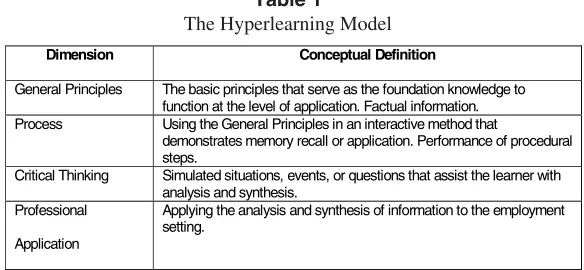
Jeffries (2000) first presented a Hyperlearning Model for designing CD-ROMs to teach nursing skills in an interactive, nonlinear framework. The Hyperlearning Model has four dimensions: (a) General Principles, (b) Process, (c) Critical Thinking, and (d) Professional Application (Table 1). The dimension, General Principles, serves as the foundation of knowledge needed to advance to higher levels of learning. Process involves activities that support active learning. The design dimension of Critical Thinking employs higher level learning activities that require the learner to analyze and evaluate information. The Professional Application dimension targets learning methods that integrate relevance to the work environment and high-level problem solving.
Table 1
The Hyperlearning Model
Dimension Conceptual Definition
General Principles The basic principles that serve as the foundation knowledge to function at the level of application. Factual information. Process Using the General Principles in an interactive method that
demonstrates memory recall or application. Performance of procedural steps.
Critical Thinking Simulated situations, events, or questions that assist the learner with analysis and synthesis.
Professional
Application
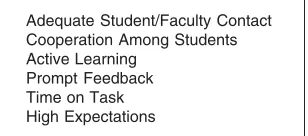
Avoiding the criticism that instructional design of hypermedia evolved from a production and procedural approach (Price, 1996), Jeffries’(2000)model established the relationships needed for grounded design as outlined by Hannafin (1997). While the Hyperlearning Model is not yet considered to be a grounded design, Jeffries2 linked learning designs, related theories, and research. Based in a defensible theoretical framework, it is consistent with research, and it is generalizable, allowing the conduction of investigational studies to provide validation by multiple implementations of empirical testing. The instructional design model incorporates the Seven Principles of Good Practice in Education (Chickering & Gamson, 1987) that serve as the foundational criteria for evaluating the usefulness of technology in learning interactions (Table 2). When systematically applied, these behaviors contribute to good student performance and satisfaction(Chickering & Gamson).
Table 2
The Seven Principles of Good Practice
Adequate Student/Faculty Contact Cooperation Among Students Active Learning
Prompt Feedback Time on Task High Expectations
APPLICATION OF THE HYPERLEARNING MODEL
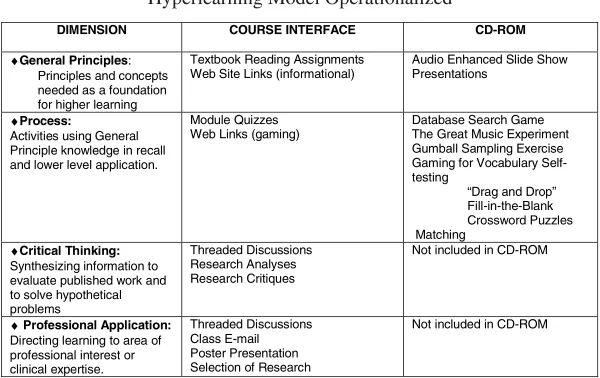
Using Jeffries Hyperlearning Model (2000) and building on Mayer’s (1997) work embracing the invention of a mental model, an electronically deliv-ered, undergraduate research course was developed. The premise of the design shifts the paradigm from teaching to learning; the learners are expected to choose the method or methods that best suit their learning style for meeting the course outcome objectives. The research course was delivered as an online course for two semesters before a grant was obtained that provided the funding to develop additional learning media. A CD-ROM was designed as courseware to accompany the online delivery. The CD-ROM incorporated audio enhanced slide show presentations, self-tests, and gaming to augment the learning activities within the electronic course. The CD-ROM allowed for the introduction of a more diverse learning environ-ment that was rich in media and provided multiple stimuli for environ-mental models without the frustration of slow modems or Internet provider problems. The embedding of the hyperlearning model in the CD-ROM served as a meta-cognitive tool by: (a) allowing the learners control of the sequence and type of instruction, (b) allowing the learners to view the total task, (c) giving the learners feedback about their learning and, (d) encouraging the learners to take the opportunity to reflect. In the selection of sequence and type of instruction, learners may choose to proceed through each dimension or they may skip elements of dimensions.
design of the CD-ROM. The dimensions of Critical Thinking and Profes-sional Application were integrated in the course interface and not in the CD-ROM.
Table 3
Hyperlearning Model Operationalized
Storyboarding detailed the content and basic approach for the activities, coordinating the CD-ROM content with the online interface. The course was divided into modules, each module included vocabulary games, self-tests, Internet links, textbook readings, journal articles, and slide show presenta-tions. To assist auditory learns, all slide shows were audio enhanced. After the faculty member developed the slides, audio files were recorded using a microphone on a personal computer. The audio recordings simulated a lecture format and the audio varied in length. The slides were not timed and did not self-advance; the audio could be replayed and the students could take notes using the computer. The audio files were programmed for synchronization with the slides.
GAMING ACTIVITIES
Interactivity and learner control are the core of the dimension, Process. Students enroll in a research course with the attitude that it will be stiff,
DIMENSION COURSE INTERFACE CD-ROM
♦General Principles: Principles and concepts needed as a foundation for higher learning
Textbook Reading Assignments Web Site Links (informational)
Audio Enhanced Slide Show Presentations
♦Process: Activities using General Principle knowledge in recall and lower level application.
Module Quizzes Web Links (gaming)
Database Search Game The Great Music Experiment Gumball Sampling Exercise Gaming for Vocabulary Self-testing
“Drag and Drop” Fill-in-the-Blank
Crossword Puzzles
Matching
♦Critical Thinking: Synthesizing information to evaluate published work and to solve hypothetical problems
Threaded Discussions Research Analyses Research Critiques
Not included in CD-ROM
♦ Professional Application: Directing learning to area of professional interest or clinical expertise.
Threaded Discussions Class E-mail Poster Presentation Selection of Research
painful, and boring. Learning the vocabulary, that is particular to research, is usually dull and monotonous. The hyperlearning model capitalizes on the potential of hypermedia systems by involving the learner through self-selected activities which reduces their boredom because they are involved with the content (Knowles, 1990). Learner control is a major advantage to designing hypermedia.
The desire for interactive learning that was creative and had visual appeal without interfering with learning drove the design of gaming activities. Jonassen (1988) defined interactivity as communication supported by a medium that enables dialogue between a learner and an instructor. In electronically delivered educational environments, interactivity can be modeled by the use of Common Gateway Interface (CGI) scripts that allow the learner to enter responses to short answer or multiple-choice questions and receive immediate feedback. Although the activities themselves do not teach, they provide a medium for learning (Oliver, Herrington, & Omari, 1996).
Figure 1. Example of a “drop and drag” vocabulary self-test
The brainstorming sessions were also used to create other learning activities to enhance learning by structuring mental models. Effectively performing library database searches save learners time and frustrations. Over the years, it was identified that most students entering the research course had not yet developed the skills necessary to perform the searches that result in the appropriate “hits.” To help research students more effectively perform electronic library database searches for research topics, an 11 item interac-tive quiz was developed. The Health Science librarian identified the top 10 problems most frequently encountered by students who were writing research papers. Using the problem list, she developed 11 questions, of varying format, that focused on databases and indexes, types of searches, and methods to produce the most effective library searches. A graphics designer and two visual arts students selected a game board design and completed the programming with the addition of some “bells and whistles” to the interface. Music and the animation of synchronized lights moving through a helix signaled the submission of a correct answer, allowing the game piece to advance. For students who were not successful completing the game, the correct answers were available on the Health Science library virtual tour on the Web (Figure 3).
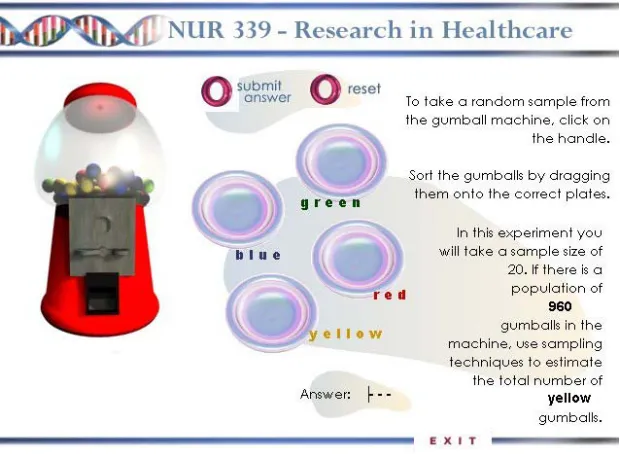
When discussing the concept of sampling and the various methods for sampling, a student designer suggested the analogy of a gumball machine for using sampling techniques to estimate the population based on the sample. The student designed the computer graphics and completed the program-ming that allowed for random population numbers and the random colors of gumballs each time the activity was reset. The gumball activity allowed the learners to develop mental models of random sampling and estimation of the population within the Process dimension. Having students on the design team, who did not have content knowledge, was beneficial as their perspec-tive for learning a concept was not inhibited or influenced by prior experi-ence of learning that content. This fresh and creative approach to the tutorial learning paradigm structured a connection between the content and the learner. Thus, supporting the suggestion by Takacs, Reed, Wells, and Dombrowski (1999) that the integration of hypermedia tools heralds a “revolution in the art of instruction” and visualization models move beyond classroom techniques (Figure 4).
To grasp an understanding of the research process, The Great Music Experiment, an activity that applies each step of the research process, was introduced in the first CD-ROM module, Introduction to Research. The Great Music Experiment is an example of a simulation and visualization model. Exemplars of the Great Music Experiment were used throughout the course to demonstrate application of the research process. Such tools motivate faculty and students to create interactive and exploratory experi-ences.
After the first two semesters using the course CD-ROM, the students believed that other students would benefit from using The Great Music Experiment (GME). Due to overwhelming encouragement by the research students and a desire to share an activity that evolved from The Cookie Experiment, a technique used in a traditional classroom (Thiel, 1987), a grant was obtained to program the activity for the Internet. Students, employed by the Multimedia Center at Purdue University, designed the graphics and completed the reprogramming using Flash software. The reprogramming allows any research faculty to use the activity. The Great Music Experiment is available as freeware at http://users.ipfw.edu/sternber/ 339/music.html. Figure 5 provides an example of a part of the survey that uses various data collection techniques.
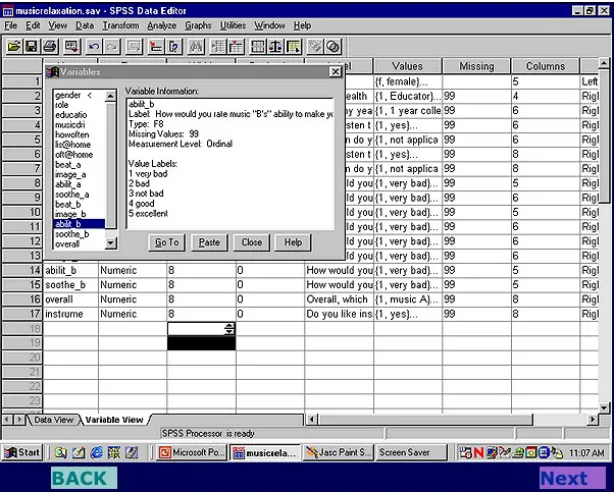
Using the data collected during the Great Music Experiment, a data file was developed using the Statistical Package for Social Sciences (SPSS). A learning activity in the module, Data Analysis, incorporated the data from the experiment to demonstrate the coding of data and its manipulation. The CD-ROM slide presentation included extensive audio explanations of various SPSS screens. This activity was designed within both dimensions, General Principles and Process. After viewing the slide presentation, the students could download the SPSS file and practice manipulating the data (Figure 6).
Figure 6. Statistical analysis exercise
STATISTICAL RESULTS
individual assignments and final course grades revealed no significant difference between grades earned by students who were enrolled in the traditional classroom course and those students who were enrolled in the online course. The online course retention rate for six semesters was 75%; most students dropped the course prior to submitting the first assignment. However, the traditional classroom retention rate was 90% with the majority of the students dropping at mid-term.
Students ranged in age from 21 to 58 years. The majority of the students (87%) were part-time students and 95% were employed, working greater than 32 hours per week. The demographics of the students are similar to Schrum and Luetkehans (1997) who reported that “the great majority of adults learning at a distance were reported to be in the 20-40 age range and studying on a part-time basis from their homes while maintaining full-time jobs” (p. 13).
The level of computer knowledge prior to registering for the online class ranged from “no previous experience” to “used computers daily.” When surveyed at the beginning of the course, 52% (n=54) of the students rated their computer confidence as “poor,” 25% (n=26) rated their computer confidence as “fair.” Only 23% of the students rated their confidence as moderate or high (16% (n=17) and 9% (n=9) respectively). The students who dropped the course reported having only “poor” or “fair” computer confidence. For those who reported having computer experience, e-mail was the most frequently listed application and the second most frequent comput-er utilization was the use of the Intcomput-ernet for web-surfing. No evaluation of the students’ computer confidence was completed at the end of the course; however, an analysis of a change in computer confidence would be helpful in future course designs.
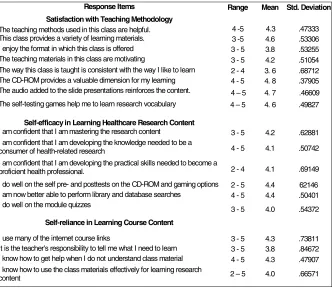
An analysis of the students’ responses is displayed in Table 4. Because the questionnaire was specifically developed for the electronically delivered course, correlations with the traditional classroom student evaluations could not be analyzed.
Table 4
An Analysis of the Evaluation Responses
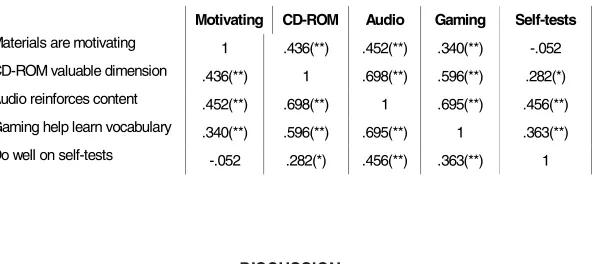
Five items on the questionnaire specifically addressed the use of the CD-ROM as a learning tool. Table 5 displays the correlation coefficients for the CD-ROM. Significant correlations were found between each of the five items except between the motivating course material and performance on self-tests.
Response Items Range Mean Std. Deviation
Satisfaction with Teaching Methodology
The teaching methods used in this class are helpful. 4 -5 4.3 .47333 This class provides a variety of learning materials. 3 -5 4.6 .53306 I enjoy the format in which this class is offered 3 - 5 3.8 .53255 The teaching materials in this class are motivating 3 - 5 4.2 .51054
The way this class is taught is consistent with the way I like to learn 2 - 4 3. 6 .68712 The CD-ROM provides a valuable dimension for my learning 4 - 5 4. 8 .37905 The audio added to the slide presentations reinforces the content. 4 – 5 4. 7 .46609
The self-testing games help me to learn research vocabulary 4 – 5 4. 6 .49827
Self-efficacy in Learning Healthcare Research Content
I am confident that I am mastering the research content 3 - 5 4.2 .62881
I am confident that I am developing the knowledge needed to be a
consumer of health-related research 4 - 5 4.1 .50742
I am confident that I am developing the practical skills needed to become a
proficient health professional. 2 - 4 4.1 .69149
I do well on the self pre- and posttests on the CD-ROM and gaming options 2 - 5 4.4 62146 I am now better able to perform library and database searches 4 - 5 4.4 .50401 I do well on the module quizzes
3 - 5 4.0 .54372
Self-reliance in Learning Course Content
I use many of the internet course links 3 - 5 4.3 .73811 It is the teacher's responsibility to tell me what I need to learn 3 - 5 3.8 .84672 I know how to get help when I do not understand class material 4 - 5 4.3 .47907
I know how to use the class materials effectively for learning research
Table 5
Correlation Coefficients for CD-ROM Related Items
DISCUSSION
The Hyperlearning Model served as an effective framework for the develop-ment of both the online research course and the CD-ROM courseware. The distance education students benefited from the CD-ROM with added learning opportunities that would not have been available to them with dial-up Internet service and the limitation of bandwidth. Receptivity to the CD-ROM was overwhelmingly positive, as students believed that it provided beneficial learning dimensions and addressed multiple learning styles. Questions related to use of the CD-ROM resulted in the highest means. English as a second language students reported that the audio enhanced slide shows provided instruction that was necessary for them to advance through the course. The international students also reported that the self-test games prepared them for the course quizzes.
Specific questions related to The Great Music Experiment were not included in the questionnaire; therefore, while the learning activity was used through-out the course, no data was available to analyze the students’ perceptions of its usefulness. Future questionnaires will contain items that specifically address the integration of the activity.
Undergraduate students continue to believe that learning should be teacher-directed. Just as developing online courses calls for complete redesigns and Motivating CD-ROM Audio Gaming Self-tests
Materials are motivating 1 .436(**) .452(**) .340(**) -.052
CD-ROM valuable dimension .436(**) 1 .698(**) .596(**) .282(*)
Audio reinforces content .452(**) .698(**) 1 .695(**) .456(**)
Gaming help learn vocabulary .340(**) .596(**) .695(**) 1 .363(**)
new teaching strategies, students need new strategies to prepare for learning in technology rich environments that are learner-directed rather than teacher directed. However, the evaluation responses suggested that the students did demonstrate self-efficacy and self-reliance at the completion of the online course. While students choose to enroll in online courses, they did not strongly believe that they learn best in the electronic environment. Yet, there was no significant difference in course final grades between the online environment and the traditional classroom to support the belief that the method of course delivery affected their grades.
Retention in online courses must be addressed. Better preparing students for the electronic environment may suggest the need to offer short computer application workshops or mini lessons prior to the beginning of the course. While the mean response for knowing how to access help to understand course content was 4.3, the students who dropped the course were not provided the opportunity to complete the questionnaire; thus, the analysis was not adequate to design interventions to improve student retention. Further evaluation of retention issues is warranted.
CONCLUSION
Use of theory-based design principles helps to construct effective hyperme-dia learning models. Cognitive gain and learner satisfaction are directly related to the strategies employed in course design (Vrasidas, 2002). The importance of well-designed online courses and the selection of learning activities related to promoting learner participation and interaction cannot be overstated (Eastmond & Ziegahn, 1996).
The Hyperlearning Model changes the role of the instructor from the “sage on the stage” to the “guide on the side” as the design focuses on the learner. The learner selects the methods needed as an individual. The model is designed to enhance interactivity through the construction of mental models and promotion of critical thinking. Providing students opportunities to develop their critical thinking skills is paramount so that they do not “mirror and reflect what they are told or what they read” (Von Glasserfeld, 1984).
References
Australian National Training Authority Pedagogical Issues: ANTA teaching & learning styles that facilitate online learning. Accessed November 6, 2005 fromhttp:// www.google.com/search?q=cache:3gopEBpbwC8J:learn.midsouthcc.edu/Learn-ingObjects/ID/pedigocial_issues.pdf+%22Pedagogical+Issues:+ANTA+ teaching+%26+learning+ styles+that+facilitate+online+learning%22&hl=en Bodner, G.M. (1986). Contstructivism: A theory of knowledge. Journal of
Chemical Education, 63, 873-878.
Chickering, A., & Gamson, Z. (1987, March). Seven principles of good practice in undergraduate education. AAHE Bulletin, 3-6
Eastmond, D., & Ziegahn, L. (1996). Instructional design for the online classroom. In Z.L.Berge, & M.P. Collins (Eds.), Computer mediated communication and the online classroom. (pp. 59-80). Cresskill, NJ: Hampton Press.
Fox, R. (2001). Constructivism examined. Oxford Review of Education, 27(1), 23-35.
Hannafin, M.J. (1997, December). The case for grounded design: What the literature suggests about effective teaching, learning, and technology. Keynote presentation at the annual meeting of the Australian Society for Computers in Tertiary Education (ASCILITE), Perth, Australia. Re-trieved November 9, 2005, from http://www.ascilite.org.au/conferences/ perth97/papers/Hannafink/Hannafink.html
Hannafin, M.J., & Hooper, S.R. (1993). Learning principles. In M. Fleming & W. Levie (Eds.), Instructional message design (2nd ed., pp. 191-228). Englewood Cliff, NJ: Educational Technology Publications. Hillman, D.C., Willis, D.J., & Gunawardena, C.N. (1994). Learner
inter-face interaction in distance education. An extension of contemporary models and strategies for practitioners. The American Journal of Dis-tance Education, 8(2), 30-42.
interac-tive CD-ROMs for teaching nursing skills. Computers in Nursing, 18(3), 118-124.
Johnson-Laird, P.N. (1989). Mental models. In M.I. Posner (Ed.), Founda-tions of cognitive science (pp. 469-499). Cambridge, MA: MIT Press. Jonassen, D.H. (1988). Integrating learning strategies into courseware to
facilitate deeper processing. In D. Jonassen (Eds.) Instructional de-signs for microcomputer courseware (pp. 151-181). Hillsdale, NJ: Lawrence Elbaum.
Mayer, R. (1997). Multimedia learning: Are we asking the right questions? Educational Psychologist, 32, 1-19.
Oliver, R., Herrington, J., & Omari, A. (1996). Creating effective instruc-tional materials for the World Wide Web. Retrieved November 5, 2005, from http://ausweb.scu.edu.au/aw96/educn/oliver/
Paivio, A. (1986). Mental representations: A dual coding approach. Ox-ford, UK: Oxford University Press.
Price, R.V. (1996). Technology doesn’t teach. People do. TechTrends, 41(6), 17-18.
Salomon, G. (1974). What is learned and how it is taught: The interaction between media, message, task, and learner. In D.R. Olson (Ed.), Media and symbols (pp. 383-406). Chicago: The University of Chicago Press. Schnotz, W. (1993). On the relation between dual coding and mental
mod-els in graphics comprehension. Learning and Instruction, 3 151-155. Schrum, L., & Luetkehans, L. (1997). A primer on distance education:
Considerations for decision makers. Washington, DC: AECT.
Takacs, J., Reed, M, Wells, J., & Dombrowski, L. (1999). The effects of online multimedia project development, learning style, and prior com-puter experience on teachers’ attitudes toward the Internet and hyper-media. Journal of Research on Computing in Education, 31(4), 342-359. Thiel, C.A. (1987). The cookie experiment: A creative teaching strategy.
Nurse Educator,12(3), 8-10.
Vrasidas, C. (2000). Constructivism versus objectivism: Implications for interaction, course design, and evaluation in distance education. Inter-national Journal of Educational Telecommunications, 6(4), 339-362. Vrasidas, C. (2002). A systematic approach for designing hypermedia
envi-ronments for teaching and learning. International Journal of Instruc-tional Media, 29(1), 1-13.