Amun Amri , Zhong-Tao Jiang, Chun-Yang Yin, Ahmad Fadli, Mohammad Mahbubur Rahman, Syaiful Bahri1
, Hantarto Widjaja2
, Nicholas Mondinos2
, Tutut Herawan4
, Muhammad Miftahul Munir5
,
and Gadang Priyotomo6
1
Department of Chemical Engineering, Universitas Riau, Kampus UR Panam, Pekanbaru, Riau 28293, Indonesia 2
School of Engineering and Information Technology, Murdoch University, 6150 WA, Australia 3
School of Science and Engineering, Teesside University, Middlesbrough, United Kingdom 4
Universitas Teknologi Yogyakarta, and AMCS Research Center, Yogyakarta, Indonesia 5
Department of Physics, Institut Teknologi Bandung (ITB), Bandung, Indonesia 6
Indonesian Institute of Sciences (LIPI), Serpong, Tangerang, Indonesia
Received 28 March 2016, revised 2 August 2016, accepted 9 August 2016 Published online 23 August 2016
Keywordscoatings, cobalt copper oxides, mechanical properties, optical absorption, sol–gel synthesis, structure *Corresponding author: e-mail[email protected], Phone:þ62 823 8176 0767, Fax:þ62 761 566 937
Thin films of CoxCuyOz have been coated on aluminum substrates via sol–gel route using low concentration of copper and cobalt precursors at annealing temperatures in range of 500–6508C. The coatings were characterized by X-ray diffraction (XRD), X-ray photoelectron spectroscopy (XPS), UV-Vis-NIR spectrophotometry, and nanoindentation. The XRD analysis in 2u-range of 308–428revealed that the coatings exhibited low crystallinity of CoCu2O3, CoCuO2, and CuCoO2. The surface bonding structure analyzed using XPS indicated that the coating contained: Cu (tetrahedral Cuþand octahedral Cu2þ), Co (octahedral Co3þ, tetrahedral Co2þ, and mixed Co2þand Co3þ), and O (lattice, surface, and sub-surface oxygens).
The optical properties characterized using UV-Vis-NIR showed that the reflectance spectra of coatings formed a spectrally solar selective absorber profile associated with the interference peaks and the absorption edges around wave-lengths of below 1.2mm. The maximum absorptance (a¼ 75.8%) was shown by coating synthesized at 5008C. The mechanical properties of coatings showed that the increase of annealing temperature increased the coating’s hardness (H) and the elastic modulus (E) due to the enhancement of the [CoCuO2/CuCoO2]:[CoCu2O3] oxide phases ratio, as the result, an excellent stability of the wear resistance (H/E) of around0.035 was recorded.
ß2016 WILEY-VCH Verlag GmbH & Co. KGaA, Weinheim
1 Introduction Cobalt and copper mixed oxides have found widespread applications such as catalyst for many important reactions (e.g., oxygen evolution reactions (OER), the Fischer–Tropsch process, etc.) and as thermo-electric materials [1–4]. The physicochemical, electrochem-ical, magnetic, conductivity, and thermal properties have been substantially studied by various researches [5–8]. A major conclusion reached is that the chemical nature and the compositions of the precursors, as well as the annealing treatments influence the properties of these mixed oxides, i.e., properties are influenced by the preparation method
crystal structure and separate minor phases composed of new cobalt and/or copper oxides [1, 9]. Normally the degree of crystallinity of the phases in CoO/CuO increases with rising annealing temperature. However, a decrease in the degree of crystallinity is observed in phases synthesized from low copper precursor concentration [8].
Apart from the previous mentioned properties, the optical and mechanical properties of cobalt-copper mixed oxides coatings are comparatively less studied. In our previous work, we studied the physico-chemical properties of cobalt-based mixed metal oxide (MxCoyOzwith M¼Mn, Cu, Ni) and CoxCuyOz–SiO2 coatings on Al substrate synthesized via sol–gel method at annealing temperature of 5008C. The optical properties of the coatings exhibited distinctive spectral selectivity in the solar wavelengths region (<2.5mm) making them promising material for solar selective absorber (SSA) applications [4, 7]. In present work, we synthesize CoxCuyOzthinfilm coatings via sol–gel process using low concentration of [Cu] and [Co] sol precursor (<0.2 M). We investigate the effects of various annealing temperatures on the structural, surface electronic compositions, optical, and mechanical properties (wear resistance) of the coatings. The synthesis conditions were optimized to obtain an improvement of mechanical stability and reproducibility of SSA optical coatings. Throughout the studies we found that the coatings synthesized using a low concentration of sol precursors (thereby enhancing cost-effectiveness of the coatings) underwent the increase of the [CoCuO2/CuCoO2]:[CoCu2O3] oxide phases ratio as the annealing temperature was increased, and this has a positive impact to retaining the wear resistance (hardness (H) per elastic modulus (E),H/E) of coating from the degradations.
2 Materials and methods
2.1 Sample preparation A series of cobalt copper oxide thin film coatings tandem on Al substrates was synthesized via simple sol–gel dip-coating route as follows. Cobalt chloride and copper acetate were mixed in absolute ethanol, with the addition of propionic acid to form cobalt chloride (0.15 M) and copper acetate (0.15 M) mixed solutions. The mixed solutions was then stirred for 2 h before being deposited on the clean aluminum substrates
using a dip-coater at withdrawal rate of 120 mm min1and subsequently dryed on a hot plate at 1508C for 10 s. The optimized four times dip-drying cycles were carried out beforefinal atmospheric annealing at temperatures ranging from 500 to 6508C for 1 h. The maximum heat treatment was limited due to the significant decrease of mechanical strengths on aluminum substrate at temperature above 6708C.
2.2 Characterizations Minerlogical properties of the thin films coatings were characterized using a Bruker Advance D8 X-Ray diffractometer (XRD) equipped with a Lynx-Eye detector Cu-tube and operated at 40 kV/ 40 mA [11, 12]. The X-ray photoelectron spectroscopy (XPS) (Kratos Axis Ultra XPS spectrometer, Manchester, UK) with Al Ka radiation (hn¼1486.6 eV) was used to
probe the surface compositions and chemical bonding structures of coatings. For quantification analysis, the CASA XPS (V.2.3.15) software was utilized using Shirley background subtraction. Jasco V–670 double beam
Figure 1 (a) XRD patterns of the cobalt–copper coatings deposited on aluminum substrate at different annealing temper-atures. (b) Expanded XRD patterns within the region of 308–428.
Table 1 Crystal structures for some cobalt copper oxides.
crystal no. of atoms in a unit cell space group a(Å) b(Å) c(Å) a(8) Z
CoCu2O3 Co¼2, Pmmn (59) 9.41a 3.98a 3.20a 2
Cu¼4, 9.27b 3.94b 3.24b
O¼6 9.62c 4.05c 2.99c
CoCuO2or CuCoO2 Co¼1, R3m (166) 5.95 27.7 1
Cu¼1, 5.95b b27.14b
O¼2 5.88d 28.07d
aXRD database ICDD 76-0442;XRD (ICDD 74-1855). bCalculated from our XRD experiment data.
c
Simulated using VASP, withk-points 4810.
d
x y z site parameters
Co 0.25 0.25 0.42 2a z¼0.42 Co 0.75 0.75 0.58 2a z¼0.42
Cu 0.08 0.75 0.85 4f x¼0.08,z¼0.85 Cu 0.42 0.75 0.85 4f x¼0.08,z¼0.85 Cu 0.58 0.25 0.15 4f x¼0.08,z¼0.85 Cu 0.92 0.25 0.15 4f x¼0.08,z¼0.85 O 0.12 0.25 0.95 4f x¼0.12,z¼0.95 O 0.38 0.25 0.95 4f x¼0.12,z¼0.95 O 0.62 0.75 0.05 4f x¼0.12,z¼0.95 O 0.88 0.75 0.05 4f x¼0.12,z¼0.95
O 0.25 0.75 0.50 2b z¼0.50
O 0.75 0.25 0.50 2b z¼0.50
a
Site in the International Tables for Crystallography no. 59, p. 293.
b
Obtained from VASP simulation.
Table 3 Atomic positions for CoCuO2or CuCoO2in fractional coordinate.
x y z sitea parameterb
Cu 0.00 0.00 0.00 1a –
Co 0.50 0.50 0.50 1b –
O 0.11 0.11 0.11 2c x¼0.11
O 0.89 0.89 0.89 2c x¼0.11
aSite in the International Tables for Crystallography no. 166, p. 547. b
Obtained from VASP simulation.
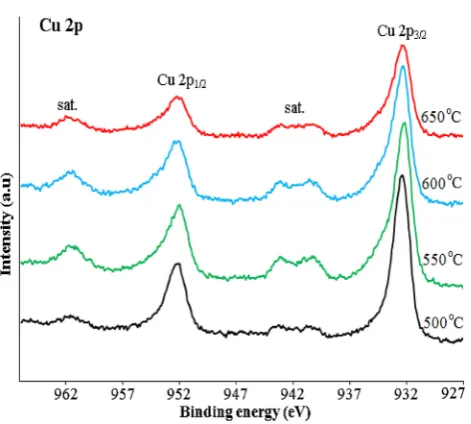
Figure 2 Cu 2p XPS spectra of copper cobalt thinfilm coatings synthesized at different annealing temperatures.
UV-Vis-NIR spectrophotometer with integrating sphere was used to obtain the reflectance spectra of samples in wavelengths range of 0.3–2.7mm. The solar absorptance value was calculated based on the AM1.5 standard as described by Duffie–Beckman [13].
The mechanical properties of film coatings were characterized using nano-indentation workstation (Ultra-Micro Indentation System 2000, CSIRO, Sydney, Australia) equipped with a Berkovich indenter. Nano-indentation test was conducted under load control with a maximum load of 0.5 mN, under which the maximum penetration depth was found to be less than 10% of the film thickness. It was carried out to ensure that only the film properties were measured. For each test, 10 incremental and 10 decremental steps were used. For each sample, 30 measurements were taken, and then the results were averaged and the standard deviation was evaluated.
3 Results and discussion
3.1 Structural analysis Figure 1 shows the XRD
patterns of the samples synthesized at different annealing temperatures. The overall XRD spectra are shown in Fig. 1a. The peaks at about 458 are from the Al substrate (in comparison to XRD spectra of the substrate). Figure 1b shows the spectra in the range 308–428with a magnified scale of the intensity. The peaks in this range are due to the mixed oxides coating clearly indicating the crystallinity of the observed phases.
Based on the peak positions, intensities,d-spacing and ICDD databases, peaks at 35.98 (011), 36.98 (310), and 40.38(301) (denoted as “!”) are due to CoCu2O3(ICDD 76-0442) (Fig. 1b). The intensity and crystallinity of the (301) direction increases extensively as the annealing temperature is increased from 500 to 6508C suggesting a preferred orientation and increased domain size in this direction. The peaks at approximately 388–398 and 31.38range are assigned to mixed phases of CoCuO2and CuCoO2 (denoted as “•”) (ICDD 74-1855 and 21-0256, respectively).
The percentage proportion of the three main oxide phases can be approximated from the intensity and width profiles of the CoCu2O3and CoCuO2/CuCoO2peaks. At the
highest annealing temperature of 6508C, we approximate a [CoCuO2/CuCoO2]:[CoCu2O3] oxide phases ratio of 3:2. A similar analysis of our previous work using higher [Co] and [Cu] sol precursors (0.25 M for each) showed a [CoCuO2/ CuCoO2]:[CoCu2O3] ratio of 1:1 [14].
Crystal structures of the identified phases were analyzed based on the space group information from the ICDD data, International Tables for Crystallography [15], and simula-tion using VASP code. Simulasimula-tion methodology comprises plane-wave density functional theory (DFT), spin-polarized PAW-GGA functional [16], van der Waals correction by Grimme [17], and a Gaussian smearing. To ensure convergence results, all stages used plane wave cut off energy of 500 eV. Completion of iterations entailed
Table 4 The curve-fittings results of Cu 2p3/2and its satellites of copper cobaltfilms synthesized at different annealing temperatures.
binding energy (in eV) and percentage
Cu 2p3/2
annealing temperature (8C) photoelectron line satellite I satellite II
500 932.4 (61.7%) 933.5 (29.05%) 940.6 (5.0%) 943.1 (4.3%)
550 932.2 (40.3%) 933.35 (40.7%) 940.5 (10.9%) 943.0 (8.1%)
600 932.3 (36.9%) 933.5 (41.8%) 940.4 (11.5%) 943.0 (9.7%)
650 932.3 (43.45%) 933.6 (37.3%) 940.4 (10.8%) 943.0 (8.4%)
attributions tetrahedral Cuþ octahedral Cu2þ Cu2þcharacteristic satellites
0.05 eV A for atomic forces. Lattice parameters from the literature values (ICDD), our XRD experiment data, and VASP simulations are tabulated in Tables 1–3. The CoCu2O3 is a type of spin ladder crystal [18, 19]. It is seen in Table 1, the lattice parameters from three sources (ICDD, our XRD and VASP) are in good agreement.
3.2 Surface electronic structure The Cu 2p XPS
spectra of CoO/CuOfilms synthesized at different annealing temperatures are shown in Fig. 2. All of the spectra show two main peaks of Cu 2p3/2and Cu 2p1/2and satellites on the high energy side of these two main peaks. The separation between the Cu 2p1/2and Cu 2p3/2peaks slightly increases as the temperature is increased from 500 to 6508C. This subtle increase from 19.7 to 19.85 eV indicates the existence of a low oxidation state of copper, while the satellite peaks indicate the presence of Cu2þand an open 3d9shell [20]. Figure 3 shows the decoupling of Cu 2p3/2peaks and the satellites at different annealing temperatures. Table 4 lists the binding energies and the percentages of the four components from the decouplings. Generally, the increase of annealing temperature does not change the Cu bonding structure significantly. The percentages for the tetrahedral Cuþions and the octahedral Cu2þions are observed to be relatively equal (approx. 1:1 ratio) except for coating synthesized at 5008C which has a much higher percentage of tetrahedral Cuþ (approx. 2:1 ratio). Increasing annealing temperature tends to decrease the number of tetrahedral Cuþions.
Figure 4 shows plots of the intensity ratios of Cu 2p3/2 satellite to Cu 2p3/2main peak (Isat/Imain) and the separation distance between the satellite and main peak. Overall the trend is an increase in the intensity ratio and a decrease in the separation distance as the annealing temperature varies from 500 to 6508C. According to the Sawatzky theory [21], the shorter separation between the Cu 2p3/2line and its satellite peak, and the higherIsat/Imain ratio points to a decrease in
coatings as compared to CuO [9].
The XPS profile of Co 2p spectra of the CoO/CuO coatings are shown in Fig. 5. All spectra have two main
Figure 5 Co 2p XPS spectra of copper cobalt thinfilm coatings synthesized at different annealing temperatures.
peaks, namely Co 2p3/2 and Co 2p1/2, with their satellites located on the high energy sides of the main peak. Even though the intensities ratio of Co 2p1/2to Co 2p3/2 for all coatings are relatively similar, the separations between Co 2p3/2and Co 2p1/2peaks owing to the spin-orbit splitting are still different. The spin-orbit splittings for the samples annealed at 550 and 6008C are 16.1 eV, while that for samples annealed at 500 and 6508C are 15.9 eV. However, this evidence could correspond to the Co2þions confirmed by the presence of characteristic satellites in between of Co 2p3/2 and Co2p1/2.
Besides the presence of cobalt ions in a partial spinel-type lattice arrangement, the relatively low intensities of satellites detected at 786 eV also indicate the presence of Co2þions mixed with Co3þions [5]. The existence of this ions mixing is confirmed by the asymmetry of Co 2p1/2 peaks [14].
Figure 6(a–d) shows the decoupling of the Co 2p3/2 peaks and their satellites resulting in five curve-fitted components. The peaks at around 780 eV (denoted as“ii”) are mostly due to the mixed Co(II,III) bonding states whereas the component with binding energy lower than 780 eV (denoted as “i”) are predominantly attributed to Co3þin octahedral coordination and the components with binding energy of Co 2p3/2greater than 780 eV with a shake-up satellite are the characteristics of Co2þ in tetrahedral coordination. Table 5 represents the details of binding energy and the percentages of each component. It is also seen in all the samples, the tetrahedral Co2þ ions are prominent, and the increase in temperature tends to decrease the number of Co2þions. In the case of CoO/CuO system, the Co2þions are partially substituted by Cu2þions [1, 10] forming copper–cobalt oxide structures [5].
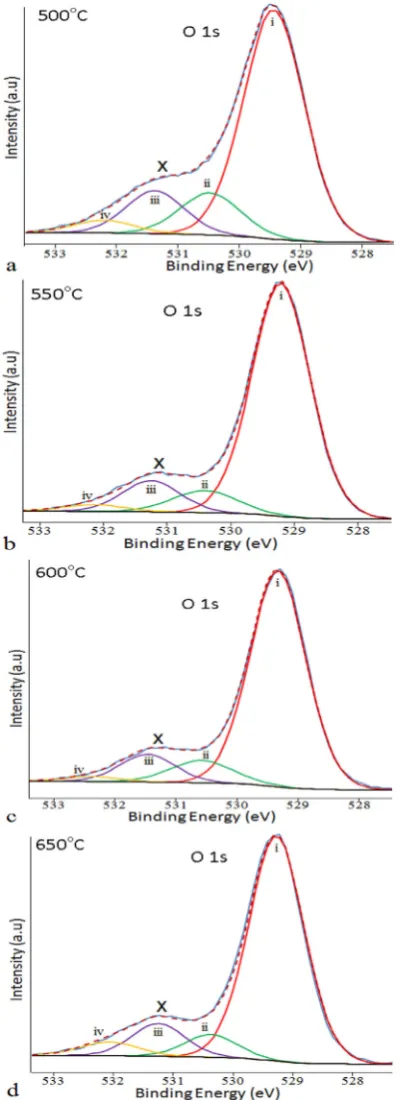
The curvefitted O 1s XPS spectra of CoO/CuO film coatings are presented in Fig. 7a–d. Generally, there is relatively no change in the oxygen surface compositions when the coatings were treated at different annealing temperatures from 500 to 6508C. In each sample, the spectrum shows a strong peak around 529.3 eV with an apparent shoulder at the higher binding energy side (denoted as“X”).
The four components are results from decoupling of each photoelectron spectrum. The components at binding
energy (BE) of around 529.2–529.5 eV (denoted as“i”) are due to lattice O2in the structure whereas at BE of around 530.4–531.4 eV (denoted as“ii”and“iii”) may be attributed to the surface oxygen from a wide variety of species (chemisorbed oxygen O, oxygen containing surface contamination, and/or OH-like species, as hydroxyl, carbonate groups, etc.) [1, 5, 9, 22–25]. The sub-surface O specieses are also observed at BE around 532.1–532.4 eV (denoted as “iv”) [26, 27]. The features exhibited by the shoulders at the high energy side of the O 1s main peaks are the characteristics of the copper–cobalt mixed oxides family which distinguish them from O 1s of Co3O4in single component [1].
3.3 Optical properties The absorptance (a) value is the basic characterization of the optical properties of CoO/CuO coatings on Al substrate (absorber–reflector tandem system). It can be measured in terms of reflectance as described by Duffie and Beckman [13]. High spectral reflectance indicates low absorptance and vice versa. Figure 8 shows the reflectance spectra and the correspond-ing solar absorptance values of coatcorrespond-ings on highly reflective aluminum substrates synthesized at different annealing temperatures.
Generally, the coatings exhibit low reflectance with 1 or 2 minor maxima below 1.5mm and moderate to high reflectance above 1.5mm which form the basis of a solar selective absorber profile. In the absorber–reflector tandem system, low reflectance spectra at lower wavelengths are attributed to the interactions between the incoming solar radiation and the coating material. In this area, most of the incoming solar radiation will be absorbed by the coating surface. There are maxima/minima in the low wavelengths area consisting of the interference peaks (labeled as“”) and the absorption edges (labeled as“#”) below 1.2mm. For coatings synthesized at 6508C, it is apparent that more than one interference peak and one absorption edge were found. This may associated with the change of oxide phases ratio as elucidated in the previous structural section (Section 3.1).
In terms of temperature change, the interference peaks and the absorption edges positions tend to raise with the increase of annealing temperature that eventually lowers the
Table 5 Binding energies and percentages of decoupling results of Co 2p3/2peaks.
binding energy (in eV) and percentage
Co 2p3/2photoelectron line satellites
annealing temperature (8C) i ii iii iv v
solar absorptance up to 10%. Figure 9 is a plot of absorptance versus temperature and clearly shows a decrease in absorptance as temperature increases. This indicates that the higher the heating temperature, the smaller the ability of coating material to absorp the UV-Vis light
with little influence on NIR light. The phenomena in this temperature range can be utilized for absorptance tuning without much change in the NIR absorption. The moderate to high reflectance spectra seen above 1.5mm are mainly attributed to the interactions between the transmittant incoming infrared radiation and the reflective aluminum surface. Basically, for coatings with similar thicknesses, the reflectance profiles above 1.5mm featured in Fig. 8 are due to the resultant transmitted infrared beam via coating material (akin to semiconductor properties) and its reflection back by the substrate surface.
3.4 Nano-indentation tests Figure 10 shows the
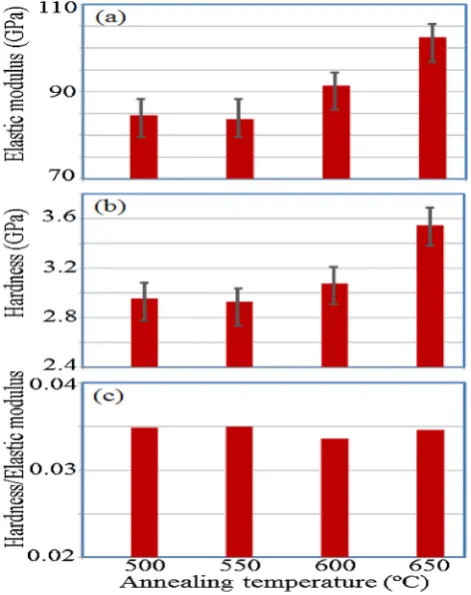
elastic modulus (E), hardness (H), andH/Eof the coatings
Figure 7 O 1s XPS spectra and curve-fittings of copper cobalt thin film coatings synthesized at different annealing temperatures.
Figure 8 Reflectance spectra with solar absorptance of copper– cobalt oxide thinfilm coatings on reflective aluminum substrates synthesized at different annealing temperatures.
characterized via nano-indentation tests. There is a desired impact on the mechanical properties of the coating layer where both the elastic modulus and the hardness increase with increasing annealing temperature, especially for coatings synthesized above 5508C. Both the elastic modulus and the hardness of these coatings were increased up to 20% above 5508C. The associated errors in both the modulus and hardness data are attributed to the porosity and the surface roughness factors of the coatings [4, 12, 14].
The parameterH/Eis used to predict the wear resistance of the thin film coatings [28]. The wear resistance is an important factor in the performance and function of the optical coatings during their operations where mechanical contacts are always expected [29]. No significant changes in
H/Ewere found after the heat treatment of the coatings. The wear resistance values tend to be stable at 0.035. It is a surprise getting stable wear resistance of coatings synthe-sized using a low sol precursor concentration (Fig. 10c) due to the increase in the hardness, as the increase of temperature is followed by an increase of elastic modulus proportionally. It is different from our previous report [14] where the critical point of the overall wear resistance deflation was at temperature of 6508C. If it is linked to the structural analysis, it is clear that the enhancement of [CoCuO2/ CuCoO2]:[CoCu2O3] oxide phases ratio indicated at annealing temperature of 6508C in this paper has a direct
impact to retain the wear resistance from degradations. Table 6 describes the qualitative differences of structural and mechanical properties of between the present and the previous work [14] for annealing temperature of 6508C. Overall, coatings prepared in this work are envisaged to have superior wear resistance compared to the aluminum substrate (H/E¼0.011) [4, 14].
4 Conclusions Cobalt and copper mixed oxides thin films have been coated on aluminum substrate via sol–gel route using low concentration of copper and cobalt sol precursors (thereby enhancing cost-effectiveness of the coatings). The coatings exhibited a low crystallinity of CoCu2O3, CoCuO2, and CuCoO2. The surface bonding structure analysis indicated that the surface contained tetrahedral Cuþ and octahedral Cu2þ, octahedral Co3þ, tetrahedral Co2þ, and mixed Co2þ and Co3þ, as well as lattice, surface, and sub-surface oxygens. The observed optical properties exhibited distinctive spectral selectivity in the solar wavelengths region (<2.5mm). Throughout this study we found that coatings synthesized at low concentra-tion of sol precursors exhibited a favorable stable wear resistance (H/E) at high operating temperatures due to the change of the [CoCuO2/CuCoO2]:[CoCu2O3] oxide phases ratio as the annealing temperature was increased.
Acknowledgements We would like to acknowledge Indonesia Government for the research funding under the
“Kerjasama Luar Negeri & Publikasi Internasional” research scheme (grant no. 548/UN. 19.5.1.3/LT/2015). Many thanks to Mr. John Boulton and Mr. Ken Seymour for their assistance in the analyses. Z.T. Jiang is grateful for the small grant scheme 2014, School of Engineering and Information Technology, Murdoch University. C.Y. Yin is supported by the Teesside University Research Fund (URF).
References
[1] M. De Koninck, S. C. Poirier, and B. Marsan, J. Electrochem. Soc.153, A2103 (2006).
[2] D. J. Singh, Phys. Rev. B76, 85110 (2007).
[3] M. Beekman, J. Salvador, X. Shi, G. S. Nolas, and J. Yang, J. Alloys Compd.489, 336 (2010).
[4] A. Amri, Z.-T. Jiang, T. Pryor, C.-Y. Yin, Z. Xie, and N. Mondinos, Surf. Coat. Technol.207, 367 (2012).
Figure 10 Mechanical properties of the deposited coatings obtained from the nano-indentation tests, (a) elastic modulus, (b) hardness, and (c)H/E.
Table 6 Qualitative differences between present and previous work for the 6508C annealing temperature.
properties previous
report [14]
present
[CoCuO2/CuCoO2]: [CoCu2O3]
1:1 3:2
elastic modulus linear trend non-linear trend
hardness constant non-linear
428
[6] R. N. Singh, J. P. Pandey, N. K. Singh, B. Lal, P. Chartier, and J. F. Koenig, Electrochim. Acta45, 1911 (2000). [7] A. Amri, Z. T. Jiang, N. Wyatt, C. Y. Yin, N. Mondinos, T.
Pryor, and M. M. Rahman, Ceram. Intl.40, 16569 (2014). [8] W. M. Shaheen and A. A. Ali, Mater. Res. Bull.36, 1703
(2001).
[9] A. La Rosa-Toro, R. Berenguer, C. Quijada, F. Montilla, E. Morallon, and J. L. Vazquez, J. Phys. Chem. B110, 24021 (2006).
[10] G. Fierro, M. Lo Jacono, M. Inversi, R. Dragone, and P. Porta, Top. Catal.10, 39 (2000).
[11] A. Amri, Z.-T. Jiang, P. A. Bahri, C.-Y. Yin, X. Zhao, Z. Xie, X. Duan, H. Widjaja, M. M. Rahman, and T. Pryor, J. Phys. Chem. C117, 16457 (2013).
[12] A. Amri, X. Duan, C.-Y. Yin, Z.-T. Jiang, M. M. Rahman, and T. Pryor, Appl. Surf. Sci.275, 127 (2013).
[13] J. A. Duffie and W. A. Beckman, Solar Engineering of Thermal Processes, 3rd ed. (John Wiley & Sons, Inc., New Jersey, 2006). [14] A. Amri, Z.-T. Jiang, X. Zhao, Z. Xie, C.-Y. Yin, N. Ali, N. Mondinos, M. M. Rahman, and D. Habibi, Surf. Coat. Technol.239, 212 (2014).
[15] E. T. Hahn, International Tables for Crystallography, Vol. A: Space-Group Symmetry, 5th ed. (Springer, Berlin, Heidel-berg, New York, 2005).
[17] S. Grimme, J. Comp. Chem.27, 1787 (2006).
[18] K. Oh-ishi, Y. Tsuchiya, Y. Iizuka, and H. Yamane, J. Solid State Chem.160, 251 (2001).
[19] E. Bordas, C. D. Graaf, R. Caballol, and C. J. Calzado, Phys. Rev. B71, 45108 (2005).
[20] M. Brandhorst, J. Zajac, D. J. Jones, J. Roziere, M. Womes, A. Jimenez-Lopez, and E. Rodrıguez-Castellon, Appl. Catal. B55, 267 (2005).
[21] D. K. G. de Boer, C. Haas, and G. A. Sawatzky, Phys. Rev. B
29, 4401 (1984).
[22] T. J. Chuang, C. R. Brundle, and D. W. Rice, Surf. Sci.59, 413 (1976).
[23] G. Tyuliev, D. Panayotov, I. Avramova, D. Stoichev, and T. Marinova, Mater. Sci. Eng. C23, 117 (2003).
[24] P. Stefanov, I. Avramova, D. Stoichev, N. Radic, B. Grbic, and T. Marinova, Appl. Surf. Sci.245, 65 (2005).
[25] G. Tyuliev and S. Angelov, Appl. Surf. Sci.32, 381 (1988). [26] J.-C. Dupin, D. Gonbeau, P. Vinatier, and A. Levasseur,
Phys. Chem. Chem. Phys.2, 1319 (2000).
[27] S. Royer, A. Van Neste, R. Davidson, S. Mcintyre, and S. Kaliaguine, Ind. Eng. Chem. Res.43, 5670 (2004). [28] A. Leyland and A. Matthews, Wear246, 1 (2000). [29] J. G. Meier, A. Mrzel, M. Canales, P. Gonzalvo, and N.