Information Technology and Control 2017/4/46 530
PCMAE: A Proxy Convertible
Multi-AE Scheme and Its Variant
ITC 4/46
Journal of Information Technology and Control
Vol. 46 / No. 4 / 2017 pp. 530-545
DOI 10.5755/j01.itc.46.4.15819 © Kaunas University of Technology
PCMAE: A Proxy Convertible Multi-AE Scheme and Its Variant
Received 2016/07/31 Accepted after revision 2017/11/14
http://dx.doi.org/10.5755/j01.itc.46.4.15819
Corresponding author: [email protected]
Han-Yu Lin
Department of Computer Science and Engineering, National Taiwan Ocean University, Keelung, Taiwan e-mail: [email protected]
This paper presents a novel proxy convertible multi-authenticated encryption (multi-AE) scheme and its vari-ant with message linkages. The proposed scheme allows two or more original signers to cooperatively delegate their signing power to an authorized proxy signer, such that the proxy signer can generate a valid authenticated ciphertext on behalf of the original signing group and only a designated recipient is capable of decrypting the ciphertext and verifying its embedded proxy multi-signature. Its variant with message linkages further ben-efits the encryption of a large message by dividing it into many smaller message blocks. The proposed proxy convertible multi-AE scheme and its variant can simultaneously fulfill the security requirements of confiden-tiality and authenticity. Thus, they are applicable to those group-oriented confidential applications with proxy delegation, e.g., proxy on-line auction, proxy contract signing and so on. In case of a later dispute over repudi-ation, our proposed scheme also allows a designated recipient to convert the ciphertext into an original proxy multi-signature for public verification. In addition, the security of confidentiality against indistinguishability under adaptive chosen-ciphertext attacks (IND-CCA2) and that of unforgeability against existential forgery under adaptive chosen-message attacks (EF-CMA) are proved in the random oracle model.
KEYWORDS: proxy multi-signature, convertible, authenticated encryption, message linkage.
1. Introduction
With the rapid development of electronic commerce (eCommerce), the security of on-line transactions has received the great attention. Generally speaking, cryp-tographic techniques can be adopted to protect the communication content over the Internet. Public key encryptions [4] and digital signature schemes [5, 30] are two fundamental cryptographic mechanisms which
re-531
Information Technology and Control 2017/4/46
quirements simultaneously be achieved. A straight-forward way would be sign-then-encrypt [36]. Yet, the approach is costly in terms of computation efforts and communication overheads. In some special cir-cumstances, a proxy might be properly delegated to conduct these confidential transactions, e.g., proxy auctions and the contract signing by an authorized proxy signer. Consider group-oriented applications such as the joint account owned by two or more in-dividuals. To withdraw money from such account, all owners must cooperatively sign the withdrawal form which can only be verified by the bank teller. In case that account owners are unable to sign personally, they can delegate their signing power to a proxy signer who can legitimately conduct transactions on behalf of them. It thus can be seen that the design of efficient and provably secure cryptographic schemes fulfilling such requirements is crucial and benefits to the prac-tical implementation.
1.2. Related Work
In 1996, Mambo et al. [25, 26] extended the concept of digital signature and introduced the notion of proxy signatures. A proxy signature scheme allows the orig-inal signer to delegate his signing power to an autho-rized person called proxy signer, such that the proxy signer can generate a valid proxy signature on behalf of the original one. As to the proxy delegation, it can be categorized into four different kinds as follows: (i). Full delegation [25, 26]: The proxy signer uses the
private key which is the same as the one of the original signer so that all (proxy) signatures are signed with the same private key. Consequent-ly, it is difficult for a verifier to identify the real signer from a given signature. That is to say, it cannot provide secure mechanisms to protect any one of the original and the proxy signers from being framed by the other.
(ii). Partial delegation [25, 26]: The proxy private key is further derived from the original signer’s one based on some cryptographic assumptions, e.g., the factorization and the discrete logarithm problems. It is infeasible to compute the original signer’s private key from the proxy one. Yet, it needs an additional revocation protocol as no in-formation (e.g., the period of validity) is bonded to the delegation. Moreover, a malicious original signer can easily impersonate the proxy signer
by deriving the corresponding proxy private key. (iii). Delegation by warrant [28, 37]: A warrant which contains necessary proxy information, e.g., the period of validity and the identifiers of the orig-inal and the proxy signers, could be regarded as the delegation authorization. The warrant is then delivered to the proxy signer for convincing anyone. However, transmitting and verifying the certificate will incur extra computational and communicational costs.
(iv). Partial delegation with warrant [16]: This ap-proach integrates the merits of partial delega-tion and delegadelega-tion by warrant. It is also compu-tationally infeasible for a proxy signer to derive the original signer’s private key from the proxy one. Besides, to certify the warrant and validate the signature can be simultaneously carried out within a single step, which helps reducing the computational and communicational costs. Obviously, the fourth approach, partial delegation with warrant, is more flexible and secure as compared to the first three. Because of its efficiency and security com-pared with the others, we also adopt partial delegation with warrant to implement the proposed scheme. Up to the present, lots of variations of proxy signatures have been proposed [10, 12-14, 16, 23, 33, 34, 36].
In 1994, Horster et al. [8] proposed an authenticated encryption (AE) scheme which further provides dig-ital signature schemes with the property of confiden-tiality and only the designated recipient can verify the signature instead of everyone. Since only the desig-nated recipient has the ability to decrypt the cipher-text and verify the corresponding signature, there might be a potential drawback that the signer repudi-ates his signature. In such a circumstance, it is even difficult for an arbitrator to judge who is lying. To deal with the case of a later dispute over repudi-ation, Araki et al. [1] proposed a convertible limited verifier signature scheme. However, the signature conversion of their scheme requires the assistance of the signer and incurs additional computation efforts, which is considered to be inefficient and unworkable if the signer is unwilling to cooperate with. More-over, Zhang and Kim [48] also pointed out that their scheme can not withstand a universal forgery attack on an arbitrary chosen message.
Information Technology and Control 2017/4/46 532
signature conversion is rather simple and can be solely done by the recipient without any computation effort or communication overhead. Huang and Chang [11] proposed an enhanced scheme in the next year. How-ever, both the Wu-Hsu and the Huang-Chang schemes cannot fulfill the security requirement of confidential-ity, i.e., the ciphertext is computationally distinguish-able with respect to two candidate messages. To elim-inate such a security weakness, Lv et al. [24] proposed a secure and practical solution. In 2005, Wu et al. [41] proposed generalized CAE schemes and adapted these schemes based on elliptic curves [17, 25] for facilitat-ing gradually popular applications like smart cards [7], mobile phones and PDAs. Since then, lots of related works [6, 21, 35, 39, 43] have been proposed.
In 2008, Chien [3] proposed a selectively CAE scheme allowing either the signer or the designated recipient to perform the signature conversion. In the next year, Lee et al. [19] addressed a CAE scheme based on the ElGamal cryptosystem. Considering the RSA crypto-system, Wu and Lin [44] also presented a CAE scheme based on RSA in 2009. Nevertheless, these schemes are not suitable for the environment of multi-user setting. To fulfill group-oriented application requirements, Wu et al. [42] proposed a convertible multi-authenticated encryption (CMAE) scheme which enables a signing group composed of multiple signers to generate a valid authenticated ciphertext. In 2010, Tsai et al. [34] re-moved the necessity of using one-way hash functions. Based on Wu et al.’s scheme, Chang [2] addressed an-other variant with shared verification of multiple des-ignated recipients. In 2012, Lu et al. [22] presented a provably CMAE scheme for generalized group com-munications. Later, Wu et al. [46] addressed a publicly verifiable PCAE scheme for confidential applications with proxy delegation. In 2014, Wu and Lin [45] pro-posed a proxy CAE scheme based on RSA. In 2015, a re-vocable CAE scheme [20] is also introduced. Yet, none of the above group-oriented CAE schemes can deal with the issue of proxy delegation. Although Lai and Singh [18] had proposed a similar scheme called ID-based multi-proxy multi-signcryption could solve the same problem, their scheme incurred time-consuming bilinear pairing operations and required extra key es-crow mechanism.
1.3. Our Contribution
In this paper, we elaborate on the merits of CAE schemes and proxy multi-signature schemes to
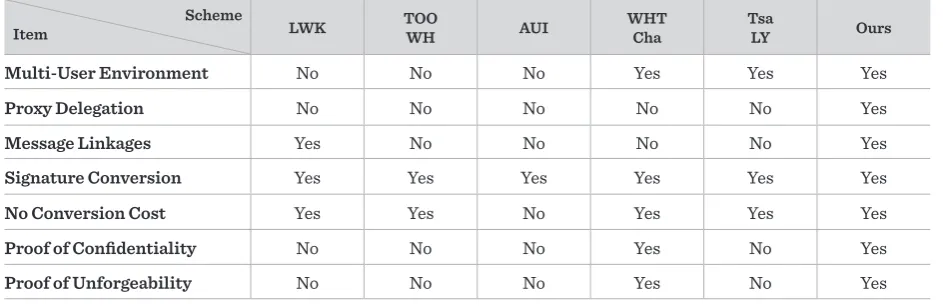
pro-pose a novel proxy convertible multi-AE scheme and its variant with message linkages. The proposed scheme allows a delegated proxy signer to generate a valid authenticated ciphertext on behalf of the origi-nal signing group, such that only a designated recipi-ent can recover the message and verify its embedded proxy multi-signature. When the case of a later dis-pute over repudiation occurs, a designated recipient can solely convert the authenticated ciphertext into a publicly verifiable proxy multi-signature without extra computation or communication cost. Besides, we further propose a variant with message linkages to benefit the encryption of a large message. We also prove that the proposed scheme achieves the secu-rity requirement of confidentiality against indistin-guishability under adaptive chosen-ciphertext at-tacks (IND-CCA2) and that of unforgeability against existential forgery under adaptive chosen-message attacks (EF-CMA) in the random oracle model. As compared with related works, the proposed scheme not only provides better functionalities, but also has the provable security.
2. Preliminaries
In this section, we first describe the parties partic-ipating in the proposed scheme and define the com-posed algorithms.
2.1. Parties
533
Information Technology and Control 2017/4/46
2.2. Algorithms
The proposed PCMAE scheme has the following four algorithms:
_ Setup: Initially, the Setup algorithm will generate public parameters utilized in the system. Let k be a security parameter. Taking as input 1k, the algorithm outputs the parameter params.
_ Credential-gen (CG): The CG algorithm is used for producing the proxy credential for an authorized proxy signer. The input information of it is composed of the identity of proxy signer along with the private keys of all original signers. The resulted output is the corresponding proxy credentials. _ Proxy-sign (PS): With the PS algorithm, an
authorized proxy signer is able to generate a valid ciphertext on behalf of the original signing group. Thus, the input parameter includes a message m, n proxy credentials, the intended recipient’s public key and the proxy signer’s private key. The corresponding output is an authenticated ciphertext d.
_ Uncover-verify (UV): The UV algorithm is used for decrypting authenticated ciphertexts and checking the validity of embedded proxy multi-signature. It takes as input a ciphertext d, a decryption key and all public keys of original and proxy signers. If the inputted ciphertext d is valid, it returns the signed message m and its converted proxy multi-signature W which is publicly verifiable. Otherwise, an error symbol ¶ is returned instead.
3. The Proposed PCMAE Schemes
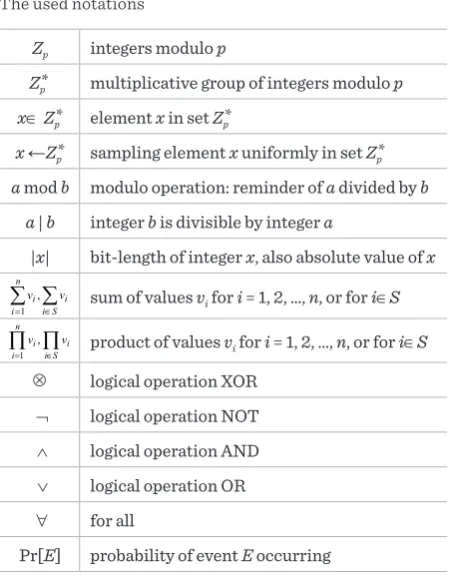
We give a concrete construction of our PCMAE scheme in this section. Also, a variant with message linkage for manipulating a large message will be pre-sented. The used notations are stated as Table 1. De-tailed steps for each algorithm are shown as follows:3.1. Basic Construction
_ Setup: Taking as input a security parameter k, the system authority (SA) selects two large primes (p, q) and a generator g of order q, where |q| = k and q | (p - 1). Let h1: {0, 1}k × Zp*→Zq, h2: {0, 1}k ×Zp*×Zp*×Zp*→ Zq and h3: Zp*→ {0, 1}k be collision resistant hash functions. The system’s public
Table 1
The used notations
Zp integers modulo p
Zp* multiplicative group of integers modulo p x∈ Zp* element x in set Zp*
x ←Zp* sampling element x uniformly in set Zp* a mod b modulo operation: reminder of a divided by b
a | b integer b is divisible by integer a
|x| bit-length of integer x, also absolute value of x
∑
∑
∈ = iS i ni i v v,
1 sum of values vi for i = 1, 2, …, n, or for i∈S
∏ ∏
∈ = iS i n
i i v v,
1 product of values vi for i = 1, 2, …, n, or for i∈S ⊗ logical operation XOR
¬ logical operation NOT ∧ logical operation AND ∨ logical operation OR
∀ for all
Pr[E] probability of event E occurring
parameters params = {p, q, g, h1, h2, h3}. Each user Ui chooses his private key xi ∈ Zq and computes the public key as yi =gximodp.
_ Credential-gen (CG): Let O = {U1, U2, …, Un} be the group of n original users delegating their signing power to the proxy signer Up. With the following steps, Ui ∈ O distributes the proxy share to Up: Step 1 Ui ∈O first chooses ti ∈R Zq to compute
Ti = gtimod p, (1)
and then sends Ti to Upand Uj O, for j i.
Step 2 Upon receiving all Tj’s, Ui computes
T p
T nj 1 jmod , (2)
i = tixi h1(mw, T) mod q, (3)
where mw is the warrant consisting of the
identifier of the original and proxy signers, the delegation duration and so on. (i, mw, T) is then sent to Up.
Step 3 Upon receiving (i, mw, T), Up verifies
) (mod
) , (
1 p
y g
Ti i ih mwT . (4)
If it does not hold, (i, mw, T) is
requested to be sent again.
We show that the verification of Eq. (4) works correctly. From the right-hand side of Eq. (4), we have
) , ( 1 m T
h i w iy
g
) , ( ) ,
( 1
1 h m T
i T x h x
ti i w y w
g
i t
g
) (modp Ti
(by Eq. (1))
which leads to the left-hand side of Eq. (4).
– Proxy-sign (PS): For signing a message mR{0,
1}k on behalf of the original signing group O, Up
chooses r RZq to compute
R = gr mod p, (5)
= ,
1
n
i i
(6)
C =
n
i
T m h
i p
y w
1
) ,
( mod ,
1 (7)
K = yv mod p, (8)
S = r + (xph2(m, C, K, R)) mod q, (9)
Q = h3(K) m, (10) and then delivers the warrant mw and the
authenticated ciphertext = (Q, S, R, T) to the designated recipient Uv.
– Uncover-verify (UV): Upon receiving , Uv first
computes C as Eq. (7) and derives K as . mod ) (TC 1 p
K xv (11)
He then recovers the message as
m = Qh3(K), (12) and checks the redundancy embedded in m. Uv can
further verify the proxy multi-signature by checking if
). (mod
) , , , (
2 C p
y g
RT S ph m C K R (13) The correctness of Eqs. (12) and (13) can be easily confirmed. From the right-hand side of Eq. (12), we have
Qh3(K)
= Qh3((TC1)xvmodp) (by Eq. (11))
= Qh3((g)xvmodp)
(by Eqs. (4), (6) and (7)) = m (by Eq. (8) and (10)) which leads to the left-hand side of Eq. (12).
If the authenticated ciphertext (Q, S, R, T) is correctly generated, it will pass the test of Eq. (13). From the right-hand side of Eq. (13), we have
C y
gS ph2(m,C,K,R)
C y
gr xph2(m,C,K,R) ph2(m,C,K,R)
(by Eq. (9))
(1)
and then sends Ti to Up and Uj ∈ O, for j ∈ i. Step 2 Upon receiving all Tj’s, Ui computes
∏
== T p
T nj 1 jmod (2)
Ti = gtimod p, (1)
and then sends Ti to Upand Uj O, for j i.
Step 2 Upon receiving all Tj’s, Ui computes
T p
T nj 1 jmod , (2)
i = ti xi h1(mw, T) mod q, (3)
where mw is the warrant consisting of the identifier of the original and proxy signers, the delegation duration and so on. (i, mw, T) is then sent to Up.
Step 3 Upon receiving (i, mw, T), Up verifies ) (mod ) , (
1 p
y g
Ti i ih mwT . (4)
If it does not hold, (i, mw, T) is requested to be sent again.
We show that the verification of Eq. (4) works correctly. From the right-hand side of Eq. (4), we have
) , (
1m T
h i w iy
g
) , ( ) ,
( 1
1 h m T
i T x h x
ti i w y w
g
i t
g
) (modp Ti
(by Eq. (1))
which leads to the left-hand side of Eq. (4).
– Proxy-sign (PS): For signing a message mR{0, 1}k on behalf of the original signing group O, Up chooses r RZq to compute
R = gr mod p, (5)
= , 1
ni i
(6)
C =
ni
T m h
i p
y w
1
) ,
( mod ,
1 (7)
K = yv mod p, (8)
S = r + (xph2(m, C, K, R)) mod q, (9)
Q = h3(K) m, (10) and then delivers the warrant mw and the authenticated ciphertext = (Q, S, R, T) to the designated recipient Uv.
– Uncover-verify (UV): Upon receiving , Uv first computes C as Eq. (7) and derives K as
. mod )
(TC 1 p
K xv (11)
He then recovers the message as
m = Qh3(K), (12) and checks the redundancy embedded in m. Uv can further verify the proxy multi-signature by checking if
). (mod ) , , , (
2 C p
y g
RT S ph m C K R (13) The correctness of Eqs. (12) and (13) can be easily confirmed. From the right-hand side of Eq. (12), we have
Qh3(K)
= Qh3((TC1)xvmodp) (by Eq. (11))
= Qh3((g)xvmodp)
(by Eqs. (4), (6) and (7)) = m (by Eq. (8) and (10)) which leads to the left-hand side of Eq. (12).
If the authenticated ciphertext (Q, S, R, T) is correctly generated, it will pass the test of Eq. (13). From the right-hand side of Eq. (13), we have
C y
gS ph2(m,C,K,R)
C y
gr xph2(m,C,K,R) ph2(m,C,K,R)
(by Eq. (9)) (3)
Information Technology and Control 2017/4/46 534 ) (mod ) , ( 1 p y g
Ti = σi ih mwT . (4)
If it does not hold, (si, mw, T) is requested to be sent again.
We show that the verification of Eq. (4) works cor-rectly. From the right-hand side of Eq. (4), we have
) , ( 1 m T
h i w iy gσ ) , ( ) , ( 1
1 h m T
i T x h x
ti i w y w
g − = i t g = ) (modp Ti
= by Eq. (3)
which leads to the left-hand side of Eq. (4).
_ Proxy-sign (PS): For signing a message m∈R{0, 1}k on behalf of the original signing group O, U
p chooses r ∈RZq to compute
Ti = gti mod p, (1)
and then sends Ti to Upand Uj O, for j
i.
Step 2 Upon receiving all Tj’s, Ui computes
T p
T nj 1 jmod , (2)
i = ti xi h1(mw, T) mod q, (3)
where mw is the warrant consisting of the
identifier of the original and proxy signers, the delegation duration and so on. (i, mw, T) is then sent to Up.
Step 3 Upon receiving (i, mw, T), Up verifies
) (mod ) , ( 1 p y g
Ti i ih mwT . (4)
If it does not hold, (i, mw, T) is
requested to be sent again.
We show that the verification of Eq. (4) works correctly. From the right-hand side of Eq. (4), we have
) , ( 1m T h i w iy
g
R = gr mod p, (5)
= , 1
n i i (6)
C =
n i T m h i p y w 1 ) ,( mod ,
1 (7)
K = yv mod p, (8)
S = r + ( xph2(m, C, K, R)) mod q, (9)
Q = h3(K) m, (10)
and then delivers the warrant mw and the
authenticated ciphertext = (Q, S, R, T) to the designated recipient Uv.
– Uncover-verify (UV): Upon receiving , Uv first
computes C as Eq. (7) and derives K as . mod )
(TC 1 p
K xv (11)
He then recovers the message as
m = Q h3(K), (12)
and checks the redundancy embedded in m. Uv can
further verify the proxy multi-signature by checking if ). (mod ) , , , (
2 C p
y g
RT S ph m C K R (13)
The correctness of Eqs. (12) and (13) can be easily confirmed. From the right-hand side of Eq. (12), we have
Q h3(K)
= Q h3((TC1)xvmodp) (by Eq. (11))
= Q h3((g)xvmodp)
(by Eqs. (4), (6) and (7))
= m (by Eq. (8) and (10))
which leads to the left-hand side of Eq. (12). If the authenticated ciphertext (Q, S, R, T) is correctly generated, it will pass the test of Eq. (13). From the right-hand side of Eq. (13), we have
C y
gS ph2(m,C,K,R)
C y
gr xph2(m,C,K,R) ph2(m,C,K,R)
(by Eq. (9))
(5)
Ti = gtimod p, (1)
and then sends Ti to Upand Uj O, for j i.
Step 2 Upon receiving all Tj’s, Ui computes
T p
T nj 1 jmod , (2)
i = ti xi h1(mw, T) mod q, (3) where mw is the warrant consisting of the identifier of the original and proxy signers, the delegation duration and so on. (i, mw, T) is then sent to Up.
Step 3 Upon receiving (i, mw, T), Up verifies ) (mod ) , ( 1 p y g
Ti i ih mwT . (4)
If it does not hold, (i, mw, T) is requested to be sent again.
We show that the verification of Eq. (4) works correctly. From the right-hand side of Eq. (4), we have
) , ( 1 m T h i w iy
g
R = gr mod p, (5)
= , 1
n i i (6)
C =
n i T m h i p y w 1 ) ,( mod ,
1 (7)
K = yv mod p, (8)
S = r + ( xph2(m, C, K, R)) mod q, (9)
Q = h3(K) m, (10) and then delivers the warrant mw and the authenticated ciphertext = (Q, S, R, T) to the designated recipient Uv.
– Uncover-verify (UV): Upon receiving , Uv first computes C as Eq. (7) and derives K as
. mod )
(TC 1 p
K xv (11)
He then recovers the message as
m = Q h3(K), (12) and checks the redundancy embedded in m. Uv can further verify the proxy multi-signature by checking if ). (mod ) , , , (
2 C p
y g
RT S ph mC K R (13) The correctness of Eqs. (12) and (13) can be easily confirmed. From the right-hand side of Eq. (12), we have
Q h3(K)
= Q h3((TC1)xvmodp) (by Eq. (11)) = Q h3((g)xvmodp)
(by Eqs. (4), (6) and (7)) = m (by Eq. (8) and (10)) which leads to the left-hand side of Eq. (12).
If the authenticated ciphertext (Q, S, R, T) is correctly generated, it will pass the test of Eq. (13). From the right-hand side of Eq. (13), we have
C y
gS ph2(m,C,K,R)
C y
gr xph2(m,C,K,R) ph2(m,C,K,R)
(by Eq. (9))
(6)
Ti = gti mod p, (1)
and then sends Ti to Upand Uj O, for j i.
Step 2 Upon receiving all Tj’s, Ui computes
T p
T nj 1 jmod , (2)
i = ti xi h1(mw, T) mod q, (3) where mw is the warrant consisting of the identifier of the original and proxy signers, the delegation duration and so on. (i, mw, T) is then sent to Up.
Step 3 Upon receiving (i, mw, T), Up verifies ) (mod ) , ( 1 p y g
Ti i ih mwT . (4)
If it does not hold, (i, mw, T) is requested to be sent again.
We show that the verification of Eq. (4) works correctly. From the right-hand side of Eq. (4), we have
) , ( 1m T
h i w iy
g
R = gr mod p, (5)
= , 1
n i i (6)
C =
n i T m h i p y w 1 ) ,( mod ,
1 (7)
K = yv mod p, (8)
S = r + ( xph2(m, C, K, R)) mod q, (9)
Q = h3(K) m, (10) and then delivers the warrant mw and the authenticated ciphertext = (Q, S, R, T) to the designated recipient Uv.
– Uncover-verify (UV): Upon receiving , Uv first computes C as Eq. (7) and derives K as
. mod )
(TC 1 p
K xv (11)
He then recovers the message as
m = Q h3(K), (12) and checks the redundancy embedded in m. Uv can further verify the proxy multi-signature by checking if ). (mod ) , , , (
2 C p
y g
RT S ph m C K R (13) The correctness of Eqs. (12) and (13) can be easily confirmed. From the right-hand side of Eq. (12), we have
Q h3(K)
= Q h3((TC1)xvmodp) (by Eq. (11))
= Q h3((g)xvmodp)
(by Eqs. (4), (6) and (7)) = m (by Eq. (8) and (10)) which leads to the left-hand side of Eq. (12).
If the authenticated ciphertext (Q, S, R, T) is correctly generated, it will pass the test of Eq. (13). From the right-hand side of Eq. (13), we have
C y
gS ph2(m,C,K,R)
C y
gr xph2(m,C,K,R) ph2(m,C,K,R)
(by Eq. (9))
(7)
Ti = gti mod p, (1)
and then sends Ti to Upand Uj O, for j i.
Step 2 Upon receiving all Tj’s, Ui computes
T p
T nj 1 jmod , (2)
i = ti xi h1(mw, T) mod q, (3) where mw is the warrant consisting of the identifier of the original and proxy signers, the delegation duration and so on. (i, mw, T) is then sent to Up.
Step 3 Upon receiving (i, mw, T), Up verifies ) (mod ) , ( 1 p y g
Ti i ih mwT . (4)
If it does not hold, (i, mw, T) is requested to be sent again.
We show that the verification of Eq. (4) works correctly. From the right-hand side of Eq. (4), we have
) , (
1m T
h i w iy
g
R = gr mod p, (5)
= , 1
n i i (6)
C =
n i T m h i p y w 1 ) ,( mod ,
1 (7)
K = yv mod p, (8)
S = r + ( xph2(m, C, K, R)) mod q, (9)
Q = h3(K) m, (10) and then delivers the warrant mw and the authenticated ciphertext = (Q, S, R, T) to the designated recipient Uv.
– Uncover-verify (UV): Upon receiving , Uv first computes C as Eq. (7) and derives K as
. mod ) (TC 1 p
K xv (11)
He then recovers the message as
m = Q h3(K), (12) and checks the redundancy embedded in m. Uv can further verify the proxy multi-signature by checking if ). (mod ) , , , (
2 C p
y g
RT S ph m C K R (13) The correctness of Eqs. (12) and (13) can be easily confirmed. From the right-hand side of Eq. (12), we have
Q h3(K)
= Q h3((TC1)xvmodp) (by Eq. (11))
= Q h3((g)xvmodp)
(by Eqs. (4), (6) and (7)) = m (by Eq. (8) and (10)) which leads to the left-hand side of Eq. (12).
If the authenticated ciphertext (Q, S, R, T) is correctly generated, it will pass the test of Eq. (13). From the right-hand side of Eq. (13), we have
C y
gS ph2(m,C,K,R)
C y
gr xph2(m,C,K,R) ph2(m,C,K,R)
(by Eq. (9))
(8)
Ti = gtimod p, (1)
and then sends Ti to Upand Uj O, for j i.
Step 2 Upon receiving all Tj’s, Ui computes
T p
T nj 1 jmod , (2)
i = ti xi h1(mw, T) mod q, (3) where mw is the warrant consisting of the identifier of the original and proxy signers, the delegation duration and so on. (i, mw, T) is then sent to Up.
Step 3 Upon receiving (i, mw, T), Up verifies ) (mod ) , ( 1 p y g
Ti i ih mwT . (4)
If it does not hold, (i, mw, T) is requested to be sent again.
We show that the verification of Eq. (4) works correctly. From the right-hand side of Eq. (4), we have
) , ( 1 m T h i w iy
g
R = gr mod p, (5)
= , 1
n i i (6)
C =
n i T m h i p y w 1 ) ,
( mod ,
1 (7)
K = yv mod p, (8)
S = r + ( xph2(m, C, K, R)) mod q, (9)
Q = h3(K) m, (10) and then delivers the warrant mw and the authenticated ciphertext = (Q, S, R, T) to the designated recipient Uv.
– Uncover-verify (UV): Upon receiving , Uv first computes C as Eq. (7) and derives K as
. mod ) (TC 1 p
K xv (11)
He then recovers the message as
m = Q h3(K), (12) and checks the redundancy embedded in m. Uv can further verify the proxy multi-signature by checking if ). (mod ) , , , (
2 C p
y g
RT S ph m C K R (13) The correctness of Eqs. (12) and (13) can be easily confirmed. From the right-hand side of Eq. (12), we have
Q h3(K)
= Q h3((TC1)xvmodp) (by Eq. (11))
= Q h3((g)xvmodp)
(by Eqs. (4), (6) and (7)) = m (by Eq. (8) and (10)) which leads to the left-hand side of Eq. (12).
If the authenticated ciphertext (Q, S, R, T) is correctly generated, it will pass the test of Eq. (13). From the right-hand side of Eq. (13), we have
C y
gS ph2(m,C,K,R)
C y
gr xph2(m,C,K,R) ph2(m,C,K,R)
(by Eq. (9))
(9)
Ti = gti mod p, (1)
and then sends Ti to Upand Uj O, for j i.
Step 2 Upon receiving all Tj’s, Ui computes
T p
T nj 1 jmod , (2)
i = ti xi h1(mw, T) mod q, (3) where mw is the warrant consisting of the identifier of the original and proxy signers, the delegation duration and so on. (i, mw, T) is then sent to Up.
Step 3 Upon receiving (i, mw, T), Up verifies
) (mod ) , ( 1 p y g
Ti i ih mwT . (4)
If it does not hold, (i, mw, T) is requested to be sent again.
We show that the verification of Eq. (4) works correctly. From the right-hand side of Eq. (4), we have
) , ( 1m T h i w iy
g
R = gr mod p, (5)
= , 1
n i i (6)
C =
n i T m h i p y w 1 ) ,( mod ,
1 (7)
K = yv mod p, (8)
S = r + ( xph2(m, C, K, R)) mod q, (9)
Q = h3(K) m, (10) and then delivers the warrant mw and the authenticated ciphertext = (Q, S, R, T) to the designated recipient Uv.
– Uncover-verify (UV): Upon receiving , Uv first
computes C as Eq. (7) and derives K as . mod ) (TC 1 p
K xv (11)
He then recovers the message as
m = Q h3(K), (12) and checks the redundancy embedded in m. Uv can further verify the proxy multi-signature by checking if ). (mod ) , , , (
2 C p
y g
RT S ph m C K R (13) The correctness of Eqs. (12) and (13) can be easily confirmed. From the right-hand side of Eq. (12), we have
Q h3(K)
= Q h3((TC1)xvmodp) (by Eq. (11))
= Q h3((g)xvmodp)
(by Eqs. (4), (6) and (7)) = m (by Eq. (8) and (10)) which leads to the left-hand side of Eq. (12).
If the authenticated ciphertext (Q, S, R, T) is correctly generated, it will pass the test of Eq. (13). From the right-hand side of Eq. (13), we have
C y
gS ph2(m,C,K,R)
C y
gr xph2(m,C,K,R) ph2(m,C,K,R)
(by Eq. (9))
(10) and then delivers the warrant mw and the authen-ticated ciphertext d = (Q, S, R, T) to the designated recipient Uv.
_ Uncover-verify (UV): Upon receiving d, Uv first computes C as Eq. (7) and derives K as
. mod )
(TC 1 p
K = − xv (11)
He then recovers the message as
m = Q⊕h3(K), (12) and checks the redundancy embedded in m. Uv can
further verify the proxy multi-signature by checking if ). (mod ) , , , (
2 C p
y g
RT = S ph m C K R (13) The correctness of Eqs. (12) and (13) can be easily confirmed. From the right-hand side of Eq. (12), we have
Q⊕h3(K)
= Q⊕h3((TC−1)xvmodp) (by Eq. (11)) = Q⊕h3((gσ)xvmodp)
(by Eqs. (4), (6) and (7)) = m (by Eq. (8) and (10)) which leads to the left-hand side of Eq. (12).
If the authenticated ciphertext (Q, S, R, T) is correctly generated, it will pass the test of Eq. (13). From the right-hand side of Eq. (13), we have
C y
gS ph2(m,C,K,R)
C y
gr+ −xph2(m,C,K,R) ph2(m,C,K,R)
= σ
(by Eq. (9))
(11)
He then recovers the message as
. mod )
(TC 1 p
K= − xv (11)
He then recovers the message as
m = Q⊕h3(K), (12) and checks the redundancy embedded in m. Uv can
further verify the proxy multi-signature by checking if ). (mod ) , , , (
2 C p
y g
RT = S ph mC K R (13) The correctness of Eqs. (12) and (13) can be easily confirmed. From the right-hand side of Eq. (12), we have
Q⊕h3(K)
= Q⊕h3((TC−1)xvmodp) (by Eq. (11)) = Q⊕h3((gσ)xvmodp)
(by Eqs. (4), (6) and (7)) = m (by Eq. (8) and (10)) which leads to the left-hand side of Eq. (12).
If the authenticated ciphertext (Q, S, R, T) is correctly generated, it will pass the test of Eq. (13). From the right-hand side of Eq. (13), we have
C y
gS ph2(m,C,K,R)
C y
gr+ −xph2(m,C,K,R) ph2(m,C,K,R)
= σ
(by Eq. (9))
(12) and checks the redundancy embedded in m. Uv can further verify the proxy multi-signature by checking if
. mod )
(TC 1 p
K = − xv (11)
He then recovers the message as
m = Q⊕h3(K), (12) and checks the redundancy embedded in m. Uv can
further verify the proxy multi-signature by checking if ). (mod ) , , , (
2 C p
y g
RT = S ph mC K R (13) The correctness of Eqs. (12) and (13) can be easily confirmed. From the right-hand side of Eq. (12), we have
Q⊕h3(K)
= Q⊕h3((TC−1)xvmodp) (by Eq. (11)) = Q⊕h3((gσ)xvmodp)
(by Eqs. (4), (6) and (7)) = m (by Eq. (8) and (10)) which leads to the left-hand side of Eq. (12).
If the authenticated ciphertext (Q, S, R, T) is correctly generated, it will pass the test of Eq. (13). From the right-hand side of Eq. (13), we have
C y
gS ph2(m,C,K,R)
C y
gr+ −xph2(m,C,K,R) ph2(m,C,K,R)
= σ
(by Eq. (9))
(13)
The correctness of Eqs. (12) and (13) can be easily confirmed. From the right-hand side of Eq. (12), we have
. mod )
(TC 1 p
K = − xv (11)
He then recovers the message as
m = Q⊕h3(K), (12) and checks the redundancy embedded in m. Uv can
further verify the proxy multi-signature by checking if ). (mod ) , , , (
2 C p
y g
RT = S ph m C K R (13) The correctness of Eqs. (12) and (13) can be easily confirmed. From the right-hand side of Eq. (12), we have
Q⊕h3(K)
= Q⊕h3((TC−1)xvmodp) (by Eq. (11)) = Q⊕h3((gσ)xvmodp)
(by Eqs. (4), (6) and (7)) = m (by Eq. (8) and (10)) which leads to the left-hand side of Eq. (12).
If the authenticated ciphertext (Q, S, R, T) is correctly generated, it will pass the test of Eq. (13). From the right-hand side of Eq. (13), we have
C y
gS ph2(m,C,K,R)
C y
gr+ −xph2(m,C,K,R) ph2(m,C,K,R)
= σ
(by Eq. (9)) by Eq. (11)
. mod )
(TC 1 p
K = − xv (11)
He then recovers the message as
m = Q⊕h3(K), (12) and checks the redundancy embedded in m. Uv can
further verify the proxy multi-signature by checking if ). (mod ) , , , (
2 C p
y g
RT = S ph m C K R (13) The correctness of Eqs. (12) and (13) can be easily confirmed. From the right-hand side of Eq. (12), we have
Q⊕h3(K)
= Q⊕h3((TC−1)xvmodp) (by Eq. (11)) = Q⊕h3((gσ)xv modp)
(by Eqs. (4), (6) and (7)) = m (by Eq. (8) and (10)) which leads to the left-hand side of Eq. (12).
If the authenticated ciphertext (Q, S, R, T) is correctly generated, it will pass the test of Eq. (13). From the right-hand side of Eq. (13), we have
C y
gS ph2(m,C,K,R)
C y
gr+ −xph2(m,C,K,R) ph2(m,C,K,R)
= σ
(by Eq. (9)) by Eqs. (4), (6) and (7)
. mod )
(TC 1 p
K= − xv (11)
He then recovers the message as
m = Q⊕h3(K), (12) and checks the redundancy embedded in m. Uv can
further verify the proxy multi-signature by checking if ). (mod ) , , , (
2 C p
y g
RT = S ph m C K R (13) The correctness of Eqs. (12) and (13) can be easily confirmed. From the right-hand side of Eq. (12), we have
Q⊕h3(K)
= Q⊕h3((TC−1)xv modp) (by Eq. (11)) = Q⊕h3((gσ)xvmodp)
(by Eqs. (4), (6) and (7)) = m (by Eq. (8) and (10)) which leads to the left-hand side of Eq. (12).
If the authenticated ciphertext (Q, S, R, T) is correctly generated, it will pass the test of Eq. (13). From the right-hand side of Eq. (13), we have
C y
gS ph2(m,C,K,R)
C y
gr+ −xph2(m,C,K,R) ph2(m,C,K,R)
= σ
(by Eq. (9)) by Eq. (8) and (10) which leads to the left-hand side of Eq. (12). If the authenticated ciphertext (Q, S, R, T) is cor-rectly generated, it will pass the test of Eq. (13). From the right-hand side of Eq. (13), we have
. mod )
(TC 1 p
K= − xv (11)
He then recovers the message as
m = Q⊕h3(K), (12) and checks the redundancy embedded in m. Uv can
further verify the proxy multi-signature by checking if ). (mod ) , , , (
2 C p
y g
RT = S ph m C K R (13) The correctness of Eqs. (12) and (13) can be easily confirmed. From the right-hand side of Eq. (12), we have
Q ⊕ h3(K)
= Q⊕h3((TC−1)xv modp) (by Eq. (11)) = Q⊕h3((gσ)xvmodp)
(by Eqs. (4), (6) and (7)) = m (by Eq. (8) and (10)) which leads to the left-hand side of Eq. (12).
If the authenticated ciphertext (Q, S, R, T) is correctly generated, it will pass the test of Eq. (13). From the right-hand side of Eq. (13), we have
C y
gS ph2(m,C,K,R)
C y
gr+ −xph2(m,C,K,R) ph2(m,C,K,R) = σ
(by Eq. (9)) by Eq. (9)
C Rgσ
= (by Eq. (5))
) (modp RT
= (by Eqs. (2), (4) and (6)) which leads to the left-hand side of Eq. (13).
When a later dispute over repudiation occurs, Uv
can reveal the converted proxy multi-signature Ω= (S, R,T,K), the warrant mwand the original message m
to prove the proxy signer’s dishonesty without any additional cost. Thus, anyone can verify the converted proxy multi-signature with the assistance of Eqs. (7) and (13).
3.2 Variant with Message Linkages
Consider the practical implementation that the original message may be large. It therefore will cause the difficulty in encryption. In the subsection, we propose a variant with message linkages to benefit the encryption of a large message by dividing it into lots of small message blocks. The construction is similar as that in Section 3.1. We only describe the different parts as follows:
– Proxy-sign (PS):For signing a large message mon behalf of the original signing group O, Up first
divides the message minto npieces, i.e., m= m1|| m2|| … || mn,mi’s∈GF(p), and then choosesr∈R
Zqand w0= 0 to computeR,σ,C,KandS as Eqs. (5) to (9). Upfurther computes
wi=mi⋅h3(wi−1⊕h3(K)) mod p,
for i= 1, 2,…, n, (10*) and delivers the warrant mwalong withδ= (S,R,T,
w1,w2, …,wn) to the designated recipient Uv.
– Uncover-verify (UV): Upon receiving it, Uv first
derives CandKas Eqs. (7) and (11), respectively. He then computes
mi=wi⋅h3(wi−1⊕h3(K))−1mod p,
for i= 1, 2,…, n, (12*) and recovers the original message mas m1|| m2 || … || mn. Uv can further verify the proxy
multi-signature by checking Eq. (13).
We show that with the authenticated ciphertext (S, R,T,w1, w2, …, wn) and the warrant mw, the
designated recipient Uvcan recover the message m
and check its validity with Eq. (12*). From the right-hand side of Eq. (12*), we have
wi⋅h3(wi−1⊕h3(K))−1
=mi⋅h3(wi−1⊕h3(K))⋅h3(wi−1⊕h3(K))−1 (by Eq. (10*)) =mi(mod p)
which leads to the left-hand side of Eq. (12*).
4.
Security Proof and Comparison
In this section, we briefly review the security notions, state the security model and prove the security of our proposed scheme. Some comparisons with related schemes are also made.
4.1 Security Notions
Discrete Logarithm Problem; DLP
Let pand qbe two large primes satisfying q |p− 1, and g a generator of order q over GF(p). The discrete logarithm problem is, given an instance (y,p, q,g), where y=gx mod pfor some x∈Zq, to derive
x.
Discrete Logarithm (DL) Assumption
Let Ik= {(p,q,g)∈I| |p| = k} with k∈N, whereI
is the universe of all instances and |p| represents the bit-length of p. For every probabilistic polynomial-time algorithm A, every positive polynomial P(⋅) and all sufficiently large k, the algorithm Acan solve the DLP with the advantage at most 1/P(k), i.e.,
Pr[A(y,p,q,g) = Logp,q,g(y),
(p,q,g)←Ik,y←Z*p]≤1/P(k).
The probability is taken over the uniformly and independently chosen instance with a given security parameter kand over the random choices of A.
Definition 1. The (t,ε)-DL assumption holds if there is no polynomial-time adversary that can solve the DLP in time at most t and with the advantage ε.
Computational Diffie-Hellman Problem; CDHP Let pand qbe two large primes satisfying that q | p − 1, and g a generator of order q over GF(p). The computational Diffie-Hellman problem is, given an instance (p,q,g,ga,gb) for some a,b∈Zq, to derive
gabmod p.
Computational Diffie-Hellman (CDH) Assumption Let Ik= {(p,q,g)∈I| |p| = k} with k∈N, where I
is the universe of all instances and |p| represents the bit-length of p. For every probabilistic polynomial-time algorithm A, every positive polynomial P(⋅) and all sufficiently large k, the algorithm Acan solve the CDHP with the advantage at most 1/P(k), i.e.,
Pr[A(p,q,g,ga,gb) = gab,
(p,q,g)←Ik,a,b←Zq]≤1/P(k).
The probability is taken over the uniformly and independently chosen instance with a given security parameter kand over the random choices of A.
by Eq. (5)
C Rgσ
= (by Eq. (5))
) (modp RT
= (by Eqs. (2), (4) and (6)) which leads to the left-hand side of Eq. (13).
When a later dispute over repudiation occurs, Uv
can reveal the converted proxy multi-signature Ω= (S, R,T,K), the warrant mwand the original message m
to prove the proxy signer’s dishonesty without any additional cost. Thus, anyone can verify the converted proxy multi-signature with the assistance of Eqs. (7) and (13).
3.2 Variant with Message Linkages
Consider the practical implementation that the original message may be large. It therefore will cause the difficulty in encryption. In the subsection, we propose a variant with message linkages to benefit the encryption of a large message by dividing it into lots of small message blocks. The construction is similar as that in Section 3.1. We only describe the different parts as follows:
– Proxy-sign (PS):For signing a large message mon behalf of the original signing group O, Up first
divides the message minto npieces, i.e., m= m1|| m2 || … ||mn,mi’s∈GF(p), and then choosesr∈R
Zqand w0= 0 to computeR,σ,C,KandSas Eqs. (5) to (9). Upfurther computes
wi=mi⋅h3(wi−1⊕h3(K)) mod p,
for i= 1, 2,…, n, (10*) and delivers the warrant mwalong withδ= (S,R,T,
w1,w2, …,wn) to the designated recipient Uv.
– Uncover-verify (UV): Upon receiving it, Uv first
derivesCandK as Eqs. (7) and (11), respectively. He then computes
mi=wi⋅h3(wi−1⊕h3(K))−1mod p,
for i= 1, 2,…, n, (12*) and recovers the original message mas m1|| m2 || … || mn. Uv can further verify the proxy
multi-signature by checking Eq. (13).
We show that with the authenticated ciphertext (S, R, T, w1,w2, …, wn) and the warrant mw, the
designated recipient Uvcan recover the message m
and check its validity with Eq. (12*). From the right-hand side of Eq. (12*), we have
wi⋅h3(wi−1⊕h3(K))−1
=mi⋅h3(wi−1⊕h3(K))⋅h3(wi−1⊕h3(K))−1 (by Eq. (10*)) =mi(mod p)
which leads to the left-hand side of Eq. (12*).
4.
Security Proof and Comparison
In this section, we briefly review the security notions, state the security model and prove the security of our proposed scheme. Some comparisons with related schemes are also made.
4.1 Security Notions
Discrete Logarithm Problem; DLP
Let p and qbe two large primes satisfying q|p − 1, and g a generator of order q over GF(p). The discrete logarithm problem is, given an instance (y,p, q,g), where y=gxmod pfor some x∈Zq, to derive
x.
Discrete Logarithm (DL) Assumption
Let Ik= {(p,q,g)∈I| |p| = k} with k∈N, whereI
is the universe of all instances and |p| represents the bit-length of p. For every probabilistic polynomial-time algorithm A, every positive polynomial P(⋅) and all sufficiently large k, the algorithm Acan solve the DLP with the advantage at most 1/P(k), i.e.,
Pr[A(y,p,q,g) = Logp,q,g(y),
(p,q,g)←Ik,y←Z*p]≤1/P(k).
The probability is taken over the uniformly and independently chosen instance with a given security parameter kand over the random choices of A.
Definition 1.The (t,ε)-DL assumption holds if there is no polynomial-time adversary that can solve the DLP in time at most t and with the advantage ε.
Computational Diffie-Hellman Problem; CDHP Let pand qbe two large primes satisfying that q| p −1, and ga generator of order q over GF(p). The computational Diffie-Hellman problem is, given an instance (p,q,g,ga,gb) for some a,b∈Zq, to derive
gabmod p.
Computational Diffie-Hellman (CDH) Assumption Let Ik= {(p,q,g)∈I| |p| = k} with k∈N, where I
is the universe of all instances and |p| represents the bit-length of p. For every probabilistic polynomial-time algorithm A, every positive polynomial P(⋅) and all sufficiently large k, the algorithm A can solve the CDHP with the advantage at most 1/P(k), i.e.,
Pr[A(p,q,g,ga,gb) = gab,
(p,q,g)←Ik,a,b←Zq]≤1/P(k).
The probability is taken over the uniformly and independently chosen instance with a given security parameter kand over the random choices of A.
by Eqs. (2), (4) and (6) which leads to the left-hand side of Eq. (13). When a later dispute over repudiation occurs, Uv can reveal the converted proxy multi-signature W = (S, R, T, K), the warrant mw and the original message m to prove the proxy signer’s dishonesty without any additional cost. Thus, anyone can ver-ify the converted proxy multi-signature with the assistance of Eqs. (7) and (13).
3.2. Variant with Message Linkages
Consider the practical implementation that the orig-inal message may be large. It therefore will cause the difficulty in encryption. In the subsection, we propose a variant with message linkages to benefit the encryp-tion of a large message by dividing it into lots of small message blocks. The construction is similar as that in Section 3.1. We only describe the different parts as follows: