https://doi.org/10.5194/we-17-69-2017
© Author(s) 2017. This work is distributed under the Creative Commons Attribution 4.0 License.
Modelling plant invasion pathways in protected areas
under climate change: implication for invasion
management
Chun-Jing Wang, Ji-Zhong Wan, Hong Qu, and Zhi-Xiang Zhang School of Nature Conservation, Beijing Forestry University, Beijing 100083, China
Correspondence:Zhi-Xiang Zhang ([email protected])
Received: 14 August 2017 – Revised: 13 November 2017 – Accepted: 15 November 2017 – Published: 20 December 2017
Abstract. Global climate change may enable invasive plant species (IPS) to invade protected areas (PAs), but plant invasion on a global scale has not yet been explicitly addressed. Here, we mapped the potential invasion pathways for IPS in PAs across the globe and explored potential factors determining the pathways of plant invasion under climate change. We used species distribution modelling to estimate the suitable habitats of 386 IPS and applied a corridor analysis to compute the potential pathways of IPS in PAs under climate change. Subsequently, we analysed the potential factors affecting the pathways in PAs. According to our results, the main potential pathways of IPS in PAs are in Europe, eastern Australia, New Zealand, southern Africa, and eastern regions of South America and are strongly influenced by changes in temperature and precipitation. Protected areas can play an important role in preventing and controlling the spread of IPS under climate change. This is due to the fact that measures are taken to monitor climate change in detail, to provide effective management near or inside PAs, and to control the introduction of IPS with a high capacity for natural dispersal. A review of conservation policies in PAs is urgently needed.
1 Introduction
Invasive plant species (IPS) have the potential to threaten global biodiversity in the face of global climatic changes (Kalusová et al., 2013). However, the relationship between IPS and climate change is complex (Hellmann et al., 2008). Different patterns of climate change may result in different distributions of species on regional scales (Bradley, 2010), and climatic factors are among the primary factors determin-ing the overall distribution patterns of IPS due to potential synergic effects (Bradley, 2010; Bai et al., 2013). Such ef-fects are related to the influence of climate factors on the global terrestrial net primary production, water availability, plant diseases, and the large-scale sexual reproduction of IPS (Rosenzweig et al., 2001; Hedhly et al., 2009; Kaser et al., 2010; Zhao and Running, 2010). Climate change can pro-mote the expansion of IPS into non-native ranges, decrease ecosystem stability, and threaten native plant diversity (Hell-mann et al., 2008; Richardson and Rejmánek, 2011; Bai et al., 2013). The increasing expansion of IPS can facilitate
their establishment and naturalization (Thuiller et al., 2005; Wilson et al., 2009; Kalusová et al., 2013; Donaldson et al., 2014). Human activities, such as agriculture, forestry, and horticulture, also increasingly interact with climate change and affect the invasion pathways of IPS (Reichard and White, 2001; Donaldson et al., 2014). Intentionally introducing IPS into new areas may play an increasingly important role in the invasion of introduced plant species, especially due to the potential synergic effects of climatic change and human activity.
2017). This implies that IPS expand and establish under the same environmental conditions in native and invasive ranges in the above-mentioned situations (Petitpierre et al., 2012; Early and Sax, 2014; Wan et al., 2016a, b; Wang et al., 2017). Hence, IPS can invade ecologically fragile protected areas (PAs) with environmental conditions similar to those of the native and invaded environments of these species (Foxcroft et al., 2013; Vicente et al., 2013; Hulme et al., 2014). Pro-tected areas often contain diverse fauna and flora and un-usual geological features; they therefore play a crucial role in biodiversity conservation (Foxcroft et al., 2013). Previous studies have shown that IPS have the potential to invade re-gional PAs under the scenario of a changing climate (Fox-croft et al., 2013), consequently altering species composition, changing the ecosystem functions, and even causing PAs to lose their function in the conservation of endangered species (Pauchard and Alaback, 2004; Hulme et al., 2014). Foxcroft et al. (2011) have suggested that PA boundaries could limit the spread of IPS into the interior of the PAs. However, IPS can pass through the boundaries of PAs and invade PAs via human activities (e.g. transportation, trade and forestry) and natural dispersion (McConnachie et al., 2012; Foxcroft et al., 2013; Donaldson et al., 2014). The connectivity of PAs, e.g. through corridors, can even offer additional routes for the spread of IPS (Vicente et al., 2013; Donaldson et al., 2014). Therefore, it is essential to evaluate whether climate change affects the movement of IPS through PAs and whether PAs can act as barriers to the invasion of non-native species.
Species distribution modelling (SDM) is widely used to predict suitable habitats of plant species based on niche con-servatism on the global scale; it can also be used to analyse the complex relationships between IPS and PAs (Václavík and Meentemeyer, 2009; Petitpierre et al., 2012; Vicente et al., 2013; Kolanowska, 2014; McConnachie et al., 2015). Species distribution modelling coupled with geographic in-formation systems (GIS) can be applied to generate spatially explicit models of the potential of IPS to invade PAs and of the invasion pathways under climate change (Thuiller et al., 2005; Vicente et al., 2013; Donaldson et al., 2014). Recent studies have shown that IPS can invade PAs under climate change at the regional scale (Vicente et al., 2013; Thalmann et al., 2015). However, our current understanding of the re-lationship between climate change, PAs, and invasion path-ways of IPS on a global scale is extremely limited. We hy-pothesized that PAs play an important role in the prevention and control of IPS under climate change. To test this hypoth-esis, we used two indices: (1) the potential factors of IPS that invade PAs under climate change and (2) the overlap of po-tential pathways of IPS and PAs, including pathways due to the intentional introduction of IPS.
We selected 386 IPS from the Invasive Species Special-ist Group (ISSG) lSpecial-ist and used Maxent to model the poten-tial distribution of these 386 IPS on a global scale (http: //www.issg.org/database/species/List.asp). We then used cor-ridor analysis in GIS to model the invasion pathways of IPS
affected by climate change and compared the overlap of po-tential pathways of IPS and global PAs (Thuiller et al., 2005). Finally, we analysed the potential factors affecting IPS path-ways in PAs.
2 Materials and methods
2.1 Protected area data
The International Union for Conservation of Nature (IUCN) has developed management categories based on the man-agement objectives of PAs (Dudley, 2008). These categories provide international criteria for defining PAs and encourage conservation planning according to the management require-ments of PAs on a global scale. We downloaded a global map of the IUCN I–VI PAs from the World Database on Protected Areas (WDPA; https://www.protectedplanet.net/). For our analysis, we selected over 23 852 PAs with areas over 10.0×10.0 km2, as they have a large enough ecological landscape to meet the requirements for studying the potential extent of pathways of IPS and to match the relatively coarse resolution of bioclimatic data.
2.2 Bioclimatic data
2.3 Species data
We used 386 IPS with more than 50 records from the In-vasive Species Specialist Group (ISSG) list of IUCN as a representative set of the IPS around the world (Wisz et al., 2008; Merow et al., 2013; García-Roselló et al., 2014; Duputié et al., 2014; Table S2). Occurrence data, in par-ticular geographic coordinates, for each IPS were obtained from the Global Biodiversity Information Facility (GBIF; www.gbif.org), which is one of the largest online providers of distribution records. We removed duplicate occurrences of recorded data for species in 5.0 arcmin grid cells (10 km at the equator) to avoid any georeferencing errors (Merow et al., 2013). All occurrence localities were checked using Google Earth and ArcGIS 10.2 (Esri; Redlands, CA, USA) to de-termine whether IPS were distributed in reasonable ranges based on the ISSG; obvious errors were removed (Bellard et al., 2014).
2.4 Species distribution modelling
We used a machine-learning technique called “maximum entropy modelling” (hereafter referred to as “Maxent”) to model suitable habitats for each IPS in current low-and high-gas-concentration scenarios, based on current presence-only species records (Phillips et al., 2006; Smith et al., 2012; Merow et al., 2013; Kolanowska, 2014). We ran Maxent using Maxent software version 3.4.0 down-loaded from http://biodiversityinformatics.amnh.org/open_ source/maxent/. Maxent can express a probability distribu-tion where each grid cell has a predicted suitability of con-ditions for the species (http://biodiversityinformatics.amnh. org/open_source/maxent/). The set of all grid cells was re-garded as the possible distribution space of maximum en-tropy (namely, that is most spread out, or closest to uniform; Phillips et al., 2006). For the map cells predicted using Max-ent, cells with values of 1 had the highest degree of habitat suitability, while cells with values of 0 had the lowest (Elith et al., 2011). Habitat suitability was determined based on the climatic similarity to sites where the species already occur (Pape¸s and Gaubert, 2007; Holcombe et al., 2007). Our mod-elling sets were the same as described in Wan et al. (2016a). The predictive precision of Maxent was based on the area under the curve (AUC) of the receiver operation charac-teristic (ROC), which regards each value of the prediction result as a possible threshold; the corresponding sensitiv-ity and specificsensitiv-ity were obtained through calculations. The AUC ranges from 0.5 (lowest predictive ability or not dif-ferent from a randomly selected predictive distribution) to 1 (highest predictive ability). Models of each species with values above 0.7 were considered useful in our study. Only one species,Poa pratensis, had an AUC value below 0.7 and was hence not considered in downstream analyses (Hijmans, 2012; Table S2). The AUC values of the other 385 species were above 0.7, indicating adequate model performance.
Fi-nally, we combined the Maxent results of the 385 IPS with the current and future climatic data to develop maps of suit-able current and future IPS habitats.
2.5 Modelling potential invasion pathways
First, IPS distribution pathways were estimated using a corri-dor analysis with the input variables set to two resistance lay-ers (ESRI, 2014) to identify the resistance of passing grids. Resistance layers indicated the movement cost of IPS across spatial and temporal scales. We considered the grids with low values of suitable habitats as resistance grids and the grids with high values of suitable IPS habitats as non-resistance grids. The purpose of a corridor analysis (the corridor func-tion in ArcGIS 10.2; Esri; Redlands, CA, USA) is to build a new pathway of minimum resistance of passing grids; this method was implemented between two resistance layers, us-ing the corridor function in ArcGIS 10.2 (Esri; Redlands, CA, USA; Rabinowitz and Zeller, 2010). Suitable habitats of low and high concentration scenarios were considered as po-tential pathways for IPS distribution under current and future conditions (Morato et al., 2014). This dispersal scenario sim-ulation of the corridor analysis served to identify connected or unconnected pairs of patches, namely invasion locations from the current to the future (including low- and high-gas-concentration scenarios; Morato et al., 2014).
Subsequently, we identified PAs which covered large areas of potential movement pathways of IPS. We used the follow-ing equation to compute the potential pathways for IPS in PAs (Alagador et al., 2011; Bellard et al., 2014):
Cj= n X
n=1
Pj,n,
whereCj represents the ability of PAs to support the poten-tial pathway of IPS,nis the number of species in PAj, and Pj,n is the average habitat suitability of cells for speciesn in PAj. The larger values represented the stronger ability of PAs to support the potential pathways of the IPS (i.e. index of potential pathways in PAs). A linear-regression analysis was used to compute the ability of the PAs to support the potential pathways of the IPS under low- and high-gas-concentration scenarios (Peterson et al., 2008).
2.6 Potential factors determining invasion pathways in protected areas
determined using a Jackknife test in the programme Maxent (Merow et al., 2013). We computed the average variances of the most important climatic variables that are most closely related to habitat suitability for IPS in each PA and classified the variance into three groups (low, medium, and high de-grees of variance of climate change). Subsequently, we ap-plied a two-way ANOVA to compare the differences in the potential IPS pathways between the three groups, based on the most important temperature and precipitation variables (Baz et al., 2009). All analyses were conducted in JMP 11.0 (SAS Institute).
3 Results
3.1 Potential invasion pathways in protected areas
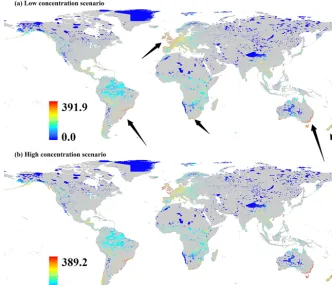
Our results show that IPS are most likely to spread across Europe, eastern Australia, New Zealand, southern Africa, and the eastern regions of South America in both low- and high-gas-concentration scenarios (Fig. 1). In the PAs, there was a significant relationship of the potential IPS movement pathways between low- and high-gas-concentration scenar-ios (P <0.001; Fig. 2). Hence, we used the PA map of po-tential IPS pathways in the low-gas-concentration scenario as the representative map for the potential IPS pathways in PAs.
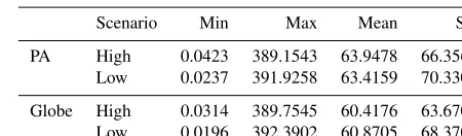
The degree of the potential pathways of IPS, including maximum, minimum, and square deviation values in PAs, was similar to that of the global potential pathways (Ta-ble 1). The maximum degree of potential IPS pathways was slightly lower in PAs than across the globe (Table 1). Mini-mum and average values of potential pathways of IPS were higher in PAs than in a global context in both low- and high-concentration scenarios (Table 1).
3.2 Potential factors determining invasion pathways in protected areas
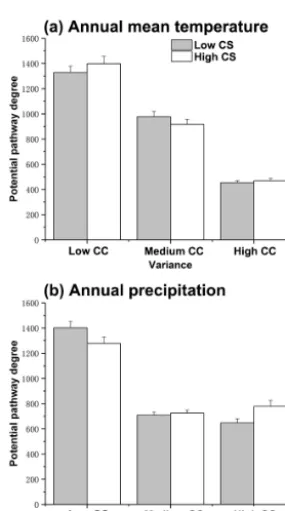
The most important climatic variables that might facili-tate the spread of IPS were temperature changes, includ-ing annual mean temperature (Bio1), temperature seasonality (Bio4), and annual precipitation (Bio 12; Table S2). Annual mean temperature coupled with annual precipitation had syn-ergic effects on potential invasion pathways in PAs in a low-gas-concentration scenario (two-way ANOVA test between the three groups:P <0.05; Table 2). With increasing vari-ance in annual mean temperature, the potential movement of IPS decreased in both low and high-concentration scenarios (ANOVA test between the three groups:P <0.05; Table 2; Fig. 3a). Also, the variation of annual precipitation may have significant negative effects on the potential movement of IPS in both low- and high-gas-concentration scenarios, except for the medium vs. high variance of annual precipitation in the high-gas-concentration scenarios (ANOVA test between the three groups:P <0.05; Table 2; Fig. 3b).
Table 1.Comparison of pathways for invasive plant species (IPS) between protected areas (PAs) and global regions based on the map cells.
Scenario Min Max Mean SD
PA High 0.0423 389.1543 63.9478 66.3564
Low 0.0237 391.9258 63.4159 70.3301
Globe High 0.0314 389.7545 60.4176 63.6703
Low 0.0196 392.3902 60.8705 68.3709
Min is the minimum pathway values for IPS between PAs and global regions, max is the maximum, mean is the mean average, and SD is standard deviation.
4 Discussion
4.1 Potential factors determining invasion pathways in protected areas
Our results suggest that the changes in annual temperature and precipitation determine the potential pathways for inva-sive plant species (IPS) inside and outside of protected areas (PAs). For PAs with numerous potential pathways for IPS, suitable habitats seem to be crucial for colonization. Our re-sults suggest that the extent of potential pathways for IPS in PAs is likely to increase with temperature. The large variabil-ity in precipitation in the PAs may lead to numerous potential pathways. The results of our study also indicate that, in or-der to be able to spread, IPS require appropriate temperatures with pronounced precipitation. Some other studies have also shown that climate change can lead to the creation of suitable habitats for the invasion of IPS in PAs (Pickering et al., 2011; Vicente et al., 2013; Thalmann et al., 2015). The connectiv-ity of these suitable habitats can then provide important cor-ridors for IPS movements (Vicente et al., 2013). Moreover, IPS often have the ability to spread rapidly in PAs (Foxcroft et al., 2013), and extreme weather events, such as large sea-sonal differences in temperature and precipitation within a year, can facilitate the formation of pathways for IPS in PAs (Bradley et al., 2010; Diez et al., 2012).
Bar-Figure 1.Maps of the global potential pathways of invasive plant species (IPS) in protected areas (PAs) under climate change.(a)Global potential pathways of IPS in a low-gas-concentration scenario;(b)Global potential pathways of IPS in a high-gas-concentration scenario. Black arrows represent the highlighted potential pathways of IPS in PAs under climate change.
Figure 2.Relationship of the pathway degrees for invasive plant species (IPS) in protected areas (PAs) between low- and high-gas-concentration scenarios.
rett (2013), IPS have the ability to rapidly spread and occupy non-native ranges under the scenario of a changing climate.
SDM has some uncertainties in the distribution predic-tions. We need to take potential niche shifts of IPS between native and invasive ranges into consideration and use more occurrence records covering the niches of native and inva-sive ranges to model the distributions of IPS under climate
change (Early and Sax, 2014; Dellinger et al., 2016; Wan et al., 2016a, b; Wang et al., 2017). With accelerating economic globalization and rapid climate change, a risk analysis of IPS on regional and global scales and intensive studies of the dis-persal methods of IPS are crucial.
4.2 Preventing and controlling IPS in protected areas
con-Table 2.Effects of annual mean temperature and annual precipitation on potential invasion pathways in protected areas (PAs) in both low-and high-gas-concentration scenarios based on two-way ANOVA.
Bio1 Bio12 Bio1×Bio12
F2.23877 P F2.23877 P F2.23877 P
Low CS 148.79 P <0.001 78.03 P <0.001 175.32 P <0.001
High CS 71.63 P <0.001 58.99 P <0.001 102.19 P <0.001
Bio1 is annual mean temperature, Bio12 is annual precipitation, CS is the gas concentration scenario.F,Pand degree of freedom are based on a two-way ANOVA.
Figure 3.Ranges of potential pathways for invasive plant species (IPS) in protected areas under climate change. CC is the degree of variation of climate change. CS is the gas concentration scenario. Bars represent standard error; vertical axes represent the extent of potential pathway degrees for IPS in protected areas.
trolling pathways for IPS and thus reducing their substantial impacts are therefore a crucial component of conservation management in PAs (Van Wilgen et al., 2012).
Measures should be taken to prevent the invasion of PAs in order to maximize their capacity to withstand colonization by IPS (Foxcroft et al., 2011). Preventing IPS from coloniz-ing PAs can decrease the population sizes of IPS (Foxcroft et al., 2013). The challenge for environmental managers will be to minimize the opportunities for IPS to be introduced into new areas, especially in the face of climate change. Adequate management has the potential to control IPS movements and therefore to prevent invasion into new areas (Hellmann et al., 2008; Lockwood et al., 2012). Such prevention depends on early detection and mechanisms to avoid introductions of IPS (Meier et al., 2014; Donaldson et al., 2014), whereas IPS
control is related to measures to remove or eradicate inva-sive species in a particular area (Foxcroft et al., 2011, 2013; Meier et al., 2014). Hence, a review of the conservation poli-cies of PAs is of utmost importance (Van Wilgen et al., 2012; Cuddington et al., 2013). For example, European legislation plays a crucial role in developing policies to protect the envi-ronment and meeting its objectives for sustainable develop-ment (http://jncc.defra.gov.uk/page-1372). Europe is the key region of prevention and control of plant invasions under cli-mate change. We need to integrate clicli-mate change and the pathways of plant invasion into the conservation policies for the management of PAs. It is therefore necessary to study lo-cal dispersal methods of IPS, to control the natural dispersal of IPS near or inside PAs, and to prevent intentional intro-duction of IPS (Van Wilgen et al., 2012).
5 Conclusions
We used a novel approach to model potential invasion path-ways of IPS under climate change and explored the spatial overlap between plant invasion pathways and PAs. Global changes in temperature are likely to control potential path-ways of IPS in the future, and the high degree of overlap between PAs and these potential global invasion pathways might pose a major problem for biological conservation. Eu-rope, eastern Australia, New Zealand, southern Africa, and eastern regions of South America are the key regions of IPS prevention and control. The changes in annual temperature and precipitation are likely to promote the movement of IPS in the future. Our results thus suggest that measures blocking pathways for IPS in PAs could effectively control the spread of IPS worldwide. Further research is needed to complement our study, such as modelling plant invasions with greater spa-tial resolution (Cuddington et al., 2013; Hulme et al., 2014).
Data availability. Data are available on request.
Competing interests. The authors declare that they have no con-flict of interest.
Acknowledgements. We are thankful for the valuable comments from the editor and the reviewers for the improvement of the early manuscript draft. This work has been supported by the project entrusted by China’s State Forestry Administration “Effectiveness assessment of small nature reserves: a case of Lin’an city, Zhejiang Province”.
Edited by: Daniel Montesinos
Reviewed by: Sa Xiao and two anonymous referees
References
Alagador, D., Martins, M. J., Cerdeira J. O., Cabeza, M., and Araújo, M. B.: A probability-based approach to match species with reserves when data are at different resolutions, Biol. Con-serv., 144, 811–820, 2011.
Bai, F., Chisholm, R., Sang, W., and Dong, M.: Spatial Risk Assess-ment of Alien Invasive Plants in China, Environ. Sci. Technol., 47, 7624–7632, 2013.
Baz, I., Geymen, A., and Er, S. N.: Development and application of GIS-based analysis/synthesis modeling techniques for urban planning of Istanbul Metropolitan Area, Adv. Eng. Softw., 40, 128–140, 2009.
Bellard, C., Leclerc, C., Leroy, B., Bakkenes, M., Veloz, S., Thuiller, W., and Courchamp, F.: Vulnerability of biodiversity hotspots to global change, Global Ecol. Biogeogr., 23, 1376– 1386, 2014.
Bradley, B. A.: Assessing ecosystem threats from global and re-gional change: hierarchical modeling of risk to sagebrush ecosys-tems from climate change, land use and invasive species in Nevada, USA, Ecography, 33, 198–208, 2010.
Bradley, B. A., Blumenthal, D. M., Wilcove, D. S., and Ziska, L. H.: Predicting plant invasions in an era of global change, Trends Ecol. Evol., 25, 310–318, 2010.
Colautti, R. I. and Barrett, S. C.: Rapid adaptation to climate facil-itates range expansion of an invasive plant, Science, 342, 364– 366, 2013.
Cuddington, K., Fortin, M. J., Gerber, L. R., Hastings, A., Lieb-hold, A., O’Connor, M., and Ray, C.: Process-based models are required to manage ecological systems in a changing world, Eco-sphere, 4, 20, https://doi.org/10.1890/ES12-00178.1, 2013. Dellinger, A. S., Essl, F., Hojsgaard, D., Kirchheimer, B., Klatt, S.,
Dawson, W., Pergl, J., Pyšek, P., van Kleunen, M., Weber, E., Winter, M., Hörandl, E., and Dullinger, S.: Niche dynamics of alien species do not differ among sexual and apomictic flowering plants, New Phytol., 209, 1313–1323, 2016.
Diez, J. M., D’Antonio, C. M., Dukes, J. S., Grosholz, E. D., Olden, J. D., Sorte, C. J., Blumenthal, D. M., Bradley, B. A., Early, R., Ibáñez, L., Jones, S. J., Lawler, J. J., and Miller, L. P.: Will ex-treme climatic events facilitate biological invasions?, Front Ecol. Environ., 10, 249–257, 2012.
Donaldson, J. E., Hui, C., Richardson, D. M., Robertson, M. P., Webber, B. L., and Wilson, J. R.: Invasion trajectory of alien
trees: the role of introduction pathway and planting history, Glob. Change Biol., 20, 1527–1537, 2014.
Dudley, N. (Ed.): Guidelines for applying protected area manage-ment categories, IUCN, available at: https://www.iucn.org/ 2008. Duputié, A., Zimmermann, N. E., and Chuine, I.: Where are the wild things? Why we need better data on species distribution, Global Ecol. Biogeogr., 23, 457–467, 2014.
Early, R. and Sax, D. F.: Climatic niche shifts between species’ na-tive and naturalized ranges raise concern for ecological forecasts during invasions and climate change, Global Ecol. Biogeogr., 23 1356–1365, 2014.
Elith, J., Phillips, S. J., Hastie, T., Dudík, M., Chee, Y. E., and Yates, C. J.: A statistical explanation of Maxent for ecologists, Divers. Distrib., 17, 43–57, 2011.
ESRI: ArcGIS desktop, available at: http://resources.arcgis.com/en/ help/main/10.2, 2014.
Foxcroft, L. C., Jarošík, V., Pyšek, P., Richardson, D. M., and Rouget, M.: Protected-Area Boundaries as Filters of Plant In-vasions, Conserv. Biol., 25, 400–405, 2011.
Foxcroft, L. C., Pyšek, P., Richardson, D. M., and Genovesi, P.: Plant Invasions in Protected Areas, Springer, Berlin, Germany, 2013.
García-Roselló, E., Guisande, C., Manjarrés-Hernández, A., Dacosta, J., Heine, J., Pelayo-Villamil, P., González-Vilas, L., Vari, R. P., Vaamonde, A., Granado-Lorencio, C., and Lobo, J. M.: Can we derive macroecological patterns from primary Global Biodiversity Information Facility data?, Global Ecol. Biogeogr., 24, 335–347, 2014.
Gallagher, R. V., Hughes, L., and Leishman, M. R.: Species loss and gain in communities under future climate change: consequences for functional diversity, Ecography, 36, 531–540, 2013. Hedhly, A., Hormaza, J. I., and Herrero, M.: Global warming and
sexual plant reproduction, Trends Plant Sci., 14, 30–36, 2009. Hellmann, J. J., Byers, J. E., Bierwagen, B. G., and Dukes, J.
S.: Five potential consequences of climate change for invasive species, Conserv. Biol., 22, 534–543, 2008.
Hijmans, R. J.: Cross-validation of species distribution models: re-moving spatial sorting bias and calibration with a null model, Ecology, 93, 679–688, 2012.
Hijmans, R. J. and Graham, C. H.: The ability of climate envelope models to predict the effect of climate change on species distri-butions, Glob. Change Biol., 12, 2272–2281, 2006.
Holcombe, T., Stohlgren, T. J., and Jarnevich, C.: Invasive species management and research using GIS, Managing Vertebrate Inva-sive Species, 18, 108–114, 2007.
Hulme, P. E., Pyšek, P., Pergl, J., Jarošík, V., Schaffner, U., and Vilà, M.: Greater focus needed on alien plant impacts in protected ar-eas, Conserv. Lett., 7, 459–466, 2014.
Kalusová, V., Chytrý, M., Kartesz, J. T., Nishino, M., and Pyšek, P.: Where do they come from and where do they go? European nat-ural habitats as donors of invasive alien plants globally, Divers. Distrib., 19, 199–214, 2013.
Kaser, G., Großhauser, M., and Marzeion, B.: Contribution potential of glaciers to water availability in different climate regimes, P. Natl. Acad. Sci. USA, 107, 20223–20227, 2010.
Lockwood, M., Worboys, G., and Kothari, A. (Eds.): Managing protected areas: a global guide, Routledge, Earthscan, London, 2012.
McConnachie, M. M., Cowling, R. M., Van Wilgen, B. W., and Mc-Connachie, D. A.: Evaluating the cost-effectiveness of invasive alien plant clearing: a case study from South Africa, Biol. Con-serv., 155, 128–135, 2012.
McConnachie, M. M., Wilgen, B. W., Richardson, D. M., Ferraro, P. J., and Forsyth, A. T.: Estimating the effect of plantations on pine invasions in protected areas: a case study from South Africa, J. Appl. Ecol., 52, 110–118, 2015.
Meier, E. S., Dullinger, S., Zimmermann, N. E., Baumgartner, D., Gattringer, A., and Hülber, K.: Space matters when defining effective management for invasive plants, Divers. Distrib., 20, 1029–1043, 2014.
Melin, A., Rouget, M., Midgley, J. J., and Donaldson, J. S.: Polli-nation ecosystem services in South African agricultural systems: review article, S. Afr. J. Sci., 110, 25–33, 2014.
Merow, C., Smith, M. J., and Silander, J. A.: A practical guide to Maxent for modeling species’ distributions: what it does, and why inputs and settings matter, Ecography, 36, 1058–1069, 2013. Merow, C., Smith, M. J., Edwards, T. C., Guisan, A., McMahon, S. M., Normand, S., Thuiller, W., Wüest, R., Zimmermann, N. E., and Elith, J.: What do we gain from simplicity versus complex-ity in species distribution models?, Ecography, 37, 1267–1281, 2014.
Morato, R. G., de Barros, K. M. P. M., de Paula, R. C., and de Cam-pos, C. B.: Identification of priority conservation areas and po-tential corridors for Jaguars in the Caatinga Biome, Brazil, PloS One, 9, e92950, https://doi.org/10.1371/journal.pone.0092950, 2014.
Pape¸s, M. and Gaubert, P.: Modelling ecological niches from low numbers of occurrences: assessment of the conservation status of poorly known viverrids (Mammalia, Carnivora) across two con-tinents, Divers. Distrib., 13, 890–902, 2007.
Pauchard, A. and Alaback, P. B.: Influence of elevation, land use, and landscape context on patterns of alien plant invasions along roadsides in protected areas of South-Central Chile, Conserv. Biol., 18, 238–248, 2004.
Perrings, C., Dehnen-Schmutz, K., Touza, J., and Williamson, M.: How to manage biological invasions under globalization, Trends Ecol. Evol., 20, 212–215, 2005.
Peterson, A. T., Stewart, A., Mohamed, K. I., and Araújo,
M. B.: Shifting global invasive potential of
Euro-pean plants with climate change, PLoS One, 3, e2441, https://doi.org/10.1371/journal.pone.0002441, 2008.
Petitpierre, B., Kueffer, C., Broennimann, O., Randin, C., Daehler, C., and Guisan, A.: Climatic niche shifts are rare among terres-trial plant invaders, Science, 335, 1344–1348, 2012.
Phillips, S. J., Anderson, R. P., and Schapire, R. E.: Maximum entropy modeling of species geographic distributions, Ecol. Model., 190, 231–259, 2006.
Pickering, C. M., Mount, A., Wichmann, M. C., and Bullock, J. M.: Estimating human-mediated dispersal of seeds within an Aus-tralian protected area, Biol. Invasions, 13, 1869–1880, 2011. Rabinowitz, A. and Zeller, K. A.: A range-wide model of landscape
connectivity and conservation for the jaguar, Panthera onca, Biol. Conserv., 143, 939–945, 2010.
Reichard, S. H. and White, P.: Horticulture as a Pathway of Inva-sive Plant Introductions in the United States Most invaInva-sive plants have been introduced for horticultural use by nurseries, botanical gardens, and individuals, BioScience, 51, 103–113, 2001. Richardson, D. M. and Rejmánek, M.: Trees and shrubs as
inva-sive alien species–a global review, Divers. Distrib., 17, 788–809, 2011.
Rosenzweig, C., Iglesias, A., Yang, X. B., Epstein, P. R., and Chi-vian, E.: Climate change and extreme weather events; impli-cations for food production, plant diseases, and pests, Global Change & Human Health, 2, 90–104, 2001.
Seebens, H., Essl, F., Dawson, W., Fuentes, N., Moser, D., Pergl, J., Pyšek, P., van Kleunen, M., Weber, E., Winter, M., and Bla-sius, B.: Global trade will accelerate plant invasions in emerging economies under climate change, Glob. Change Biol., 21, 4128– 4140, 2015.
Smith, A., Page, B., Duffy, K., and Slotow, R.: Using Maxi-mum Entropy modeling to predict the potential distributions of large trees for conservation planning, Ecosphere, 3, 56, https://doi.org/10.1890/ES12-00053.1, 2012.
Spear, D., Foxcroft, L. C., Bezuidenhout, H., and McGeoch, M. A.: Human population density explains alien species richness in pro-tected areas, Biol. Conserv., 159, 137–147, 2013.
Thalmann, D. J. K., Kikodze, D., Khutsishvili, M., Kharazishvili, D., Guisan, A., Broennimann, O., and Müller-Schärer, H.: Areas of high conservation value in Georgia: present and future threats by invasive alien plants, Biol. Invasions, 17, 1041–1054, 2015. Thuiller, W., Richardson, D. M., Pyšek, P., Midgley, G. F., Hughes,
G. O., and Rouget, M.: Niche-based modelling as a tool for pre-dicting the risk of alien plant invasions at a global scale, Glob. Change Biol., 11, 2234–2250, 2005.
Václavík, T. and Meentemeyer, R. K.: Invasive species distribution modeling (iSDM): Are absence data and dispersal constraints needed to predict actual distributions?, Ecol. Model., 220, 3248– 3258, 2009.
Van Wilgen, B. W., Forsyth, G. G., Le Maitre, D. C., Wannenburgh, A., Kotzé, J. D., van den Berg, E., and Henderson, L.: An as-sessment of the effectiveness of a large, national-scale invasive alien plant control strategy in South Africa, Biol. Conserv., 148, 28–38, 2012.
Vicente, J. R., Fernandes, R. F., Randin, C. F., Broennimann, O., Gonçalves, J., Marcos, B., Pôcas, I., Alves, P., Guisan, A., and Honrado, J. P.: Will climate change drive alien invasive plants into areas of high protection value? An improved model-based regional assessment to prioritise the management of invasions, J. Environ. Manage., 131, 185–195, 2013.
Wan, J. Z., Wang, C. J., and Yu, F. H.: Impacts of the spatial scale of climate data on the modeled distribution probabilities of inva-sive tree species throughout the world, Ecol. Inform., 36, 42–49, 2016a.
Wan, J. Z., Wang, C. J., Tan, J. F., and Yu, F. H.: Climatic niche divergence and habitat suitability of eight alien invasive weeds in China under climate change, Ecol. Evol., 7, 1541–1552, 2016b. Wang, C. J., Wan, J. Z., Qu, H., and Zhang, Z. X.:
Wilson, J. R., Dormontt, E. E., Prentis, P. J., Lowe, A. J., and Richardson, D. M.: Something in the way you move: dispersal pathways affect invasion success, Trends Ecol. Evol., 24, 136– 144, 2009.
Wisz, M. S., Hijmans, R. J., Li, J., Peterson, A. T., Graham, C. H., Guisan, A., and NCEAS Predicting Species Distributions Work-ing Group: Effects of sample size on the performance of species distribution models, Divers. Distrib., 14, 763–773, 2008.